
GATE 2026 Geology and Geophysics: Geophysics (GG2) Question Paper with Solutions: Free PDF Download with Answer Key and Exam Pattern
- Chemistry Syllabus
- Maths Syllabus
- Physics Syllabus
- Exam Pattern
- Paper Analysis
- Chemical Engg Syllabus
- Civil Engg Syllabus
- ECE Syllabus
- Mechanical Engg Syllabus
- Engg Science Syllabus
- Mining Engg Syllabus
- IN Syllabus
- CSE Syllabus
- EE Syllabus
- AE Syllabus
- BM Syllabus
- GG Syllabus
- EY Syllabus
- ST Syllabus
- TF Syllaus
- AR Syllabus
- XL Syllabus
- MT Syllabus
- PI Syllabus
- PE Syllabus
- ME Pattern
- TF Pattern
- CE Pattern
- EE Pattern
- EC Pattern
- CS Pattern
- BT Pattern
- BM Pattern
- IN Pattern
- DA Syllabus
- NA & ME Syallabus
- ES & Engg Syllabus
- Geomatics Engg Syllabus
- Agri Engg Syllabus
- Humanities and Social Sci
- PI Syllabus


| Updated On - Jul 21, 2026
The GATE 2026 Geology and Geophysics: Geophysics (GG2) question paper is now available with detailed solutions for free download. GATE 2026 GG was conducted by IIT Guwahati on February 7, 2026 (morning session), and the paper carried 65 questions worth 100 marks in 3 hours.
| GATE 2026 Geology and Geophysics: Geophysics (GG2) Question Paper with Solutions | Download PDF | Check Solutions |
GATE 2026 Geology and Geophysics - Geophysics (GG-2) Questions with Solutions
Suresh said, "I did it yesterday." Which one of the following options is the correct form of this sentence in indirect speech?
To continue the sequence of tiles shown, the tile indicated by the question mark should be
- (A)
![]()
- (B)
![]()
- (C)
![]()
- (D)
![]()


Consider an art gallery whose walkways are shown as lines in the diagram. A black dot represents a junction of two walkways. A guard may be placed at a junction to watch over the walkways that join at that junction. The minimum number of guards needed to watch all the walkways is ________.
The 2nd of June is a Thursday in a certain year. Which day of the week is the 3rd of July in that year?
A coin with heads facing up is shown as H and a coin with tails facing up is shown as T.
Six coins are placed in the Starting Arrangement, as shown in the figure below. A "step" is defined as interchanging a pair of adjacent coins without flipping them. The minimum number of steps needed to go from the Starting Arrangement to the Final Arrangement, as shown in the figure, is ________.
Exacerbate : Mitigate :: ___________
Choose the option with the correct pair of words to fill the blank.
A paper shown in Panel I is folded along the dashed lines (- - -) to construct a cube. The shaded regions shown in Panel I appear on the outer surface of the cube. Referring to cubes shown in Panel II, which one of the options is correct?
In a population, patients who have high cholesterol also have high blood pressure (BP). Some patients with high BP also have diabetes. There are no patients who have both high cholesterol and diabetes. Furthermore,
1. the total number of patients with at least one of these conditions is 75,
2. the number of patients with high cholesterol is 10,
3. the number of patients with high BP is 45, and
4. the number of patients with only high BP and no other conditions is 20.
Then the number of patients who have both diabetes and high BP is _______
Four people P, Q, R, and S, of different ages, make the following observations.
P: I am younger than S.
Q: I am neither the youngest nor the oldest.
R: P is older than me.
Based on these observations, the youngest person is ______.
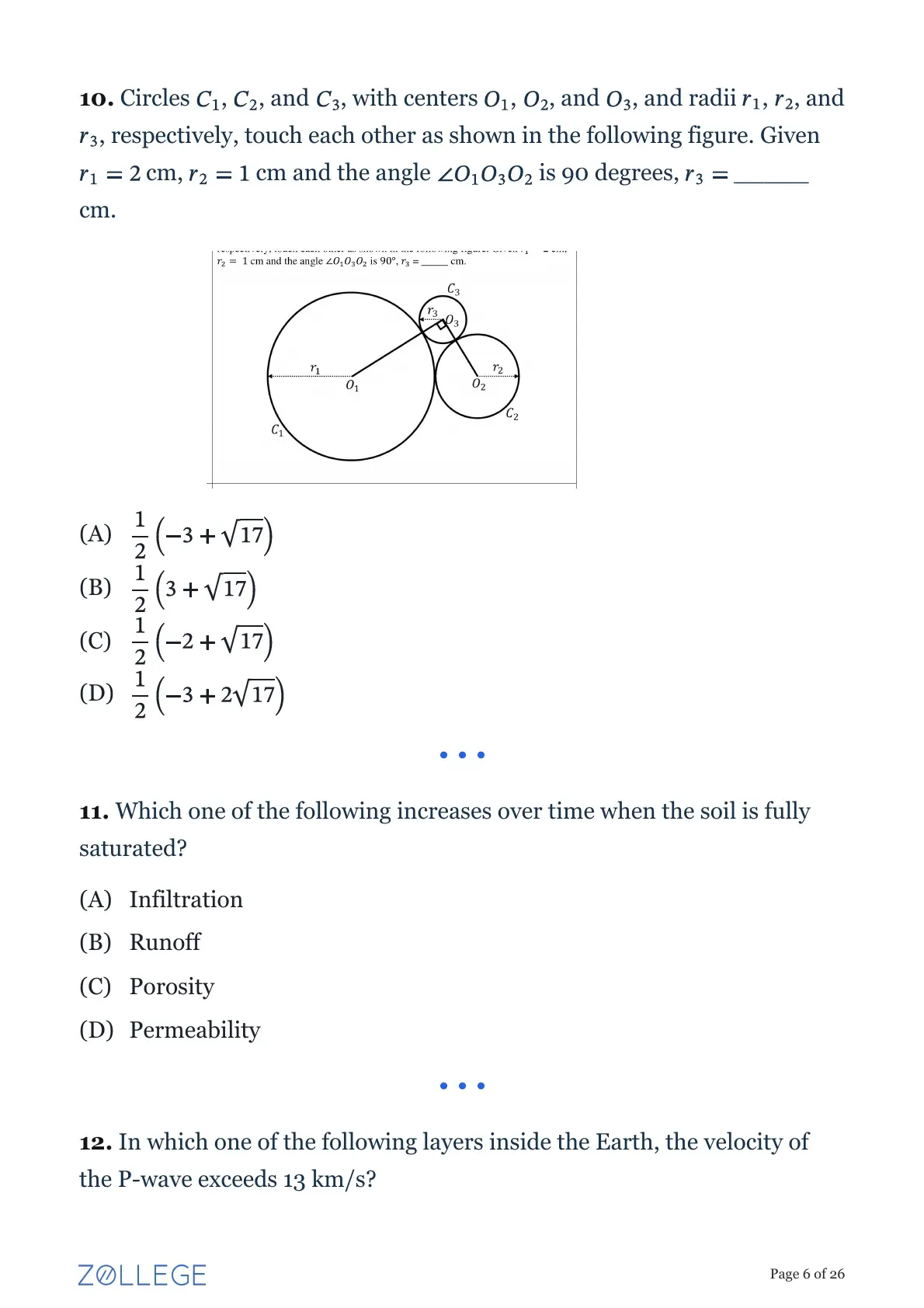
Circles \(C_1\), \(C_2\), and \(C_3\), with centers \(O_1\), \(O_2\), and \(O_3\), and radii \(r_1\), \(r_2\), and \(r_3\), respectively, touch each other as shown in the following figure. Given \(r_1 = 2\) cm, \(r_2 = 1\) cm and the angle \(\angle O_1 O_3 O_2\) is 90 degrees, \(r_3 =\) _____ cm.

Which one of the following increases over time when the soil is fully saturated?
In which one of the following layers inside the Earth, the velocity of the P-wave exceeds 13 km/s?
Which one of the following is NOT a volcanic igneous rock?
If \(r_1\) and \(r_2\), respectively, denote the equatorial and polar radii of a reference ellipsoid, then the radius, \(R\), of its equivalent sphere is given by
Which of the following sources is/are used in land seismic surveys?
A pebble has an average diameter of 8 mm. Its \(\phi\)-value on the Udden-Wentworth scale is ___________ (answer in integer).
A quartz vein in a granitic outcrop has an initial length of 20 cm. If it undergoes uniform stretching resulting in a longitudinal strain of 0.45, the length of the vein post deformation is _________cm (answer in integer).
Which one of the following is the CORRECT pair of radioactive parent isotope and the corresponding radiogenic daughter isotope?
Which one of the following pairs of geophysical signatures most commonly indicates volcanogenic massive sulphide deposits?
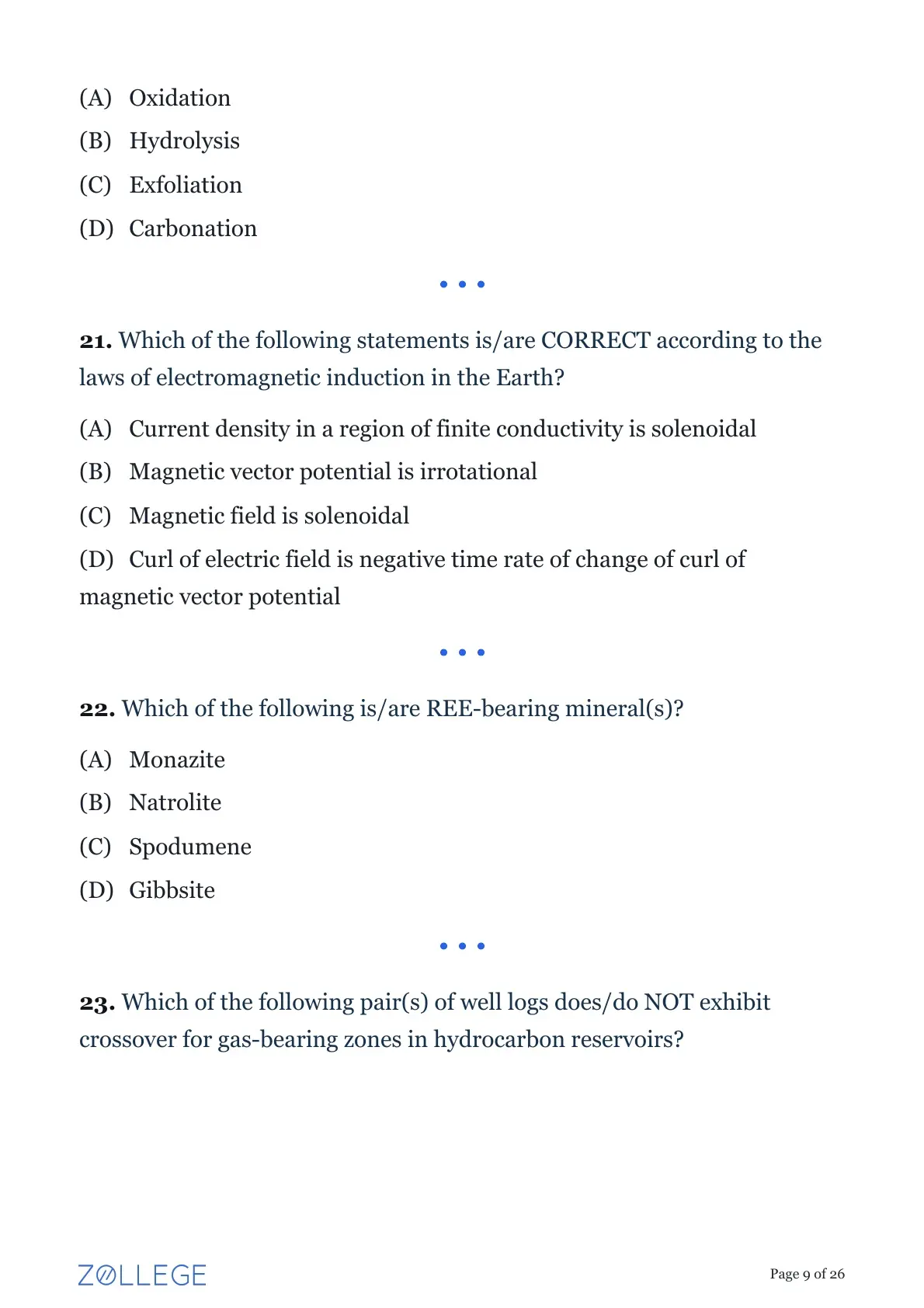
Which one of the following is a physical weathering process?
Which of the following statements is/are CORRECT according to the laws of electromagnetic induction in the Earth?
Which of the following is/are REE-bearing mineral(s)?
Which of the following pair(s) of well logs does/do NOT exhibit crossover for gas-bearing zones in hydrocarbon reservoirs?
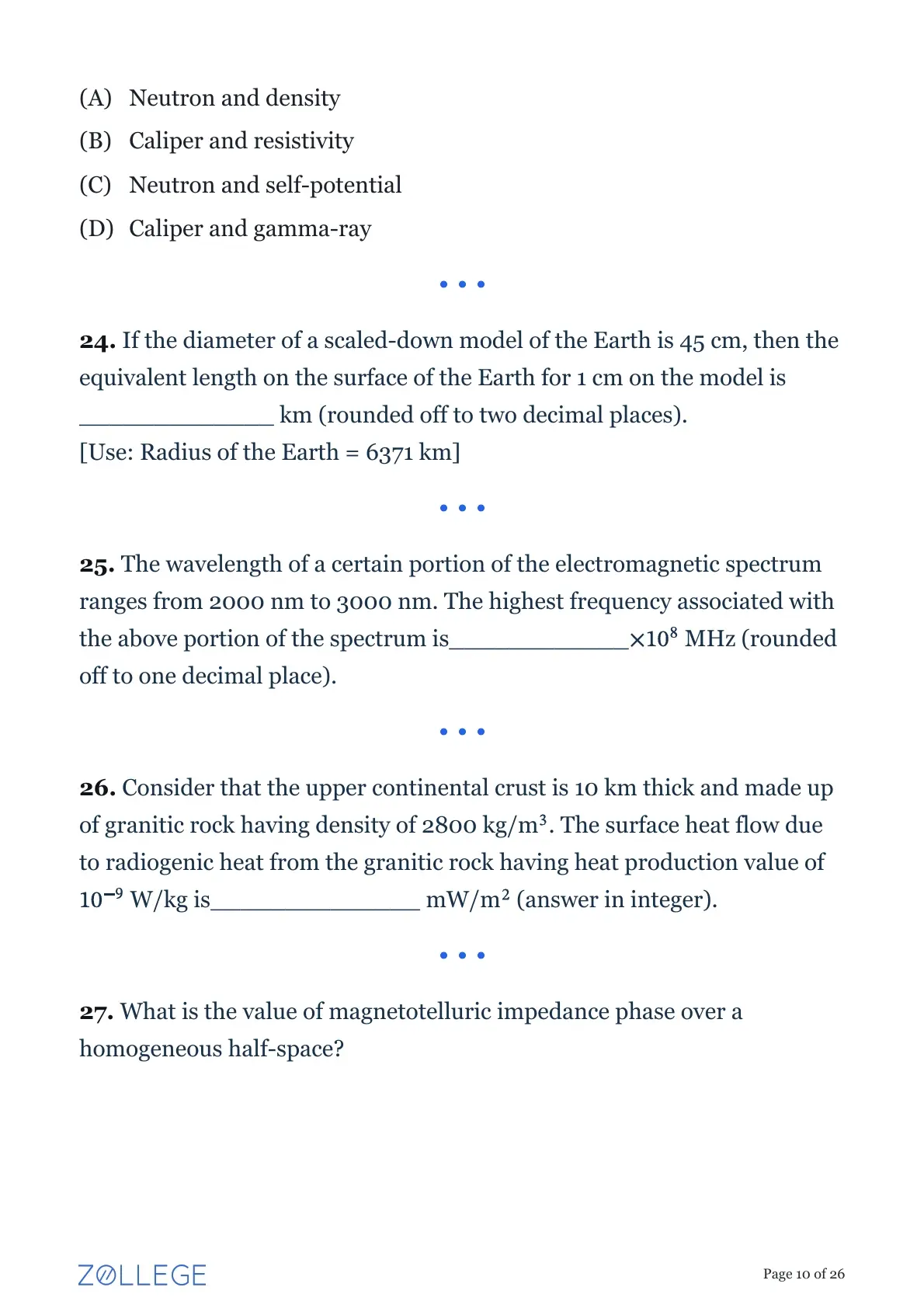
If the diameter of a scaled-down model of the Earth is 45 cm, then the equivalent length on the surface of the Earth for 1 cm on the model is _____________ km (rounded off to two decimal places).
[Use: Radius of the Earth = 6371 km]
The wavelength of a certain portion of the electromagnetic spectrum ranges from 2000 nm to 3000 nm. The highest frequency associated with the above portion of the spectrum is____________\(\times10^{8}\) MHz (rounded off to one decimal place).
Consider that the upper continental crust is 10 km thick and made up of granitic rock having density of 2800 kg/m\(^3\). The surface heat flow due to radiogenic heat from the granitic rock having heat production value of \(10^{-9}\) W/kg is______________ mW/m\(^2\) (answer in integer).
What is the value of magnetotelluric impedance phase over a homogeneous half-space?
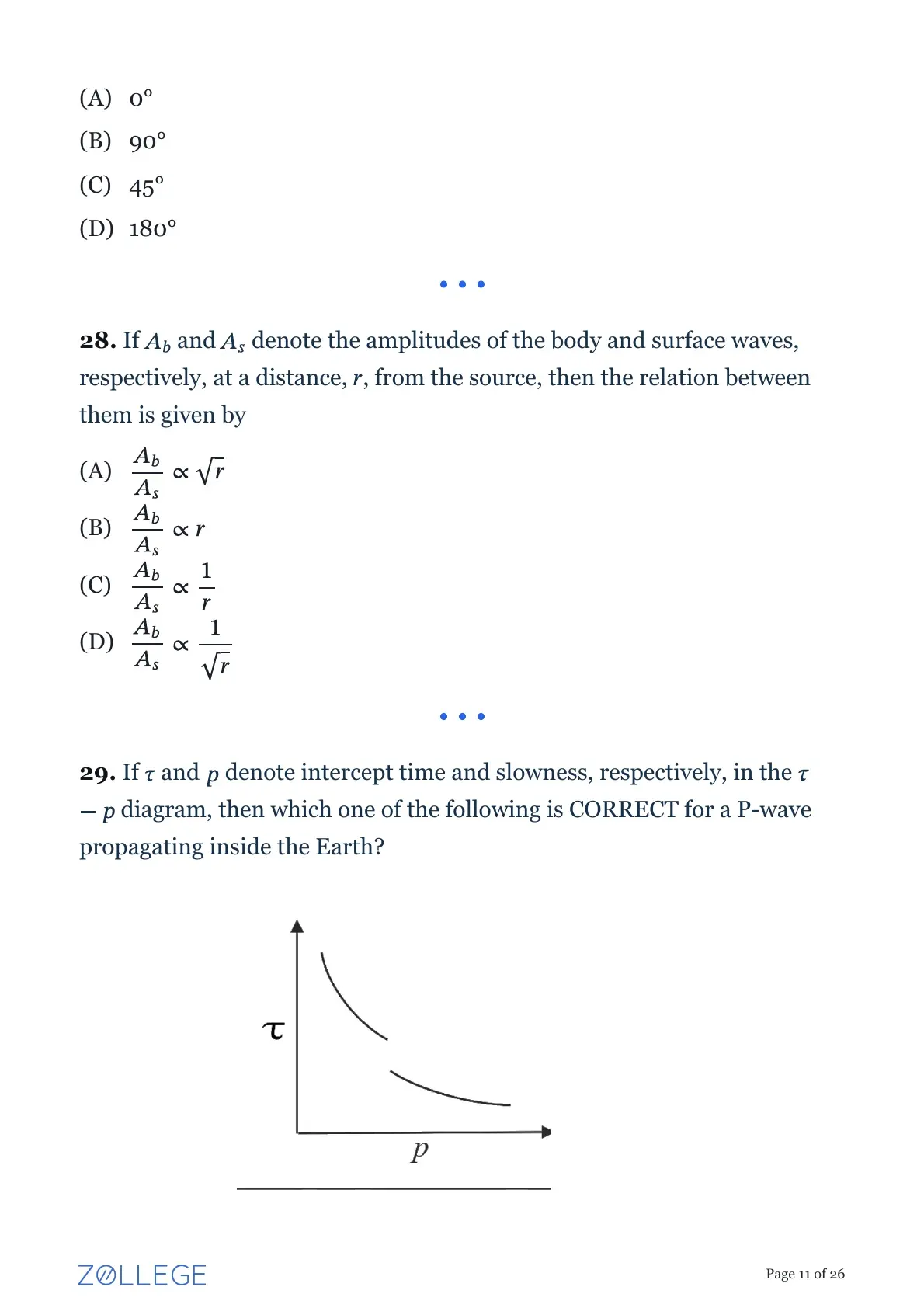
If \(A_b\) and \(A_s\) denote the amplitudes of the body and surface waves, respectively, at a distance, \(r\), from the source, then the relation between them is given by
If \(\tau\) and \(p\) denote intercept time and slowness, respectively, in the \(\tau-p\) diagram, then which one of the following is CORRECT for a P-wave propagating inside the Earth?
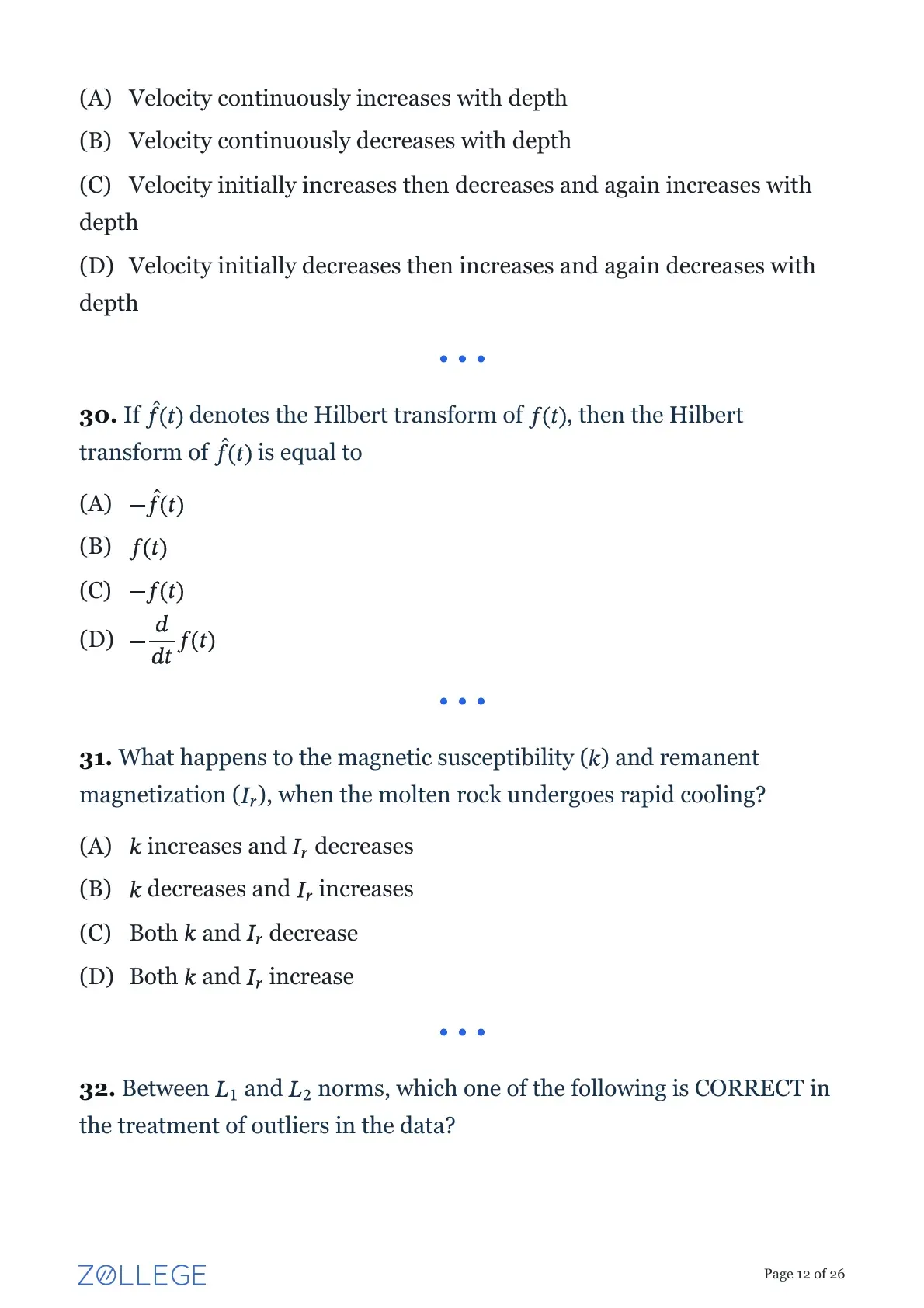
If \(\hat{f}(t)\) denotes the Hilbert transform of \(f(t)\), then the Hilbert transform of \(\hat{f}(t)\) is equal to
What happens to the magnetic susceptibility (\(k\)) and remanent magnetization (\(I_r\)), when the molten rock undergoes rapid cooling?
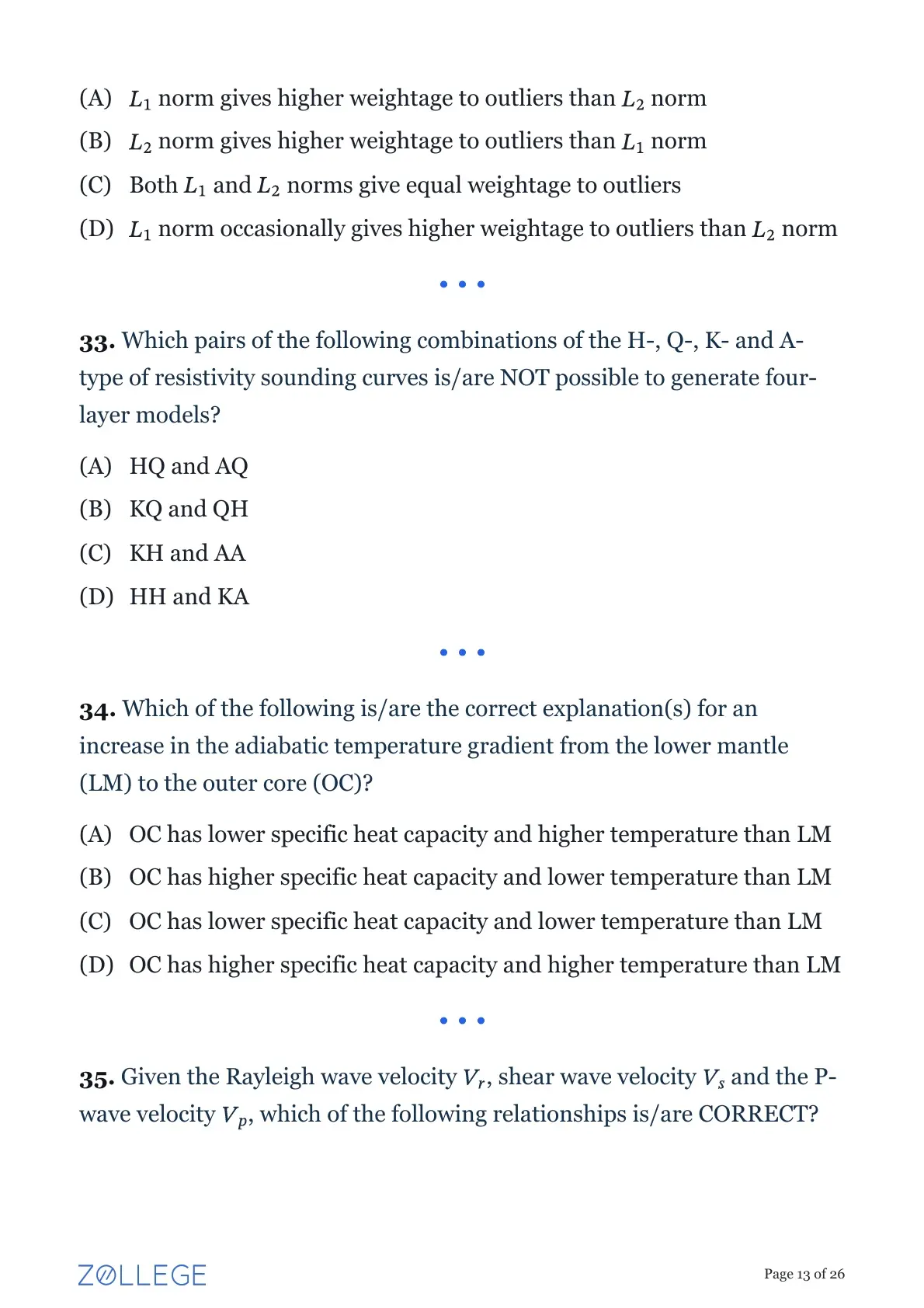
Between \(L_1\) and \(L_2\) norms, which one of the following is CORRECT in the treatment of outliers in the data?
Which pairs of the following combinations of the H-, Q-, K- and A- type of resistivity sounding curves is/are NOT possible to generate four-layer models?
Which of the following is/are the correct explanation(s) for an increase in the adiabatic temperature gradient from the lower mantle (LM) to the outer core (OC)?
Given the Rayleigh wave velocity \(V_r\), shear wave velocity \(V_s\) and the P-wave velocity \(V_p\), which of the following relationships is/are CORRECT?
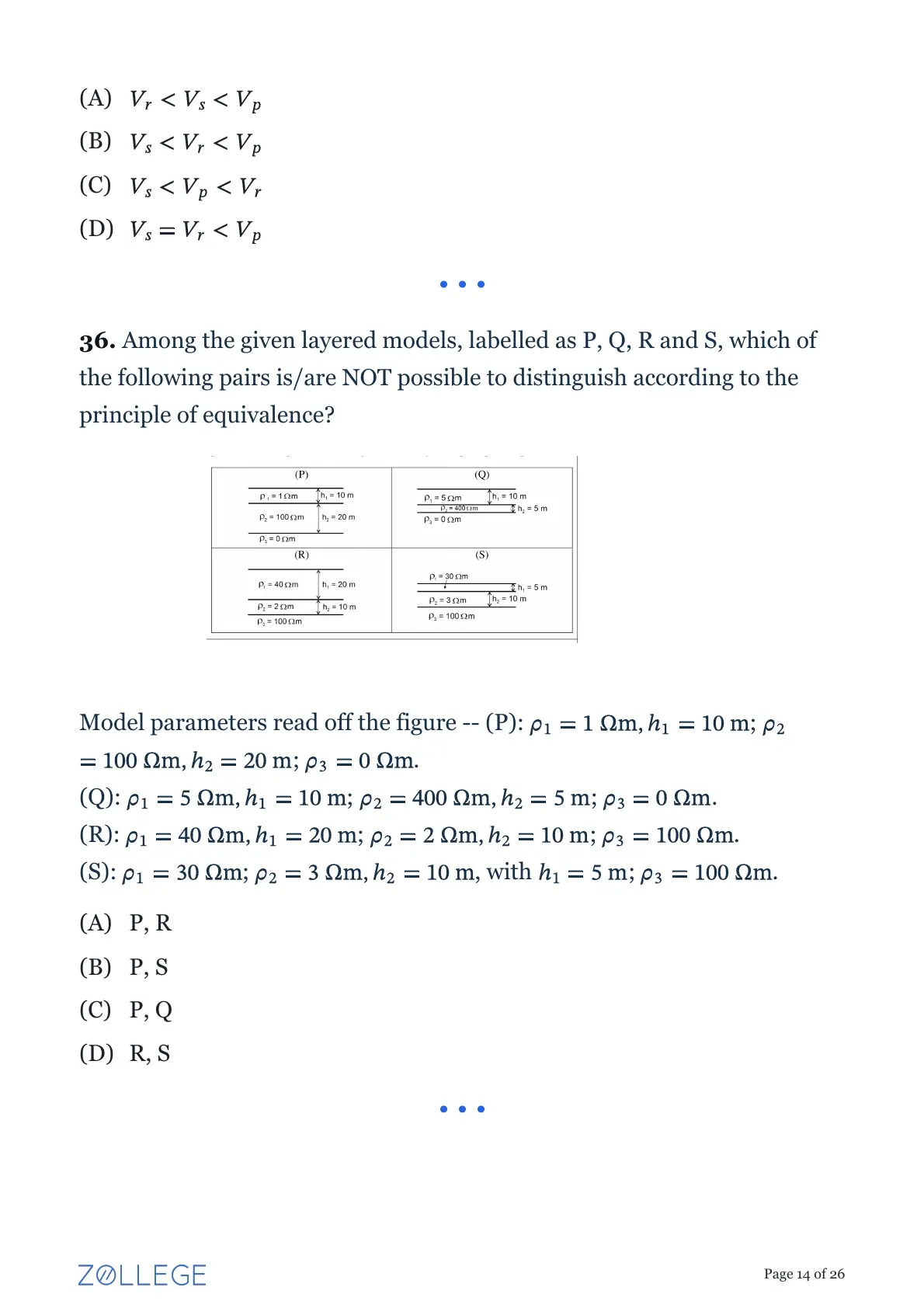
Among the given layered models, labelled as P, Q, R and S, which of the following pairs is/are NOT possible to distinguish according to the principle of equivalence?
Model parameters read off the figure -- (P): \(\rho_1 = 1\ \Omega\text{m}, h_1 = 10\ \text{m}\); \(\rho_2 = 100\ \Omega\text{m}, h_2 = 20\ \text{m}\); \(\rho_3 = 0\ \Omega\text{m}\).
(Q): \(\rho_1 = 5\ \Omega\text{m}, h_1 = 10\ \text{m}\); \(\rho_2 = 400\ \Omega\text{m}, h_2 = 5\ \text{m}\); \(\rho_3 = 0\ \Omega\text{m}\).
(R): \(\rho_1 = 40\ \Omega\text{m}, h_1 = 20\ \text{m}\); \(\rho_2 = 2\ \Omega\text{m}, h_2 = 10\ \text{m}\); \(\rho_3 = 100\ \Omega\text{m}\).
(S): \(\rho_1 = 30\ \Omega\text{m}\); \(\rho_2 = 3\ \Omega\text{m}, h_2 = 10\ \text{m}\), with \(h_1 = 5\ \text{m}\); \(\rho_3 = 100\ \Omega\text{m}\).
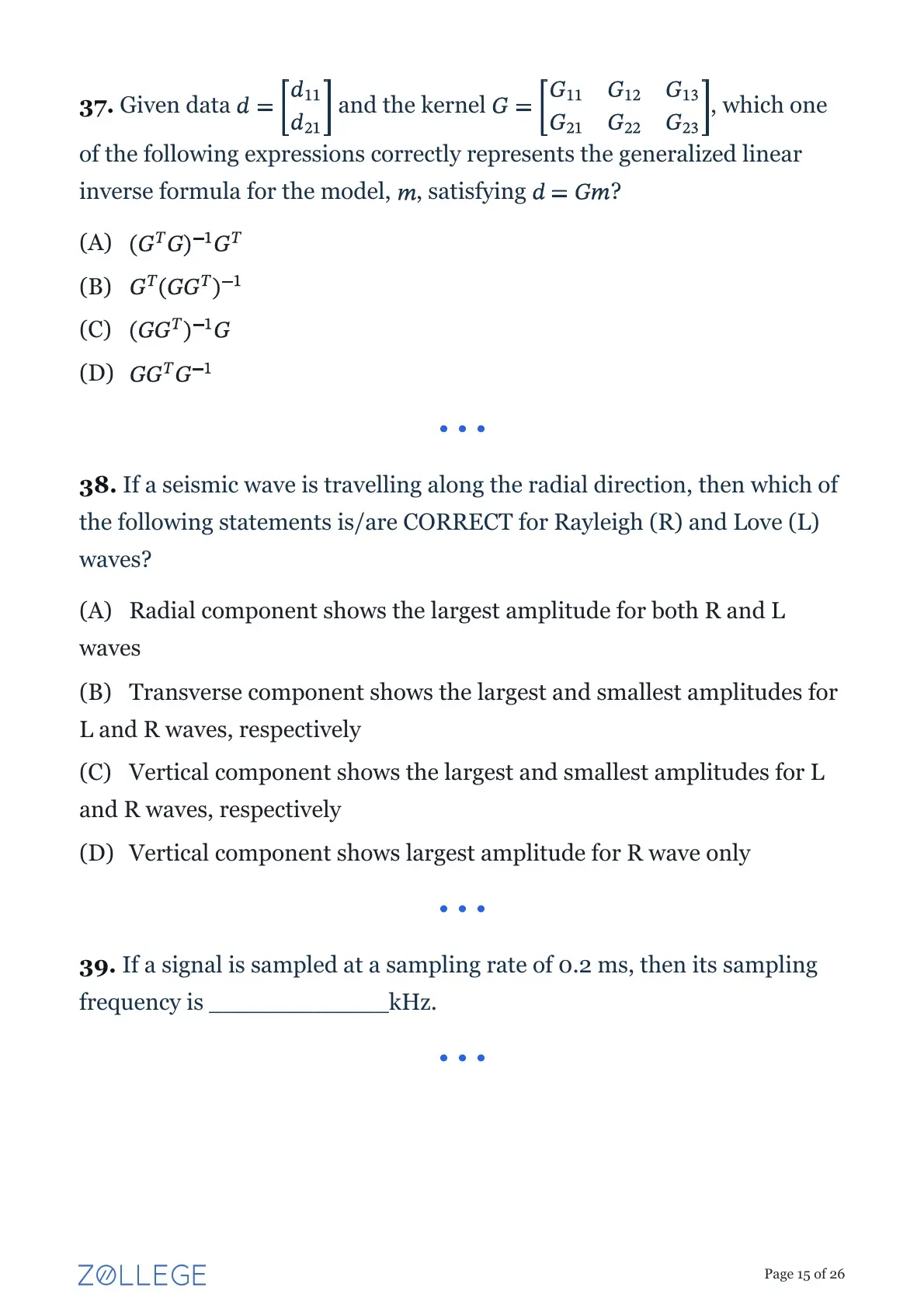
Given data \(d = \begin{bmatrix} d_{11} \\ d_{21} \end{bmatrix}\) and the kernel \(G = \begin{bmatrix} G_{11} & G_{12} & G_{13} \\ G_{21} & G_{22} & G_{23} \end{bmatrix}\), which one of the following expressions correctly represents the generalized linear inverse formula for the model, \(m\), satisfying \(d = Gm\)?
If a seismic wave is travelling along the radial direction, then which of the following statements is/are CORRECT for Rayleigh (R) and Love (L) waves?
If a signal is sampled at a sampling rate of 0.2 ms, then its sampling frequency is ____________kHz.
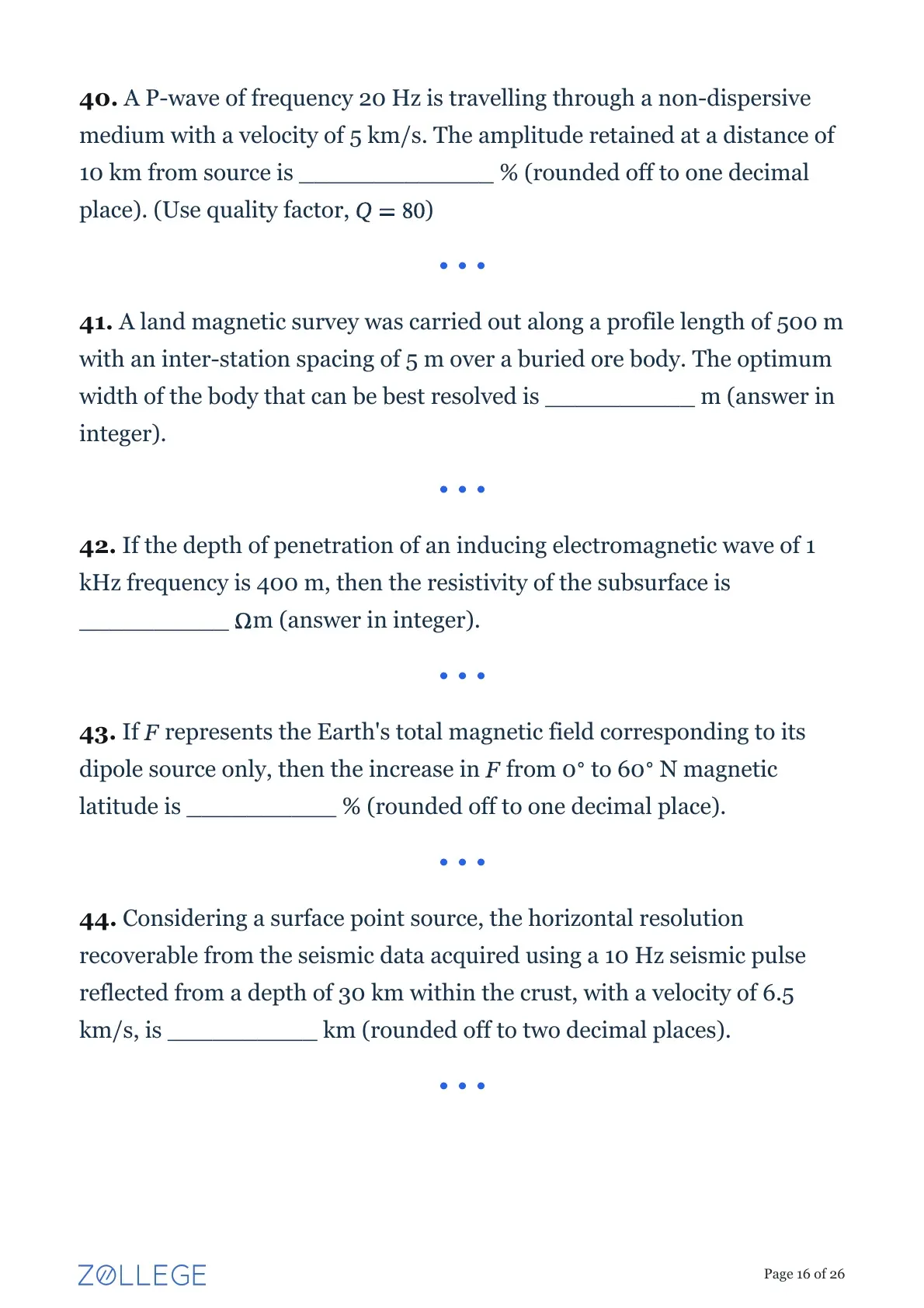
A P-wave of frequency 20 Hz is travelling through a non-dispersive medium with a velocity of 5 km/s. The amplitude retained at a distance of 10 km from source is _____________ % (rounded off to one decimal place). (Use quality factor, \(Q = 80\))
A land magnetic survey was carried out along a profile length of 500 m with an inter-station spacing of 5 m over a buried ore body. The optimum width of the body that can be best resolved is __________ m (answer in integer).
If the depth of penetration of an inducing electromagnetic wave of 1 kHz frequency is 400 m, then the resistivity of the subsurface is __________ \(\Omega\)m (answer in integer).
If \(F\) represents the Earth's total magnetic field corresponding to its dipole source only, then the increase in \(F\) from 0\(^\circ\) to 60\(^\circ\) N magnetic latitude is __________ % (rounded off to one decimal place).
Considering a surface point source, the horizontal resolution recoverable from the seismic data acquired using a 10 Hz seismic pulse reflected from a depth of 30 km within the crust, with a velocity of 6.5 km/s, is __________ km (rounded off to two decimal places).
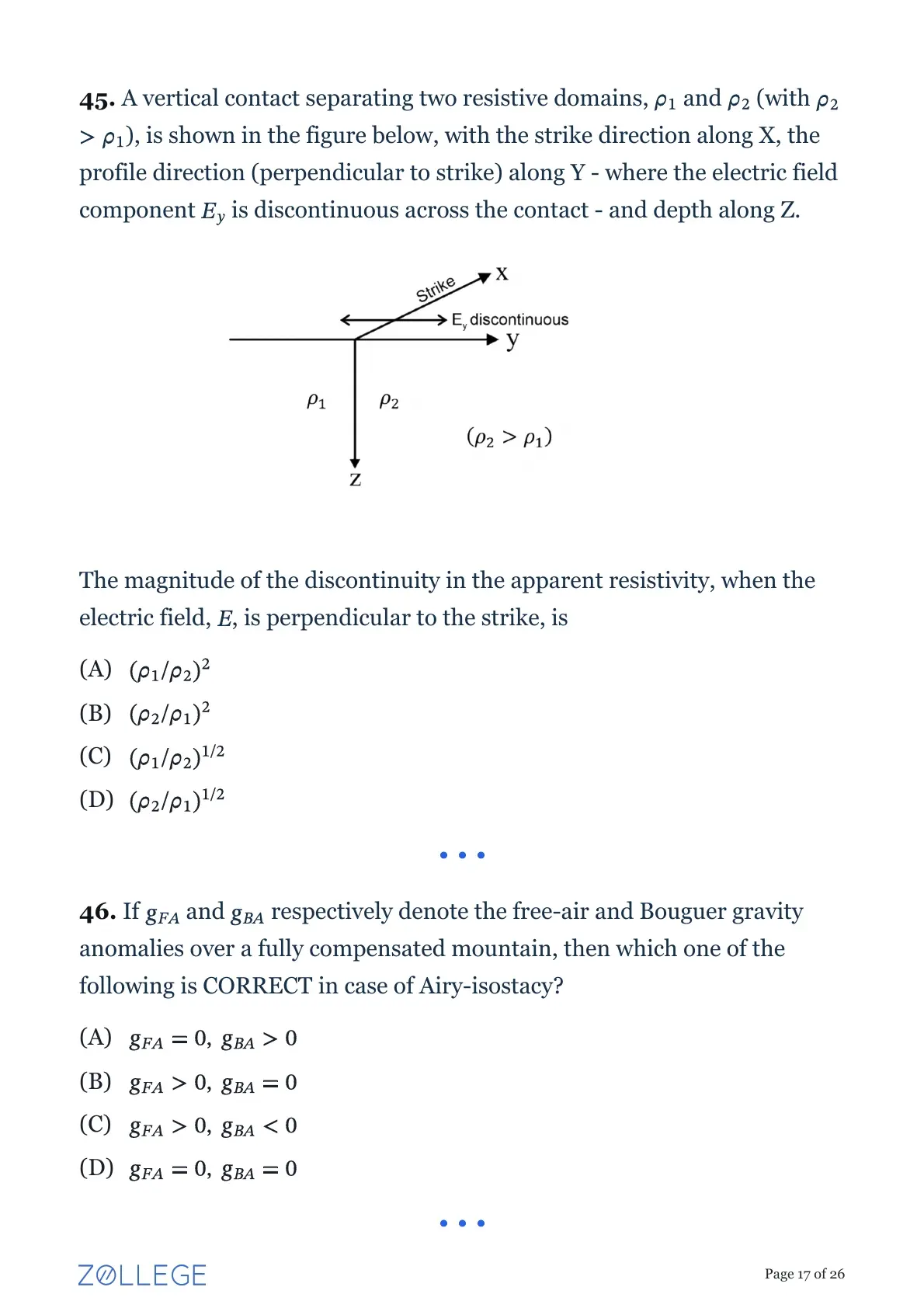
A vertical contact separating two resistive domains, \(\rho_1\) and \(\rho_2\) (with \(\rho_2 > \rho_1\)), is shown in the figure below, with the strike direction along X, the profile direction (perpendicular to strike) along Y - where the electric field component \(E_y\) is discontinuous across the contact - and depth along Z.
The magnitude of the discontinuity in the apparent resistivity, when the electric field, \(E\), is perpendicular to the strike, is
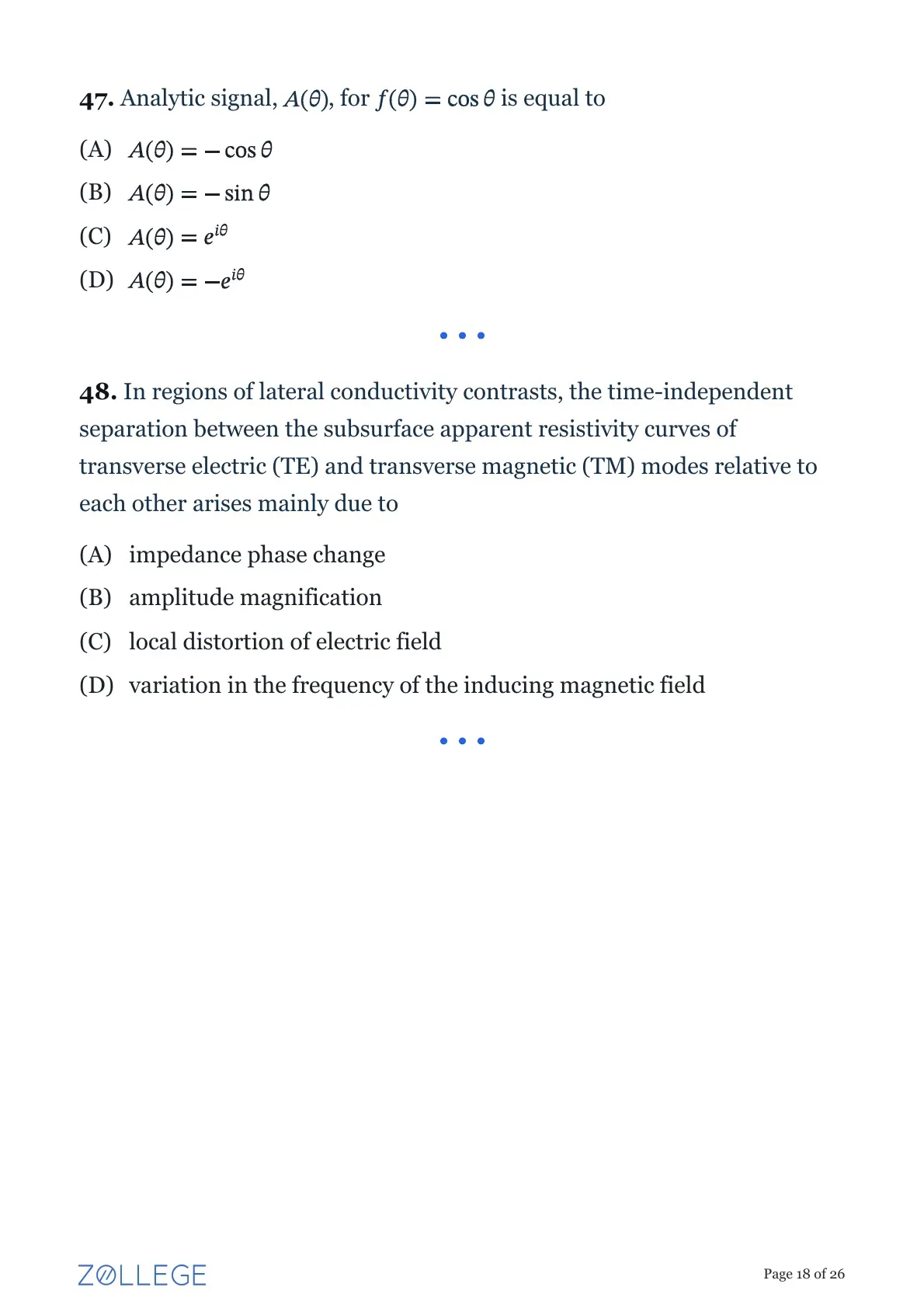
If \(g_{FA}\) and \(g_{BA}\) respectively denote the free-air and Bouguer gravity anomalies over a fully compensated mountain, then which one of the following is CORRECT in case of Airy-isostacy?
Analytic signal, \(A(\theta)\), for \(f(\theta) = \cos\theta\) is equal to
In regions of lateral conductivity contrasts, the time-independent separation between the subsurface apparent resistivity curves of transverse electric (TE) and transverse magnetic (TM) modes relative to each other arises mainly due to
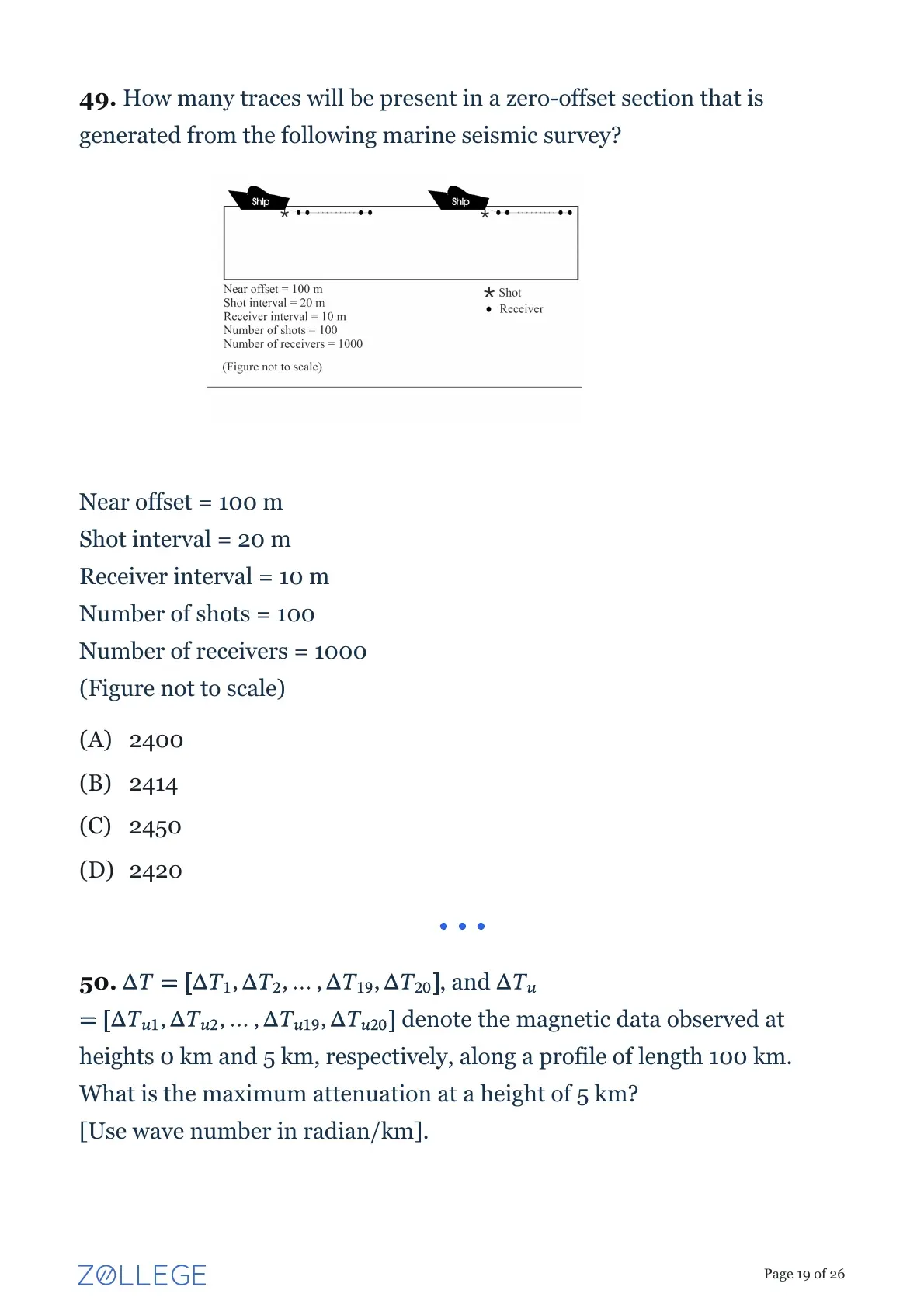
How many traces will be present in a zero-offset section that is generated from the following marine seismic survey?
Near offset = 100 m
Shot interval = 20 m
Receiver interval = 10 m
Number of shots = 100
Number of receivers = 1000
(Figure not to scale)
\(\Delta T = [\Delta T_1, \Delta T_2, \ldots, \Delta T_{19}, \Delta T_{20}]\), and \(\Delta T_u = [\Delta T_{u1}, \Delta T_{u2}, \ldots, \Delta T_{u19}, \Delta T_{u20}]\) denote the magnetic data observed at heights 0 km and 5 km, respectively, along a profile of length 100 km. What is the maximum attenuation at a height of 5 km?
[Use wave number in radian/km].
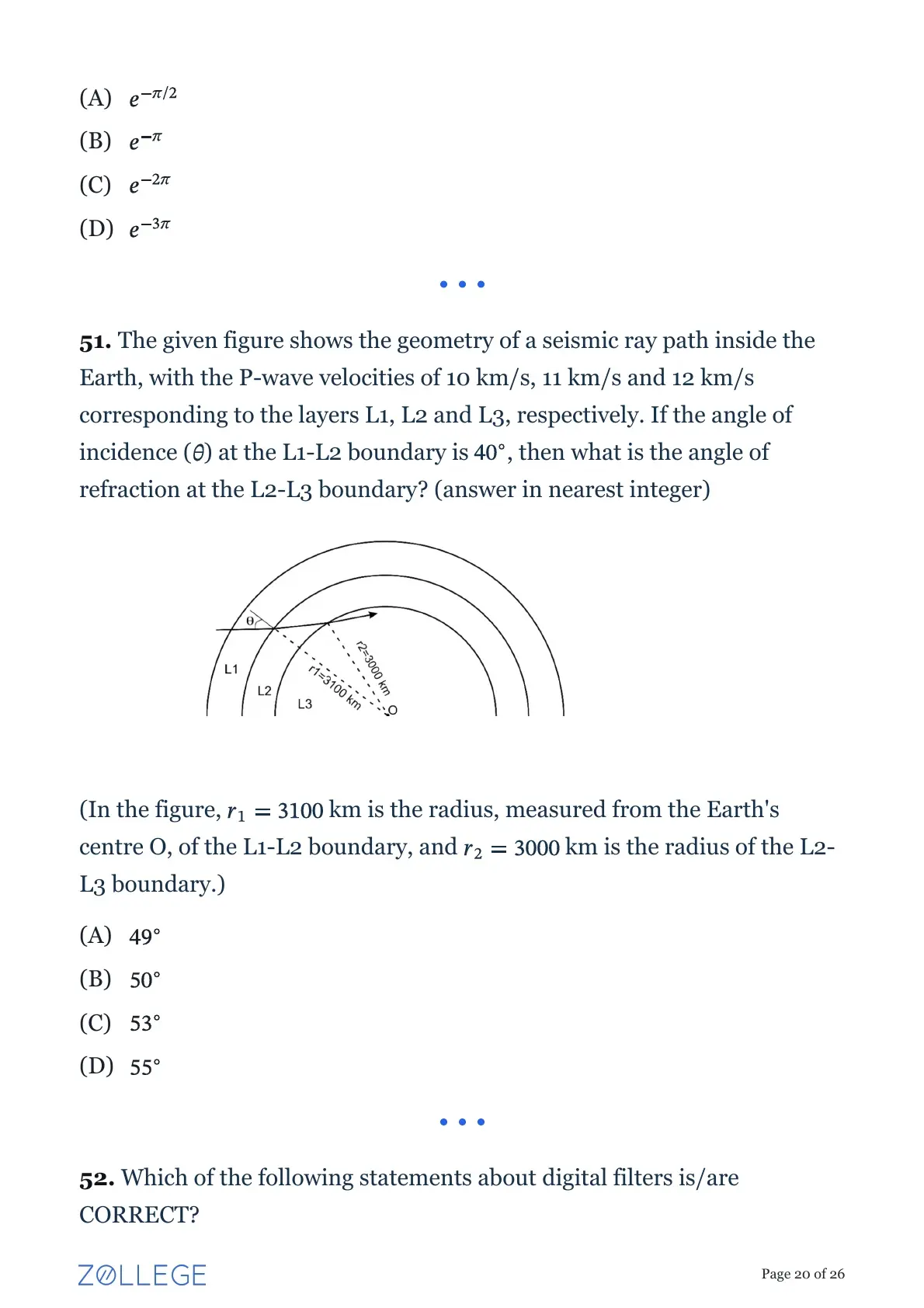
The given figure shows the geometry of a seismic ray path inside the Earth, with the P-wave velocities of 10 km/s, 11 km/s and 12 km/s corresponding to the layers L1, L2 and L3, respectively. If the angle of incidence (\(\theta\)) at the L1-L2 boundary is \(40^\circ\), then what is the angle of refraction at the L2-L3 boundary? (answer in nearest integer)
(In the figure, \(r_1 = 3100\) km is the radius, measured from the Earth's centre O, of the L1-L2 boundary, and \(r_2 = 3000\) km is the radius of the L2-L3 boundary.)
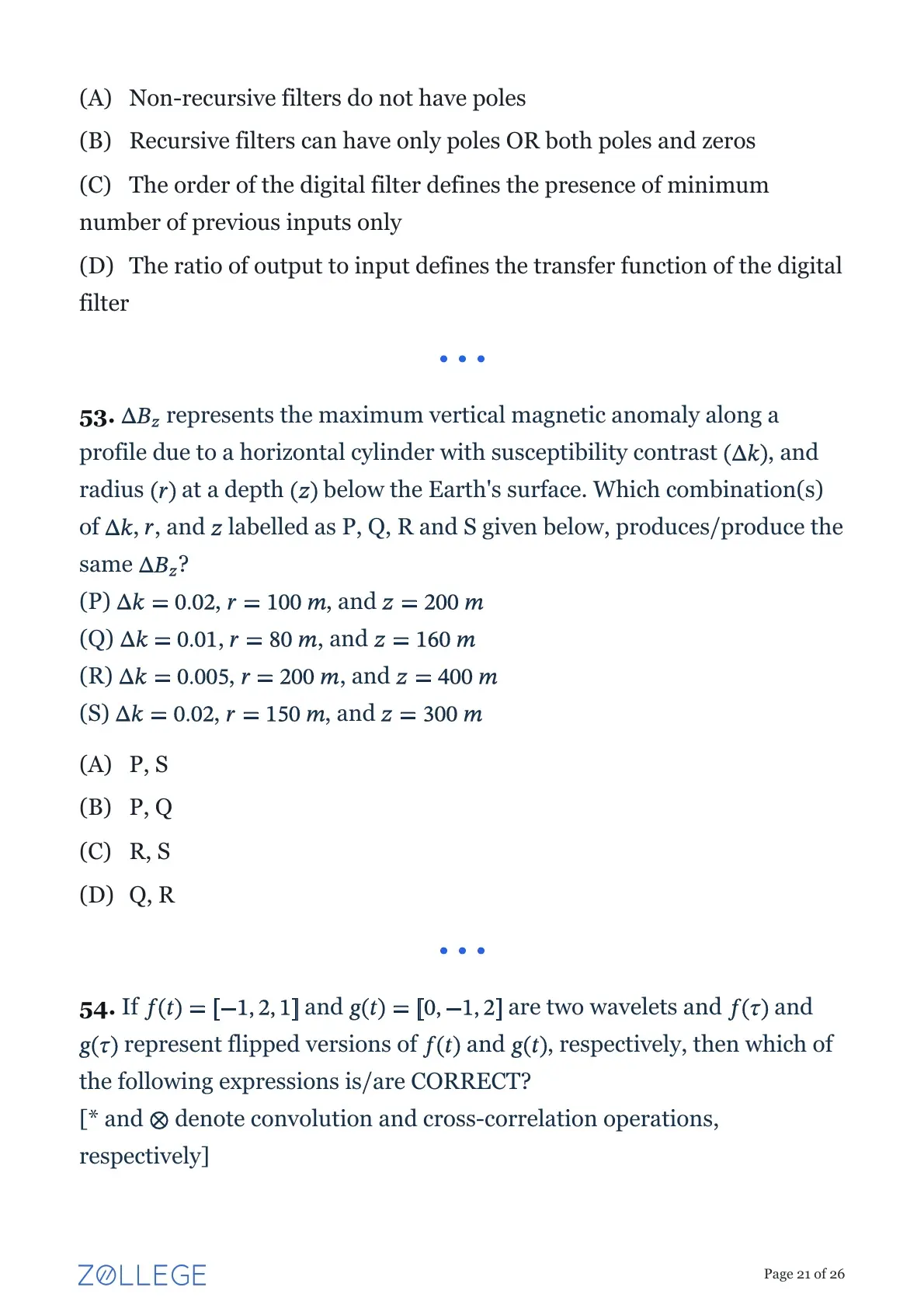
Which of the following statements about digital filters is/are CORRECT?
\(\Delta B_z\) represents the maximum vertical magnetic anomaly along a profile due to a horizontal cylinder with susceptibility contrast \((\Delta k)\), and radius \((r)\) at a depth \((z)\) below the Earth's surface. Which combination(s) of \(\Delta k\), \(r\), and \(z\) labelled as P, Q, R and S given below, produces/produce the same \(\Delta B_z\)?
(P) \(\Delta k=0.02\), \(r=100\ m\), and \(z=200\ m\)
(Q) \(\Delta k=0.01\), \(r=80\ m\), and \(z=160\ m\)
(R) \(\Delta k=0.005\), \(r=200\ m\), and \(z=400\ m\)
(S) \(\Delta k=0.02\), \(r=150\ m\), and \(z=300\ m\)
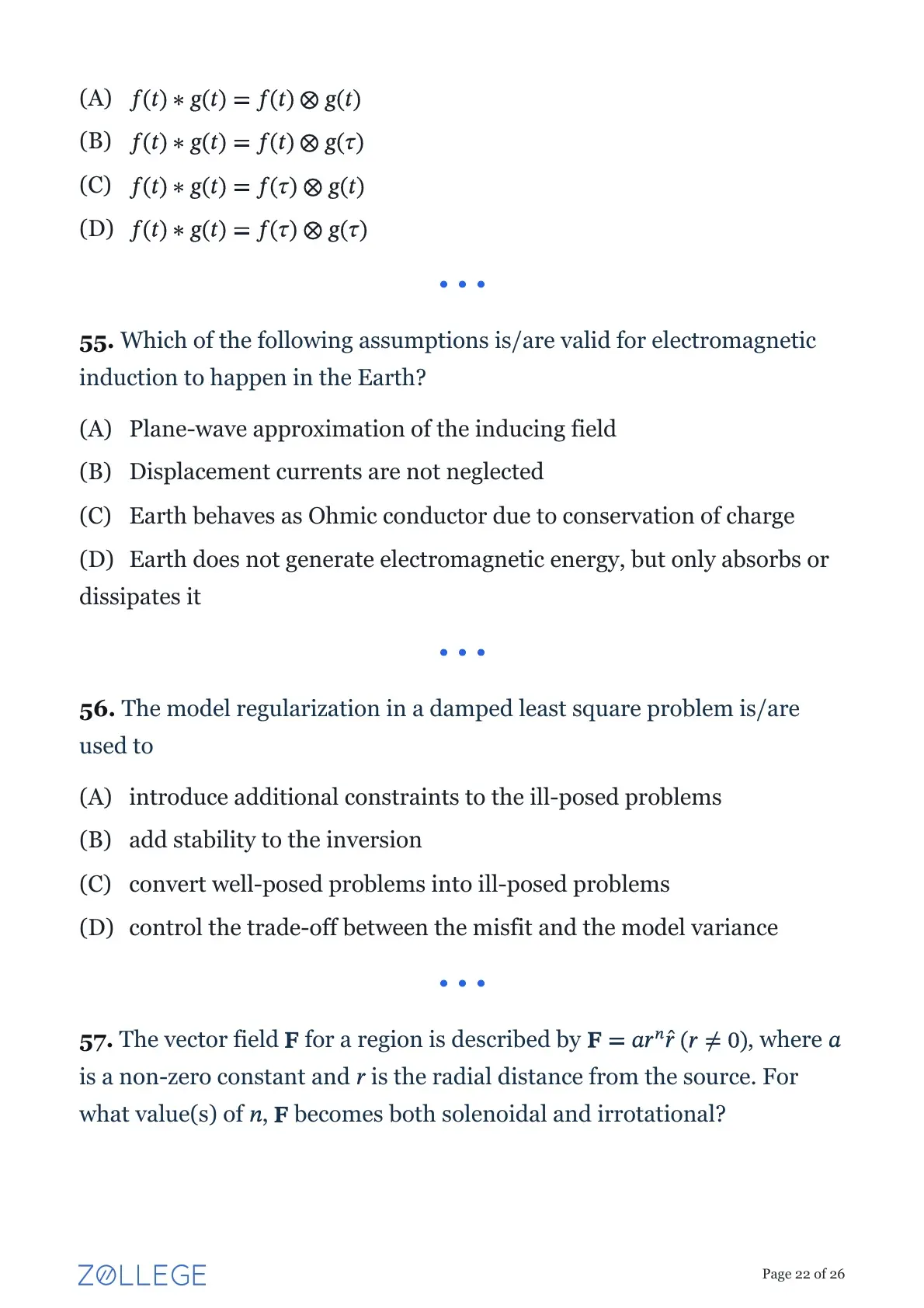
If \(f(t) = [-1, 2, 1]\) and \(g(t) = [0, -1, 2]\) are two wavelets and \(f(\tau)\) and \(g(\tau)\) represent flipped versions of \(f(t)\) and \(g(t)\), respectively, then which of the following expressions is/are CORRECT?
[* and \(\otimes\) denote convolution and cross-correlation operations, respectively]
Which of the following assumptions is/are valid for electromagnetic induction to happen in the Earth?
The model regularization in a damped least square problem is/are used to
The vector field \(\mathbf{F}\) for a region is described by \(\mathbf{F} = a r^n \hat{r}\) \((r\neq 0)\), where \(a\) is a non-zero constant and \(r\) is the radial distance from the source. For what value(s) of \(n\), \(\mathbf{F}\) becomes both solenoidal and irrotational?
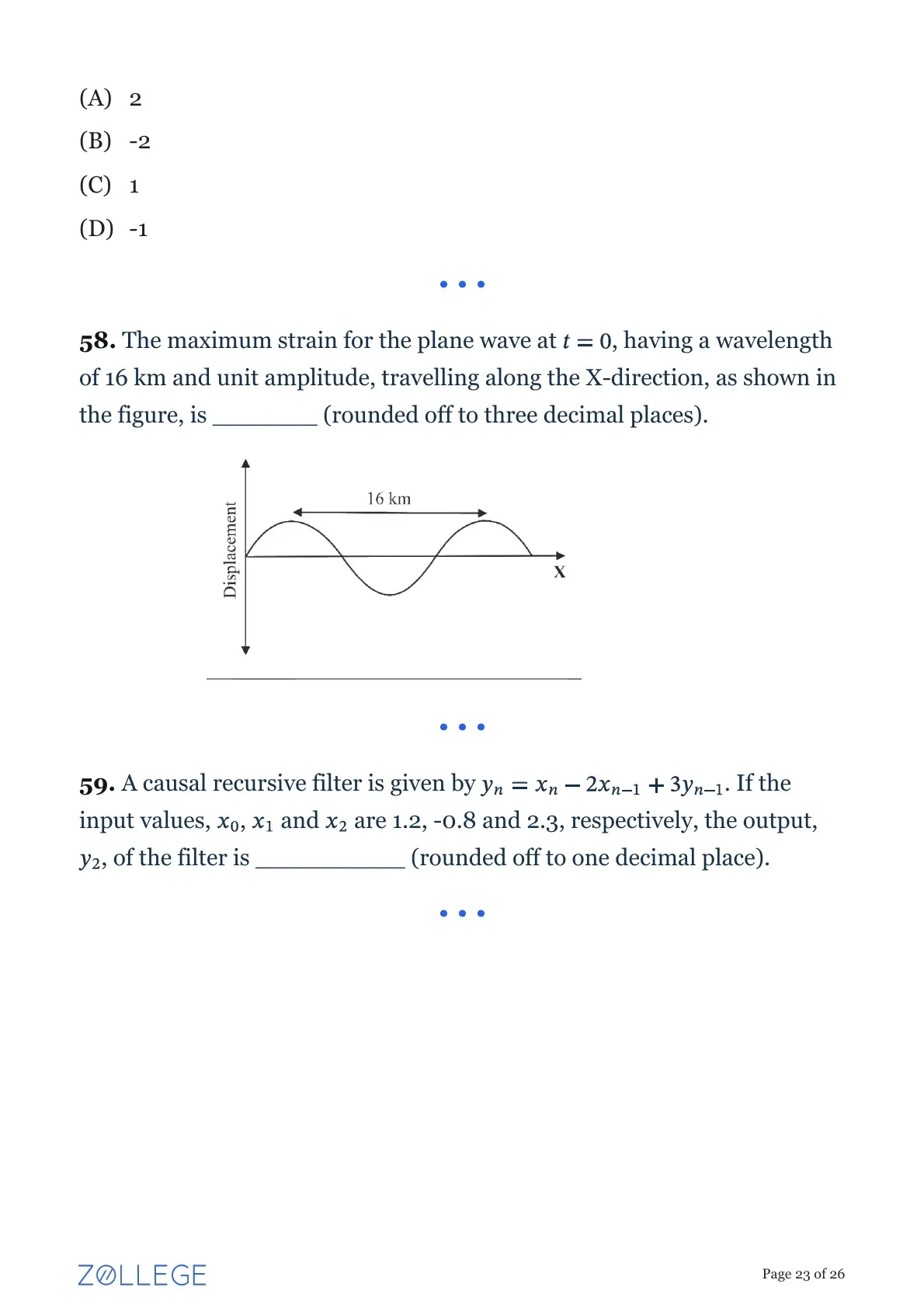
The maximum strain for the plane wave at \(t=0\), having a wavelength of 16 km and unit amplitude, travelling along the X-direction, as shown in the figure, is _______ (rounded off to three decimal places).
A causal recursive filter is given by \(y_n = x_n - 2x_{n-1} + 3y_{n-1}\). If the input values, \(x_0\), \(x_1\) and \(x_2\) are 1.2, -0.8 and 2.3, respectively, the output, \(y_2\), of the filter is __________ (rounded off to one decimal place).
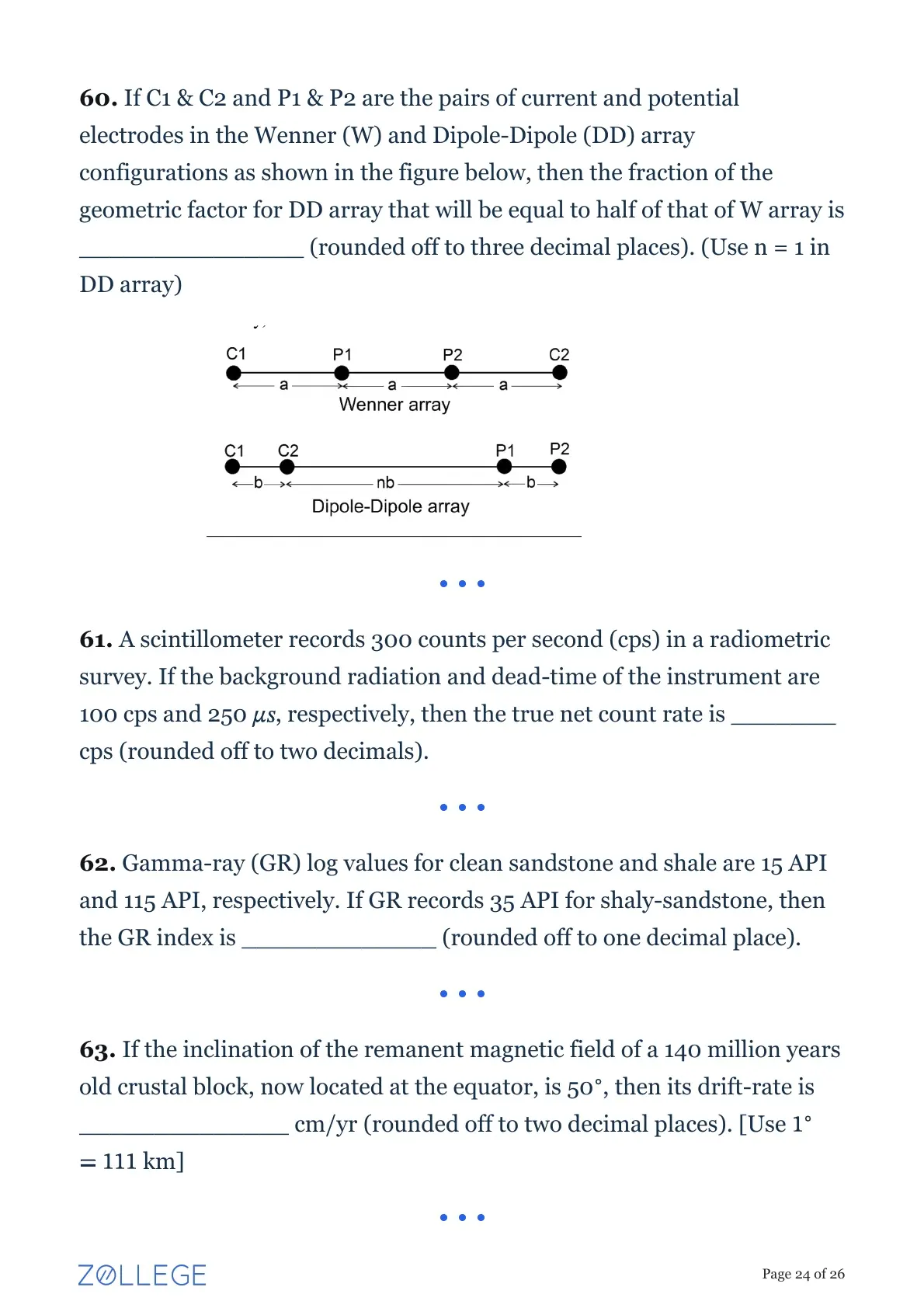
If C1 & C2 and P1 & P2 are the pairs of current and potential electrodes in the Wenner (W) and Dipole-Dipole (DD) array configurations as shown in the figure below, then the fraction of the geometric factor for DD array that will be equal to half of that of W array is _______________ (rounded off to three decimal places). (Use n = 1 in DD array)
A scintillometer records 300 counts per second (cps) in a radiometric survey. If the background radiation and dead-time of the instrument are 100 cps and 250 \(\mu s\), respectively, then the true net count rate is _______ cps (rounded off to two decimals).
Gamma-ray (GR) log values for clean sandstone and shale are 15 API and 115 API, respectively. If GR records 35 API for shaly-sandstone, then the GR index is _____________ (rounded off to one decimal place).
If the inclination of the remanent magnetic field of a 140 million years old crustal block, now located at the equator, is 50\(^\circ\), then its drift-rate is ______________ cm/yr (rounded off to two decimal places). [Use \(1^\circ=111\) km]
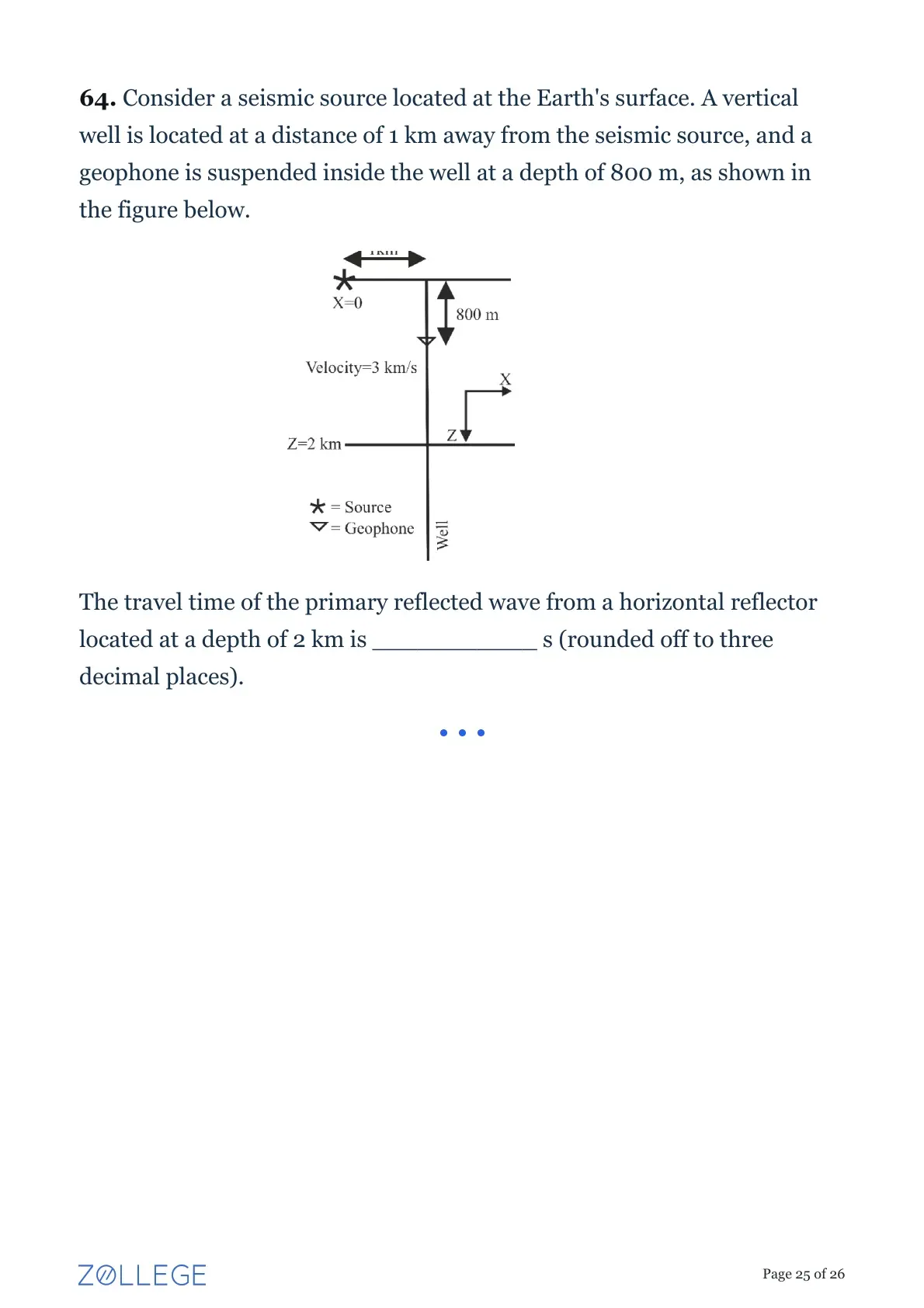
Consider a seismic source located at the Earth's surface. A vertical well is located at a distance of 1 km away from the seismic source, and a geophone is suspended inside the well at a depth of 800 m, as shown in the figure below.  The travel time of the primary reflected wave from a horizontal reflector located at a depth of 2 km is ___________ s (rounded off to three decimal places).
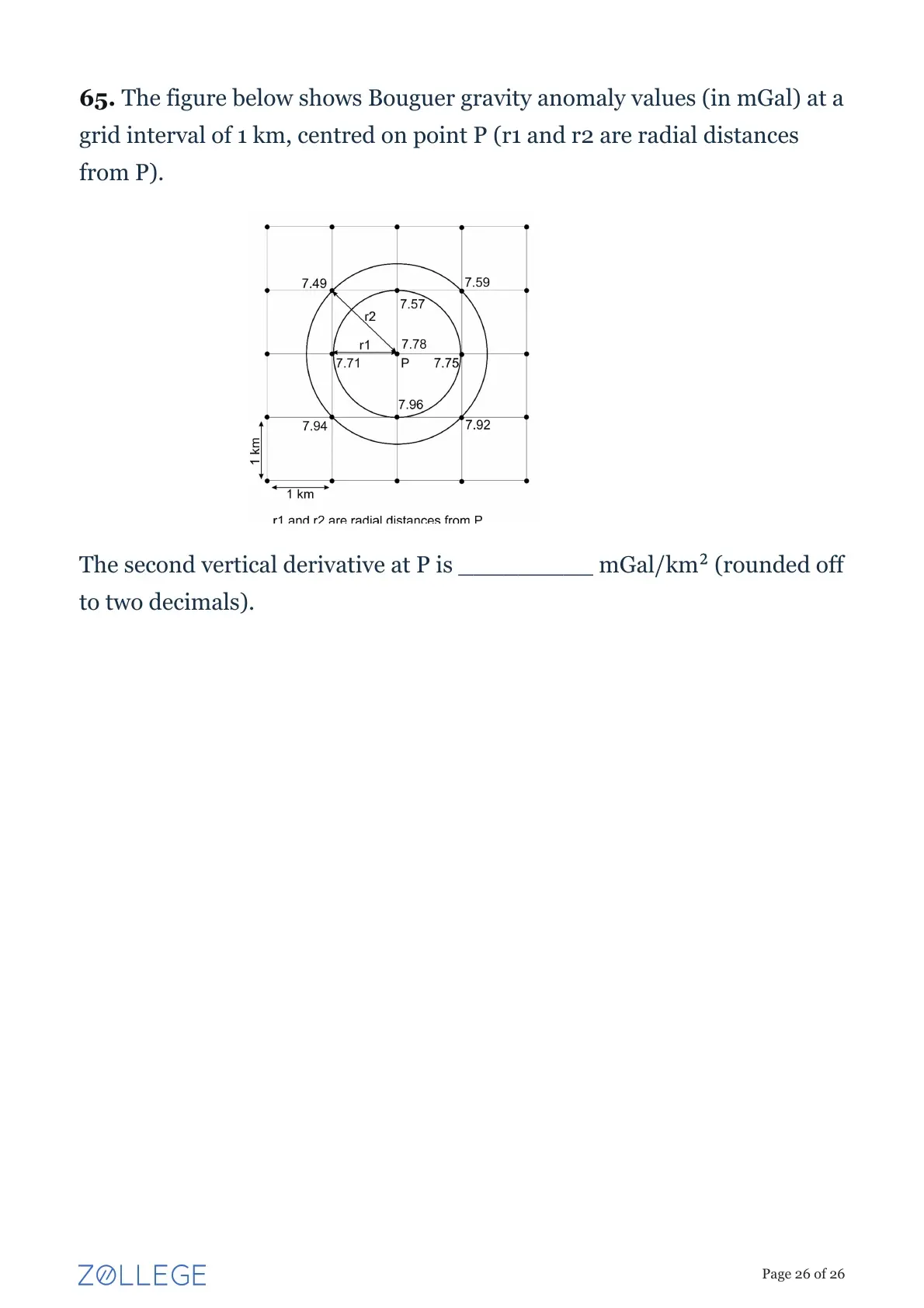
The figure below shows Bouguer gravity anomaly values (in mGal) at a grid interval of 1 km, centred on point P (r1 and r2 are radial distances from P).  The second vertical derivative at P is _________ mGal/km\(^2\) (rounded off to two decimals).
GATE 2026 GG2 Exam Pattern and Marking Scheme Explained
As per the information bulletin on the official GATE 2026 website (gate2026.iitg.ac.in), the Geology and Geophysics paper is a computer-based test split into a common Part A and a subject-specific Part B.
- Total questions: 65 across General Aptitude (GA), Part A (compulsory for both Geology and Geophysics candidates), and Part B Section II (Geophysics-only, GG2)
- Duration: 3 hours
- Total marks: 100 (GA 15, Part A 25, Part B Geophysics 60)
- Marking scheme: 1/3 mark cut for a wrong 1-mark MCQ, 2/3 mark cut for a wrong 2-mark MCQ, no negative marking on MSQ or NAT questions
- Question types: single-correct MCQ, multiple-correct MSQ, and Numerical Answer Type (NAT) questions with no options
High-Weightage Topics in GATE 2026 GG2 to Focus On First
The Geophysics-specific Part B (Section II) is built around a compact set of core solid-earth geophysics areas, so structure your revision around these first.
- Seismology and seismic wave propagation - travel-time curves, P- and S-wave velocity contrasts across the Earth's layers, and reflection/refraction survey geometry
- Seismic data processing - deconvolution, stacking, migration, and noise-attenuation steps used to turn raw seismic traces into an interpretable section
- Gravity and magnetic methods - Bouguer and free-air corrections, anomaly interpretation, and the rock-magnetic properties used to locate subsurface bodies
- Electrical resistivity and electromagnetic (EM) methods - vertical electrical sounding, induced polarization, and EM induction response in a layered earth
- Well logging - neutron, density, resistivity, spontaneous-potential, and gamma-ray log responses, including crossover behaviour used to flag gas-bearing zones
- Geophysical inversion and inverse theory - forward versus inverse modelling, non-uniqueness, and least-squares/regularization approaches to fitting field data
- Radiometric and isotopic methods - radioactive decay schemes, parent-daughter isotope pairs, and heat-production calculations used in geochronology
- Across the full paper, 10 questions were General Aptitude, 16 were common Part A questions shared with Geology candidates, and 39 were Geophysics-only Part B questions
GATE 2026 GG2 Question Paper Analysis Video
Source: SOURAV SIR'S CLASSES
How to Use the GATE GG2 Question Paper for Practice
Treat this as a full 3-hour mock before you look at a single solution, then use the solved PDF to find exactly where marks slipped.
- Attempt all 65 questions in one 3-hour sitting under real exam conditions first
- Mark every question you were unsure of, then check it against the step-by-step solution PDF
- Redo the NAT questions on paper - the GG2 paper carries a mix of numerical-answer questions across Part A and Section II, and small unit-conversion slips there cost marks
- Revisit MSQ questions separately - partial selection on a multiple-correct question earns zero credit
GATE GG Cutoff Trend to Set Your Target Score
- The General category qualifying cutoff for GG has stayed in the 30-32 mark range over recent years
- Use this as your practice target when you total your score on this paper
- The official GATE 2026 cutoff is released by IIT Guwahati after the result declaration, alongside category-wise scores
GATE 2026 GG2 Question Paper FAQs
Ques. Where can I download the GATE 2026 Geology and Geophysics: Geophysics (GG2) question paper with solutions PDF for free?
Ans. You can download it from the table above on this Collegedunia page, which has both the questions-only PDF and the full solutions PDF. The official question paper and answer key are also available on gate2026.iitg.ac.in.
Ques. How many questions were there in the GATE 2026 GG2 (Geophysics) paper and how are they split?
Ans. The paper had 65 questions for 100 marks: 10 General Aptitude questions worth 15 marks, 16 Part A questions common to Geology and Geophysics worth 25 marks, and 39 Geophysics-only Part B (Section II) questions worth 60 marks.
Ques. Which topics had the highest weightage in GATE 2026 GG2?
Ans. The Geophysics section drew heavily on seismology and seismic data processing, gravity and magnetic methods, electrical resistivity and EM methods, well logging, geophysical inversion, and radiometric/isotopic methods, matching the core solid-earth geophysics syllabus.
Ques. Is there negative marking in the GATE GG2 paper?
Ans. Yes, for MCQs only. A wrong 1-mark MCQ costs 1/3 mark and a wrong 2-mark MCQ costs 2/3 mark. Multiple-correct MSQ questions and Numerical Answer Type (NAT) questions carry no negative marking.
Ques. What is a good score to aim for in GATE GG based on past cutoffs?
Ans. The General category cutoff for GG has held in the 30-32 mark range in recent years. Use this range as your benchmark when you score yourself on this solved paper.
Ques. Are GATE GG2 questions repeated from previous years?
Ans. The exact questions are not repeated, but the same core topics - seismic wave behaviour, gravity and magnetic anomaly interpretation, well-log crossover diagnostics, and inversion theory - come back nearly every year, so solving multiple years of GG2 papers builds real pattern recognition.
*The article might have information for the previous academic years, please refer the official website of the exam.