
GATE 2026 Mechanical Engineering (ME) Question Paper with Solutions PDF Download
- Chemistry Syllabus
- Maths Syllabus
- Physics Syllabus
- Exam Pattern
- Paper Analysis
- Chemical Engg Syllabus
- Civil Engg Syllabus
- ECE Syllabus
- Mechanical Engg Syllabus
- Engg Science Syllabus
- Mining Engg Syllabus
- IN Syllabus
- CSE Syllabus
- EE Syllabus
- AE Syllabus
- BM Syllabus
- GG Syllabus
- EY Syllabus
- ST Syllabus
- TF Syllaus
- AR Syllabus
- XL Syllabus
- MT Syllabus
- PI Syllabus
- PE Syllabus
- ME Pattern
- TF Pattern
- CE Pattern
- EE Pattern
- EC Pattern
- CS Pattern
- BT Pattern
- BM Pattern
- IN Pattern
- DA Syllabus
- NA & ME Syallabus
- ES & Engg Syllabus
- Geomatics Engg Syllabus
- Agri Engg Syllabus
- Humanities and Social Sci
- PI Syllabus


| Updated On - Jul 28, 2026
The GATE 2026 Mechanical Engineering (ME) question paper is now available with detailed solutions for free download. GATE 2026 ME was conducted by IIT Guwahati on February 14, 2026, and the paper carried 65 questions for 100 marks in 3 hours.
| GATE 2026 Mechanical Engineering (ME) Question Paper with Solutions | Download PDF | Check Solutions |
GATE 2026 Mechanical Engineering Questions with Solutions
"The team ______ more than 300 runs in 20 overs ___________ rains. However, some players needed to improve their batting skills." Choose the option with the correct sequence of words to fill the blanks.
If a positive real \(x\) satisfies the following equation \[ \log_2 x + \log_{\sqrt{2}} x = 48, \] then the value of \(x\) is ____________
The next figure (indicated by '?') in the sequence is:

Each panel shows a 4 row by 3 column grid holding one triangle and one circle. Moving from one panel to the next, the triangle stays in the rightmost column and drops down by one row, while the circle stays in the leftmost column and drops down by one row, wrapping back up to the top row once it passes the bottom row. Which panel comes next?
- (A)
![]()
- (B)
![]()
- (C)
![]()
- (D)
![]()


"All the mangoes in the basket are good." If the above statement is false, then which one of the following statements is necessarily true?
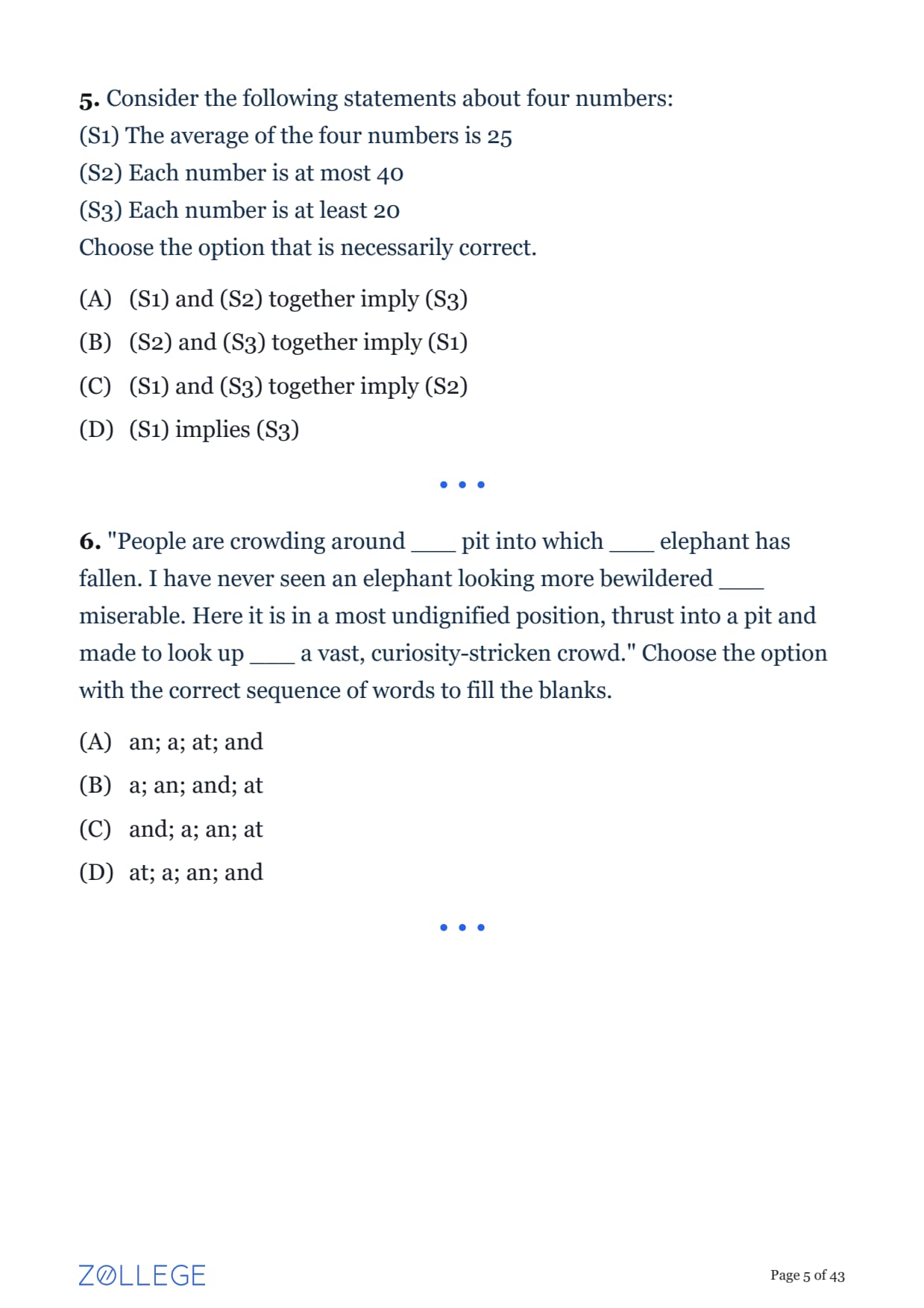
Consider the following statements about four numbers:
(S1) The average of the four numbers is 25
(S2) Each number is at most 40
(S3) Each number is at least 20
Choose the option that is necessarily correct.
"People are crowding around ___ pit into which ___ elephant has fallen. I have never seen an elephant looking more bewildered ___ miserable. Here it is in a most undignified position, thrust into a pit and made to look up ___ a vast, curiosity-stricken crowd." Choose the option with the correct sequence of words to fill the blanks.
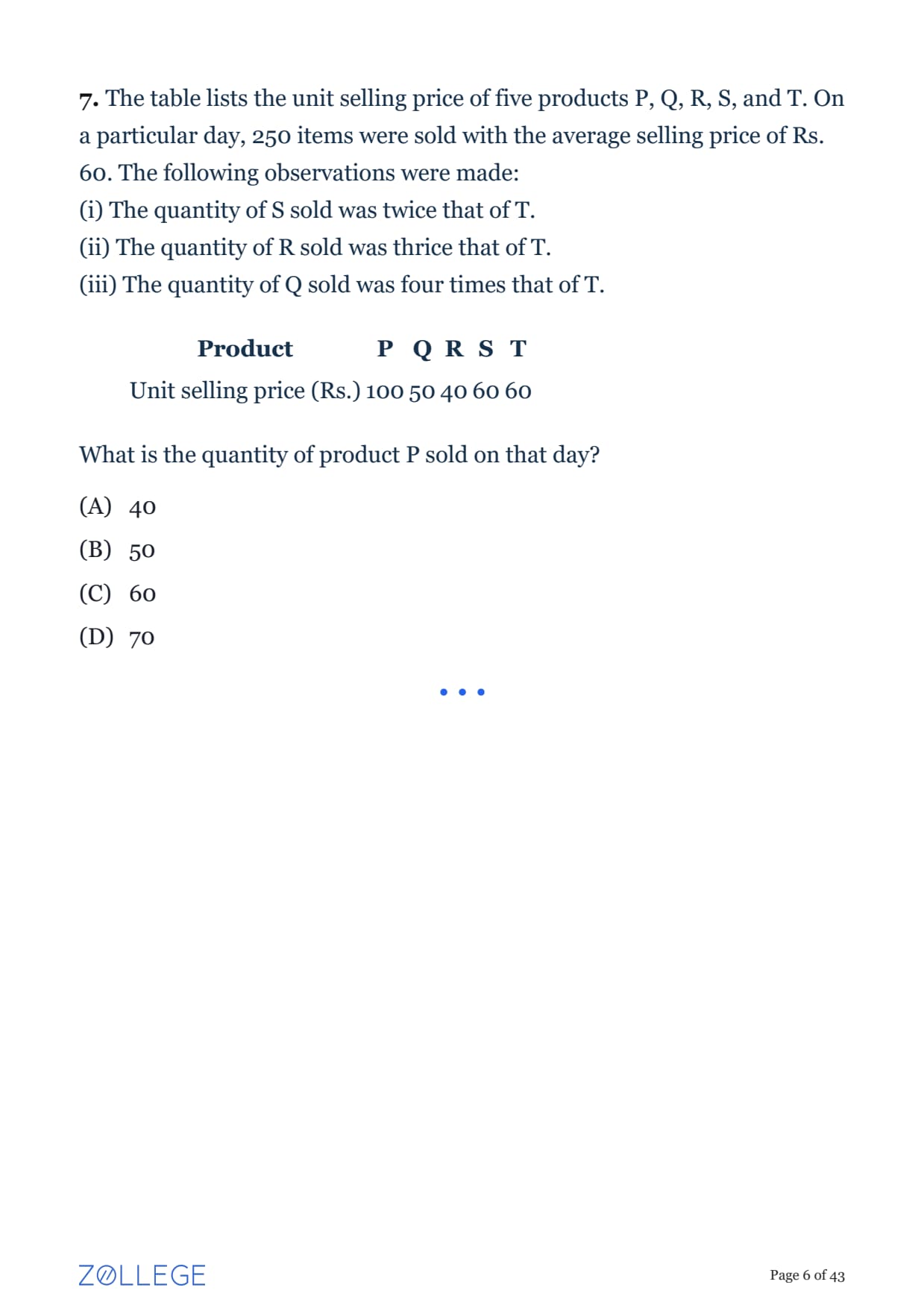
The table lists the unit selling price of five products P, Q, R, S, and T. On a particular day, 250 items were sold with the average selling price of Rs. 60. The following observations were made:
(i) The quantity of S sold was twice that of T.
(ii) The quantity of R sold was thrice that of T.
(iii) The quantity of Q sold was four times that of T.
| Product | P | Q | R | S | T |
|---|---|---|---|---|---|
| Unit selling price (Rs.) | 100 | 50 | 40 | 60 | 60 |
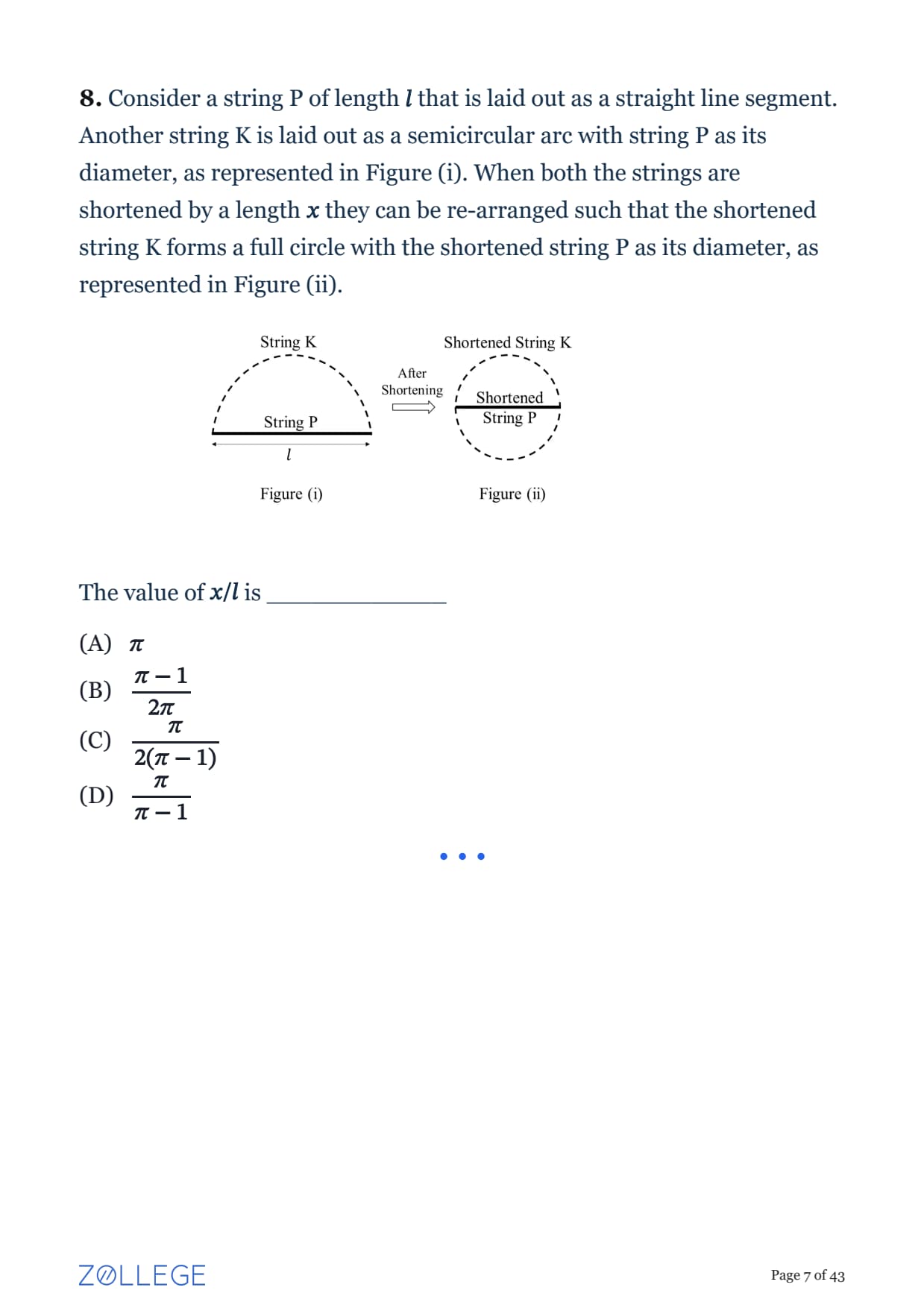
Consider a string P of length \(l\) that is laid out as a straight line segment. Another string K is laid out as a semicircular arc with string P as its diameter, as represented in Figure (i). When both the strings are shortened by a length \(x\) they can be re-arranged such that the shortened string K forms a full circle with the shortened string P as its diameter, as represented in Figure (ii).

The value of \(x/l\) is ____________
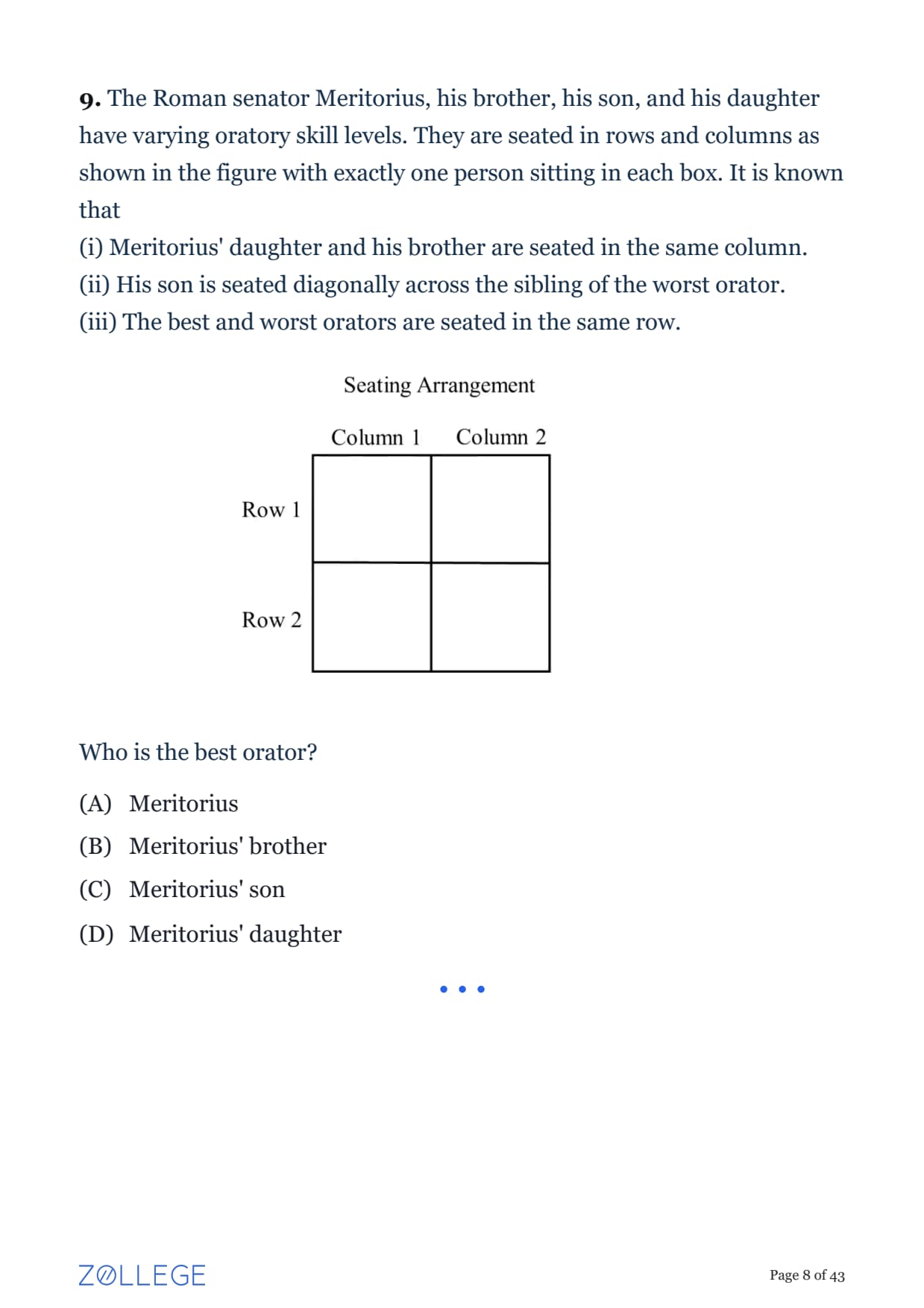
The Roman senator Meritorius, his brother, his son, and his daughter have varying oratory skill levels. They are seated in rows and columns as shown in the figure with exactly one person sitting in each box. It is known that
(i) Meritorius' daughter and his brother are seated in the same column.
(ii) His son is seated diagonally across the sibling of the worst orator.
(iii) The best and worst orators are seated in the same row.

Who is the best orator?
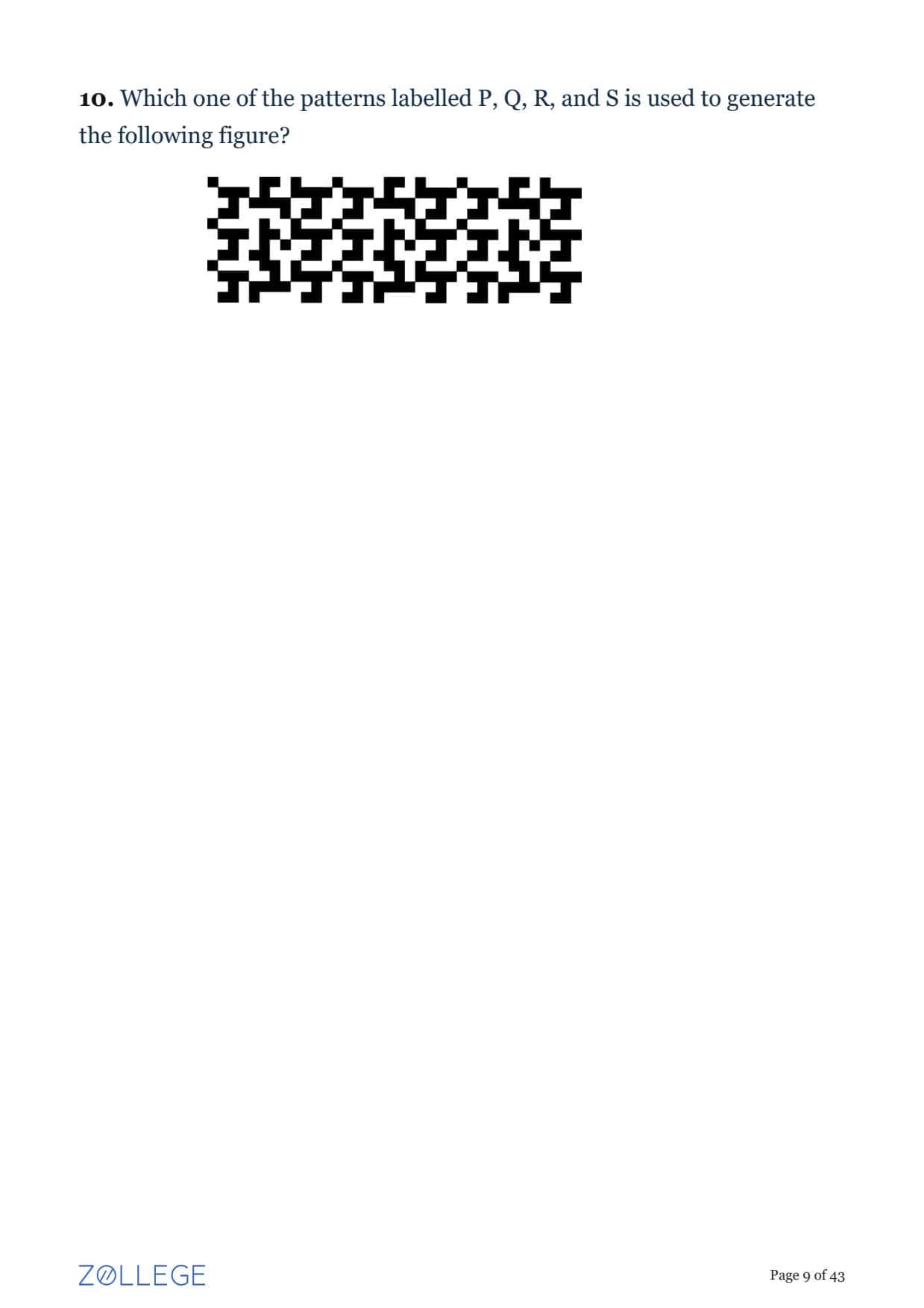
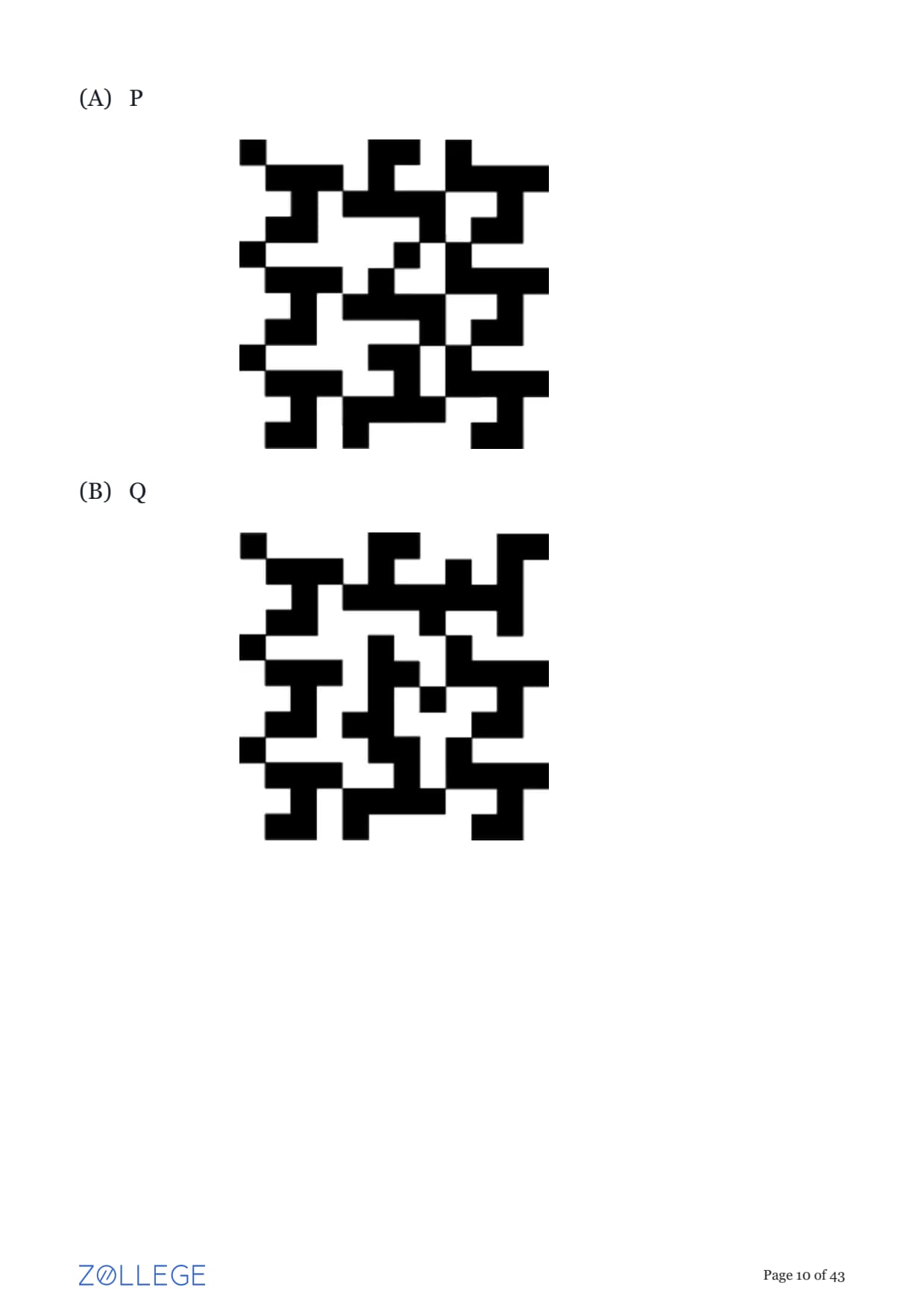
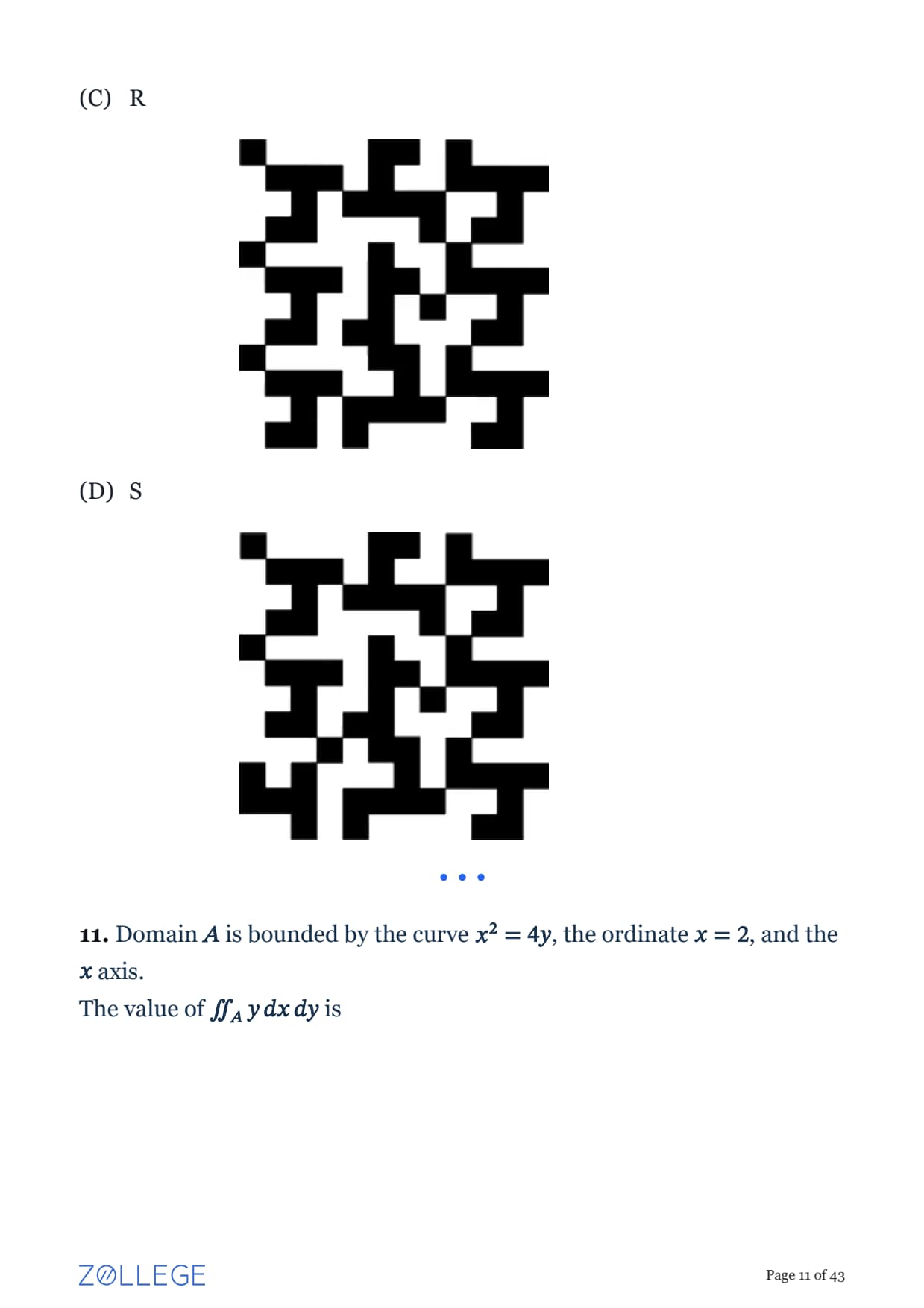
Which one of the patterns labelled P, Q, R, and S is used to generate the following figure?

- (A) P
![]()
- (B) Q
![]()
- (C) R
![]()
- (D) S
![]()


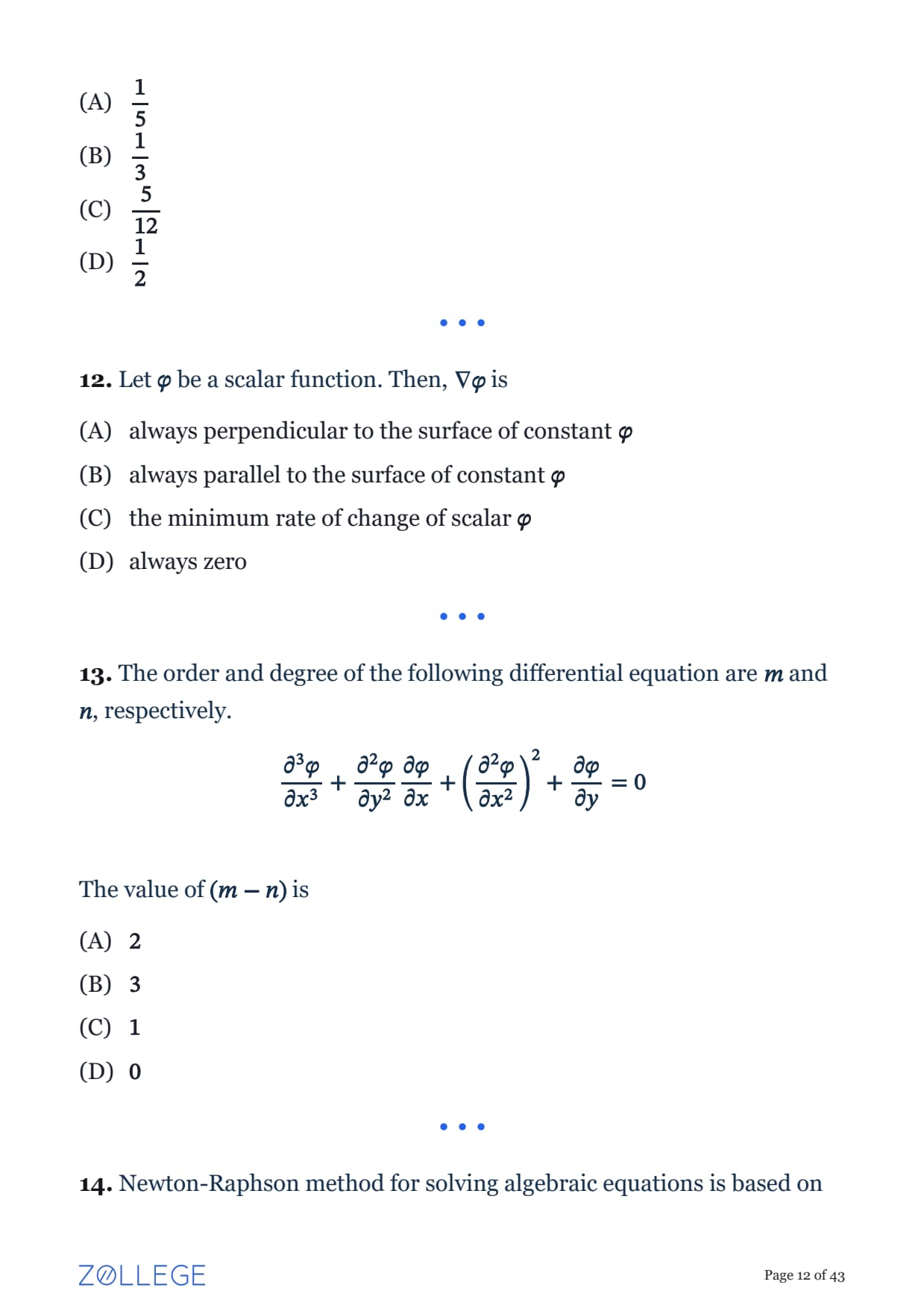
Domain \( A \) is bounded by the curve \( x^2 = 4y \), the ordinate \( x = 2 \), and the \( x \) axis.
The value of \( \iint_A y \, dx \, dy \) is
Let \( \varphi \) be a scalar function. Then, \( \nabla \varphi \) is
The order and degree of the following differential equation are \( m \) and \( n \), respectively.
\[ \frac{\partial^3 \varphi}{\partial x^3} + \frac{\partial^2 \varphi}{\partial y^2}\frac{\partial \varphi}{\partial x} + \left(\frac{\partial^2 \varphi}{\partial x^2}\right)^2 + \frac{\partial \varphi}{\partial y} = 0 \]
The value of \( (m-n) \) is
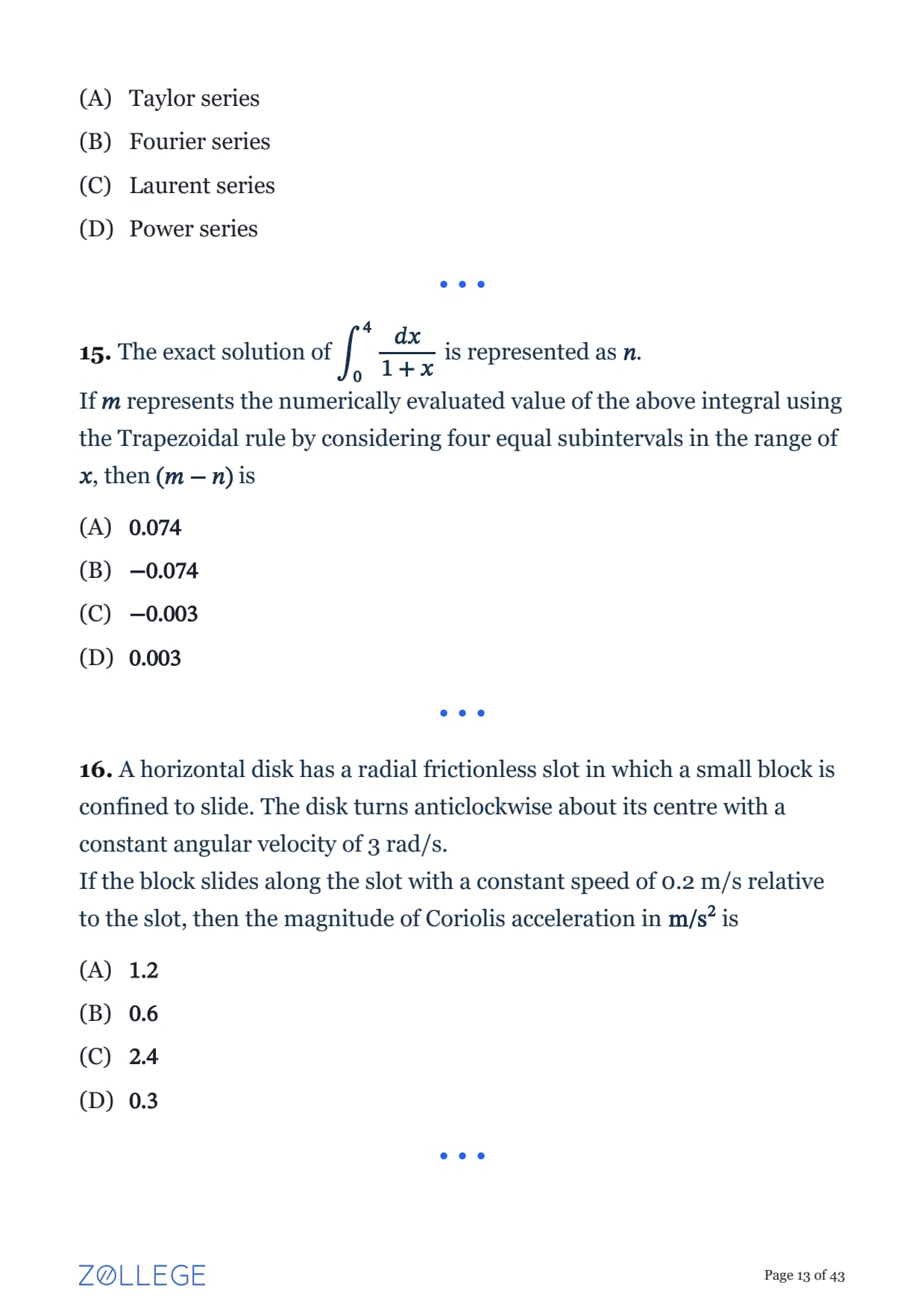
Newton-Raphson method for solving algebraic equations is based on
The exact solution of \( \displaystyle\int_0^4 \frac{dx}{1+x} \) is represented as \( n \).
If \( m \) represents the numerically evaluated value of the above integral using the Trapezoidal rule by considering four equal subintervals in the range of \( x \), then \( (m-n) \) is
A horizontal disk has a radial frictionless slot in which a small block is confined to slide. The disk turns anticlockwise about its centre with a constant angular velocity of 3 rad/s.
If the block slides along the slot with a constant speed of 0.2 m/s relative to the slot, then the magnitude of Coriolis acceleration in \( \text{m/s}^2 \) is
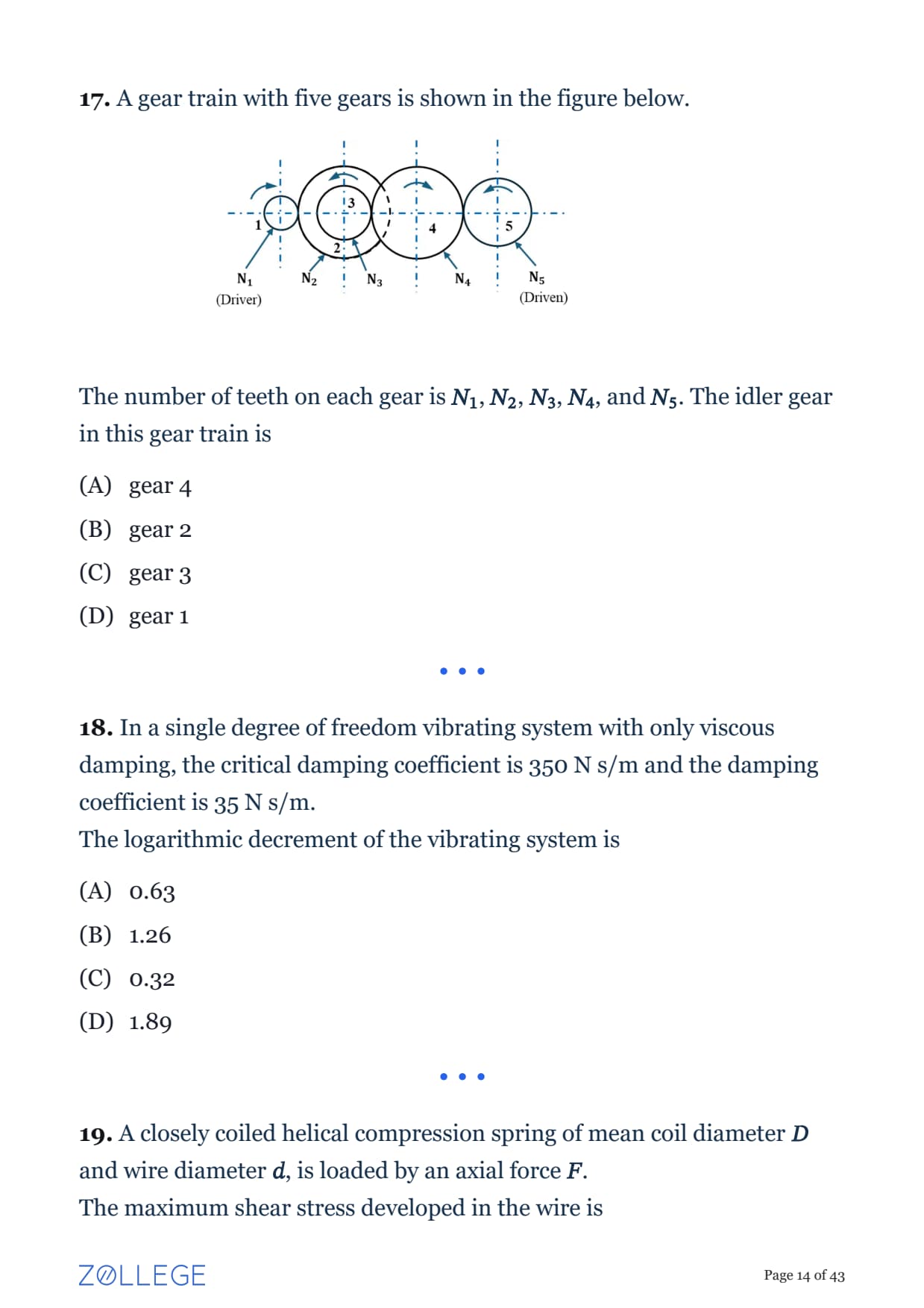
A gear train with five gears is shown in the figure below.
The number of teeth on each gear is \(N_1\), \(N_2\), \(N_3\), \(N_4\), and \(N_5\). The idler gear in this gear train is
In a single degree of freedom vibrating system with only viscous damping, the critical damping coefficient is 350 N s/m and the damping coefficient is 35 N s/m.
The logarithmic decrement of the vibrating system is
A closely coiled helical compression spring of mean coil diameter \(D\) and wire diameter \(d\), is loaded by an axial force \(F\).
The maximum shear stress developed in the wire is
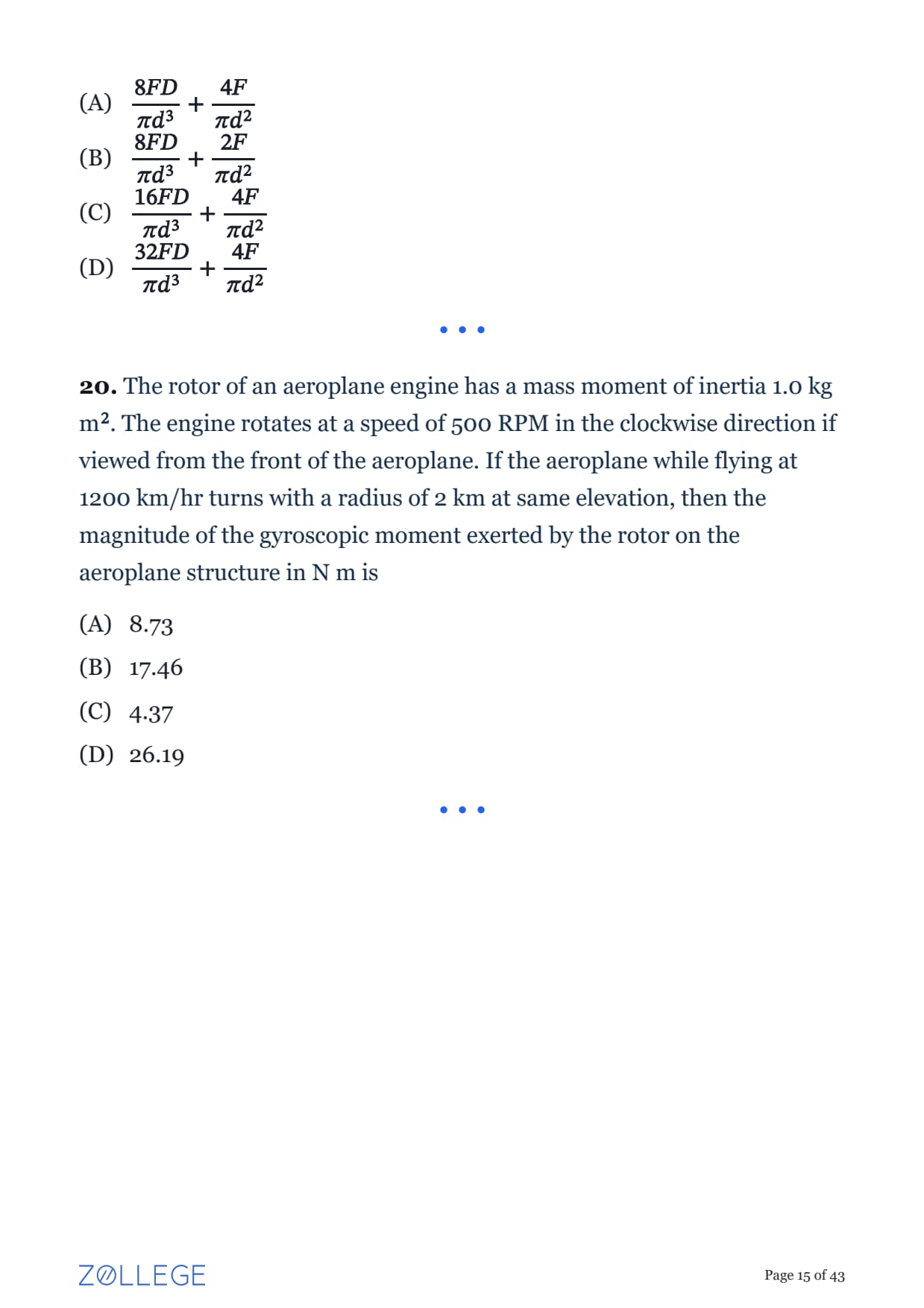
The rotor of an aeroplane engine has a mass moment of inertia 1.0 kg m\(^2\). The engine rotates at a speed of 500 RPM in the clockwise direction if viewed from the front of the aeroplane. If the aeroplane while flying at 1200 km/hr turns with a radius of 2 km at same elevation, then the magnitude of the gyroscopic moment exerted by the rotor on the aeroplane structure in N m is
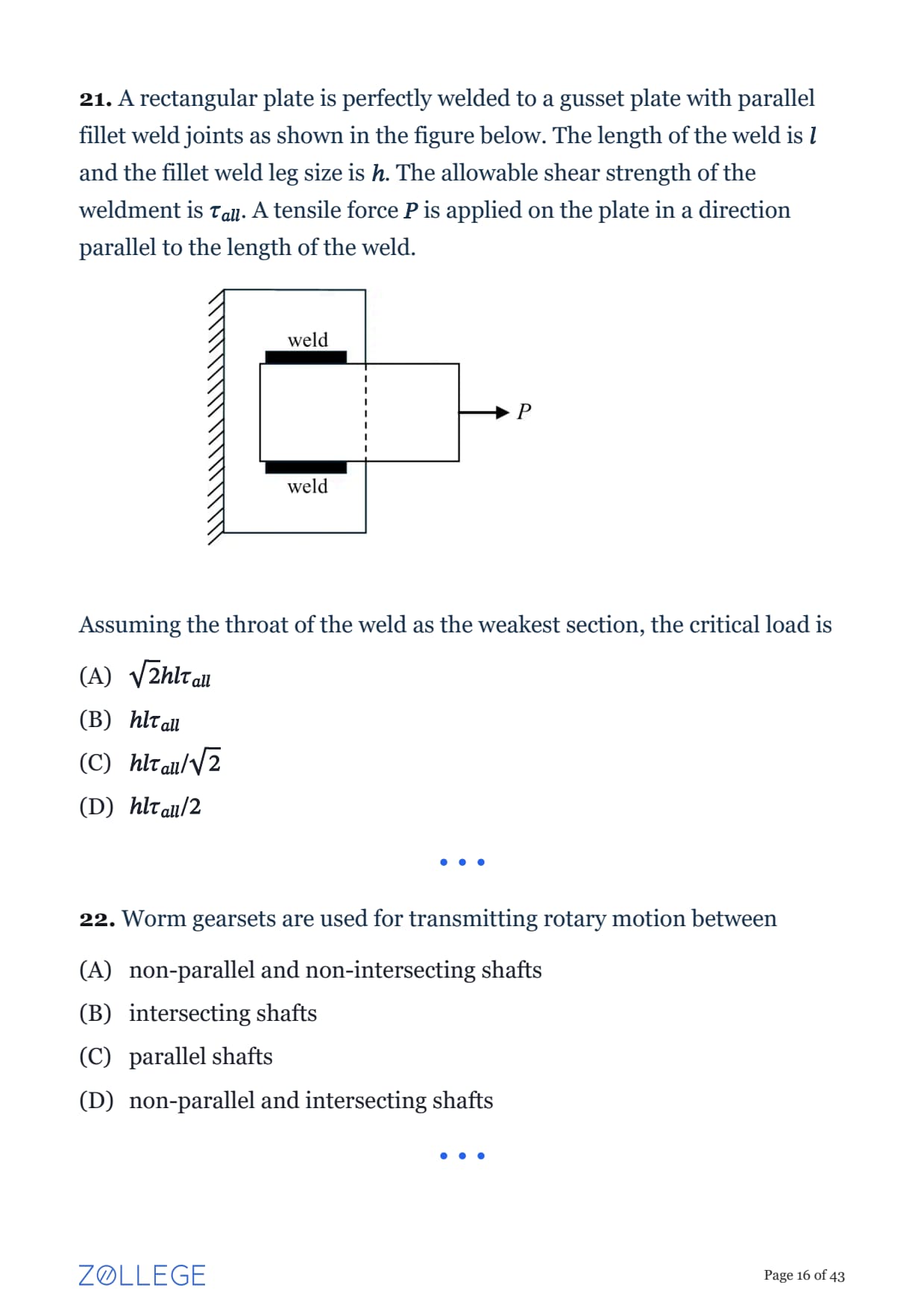
A rectangular plate is perfectly welded to a gusset plate with parallel fillet weld joints as shown in the figure below. The length of the weld is \(l\) and the fillet weld leg size is \(h\). The allowable shear strength of the weldment is \(\tau_{all}\). A tensile force \(P\) is applied on the plate in a direction parallel to the length of the weld. 
Assuming the throat of the weld as the weakest section, the critical load is
Worm gearsets are used for transmitting rotary motion between
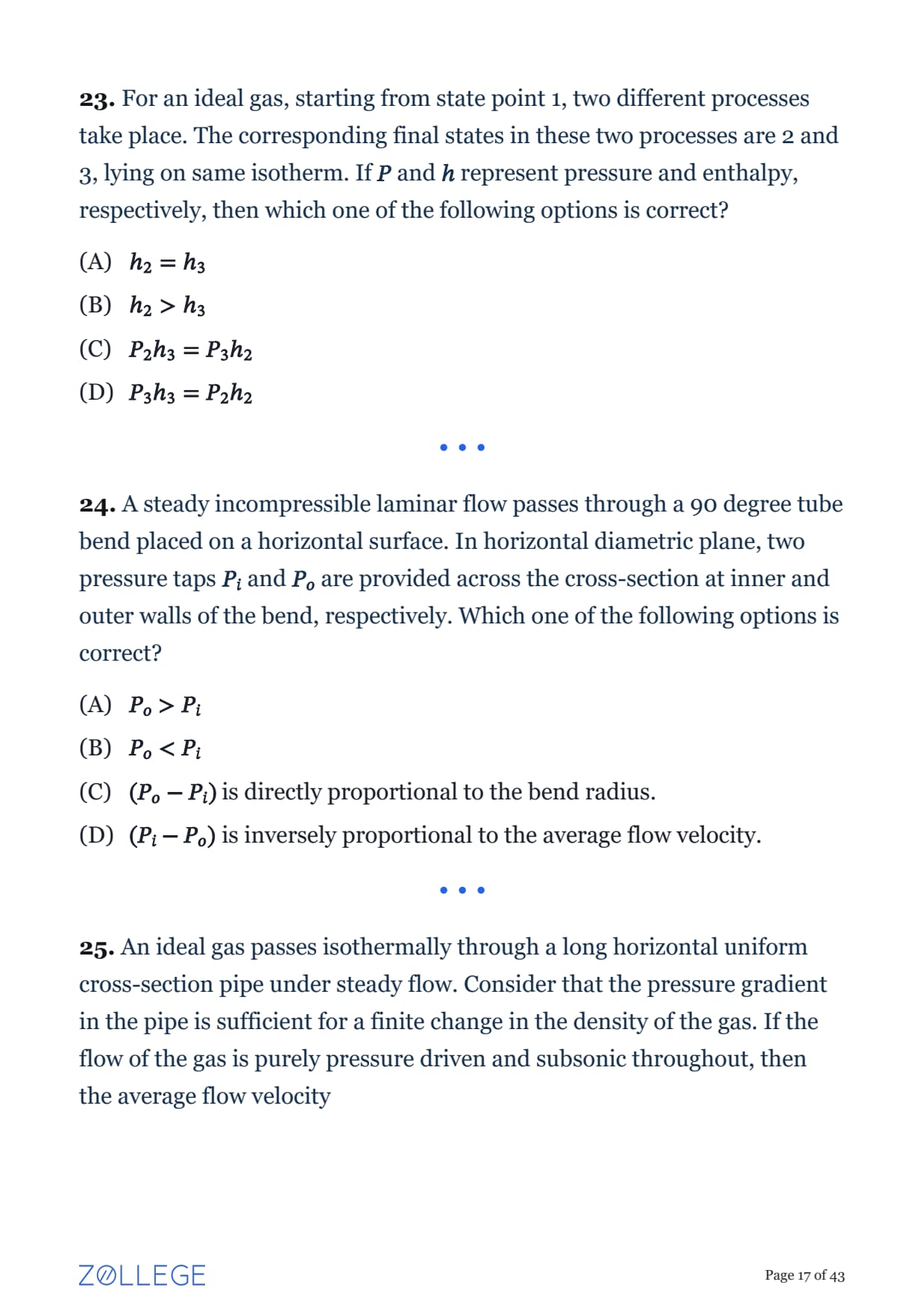
For an ideal gas, starting from state point 1, two different processes take place. The corresponding final states in these two processes are 2 and 3, lying on same isotherm. If \(P\) and \(h\) represent pressure and enthalpy, respectively, then which one of the following options is correct?
A steady incompressible laminar flow passes through a 90 degree tube bend placed on a horizontal surface. In horizontal diametric plane, two pressure taps \(P_i\) and \(P_o\) are provided across the cross-section at inner and outer walls of the bend, respectively. Which one of the following options is correct?
An ideal gas passes isothermally through a long horizontal uniform cross-section pipe under steady flow. Consider that the pressure gradient in the pipe is sufficient for a finite change in the density of the gas. If the flow of the gas is purely pressure driven and subsonic throughout, then the average flow velocity
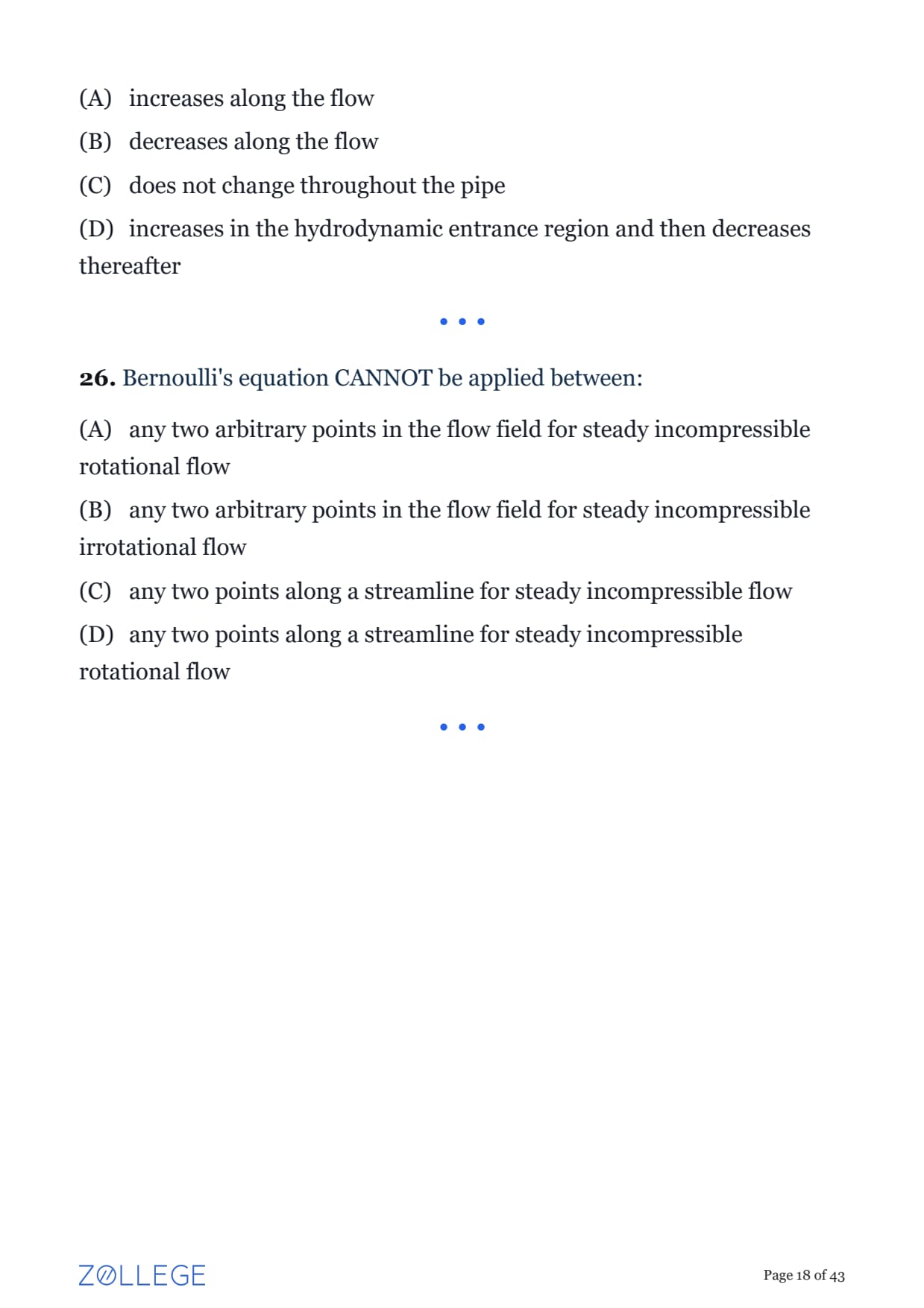
Bernoulli's equation CANNOT be applied between:
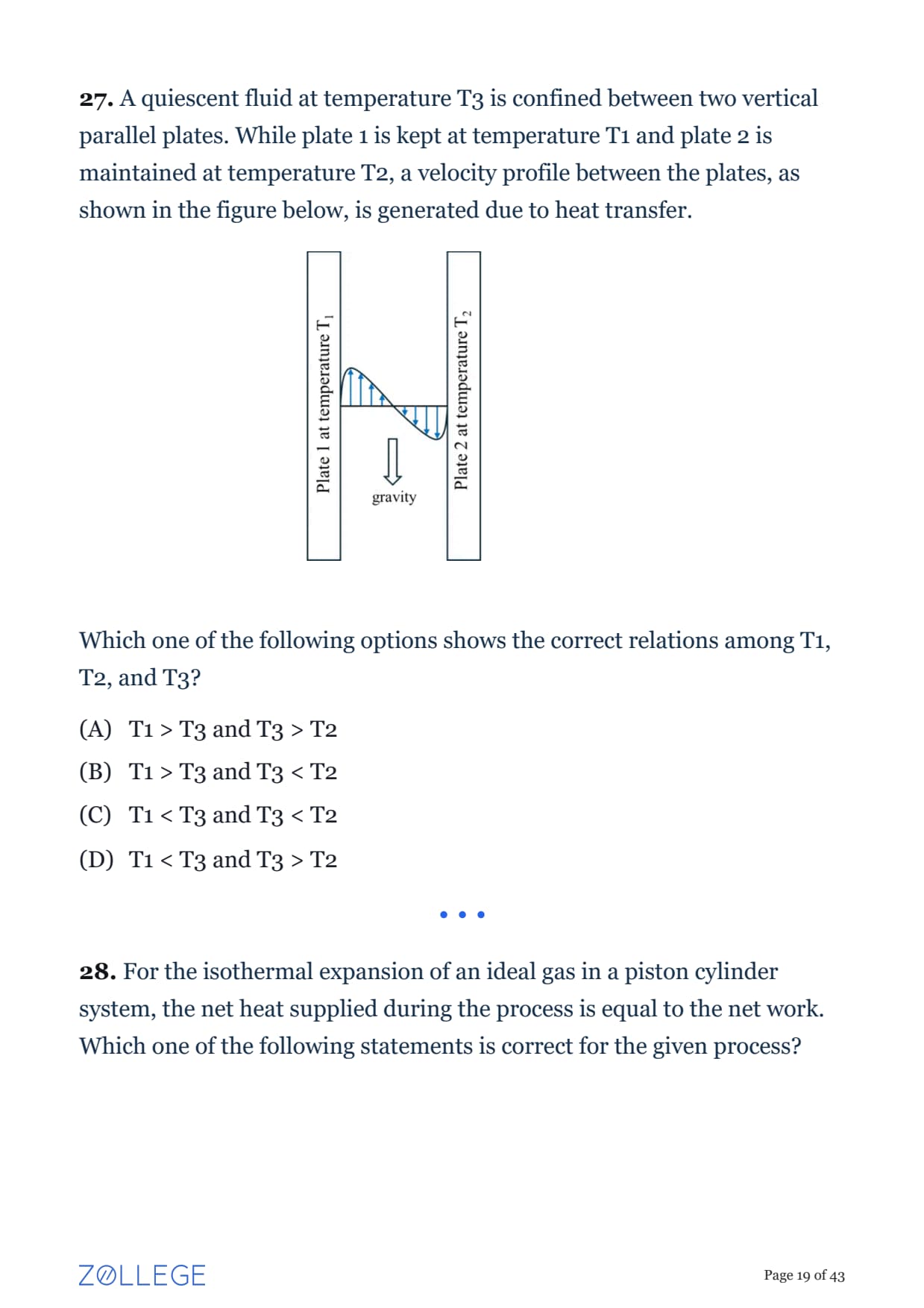
A quiescent fluid at temperature T3 is confined between two vertical parallel plates. While plate 1 is kept at temperature T1 and plate 2 is maintained at temperature T2, a velocity profile between the plates, as shown in the figure below, is generated due to heat transfer.
Which one of the following options shows the correct relations among T1, T2, and T3?
For the isothermal expansion of an ideal gas in a piston cylinder system, the net heat supplied during the process is equal to the net work. Which one of the following statements is correct for the given process?
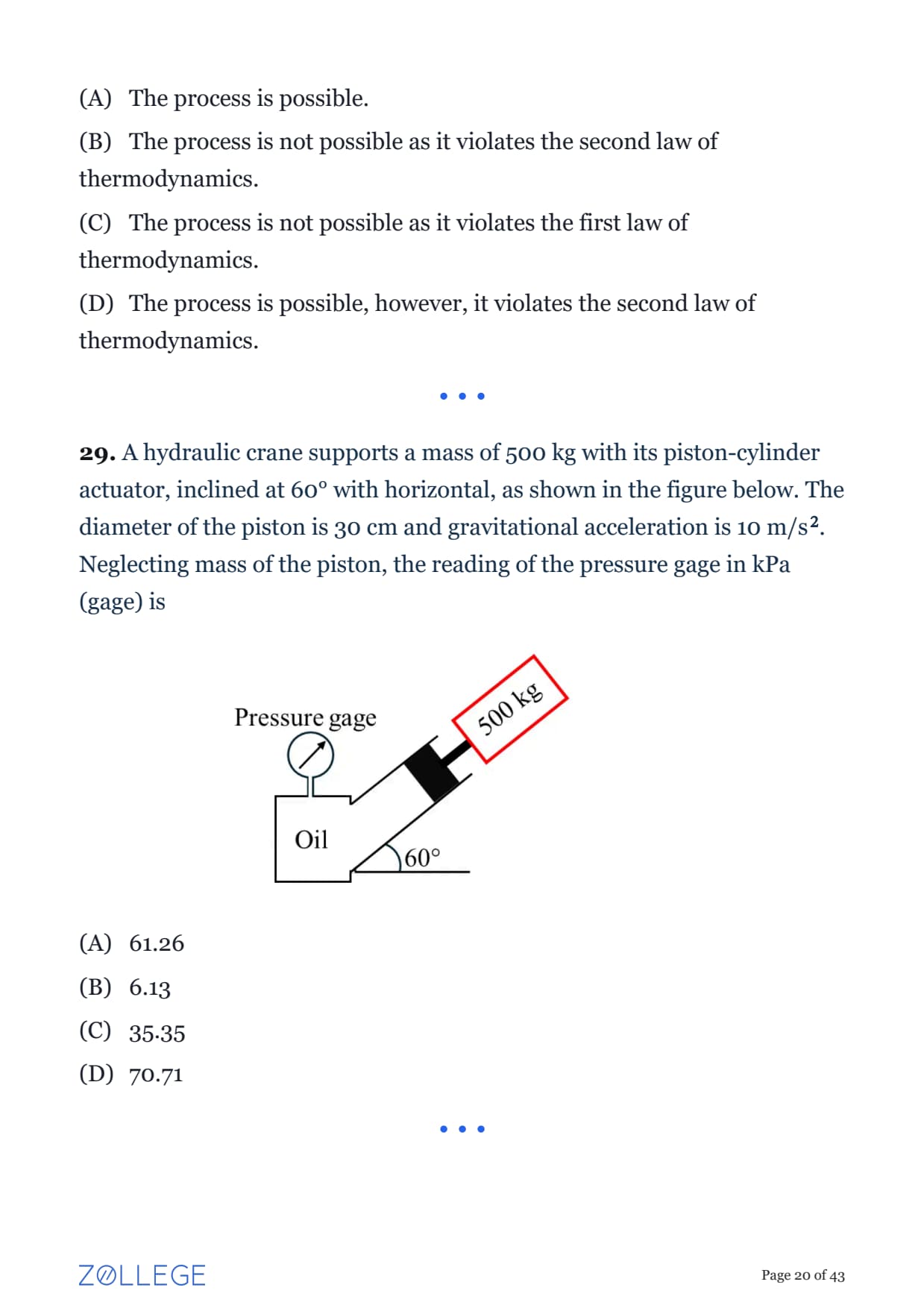
A hydraulic crane supports a mass of 500 kg with its piston-cylinder actuator, inclined at 60° with horizontal, as shown in the figure below. The diameter of the piston is 30 cm and gravitational acceleration is 10 m/s\(^2\). Neglecting mass of the piston, the reading of the pressure gage in kPa (gage) is
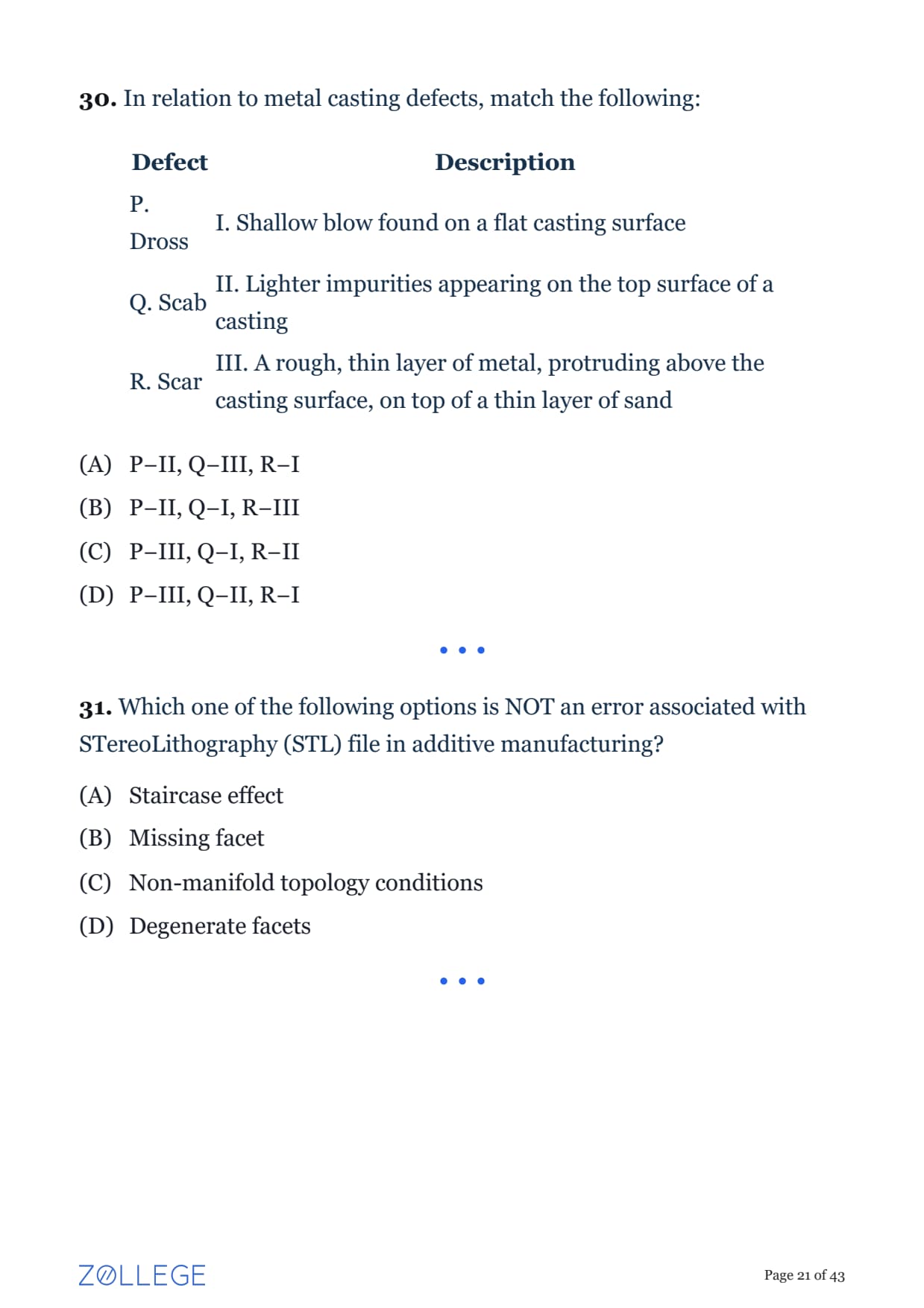
In relation to metal casting defects, match the following:
| Defect | Description |
|---|---|
| P. Dross | I. Shallow blow found on a flat casting surface |
| Q. Scab | II. Lighter impurities appearing on the top surface of a casting |
| R. Scar | III. A rough, thin layer of metal, protruding above the casting surface, on top of a thin layer of sand |
Which one of the following options is NOT an error associated with STereoLithography (STL) file in additive manufacturing?
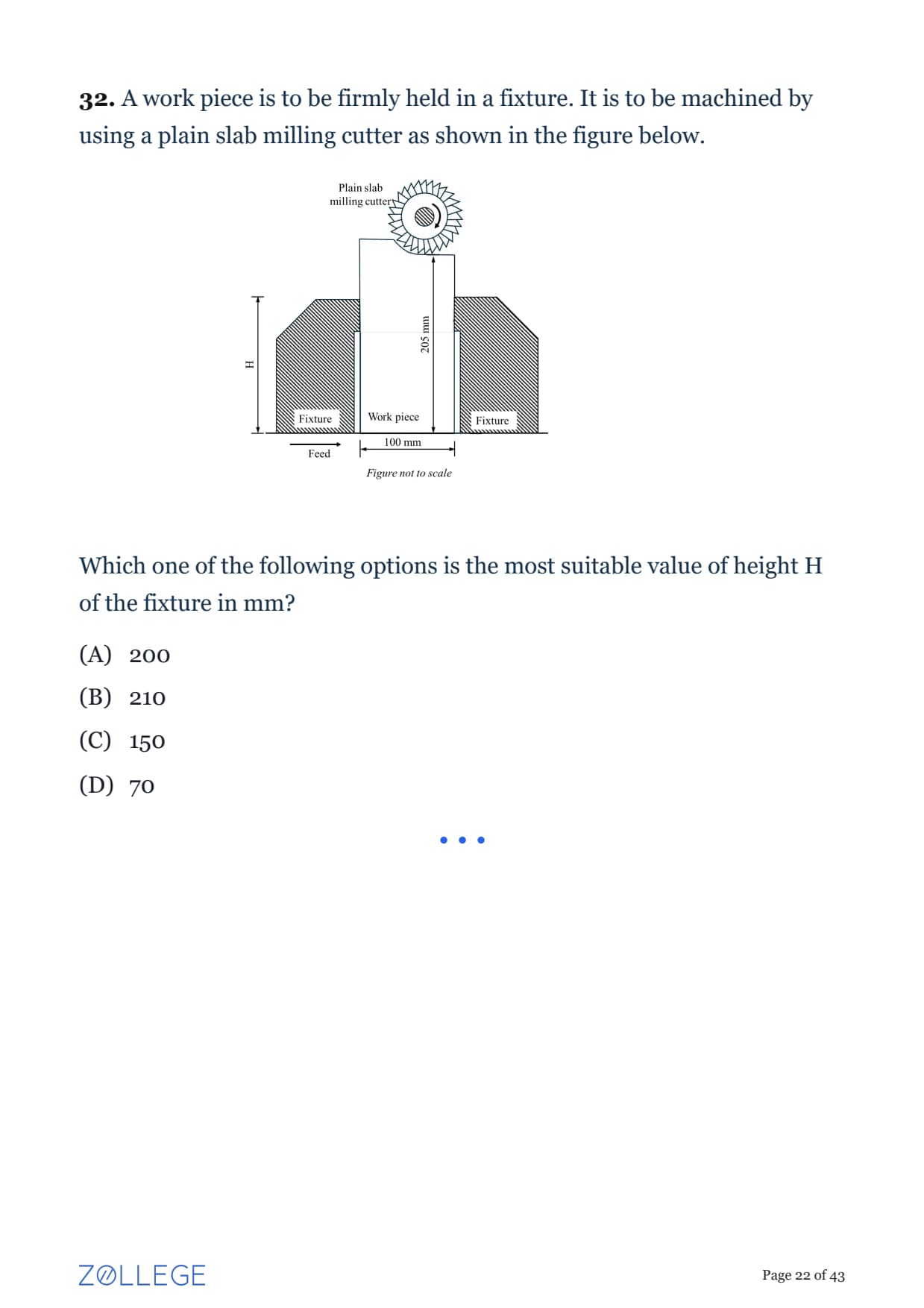
A work piece is to be firmly held in a fixture. It is to be machined by using a plain slab milling cutter as shown in the figure below.
Which one of the following options is the most suitable value of height H of the fixture in mm?
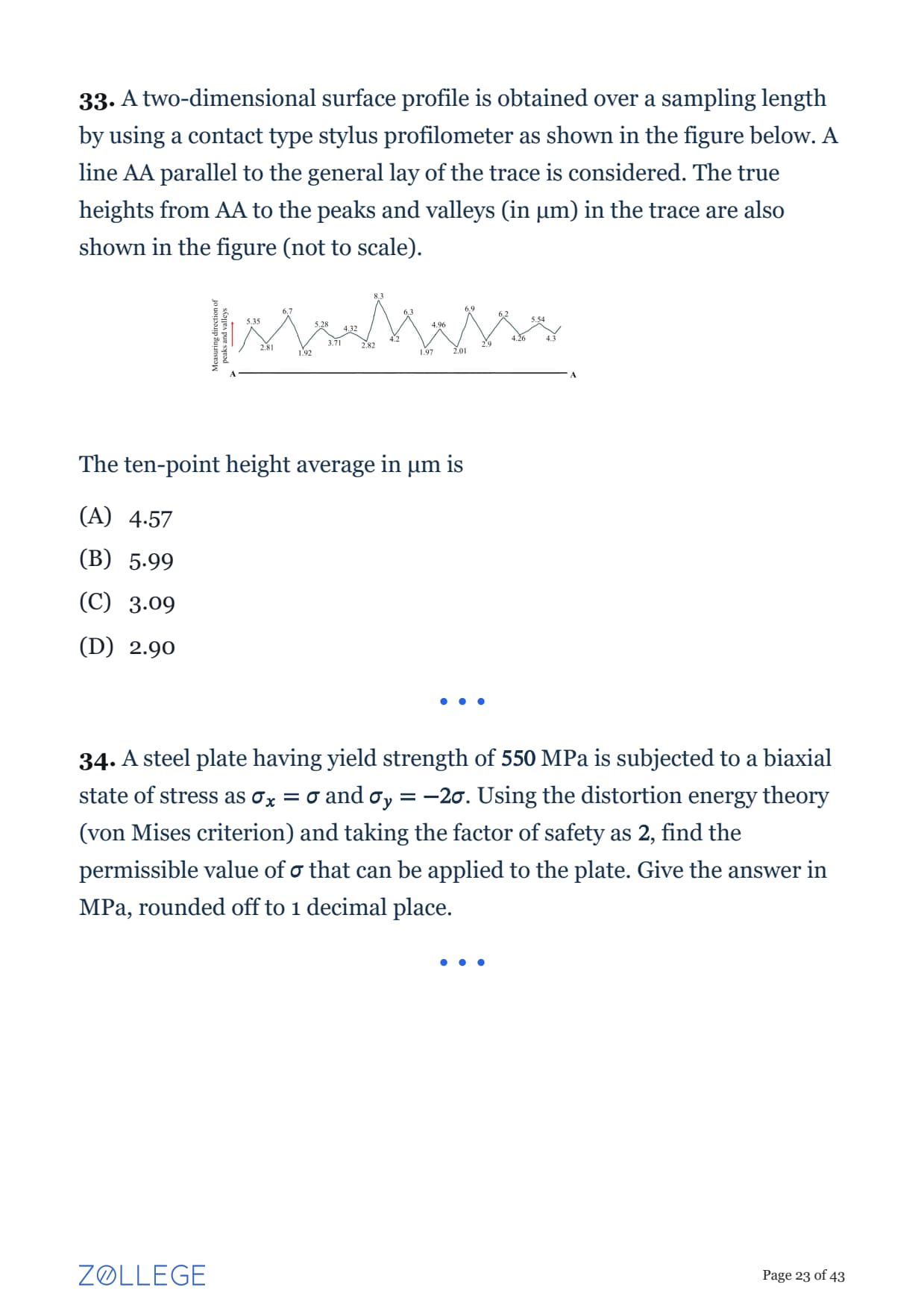
A two-dimensional surface profile is obtained over a sampling length by using a contact type stylus profilometer as shown in the figure below. A line AA parallel to the general lay of the trace is considered. The true heights from AA to the peaks and valleys (in μm) in the trace are also shown in the figure (not to scale).
The ten-point height average in μm is
A steel plate having yield strength of \( 550 \) MPa is subjected to a biaxial state of stress as \( \sigma_x = \sigma \) and \( \sigma_y = -2\sigma \). Using the distortion energy theory (von Mises criterion) and taking the factor of safety as \( 2 \), find the permissible value of \( \sigma \) that can be applied to the plate. Give the answer in MPa, rounded off to 1 decimal place.
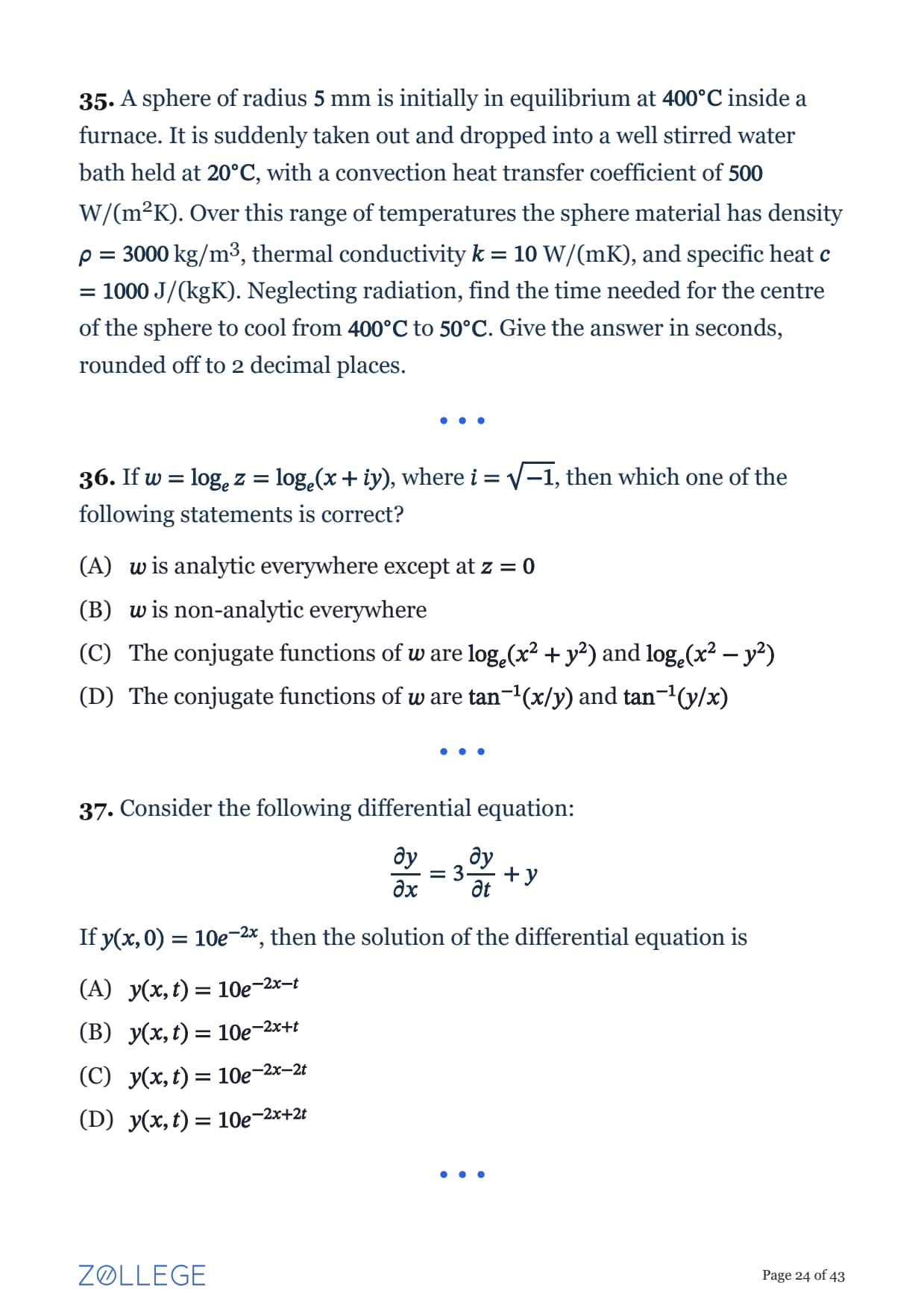
A sphere of radius \( 5 \) mm is initially in equilibrium at \( 400^{\circ}\text{C} \) inside a furnace. It is suddenly taken out and dropped into a well stirred water bath held at \( 20^{\circ}\text{C} \), with a convection heat transfer coefficient of \( 500 \) W/(m2K). Over this range of temperatures the sphere material has density \( \rho = 3000 \) kg/m3, thermal conductivity \( k = 10 \) W/(mK), and specific heat \( c = 1000 \) J/(kgK). Neglecting radiation, find the time needed for the centre of the sphere to cool from \( 400^{\circ}\text{C} \) to \( 50^{\circ}\text{C} \). Give the answer in seconds, rounded off to 2 decimal places.
If \( w = \log_e z = \log_e(x+iy) \), where \( i = \sqrt{-1} \), then which one of the following statements is correct?
Consider the following differential equation: \[ \frac{\partial y}{\partial x} = 3\frac{\partial y}{\partial t} + y \] If \( y(x,0) = 10e^{-2x} \), then the solution of the differential equation is
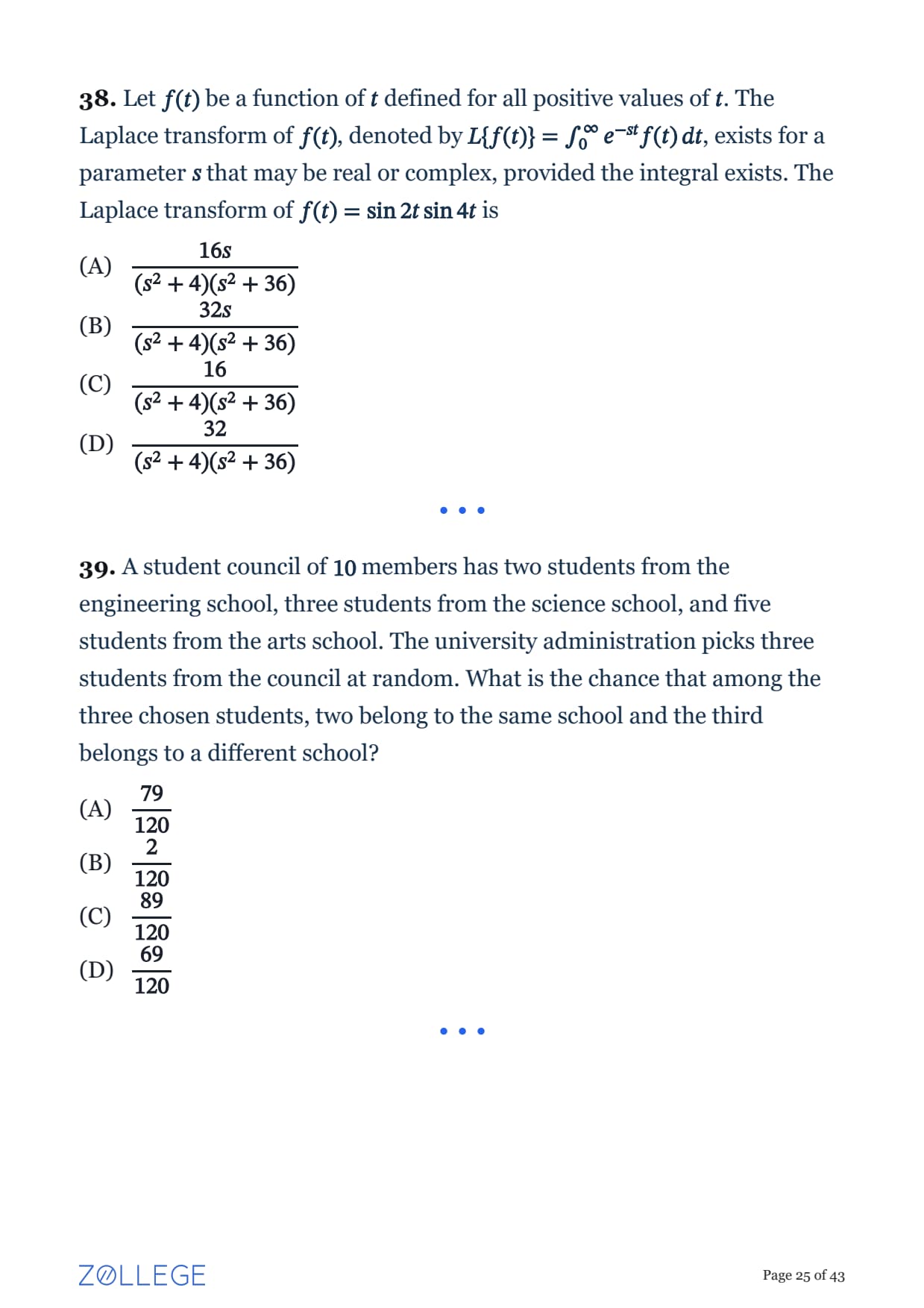
Let \( f(t) \) be a function of \( t \) defined for all positive values of \( t \). The Laplace transform of \( f(t) \), denoted by \( L\{f(t)\} = \int_0^{\infty} e^{-st}f(t)\,dt \), exists for a parameter \( s \) that may be real or complex, provided the integral exists. The Laplace transform of \( f(t) = \sin 2t\sin 4t \) is
A student council of \( 10 \) members has two students from the engineering school, three students from the science school, and five students from the arts school. The university administration picks three students from the council at random. What is the chance that among the three chosen students, two belong to the same school and the third belongs to a different school?
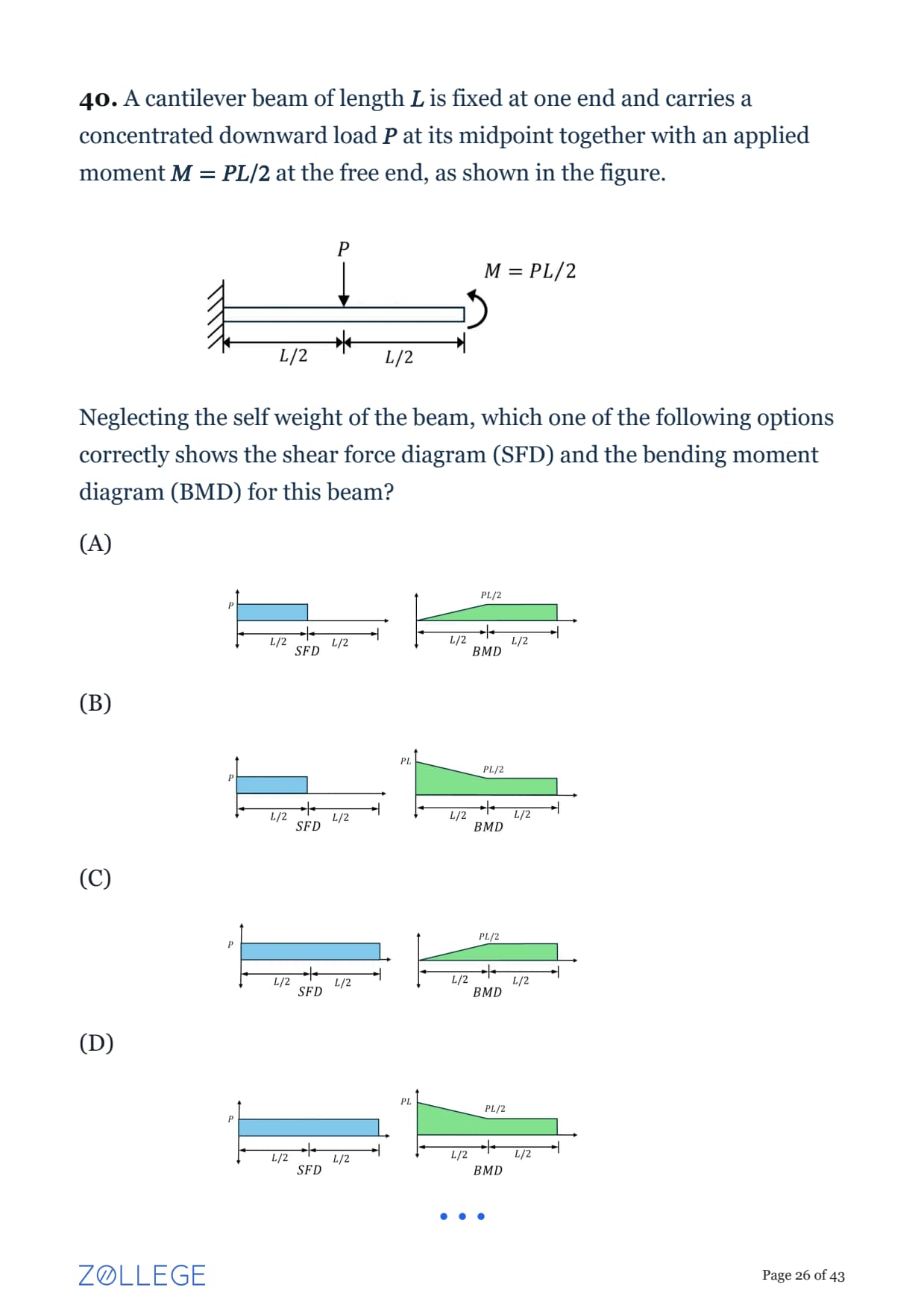
A cantilever beam of length \( L \) is fixed at one end and carries a concentrated downward load \( P \) at its midpoint together with an applied moment \( M = PL/2 \) at the free end, as shown in the figure.  Neglecting the self weight of the beam, which one of the following options correctly shows the shear force diagram (SFD) and the bending moment diagram (BMD) for this beam?
- (A)
![]()
- (B)
![]()
- (C)
![]()
- (D)
![]()


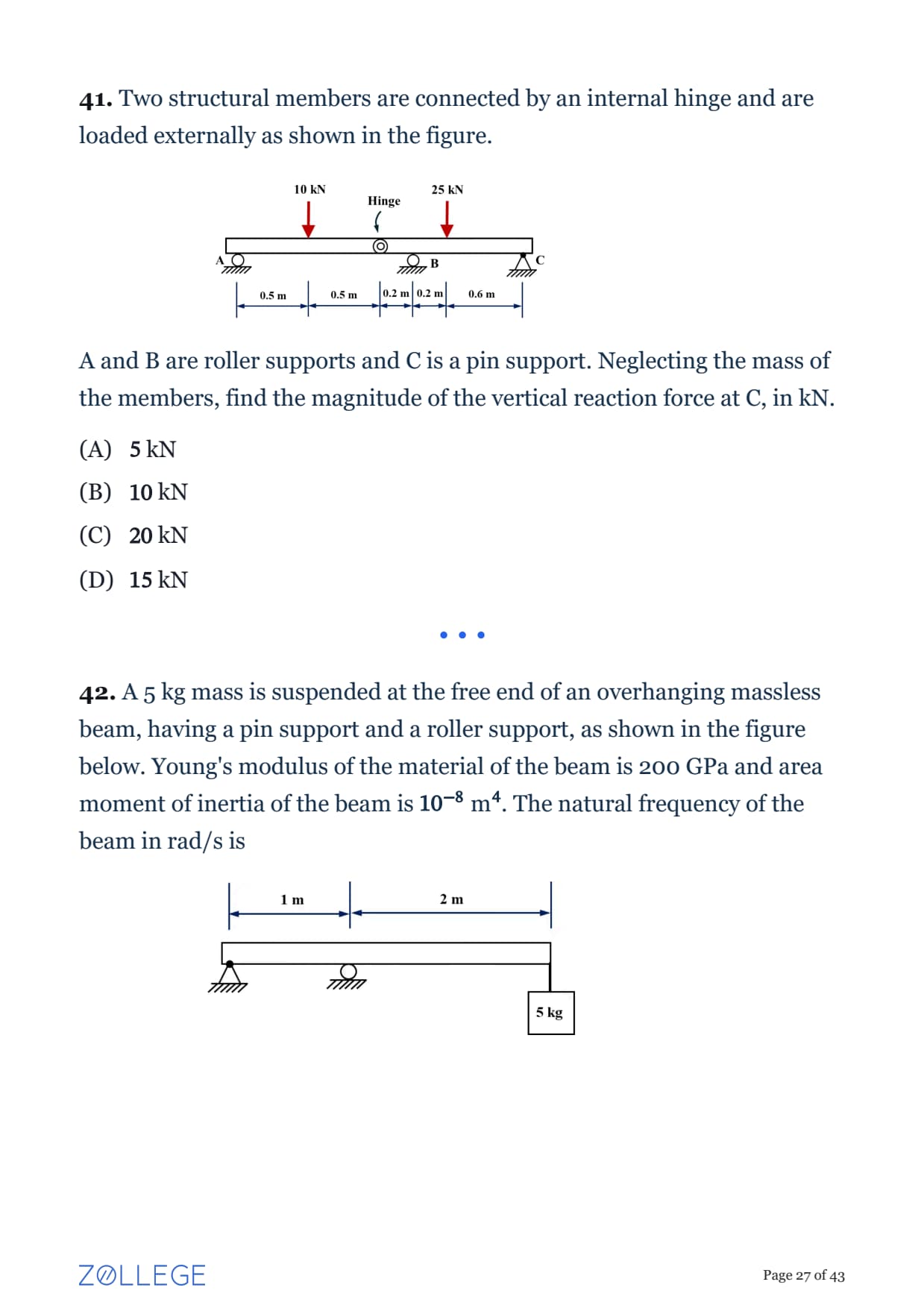
Two structural members are connected by an internal hinge and are loaded externally as shown in the figure.  A and B are roller supports and C is a pin support. Neglecting the mass of the members, find the magnitude of the vertical reaction force at C, in kN.
A 5 kg mass is suspended at the free end of an overhanging massless beam, having a pin support and a roller support, as shown in the figure below. Young's modulus of the material of the beam is 200 GPa and area moment of inertia of the beam is \(10^{-8}\) m\(^4\). The natural frequency of the beam in rad/s is

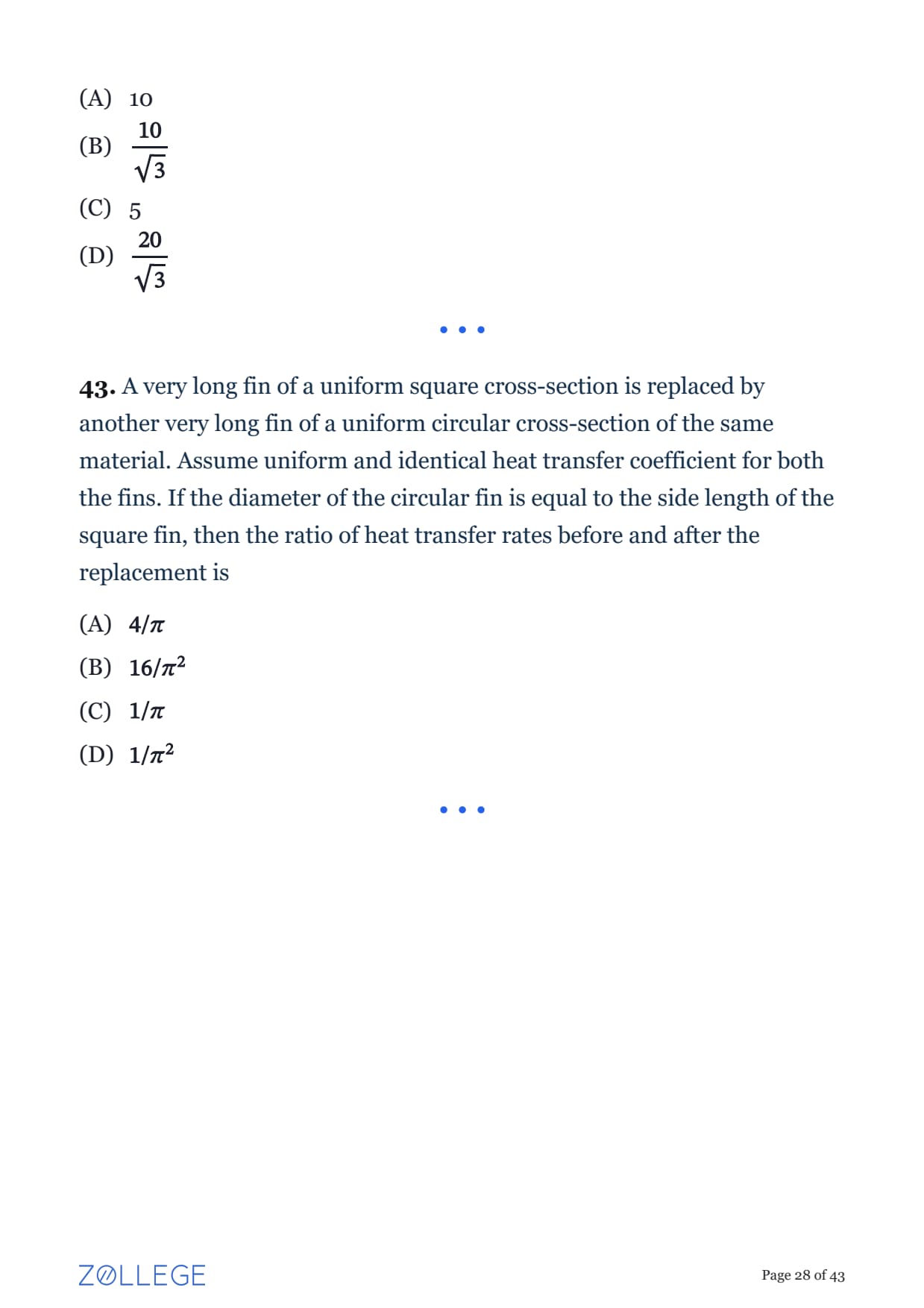
A very long fin of a uniform square cross-section is replaced by another very long fin of a uniform circular cross-section of the same material. Assume uniform and identical heat transfer coefficient for both the fins. If the diameter of the circular fin is equal to the side length of the square fin, then the ratio of heat transfer rates before and after the replacement is
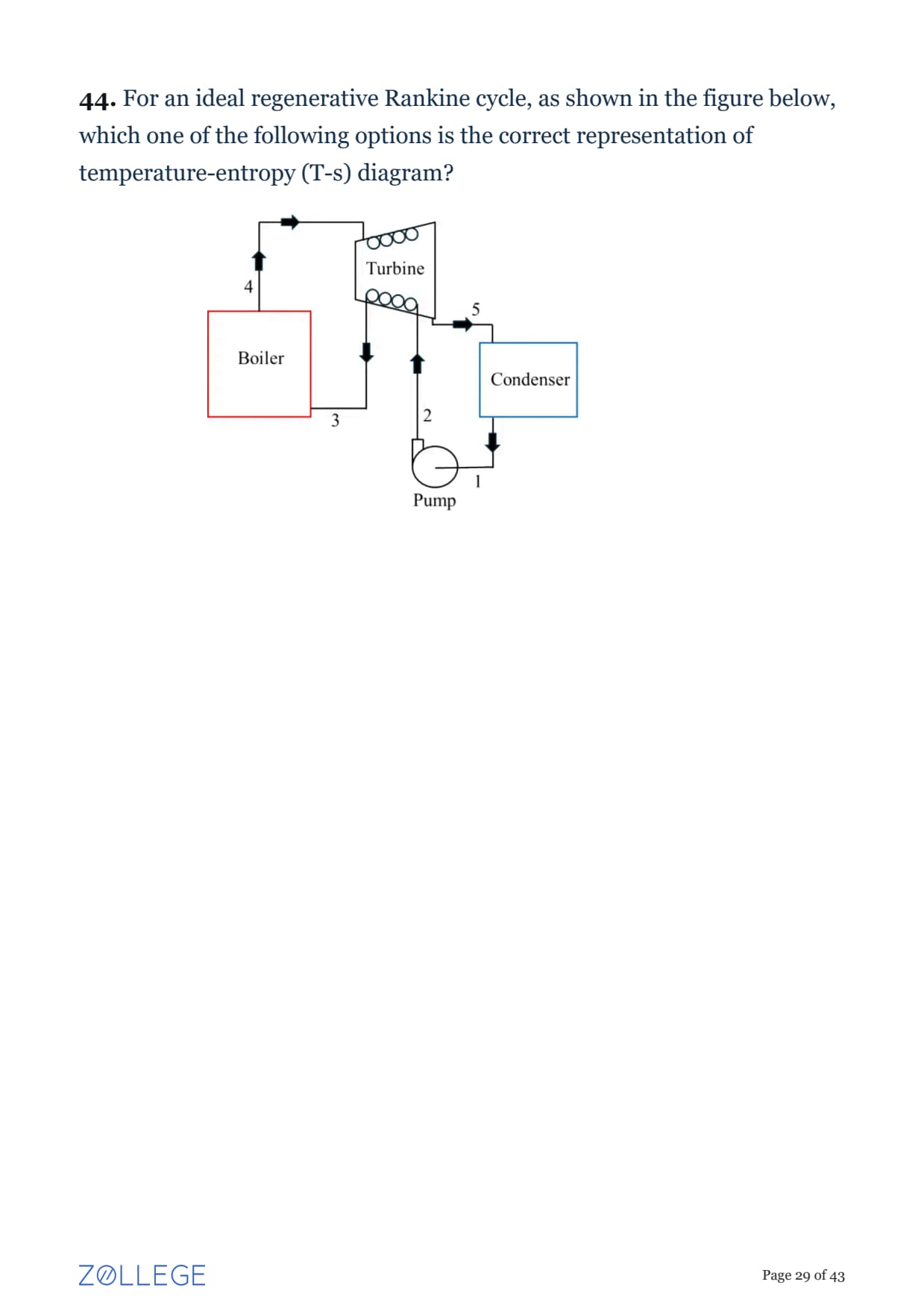
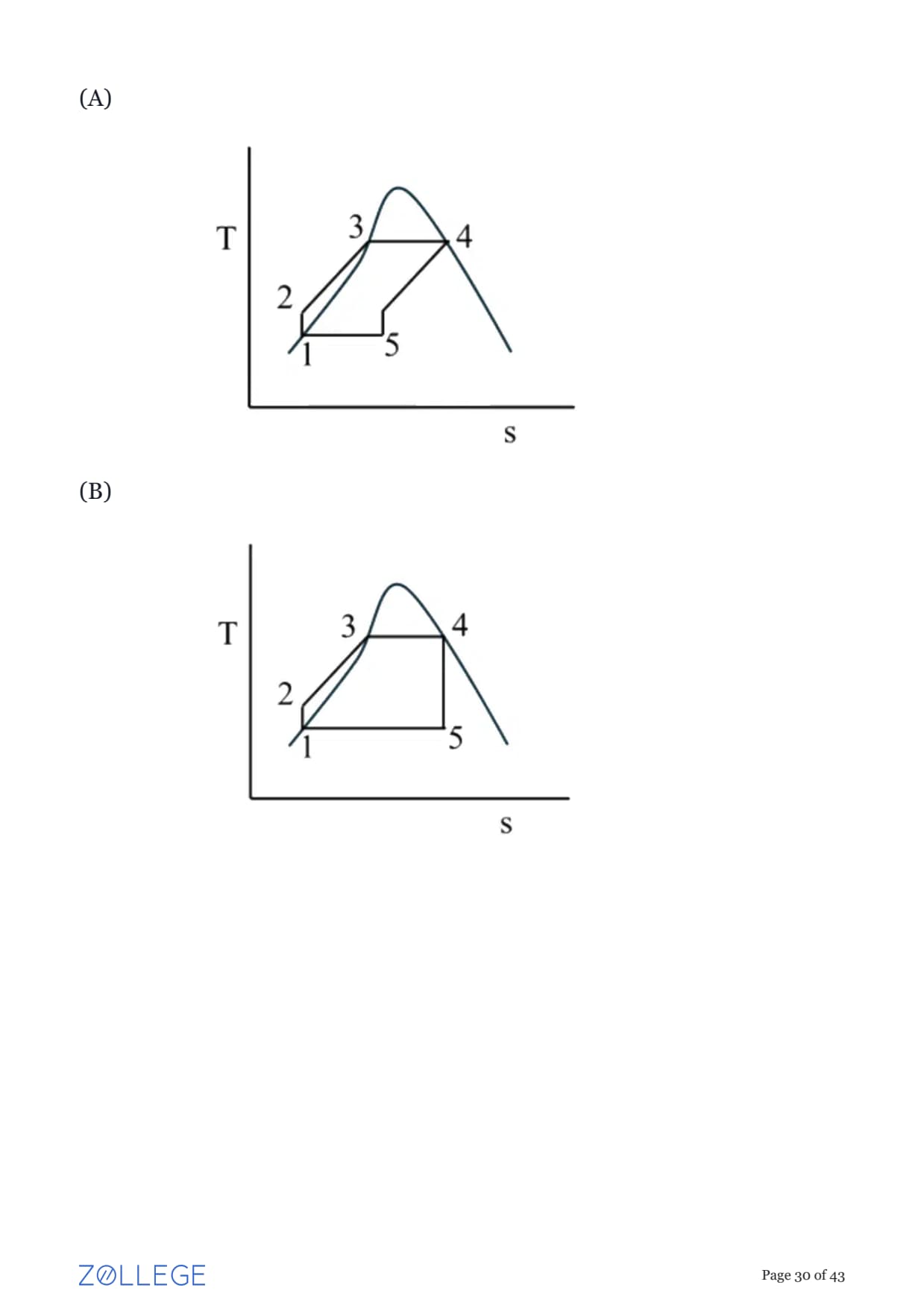
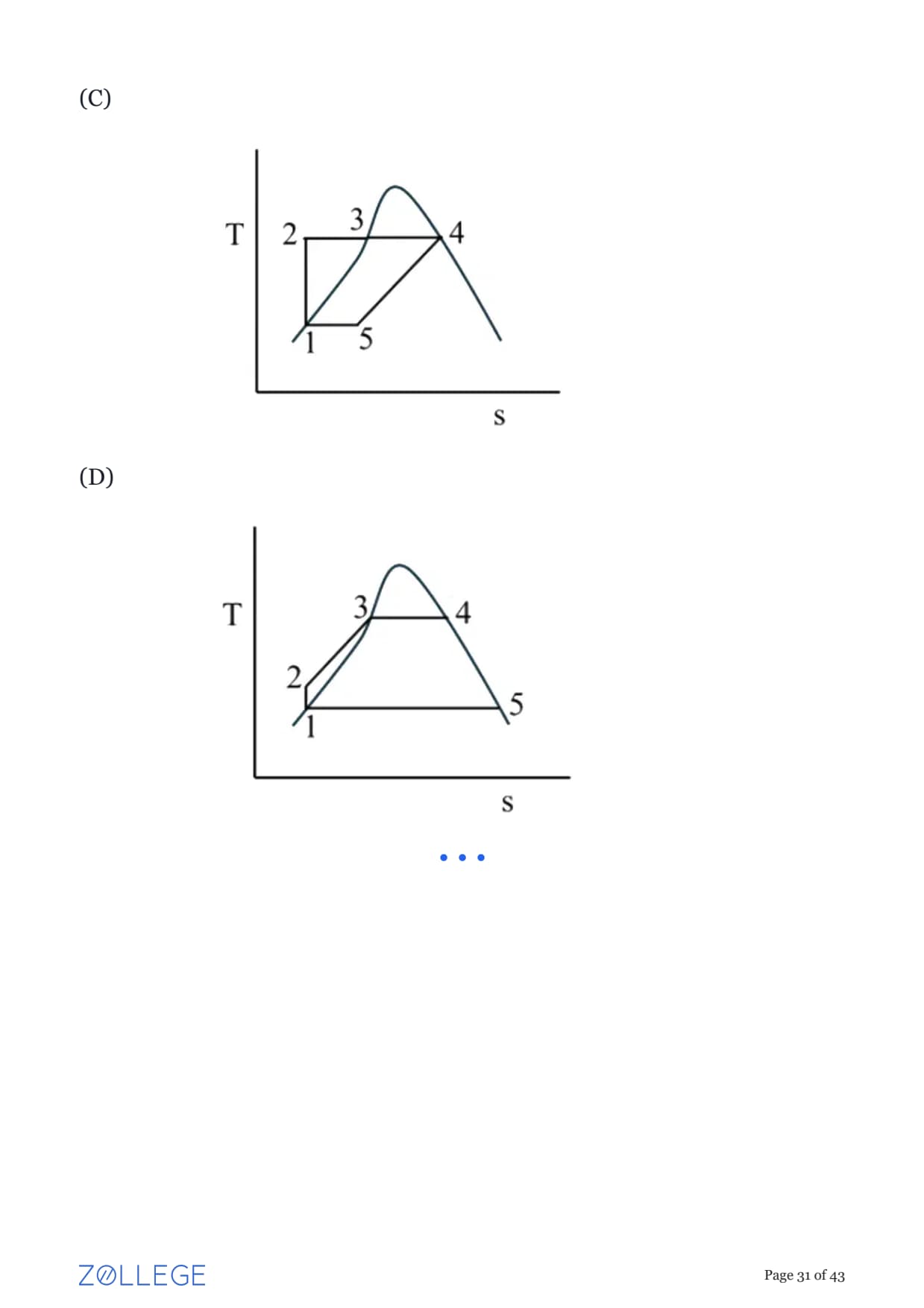
For an ideal regenerative Rankine cycle, as shown in the figure below, which one of the following options is the correct representation of temperature-entropy (T-s) diagram?

- (A)
![]()
- (B)
![]()
- (C)
![]()
- (D)
![]()


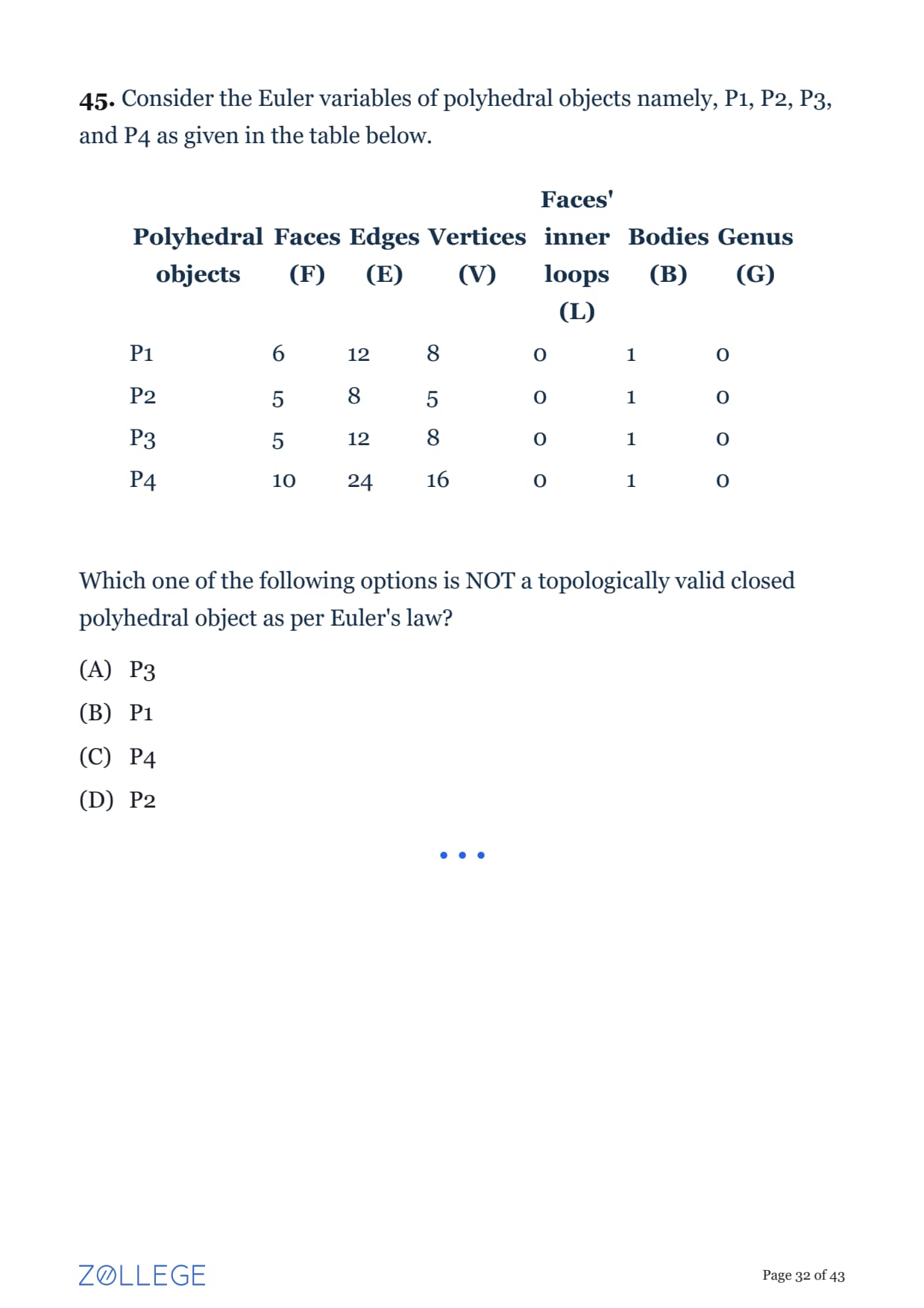
Consider the Euler variables of polyhedral objects namely, P1, P2, P3, and P4 as given in the table below.
| Polyhedral objects | Faces (F) | Edges (E) | Vertices (V) | Faces' inner loops (L) | Bodies (B) | Genus (G) |
|---|---|---|---|---|---|---|
| P1 | 6 | 12 | 8 | 0 | 1 | 0 |
| P2 | 5 | 8 | 5 | 0 | 1 | 0 |
| P3 | 5 | 12 | 8 | 0 | 1 | 0 |
| P4 | 10 | 24 | 16 | 0 | 1 | 0 |
Which one of the following options is NOT a topologically valid closed polyhedral object as per Euler's law?
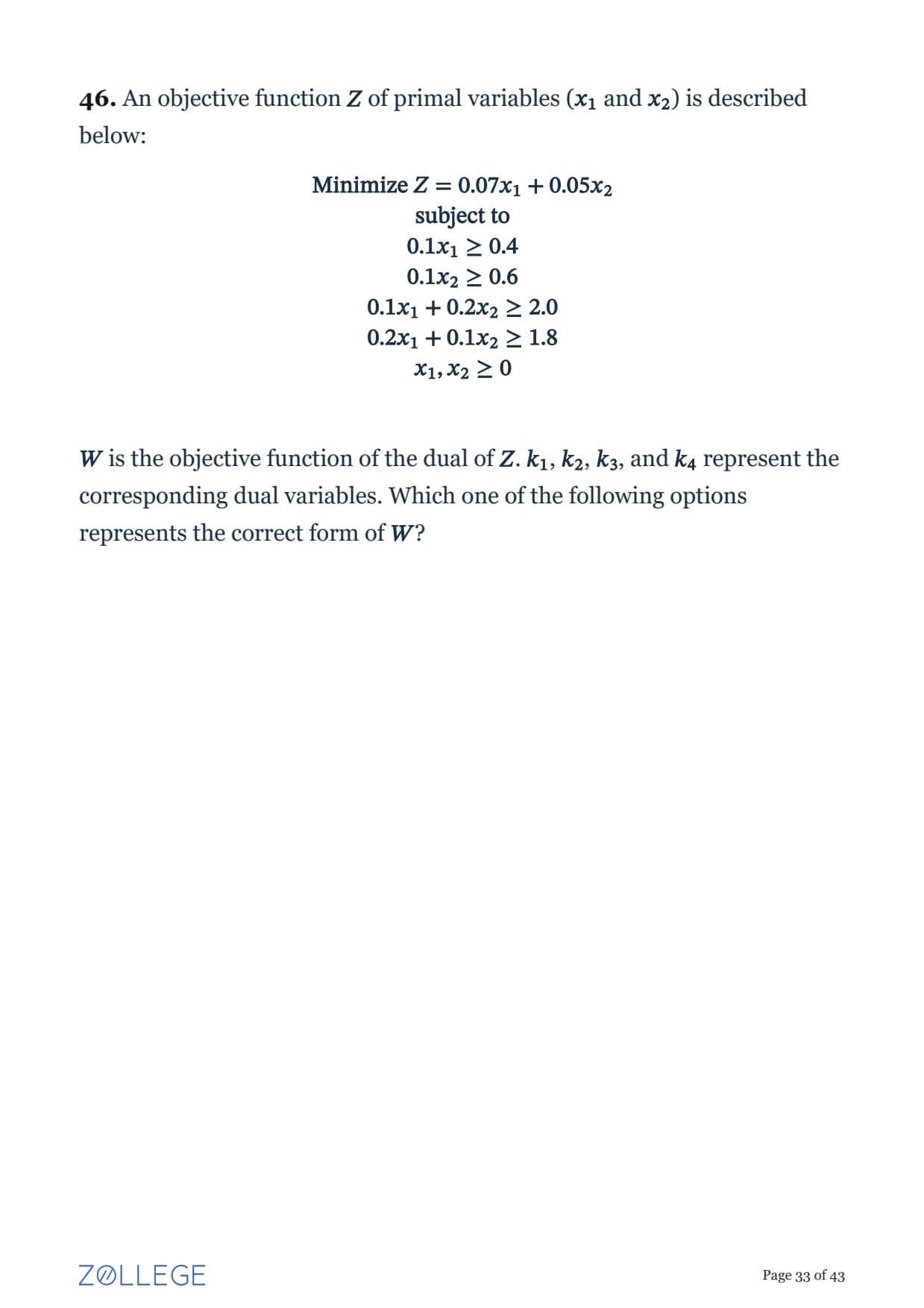
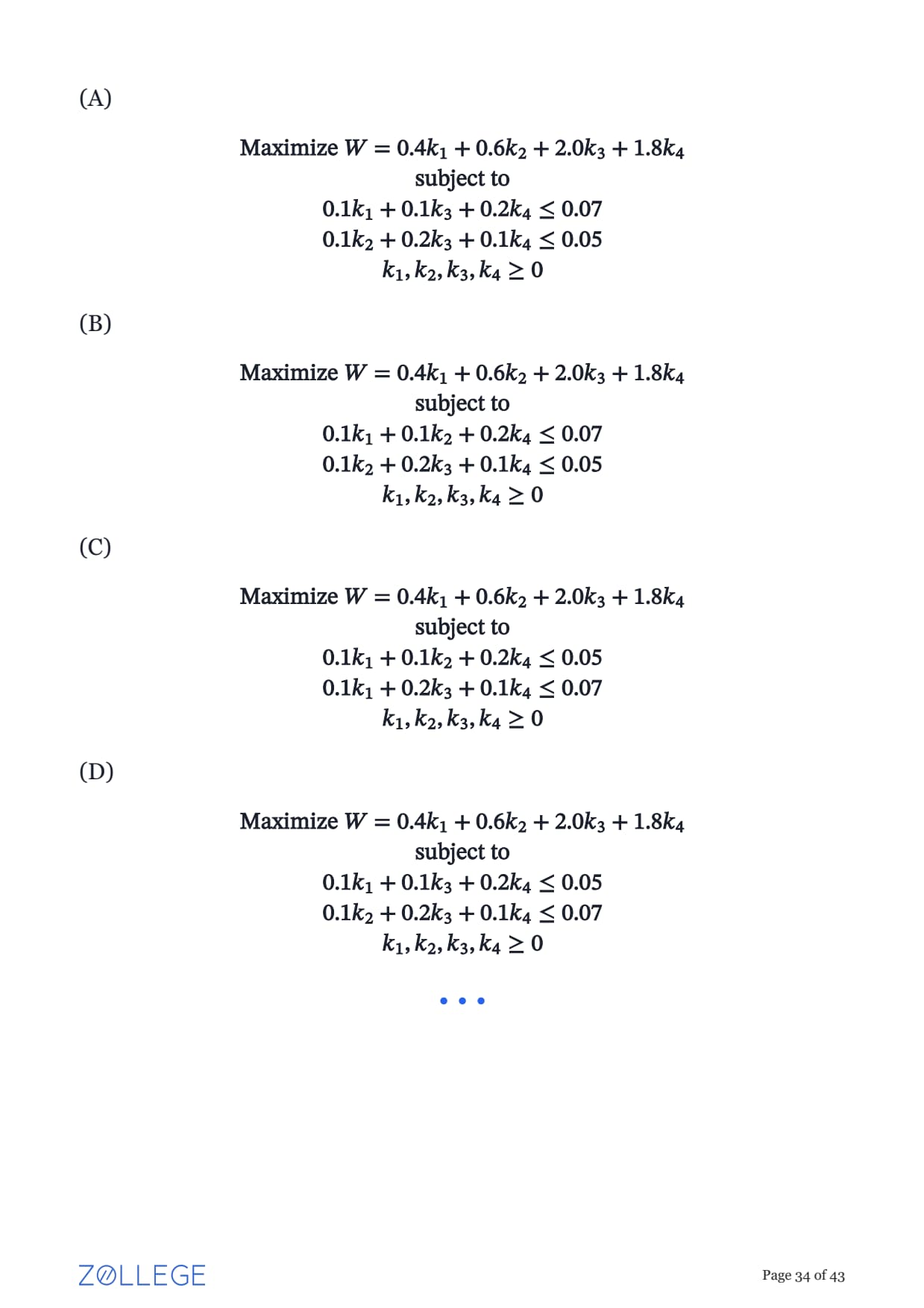
An objective function \(Z\) of primal variables (\(x_1\) and \(x_2\)) is described below:
\[ \begin{gathered} \text{Minimize } Z = 0.07x_1 + 0.05x_2 \\ \text{subject to} \\ 0.1x_1 \ge 0.4 \\ 0.1x_2 \ge 0.6 \\ 0.1x_1 + 0.2x_2 \ge 2.0 \\ 0.2x_1 + 0.1x_2 \ge 1.8 \\ x_1, x_2 \ge 0 \end{gathered} \]
\(W\) is the objective function of the dual of \(Z\). \(k_1\), \(k_2\), \(k_3\), and \(k_4\) represent the corresponding dual variables. Which one of the following options represents the correct form of \(W\)?
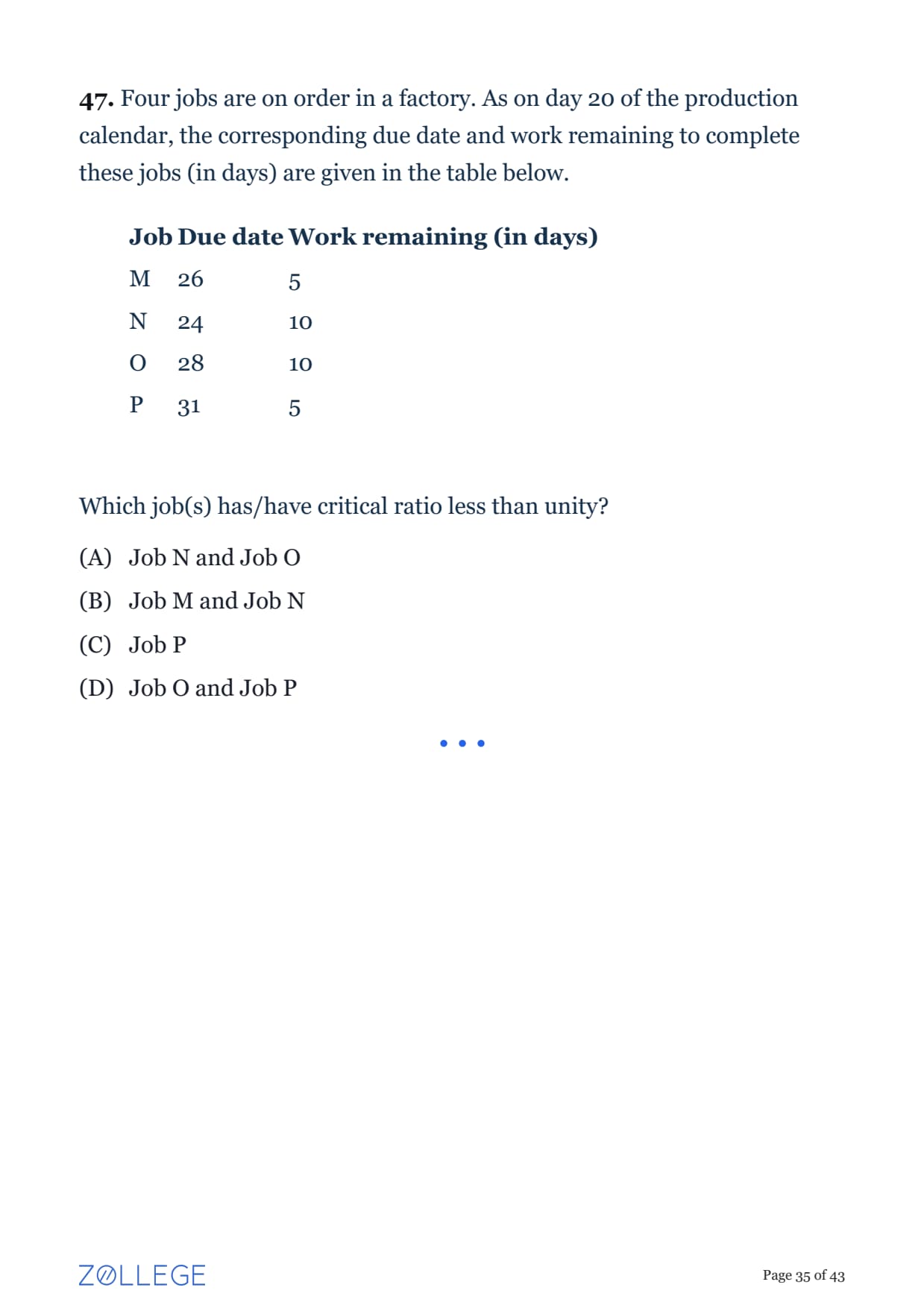
Four jobs are on order in a factory. As on day 20 of the production calendar, the corresponding due date and work remaining to complete these jobs (in days) are given in the table below.
| Job | Due date | Work remaining (in days) |
|---|---|---|
| M | 26 | 5 |
| N | 24 | 10 |
| O | 28 | 10 |
| P | 31 | 5 |
Which job(s) has/have critical ratio less than unity?
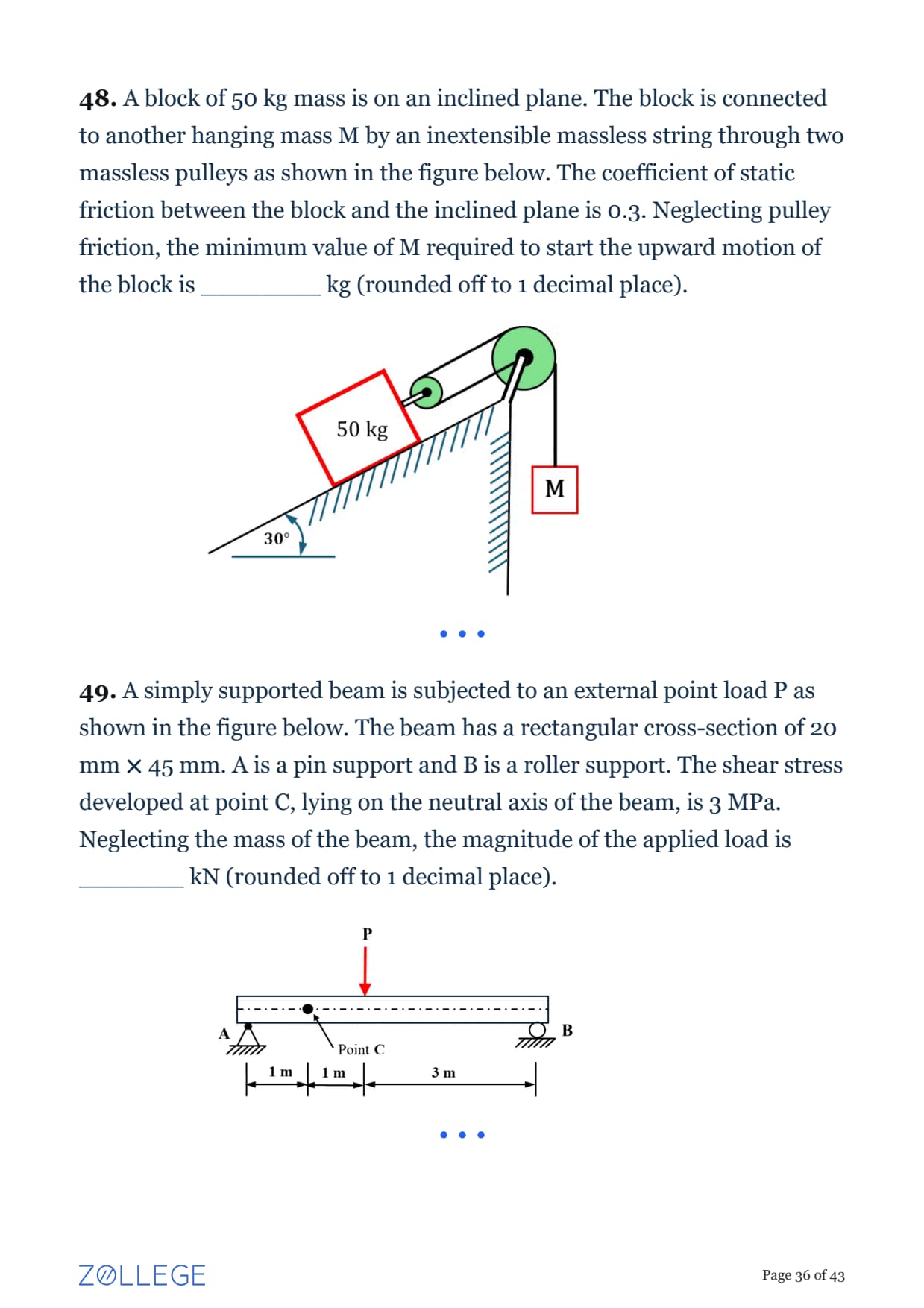
A block of 50 kg mass is on an inclined plane. The block is connected to another hanging mass M by an inextensible massless string through two massless pulleys as shown in the figure below. The coefficient of static friction between the block and the inclined plane is 0.3. Neglecting pulley friction, the minimum value of M required to start the upward motion of the block is ________ kg (rounded off to 1 decimal place).

A simply supported beam is subjected to an external point load P as shown in the figure below. The beam has a rectangular cross-section of 20 mm \(\times\) 45 mm. A is a pin support and B is a roller support. The shear stress developed at point C, lying on the neutral axis of the beam, is 3 MPa. Neglecting the mass of the beam, the magnitude of the applied load is _______ kN (rounded off to 1 decimal place).

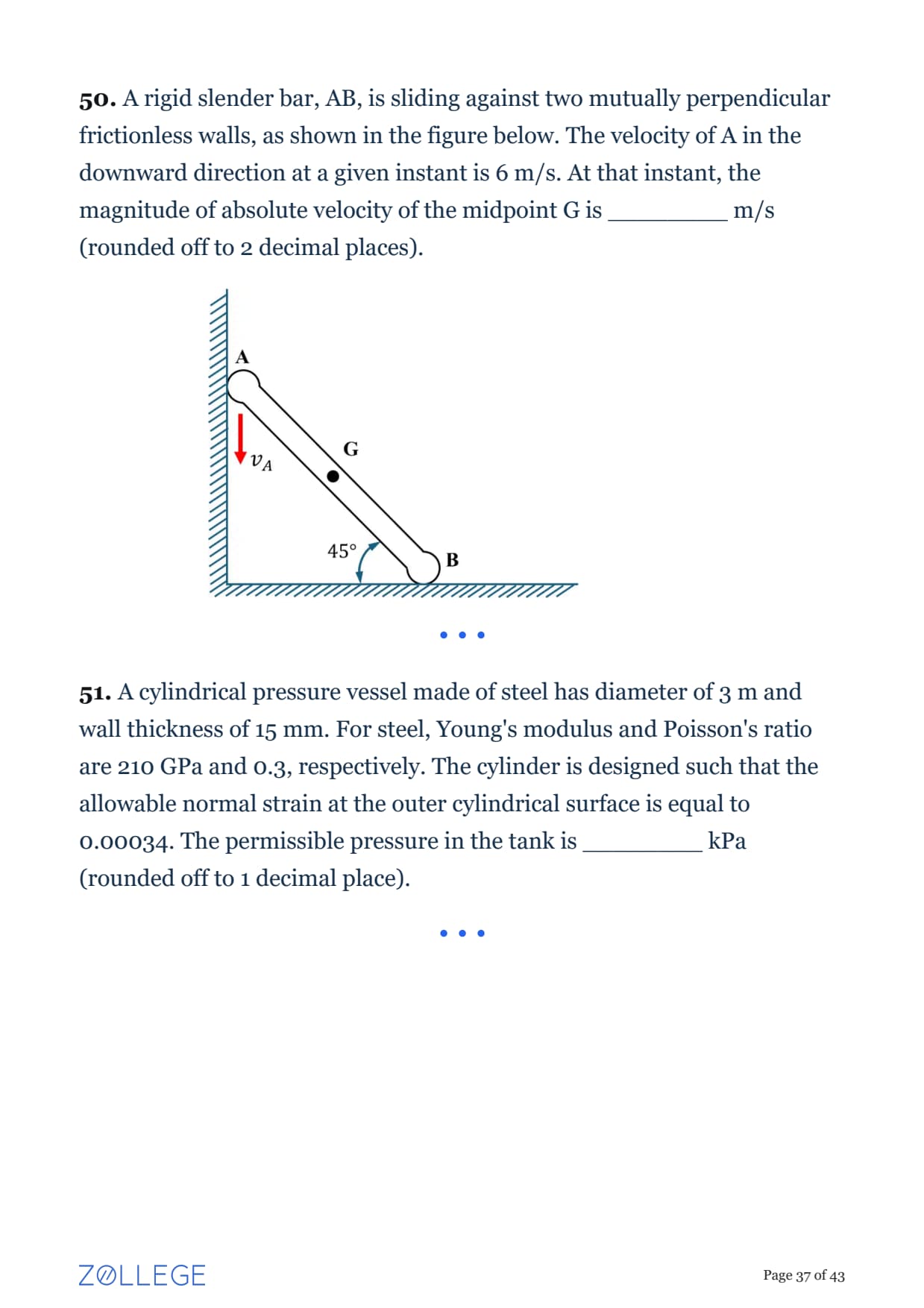
A rigid slender bar, AB, is sliding against two mutually perpendicular frictionless walls, as shown in the figure below. The velocity of A in the downward direction at a given instant is 6 m/s. At that instant, the magnitude of absolute velocity of the midpoint G is ________ m/s (rounded off to 2 decimal places).
A cylindrical pressure vessel made of steel has diameter of 3 m and wall thickness of 15 mm. For steel, Young's modulus and Poisson's ratio are 210 GPa and 0.3, respectively. The cylinder is designed such that the allowable normal strain at the outer cylindrical surface is equal to 0.00034. The permissible pressure in the tank is ________ kPa (rounded off to 1 decimal place).
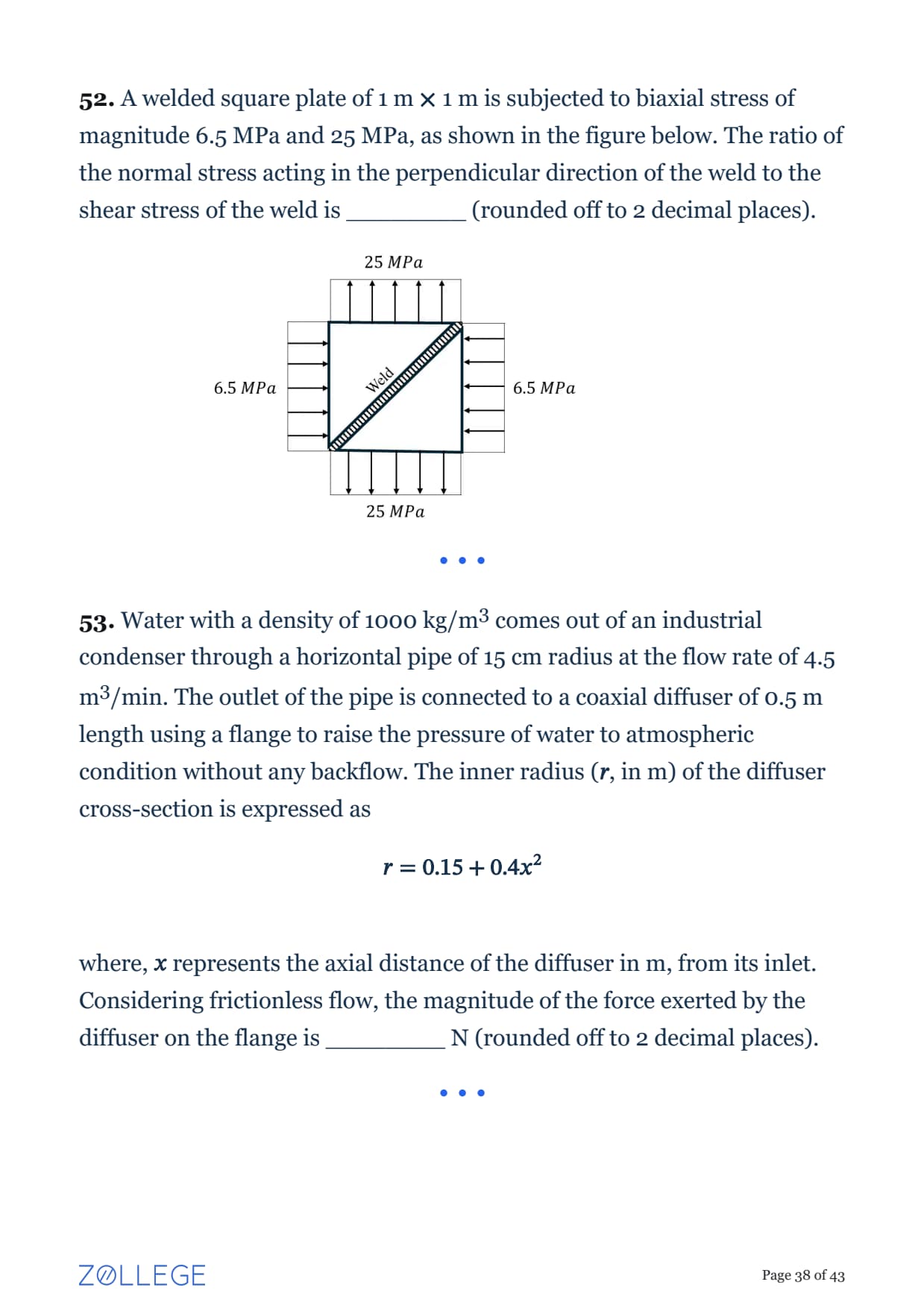
A welded square plate of 1 m \(\times\) 1 m is subjected to biaxial stress of magnitude 6.5 MPa and 25 MPa, as shown in the figure below. The ratio of the normal stress acting in the perpendicular direction of the weld to the shear stress of the weld is ________ (rounded off to 2 decimal places).
Water with a density of 1000 kg/m3 comes out of an industrial condenser through a horizontal pipe of 15 cm radius at the flow rate of 4.5 m3/min. The outlet of the pipe is connected to a coaxial diffuser of 0.5 m length using a flange to raise the pressure of water to atmospheric condition without any backflow. The inner radius (\(r\), in m) of the diffuser cross-section is expressed as
\[ r = 0.15 + 0.4x^2 \]
where, \(x\) represents the axial distance of the diffuser in m, from its inlet. Considering frictionless flow, the magnitude of the force exerted by the diffuser on the flange is ________ N (rounded off to 2 decimal places).
Two rectangular surfaces both having 1 m2 area are placed perpendicular to each other with a common edge. One surface is hot, having a temperature of 1000 K and emissivity of 0.4, while the other is insulated and in radiant balance with a large surrounding room at 300 K. If the fraction of radiation leaving the hot surface which reaches the cold surface is 0.2, then the equivalent overall resistance for the radiation heat loss from the hot surface is _______ m-2 (rounded off to 2 decimal places).
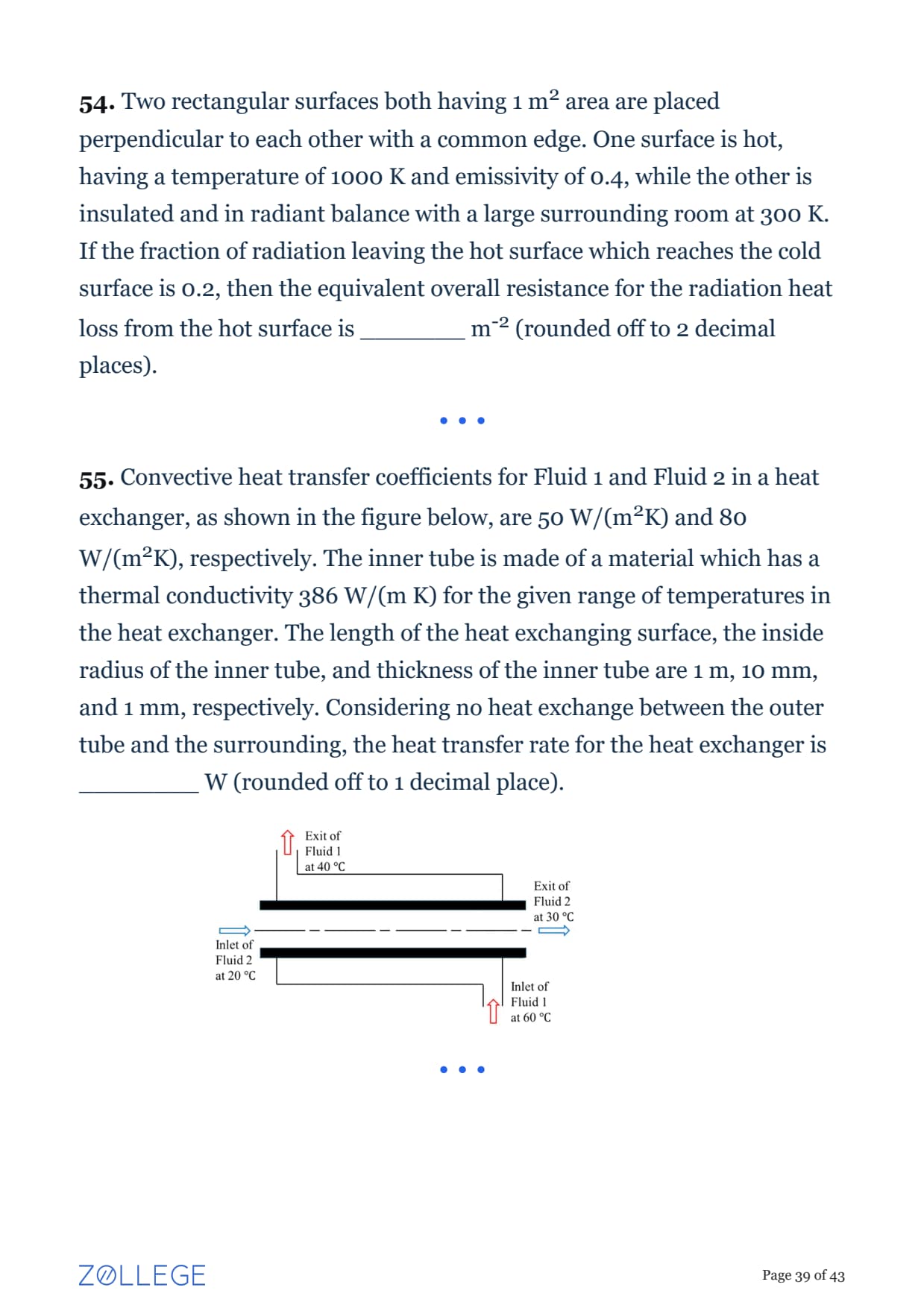
Convective heat transfer coefficients for Fluid 1 and Fluid 2 in a heat exchanger, as shown in the figure below, are 50 W/(m2K) and 80 W/(m2K), respectively. The inner tube is made of a material which has a thermal conductivity 386 W/(m K) for the given range of temperatures in the heat exchanger. The length of the heat exchanging surface, the inside radius of the inner tube, and thickness of the inner tube are 1 m, 10 mm, and 1 mm, respectively. Considering no heat exchange between the outer tube and the surrounding, the heat transfer rate for the heat exchanger is ________ W (rounded off to 1 decimal place).
A liquid comes out of the reactor of a chemical plant at 250 °C temperature with a flow rate of 100 LPM. The ambient temperature is 25 °C. Density and specific heat of the liquid remain constant at 1000 kg/m3 and 4.18 kJ/kg K, respectively, for the given range of temperature. The rate of exergy associated with the hot liquid stream at the exit of the plant is ________ kW (rounded off to 2 decimal places).
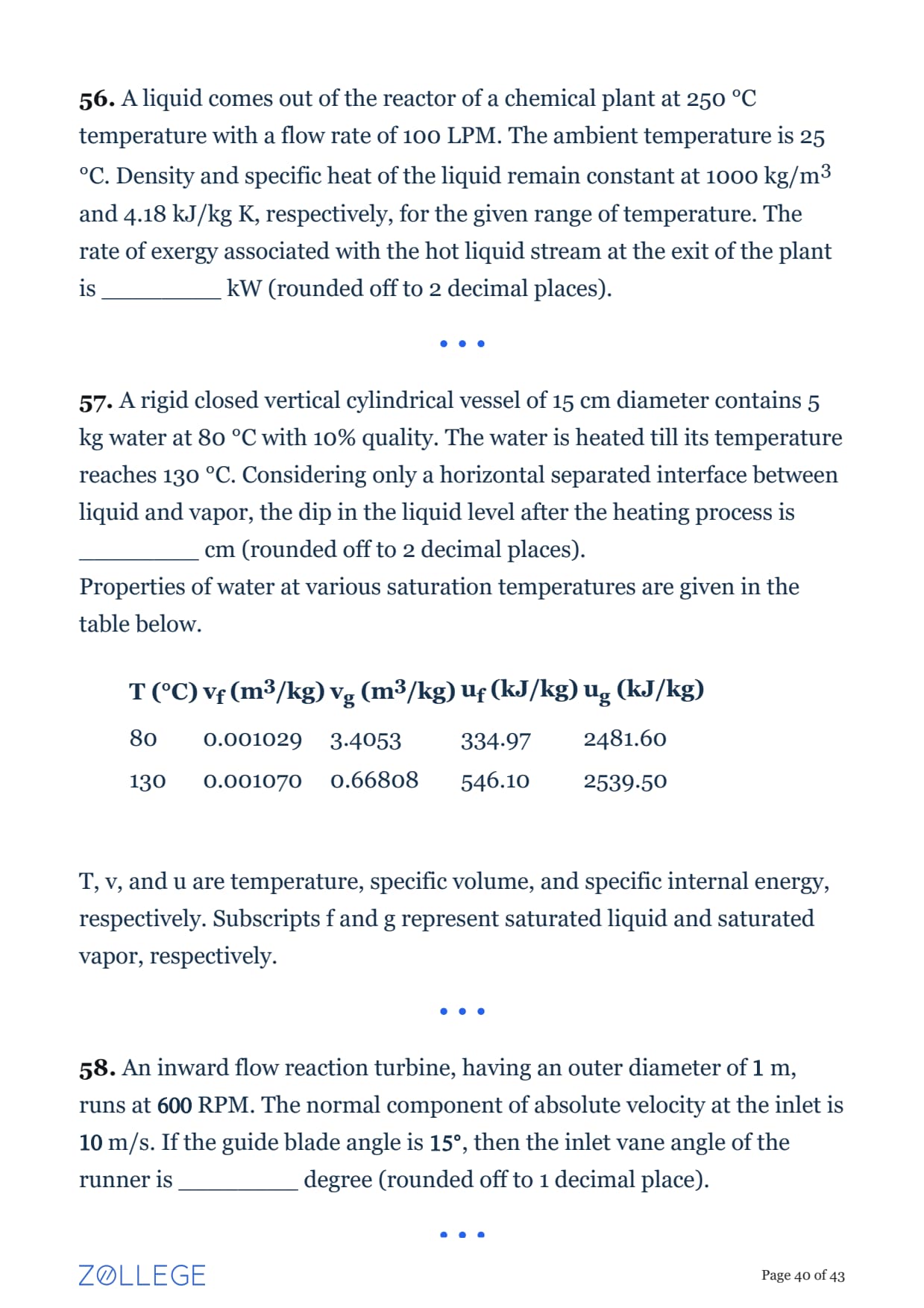
A rigid closed vertical cylindrical vessel of 15 cm diameter contains 5 kg water at 80 °C with 10% quality. The water is heated till its temperature reaches 130 °C. Considering only a horizontal separated interface between liquid and vapor, the dip in the liquid level after the heating process is ________ cm (rounded off to 2 decimal places).
Properties of water at various saturation temperatures are given in the table below.
| T (°C) | vf (m3/kg) | vg (m3/kg) | uf (kJ/kg) | ug (kJ/kg) |
|---|---|---|---|---|
| 80 | 0.001029 | 3.4053 | 334.97 | 2481.60 |
| 130 | 0.001070 | 0.66808 | 546.10 | 2539.50 |
T, v, and u are temperature, specific volume, and specific internal energy, respectively. Subscripts f and g represent saturated liquid and saturated vapor, respectively.
An inward flow reaction turbine, having an outer diameter of \(1\) m, runs at \(600\) RPM. The normal component of absolute velocity at the inlet is \(10\) m/s. If the guide blade angle is \(15^{\circ}\), then the inlet vane angle of the runner is ________ degree (rounded off to 1 decimal place).
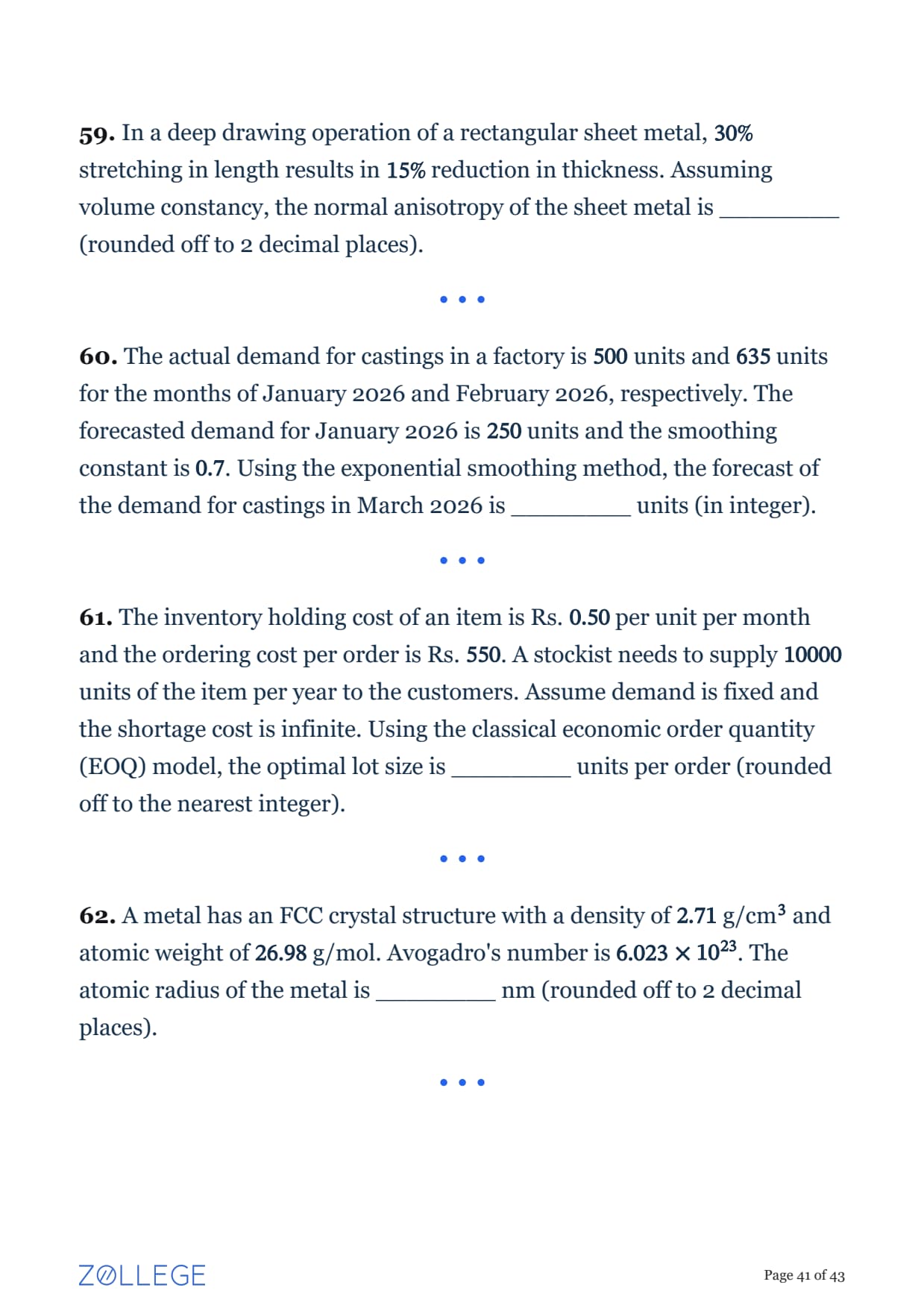
In a deep drawing operation of a rectangular sheet metal, \(30\%\) stretching in length results in \(15\%\) reduction in thickness. Assuming volume constancy, the normal anisotropy of the sheet metal is ________ (rounded off to 2 decimal places).
The actual demand for castings in a factory is \(500\) units and \(635\) units for the months of January 2026 and February 2026, respectively. The forecasted demand for January 2026 is \(250\) units and the smoothing constant is \(0.7\). Using the exponential smoothing method, the forecast of the demand for castings in March 2026 is ________ units (in integer).
The inventory holding cost of an item is Rs. \(0.50\) per unit per month and the ordering cost per order is Rs. \(550\). A stockist needs to supply \(10000\) units of the item per year to the customers. Assume demand is fixed and the shortage cost is infinite. Using the classical economic order quantity (EOQ) model, the optimal lot size is ________ units per order (rounded off to the nearest integer).
A metal has an FCC crystal structure with a density of \(2.71\) g/cm\(^3\) and atomic weight of \(26.98\) g/mol. Avogadro's number is \(6.023 \times 10^{23}\). The atomic radius of the metal is ________ nm (rounded off to 2 decimal places).
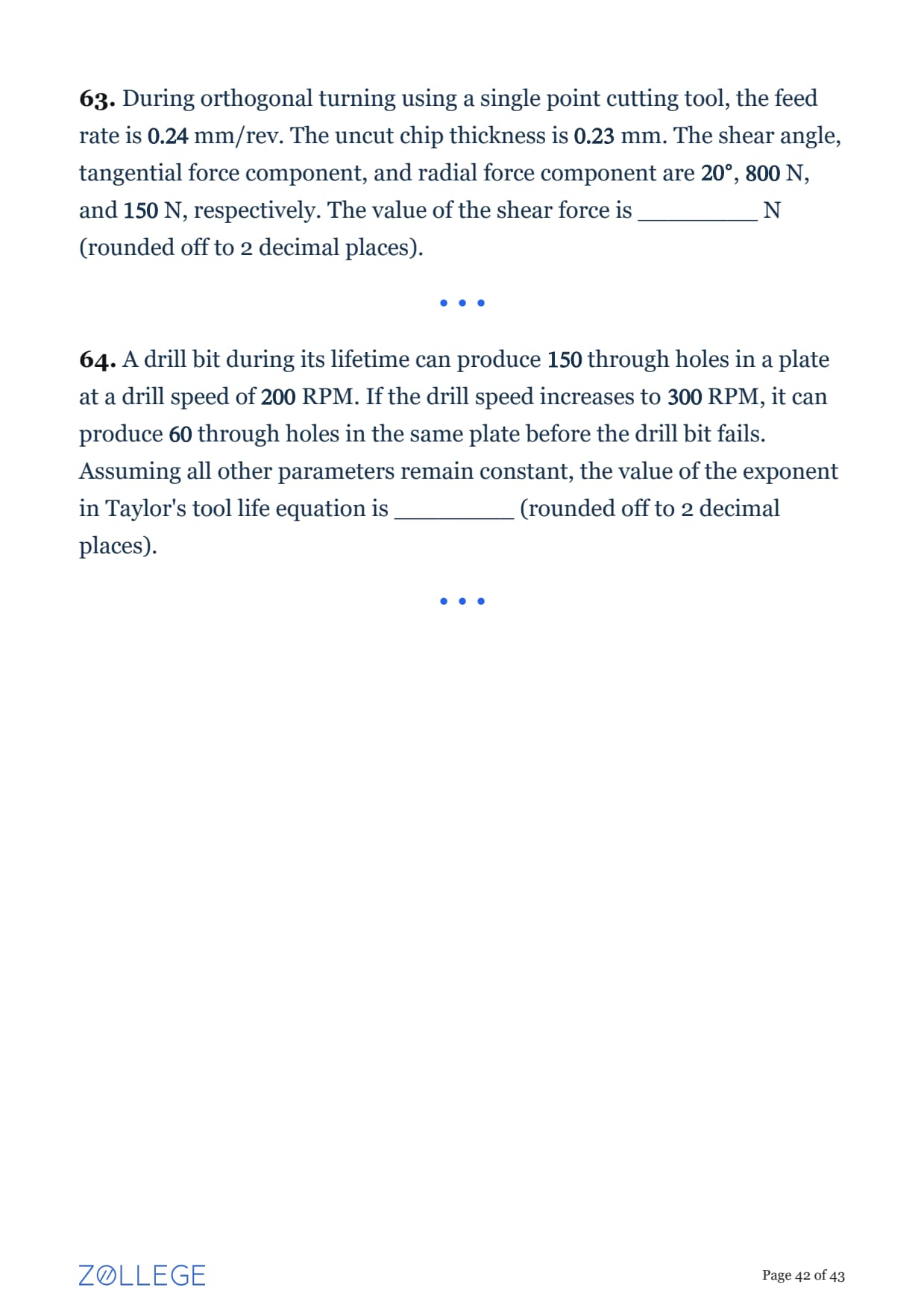
During orthogonal turning using a single point cutting tool, the feed rate is \(0.24\) mm/rev. The uncut chip thickness is \(0.23\) mm. The shear angle, tangential force component, and radial force component are \(20^{\circ}\), \(800\) N, and \(150\) N, respectively. The value of the shear force is ________ N (rounded off to 2 decimal places).
A drill bit during its lifetime can produce \(150\) through holes in a plate at a drill speed of \(200\) RPM. If the drill speed increases to \(300\) RPM, it can produce \(60\) through holes in the same plate before the drill bit fails. Assuming all other parameters remain constant, the value of the exponent in Taylor's tool life equation is ________ (rounded off to 2 decimal places).
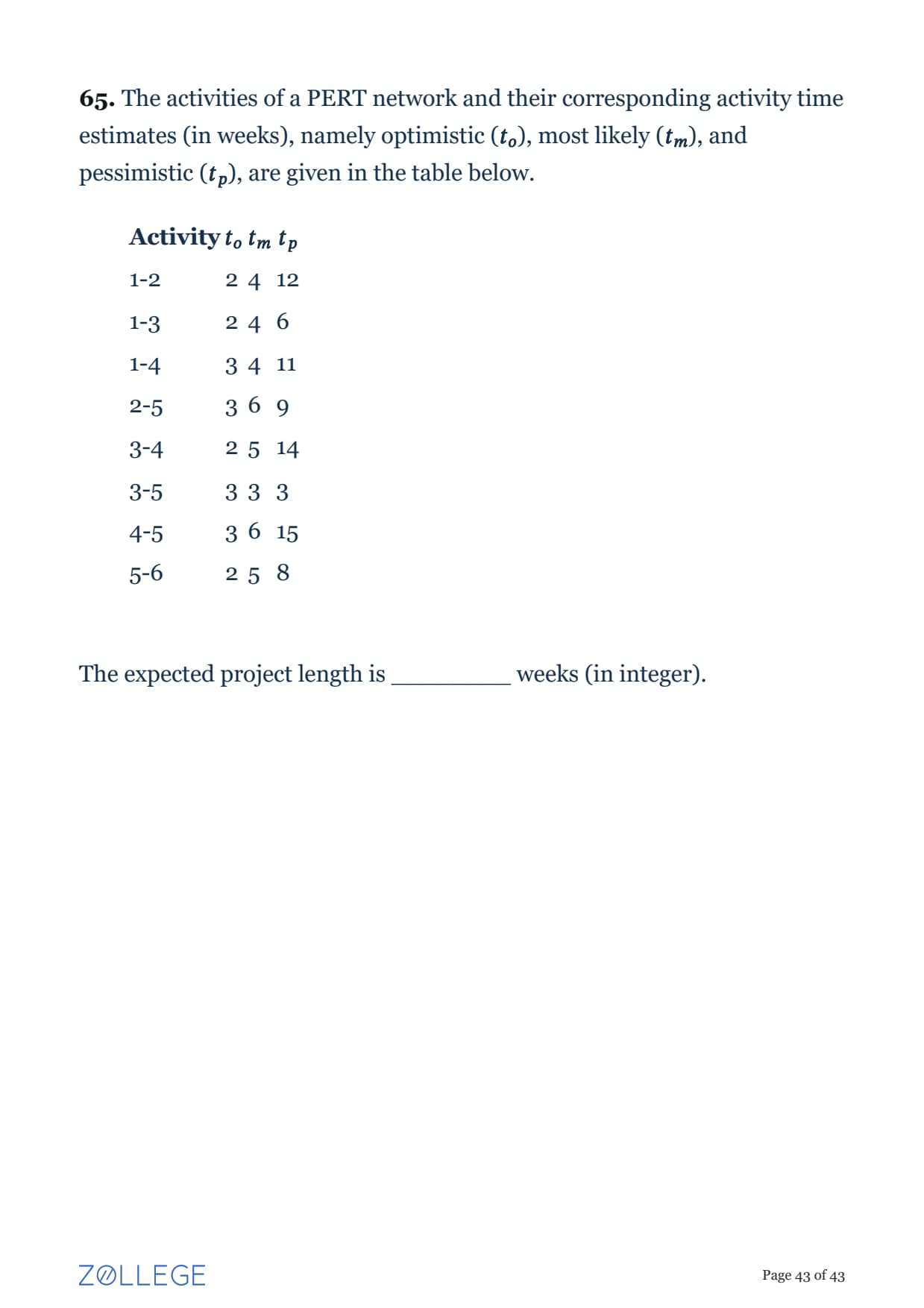
The activities of a PERT network and their corresponding activity time estimates (in weeks), namely optimistic (\(t_o\)), most likely (\(t_m\)), and pessimistic (\(t_p\)), are given in the table below.
| Activity | \(t_o\) | \(t_m\) | \(t_p\) |
|---|---|---|---|
| 1-2 | 2 | 4 | 12 |
| 1-3 | 2 | 4 | 6 |
| 1-4 | 3 | 4 | 11 |
| 2-5 | 3 | 6 | 9 |
| 3-4 | 2 | 5 | 14 |
| 3-5 | 3 | 3 | 3 |
| 4-5 | 3 | 6 | 15 |
| 5-6 | 2 | 5 | 8 |
The expected project length is ________ weeks (in integer).
GATE 2026 Mechanical Engineering (ME) Exam Pattern and Marking Scheme Explained
As per the official GATE 2026 information brochure on the IIT Guwahati website (gate2026.iitg.ac.in), the ME paper mixes General Aptitude, Engineering Mathematics and core Mechanical Engineering subjects, and is a 3-hour computer-based test.
- Total questions: 65 questions across three sections - General Aptitude, Engineering Mathematics and core Mechanical Engineering
- Total marks: 100 - General Aptitude carries 15 marks, Engineering Mathematics 13 marks, and core ME subjects 72 marks
- Duration: 3 hours (180 minutes), single session
- Question types: MCQ (single correct answer) and NAT (numerical answer type)
- Marking scheme: 1-mark and 2-mark questions. MCQs carry negative marking (-1/3 on 1-mark, -2/3 on 2-mark); NAT questions have no negative marking
High-Weightage Subjects in GATE 2026 Mechanical Engineering (ME) to Focus On First
The 65 questions this year were spread across the full ME syllabus, but a few areas clearly dominated the paper. These are where your practice pays back the most.
- Applied Mechanics and Design: the joint-largest core area with 16 questions - Theory of Machines, Strength of Materials, Machine Design, Vibrations and Engineering Mechanics
- Fluid Mechanics and Thermal Sciences: also 16 questions, led by Thermodynamics (5 questions) plus Fluid Mechanics and Heat Transfer (4 questions each)
- Materials, Manufacturing and Industrial Engineering: 14 questions covering Machining, Casting, Metrology, Metal Forming, Production Planning and Control, and Engineering Materials
- General Aptitude: 10 questions - Verbal, Quantitative, Analytical and Spatial Aptitude, plus Logical Reasoning and Pattern Recognition
- Engineering Mathematics: 9 questions on Linear Algebra, Calculus, Vector Calculus, Differential Equations, Complex Variables, Probability and Numerical Methods
GATE 2026 Mechanical Engineering (ME) Question Paper Solution Video
Source: RAKESH VALASA
How to Use the GATE 2026 Mechanical Engineering (ME) Question Paper for Practice
Treat this paper as a full mock before you read a single solution. The ME paper rewards steady accuracy across a wide spread of core subjects rather than depth in just one or two areas.
- Solve all 65 questions in one 3-hour sitting first, then score yourself against the official answer key
- Review every wrong answer with the solution PDF above, focusing on the 2-mark NAT questions in Thermodynamics, Fluid Mechanics and Strength of Materials where a small setup mistake costs the full 2 marks
- Redo the Applied Mechanics and Design set and the Fluid Mechanics and Thermal Sciences set - together they made up 32 of the 65 questions
- Attempt the NAT questions on paper without the on-screen calculator crutch, since ME NAT answers usually need a clean unit-by-unit setup, not heavy arithmetic
GATE 2026 Mechanical Engineering (ME) Question Paper FAQs
Ques. Was the GATE 2026 Mechanical Engineering (ME) paper tough?
Ans. Student feedback described the GATE 2026 ME paper as shifting toward deeper conceptual understanding, with an overall difficulty level of moderate to tough, and a spread of questions across all four core subject areas rather than a concentration in one or two.
Ques. Which subjects had the highest weightage in GATE 2026 Mechanical Engineering?
Ans. Applied Mechanics and Design and Fluid Mechanics and Thermal Sciences tied for the highest weightage with 16 questions each, followed by Materials, Manufacturing and Industrial Engineering with 14 questions. General Aptitude (10) and Engineering Mathematics (9) made up the rest of the 65-question paper.
Ques. How many questions and marks are there in the GATE ME paper?
Ans. GATE ME has 65 questions for 100 marks. 10 questions (15 marks) are General Aptitude, 9 questions (13 marks) are Engineering Mathematics, and the remaining 46 questions (72 marks) cover core Mechanical Engineering subjects, split across 1-mark and 2-mark questions of MCQ and NAT type.
Ques. Is there negative marking in GATE 2026 Mechanical Engineering?
Ans. Yes, but only on MCQs. A wrong 1-mark MCQ loses 1/3 mark and a wrong 2-mark MCQ loses 2/3 mark. NAT questions carry no negative marking, so never leave an NAT question blank if you have a reasonable value to enter.
Ques. Where can I download the GATE 2026 Mechanical Engineering question paper with solutions PDF for free?
Ans. You can download the full GATE 2026 ME question paper with step-by-step solutions from the table at the top of this page on Collegedunia. The official master question paper and answer key are also available on the IIT Guwahati website, gate2026.iitg.ac.in.
Ques. How many marks are needed to qualify GATE 2026 Mechanical Engineering?
Ans. The ME qualifying mark usually sits in the mid-20s out of 100 for the general category, but a competitive score for admissions and scholarships is much higher. Aim for 55 to 60+ marks to target a rank under 1000.
*The article might have information for the previous academic years, please refer the official website of the exam.