
GATE 2026 Petroleum Engineering Question Paper with Solutions
- Chemistry Syllabus
- Maths Syllabus
- Physics Syllabus
- Exam Pattern
- Paper Analysis
- Chemical Engg Syllabus
- Civil Engg Syllabus
- ECE Syllabus
- Mechanical Engg Syllabus
- Engg Science Syllabus
- Mining Engg Syllabus
- IN Syllabus
- CSE Syllabus
- EE Syllabus
- AE Syllabus
- BM Syllabus
- GG Syllabus
- EY Syllabus
- ST Syllabus
- TF Syllaus
- AR Syllabus
- XL Syllabus
- MT Syllabus
- PI Syllabus
- PE Syllabus
- ME Pattern
- TF Pattern
- CE Pattern
- EE Pattern
- EC Pattern
- CS Pattern
- BT Pattern
- BM Pattern
- IN Pattern
- DA Syllabus
- NA & ME Syallabus
- ES & Engg Syllabus
- Geomatics Engg Syllabus
- Agri Engg Syllabus
- Humanities and Social Sci
- PI Syllabus


| Updated On - Jul 28, 2026
The GATE 2026 Petroleum Engineering (PE) question paper is now available with detailed solutions for free download. GATE 2026 PE was conducted by IIT Guwahati on February 8, 2026, in the afternoon session, and the paper carried 65 questions for 100 marks in 3 hours.
| GATE 2026 Petroleum Engineering Question Paper with Solutions | Download PDF | Check Solutions |
GATE 2026 Petroleum Engineering Questions with Solutions
Expedite, Hasten, Hurry, __________
Fill the blank by choosing a word with a meaning similar to that of the words given above.
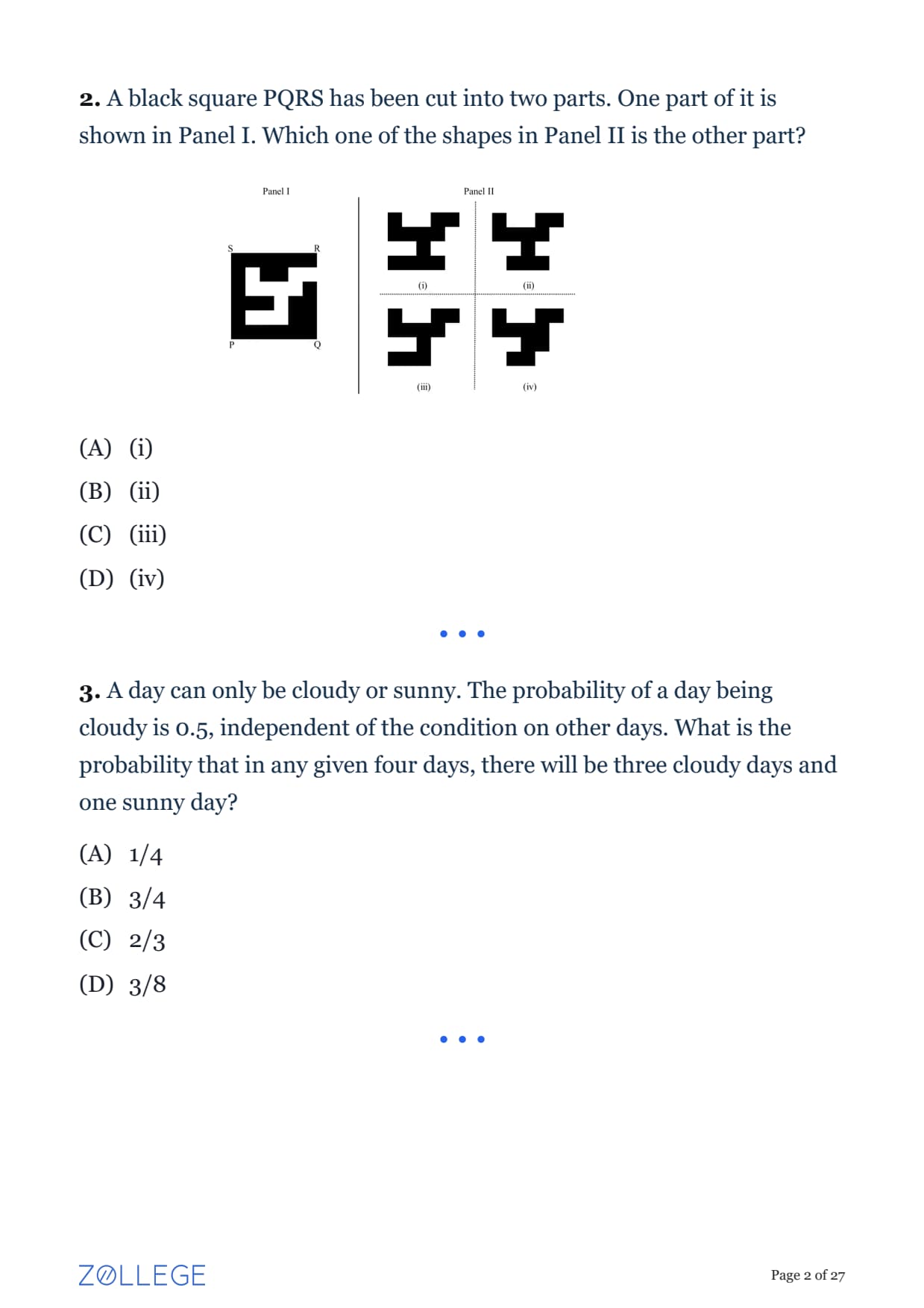
A black square PQRS has been cut into two parts. One part of it is shown in Panel I. Which one of the shapes in Panel II is the other part?
A day can only be cloudy or sunny. The probability of a day being cloudy is 0.5, independent of the condition on other days. What is the probability that in any given four days, there will be three cloudy days and one sunny day?
The values of Stock A and Stock B on a particular day are Rs. 50 and Rs. 80, respectively. An investor invests Rs. 100 in Stock A and Rs. 80 in Stock B. He sells all the stocks the next day when the value of Stock A is Rs. 55 and Stock B is Rs. 70. The profit made by the investor is Rs. __________
'When it is raining, peacocks dance.'
Based only on this sentence, which one of the following options is necessarily true?
Water : P :: Food : Q
Choose the P and Q combination from the options below to form a meaningful analogy.
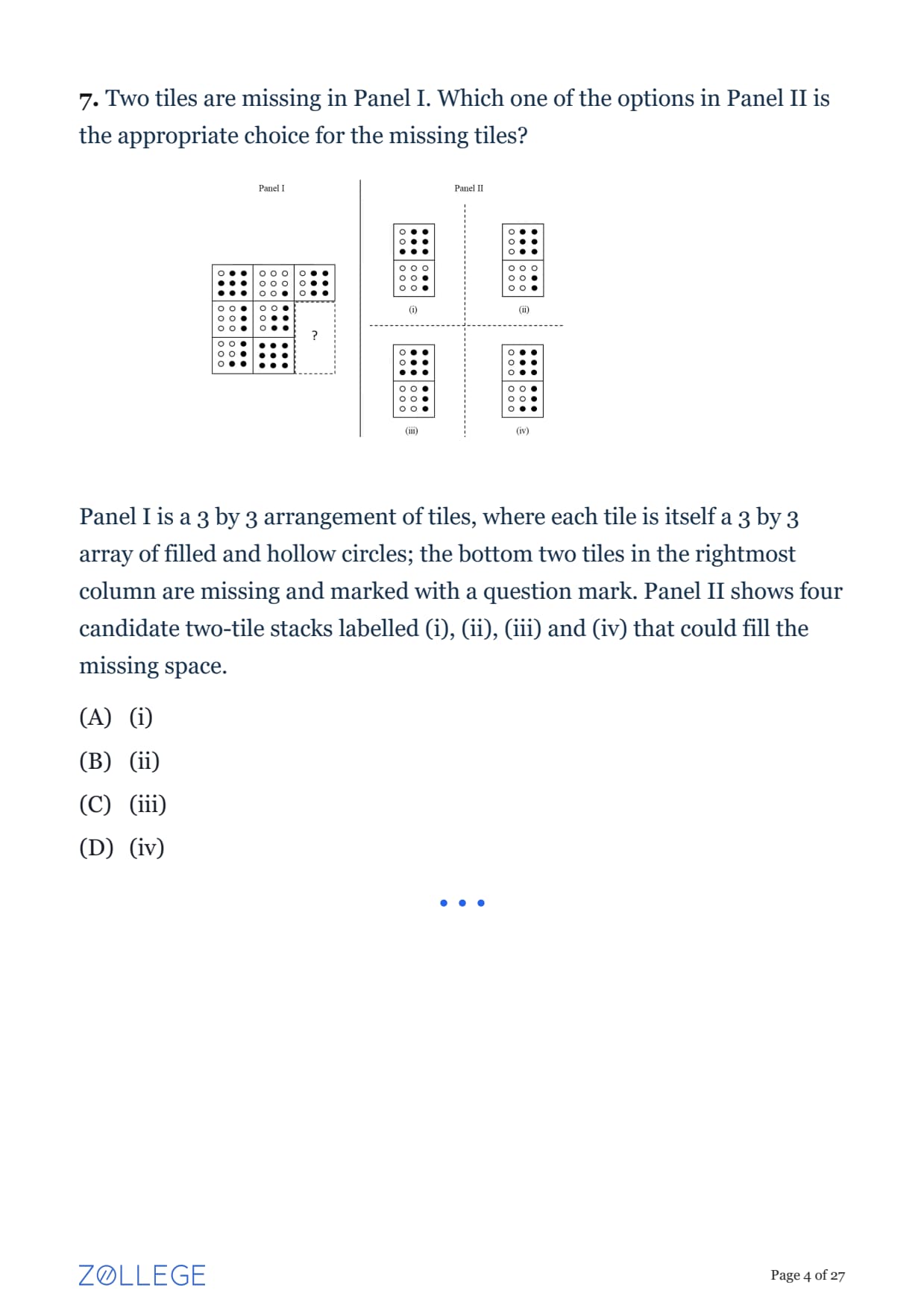
Two tiles are missing in Panel I. Which one of the options in Panel II is the appropriate choice for the missing tiles?
Panel I is a 3 by 3 arrangement of tiles, where each tile is itself a 3 by 3 array of filled and hollow circles; the bottom two tiles in the rightmost column are missing and marked with a question mark. Panel II shows four candidate two-tile stacks labelled (i), (ii), (iii) and (iv) that could fill the missing space.
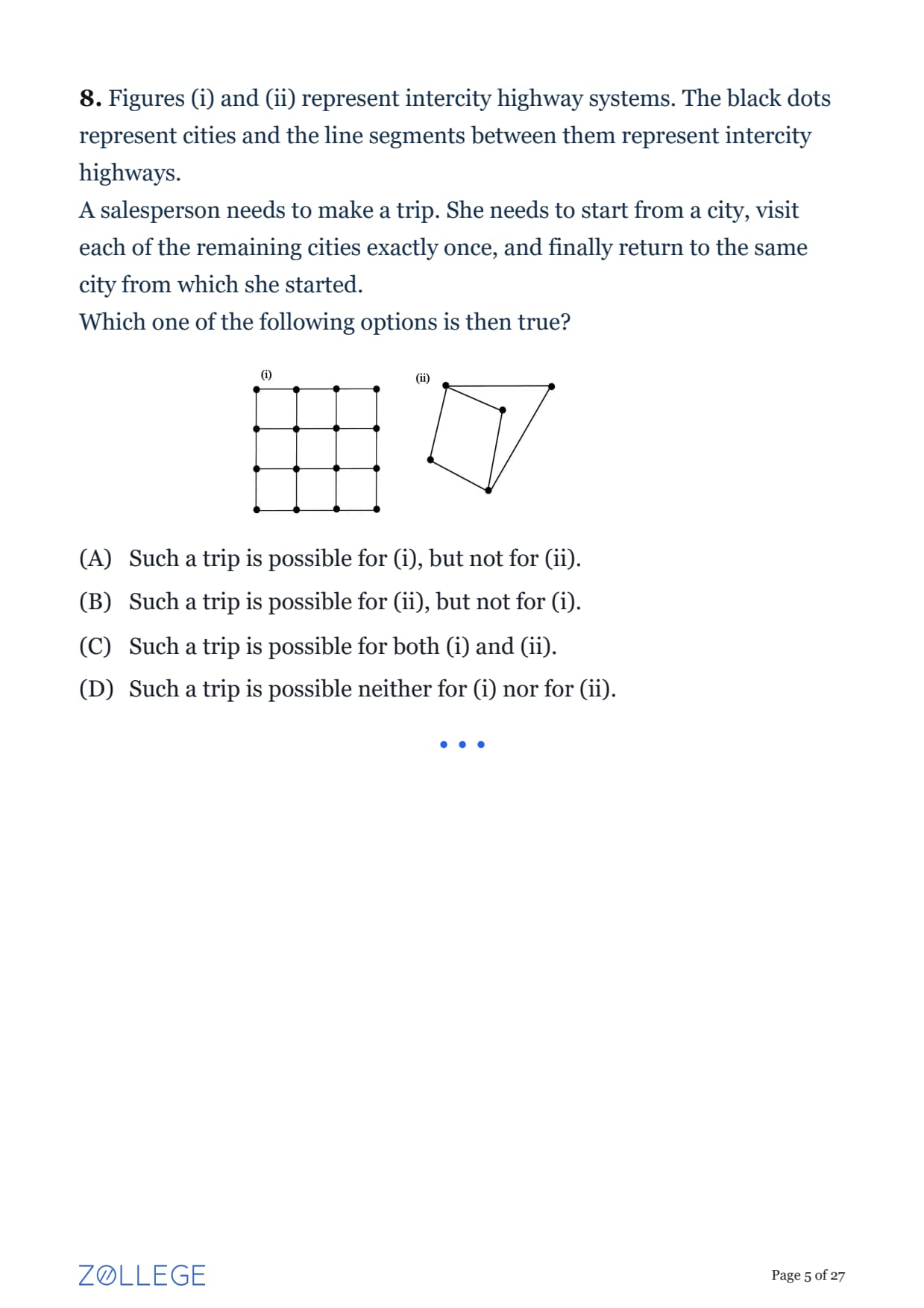
Figures (i) and (ii) represent intercity highway systems. The black dots represent cities and the line segments between them represent intercity highways.
A salesperson needs to make a trip. She needs to start from a city, visit each of the remaining cities exactly once, and finally return to the same city from which she started.
Which one of the following options is then true?
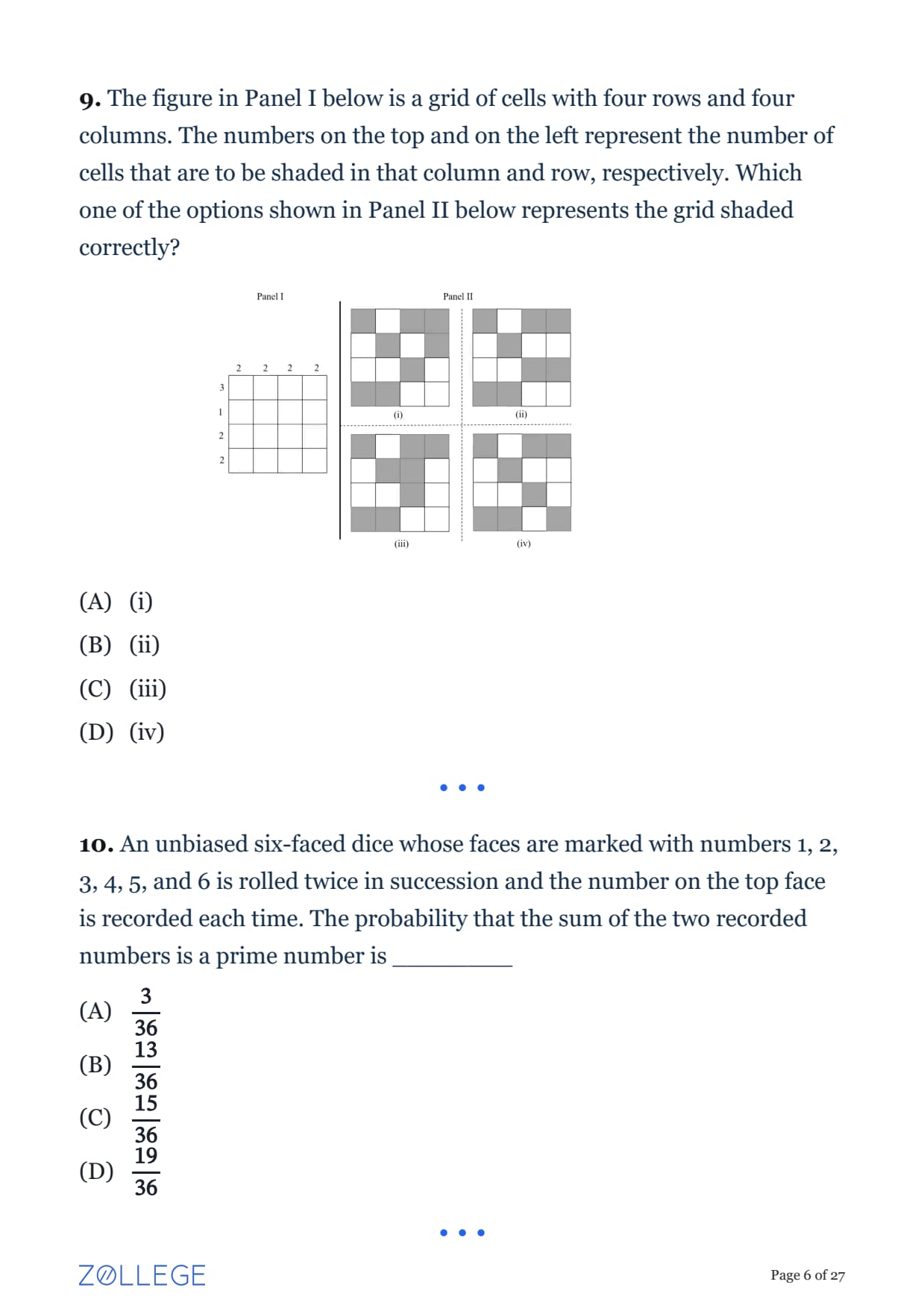
The figure in Panel I below is a grid of cells with four rows and four columns. The numbers on the top and on the left represent the number of cells that are to be shaded in that column and row, respectively. Which one of the options shown in Panel II below represents the grid shaded correctly?
An unbiased six-faced dice whose faces are marked with numbers 1, 2, 3, 4, 5, and 6 is rolled twice in succession and the number on the top face is recorded each time. The probability that the sum of the two recorded numbers is a prime number is ________
Two identical cubic dice are rolled simultaneously. Which of the following is the probability that at least one of the face values of the two dice is greater than 3?
Which of the following options is CORRECT for the eigenvalues \(\lambda\) of the given matrix?
\[ \begin{bmatrix} 8 & 0 & 0 \\ 0 & 5 & 0 \\ 0 & 0 & 7 \end{bmatrix} \]
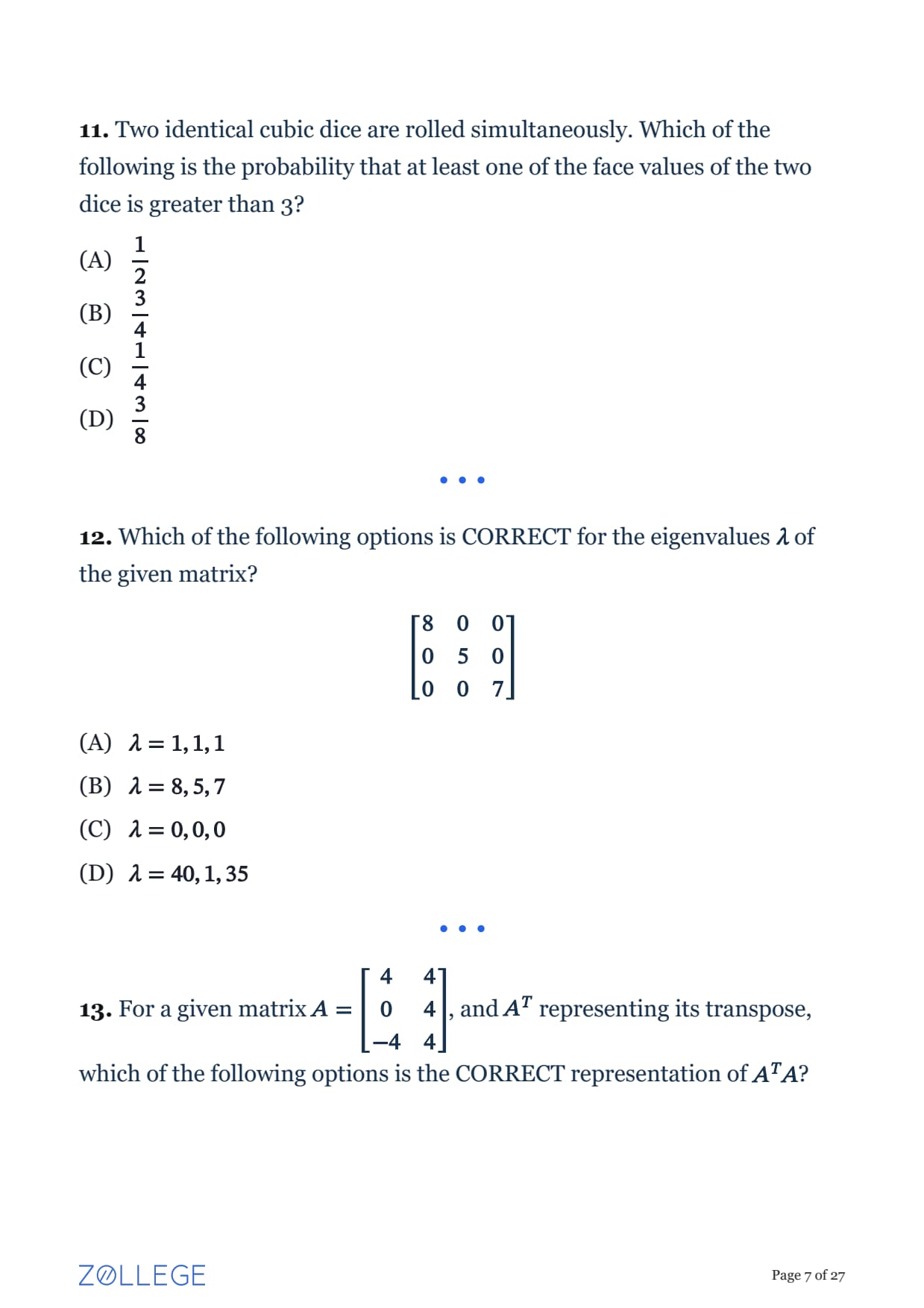
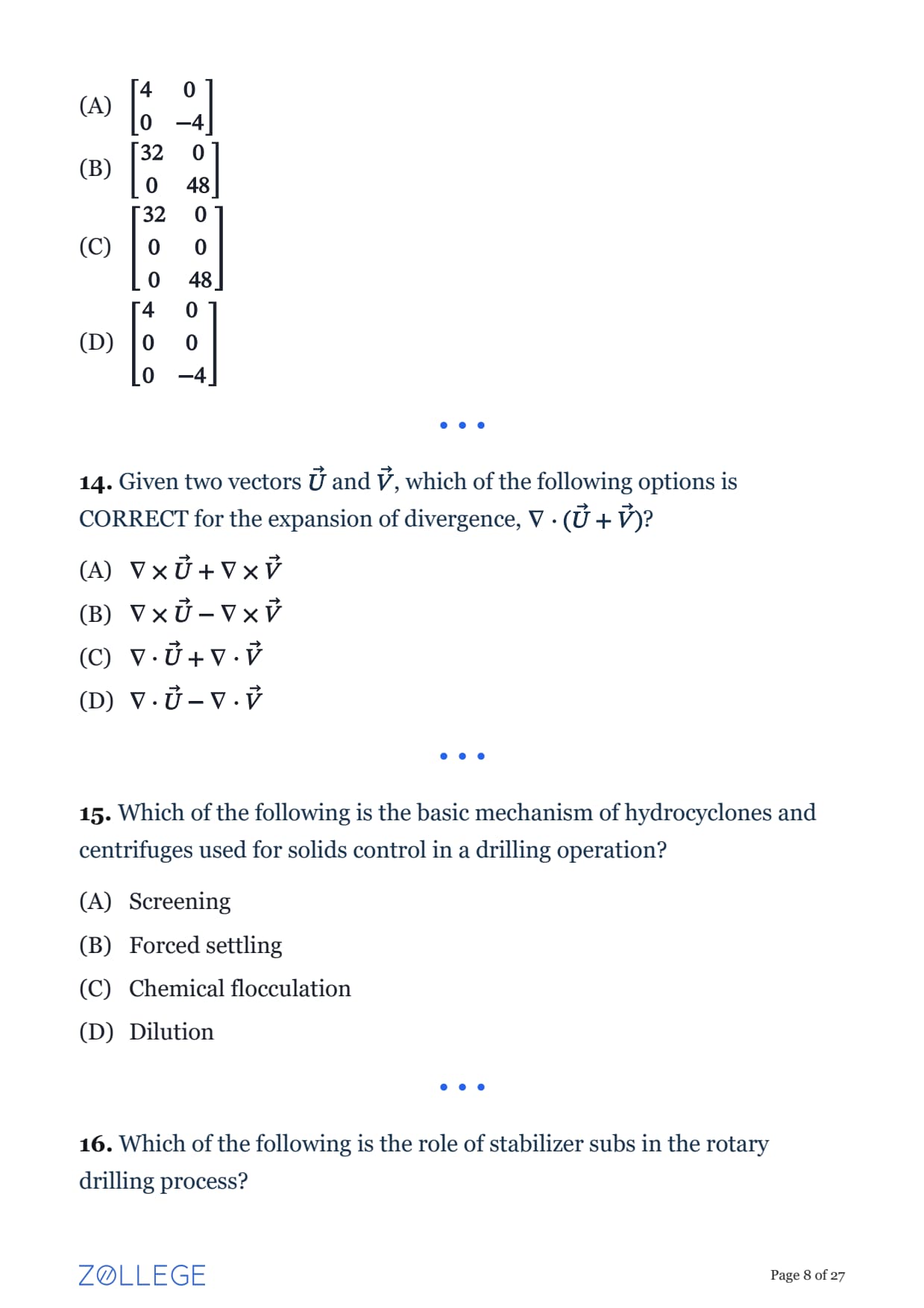
For a given matrix \(A = \begin{bmatrix} 4 & 4 \\ 0 & 4 \\ -4 & 4 \end{bmatrix}\), and \(A^T\) representing its transpose, which of the following options is the CORRECT representation of \(A^T A\)?
Given two vectors \(\vec{U}\) and \(\vec{V}\), which of the following options is CORRECT for the expansion of divergence, \(\nabla \cdot (\vec{U} + \vec{V})\)?
Which of the following is the basic mechanism of hydrocyclones and centrifuges used for solids control in a drilling operation?
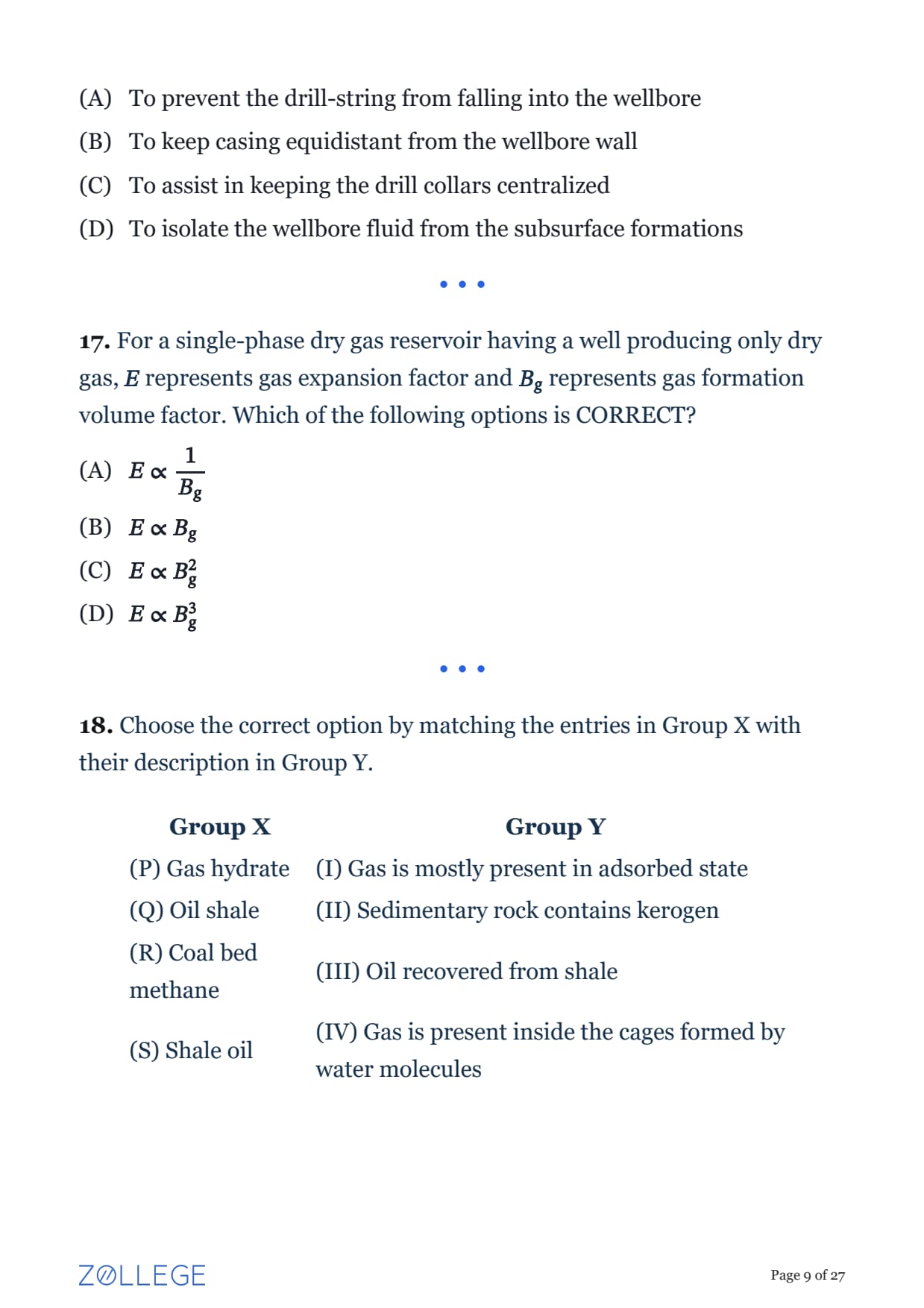
Which of the following is the role of stabilizer subs in the rotary drilling process?
For a single-phase dry gas reservoir having a well producing only dry gas, \(E\) represents gas expansion factor and \(B_g\) represents gas formation volume factor. Which of the following options is CORRECT?
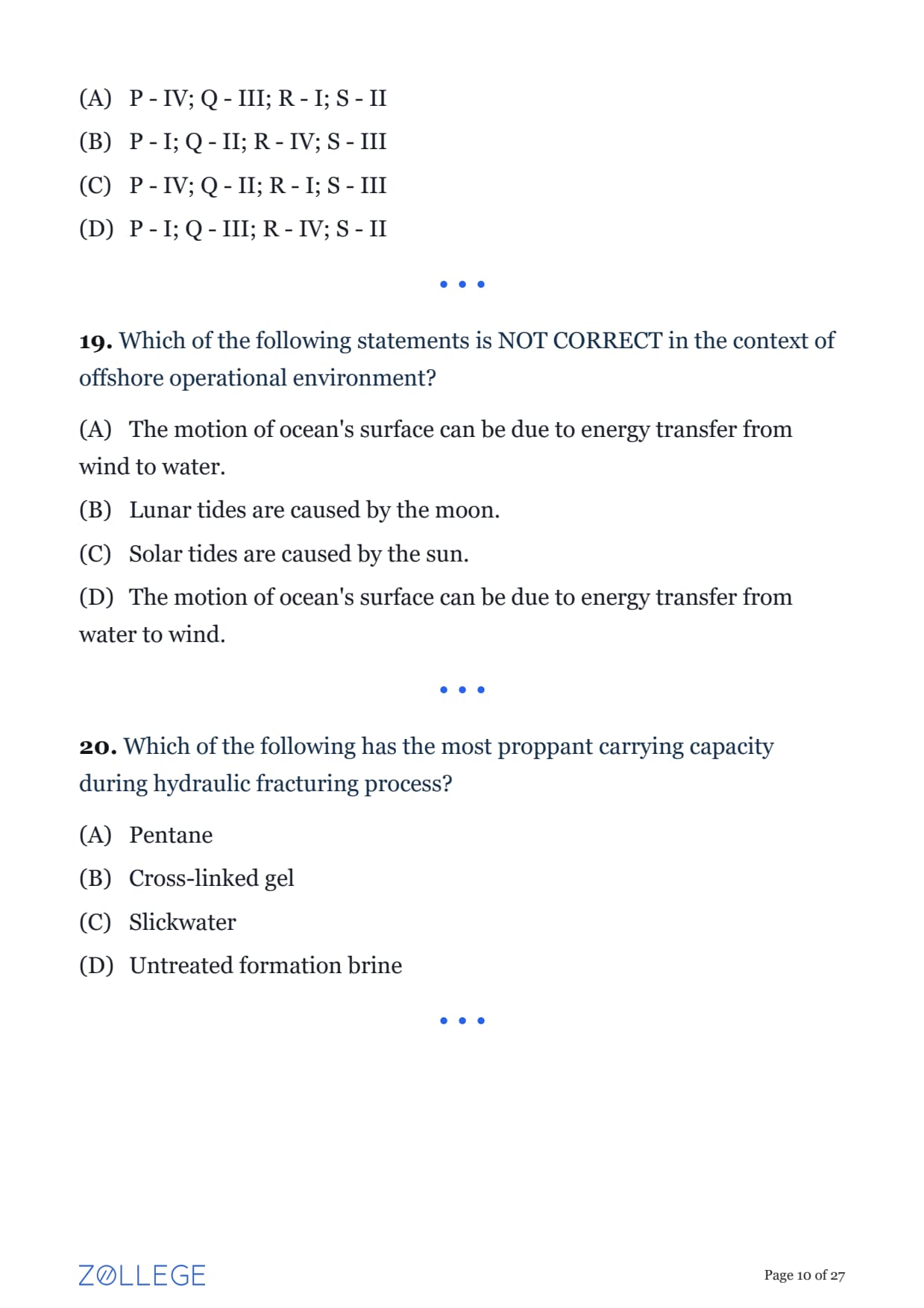
Choose the correct option by matching the entries in Group X with their description in Group Y.
| Group X | Group Y |
|---|---|
| (P) Gas hydrate | (I) Gas is mostly present in adsorbed state |
| (Q) Oil shale | (II) Sedimentary rock contains kerogen |
| (R) Coal bed methane | (III) Oil recovered from shale |
| (S) Shale oil | (IV) Gas is present inside the cages formed by water molecules |
Which of the following statements is NOT CORRECT in the context of offshore operational environment?
Which of the following has the most proppant carrying capacity during hydraulic fracturing process?
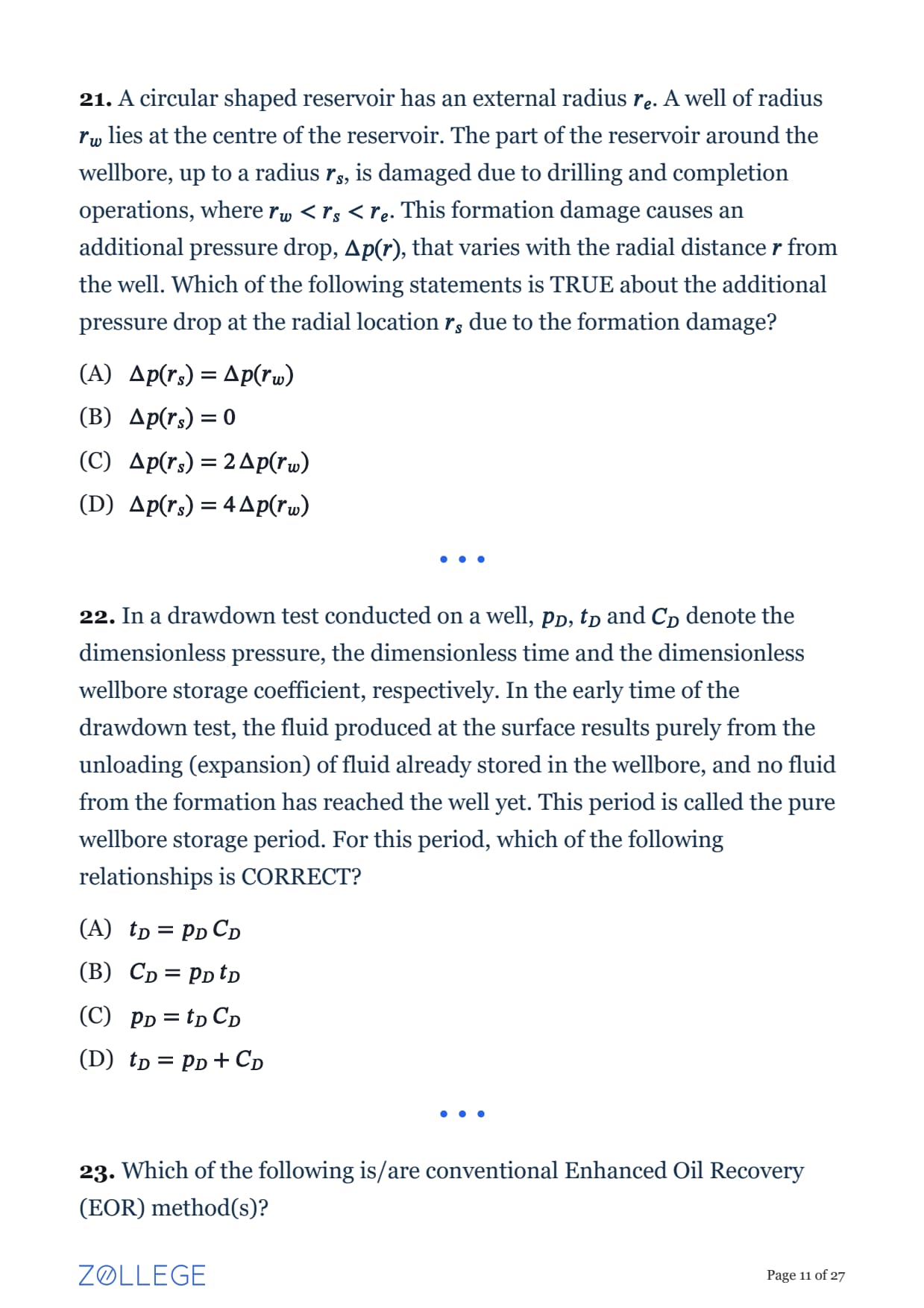
A circular shaped reservoir has an external radius \(r_e\). A well of radius \(r_w\) lies at the centre of the reservoir. The part of the reservoir around the wellbore, up to a radius \(r_s\), is damaged due to drilling and completion operations, where \(r_w < r_s < r_e\). This formation damage causes an additional pressure drop, \(\Delta p(r)\), that varies with the radial distance \(r\) from the well. Which of the following statements is TRUE about the additional pressure drop at the radial location \(r_s\) due to the formation damage?
In a drawdown test conducted on a well, \(p_D\), \(t_D\) and \(C_D\) denote the dimensionless pressure, the dimensionless time and the dimensionless wellbore storage coefficient, respectively. In the early time of the drawdown test, the fluid produced at the surface results purely from the unloading (expansion) of fluid already stored in the wellbore, and no fluid from the formation has reached the well yet. This period is called the pure wellbore storage period. For this period, which of the following relationships is CORRECT?
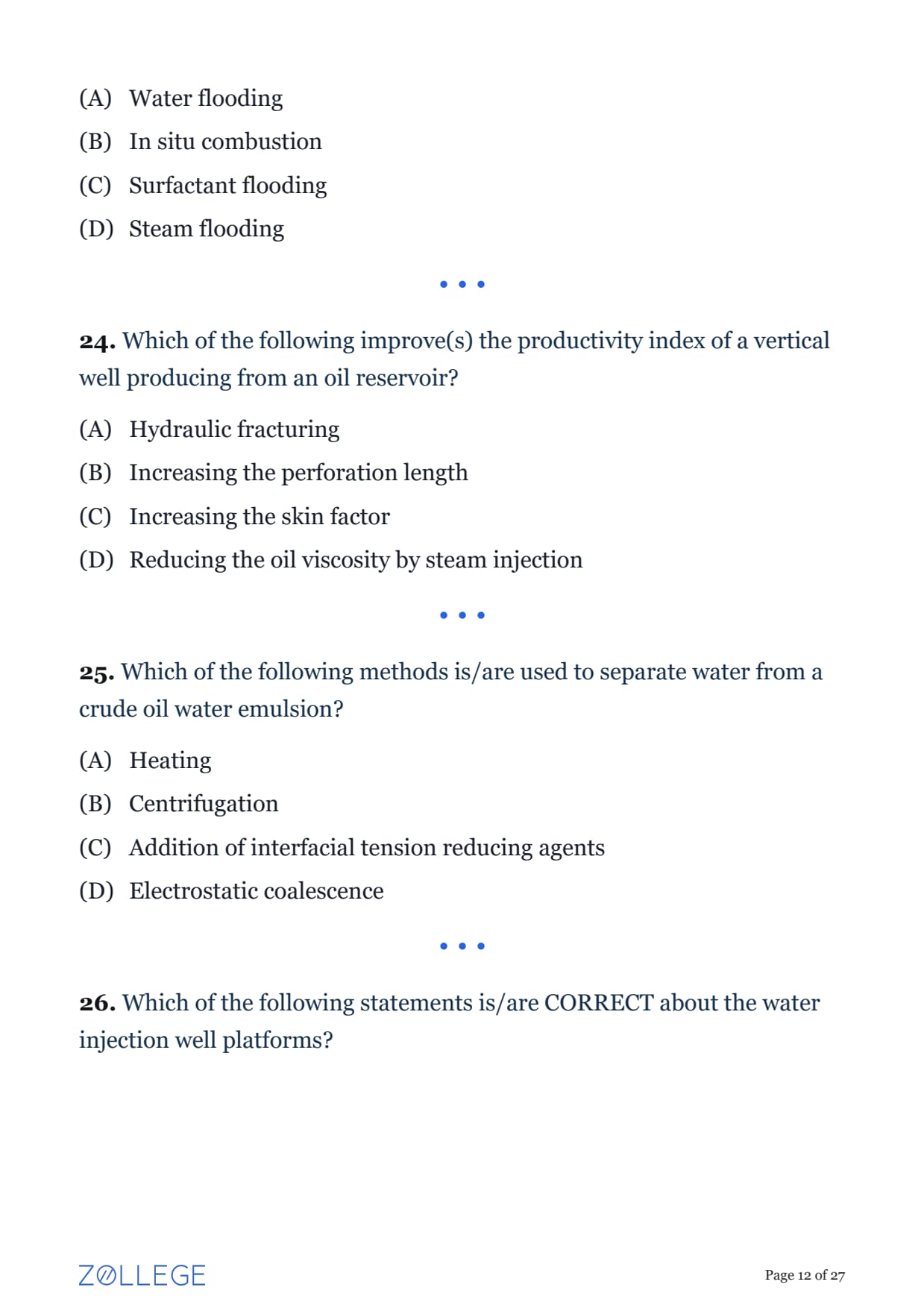
Which of the following is/are conventional Enhanced Oil Recovery (EOR) method(s)?
Which of the following improve(s) the productivity index of a vertical well producing from an oil reservoir?
Which of the following methods is/are used to separate water from a crude oil water emulsion?
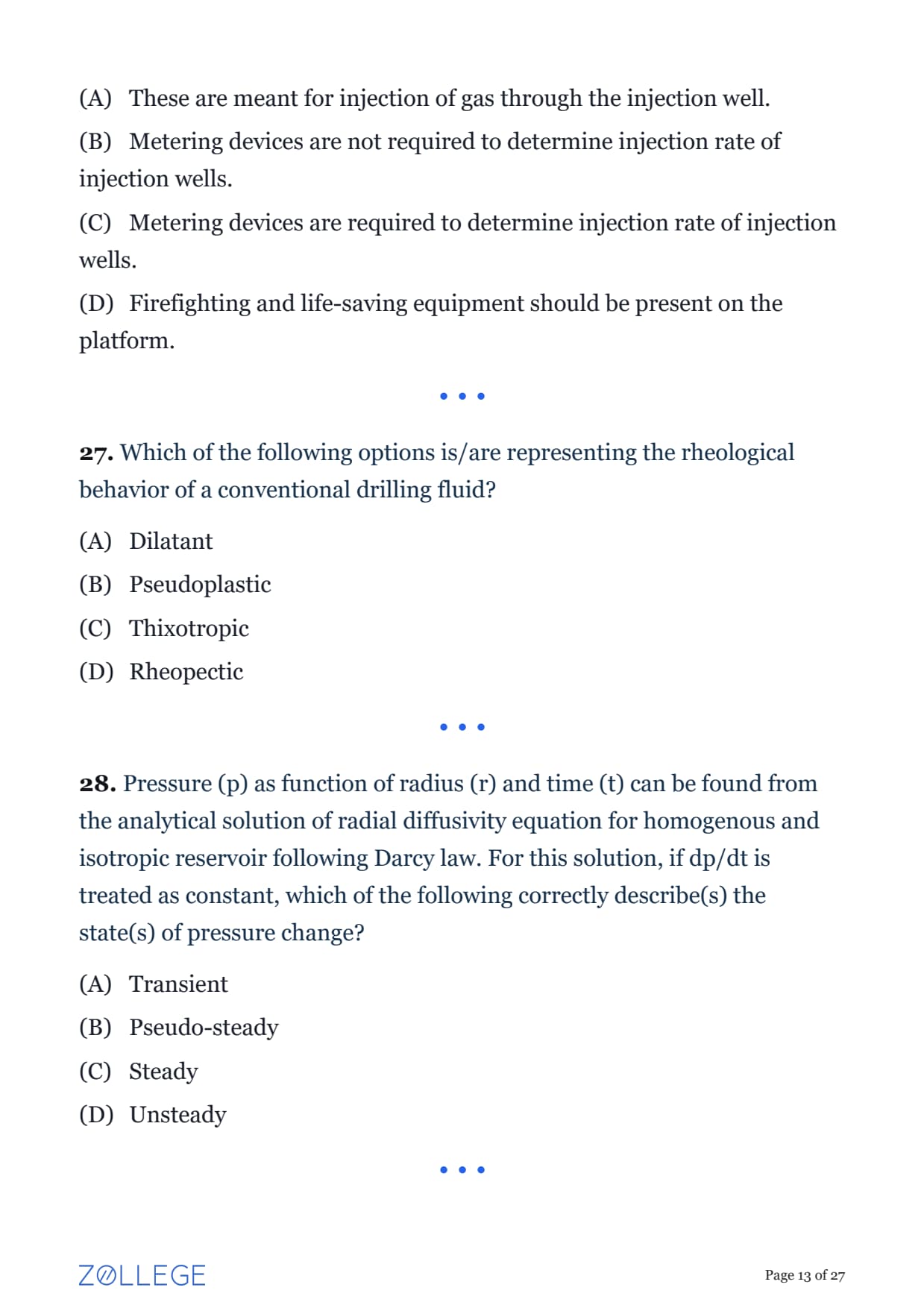
Which of the following statements is/are CORRECT about the water injection well platforms?
Which of the following options is/are representing the rheological behavior of a conventional drilling fluid?
Pressure (p) as function of radius (r) and time (t) can be found from the analytical solution of radial diffusivity equation for homogenous and isotropic reservoir following Darcy law. For this solution, if dp/dt is treated as constant, which of the following correctly describe(s) the state(s) of pressure change?
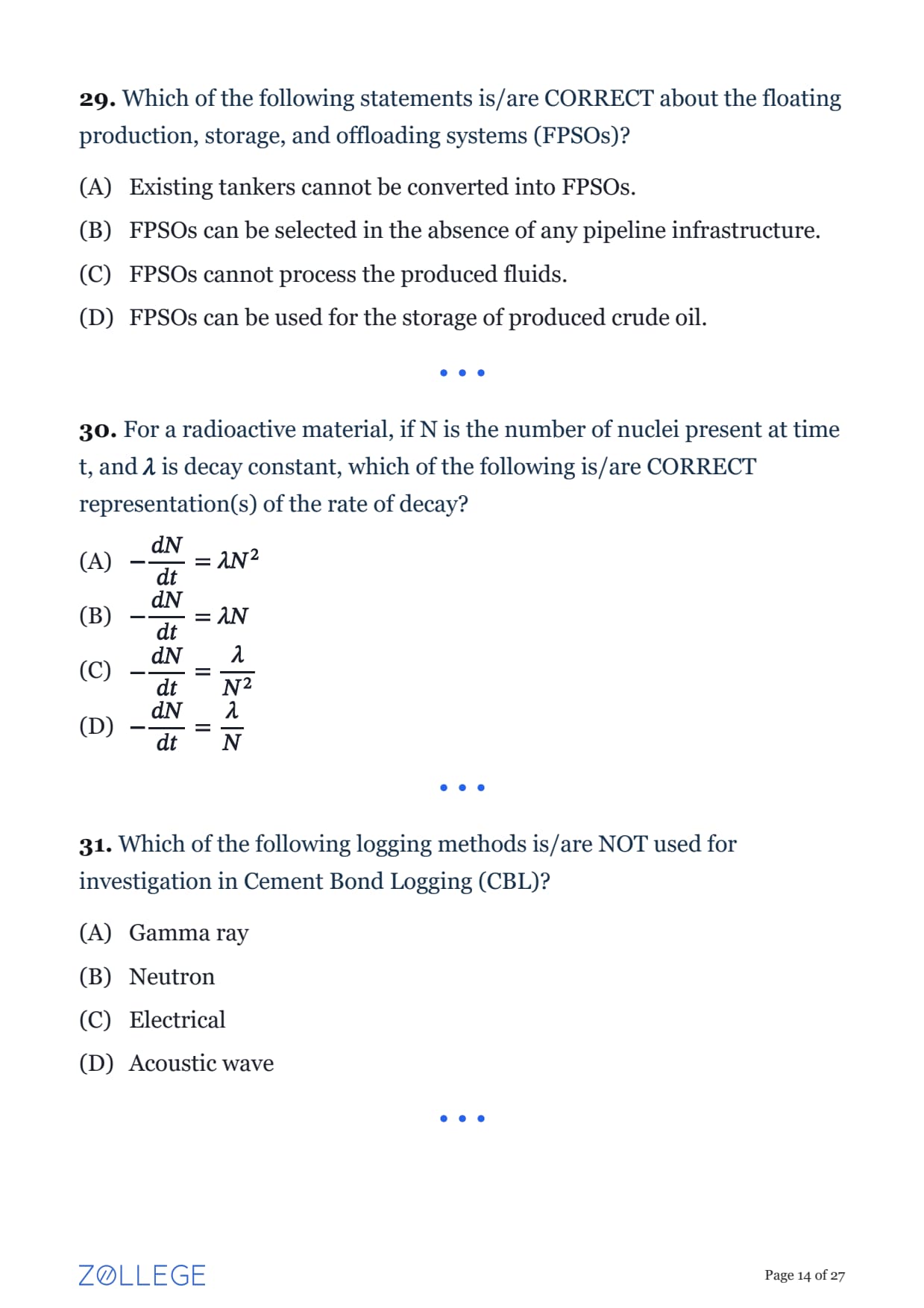
Which of the following statements is/are CORRECT about the floating production, storage, and offloading systems (FPSOs)?
For a radioactive material, if N is the number of nuclei present at time t, and \(\lambda\) is decay constant, which of the following is/are CORRECT representation(s) of the rate of decay?
Which of the following logging methods is/are NOT used for investigation in Cement Bond Logging (CBL)?
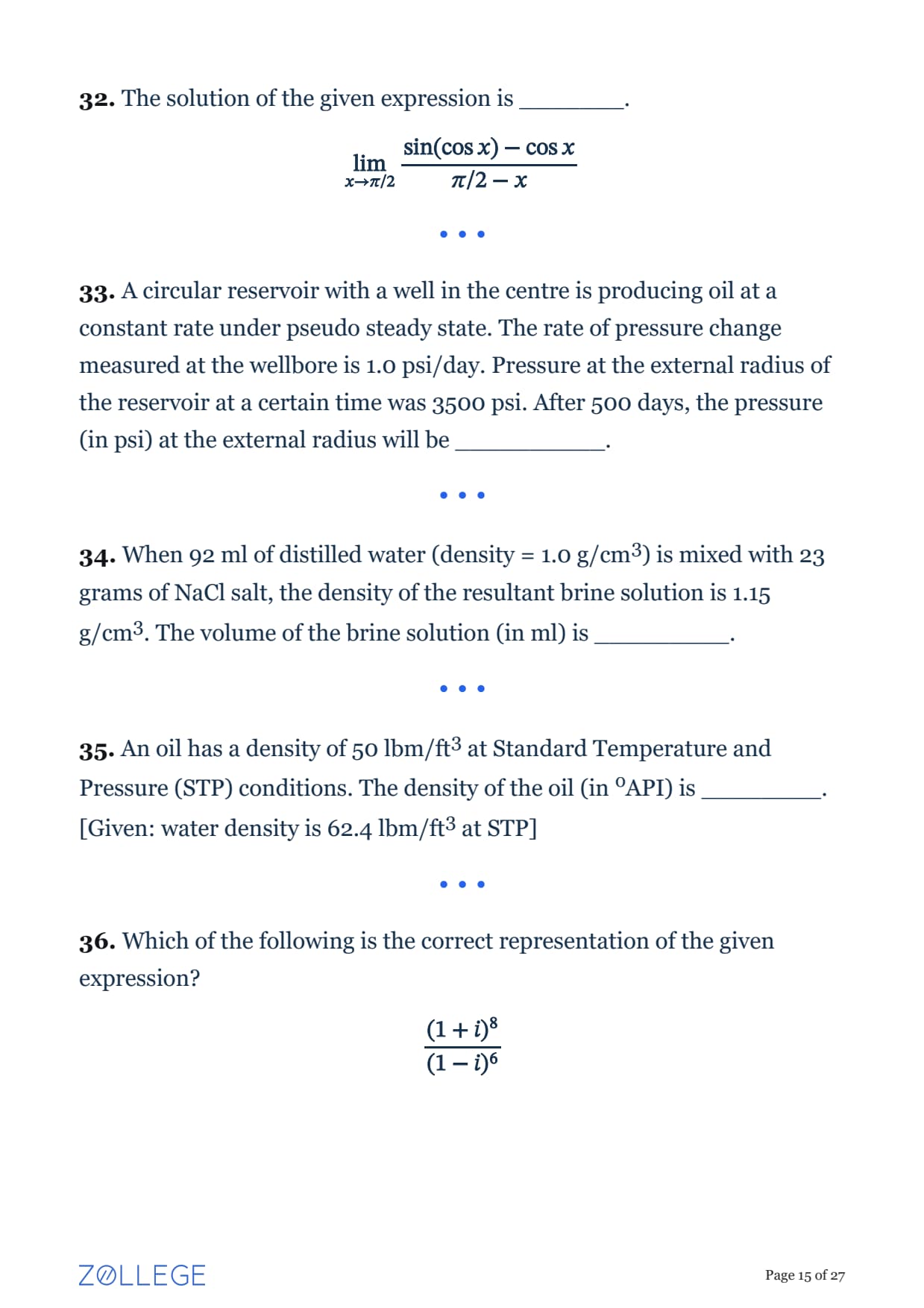
The solution of the given expression is _______. \[ \lim_{x \to \pi/2} \frac{\sin(\cos x) - \cos x}{\pi/2 - x} \]
A circular reservoir with a well in the centre is producing oil at a constant rate under pseudo steady state. The rate of pressure change measured at the wellbore is 1.0 psi/day. Pressure at the external radius of the reservoir at a certain time was 3500 psi. After 500 days, the pressure (in psi) at the external radius will be __________.
When 92 ml of distilled water (density = 1.0 g/cm3) is mixed with 23 grams of NaCl salt, the density of the resultant brine solution is 1.15 g/cm3. The volume of the brine solution (in ml) is _________.
An oil has a density of 50 lbm/ft3 at Standard Temperature and Pressure (STP) conditions. The density of the oil (in oAPI) is ________. [Given: water density is 62.4 lbm/ft3 at STP]
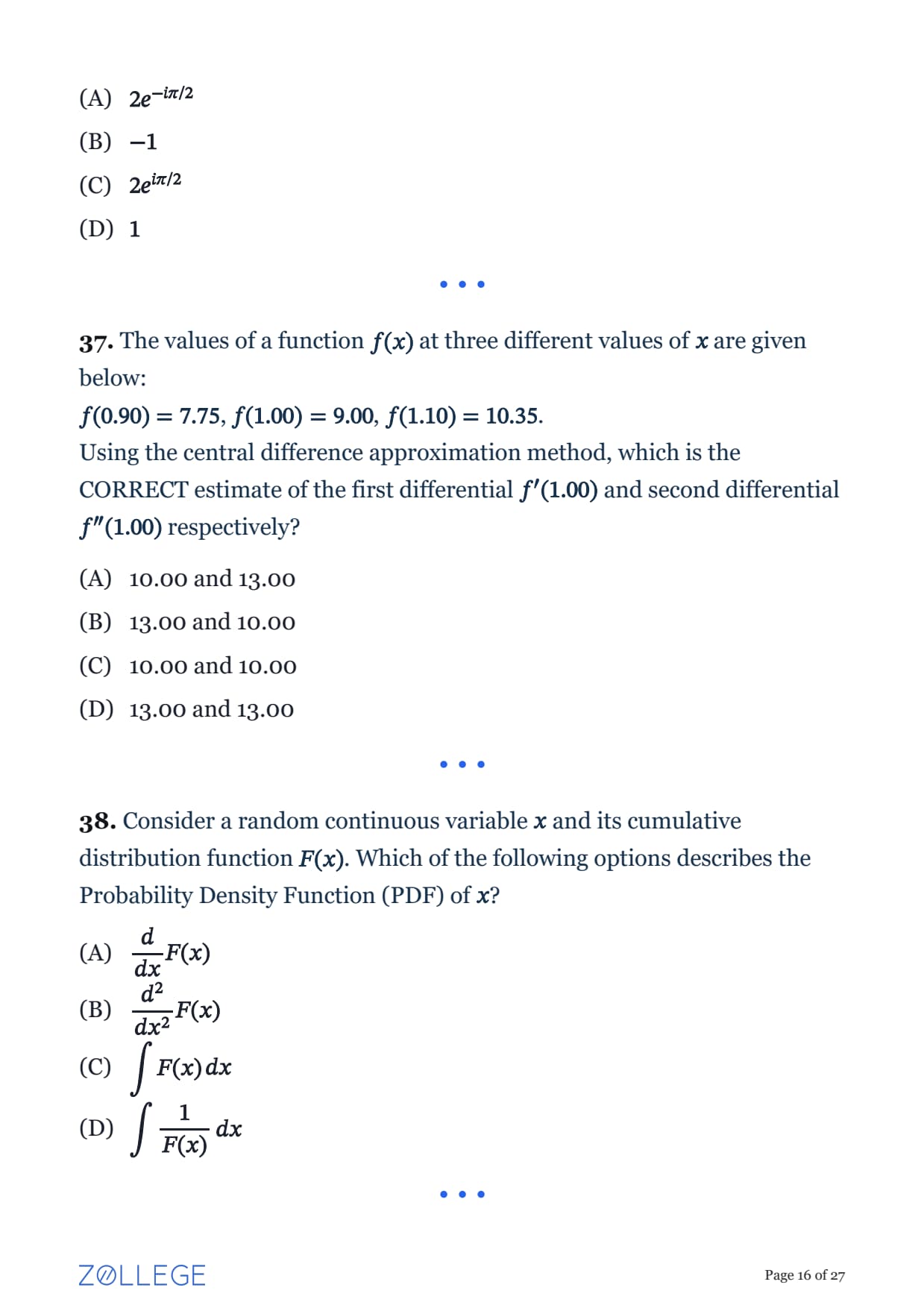
Which of the following is the correct representation of the given expression?
\[ \frac{(1+i)^8}{(1-i)^6} \]
The values of a function \(f(x)\) at three different values of \(x\) are given below:
\(f(0.90) = 7.75\), \(f(1.00) = 9.00\), \(f(1.10) = 10.35\).
Using the central difference approximation method, which is the CORRECT estimate of the first differential \(f'(1.00)\) and second differential \(f''(1.00)\) respectively?
Consider a random continuous variable \(x\) and its cumulative distribution function \(F(x)\). Which of the following options describes the Probability Density Function (PDF) of \(x\)?
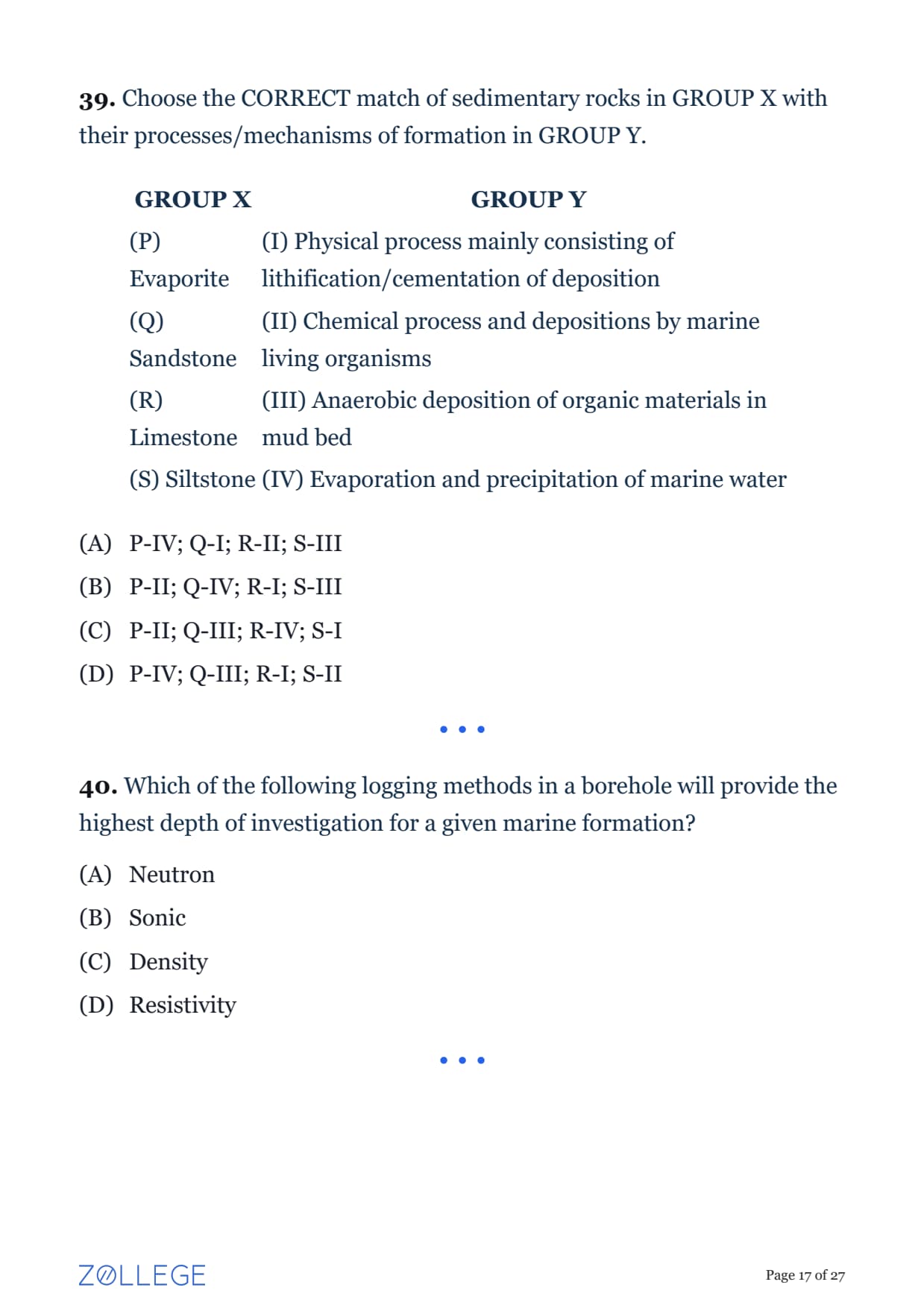
Choose the CORRECT match of sedimentary rocks in GROUP X with their processes/mechanisms of formation in GROUP Y.
| GROUP X | GROUP Y |
|---|---|
| (P) Evaporite | (I) Physical process mainly consisting of lithification/cementation of deposition |
| (Q) Sandstone | (II) Chemical process and depositions by marine living organisms |
| (R) Limestone | (III) Anaerobic deposition of organic materials in mud bed |
| (S) Siltstone | (IV) Evaporation and precipitation of marine water |
Which of the following logging methods in a borehole will provide the highest depth of investigation for a given marine formation?
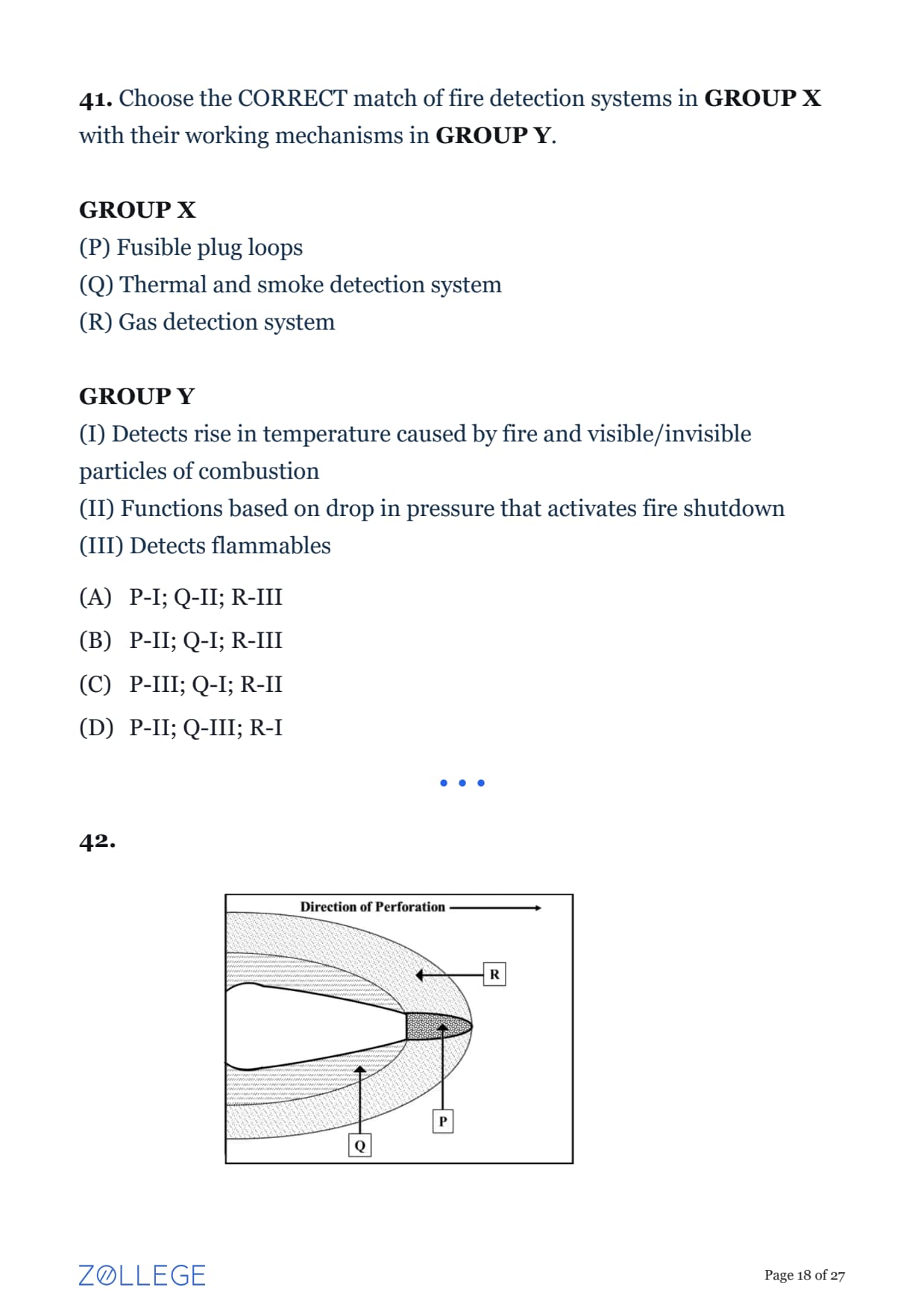
Choose the CORRECT match of fire detection systems in GROUP X with their working mechanisms in GROUP Y.
GROUP X
(P) Fusible plug loops
(Q) Thermal and smoke detection system
(R) Gas detection system
GROUP Y
(I) Detects rise in temperature caused by fire and visible/invisible particles of combustion
(II) Functions based on drop in pressure that activates fire shutdown
(III) Detects flammables

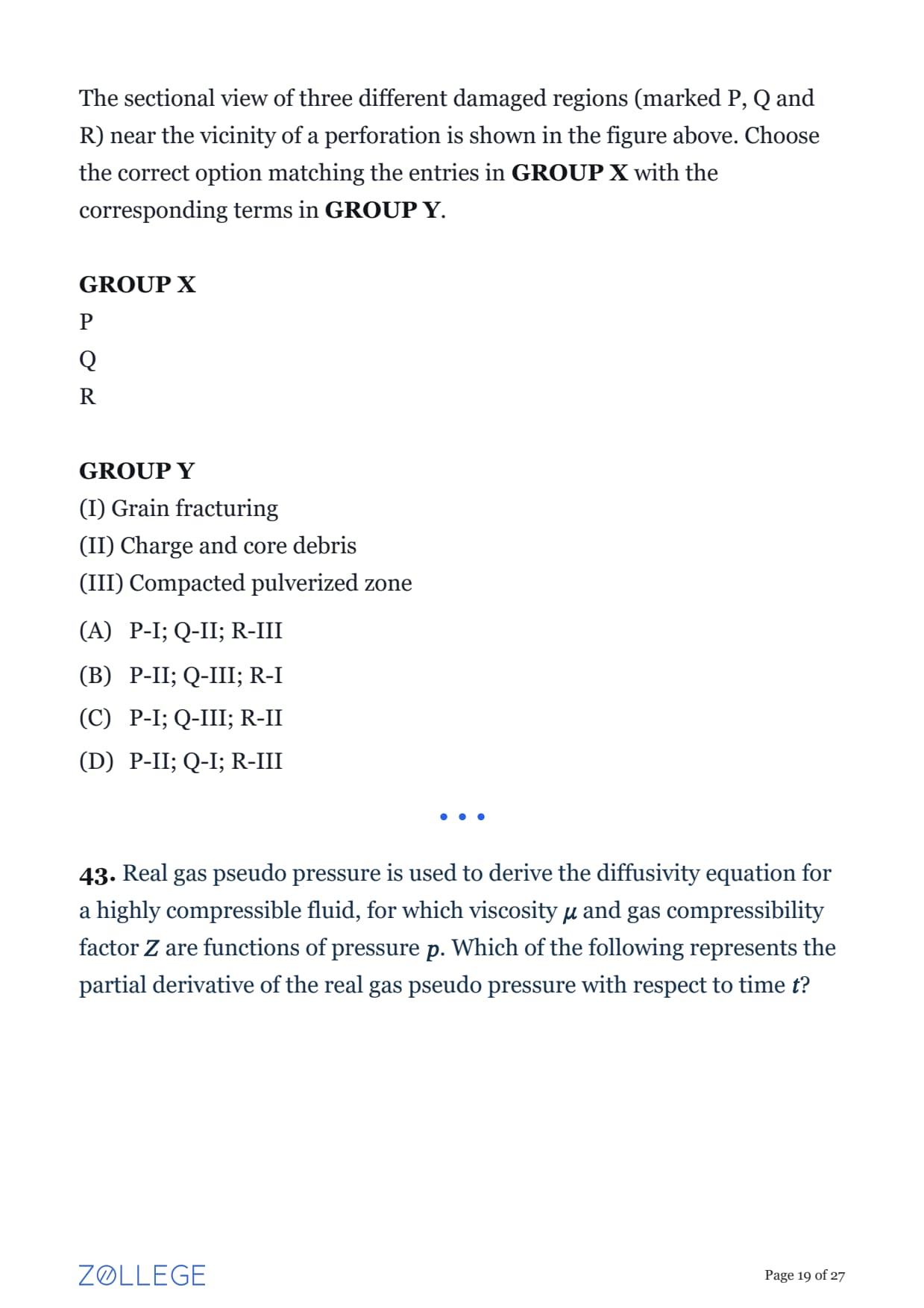
GROUP X
P
Q
R
GROUP Y
(I) Grain fracturing
(II) Charge and core debris
(III) Compacted pulverized zone
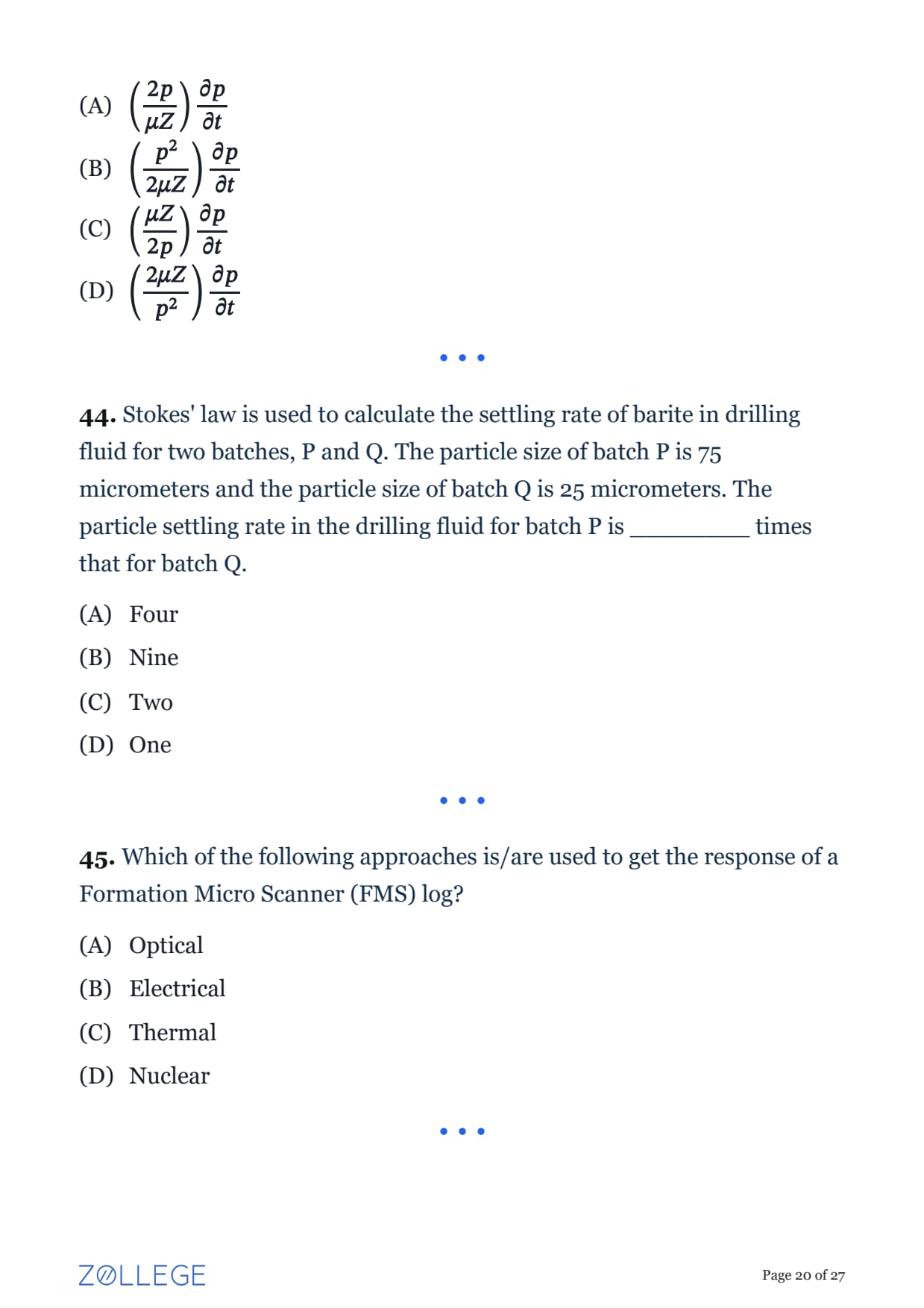
Real gas pseudo pressure is used to derive the diffusivity equation for a highly compressible fluid, for which viscosity \(\mu\) and gas compressibility factor \(Z\) are functions of pressure \(p\). Which of the following represents the partial derivative of the real gas pseudo pressure with respect to time \(t\)?
Stokes' law is used to calculate the settling rate of barite in drilling fluid for two batches, P and Q. The particle size of batch P is 75 micrometers and the particle size of batch Q is 25 micrometers. The particle settling rate in the drilling fluid for batch P is ________ times that for batch Q.
Which of the following approaches is/are used to get the response of a Formation Micro Scanner (FMS) log?
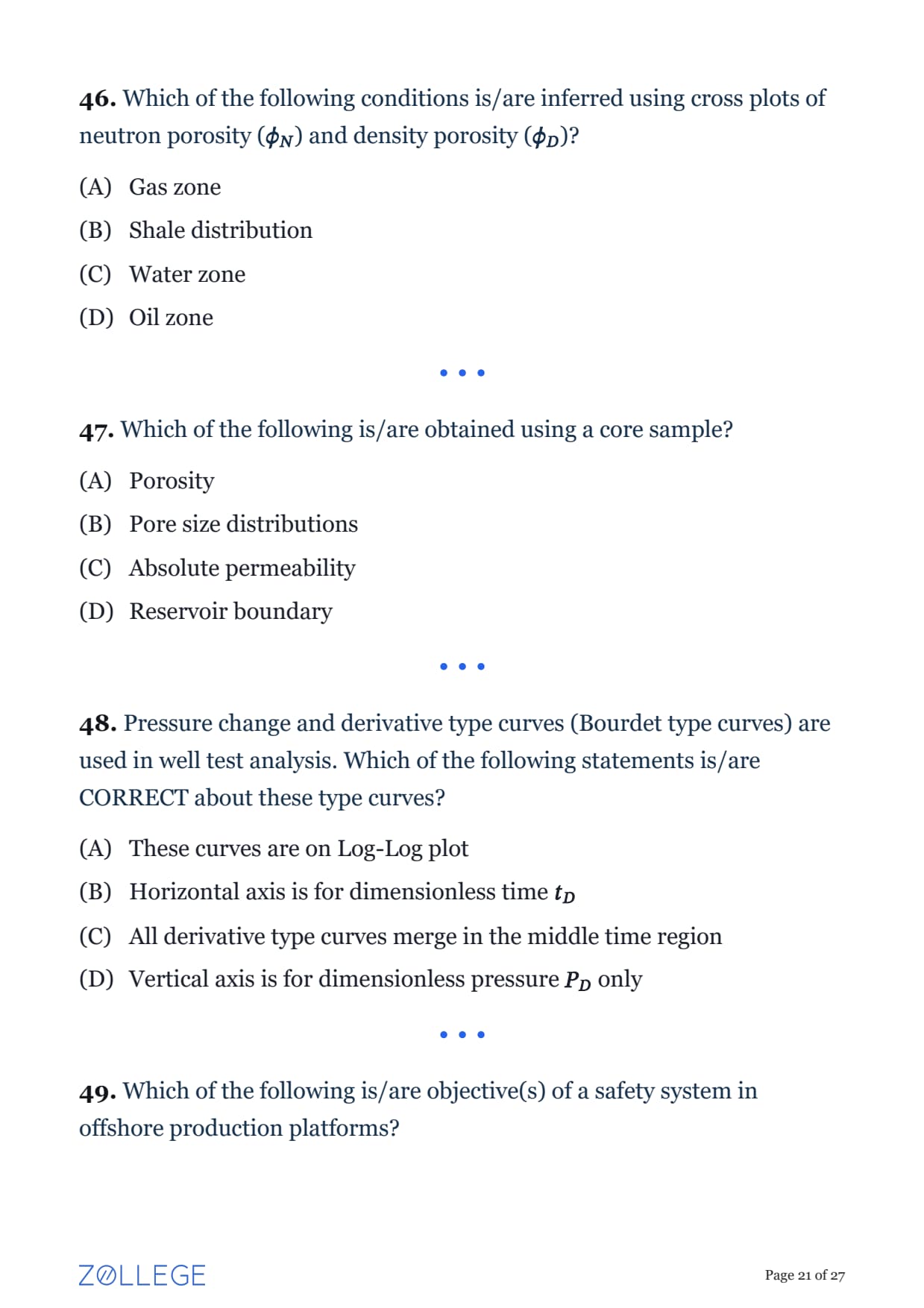
Which of the following conditions is/are inferred using cross plots of neutron porosity (\(\phi_N\)) and density porosity (\(\phi_D\))?
Which of the following is/are obtained using a core sample?
Pressure change and derivative type curves (Bourdet type curves) are used in well test analysis. Which of the following statements is/are CORRECT about these type curves?
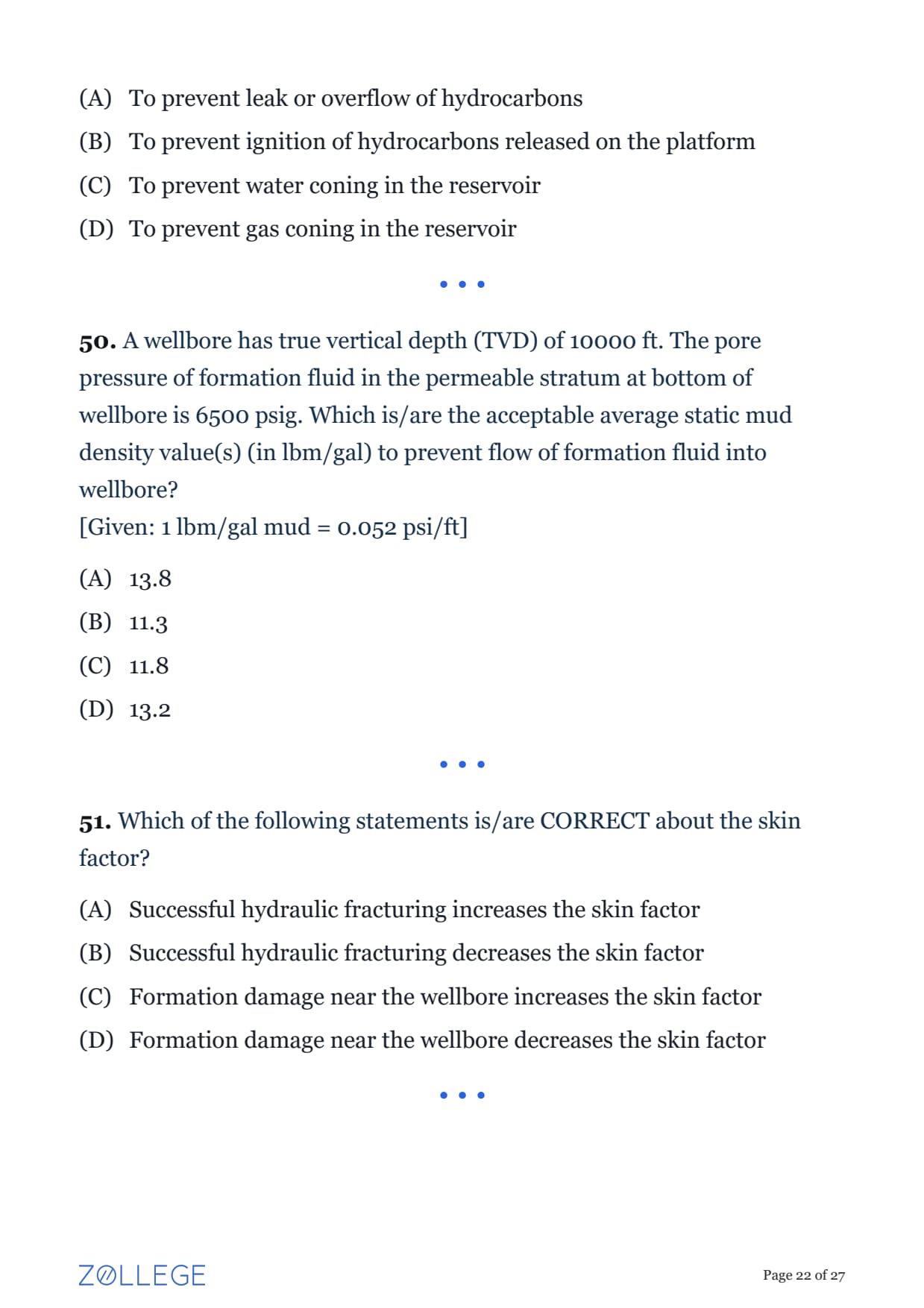
Which of the following is/are objective(s) of a safety system in offshore production platforms?
A wellbore has true vertical depth (TVD) of 10000 ft. The pore pressure of formation fluid in the permeable stratum at bottom of wellbore is 6500 psig. Which is/are the acceptable average static mud density value(s) (in lbm/gal) to prevent flow of formation fluid into wellbore?
[Given: 1 lbm/gal mud = 0.052 psi/ft]
Which of the following statements is/are CORRECT about the skin factor?
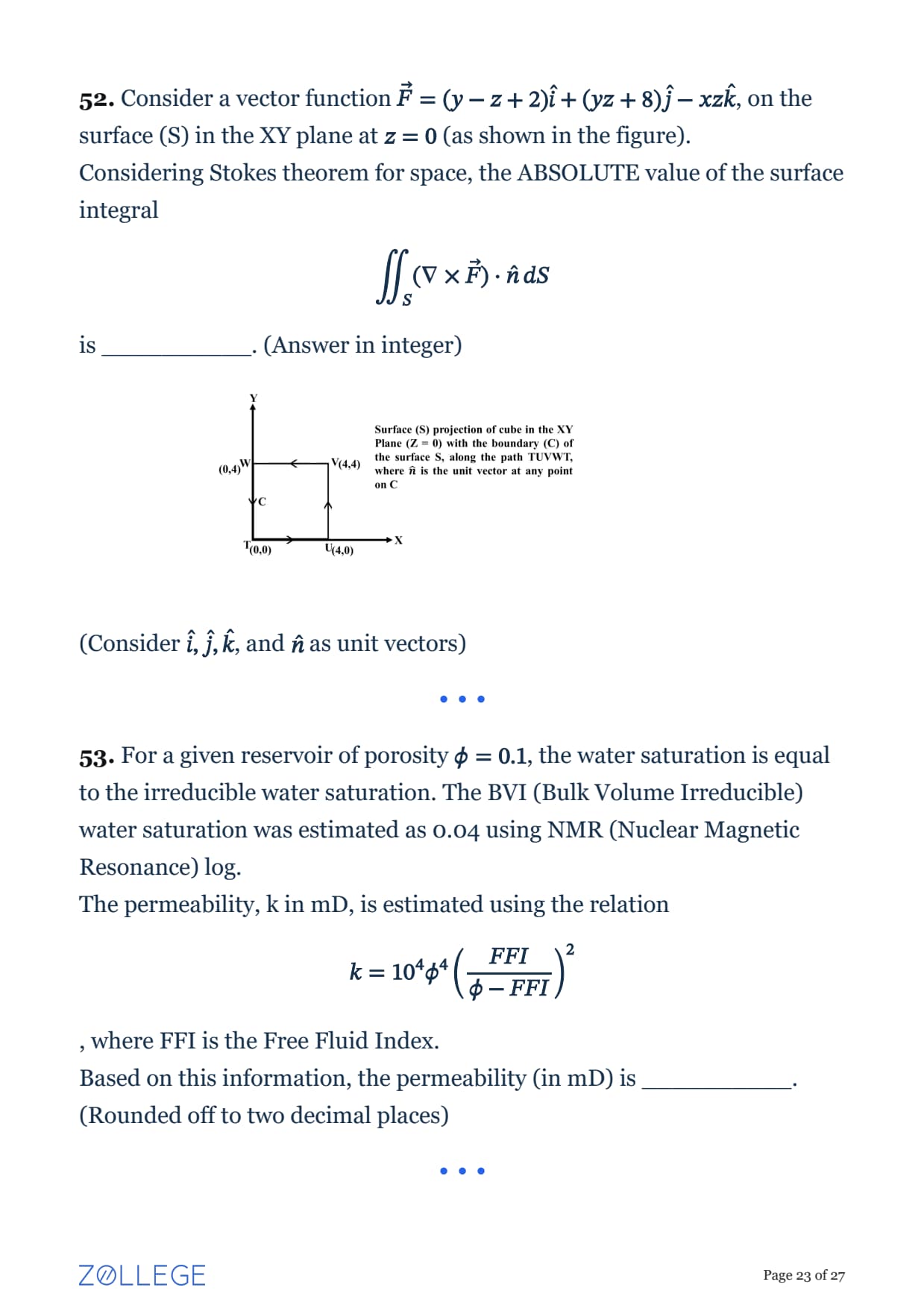
Consider a vector function \( \vec{F} = (y-z+2)\hat{i} + (yz+8)\hat{j} - xz\hat{k} \), on the surface (S) in the XY plane at \( z = 0 \) (as shown in the figure).
Considering Stokes theorem for space, the ABSOLUTE value of the surface integral \[ \iint_S (\nabla \times \vec{F}) \cdot \hat{n}\, dS \] is __________. (Answer in integer)
(Consider \( \hat{i}, \hat{j}, \hat{k} \), and \( \hat{n} \) as unit vectors)
For a given reservoir of porosity \( \phi = 0.1 \), the water saturation is equal to the irreducible water saturation. The BVI (Bulk Volume Irreducible) water saturation was estimated as 0.04 using NMR (Nuclear Magnetic Resonance) log.
The permeability, k in mD, is estimated using the relation \[ k = 10^4 \phi^4 \left(\frac{FFI}{\phi - FFI}\right)^2 \], where FFI is the Free Fluid Index.
Based on this information, the permeability (in mD) is __________. (Rounded off to two decimal places)
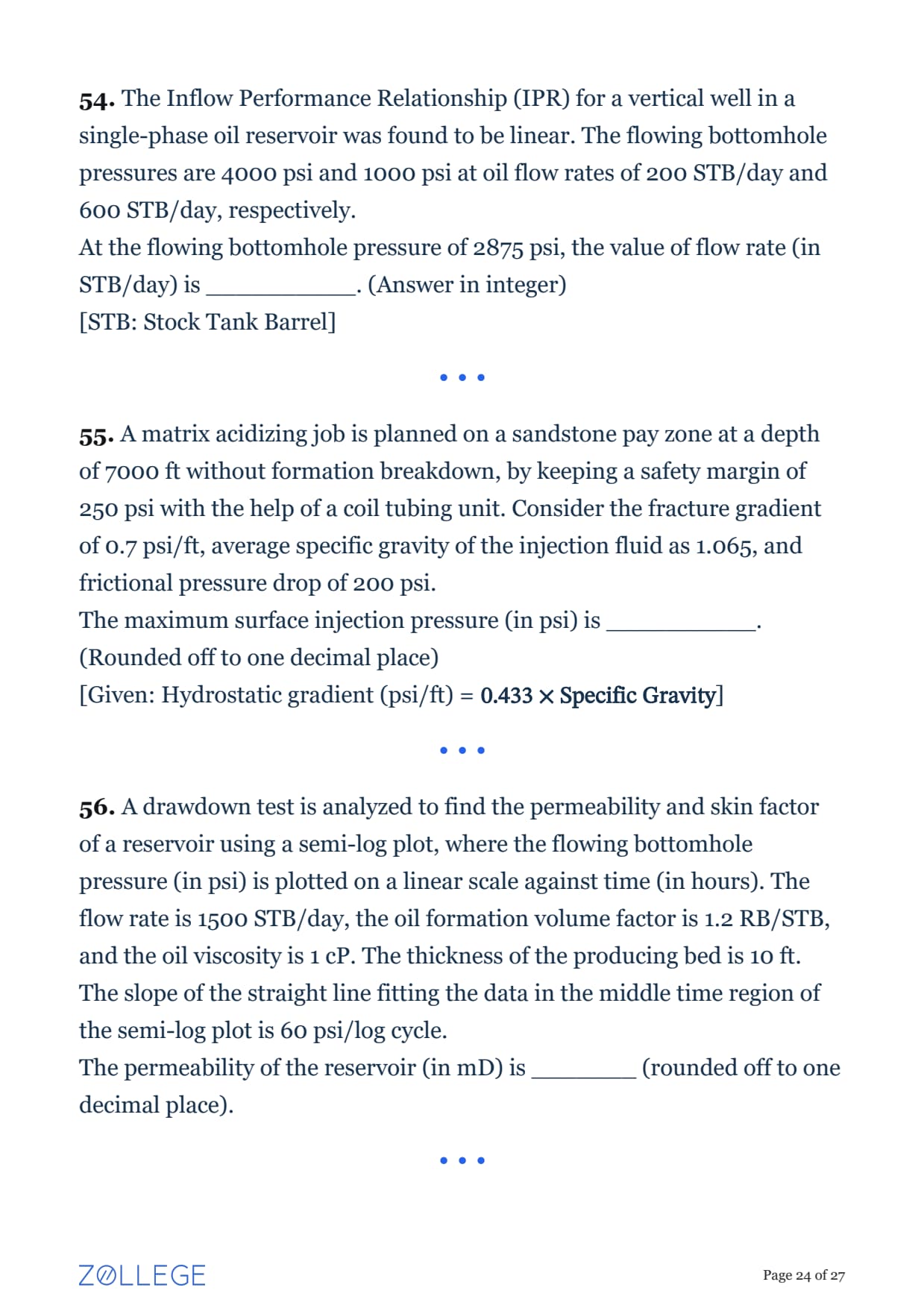
The Inflow Performance Relationship (IPR) for a vertical well in a single-phase oil reservoir was found to be linear. The flowing bottomhole pressures are 4000 psi and 1000 psi at oil flow rates of 200 STB/day and 600 STB/day, respectively.
At the flowing bottomhole pressure of 2875 psi, the value of flow rate (in STB/day) is __________. (Answer in integer)
[STB: Stock Tank Barrel]
A matrix acidizing job is planned on a sandstone pay zone at a depth of 7000 ft without formation breakdown, by keeping a safety margin of 250 psi with the help of a coil tubing unit. Consider the fracture gradient of 0.7 psi/ft, average specific gravity of the injection fluid as 1.065, and frictional pressure drop of 200 psi.
The maximum surface injection pressure (in psi) is __________. (Rounded off to one decimal place)
[Given: Hydrostatic gradient (psi/ft) = \( 0.433 \times \text{Specific Gravity} \)]
A drawdown test is analyzed to find the permeability and skin factor of a reservoir using a semi-log plot, where the flowing bottomhole pressure (in psi) is plotted on a linear scale against time (in hours). The flow rate is 1500 STB/day, the oil formation volume factor is 1.2 RB/STB, and the oil viscosity is 1 cP. The thickness of the producing bed is 10 ft. The slope of the straight line fitting the data in the middle time region of the semi-log plot is 60 psi/log cycle.
The permeability of the reservoir (in mD) is _______ (rounded off to one decimal place).
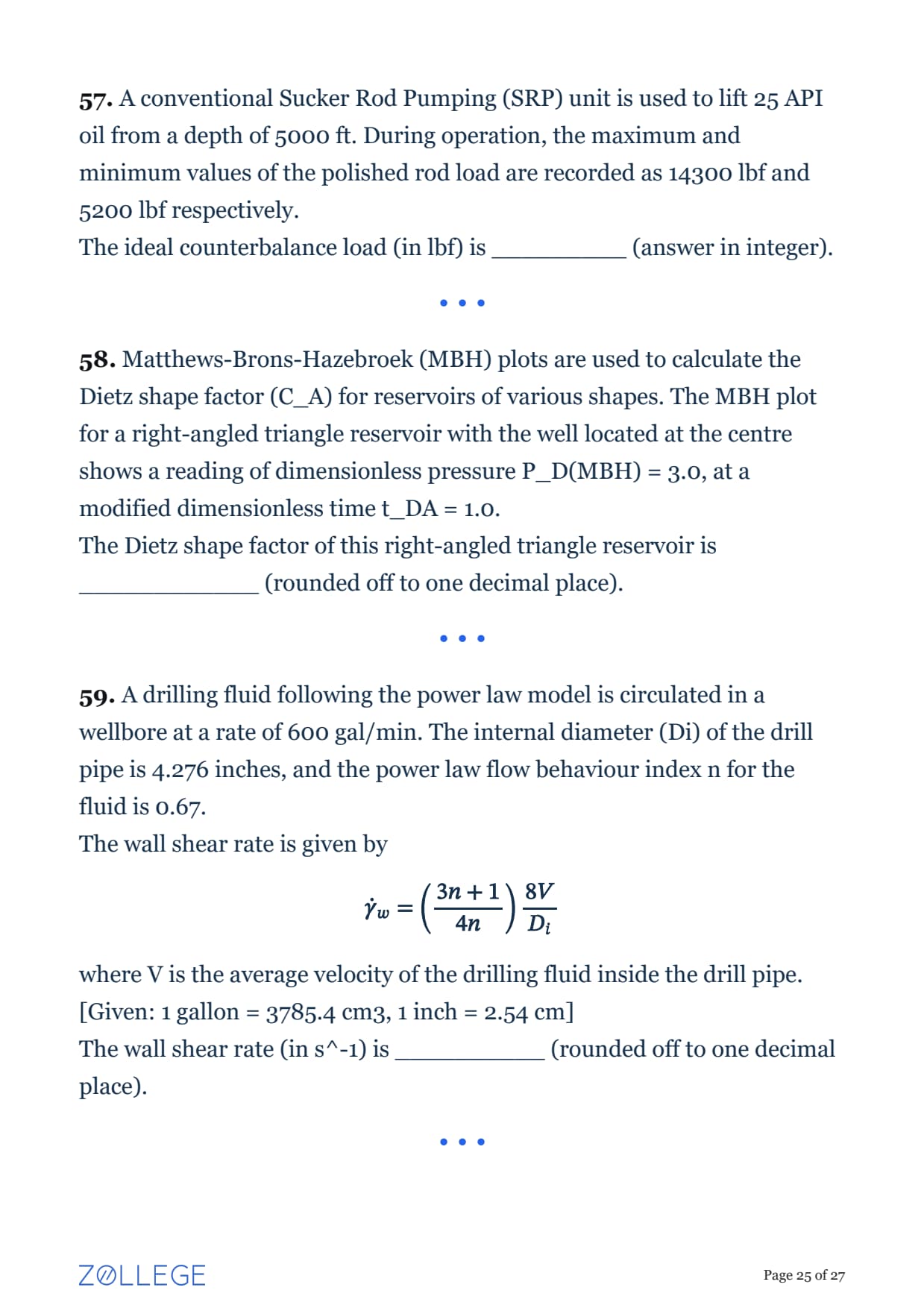
A conventional Sucker Rod Pumping (SRP) unit is used to lift 25 API oil from a depth of 5000 ft. During operation, the maximum and minimum values of the polished rod load are recorded as 14300 lbf and 5200 lbf respectively.
The ideal counterbalance load (in lbf) is _________ (answer in integer).
Matthews-Brons-Hazebroek (MBH) plots are used to calculate the Dietz shape factor (C_A) for reservoirs of various shapes. The MBH plot for a right-angled triangle reservoir with the well located at the centre shows a reading of dimensionless pressure P_D(MBH) = 3.0, at a modified dimensionless time t_DA = 1.0.
The Dietz shape factor of this right-angled triangle reservoir is ____________ (rounded off to one decimal place).
A drilling fluid following the power law model is circulated in a wellbore at a rate of 600 gal/min. The internal diameter (Di) of the drill pipe is 4.276 inches, and the power law flow behaviour index n for the fluid is 0.67.
The wall shear rate is given by \[ \dot{\gamma}_w = \left(\frac{3n+1}{4n}\right)\frac{8V}{D_i} \] where V is the average velocity of the drilling fluid inside the drill pipe.
[Given: 1 gallon = 3785.4 cm3, 1 inch = 2.54 cm]
The wall shear rate (in s^-1) is __________ (rounded off to one decimal place).
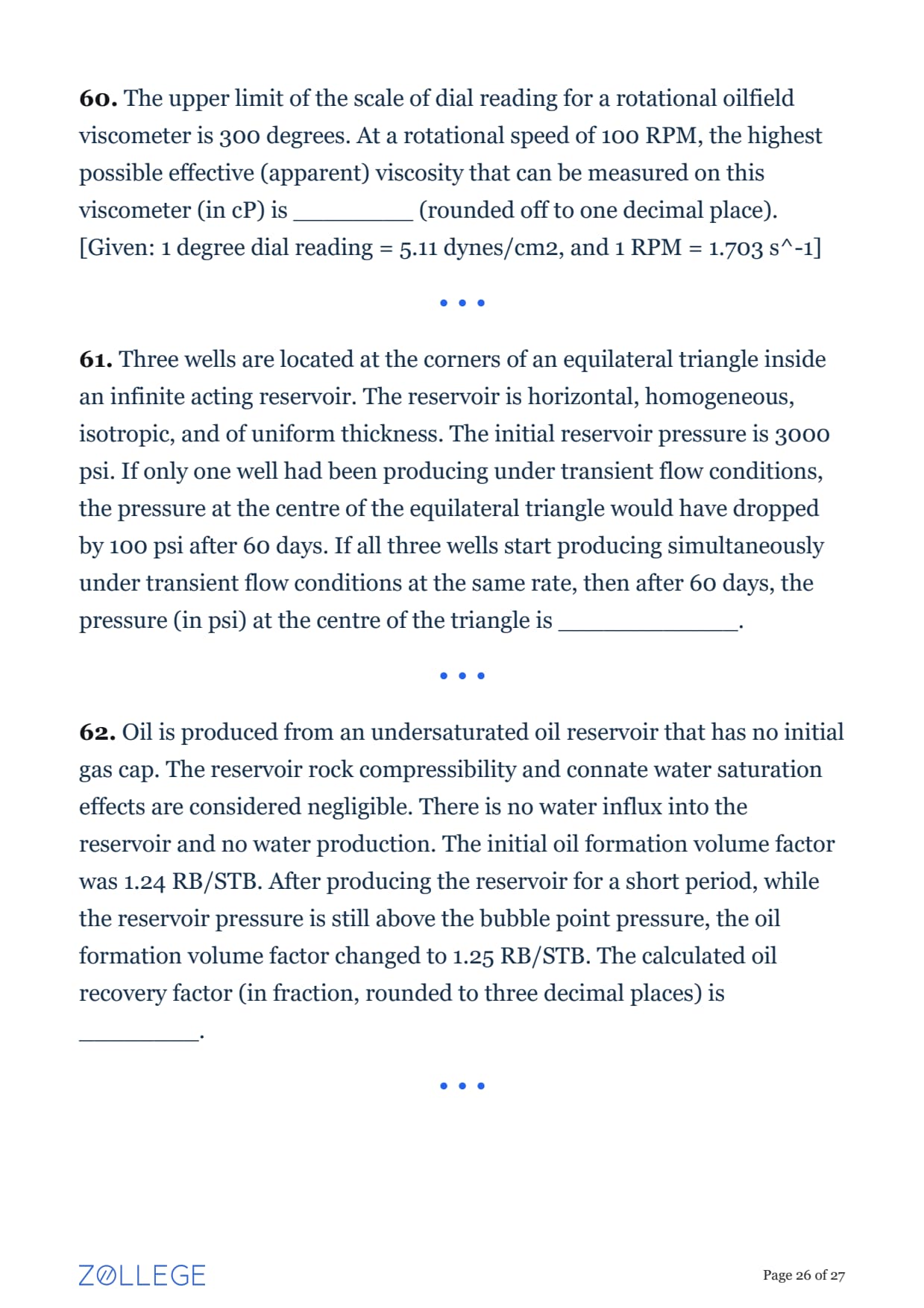
The upper limit of the scale of dial reading for a rotational oilfield viscometer is 300 degrees. At a rotational speed of 100 RPM, the highest possible effective (apparent) viscosity that can be measured on this viscometer (in cP) is ________ (rounded off to one decimal place).
[Given: 1 degree dial reading = 5.11 dynes/cm2, and 1 RPM = 1.703 s^-1]
Three wells are located at the corners of an equilateral triangle inside an infinite acting reservoir. The reservoir is horizontal, homogeneous, isotropic, and of uniform thickness. The initial reservoir pressure is 3000 psi. If only one well had been producing under transient flow conditions, the pressure at the centre of the equilateral triangle would have dropped by 100 psi after 60 days. If all three wells start producing simultaneously under transient flow conditions at the same rate, then after 60 days, the pressure (in psi) at the centre of the triangle is ____________.
Oil is produced from an undersaturated oil reservoir that has no initial gas cap. The reservoir rock compressibility and connate water saturation effects are considered negligible. There is no water influx into the reservoir and no water production. The initial oil formation volume factor was 1.24 RB/STB. After producing the reservoir for a short period, while the reservoir pressure is still above the bubble point pressure, the oil formation volume factor changed to 1.25 RB/STB. The calculated oil recovery factor (in fraction, rounded to three decimal places) is ________.
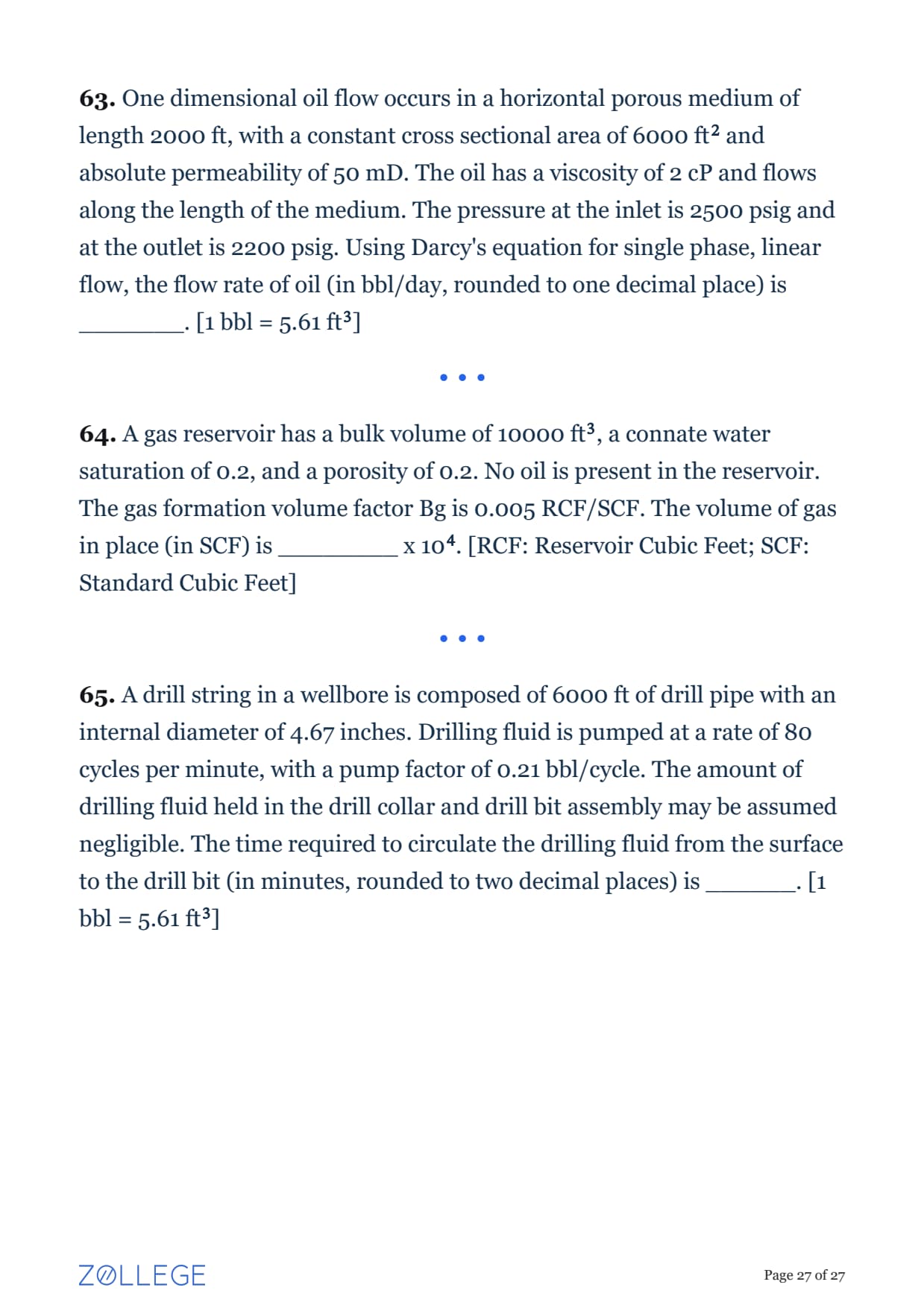
One dimensional oil flow occurs in a horizontal porous medium of length 2000 ft, with a constant cross sectional area of 6000 ft\(^2\) and absolute permeability of 50 mD. The oil has a viscosity of 2 cP and flows along the length of the medium. The pressure at the inlet is 2500 psig and at the outlet is 2200 psig. Using Darcy's equation for single phase, linear flow, the flow rate of oil (in bbl/day, rounded to one decimal place) is _______. [1 bbl = 5.61 ft\(^3\)]
A gas reservoir has a bulk volume of 10000 ft\(^3\), a connate water saturation of 0.2, and a porosity of 0.2. No oil is present in the reservoir. The gas formation volume factor Bg is 0.005 RCF/SCF. The volume of gas in place (in SCF) is ________ x 10\(^4\). [RCF: Reservoir Cubic Feet; SCF: Standard Cubic Feet]
A drill string in a wellbore is composed of 6000 ft of drill pipe with an internal diameter of 4.67 inches. Drilling fluid is pumped at a rate of 80 cycles per minute, with a pump factor of 0.21 bbl/cycle. The amount of drilling fluid held in the drill collar and drill bit assembly may be assumed negligible. The time required to circulate the drilling fluid from the surface to the drill bit (in minutes, rounded to two decimal places) is ______. [1 bbl = 5.61 ft\(^3\)]
GATE 2026 Petroleum Engineering Exam Pattern and Marking Scheme Explained
GATE 2026 was conducted by IIT Guwahati across four days, February 7, 8, 14 and 15, and the PE paper ran in the afternoon slot on February 8.
- Total questions: 65, split into 10 General Aptitude and 55 Engineering Mathematics plus core Petroleum Engineering questions
- Duration: 3 hours
- Total marks: 100, with General Aptitude worth 15 marks and the rest worth 85 marks
- Marking scheme: 1/3 mark cut for a wrong 1-mark MCQ, 2/3 mark cut for a wrong 2-mark MCQ, no negative marking on multi-select or numerical answer type questions
- Question types: single-answer MCQs, multi-select MCQs (MSQ), and numerical answer type (NAT) questions
High-Weightage Subjects in GATE 2026 Petroleum Engineering to Focus On First
Out of the 46 core Petroleum Engineering questions in this paper, well testing and reservoir engineering carried the most weight.
- Well Testing: 8 questions, covering drawdown tests, dimensionless pressure relations, and MBH type curve analysis
- Reservoir Engineering: 5 questions, including material balance, recovery factor, and Darcy flow calculations
- Drilling Engineering and Drilling Fluids combined: 8 questions, spanning rig components, mud rheology, and circulation time problems
- Offshore Engineering and Well Logging: 4 questions each, covering platform safety systems, FPSOs, and log response interpretation
- Petrophysics: 3 questions on porosity, permeability, and NMR-based permeability estimation
GATE 2026 PE Good Attempts and Qualifying Score Benchmark
- Based on past GATE PE trends, attempting 55-65 of the 65 questions with about 85-90% accuracy is considered a safe score
- Since MSQ and NAT questions in this paper carry no negative marking, attempt every NAT question even if you are only partly sure of the calculation
- Use the solutions PDF to time yourself section by section rather than attempting the full paper end to end on your first pass
GATE 2026 Petroleum Engineering Question Paper Analysis Video
Source: Portam Tech
How to Use the GATE Petroleum Engineering Question Paper for Practice
Solve this paper as a timed 3-hour mock before you look at the solutions PDF.
- Attempt all 65 questions cold in one sitting, marking the ones you were unsure about
- Compare your working against the step-by-step solutions PDF, not just the final answer
- Redo the well testing and drilling fluid numerical questions separately, since these carried the most marks in this paper
- Track how many NAT questions you got within the accepted range rather than the exact decimal, since GATE grades NAT answers on a range
GATE 2026 Petroleum Engineering Question Paper FAQs
Ques. How many questions were there in the GATE 2026 Petroleum Engineering paper and how are marks split?
Ans. The paper had 65 questions for 100 marks total, 10 General Aptitude questions worth 15 marks and 55 Engineering Mathematics plus core Petroleum Engineering questions worth 85 marks.
Ques. How many attempts are considered good in GATE Petroleum Engineering to clear the cutoff?
Ans. Attempting 55-65 of the 65 questions with 85-90% accuracy has been a safe zone in recent GATE PE papers. Since MSQ and NAT carry no negative marking, attempt every numerical question even on a partial calculation.
Ques. Which topics had the highest weightage in GATE 2026 Petroleum Engineering?
Ans. Well testing led with 8 of the 46 core questions, followed by reservoir engineering with 5, and drilling engineering plus drilling fluids together with 8. Offshore engineering and well logging carried 4 questions each.
Ques. Is there negative marking in GATE Petroleum Engineering for MSQ and NAT questions?
Ans. No. Negative marking applies only to single-answer MCQs, 1/3 mark for a wrong 1-mark MCQ and 2/3 mark for a wrong 2-mark MCQ. Multi-select and numerical answer type questions carry no penalty for a wrong attempt.
Ques. Are GATE Petroleum Engineering questions repeated from previous years?
Ans. Core concepts like Darcy flow, well testing type curves, and drilling hydraulics repeat almost every year, though the exact numbers and scenarios change. Solving the last 5 years of PE papers alongside this one is the fastest way to spot the recurring question patterns.
Ques. Where can I download the GATE 2026 Petroleum Engineering question paper with solutions PDF for free?
Ans. You can download both the question paper and the step-by-step solutions PDF from the table above on Collegedunia. The official question paper and answer key are also available on the GATE 2026 website run by IIT Guwahati, gate2026.iitg.ac.in.
*The article might have information for the previous academic years, please refer the official website of the exam.