
CAT 1992 Question Paper with Solution PDF
- Cut Off for IITs
- IIM Kashipur Cut Off
- IIM Amritsar Cut Off
- IIM Nagpur Cut Off
- IIM Indore Cut Off
- IIM Udaipur Cut Off
- IIM Ranchi Cut Off
- IIM Raipur Cut Off
- IIM Jammu Cut Off
- IIM Bodh Gaya Cut Off
- IIM Kozhikode Cut Off
- IIM Sambalpur Cut Off
- IIM Bangalore Cut Off
- IIM Sirmaur Cut Off
- IIM Trichy Cut Off
- IIM Visakhapatnam Cut Off
- IIM Lucknow Cut Off
- IIM Shillong Cut Off
- IIM Calcutta Cut Off
- IIM Ahmedabad Cut Off
- IIM Rohtak Cut Off


Content Writer | Updated On - Nov 29, 2025
CAT Question Papers are the most important study material for effective exam preparation. We at Zollege have provided all CAT Previous Year Papers with Solution PDFs here. CAT 1992 was conducted successfully by Indian Institutes of Management (IIM) Ahmedabad.
Students can freely download the CAT previous year's question paper PDFs along with their solutions here. We strongly encourage cat aspirants to scan through all the CAT Question Paper to know the overall difficulty level, CAT Syllabus and understand the changes in CAT Exam Pattern over the years.
Also Check:
CAT 1992 Question Paper with Solution PDF
| CAT 1992 Question Paper with Solutions PDF | Download PDF | Check Solutions |
Q1 to 7 : arrange the sentences A, B, C and D to form a logical sequence between sentences
1 and 6.
1. Amount of published information available varies widely by industry.
A. Unfortunately for the researcher, many industries do not meet these criteria, and there may be little published information available.
B. Generally, the problem the researcher will face in using published data for analysing an economically meaningful industry is that they are too broad or too arranged to fit the industry.
C. However, it is always possible to gain some important information about an industry from published sources and these sources should be aggressively pursued.
D. Larger the industry, the older it is, and the slower the rate of technological change, better is the available published information.
6. If a researcher starts searching for data with this reality in mind, the uselessness of broad data will be better recognised and the tendency to give up will be avoided.
View Solution
1-D Link: Sentence 1 introduces the variability of published information. Sentence D logically follows by detailing the factors influencing this availability (size, age, technological change).
D-A Link: Sentence D establishes criteria for good information. Sentence A presents the problem that follows from this: many industries do not meet these criteria.
A-C Link: Sentence A notes the potential lack of information. Sentence C offers a counterpoint, stating that some valuable data can always be found and should be pursued.
C-B Link: Sentence C encourages pursuing sources. Sentence B then specifies the general problem researchers face with these sources (being too broad), which sets up the advice in sentence 6.
Conclusion: The correct logical sequence is DACB. Quick Tip: Look for sentences that explain or qualify the first line's general statement before moving to problems and solutions.
1. The main source of power in industrial undertaking is electricity.
A. Electricity from water also requires enormous river valley projects involving huge expenditure.
B. In contrast, electricity from atomic power stations will result in a tremendous saving in expenditure.
C. Besides, the mineral resources of the world required for generation of electricity are being rapidly depleted.
D. But the production of electricity needs huge quantities of coal.
6. The installation of atomic plants will help in meeting the shortage of these resources.
View Solution
1-D Link: Sentence 1 introduces electricity. Sentence D follows by discussing a primary method of its production (from coal) and its requirement.
D-A Link: Sentence D mentions coal. Sentence A introduces another method, hydroelectricity, using the word "also" to connect it to the previous method and its associated problem (expenditure).
A-B Link: Sentence A mentions "huge expenditure." Sentence B provides a direct "contrast" with the "tremendous saving" from atomic power, creating a strong logical pair.
B-C Link: After discussing various power sources, Sentence C presents a broader problem: the depletion of mineral resources, which logically leads to the solution presented in sentence 6.
Conclusion: The correct logical sequence is DABC. Quick Tip: Look for contrast words like "But," "In contrast," and sequence words like "also" or "Besides" to establish clear links between sentences.
1. Intensity of competition in an industry is neither a matter of coincidence nor bad luck.
A. The collective strength of these forces determines the ultimate profit potential in the industry where profit potential is measured in terms of long run returns on invested capital.
B. Rather, competition in an industry is rooted in its underlying economic structure and goes well beyond the behaviour of current competitors.
C. Not all industries have the same potential.
D. The state of competition in an industry depends on five basic competitive forces.
6. They differ fundamentally in their ultimate profit potential as the collective strength of the forces differ.
View Solution
1-B Link: Sentence 1 states what competition is not. Sentence B, with the word "Rather," explains what it is: rooted in economic structure.
B-D Link: Sentence B makes a general statement about structure. Sentence D specifies this structure by stating it "depends on five basic competitive forces."
D-A Link: Sentence D introduces the "five basic competitive forces." Sentence A explains the effect of "these forces": determining profit potential.
A-C Link: Sentence A discusses "ultimate profit potential." Sentence C logically follows by stating that this potential is not the same for all industries, leading into sentence 6.
Conclusion: The correct logical sequence is BDAC. Quick Tip: Follow a "What it's not -> What it is -> How it works -> What's the result" structure.
1. The general enemy of mankind, as people have discovered, is not science, but war.
A. It is found that there is peace, science is constructive; when there is war science is perverted to destructive ends.
B. Science merely reflects the social forces by which it is surrounded.
C. Until now, they have brought us to the doorstep of doom.
D. The weapon which science gives us do not necessarily create war, these make war increasingly more terrible.
6. Our main problem, therefore, is not to curb science, but to stop war, to substitute law for force and international governments for anarchy in the relations between nations.
View Solution
1-B Link: Sentence 1 presents science vs. war. Sentence B offers a thesis statement explaining science's role: it "merely reflects the social forces."
B-A Link: Sentence B makes a general claim. Sentence A provides a specific example of this reflection: science is constructive in peace (a social force) and destructive in war (another social force).
A-D Link: Sentence A mentions science's destructive role in war. Sentence D elaborates on this point, explaining that the weapons from science make war "more terrible."
D-C Link: Sentence D discusses how terrible war has become. Sentence C provides the dire consequence: "they have brought us to the doorstep of doom," which sets up the call to action in sentence 6.
Conclusion: The correct logical sequence is BADC. Quick Tip: Start with the main argument or thesis, then provide supporting examples, elaborate on the consequences, and conclude with the final outcome.
1. It will be foolish to deny that the countryside has many attractions to offer.
A. One soon gets tired of the same old scenes and creatures day in and day out.
B. But there is another side of the picture.
C. The honesty and frankness of the country-folk, too, is a refreshing change from the dishonesty and selfishness we find in so many urban people.
D. There is the lovely scenery, the interesting and varied wildlife, the long rambles through the woods and fields and the clean, healthy air.
6. The loneliness and monotony in the countryside soon begin to make themselves felt and we long for the familiar sidewalks and street corners of the town.
View Solution
1-D Link: Sentence 1 makes a general statement about the countryside's attractions. Sentence D provides specific examples of these attractions: "lovely scenery, the interesting and varied wildlife."
D-C Link: Sentence D lists physical attractions. Sentence C adds another positive aspect, the social attraction of "the honesty and frankness of the country-folk."
C-B Link: After listing all the positive points, Sentence B acts as a perfect transition with "But there is another side of the picture," signaling a shift to the negative aspects.
B-A Link: Sentence B introduces the "other side." Sentence A provides the first example of this negative side: one "gets tired of the same old scenes." This leads into the feeling of monotony described in sentence 6.
Conclusion: The correct logical sequence is DCBA. Quick Tip: When an argument presents two sides, look for the transition sentence (often starting with "But" or "However") that pivots from one side to the other.
1. A welfare state in the attainment of its objective must avoid coercion and violence.
A. But communism implies the loss of freedom of expression and action and introduces a regimentation of life.
B. There are all serious disadvantages which perhaps outweigh the economic gains.
C. Communism aims at the welfare state and perhaps the completest form of the welfare state in most respects.
D. Communism implies the loss of freedom of expression and action and introduces a regimentation of life.
6. A true welfare state can develop only by following the path of peace and democracy.
View Solution
1-C Link: Sentence 1 defines a condition for a welfare state. Sentence C introduces communism as a system that also "aims at the welfare state," connecting the two concepts.
C-D Link: Sentence C presents the aim of communism. Sentence D (identical to A) immediately contrasts this with its negative method: the "loss of freedom."
D-B Link: Sentence D specifies the disadvantages. Sentence B summarizes these as "serious disadvantages which perhaps outweigh the economic gains."
B-A Link: Sentence A (identical to D) is redundant here but in a sequence, reiterating the main disadvantage (loss of freedom) reinforces the point before the conclusion in sentence 6. The logic flows from C to D/A to B.
Conclusion: The most logical sequence among the choices, acknowledging the repetition, is CDBA. Quick Tip: When faced with identical sentences, evaluate the logic based on the unique sentences first. The repeated sentence can often be placed to emphasize a point.
1. Human experience tends to show that the more we mix with a man, the more we come to dislike him.
A. When the acquaintance with him ripens into intimacy, we are likely to become very keenly aware of his defects and imperfections.
B. In the beginning, we may feel greatly attracted by someone because of certain qualities that we find in him.
C. But on closer acquaintance we will begin to perceive his faults and shortcomings.
D. The truth is that nobody is free from faults and weaknesses.
6. But while a man makes a show of his strong points and his good qualities, he generally tries to conceal or cover his faults and defects.
View Solution
1-B Link: Sentence 1 presents a negative outcome. To explain this, it is logical to start from the beginning of a relationship. Sentence B does this by describing the initial attraction.
B-C Link: Sentence B describes the beginning. Sentence C, starting with "But," shows the progression: "on closer acquaintance we will begin to perceive his faults."
C-A Link: Sentence C introduces perceiving faults. Sentence A elaborates on this, explaining that intimacy makes us "very keenly aware of his defects," intensifying the idea.
A-D Link: After describing the process of discovering flaws, Sentence D offers a concluding, universal explanation for it: "The truth is that nobody is free from faults," which sets up sentence 6.
Conclusion: The correct logical sequence is BCAD. Quick Tip: Paragraphs describing a process or relationship over time often follow a chronological order: beginning, middle, and end, followed by a general conclusion.
Q8 to 15 : A number of sentences are given below which, when properly sequenced, form a
coherent paragraph, Each sentence is labelled with a letter. Choose the most logical order of
sentences from among the four given choices to construct a coherent paragraph.
Arrange the sentences to form a coherent paragraph:
A. It is turning off the tap.
B. And with no consensus of the exit policy, the government is damned if it supports loss making units and damned if it doesn’t.
C. The private sector did the same in the past because securing legal sanction for closure was virtually impossible.
D. After years of funding the losses of public sector companies, the government is doing the unthinkable.
View Solution
Opening Sentence: The paragraph starts with D, introducing the main subject: the government is taking an "unthinkable" action regarding public sector companies.
D-A Link: Sentence D mentions an "unthinkable" action. Sentence A immediately clarifies this abstract action with a concrete metaphor: "It is turning off the tap."
A-C Link: After the action is stated, C provides historical context by comparing the government's current action to the past behavior of the private sector, explaining why they couldn't do the same.
C-B Link: Finally, B explains the current dilemma ("damned if it does, damned if it doesn’t") the government faces due to this policy, concluding the paragraph by highlighting the lack of consensus.
Conclusion: Thus, the most coherent order is DACB. Quick Tip: Look for a sentence that introduces a broad new idea or action to be the opener. Explanations and consequences should follow.
Arrange the sentences to form a coherent paragraph:
A. Trade protocols were signed, the dollar as the medium of exchange was ignored, trade was denominated in rupees and the exchange rate between the two countries was to be fixed outside the ambit of free markets.
B. A young India, some years after independence fashioning her foreign policy of nonalignment, found it prudent to stay close to the former Soviet Union.
C. Once upon a time there was a super power named Soviet Union that attracted nations apprehensive of the global aspirations of the other superpower, the U.S.A.
D. One way of doing this was to evolve a bilateral relationship in trade that could be called upon to provide a buffer against the arm-twisting by the U.S.A.
View Solution
Opening Sentence: The paragraph begins with C, setting the broad, global historical context of a two-superpower world.
C-B Link: Sentence C introduces the Soviet Union's role. Sentence B then narrows the focus to a specific nation, India, and explains its alignment within that global context.
B-D Link: Sentence B states India's policy to "stay close" to the USSR. Sentence D explains the reason or strategy behind this closeness: to create a "buffer" via a trade relationship.
D-A Link: Sentence D introduces the idea of a bilateral trade relationship. Sentence A provides the specific details and mechanics of that relationship (protocols, rupee denomination, etc.).
Conclusion: Hence, the correct sequence is CBDA. Quick Tip: In historical narratives, the logical flow is often from the general global context to the specific national context, then to strategy, and finally to implementation details.
Arrange the sentences to form a coherent paragraph:
A. I had heard that sort of thing before.
B. He said that his generation was the first to believe that it had no future.
C. A young American made earthling stopped by my house the other day to talk about some book of mine he had read.
D. He was the son of a Boston man who had died an alcoholic vagrant.
View Solution
Opening Sentence: The narrative starts with C, which introduces the character ("A young American") and the setting for the interaction.
C-D Link: Sentence D logically follows by providing crucial background information about this character ("He was the son of..."), adding depth to his introduction.
D-B Link: After the character is introduced and described, B presents his key statement or belief ("He said that...").
B-A Link: Sentence B contains the statement. The paragraph concludes with A, which is the narrator's internal reaction ("I had heard...") to that statement.
Conclusion: Therefore, the coherent sequence is CDBA. Quick Tip: Narrative paragraphs often follow a sequence of: introduction of character -> background details -> character's action/dialogue -> narrator's reaction.
Arrange the sentences to form a coherent paragraph:
A. This is probably one of the reasons why the number of women and men remain roughly equal in most societies.
B. Fortunately or unfortunately, individual couples cannot really be concerned about this overall 'error'.
C. Population growth can then be considered the error of this central process.
D. Purely at the human level, it appears that most couples like to have at least one living daughter and one living son when they are in the middle ages.
View Solution
Opening Sentence: The paragraph opens with D, which states an observation about a common preference at the individual, micro-level (couples wanting a son and daughter).
D-A Link: Sentence A takes this individual preference and proposes it as a reason for a large-scale, macro-level societal outcome (stable gender ratios).
A-C Link: Building on this idea of a self-regulating societal process, C introduces a new concept, reframing population growth as a deviation or 'error' from this central balancing process.
C-B Link: Finally, B concludes by returning the focus to the individual perspective from the start, noting that "individual couples" are not concerned with these larger systemic effects or 'errors'.
Conclusion: Hence, DACB is the right sequence. Quick Tip: In paragraphs moving from specific observations to general theories, the structure is often: specific behavior -> societal consequence -> theoretical interpretation -> return to individual perspective.
Arrange the sentences to form a coherent paragraph:
A. Against this background, the current target of 12.8 percent does not seem that high a figure.
B. A better vantage point to evaluate the 12.8 percent target for export growth is our performance in the ‘golden years’ between 1986–87 and 1990–91, during which time exports in dollar terms increased by 17.1 percent.
C. In fact, the rate of growth would have to increase still further if we were to achieve the eighth plan target of export growth in value terms of 13.6 percent per annum.
D. In 1990–91, the year of the Gulf War, exports went up by 9 percent.
View Solution
Opening Sentence: The argument begins with B, which proposes a method for evaluation: using the historical benchmark of the 'golden years' (17.1%) as a "vantage point."
B-D Link: Sentence D immediately provides a specific data point from that historical period (9% growth in 1990-91), adding detail and context to the benchmark.
D-A Link: With the historical background of 17.1% and 9% established, A uses this context ("Against this background") to make its main point: the "current target of 12.8 percent does not seem that high."
A-C Link: After evaluating the current target, the paragraph concludes with C, which looks forward and raises the standard even higher by introducing the future Eighth Plan target (13.6%).
Conclusion: Thus, BDAC is the logical order. Quick Tip: For arguments involving data, the structure often is: establish a benchmark -> provide specific examples -> make a comparison to the present -> discuss future goals.
Arrange the sentences to form a coherent paragraph:
A. Their growing costs and a growing economy must be reckoned with realistically.
B. Central programmes persist and in some cases grow.
C. As demand expands, programmes expand.
D. It is extremely difficult to curtail them.
View Solution
Opening Sentence: The paragraph starts with B, stating the initial observation or fact: central programmes persist and grow.
B-C Link: Sentence C immediately provides the cause-and-effect reason for this growth: "As demand expands, programmes expand."
C-D Link: Following the cause of expansion, D highlights the consequence or resulting problem of this dynamic: the programmes become "extremely difficult to curtail."
D-A Link: Finally, A serves as the concluding thought or required action based on the previously stated problem: their costs must be "reckoned with realistically."
Conclusion: Hence, BCDA is the right sequence. Quick Tip: Paragraphs explaining a process or problem often follow a logical chain: Observation -> Cause -> Consequence -> Required Action/Conclusion.
Arrange the sentences to form a coherent paragraph:
A. It was never denied and seemed to be integrated into the city life.
B. The poverty was there right in the open in all the streets.
C. But, somehow it did not depress me as much as I had feared.
D. Indian society is associated with great poverty, and indeed I saw a lot of poverty in Bombay.
View Solution
Opening Sentence: The paragraph opens with D, which introduces the general topic (poverty in India) and connects it to the narrator's personal experience in a specific place (Bombay).
D-B Link: Sentence B logically follows by narrowing this general observation down to a more specific detail, describing how the poverty was visibly present "in all the streets."
B-C Link: After describing the external scene, C shifts the focus to the narrator's internal emotional response ("it did not depress me"). The word "But" signals this shift from observation to reaction.
C-A Link: Finally, A provides the reason or explanation for the unexpected emotional response mentioned in C: the poverty seemed "integrated into the city life."
Conclusion: Thus, the correct sequence is DBCA. Quick Tip: In paragraphs of personal reflection, the flow is often from a general statement to a specific observation, then to an internal reaction, and finally to an explanation for that reaction.
Arrange the sentences to form a coherent paragraph:
A. This has been going on now for nearly 200 years.
B. They haven’t even been noticed much by central, state, or local governments, no matter how insolent or blasphemous or treasonous those writers may be.
C. But writers of novels, plays, short stories or poems have never been hurt or hampered much.
D. Journalists and teachers are often bullied or fired in my country for saying this or that.
View Solution
Opening Sentence: The paragraph starts with D, which establishes the first part of a contrast by describing how one group (journalists and teachers) is often suppressed.
D-C Link: Sentence C immediately introduces the other side of the contrast with the pivotal word "But," stating that another group (literary writers) has not faced similar issues.
C-B Link: Sentence B elaborates on the point made in C, explaining in more detail how these writers have been left alone ("haven’t even been noticed much").
B-A Link: The paragraph concludes with A, which adds a historical dimension or timescale ("for nearly 200 years") to the entire situation described in the previous sentences.
Conclusion: Hence, DCBA is the most coherent sequence. Quick Tip: For paragraphs built on contrast, identify the two opposing ideas first. The structure will present one, then use a transition word like "but" to introduce the second, followed by elaboration.
Q16 to 24 : Each question contains six statements followed by four sets of combinations of
three. Choose the set in which the statements are logically related.
A. All boys are good.
B. Some girls are bad.
C. Good people are educated.
D. Boys are educated.
E. Ram is an educated boy.
F. Lata is an educated girl.
View Solution
Premise 1 (A): All boys are good.
Premise 2 (C): Good people are educated.
Conclusion (D): Based on the transitive property, if all boys fall into the category of 'good people' (from A), and all 'good people' fall into the category of 'educated people' (from C), it logically follows that all boys are educated.
Logical Link: Statements A and C serve as premises that directly lead to the conclusion in statement D. Quick Tip: In syllogism-based selection, link statements so the subject of one matches the predicate of another, producing a direct logical conclusion.
A. All who are sincere are graduates.
B. Some graduates are not sincere.
C. All who are sincere are dull.
D. All graduates are dull.
E. Some who are dull are graduates.
F. No one who is dull is sincere.
View Solution
Premise 1 (A): All who are sincere are graduates.
Premise 2 (D): All graduates are dull.
Derived Conclusion: Combining A and D, we can deduce that "All who are sincere are dull."
Relation to F: Statement F is "No one who is dull is sincere." This statement is logically related to the derived conclusion because they both describe the relationship between 'dull' and 'sincere' people. They are contradictory statements (unless the set of sincere people is empty), which establishes a strong logical connection. Quick Tip: Look for universal (“All”) statements to form major premises, then link them with negatives (“No one”) to close the argument.
A. Sham won a lottery.
B. Sham lost in a chess game.
C. Sham is not intelligent.
D. One need not be intelligent to win a lottery.
E. One need not be intelligent to win a chess game.
F. Sham plays chess.
View Solution
General Rule (D): One need not be intelligent to win a lottery.
Specific Case (A \& C): Statement A says "Sham won a lottery," and statement C says "Sham is not intelligent."
Logical Consistency: The specific case of Sham, a person who is not intelligent but won a lottery, serves as a perfect real-world example supporting the general rule stated in D. The three statements are consistent and logically interconnected. Quick Tip: When an option includes an example and a general rule, verify if the example is consistent with the general rule before accepting it.
A. Good managers are intuitive.
B. Some managers are women.
C. Supriya is a good manager.
D. Supriya is a woman.
E. Some women are intuitive.
F. Supriya is intuitive.
View Solution
General Rule (A): Good managers are intuitive.
Specific Premise (C): Supriya is a good manager.
Logical Conclusion (F): By applying the general rule from A to the specific premise C, it can be directly deduced that Supriya must be intuitive.
Logical Link: A and C act as premises that logically derive F as the conclusion. Quick Tip: For individual cases, combine a general statement with a specific example to draw direct conclusions.
A. Some college athletes are professionals.
B. No college athlete is a professional.
C. Some professionals are well paid.
D. All professionals are well paid.
E. All well–paid persons are professionals.
F. No well–paid person is a college athlete.
View Solution
Premise 1 (B): No college athlete is a professional. (The sets 'college athletes' and 'professionals' are mutually exclusive).
Premise 2 (E): All well-paid persons are professionals. (The set 'well-paid persons' is a subset of the 'professionals' set).
Logical Conclusion (F): Since the entire set of 'well-paid persons' is contained within the 'professionals' set, and the 'professionals' set has no overlap with the 'college athletes' set, it must be true that there is no overlap between 'well-paid persons' and 'college athletes'.
Logical Link: B and E are premises that logically lead to F as the conclusion. Quick Tip: In categorical logic, combine universal negatives with universal affirmatives to deduce strict exclusions.
A. Some intolerant are poor–thinkers.
B. Some poor–thinker is intolerant.
C. All people with high ideals are intolerant.
D. No poor thinker is intolerant.
E. No poor thinker has high ideals.
F. Some people with high ideals are not poor thinkers.
View Solution
Premise 1 (C): All people with high ideals are intolerant. (The 'high ideals' set is a subset of the 'intolerant' set).
Premise 2 (D): No poor thinker is intolerant. (The 'poor thinker' and 'intolerant' sets are mutually exclusive).
Logical Conclusion (E): Since all people with 'high ideals' are inside the 'intolerant' set, and the 'intolerant' set has no overlap with the 'poor thinker' set, it logically follows that no person with high ideals can be a poor thinker. This is equivalent to statement E, "No poor thinker has high ideals."
Logical Link: C and D act as premises that logically derive conclusion E. Quick Tip: When multiple universals are given, look for overlapping terms to generate immediate conclusions.
A. All engineers can sing.
B. No music lover can sing.
C. All who can sing are music lovers.
D. All music lovers can sing.
E. Some who can sing are engineers.
F. All engineers are music lovers.
View Solution
Premise 1 (A): All engineers can sing.
Premise 2 (C): All who can sing are music lovers.
Logical Conclusion (F): This is a classic example of a transitive relationship. If the set of 'engineers' is a subset of 'people who can sing', and the set of 'people who can sing' is a subset of 'music lovers', then the set of 'engineers' must be a subset of 'music lovers'.
Logical Link: A and C are premises that directly lead to the conclusion F. Quick Tip: Look for transitive links: If A \(\rightarrow\) B and B \(\rightarrow\) C, then A \(\rightarrow\) C.
A. Some well-dressed people are sociable.
B. All sociable people are well-dressed.
C. Some well-dressed people are dull.
D. No dull person is well-dressed.
E. Some sociable people are dull.
F. Some dull ones are well-dressed.
View Solution
Premise 1 (B): All sociable people are well-dressed.
Premise 2 (E): Some sociable people are dull.
Logical Conclusion (C): From E, we know there is a group of people who are both 'sociable' and 'dull'. From B, we know that all 'sociable' people are also 'well-dressed'. Therefore, the group identified in E (sociable and dull people) must also be 'well-dressed'. This leads to the valid conclusion that "Some well-dressed people are dull."
Logical Link: Statements B and E act as premises that logically imply statement C. Quick Tip: Venn diagrams are a quick way to test partial overlaps and avoid invalid assumptions.
A. Iran and Iraq are members of the UN.
B. Iran and Iraq are not friends.
C. Iran and Iraq are neighbours.
D. Some UN members are friends.
E. Not all members of the UN are friends.
F. All neighbours are not friends.
View Solution
Specific Example (A \& B): Statement A identifies Iran and Iraq as members of the UN. Statement B establishes a fact about them: they are not friends.
Generalization (E): The specific case of Iran and Iraq serves as a counterexample to the universal claim "All members of the UN are friends." Because we have at least two members who are not friends, we can logically generalize that "Not all members of the UN are friends."
Logical Link: A and B provide the factual evidence required to support the conclusion drawn in E. Quick Tip: Generalise from specific examples only when the example is valid and representative of the category.
Q25 to 27 : Kya –Kya is an obscure island which is inhabited by two types of people: the
‘Yes’ type and the ‘No’ type. Native of type ‘Yes’ ask only questions the right answer to
which is ‘Yes’ while those of type ‘No’ ask only questions the right answer to which is ‘No’.
For example. The ‘Yes’ type will ask questions like “Is 2 plus 2 equal to 4?” while the ‘No’
type will ask questions like “Is 2 plus 2 equal to five?” The following questions are based on
your visit to the island of Kya – Kya.
If an islander asks, "Do I belong to the No type", which of the following is correct?
View Solution
Scenario 1: Assume the islander is a 'Yes' type.
Rule: A 'Yes' type only asks questions where the true answer is "Yes".
Question: "Do I belong to the No type?"
True Answer for a 'Yes' type: "No".
Contradiction: A 'Yes' type cannot ask a question whose true answer is "No".
Scenario 2: Assume the islander is a 'No' type.
Rule: A 'No' type only asks questions where the true answer is "No".
Question: "Do I belong to the No type?"
True Answer for a 'No' type: "Yes".
Contradiction: A 'No' type cannot ask a question whose true answer is "Yes".
Conclusion: Since neither type can ask this question without violating their fundamental rule, it is an impossible question to be asked on the island. Quick Tip: In such logic puzzles, test both roles against the truthfulness constraint to see if the question itself can be asked.
Ram and Laxman are brothers from the Island. Laxman asks you, "Is at least one of us brothers of type 'No'?" You can conclude that:
View Solution
Scenario 1: Assume Laxman (the speaker) is a 'Yes' type.
Rule: The true answer to his question must be "Yes".
Implication: The statement "at least one of us is of type 'No'" must be true.
Deduction: Since we assumed Laxman is 'Yes', the one who is 'No' must be his brother, Ram.
Result: This scenario is consistent (Laxman = 'Yes', Ram = 'No').
Scenario 2: Assume Laxman (the speaker) is a 'No' type.
Rule: The true answer to his question must be "No".
Implication: The statement "at least one of us is of type 'No'" must be false.
Deduction: If it's false that at least one is 'No', it means both must be 'Yes'.
Contradiction: This conclusion (Laxman is 'Yes') contradicts our initial assumption that Laxman is 'No'.
Conclusion: Only the first scenario is logically possible. Therefore, Laxman is 'Yes' and Ram is 'No'. Quick Tip: Always separate the logical truth of the statement from the truthfulness of the speaker, then test each assumption for contradiction.
You are approached by one of the islanders and asked, "Am I of type 'Yes'?" You can infer that:
View Solution
Scenario 1: Assume the islander is a 'Yes' type.
Rule: Must ask a question where the true answer is "Yes".
Question: "Am I of type 'Yes'?"
True Answer for a 'Yes' type: "Yes".
Consistency: This is a possible question for a 'Yes' type.
Scenario 2: Assume the islander is a 'No' type.
Rule: Must ask a question where the true answer is "No".
Question: "Am I of type 'Yes'?"
True Answer for a 'No' type: "No".
Consistency: This is a possible question for a 'No' type.
Deeper Analysis: Although both scenarios seem possible, in this type of logic puzzle, the structure of the question itself reveals the identity. A 'No' type's rule forces them to ask a question about something that is false. The question "Am I of type 'Yes'?" is a statement about his identity that is false for him, and thus is a question to which the answer is 'No'. This fits the 'No' type's behavior perfectly. While a 'Yes' type could also ask it, the question's structure is fundamentally aligned with the 'No' type's need to ask about a false state. Therefore, we can infer his identity.
Conclusion: The islander is a 'No' type. Quick Tip: Identify whether the form of the question aligns only with one type's asking rule; if it does, you can identify their type with certainty.
Q28 to 34 : Each of these questions has four items. You are required to select that item
which does not belong to the group.
Each of these questions has four items. You are required to select that item which does not belong to the group.
View Solution
Categorize by Part of Speech:
(b) \textit{cruel, (c) \textit{kind, and (d) \textit{loyal are all adjectives.
(a) \textit{authority is a noun.
Categorize by Meaning:
\textit{cruel, \textit{kind, and \textit{loyal describe personal qualities or character traits.
\textit{authority refers to a position of power or control, not a personal trait.
Conclusion: 'authority' is the odd one out as it belongs to a different grammatical category and conceptual group. Quick Tip: When finding the odd one out, check if three belong to the same grammatical category (adjectives, nouns, verbs) or theme, and the fourth is different.
Each of these questions has four items. You are required to select that item which does not belong to the group.
View Solution
Analyze the Financial Concept: All four terms are related to finance. We must determine the direction of cash flow they represent.
(a) \textit{revenue, (b) \textit{income, and (d) \textit{receivables all relate to financial inflows or money coming into an entity.
(c) \textit{expenditure relates to financial outflows or money being spent.
Identify the Common Theme: Three of the items represent money coming in.
Conclusion: \textit{Expenditure is the odd one out because it represents the opposite financial direction (outflow) compared to the other three (inflows). Quick Tip: Look for antonym/opposite meaning in the set; often the odd one out is the opposite concept of the other three.
Each of these questions has four items. You are required to select that item which does not belong to the group.
View Solution
Categorize the Items:
(a) \textit{courage, (b) \textit{strength, and (c) \textit{valour are all abstract nouns representing qualities or attributes that a person can possess.
(d) \textit{warrior is a concrete noun representing a person who possesses such qualities.
Identify the Relationship: The group consists of attributes. The odd item is the entity that has those attributes.
Conclusion: \textit{Warrior is the odd one out because it is a person, while the others are the qualities that person might have. Quick Tip: Differentiate between qualities/attributes and the person/entity possessing them when identifying the odd one out.
Each of these questions has four items. You are required to select that item which does not belong to the group.
View Solution
Identify the Core Concept: All items are related to politics and governance.
Categorize the Items:
(a) \textit{democracy, (c) \textit{monarchy, and (d) \textit{dictatorship are all types or systems of government.
(b) \textit{voting is a process or an action that takes place within some systems of government (like a democracy), but it is not a system of government itself.
Conclusion: \textit{Voting is the odd one out because it is a process, whereas the other three are complete systems. Quick Tip: In concept-based odd-one-out questions, identify whether three are categories/types of a larger idea while the fourth is just a related process.
Each of these questions has four items. You are required to select that item which does not belong to the group.
View Solution
Analyze the Relationship: All terms are related to sports.
Categorize the Items:
(a) \textit{Gold medalist, (c) \textit{Olympic Champion, and (d) \textit{Record holder are all specific titles or achievements earned by a sportsperson for exceptional performance.
(b) \textit{Athlete is a general term for a person who participates in sports; it does not denote a specific achievement.
Conclusion: \textit{Athlete is the odd one out because it represents a general role, while the others represent specific, high-level accomplishments. Quick Tip: Distinguish between generic categories and specific achievements when selecting the odd one out.
Each of these questions has four items. You are required to select that item which does not belong to the group.
View Solution
Identify the Pattern: Each statement follows the pattern "[Profession] uses their [Tool/Ability]."
Analyze the "Tool/Ability":
(b) Logical abilities, (c) creative abilities, and (d) technical skills are all intrinsic personal skills or cognitive abilities.
(a) Authority is an extrinsic power granted by a position or rank; it is not an intrinsic skill.
Conclusion: Statement (a) is the odd one out because it involves the use of positional power, while the other three involve the use of personal, inherent skills. Quick Tip: When finding the odd one out, see if three options involve personal skill/ability while one involves positional power or unrelated concept.
Each of these questions has four items. You are required to select that item which does not belong to the group.
View Solution
Identify the Common Theme: Analyze the main topic of each statement.
(a) "Air travel is expensive" - Focuses on the cost.
(d) "Aeroplanes are expensive" - Focuses on the cost.
(c) "Businessmen travel a lot by air" - While about travel, it is often contextually linked to the high cost and value proposition for business. However, let's re-evaluate.
A better grouping is: (a) and (d) are directly about the high cost. (c) is about the frequency of use by a specific demographic. (b) is about the primary mode of travel to a specific destination.
Refined Analysis: Let's find a stronger common theme.
(a), (c), and (d) all make general statements about air travel or aeroplanes (cost, user group, asset cost).
(b) is a very specific statement about the mode of travel to a particular destination (Australia).
Alternative Analysis (from original solution): The clearest distinction is the theme of cost.
(a), (c), and (d) are statements related to the theme of expense. 'Businessmen travel a lot by air' implies a willingness to bear high costs. 'Air travel is expensive' and 'Aeroplanes are expensive' are direct statements about cost.
(b) is a statement about travel patterns or geography, not cost.
Conclusion: Statement (b) is the odd one out because its primary focus is on the mode of travel to a location, whereas the others are thematically linked to the high cost of air travel. Quick Tip: Odd-one-out questions can also be solved by identifying the theme; here, three deal with expense, one deals with travel habit.
Each of three friends knows whether the other two have passed or failed in an examination, but does not know his own result. The teacher comes and says, "At least one has failed." If all three still do not know their own results, which of the following is true?
View Solution
Analyze the Initial State: Each student (A, B, C) sees the results of the other two.
Teacher's Public Announcement: "At least one has failed." This is new information only for a student who sees two others have passed.
Hypothesis 1: Exactly one student failed.
Let's say A failed, while B and C passed.
In this scenario, B would see one fail (A) and one pass (C). C would see one fail (A) and one pass (B). They cannot be sure of their own results.
However, A would see two passes (B and C). Before the teacher speaks, A does not know their result.
When the teacher says, "At least one has failed," student A, who sees two passes, can immediately deduce: "Since I don't see any failures among B and C, I must be the one who failed."
Since the problem states that *all three still do not know their results*, this scenario is impossible. Therefore, there cannot be exactly one failure.
Hypothesis 2: Exactly two students failed.
Let's say A and B failed, while C passed.
Student C sees two failures (A and B). The teacher's statement adds no new information for C, so C cannot deduce their own result (Pass or Fail).
Student A sees one fail (B) and one pass (C). The teacher's statement adds no new information for A, so A cannot deduce their own result.
This scenario is consistent with the problem statement that no one knows their result.
Hypothesis 3: All three students failed.
Every student sees two other failures. The teacher's statement adds no new information for anyone. No one can deduce their result.
This scenario is also consistent with the problem statement.
Conclusion: Since the "one failure" scenario is ruled out, the only possibilities are two failures or three failures. This means that two or more students must have failed. Quick Tip: In logic puzzles where players see others' results but not their own, if an "at least one" clue does not lead to an immediate deduction, it often means the minimum failure count is higher than one.
Q36 to 45 : Each question has a pair of CAPITALIZED words followed by four pairs of
words. Choose the pair of words which best expresses the relationship similar to that
expressed in the capitalized pair.
SYMPHONY : COMPOSER
View Solution
Relationship: A SYMPHONY is a creative work produced by a COMPOSER. The relationship is that of a \textit{Creation : Creator.
Analysis of Options:
(a) rain : flood is a cause-and-effect relationship.
(b) light : switch is an object and its activator.
(c) A novel is a creative work produced by an author, matching the \textit{Creation : Creator relationship.
(d) song : music is a specific example to a general category (part to whole).
Conclusion: The pair 'novel : author' correctly mirrors the relationship. Quick Tip: Identify whether the first term is a creation, component, user, or description of the second. This clarifies analogy relationships quickly.
TREE : TRUNK
View Solution
Relationship: A TRUNK is the core structural framework of a TREE. The relationship is \textit{Whole : Main Supporting Structure.
Analysis of Options:
(a) pen : ink is a container and its contents.
(b) A chassis is the core structural framework of a car, matching the relationship.
(c) cabin : log is a structure and its building material.
(d) arm : body is a part-to-whole relationship, but the arm is an appendage, not the core support.
Conclusion: The pair 'car : chassis' has the same functional relationship. Quick Tip: Look for functional analogies — here, both pairs are about the "main supporting framework".
CIRCLE : ARC
View Solution
Relationship: An ARC is a part of a CIRCLE. This is a specific \textit{Geometric Whole : Geometric Part relationship.
Analysis of Options:
(a) A segment is a part of a line, which is another specific \textit{Geometric Whole : Geometric Part relationship.
(b) part : whole is the generic form of the relationship, but less precise.
(c) percent : fraction are two different representations of a quantity.
(d) small : big is a relationship of size (antonyms).
Conclusion: The pair 'line : segment' is the most similar specific analogy. Quick Tip: When geometry terms are given, check if the second is a portion or subdivision of the first.
COW : HERD
View Solution
Relationship: A COW is a single member of a group known as a HERD. The relationship is \textit{Individual Member : Collective Group.
Analysis of Options:
(a) grass : green is an object and its quality.
(b) A child is a single member of a group known as a family, matching the relationship.
(c) bald : hair describes a state of lacking something.
(d) horse : jockey is an animal and its rider/handler.
Conclusion: The pair 'child : family' shares the same individual-to-group relationship. Quick Tip: Check if the first term belongs to the collective category represented by the second term.
WOOL : ACRYLIC
View Solution
Relationship: WOOL is a natural fiber, and ACRYLIC is a man-made, synthetic fiber often used as a substitute for wool. The relationship is \textit{Natural Material : Synthetic Substitute.
Analysis of Options:
(a) rayon : silk has the relationship of synthetic to natural (order is reversed).
(b) plastic : rubber is too general; both can be synthetic or natural.
(c) winter : spring is a sequential relationship.
(d) Cotton is a natural fiber, and terylene is a synthetic substitute, matching the relationship perfectly.
Conclusion: The pair 'cotton : terylene' correctly mirrors the natural-to-synthetic relationship. Quick Tip: Identify if the relationship is natural vs synthetic version of a material.
DOCTOR : DISEASE
View Solution
Relationship: A DOCTOR is a professional whose purpose is to combat or eliminate DISEASE. The relationship is \textit{Problem Solver : Problem.
Analysis of Options:
(a) A policeman apprehends a criminal (the person), not crime (the problem).
(b) A dentist uses a drill; this is a professional-to-tool relationship.
(c) A politician serves an electorate; this is a professional-to-client group relationship.
(d) A teacher works to combat or eliminate ignorance, which perfectly matches the relationship of a professional eliminating a negative state.
Conclusion: The pair 'teacher : ignorance' is the most analogous. Quick Tip: Look for the "remover of" relationship when the first term addresses or solves the second.
BIRD : ORNITHOLOGY
View Solution
Relationship: ORNITHOLOGY is the field of study dedicated to BIRDS. The relationship is \textit{Subject of Study : Field of Study.
Analysis of Options:
(a) zoology : animal has the order reversed (Field of Study : Subject).
(b) stars : galaxy is a part-to-whole relationship.
(c) archeology : antiquity is Field of Study : General Concept Studied.
(d) Botany is the field of study dedicated to plants, matching the relationship and order correctly.
Conclusion: The pair 'plants : botany' is the correct match. Quick Tip: When a science term is given, check if it denotes the study of the preceding noun.
FOOD : HUNGER
View Solution
Relationship: FOOD is what alleviates or satisfies HUNGER. The relationship is \textit{Remedy : Condition.
Analysis of Options:
(a) Sleep is what alleviates or satisfies weariness, perfectly matching the relationship.
(b) night : slumber is a time period and an activity done within it.
(c) dream : sleep is an experience that occurs during a state.
(d) thirst : drink has the order reversed (Condition : Remedy).
Conclusion: The pair 'sleep : weariness' has the same remedy-to-condition relationship. Quick Tip: If the first term removes or alleviates the condition given in the second term, it’s a remedy analogy.
SPEAR : DART
View Solution
Relationship: A DART is a smaller version of a SPEAR. The relationship is \textit{Larger Object : Smaller, Similar Object.
Analysis of Options:
(a) knife : sword has the order reversed (Smaller : Larger).
(b) door : window are two different types of openings.
(c) A molehill is a much smaller version of a mountain, matching the relationship.
(d) cannon : gun is generally a larger-to-smaller relationship, but the terms are less directly analogous than mountain and molehill.
Conclusion: The pair 'mountain : molehill' best captures the scale relationship. Quick Tip: When size or scale is the key difference, identify whether both terms are of the same category.
BUILDING : BRICK
View Solution
Relationship: A BUILDING is a structure that is made from BRICK as a primary component. The relationship is \textit{Whole Structure : Constituent Material.
Analysis of Options:
(a) lime : cement are two different materials.
(b) A highway is a structure made from asphalt, which matches the relationship.
(c) A bridge is a structure built over a river.
(d) A vehicle travels on a road.
Conclusion: The pair 'highway : asphalt' has the same structure-to-material relationship. Quick Tip: If the first term is a structure, check if the second term is the basic construction material.
Q46 to 50 : In each of the three questions, a sentence has been divided into four parts and
marked a, b, c and d. One of these parts contains a mistake in grammar, idiom or syntax.
Identify that part and mark it as the answer
Pakistan was the team / whom most people thought / would win the World Cup / held in 1987.
View Solution
Error Identification: The error is in part (b) with the use of the pronoun "whom".
Reasoning: The pronoun refers back to "team". Since "team" is a non-human entity (a thing), the relative pronoun should be "which" or "that". The pronoun "whom" is used to refer to people in the objective case.
Correction: The sentence should read, "Pakistan was the team that (or which) most people thought would win the World Cup..." Quick Tip: Use “who/whom” for people, and “which/that” for animals or things.
When you turn to your right, / you will find a big house / with a beautiful garden on the front side of it / and that is my residence.
View Solution
Error Identification: The error is in part (c) with the phrase "on the front side of it".
Reasoning: This phrase is redundant. The word "front" itself indicates the side, so adding "side" is unnecessary repetition.
Correction: The sentence would be more concise and grammatically sound as "...with a beautiful garden in front of it." Quick Tip: Avoid redundant expressions; keep the sentence concise without changing meaning.
I have been postponing calling / on my friend in the hospital, / but I am planning / I would go there tomorrow.
View Solution
Error Identification: The error is in part (d) with the phrase "I would go there tomorrow".
Reasoning: The phrase "I am planning" indicates a definite intention for a future action. The correct verb form to express this future plan is "to go" or "will go". The modal verb "would" is used for hypothetical situations or past future tense, which is incorrect here.
Correction: The sentence should read, "...but I am planning to go there tomorrow." Quick Tip: Use “will/shall” for future plans, and “would/should” for hypothetical or conditional situations.
I wondered who could be calling me at midnight / and when I took the phone / I found it was not other / than my fiancé from Paris.
View Solution
Error Identification: The error is in part (c) with the phrase "not other".
Reasoning: The standard and correct idiomatic expression used to emphasize the identity of a person is "none other than". The phrase "not other" is not a recognized idiom in English.
Correction: The sentence should read, "...I found it was none other than my fiancé from Paris." Quick Tip: Idiomatic expressions must be used exactly as they are commonly accepted.
I want you to take the first bus / and to go to the Bank / and remit this cheque and then / come back straight here.
View Solution
Error Identification: The error in part (b) is the unnecessary capitalization of "Bank".
Reasoning: "Bank" is a common noun and should not be capitalized unless it is part of a proper noun (the specific name of a bank, e.g., "the State Bank of India"). In this general instruction, it should be lowercase.
Correction: The sentence should read, "...and to go to the bank..." Quick Tip: Articles “a” and “the” must be used correctly depending on whether the noun is specific or general.
Passage 1
The core of modern doctoring is diagnosis, treatment and prognosis. Most medical schools
emphasize little else. Western doctors have been analyzing the wheezes and pains of their
patients since the 17th century to identify the underlying disease of the cause of complaints.
They did it well and good diagnosis became the hallmark of a good physician. They were less
strong on treatment. But when sulphonamides were discovered in 1935 to treat certain
bacterial infections, doctors found themselves with powerful new tools. The area of modern
medicine was born. Today there is a ever-burgeoning array of complex diagnostic tests, and of
pharmaceutical and surgical methods of treatment. Yet what impact has all this had on
health?
Most observers ascribe recent improvements in health in rich countries to better living
standards and changes in lifestyle. The World Health Organization cites the wide differences
in health between Western and Eastern Europe. The two areas have similar pattern of
diseases: heart disease, senile dementia, arthritis and cancer are the most common cause of
sickness and death. Between 1947 and 1964, both parts of Europe saw general health improve,
with the arrival of cleaner water, better sanitation and domestic refrigerators. Since the mid
1960s, however, E. European countries, notable Poland and Hungary, have seen mortality
rates rise and life expectancy fall. Why? The WHO ascribes the divergence to differences in
lifestyle-diet, smoking habits, alcohol, a sedentary way of life (factors associated with chronic
and degenerative diseases) rather than differences in access in modern medical care.
In contrast, the huge sum now spent in the same of medical progress produce only marginal
improvements in health. America devotes nearly 12% of its GNP to high technology medicine,
more than any other developed country. Yet, overall, Americans die younger, lose more babies
and are at least as likely to suffer from chronic diseases. Some medical procedures
demonstrably do work: mending broken bones, the removable of cataracts, drugs for ulcers,
vaccination, aspirin for headaches, antibiotics for bacterial infections, techniques that save
new born babies, some organ transplant, yet the evidence is scant for many other common
treatments. The coronary bypass, a common surgical technique, is usually to overcome the
obstruction caused by a blood clot in arteries leading to the heart. Deprived of oxygen,
tissues in the heart might otherwise die. Yet, according to a 1988 study conducted in Europe,
coronary bypass surgery is beneficial only in the short term. A bypass patient who dies within
five years has probably lasted longer than if he had simply taken drugs. But among those who
get to or past five years, the drug-takers live longer than those who have surgery.
An American study completed in 1988 concluded that removing tissue from the prostate
gland after the appearance of (non-cancerous) growth, but before the growths can do much
damage, does not prolong life expectancy. Yet the operation was performed regularly and cost
Medicare, the federally – subsidized system for the elderly, over $1 billion a year.
Though they have to go through extensive clinical trials, it is not always clear that drugs
provide health benefits. According to Dr. Louise Russell, a professor of economics at Rutgers
University, in New Jersey, although anti–cholesterol drugs have been shown in clinical trials to
reduce the incidence of deaths due to coronary heart disease, in ordinary life there is no
evidence that extended the individual taker’s life expectancy. Medical practice varies widely
from one country to another. Each year in America about 60 of every 100,000 people have a
coronary by-pass; in Britain about six Anti-diabetic drugs are far more commonly used in
some European countries than in others. One woman in five, in Britain, has a hysterectomy
(removal of the womb) at some time during her life; In America and Denmark, seven out of
ten do so.
Why? If coronary heart problems were far commoner in America than Britain, or diabetes in
one part of Europe than another, such differences would be justified. But that is not so. Nor
do American and Danish women become evidently healthier than British ones. It is the
medical practice, not the pattern of illness or the outcome, that differs. Perhaps American
patients expect their doctors to “do something” more urgently than British ones? Perhaps
American doctors are readier to comply? Certainly the American medical fraternity grows
richer as a result. No one else seems to have gained through such practices.
To add injury to insult, modern medical procedures may not be just of questionable worth
but sometimes dangerous. Virtually all drugs have some adverse side-effects on some people.
No surgical procedure is without risk. Treatments that prolong life can also promote sickness:
the heart attack victim may be saved but survive disabled.
Attempts have been made to sort out this tangle. The “outcomes movement” born in
America during the past decade, aims to lessen the use of inappropriate drugs and pointless
surgery by reaching some medical consensus–which drug to give? whether to operate or
medicate?–through better assessment of the outcome of treatments.
Ordinary clinical trials measure the safety and immediate efficacy of products or procedures.
The outcomes enthusiasts try to measure and evaluate far wider consequences. Do patients
actually feel better? What is the impact on life expectancy and other health statistics? And
instead of relying on results from just a few thousand patients, the effect of treating tens of
thousands are studied retrospectively. As an example of what this can turn up, the adverse
side-effects associated with Opren, an anti-arthritis drug, were not spotted until it was widely
used.
Yet Dr. Arnold Epstein, of the Harvard Medical School, argues that, worthy as it may be, the
outcomes movement is likely to have only a modest impact on medical practice. Effectiveness
can be difficult to measure: patients can vary widely in their responses. In some, a given drug
may relieve pain, in others not: is highly subjective. Many medical controversies will be hard
to resolve because of data conflict.
And what of the promised heart-disease or cancer cures? Scientists accept that they are
unlikely to find an answer to cancer, heart disease or degenerative brain illness for a long while
yet. These diseases appear to be highly complex, triggered when a number of bodily functions
go awry. No one pill or surgical procedure is likely to be the panacea. The doctors probably
would do better looking at the patient’s diet and lifestyle before he becomes ill than giving
him six pills for the six different bodily failure that are causing the illness once he has got it.
Nonetheless modern medicine remains entrenched. It is easier to pop pills than change a
lifetime’ habits. And there is always the hope of some new miracle cure –or some individual
miracle.
Computer technology has helped produce cameras so sensitive that they can detect the egg in
the womb, to be extracted for test tube fertilization. Bio-materials have created an artificial
heart that is expected to increase life expectancy among those fitted with one by an average
of 54 months. Bio-technology has produced expensive new drugs for the treatment of cancer.
Some have proved life-savers against some rare cancers; none has yet had a substantial impact
on overall death rates due to cancer.
These innovations have vastly increased the demand and expectations of health care and
pushed medical bills even higher – not lower, as was once hoped. Inevitably, governments,
employers and insurers who finance health care have rebelled over the past decade against its
astronomic costs, and have introduced budgets and rationing to curb them.
Just as inevitably, this limits access to health care: rich people get it more easily than poor
ones. Some proposed solutions would mean no essential change, just better management of
the current system. But others, mostly from American academics, go further, aiming to
reduce the emphasis on modern medicine and its advance. Their trust is two headed: (i)
prevention is better – and might be cheaper – than cure; and (ii) if you want high-tech,
high-cost medicine, you (or your insurers, but not the public) must pay for it, especially when
its value is uncertain.
Thus the finance of health-care systems, private or public, could be skewed to favour
prevention rather than cure. Doctors would be reimbursed for preventive practices, whilst
curative measures would be severely rationed. Today the skew is all the other way:
Governments or insurers pay doctors to diagnose disease and prescribe treatment, but not to
give advise on smoking or diet.
Most of the main chronic diseases are man-made. By reducing environmental pollution,
screening for and treating biological risk indicators such as high blood pressure, providing
vaccination and other such measures – above all, by changing people’s own behavior – within
decades the incidence of these diseases could be much reduced. Governments could help by
imposing ferocious “Sin taxes” on unhealthy products such as cigarettes, alcohol, maybe even
fatty foods, to discourage consumption.
The trouble is that nobody knows precisely which changes – apart from stopping smoking –
are really worth putting into effect, let alone how. It is clear that people whose blood pressure
is brought down have a brighter future than if it stayed high; It is not clear that cholesterol
screening and treatment are similarly valuable. Today’s view of what constitutes a good diet
may be judged wrong tomorrow.
Much must change before any of these “caring” rather than “cure” schemes will get beyond
the academic drawing-board. Nobody has yet been able to assemble a coherent preventive
programme. Those countries that treat medicine as a social cost have been wary of moves to
restrict public use of advanced and / or costly medical procedures, while leaving the rich to
buy what they like. They fear that this would simply reduce ordinary people with third-class
medicine.
In any case, before fundamental change can come, society will have to recognize that modern
medicine is an imprecise science that does not always work; and that questions of how much
to spend on it, and how, should not be determined almost incidentally, by doctor’s medical
preferences.
The discovery of sulphonamides
a. helped the doctors to diagnose better.
b. led to better treatment of some bacterial infections.
c. eventually led to pharmaceutical and surgical methods of treatment.
d. None of the above.
View Solution
Locate Evidence: The first paragraph states, "...when sulphonamides were discovered in 1935 to treat certain bacterial infections, doctors found themselves with powerful new tools."
Evaluate Option (b): This option directly reflects the information in the passage.
Evaluate Other Options: Option (a) is incorrect; the passage notes that doctors were already good at diagnosis. Option (c) is too broad and not directly supported; sulphonamides were a catalyst, not the sole cause of all subsequent methods.
Conclusion: Option (b) is the most accurate answer based on the provided text. Quick Tip: When a question asks about a historical development mentioned in the passage, focus on the specific role or use stated, rather than drawing broad conclusions not explicitly mentioned.
The current medical practice as carried out in America benefits mostly the
a. doctors
b. rich
c. biotechnology companies
d. None of the above.
View Solution
Locate Evidence: The passage states that due to the high costs of modern medicine, access is limited: "...rich people get it more easily than poor ones."
Analyze the Question: The question asks who benefits "mostly".
Evaluate Option (b): The passage directly confirms that the rich have better access to healthcare, making them the primary beneficiaries of the system in terms of receiving care.
Evaluate Other Options: While doctors and companies may profit financially, the ultimate benefit of access to medical procedures is received by those who can afford it.
Conclusion: The rich are identified as the main beneficiaries. Quick Tip: When the question asks “benefits mostly,” focus on the group that gains the most in practical use or access, not just financially.
In some European countries anti-diabetic drugs are far more commonly used than others because
a. the drugs are fairly easy to take.
b. more people in those countries suffer from diabetes than in others.
c. medical practice in different countries varies.
d. the sedentary way of life which marks their lifestyle results in more people becoming
diabetic.
View Solution
Locate Evidence: After noting the differences in drug usage, the passage asks "Why?" and answers directly: "It is the medical practice, not the pattern of illness or the outcome, that differs."
Evaluate Option (c): This option is a direct paraphrase of the explanation provided in the passage.
Evaluate Other Options: The passage explicitly refutes that the pattern of illness is the cause (ruling out b and d). Option (a) is not mentioned.
Conclusion: The variation is attributed directly to differences in medical practice. Quick Tip: When the passage directly gives a cause-and-effect statement, prioritize that over logical guesses that are not explicitly confirmed.
Which of the following statements is false?
a. Coronary by-pass operation is entirely ineffective.
b. Drug taking is sometimes better than undergoing coronary by-pass surgery.
c. Removing tissue from prostate gland after non-cancerous growths appear is a risky
operation.
d. The American medicare is billed about a billion dollars annually for prostrate operations.
View Solution
Analyze the Question: The task is to identify the statement that is false based on the passage.
Evaluate Option (a): The passage states that coronary bypass surgery is "beneficial only in the short term." This implies it has some effectiveness, so the statement that it is "entirely ineffective" is false.
Evaluate Option (b): The passage notes that for patients surviving past five years, "drug-takers live longer," making this statement true.
Evaluate Option (c): The passage states, "No surgical procedure is without risk," making it true that the prostate operation is risky.
Evaluate Option (d): The passage says the operation "cost Medicare... over
(1 billion a year," making this statement true.
Conclusion: Statement (a) is the only one that contradicts the information in the passage. Quick Tip: For “false” type questions, verify each statement against the passage and select the one that contradicts or overstates the given information.
Which of the following measures if undertaken under ‘Care rather than Cure’ movement could prove to be controversial?
a. ‘Sin’ taxes on harmful substances such as tobacco and alcohol.
b. Screening for high blood pressure.
c. Providing vaccinations.
d. Cholesterol screening.
View Solution
Analyze the Question: The question asks to identify a potentially controversial measure.
Locate Evidence: The passage mentions that governments could impose "ferocious 'Sin taxes' on unhealthy products."
Evaluate the Options: While screening (b, d) and vaccinations (c) are standard public health initiatives, imposing "ferocious" taxes on consumer products is a strong government intervention that often faces public and political opposition, making it inherently controversial.
Conclusion: 'Sin' taxes are the most likely measure to be controversial. Quick Tip: When asked for “controversial” measures, look for actions with potential public resistance or political pushback, not just medical debate.
The outcomes movement could make a significant impact on medical practice if only
a. the efficacy of all drugs could be tested fast.
b. the results from just a few thousands patients could be relied on.
c. the patient had responded uniformly to drugs and medical procedure.
d. pain could be easily relieved.
View Solution
Locate Evidence: The passage states a key challenge for the outcomes movement: "Effectiveness can be difficult to measure: patients can vary widely in their responses."
Analyze the Question: The question asks what condition would allow the movement to have a significant impact, which implies removing its main obstacle.
Evaluate Option (c): If patients responded uniformly, the problem of wide variation in responses would be solved, making it much easier to measure effectiveness and thus increasing the movement's impact.
Evaluate Other Options: These options do not address the central problem of variable patient response as described in the passage.
Conclusion: Uniform patient response is the condition that would most significantly help the outcomes movement. Quick Tip: Look for conditional words like “if only” and match them to limitations stated in the passage; the inverse of the limitation becomes the correct condition.
Modern cure are known to be expensive because
a. bio-material are expensive.
b. employing biotechnological process in making medicines is an expensive process.
c. there is a huge demand for them but the supply is limited.
d. None of these.
View Solution
Locate Evidence: The passage says, "Bio-technology has produced expensive new drugs for the treatment of cancer." This directly links the technology to the high cost.
Evaluate Option (b): This option correctly infers that the biotechnological process itself is what makes the resulting medicines expensive.
Evaluate Other Options: While bio-materials (a) are mentioned, the passage emphasizes "Bio-technology" as the source of expensive drugs. Increased demand (c) is mentioned as a result of innovations, but not as the primary reason for the high production cost.
Conclusion: The expense is attributed to the advanced biotechnological processes used in drug creation. Quick Tip: When a question asks for the main reason, ensure the answer matches the key cause directly stated in the passage.
The main objection to ‘care rather cure’ approach is that it
a. might leave the poor to fend for themselves.
b. will lead to confusion as far as the choice of medical technique to be followed.
c. is not possible to put together coherent preventive programme.
d. will lead to the neglect to curative techniques.
View Solution
Locate Evidence: The passage describes the fear associated with restricting public use of advanced procedures: "They fear that this would simply reduce ordinary people with third-class medicine."
Analyze the Question: The question asks for the "main objection" to the approach.
Evaluate Option (a): Providing "third-class medicine" to the general public while the rich can buy better care is a form of leaving the poor/ordinary people to fend for themselves with inferior treatment. This matches the concern raised in the passage.
Evaluate Other Options: While the passage does mention that assembling a coherent program is difficult (c), the primary fear or objection highlighted is the creation of a two-tiered, inequitable system.
Conclusion: The main objection is rooted in social equity concerns. Quick Tip: Focus on explicitly stated drawbacks rather than speculating; often the objection is given as a direct caution in the text.
Passage 2
September 7, 2025
Smith did not invent economics. Joseph Schumpeter observed that “The Wealth of the
Nations” did not contain “a single analytic idea, principle or method that was entirely new”.
Smith’s achievement was to combine an encyclopaedic variety of insight, information and
anecdote, and to distil from it a revolutionary doctrine. The resulting masterpiece is the most
influential book about economics ever published. Remarkably, much of it speaks directly to
questions that are still of pressing concern.
The pity is that Smith’s great book, like most classics (of 900 pages), is more quoted than
read. All sides in today’s debates about economic policy have conspired to peddle a
conveniently distorted version of its idea. If his spirit is still monitoring events, it will
undoubtedly have celebrated the collapse of communism. But it must also long to meet the
politicians who have taken charge of a fine reputation and not so fine profile. And put them
right on one or two points.
Today Smith is widely seen as intellectual champion of self-interest. This is a misconception.
Smith saw no moral virtue in selfishness; on the contrary he saw its dangers. Still less was he
a defender of capital over labour (he talked of the capitalist’s “mean rapacity”), of the rising
bourgeoisie over the common folk. His suspicion of self-interest and his regard for the people
as a whole come through clearly in one of his best-known remarks: “People of the same trade
often meet together, even have merriment and diversion, but the conversation ends in a
conspiracy against the public, or in some contrivance to raise prices.”
Far from praising self-interest as a virtue, Smith merely observed it to be a driving economic
force. In “The Wealth of Nations” he explained how this potentially destructive impulse is
harnessed to the social good. What is to prevent greedy producers raising their prices until
their customers can afford to pay no more? The answer is competition. If producers raise
their prices too high, they create an opportunity for one or more among them to profit by
charging less and thus selling more. In this way competition tames selfishness and regulates
prices and quality. At the same time it regulates quantities. If buyers want more bread and
less cheese, their demand enables bakers to charge more and obliges cheese-mongers to charge
less. Profits in bread-making would rise and profits in cheese-making would fall; effort and
capital would move from one task to the other.
Through Smith’s eyes, it is possible to marvel afresh at this fabulously powerful mechanism
and to relish, as he did, the paradox of private gain yielding social good. Only more so, for
the transactions that deliver a modern manufactured good to its customer are infinitely more
complicated than those described by Smith. In his day, remember, the factory was still a
novel idea: manufacturing meant pins and coats.
A modern car is made of raw materials that have been gathered from all over the world,
combined into thousands of intermediate products, sub-assembled by scores of separate
enterprises. The consumer need know nothing of all this, any more than the worker who
tapped the rubber for the tyres knows or cares what its final use will be. Every transaction is
voluntary. Self-interest and competition silently process staggering quantities of information
and direct the flow of good. Services, capital and labour – just as in Smith’s much simpler
world. Far-sighted as he was, he would surely have been impressed. Mind you, modern man
has also discovered something else. With great effort and ingenuity, and the systematic denial
of personal liberty, governments can supplant self-interest and competition, and replace the
invisible hand of market forces with collective endeavour and a visible input-output table.
The result is a five-year waiting list for Trabants.
Because Smith was convinced that the market would, literally, deliver the goods, he wanted
it, by and large, left alone. He said that governments should confine themselves to three main
tasks: defending the people from the “violence and invasion of other independent societies”;
protecting every member of society from the “injustice or oppression of every other member of
it”; and providing “certain public works and certain public institutions, which it can never be
for the interest of any individual, or small number of individuals, to erect and maintain.”
Each of these jobs arises because the market in some ways fails. In the first two cases –
collective defence and the administration of justice – the failure is the so-called free-rider
problem. People disguise what they are willing to pay for a service that must be provided to
everybody or not at all; they want to consume it and let others meet the cost. However the
third job – the provision of “certain public works and certain public institutions” – goes much
wider. Indeed, to modern minds, it threatens to be all encompassing. It recognizes not only
the free-rider problem but also other species of market failure notably, the effects of private
transactions on third parties, or “externalities”. Smith has in mind roads, public education,
and help for the destitute. As it turned out, millions of teachers, nurses, firemen, postmen,
rubbish collectors, bus drivers and 57,000 varieties of civil servant have since marched through
this opening.
Smith’s thinking already seems to permit a great deal of government intervention. Add some
modern economics and the floodgates open. For instance, theorists have shown that if just
one price in an economy is different from price under competition, efficiency may require
other every price to be somewhat distorted as well. Less government intervention, it seems to
follow, cannot be assumed to be better. Competition itself has changed out of recognition.
Modern economies, it is said, are driven not by countless small producers, but by handful of
giant enterprises and monopolistic trade unions. And the rapid pace of industrial change has
made the externality of pollution far more obvious than before. Smith, admittedly, is a bit
thin on global warming.
Above all, many have forgotten something that Smith saw clearly: that every advantage
granted by government to one part of the economy puts the rest at a disadvantage.
Accordingly, he talked not of “intervention” at a too-neutral word-but of “preference” and
“restraint”. Modern governments offer preference as though it costs nothing: the beneficiaries
demand it as of right.
But Smith went further than revealing the penalty in every preference. He also understood
that ministers, like markets, fail. A great virtue of unfettered competition, he said, was that
“the sovereign is completely discharged from a duty, in the attempting to perform which he
must always be exposed to innumerable delusions, and for the proper performance of which
no human wisdom or knowledge could ever be sufficient.” Many of the reasons why markets
fail are also reasons why governments fail at the same task. If the consumer refuses to reveal
his preferences in a market setting, how are governments to discover them? All too often,
moreover, government intervention is itself a cause of the market breaking down which
becomes the reason for further rounds of intervention, and so on. In Britain think of tax
preferences for housing, rent controls, planning, regulations; American think of tax
preferences for borrowing, deposit insurance, leverage buy-outs, financial-market regulation.
In one crucial respect, Smith’s arguments are even more powerful now than in his day.
Naturally, he favoured free trade to prevent market failure: “By means of glasses, hothbeds,
and hotwalls, very good grapes can be raised in Scotland, and very good wine too can be
made of them at about thirty times the expense for which at least equally good can be
brought from foreign countries. Would it be a reasonable law to prohibit the importation of
all foreign wines, merely to encourage the making of claret and burgundy in Scotland?” Two
centuries later, free trade is not just a matter of the cheapest supply; it is also the best way to
force producers that might otherwise be near-monopolies to compete. It is perfect folly to
complain that today’s big companies render the invisible hand powerless, and to conclude that
barriers to trade must go up: trade and competition need each other more than ever before.
Smith was a pragmatist. The principles he expounded on the proper role of government are
flexible if anything, too flexible. They are a remainder that imperfect markets are usually
cleverer than imperfect governments, but they cannot draw a line to separate good
intervention from bad. If governments and voters could be guided by two Smithian precepts,
however, the market system that has worked so well would work even better.
First, the competitive clash of self interest against self-interest, however imperfect, has
built-in safeguards. Before governments exert their monopoly power to displace it, they must
justify themselves. Let the burden of proof always be on them. Second, when preference or
restraint are judged to be necessary, use market forces to apply them. Tariffs are better than
quotas; taxes are better than bans or direct controls; allocating resources by price (e.g. in
health or education) is better than allocating them by fiat, even if the services are then
provided “free” (but never forget those inverted commas) to their consumers.
Smith's attitude to the virtues of self-interest can be best described as
a. pragmatic
b. cynical
c. skeptical
d. supportive
View Solution
Analyze Smith's View: The passage states Smith saw "no moral virtue in selfishness" and recognized its "dangers." However, he also observed it to be a "driving economic force" that could be "harnessed to the social good" through competition.
Define 'Pragmatic': This approach of acknowledging a force's existence and potential dangers, while focusing on its practical utility and how to manage it, is the definition of being pragmatic.
Eliminate Other Options:
He was not \textit{supportive in a moral sense because he saw its dangers.
He was not \textit{cynical or \textit{skeptical because he clearly saw its powerful role in making the economy function.
Conclusion: His attitude was practical and realistic, hence pragmatic. Quick Tip: When the author recognizes a force as inevitable but proposes realistic controls instead of moral judgment, the stance is generally pragmatic.
According to Adam Smith
a. selfishness is dangerous.
b. competition is the result of ’mean rapacity’
c. self interest always leads to competition.
d. competition regulates quantities.
View Solution
Locate Evidence: The fourth paragraph explicitly states that competition "regulates prices and quality. At the same time it regulates quantities."
Evaluate Option (d): This statement is directly supported by the text.
Evaluate Other Options:
(a) While Smith saw dangers in selfishness, his key economic point was how competition tames it.
(b) 'Mean rapacity' was his description of capitalists, not competition.
(c) The passage says competition tames self-interest, not that self-interest always leads to competition.
Conclusion: The passage makes a direct statement that competition regulates quantities. Quick Tip: When answering RC questions, look for the option that captures the exact role or function described by the author, not just a related fact.
All of the following are reasons for market failure except:
a. The effects of private transactions on third parties.
b. People would like to consume goods without paying for them.
c. Unfettered and unbridled trade.
d. Government intervention.
View Solution
Identify Causes of Market Failure in the Passage: The passage mentions several reasons for market failure:
The "free-rider problem" (people consuming without paying), which matches option (b).
"Externalities" (effects on third parties), which matches option (a).
The passage also states, "government intervention is itself a cause of the market breaking down," which matches option (d).
Evaluate the Exception: The passage presents "unfettered" trade not as a cause of market failure, but as a key part of the solution and the competitive mechanism that makes markets work.
Conclusion: "Unfettered and unbridled trade" is the exception. Quick Tip: For “except” questions, identify all options that fit the category in the passage, then eliminate them to find the outlier.
Adam Smith is most likely to agree with the statement:
a. It is necessary for capital to exploit labour if competition and low prices are to be
engendered.
b. Businessmen would form cartels given the chance.
c. Lesser government intervention is better.
d. Collective endeavour could be the basis of economic growth.
View Solution
Locate Supporting Quote: The passage quotes Smith directly on this topic: "People of the same trade often meet together... but the conversation ends in a conspiracy against the public, or in some contrivance to raise prices."
Interpret the Quote: This quote clearly shows Smith's belief that businessmen, when they meet, are inclined to conspire to fix prices, which is the function of a cartel.
Evaluate Other Options:
(a) is wrong; Smith was suspicious of capitalists' "mean rapacity."
(c) is too general; he allowed for necessary intervention.
(d) is the opposite of his view; he championed market forces over collective endeavor.
Conclusion: Option (b) is the statement that most closely reflects a specific view of Smith's mentioned in the text. Quick Tip: When matching a statement to the author, look for direct quotations or paraphrases from the passage.
Which of the following situations is not an instance of market failure?
a. A government practising apartheid.
b. A specialist doctor charging high fees.
c. Poor development of roads and railways.
d. A murderer going scot-free.
View Solution
Define Market Failure: Based on the passage, market failure is an economic concept related to issues like the free-rider problem (public works like roads), externalities, and protection from injustice within society.
Analyze the Options:
(a) Apartheid is an example of "injustice or oppression," which Smith says is a reason for government to exist because the market fails to prevent it.
(c) Roads are a classic example of "public works" that the market fails to provide adequately.
(b) A specialist doctor charging high fees could be seen as a failure of competition.
(d) A murderer going scot-free is a failure of the \textit{justice system, not an economic market failure.
Conclusion: The failure of the justice system is distinct from the economic concept of market failure. Quick Tip: Differentiate between failures of economic systems and failures in legal or political systems when answering market-related questions.
The 'free rider' problem results in the need for all of the following except
a. government laws to prevent crime.
b. a national defence budget.
c. a national R & D centre for an industry.
d. a United Nations peace keeping force.
View Solution
Define the 'Free Rider' Problem: The passage explains this as people wanting to consume a service that must be provided to everyone without paying for it.
Apply to Options:
(b) National defence protects everyone, even those who don't pay taxes for it.
(d) International peacekeeping benefits all nations, even those who don't contribute.
(c) R\&D can benefit a whole industry, even companies that didn't fund it.
(a) Laws against crime are part of the "administration of justice" to protect members of society from oppression. While funded publicly, it is not a classic 'free rider' good but a core function of justice. The problem with crime is not that people want to consume it for free.
Conclusion: Crime prevention is a matter of justice and order, not a typical free-rider problem. Quick Tip: Free rider problems are usually tied to public goods — think defence, infrastructure, and services available to all.
Based on the passage, competitions will directly affect all of the following except:
a. quantity of a good produced.
b. quality of a good produced.
c. direction of flow of goods.
d. price of goods sold.
View Solution
Locate Evidence: The fourth paragraph explicitly lists the effects of competition: it "regulates prices and quality" and "at the same time it regulates quantities."
Evaluate the Options: This directly confirms that competition affects (a) quantity, (b) quality, and (d) price.
Evaluate the Exception: The passage later mentions that self-interest and competition "direct the flow of good[s], Services, capital and labour." However, the direction itself is a broader outcome of all market forces (like demand and supply logistics), not just a direct regulation by competition in the same way as price or quality.
Conclusion: Price, quality, and quantity are directly regulated by competition according to the text. "Direction of flow" is a broader market function. Quick Tip: Identify what the passage explicitly attributes to competition, and separate it from outcomes driven by other market forces.
We can conclude from the passage that:
a. government control is often self propagating.
b. rulers are prone to delusions.
c. governments often fail because markets also fail.
d. government actions rarely have justifications.
View Solution
Locate Evidence: The passage states, "All too often, moreover, government intervention is itself a cause of the market breaking down which becomes the reason for further rounds of intervention, and so on."
Interpret the Evidence: This description of intervention causing problems that lead to more intervention is the definition of a self-propagating or self-perpetuating cycle.
Evaluate Other Options:
(b) is a direct quote but it describes a risk, not a general conclusion about all government control.
(c) The passage says governments fail for the *same reasons* as markets, not *because* markets fail.
(d) is an overstatement; the passage argues for justification, not that it's rarely present.
Conclusion: The idea of a cycle of intervention is directly supported. Quick Tip: Look for cause-effect patterns in the passage to infer conclusions, especially when the author describes cycles or repeating outcomes.
Based on the passage, we could say that Adam Smith would not support
a. government intervention.
b. corporation
c. taxes.
d. import licences.
View Solution
Analyze Smith's Views: The passage highlights Smith's strong support for free trade. He uses the example of growing grapes in Scotland to argue against prohibiting imports.
Evaluate the Options:
(a) and (c) He supported limited government intervention and taxes to fund public works.
(b) He was suspicious of corporations ("conspiracy against the public") but did not seek to ban them.
(d) Import licences are a direct barrier to the free trade that he championed. They are a form of "preference" and "restraint" that he argued against.
Conclusion: Given his stance on free trade, he would be most strongly opposed to import licences. Quick Tip: When an author consistently promotes free trade, they are usually against any restrictive trade tools like licences or quotas.
All the following characteristics of the modern world are used as arguments for government intervention except:
a. advanced and costly research in basic science.
b. the far greater complexity of the modern manufacturing process.
c. increased pollution and environmental hazards.
d. the pre-eminence of large corporations.
View Solution
Identify Arguments for Intervention: The passage lists several modern arguments:
The pre-eminence of large corporations and unions, matching (d).
Externalities like pollution becoming more obvious, matching (c).
The need for public works, which can include things like basic science research, matching (a).
Evaluate the Exception: The passage describes the complexity of modern manufacturing (making a car) as a marvel of the "invisible hand" and market forces working silently. It is presented as an example of the market's success, not as an argument for government intervention.
Conclusion: The complexity of manufacturing is used to praise the market, not to justify intervention. Quick Tip: Pay attention to whether a detail is simply descriptive or actually used as a reason or argument in the passage.
Based on the passage, the following can be inferred, except which of the following?
a. Governments must act only when necessary.
b. High customs duties are an acceptable way to restrict a change.
c. High taxation is better than bans.
d. The role of governments must be more flexible.
View Solution
Analyze Smith's Precepts: The end of the passage outlines Smith's principles.
"Let the burden of proof always be on them [governments]" implies they should act only when necessary, supporting (a).
"Tariffs are better than quotas; taxes are better than bans" supports (c).
The passage notes his principles are "flexible if anything, too flexible," supporting (d).
Evaluate the Exception: The passage states "Tariffs are better than quotas." A customs duty is a type of tariff. However, the passage does not endorse "high" duties as acceptable. Smith's strong preference for free trade suggests he would be against high duties, even if they are a better tool than an outright ban. The statement in (b) is too strong an endorsement.
Conclusion: The passage does not support the idea that high customs duties are an acceptable restriction. Quick Tip: For “except” inference questions, eliminate all options that are clearly supported, then carefully examine the remaining choice for subtle contradictions.
The most serious problem of modern government is that they
a. hire too many people.
b. offer advantages to groups as if it costs nothing.
c. are often unwise in their decisions.
d. tax the citizens too much.
View Solution
Locate Key Criticism: The passage states, "Above all, many have forgotten something that Smith saw clearly: that every advantage granted by government to one part of the economy puts the rest at a disadvantage." It continues, "Modern governments offer preference as though it costs nothing."
Analyze the Statement: This identifies the failure to recognize the hidden costs of granting "preference" (advantages) to specific groups as a major, often forgotten, problem.
Evaluate Other Options: While the passage implies governments can be unwise (c) or hire many people (a), the central criticism highlighted is the act of giving preferences without acknowledging the cost to the rest of society.
Conclusion: Option (b) directly captures this key problem identified in the passage. Quick Tip: Look for key criticisms in the author’s tone — they often point directly to the correct answer in such evaluative questions.
Passage 3
Atmospheric jet streams were discovered towards the end of World War II by U.S. bomber
pilots over Japan and by German reconnaissance aircraft over the Mediterranean. The World
Meteorological Organization defines a jet stream as a strong, narrow air current that is
concentrated along nearly horizontal axis in the upper troposphere or stratosphere (10 to 50
km altitude), characterized by wind motions that produce strong vertical lateral shearing
action and featuring one or more velocity maximum. Normally a jet stream is thousands of
kilometers long, hundreds of kilometers wide and several kilometers deep. The vertical wind
shear is of the order of 5 to 10 m/sec per kilometer, and the lateral shear is of the order of 5
m/sec per 100 km. An arbitrary lower limit of 30m/sec is assigned to the speed of the wind
along the axis of a jet stream.
With abundant radio-sonic data now available over the Northern Hemisphere it is possible to
map the jet streams in the upper troposphere (near 10 to 12 km) in their daily occurrence
and variation and to forecast them reasonably well with numerical prediction techniques.
Upper-air information from the Southern Hemisphere is still sparse. Constant-level balloons
(the so-called GHOST balloons) and satellite information on temperature structure and
characteristic cloud formations in the atmosphere are serving to close the data on the global
jet stream distribution.
The strongest winds known in jet streams have been encountered over Japan, where speeds up
to 500 km/hr (close to 300 knots) occur. A persistent band of strong winds occurs during the
winter season over this region, flowing from the southwest and leading tropical air northern
India into juxtaposition with polar and arctic air from Siberia. A similar region of confluence
of air masses with vastly different temperatures exists over the central and eastern United
States, leading to a maximum frequency of occurrence of jet streams during winter and spring.
The main impact on weather and climate comes from two distinct jet stream systems: the
Polar - Front Jet Stream, which is associated with the air mass contracts (the fronts) of
middle latitudes and which gives rise to the formation of squalls, storms, and cyclones in this
latitude belt; and the Subtropical Jet Stream, which lies over the subtropical high-pressure
belt, and which is characterized by predominant subsidence motions and, hence, with fair
weather. During summer, a belt of strong easterly winds is found over Southeast Asia, India,
the Arabian Sea, and tropical Africa, this tropical, easterly jet stream is linked with the
weather disturbances of the Indian and African summer monsoons and their heavy rainfalls.
Because jet streams have a great effect on aircraft flights, they are of considerable importance
to aviation. On eastbound transoceanic flights, extra fuel, which takes up useful cargo space.
Clear air turbulence (CAT) is often found in jet streams, and this turbulence, which leads to
irregular aircraft motion, can be a hazard to passengers.
An atmospheric jet stream is
a. a rare phenomenon.
b. three dimensional.
c. concentrated in the northern hemisphere.
d. more common in summer.
View Solution
The passage provides the dimensions of a jet stream:
Length: "thousands of kilometers long"
Width: "hundreds of kilometers wide"
Depth: "several kilometers deep"
The description of length, width, and depth confirms that a jet stream is a three-dimensional feature.
Analysis of other options:
Option (a) is incorrect. The passage states that jet streams are mapped and forecast daily, which implies they are not rare.
Option (c) is incorrect. While data is more abundant for the Northern Hemisphere, the passage refers to the "global jet stream distribution," indicating they are not confined to one hemisphere.
Option (d) is incorrect. The passage links the "winter season" to a "persistent band of strong winds" over Japan and the US, suggesting they are more frequent in winter. Quick Tip: Look for dimensional descriptions in scientific passages — if length, width, and depth are all mentioned, it is three-dimensional.
Detailed studies of atmospheric streams have been made over
a. South Africa
b. Europe
c. Australia
d. Antarctica
View Solution
The passage states that "abundant radio-sonic data now available over the Northern Hemisphere" allows for detailed mapping and forecasting.
Europe is located in the Northern Hemisphere, so it is a region where detailed studies would have been conducted.
The passage also notes that "Upper-air information from the Southern Hemisphere is still sparse." This rules out the other options, which are all in the Southern Hemisphere.
Analysis of other options:
Options (a), (c), and (d) are incorrect because the passage indicates that data from the Southern Hemisphere (where these regions are located) is sparse, precluding detailed studies. Quick Tip: Link geographic references in the question to the specific regions discussed in the passage.
The atmospheric jet stream consists of
a. cumulous clouds bearing saturated moisture.
b. debris caused by meteorites.
c. air currents.
d. effluents from speeding aircraft
View Solution
The passage provides a definition from the World Meteorological Organization.
This definition explicitly describes a jet stream as a "strong, narrow air current".
This directly confirms that jet streams consist of air currents.
Analysis of other options:
Option (a) is incorrect. While clouds can be associated with weather patterns caused by jet streams, the stream itself is fundamentally an air current.
Option (b) is incorrect. The passage does not mention meteorite debris in relation to jet streams.
Option (d) is incorrect. Aircraft effluents are a result of aviation, not a natural component of an atmospheric jet stream. Quick Tip: Always check for the passage’s explicit definition — these usually give the direct answer to “consists of” questions.
According to present knowledge, jet streams are caused when
a. polar and Arctic air meet.
b. air masses with considerably different temperatures meet.
c. winds with different speeds meet.
d. squalls, storms and cyclones get dispersed.
View Solution
The passage explains jet stream formation over Japan by describing "tropical air... in juxtaposition with polar and arctic air from Siberia."
It further clarifies this as a "confluence of air masses with vastly different temperatures."
This establishes that the primary cause is the meeting of air masses with significant temperature differences.
Analysis of other options:
Option (a) is incomplete. The interaction also involves warmer tropical air, making the temperature difference the key factor.
Option (c) is incorrect. Different wind speeds and shearing are characteristics *of* a jet stream, not its primary cause.
Option (d) is incorrect. Squalls, storms, and cyclones are effects *caused by* the Polar-Front Jet Stream, not the cause of the jet stream itself. Quick Tip: In cause-and-effect questions, distinguish between what triggers the phenomenon and what results from it.
Jet streams affect air-traffic by
I. delaying flights.
II. Increased fuel consumption.
III. Their propensity to cause accidents.
IV. Damaging the air frame.
a. I, II, III & IV
b. II & IV only
c. II, III & IV only
d. II & III only
View Solution
The passage describes the effects of jet streams on aviation.
It states that westbound flights require "extra fuel," which supports statement (II) Increased fuel consumption.
It also mentions that "Clear air turbulence (CAT)... can be a hazard to passengers," which supports statement (III) Their propensity to cause accidents.
Analysis of other statements:
Statement (I) is not supported. The passage does not explicitly mention delaying flights; in fact, eastbound flights with a tailwind could be faster.
Statement (IV) is not mentioned. The text discusses irregular motion and hazards to passengers but does not mention physical damage to the airframe.
Therefore, only statements II and III are directly supported by the text. Quick Tip: Be precise — only include effects explicitly mentioned in the passage.
The summer monsoon over India is caused by
a. the rotation of the earth.
b. jet streams from the subtropical regions.
c. juxtaposition of tropical air with Arctic air in the upper atmosphere.
d. a tropical and easterly jet stream.
View Solution
The passage discusses different jet stream systems and their specific weather impacts.
It explicitly states, "this tropical, easterly jet stream is linked with the weather disturbances of the Indian and African summer monsoons and their heavy rainfalls."
This directly identifies "a tropical and easterly jet stream" as the cause.
Analysis of other options:
Options (a) and (c) are not mentioned in the passage as the cause of the Indian summer monsoon.
Option (b) is incorrect. The passage links the Subtropical Jet Stream to "fair weather," not monsoons. Quick Tip: When multiple jet streams are described, match the specific type to the correct seasonal/weather effect.
The result of the Subtropical Jet Stream is
a. the occurrence of cyclones.
b. the prevalence of fair weather.
c. head winds which affect air traffic.
d. high wind speed over Japan
View Solution
The passage describes two distinct jet stream systems.
It states that the Subtropical Jet Stream "is characterized by predominant subsidence motions and, hence, with fair weather."
This directly confirms that the result of this specific jet stream is the prevalence of fair weather.
Analysis of other options:
Option (a) is incorrect. The passage explicitly associates cyclones with the "Polar-Front Jet Stream."
Option (c) is a general effect of all jet streams on air traffic, not a specific weather pattern resulting from the subtropical stream.
Option (d) is incorrect. The high wind speeds over Japan are linked to the Polar-Front Jet Stream region where air masses of different temperatures meet. Quick Tip: Match the correct jet stream type to its weather pattern — subtropical equals fair weather, polar-front equals storms/cyclones.
Passage 4
A conservation problem equally as important as that of soil erosion is the loss of soil fertility.
Most agriculture was originally supported by the natural fertility of the soil; and, in areas in
which soils were deep and rich in minerals, farming could be carried on for many years
without the return of any nutrients to the soil other than those supplied through the natural
breakdown of plant and animal wastes. In river basins, such as that of the Nile, annual
flooding deposited a rich layer of silt over the soil, thus restoring its fertility. In areas of active
volcanism, such as Hawaii, soil fertility has been renewed by the periodic deposition of
volcanic ash. In other areas, however, natural fertility has been quickly exhausted. This is
true of most forest soils, particularly those in the humid tropics. Because continued cropping
in such areas caused a rapid decline in fertility and therefore in crop yields, fertility could be
restored only by abandoning the areas and allowing the natural forest vegetation to return.
Over a period of time, the soil surface would be rejuvenated by parent materials, new
circulation channels would form deep in the soil, and the deposition of forest debris would
restore minerals to the topsoil. Primitive agriculture in such forests was of shifting nature:
areas were cleared of trees and the woody material burned to add ash to the soil; after a few
years of farming, the plots would be abandoned and new sites cleared. As long as populations
were sparse in relation to the area of forestland, such agricultural methods did little harm.
They could not, however, support dense populations or produce large quantities of surplus
foods.
Starting with the most easily depleted soils, which were also the easiest to farm, the practice
of using various fertilizers was developed. The earliest fertilizers were organic manures, but
later, larger yields were obtained by adding balanced combinations of those nutrients (e.g.
potassium, nitrogen, phosphorus and calcium) that crop plants require in greatest quantity.
Because high yields are essential, most modern agriculture depends upon the continued
addition of chemical fertilizers to the soil. Usually these substances are added in mineral
form, but nitrogen is often added as urea, an organic compound.
Early in agricultural history, it was found that the practice of growing the same crop year
after year in a particular plot of ground not only caused undesirable changes in the physical
structure of the soil, but also drained the soil of its nutrients. The practice of crop rotation
was discovered to be a useful way to maintain the condition of the soil, and also to prevent
the buildup of those insects and other plant pests that are attracted to a particular kind of
crop. In rotation systems, a grain crop is often grown the first year, followed by a
leafy-vegetable crop in the second year, and pasture crop in the third. The last usually
contains legumes (e.g. clover, alfalfa), because such plants can restore nitrogen to the soil
through the action of bacteria that live in nodules on their roots.
In irrigation agriculture, in which water is brought in to supply the needs of crops in an area
with insufficient rainfall, a particular soil-management problem that develops is the
salinization (concentration of salts) of the surface soil. This most commonly results from
inadequate drainage of the irrigated land; because the water cannot flow freely, it evaporates,
and the salts dissolved in the water are left on the surface of the soil. Even though the water
does not contain a large concentration of dissolved salts, the accumulation over the years can
be significant enough to make the soil unsuitable for crop production. Effective drainage
solves the problem; in many cases, drainage canals must be constructed, and drainage tiles
must be laid beneath the surface of the soil. Drainage also requires the availability of an
excess of water to flush the salts from the surface soil. In certain heavy soils with poor
drainage, this problem can be quite severe; for example, large areas of formerly irrigated land
in the Indus basin, in the Tigris-Euphrates region, in the Nile Basin, and in the Western
United States, have been seriously damaged by salinization.
The areas most prone to salinization are
a. those irrigated with well-water.
b. those in which crop rotation is not practiced.
c. sub-tropical forests.
d. flat land irrigated from reservoirs.
View Solution
The passage links salinization to irrigated agriculture where drainage is inadequate.
It explains that on flat land, water can't flow freely, leading to evaporation and the accumulation of dissolved salts on the soil surface.
This process makes flat, irrigated lands with poor drainage highly susceptible to salinization.
Analysis of other options:
Option (a) is incorrect. The issue is poor drainage, not the water source (like well-water).
Option (b) is incorrect. Crop rotation is related to nutrient depletion and pests, not salinization.
Option (c) is incorrect. Humid tropical forests are discussed in the context of rapid nutrient loss, not salinization. Quick Tip: For environmental process questions, match the exact condition (e.g., flat irrigated land with poor drainage) described in the passage.
The most appropriate title to this passage is
a. Problems of soil erosion.
b. Agriculture in Volcanic islands.
c. The importance of chemical fertilizers.
d. Causes of and remedies of soil-infertility.
View Solution
The passage discusses several causes of soil infertility, including:
Exhaustion of natural fertility.
Continuous cropping without rotation.
Salinization due to poor irrigation drainage.
It also explores various remedies, such as:
Shifting agriculture.
Organic and chemical fertilizers.
Crop rotation.
Constructing drainage systems.
Since the passage addresses both the problems and solutions related to soil infertility, this title is the most comprehensive.
Analysis of other options:
Options (a), (b), and (c) are too specific and only cover minor points or single aspects discussed in the text. Quick Tip: For title questions, choose the option that covers the entire scope of the passage rather than a single example.
Natural fertility exhausts most quickly in
a. river valley lands
b. humid tropical forests
c. volcanic areas
d. lands near urban areas
View Solution
The passage explicitly states, "natural fertility has been quickly exhausted. This is true of most forest soils, particularly those in the humid tropics."
It explains that continuous cropping in these areas leads to a rapid decline in fertility.
Analysis of other options:
Option (a) is incorrect. River valleys are described as having their fertility restored by annual flooding and silt deposition.
Option (c) is incorrect. Volcanic areas are described as having fertility renewed by volcanic ash.
Option (d) is not mentioned as an area where fertility is quickly exhausted. Quick Tip: When identifying “most quickly,” focus on the area described as having the fastest decline or most severe problem in the passage.
The factor that can restore fertility to the soil not mentioned in the passage is
a. alluvium brought by rivers
b. bacterial action
c. fertilizer fixation through lightning
d. organic manure
View Solution
The passage mentions several methods for restoring soil fertility:
Annual flooding depositing rich silt (alluvium).
Bacteria in legume roots restoring nitrogen.
The addition of organic manures and chemical fertilizers.
Burning woody material to add ash.
The process of fertilizer fixation through lightning is not mentioned anywhere in the text.
Therefore, this is the factor not mentioned. Quick Tip: Check each option against the text — if one is completely absent, it’s likely the correct choice for “not mentioned” questions.
Crop rotation helps to
I. increase the farmer’s seasonal income.
II. preserve soil condition.
III. desalinate the soil.
IV. destroy pests.
a. I, II, III & IV
b. II & IV only
c. II & IV only
d. II, III & IV only
View Solution
The passage states that crop rotation is a useful way to "maintain the condition of the soil," which supports statement (II).
It also mentions that rotation helps to "prevent the buildup of those insects and other plant pests," which supports statement (IV).
Analysis of other statements:
Statement (I) is not supported. The passage does not mention any impact on a farmer's income.
Statement (III) is incorrect. Desalination is discussed in the context of irrigation and drainage, not crop rotation.
Thus, only statements II and IV are correct. Quick Tip: Filter each listed effect through the passage content — keep only those explicitly connected to the concept in question.
One of the characteristics of agricultural land in Nile basin is
a. it contains a lot of bacteria.
b. it consists of heavy soil with poor drainage properties.
c. the Nile water contains an excess of salts.
d. it contains nutritive minerals.
View Solution
The passage mentions the Nile basin in the context of natural fertility restoration.
It states that "annual flooding deposited a rich layer of silt over the soil, thus restoring its fertility."
Rich silt contains nutritive minerals, making the land fertile.
Analysis of other options:
Options (a) and (c) are not mentioned in the passage in relation to the Nile basin's soil.
Option (b) contradicts the description of fertile land; while the passage mentions the Nile basin in the context of salinization damage later, the primary characteristic described is its natural fertility from silt. The most defining feature mentioned is the nutritive minerals from silt. Quick Tip: For geography-based factual questions, locate the exact regional reference in the passage.
Plants with nodules on their roots are known as
a. debris
b. leafy-vegetables
c. legumes
d. grain crop
View Solution
The passage discusses crop rotation and mentions a specific type of plant used to restore nitrogen.
It states, "The last usually contains legumes (e.g. clover, alfalfa), because such plants can restore nitrogen to the soil through the action of bacteria that live in nodules on their roots."
This explicitly identifies plants with root nodules as legumes.
Analysis of other options:
Options (a), (b), and (d) are other types of crops or materials mentioned in the passage but are not described as having root nodules. Quick Tip: Match specific plant traits in the question to botanical terms mentioned in the passage.
Passage 5
Scientism has left humanity in our technical mastery of inanimate nature, but improvised us
in our quest for an answer to the riddle of the universe and of our existence in it. Scientism
has done worse than that with respect to our status as social beings, that is, to our life with
our fellow human beings. The quest for the technical mastery of social life, comparable to our
mastery over nature, did not find scientist at a loss for an answer: reason suggested that
physical nature and social life were fundamentally alike and therefore proposed identical
methods for their domination. Since reason in the form of causality reveals itself most plainly
in nature, nature became the model for the social world and the natural sciences the image of
what the social sciences one day would be. According to scientism, there was only one truth,
the truth of science, and by knowing it, humanity would know all. This was, however, a
fallacious argument, its universal acceptance initiated an intellectual movement and a
political technique which retarded, rather than furthered, human mastery of the social world.
The analogy between the natural and social worlds is mistaken for two reasons. On the one
hand human action is unable to model the social world with the same degree of technical
perfection that is possible in the natural world. On the other hand, the very notion that
physical nature is the embodiment of reason from which the analogy between natural and
social worlds derives, is invalidated by modern scientific thought itself.
Physical nature, as seen by the practitioner of sciences consists of a multitude of isolated facts
over which human action has complete control. We know that water boils at a temperature of
212 degrees Fahrenheit and, by exposing water to this temperature, we can make it boil at
will. All practical knowledge of physical nature and all control over it are essentially of the
same kind.
Scientism proposed that the same kind of knowledge and of control held true for the social
world. The search for a single cause, in the social sciences, was but a faithful copy of the
method of the physical sciences. Yet in the social sphere, the logical coherence of the natural
sciences finds no adequate object and there is no single cause by the creation of which one can
create a certain effect at will. Any single cause in the social sphere can entail an indefinite
number of different effects, and the same effect can spring from an indefinite number of
different effects, and the same effect can spring from an indefinite number of different causes.
The author’s attitude towards the application of scientism to the social sciences is best described as one of
a. committed scrutiny
b. dismissal
c. criticism
d. approval
View Solution
The author's tone throughout the passage is clearly critical.
This is evident from the use of words like "fallacious argument," "mistaken" analogy, and the assertion that scientism has "retarded, rather than furthered, human mastery of the social world."
Such language indicates a strong disagreement with the approach, which is best described as criticism.
Analysis of other options:
Option (a) is incorrect. "Committed scrutiny" suggests a neutral investigation, whereas the author has already reached a negative conclusion.
Option (b) is incorrect. "Dismissal" is too strong; the author critiques the specific application of scientism, not necessarily all scientific inquiry into social matters.
Option (d) is incorrect. This is the opposite of the author's stated position. Quick Tip: Identify the tone by looking for words like “mistaken,” “fallacious,” or “invalidated” — these indicate criticism rather than approval.
According to the author, causes and effects in the social world are
a. unrelated to each other
b. difficult to identify or predict.
c. subject to manipulation at will.
d. reducible to a single cause for each effect.
View Solution
The author argues that unlike in the natural sciences, there is no simple cause-and-effect relationship in the social sphere.
The passage states: "Any single cause in the social sphere can entail an indefinite number of different effects, and the same effect can spring from an indefinite number of different causes."
This complexity makes the relationship between causes and effects hard to identify with certainty and difficult to predict.
Analysis of other options:
Option (a) is incorrect. Causes and effects are related, but in a complex, non-linear way.
Option (c) is incorrect. The author explicitly contrasts the social world with the natural world, where phenomena can be manipulated at will.
Option (d) is incorrect. This is the very premise of scientism that the author directly refutes. Quick Tip: In cause-effect questions, check whether the author emphasizes simplicity or complexity; here, the emphasis is clearly on unpredictability.
Which of the following statements about scientism is best supported by the passage?
a. Scientism provides the basis for mastery of the social world.
b. Scientism is only superficially concerned with cause-and-effect relationships.
c. Scientism is poorly suited to explain social behaviour.
d. Scientism is no longer applicable to the study of the natural sciences.
View Solution
The passage's central argument is that the methods of the natural sciences are inappropriate for the social world because the underlying cause-and-effect structures are different.
The author claims the analogy is "mistaken" and has "retarded" progress.
This directly implies that scientism is not a suitable framework for explaining the complexities of social behaviour.
Analysis of other options:
Option (a) is incorrect. The passage explicitly states the opposite.
Option (b) is incorrect. Scientism is deeply concerned with cause-and-effect, but it applies a simplistic model inappropriately.
Option (d) is incorrect. The author's critique is focused on the application of scientism to the social sciences, not its validity within the natural sciences. Quick Tip: For “best supported” questions, match the statement to the main criticism or praise found in the passage.
As is used in the passage, the term ‘scientism’ can best be defined as
a. belief that the methods of the physical sciences can be applied to all fields of enquiry.
b. faith that human beings can master their own physical limitations.
c. desire to keep the social sciences separate from the physical sciences.
d. opinion that scientists must take moral responsibility for their actions.
View Solution
The passage defines scientism as the idea that "physical nature and social life were fundamentally alike and therefore proposed identical methods for their domination."
It further explains that under this view, "nature became the model for the social world and the natural sciences the image of what the social sciences one day would be."
This is a clear description of the belief that the methods of the physical sciences are universally applicable.
Analysis of other options:
Options (b), (c), and (d) introduce ideas that are not discussed in the passage as part of the definition of scientism. Quick Tip: When defining a term, look for where the author first introduces it and explains its application.
In the passage, the author is most concerned with doing which of the following?
a. Upholding the primacy of reason over superstition.
b. Attacking a particular approach to the social sciences.
c. Describing a method for achieving control over human social behaviour.
d. Demonstrating the superiority of the social sciences over the natural sciences.
View Solution
The entire passage is structured as a critique of scientism's application to the social world.
The author identifies the core belief of scientism, explains why the analogy between natural and social worlds is "mistaken," and concludes that this approach has been detrimental.
The primary goal is therefore to attack this specific methodological approach.
Analysis of other options:
Option (a) is incorrect. The author is critiquing a specific form of reasoning (scientism), not upholding reason in general.
Option (c) is incorrect. The author is arguing against the feasibility of such a method, not describing it.
Option (d) is incorrect. The author does not claim superiority for the social sciences, but rather that they require different methods. Quick Tip: Main concern questions require identifying the central argument or critique that ties the whole passage together.
Passage 6
From a vantage point in space, an observer could see that the Earth is engaged in a variety of
motions. First, there is its rotation on its own axis, causing the alternation of day and night.
This rotation, however, is not altogether steady. Primarily because of the moon’s
gravitational action, the Earth’s axis wobbles like that of an ill-spun top. In this motion,
called ‘precession’, the North and South Poles each traces out the base of a cone in space,
completing a circle every 25,800 years. In addition, as the Sun and the Moon change their
positions with respect to the Earth, their changing gravitational effects result in a slight
‘nodding’ of the earth’s axis, called ‘mutation’, which is superimposed on precession. The
Earth completes one of these ‘nods’ every 18.6 years.
The earth also, of course, revolves round the Sun, in a 6-million mile journey that takes 365.25
days. The shape of this orbit is an ellipse, but it is not the center of the Earth that follows the
elliptical path. Earth and Moon behave like an asymmetrical dumb-bell, and it is the center of
mass of this dumb-bell that traces the ellipse around the sun. The center of the Earth-Moon
mass lies about 3000 miles away from the center of the Earth, and the Earth thus moves in an
S-curve that crosses and re-crosses its orbital path. Then too, the Earth accompanies the sun
in the sun’s movements: first, through its local star cloud, and second, in a great sweep
around the hub of its galaxy, the Milky Way that takes 200 million years to complete.
The passage is most likely directed towards an audience of
a. geologists.
b. astronauts.
c. meteorologists interested in weather prediction.
d. person with little technical knowledge of astronomy
View Solution
The passage explains complex astronomical concepts (precession, mutation) using simple, non-technical language.
It employs analogies like an "ill-spun top" and an "asymmetrical dumb-bell" to make the ideas accessible.
This approach is characteristic of writing for a general audience with little prior technical knowledge.
Analysis of other options:
Options (a), (b), and (c) represent specialist audiences who would likely be familiar with more technical jargon than is used in the text. Quick Tip: When determining the audience, consider the vocabulary level, use of analogies, and the assumed background knowledge in the passage.
Which of the following best describes the main subject of the passage?
a. The various types of the Earth’s motions
b. Past changes in the Earth’s position
c. The moon gravitational effect on the earth
d. Oddities of the Earth’s rotation of its axis
View Solution
The passage comprehensively covers a range of Earth's movements:
Rotation on its axis.
Precession (wobble).
Mutation (nodding).
Revolution around the Sun.
Movement as part of the Earth-Moon system.
Movement with the Sun through the galaxy.
This extensive list confirms that the main subject is the "various types of the Earth’s motions."
Analysis of other options:
Options (b), (c), and (d) are too specific, as they each address only a single aspect of the broader topic discussed. Quick Tip: Main subject questions should be answered with the most inclusive option that covers the whole passage.
The passage indicates that a single cycle of which of the following motions is completed in the shortest period of time?
a. Mutation.
b. Precession.
c. The Earth’s rotation on its axis.
d. The movement of the dumb-bell formed by the center of mass of Earth-Moon.
View Solution
The passage provides the time periods for several motions:
Earth's rotation on its axis: Causes day and night, implying a cycle of about 24 hours.
Mutation: Completes one "nod" every 18.6 years.
Precession: Completes a circle every 25,800 years.
Earth-Moon revolution: Takes 365.25 days (one year).
Comparing these durations, the Earth's rotation on its axis is clearly the shortest. Quick Tip: For time-comparison questions, identify the period stated for each motion and pick the smallest.
Which of the following techniques does the author use in order to make the descriptions of motion clear?
I. Comparison with familiar objects.
II. Reference of geometric forms.
III. Allusions to the works of other authors.
a. I only
b. II only
c. I and II only
d. II and III only
View Solution
The author uses several descriptive techniques for clarity:
Comparison (I): The Earth's wobble is compared to an "ill-spun top," and the Earth-Moon system is described as an "asymmetrical dumb-bell."
Geometric forms (II): Precession is described as the poles tracing out the base of a "cone" and completing a "circle."
Allusions (III): The passage contains no references or allusions to the works of other authors.
Therefore, only techniques I and II are used. Quick Tip: Look for analogies and shapes mentioned in descriptive passages — they help identify techniques used for clarity.
Passage 7
The connective tissues are heterogeneous group of tissues derived from the mesenchyme, a
meshwork of stellate cells that develop in the middle layer of the early embryo. They have the
general function of maintaining the structural integrity of organs, and providing cohesion and
internal support for the body as a whole. The connective tissues include several types of
fibrous tissue that vary only in their density and cellularity, as well as more specialized
variations ranging from adipose tissue through cartilage to bone. The cells that are
responsible for the specific function of an organ are referred to as its parenchyma, while the
delicate fibrous network that binds the cells together into functional units, the fibrous
partitions or septa that enclose aggregations of functional units, and the dense fibrous capsule
that encloses the whole organ, collectively make up its connective-tissue framework, or
stroma. Blood vessels, both large and small, course through connective tissues, which is
therefore closely associated with the nourishment of tissues and organs throughout the body.
All nutrient materials and waste products exchanged between the organs and the blood must
traverse peri-vascular spaces occupied by connective tissue. One of the important functions of
the connective–tissue cells is to maintain conditions in the extra-cellular spaces that favour
this exchange.
Some organs are suspended from the wall of a body cavity by thin sheets of connective tissues
called mesenteries; others are embedded in adipose tissue a form of a connective tissue in
which the cells are specialized for the synthesis and storage of energy-rich reserves of fat, or
lipid. The entire body is supported from within by a skeleton composed of bone, a type of
connective tissue endowed with great resistance to stress owing to its highly ordered,
laminated structure and to its hardness, which results from deposition of mineral salts in its
fibres and amorphous matrix. The individual bones of the skeleton are held firmly together by
ligaments, and muscles are attached to bone by tendons, both of which are examples of dense
connective tissue in which many fibre bundles are associated in parallel array to provide great
tensile strength. At joints, the articular surfaces of the bones are covered with cartilage, a
connective tissue with an abundant intercellular substance that gives it a firm consistency
well adopted to permit smooth gliding movements between the opposed surfaces. The
synovial membrane, which lines the margins of the joint cavity and lubricates and nourishes
the joint surfaces, is also a form of connective tissue.
The passage has most probably been taken from a book on
a. neurology
b. nutrition
c. physiology
d. calisthenics
View Solution
The passage describes the structure, function, origin, and types of connective tissues within the body.
This subject matter is a core component of physiology, which is the biological study of the functions of living organisms and their parts.
Analysis of other options:
Option (a), neurology, is the study of the nervous system.
Option (b), nutrition, focuses on food and nourishment.
Option (d), calisthenics, relates to physical exercise. Quick Tip: Match the content’s subject matter to the correct academic discipline for “source of passage” questions.
Mesenteries are
a. adipose tissue in which some organs are embedded.
b. referred to as parenchyma, and are responsible for specific functions of an organ.
c. thin sheets from which some organs are suspended.
d. cells through which blood flows.
View Solution
The passage provides a direct definition.
It states: "Some organs are suspended from the wall of a body cavity by thin sheets of connective tissues called mesenteries".
This directly matches the description in the correct option.
Analysis of other options:
Option (a) describes adipose tissue.
Option (b) describes parenchyma.
Option (d) is a vague description that does not define mesenteries. Quick Tip: For definition-based questions, quote or paraphrase directly from the passage.
Through peri-vascular spaces exchange takes place between
a. blood and organs.
b. cells and embryo.
c. nutrients and waste products.
d. septa and stroma.
View Solution
The passage states: "All nutrient materials and waste products exchanged between the organs and the blood must traverse peri-vascular spaces".
This indicates that the exchange occurs *between* the blood and the organs.
The nutrients and waste products are the substances *being exchanged*, not the locations the exchange takes place between.
Therefore, the correct answer identifies the two primary entities involved in the exchange. Quick Tip: Pay attention to whether the question asks about the process itself or the entities involved in it.
The connective tissue in which fat is stored is called
a. adipose tissue
b. mesenteries
c. ligaments
d. adipose tissue
View Solution
The passage explicitly defines the tissue responsible for fat storage.
It states that some organs are "embedded in adipose tissue a form of a connective tissue in which the cells are specialized for the synthesis and storage of energy-rich reserves of fat, or lipid."
This directly identifies adipose tissue as the correct answer.
Analysis of other options:
Options (b) and (c) are other forms of connective tissue with different functions described in the passage. Quick Tip: In biology passages, use the exact terminology from the text for structure-function matches.
The connective tissues originate in the
a. cartilage
b. bone
c. embryo
d. nutrients
View Solution
The first sentence of the passage identifies the origin of connective tissues.
It says they are "derived from the mesenchyme, a meshwork of stellate cells that develop in the middle layer of the early embryo."
This clearly indicates that the tissues originate in the embryo. Quick Tip: Trace the origin in the passage’s description — embryonic sources are often key in anatomy questions.
Some instances of connective tissues are
I. Cartilage
II. Stroma
III. Lipid
IV. Synovia
a. I, II, III & IV
b. II, III & IV only
c. I, II, & IV only
d. I and II only
View Solution
The passage identifies several types and forms of connective tissue:
Cartilage (I): Explicitly mentioned as a type of connective tissue.
Stroma (II): Defined as the connective-tissue framework of an organ.
Lipid (III): Mentioned as being stored in adipose tissue, which is a form of connective tissue. The solution interprets this as an instance.
Synovia (IV): The synovial membrane is stated to be a form of connective tissue.
Based on the text's descriptions, the provided solution confirms all four are considered instances. Quick Tip: For “all that apply” type questions, confirm each listed example is mentioned in the passage as part of the category.
The tissue which enables smooth gliding movements of neighbouring surfaces is
a. adipose tissue
b. cartilage
c. synovial membrane
d. stellate cells
View Solution
The passage describes the function of cartilage at joints.
It states that "articular surfaces of the bones are covered with cartilage, a connective tissue... well adopted to permit smooth gliding movements".
This pinpoints cartilage as the tissue directly responsible for enabling these movements.
Analysis of other options:
The synovial membrane (c) lubricates and nourishes the joint, which aids the movement, but it is the cartilage that provides the smooth surface for gliding. Quick Tip: Distinguish between the tissue that performs the function directly and those that support the function indirectly.
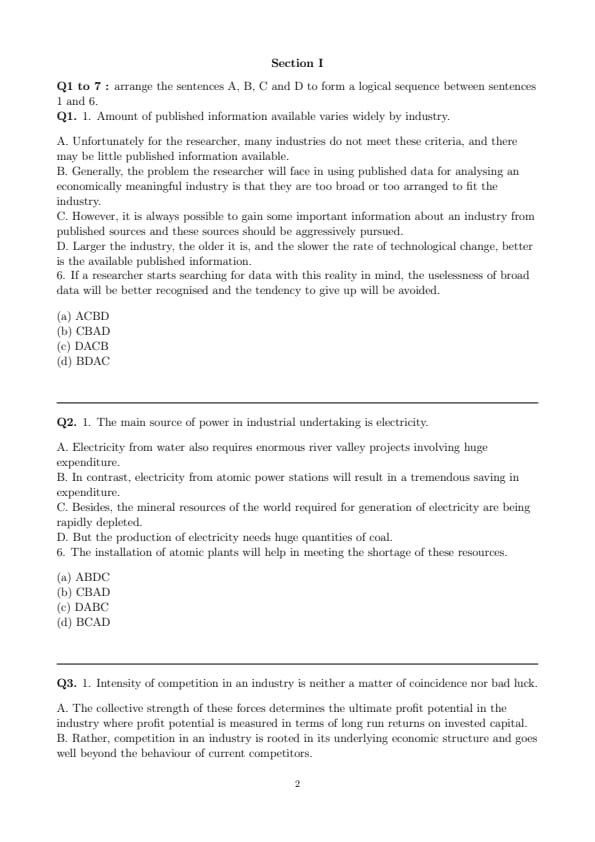
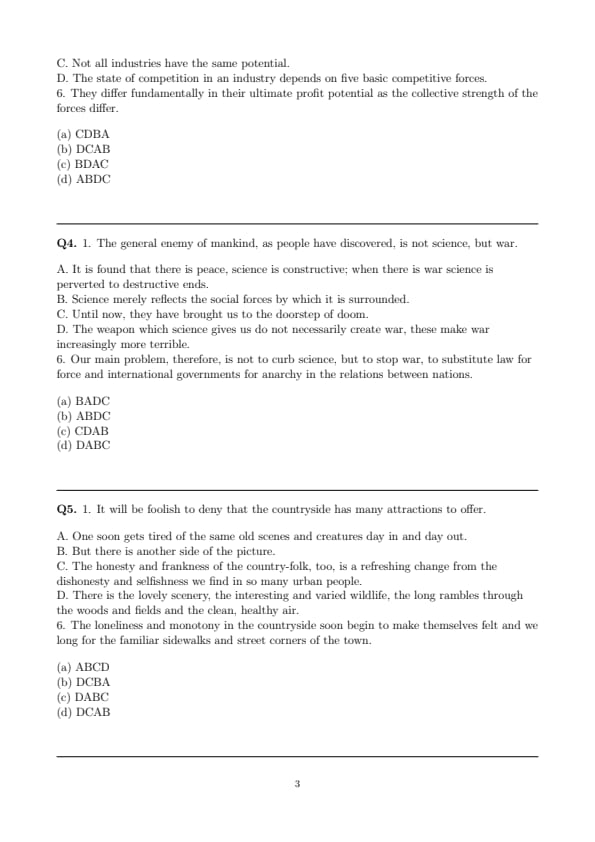
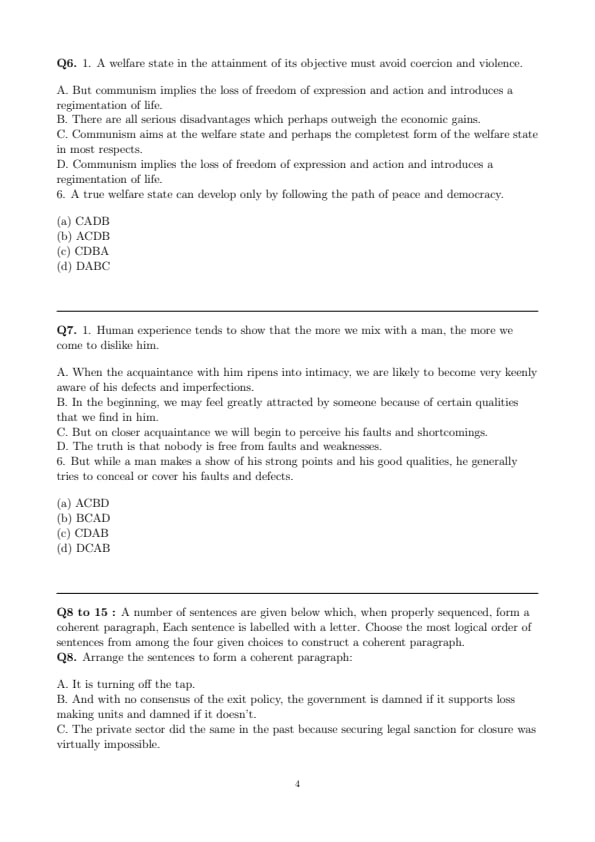
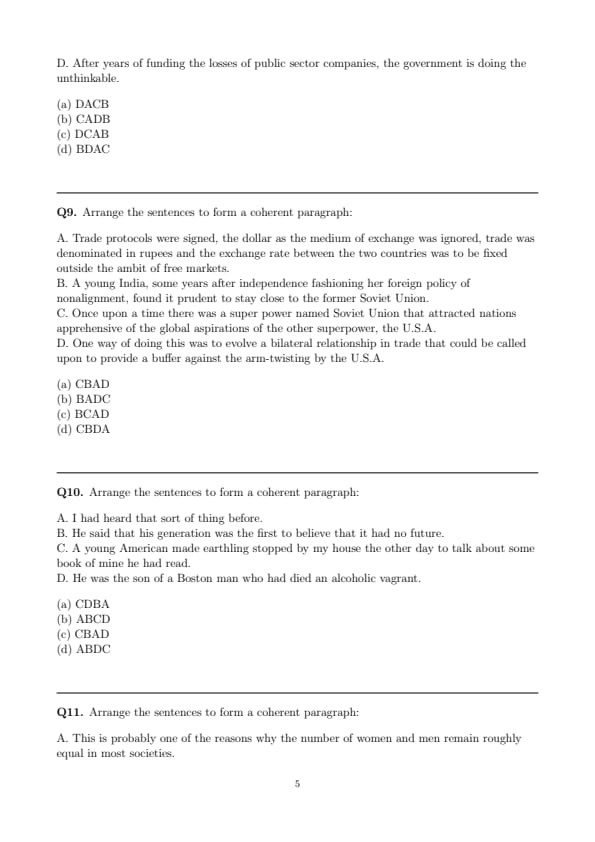
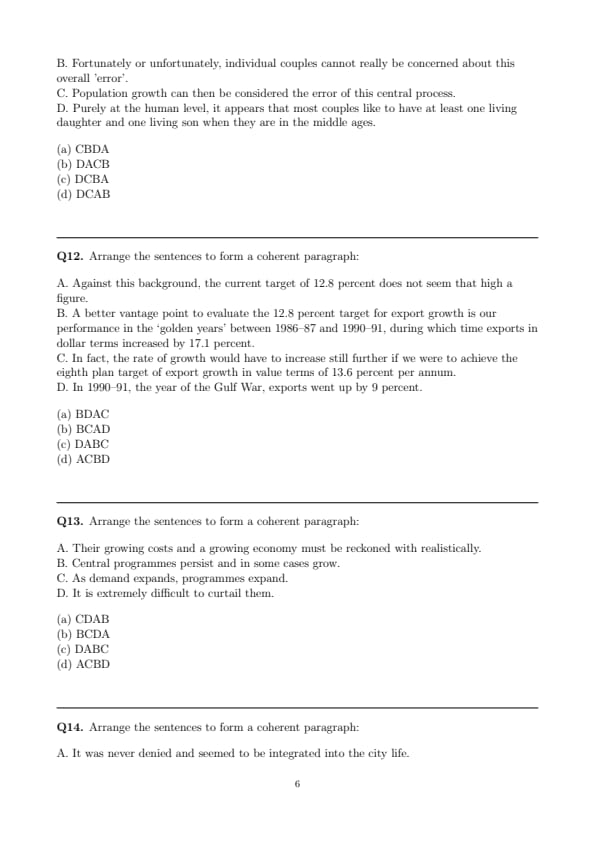
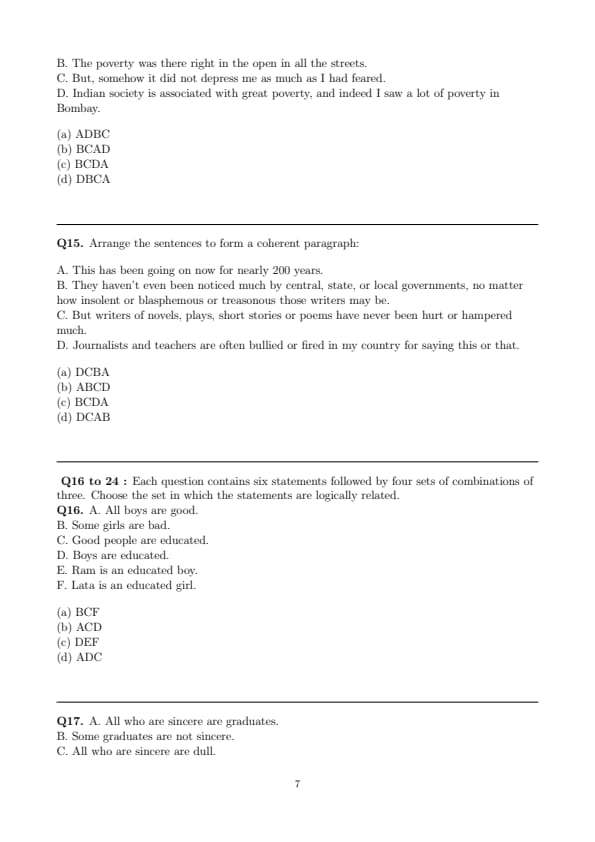
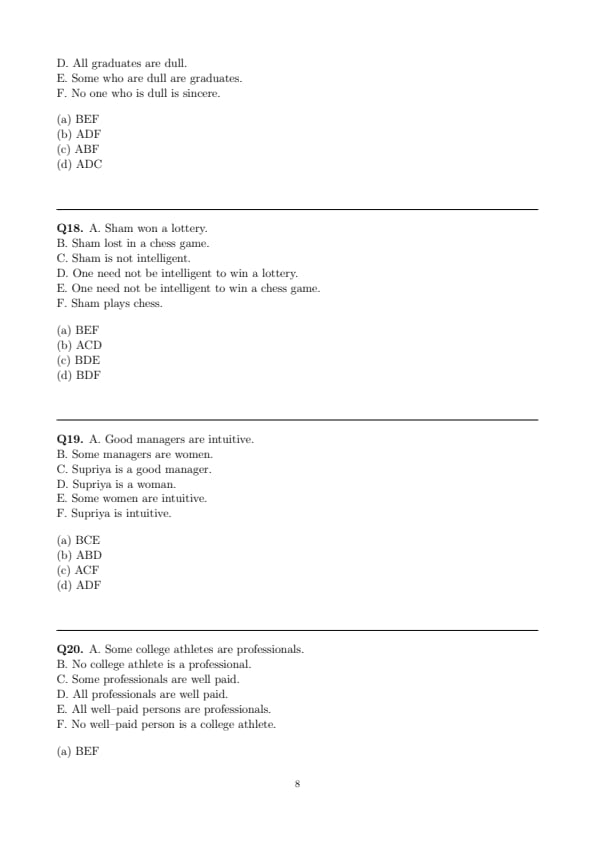
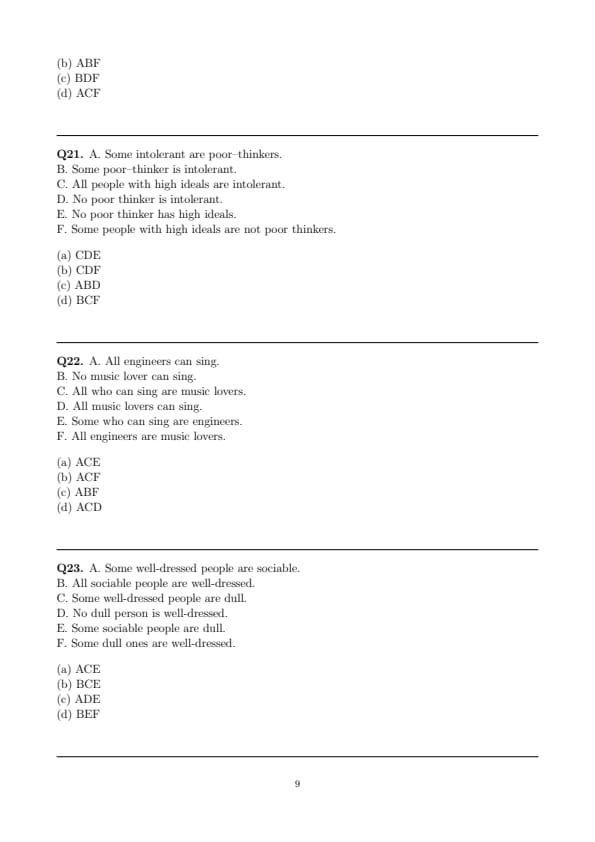
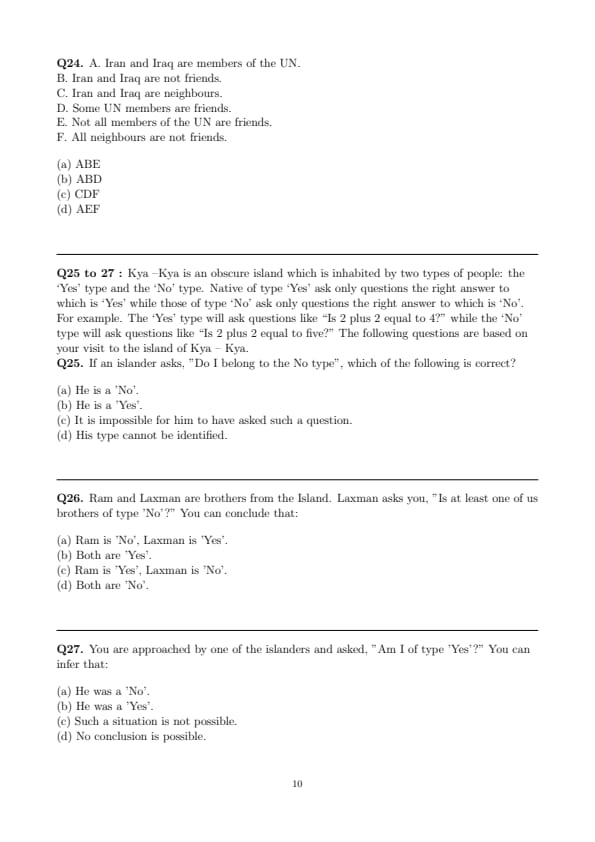
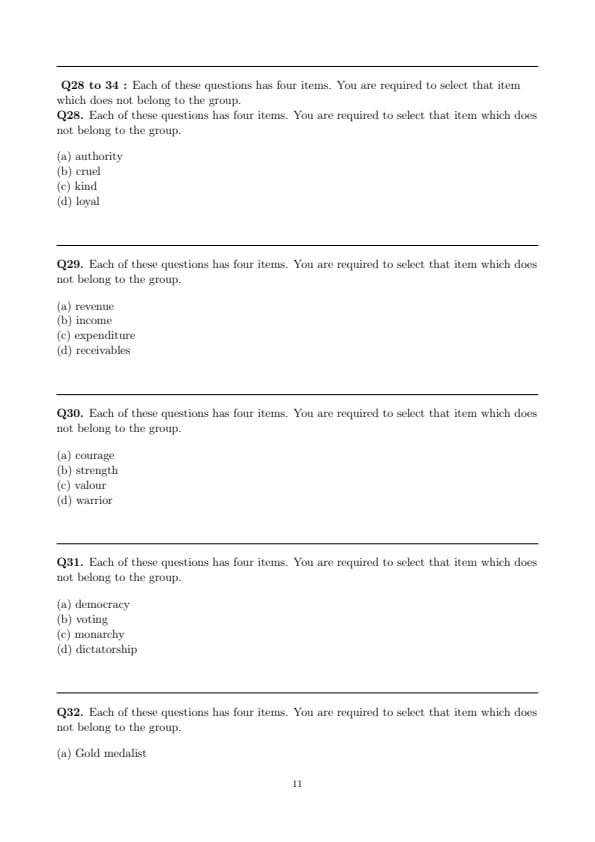
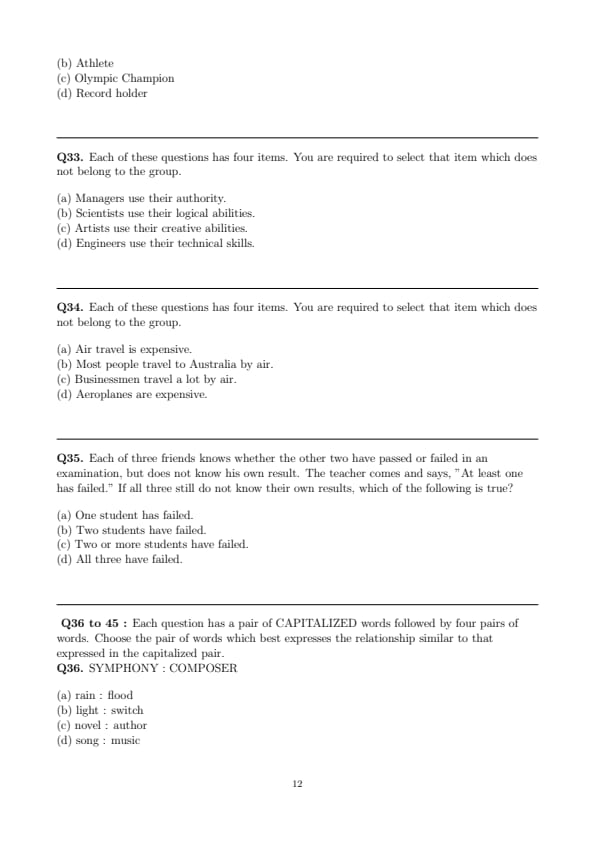
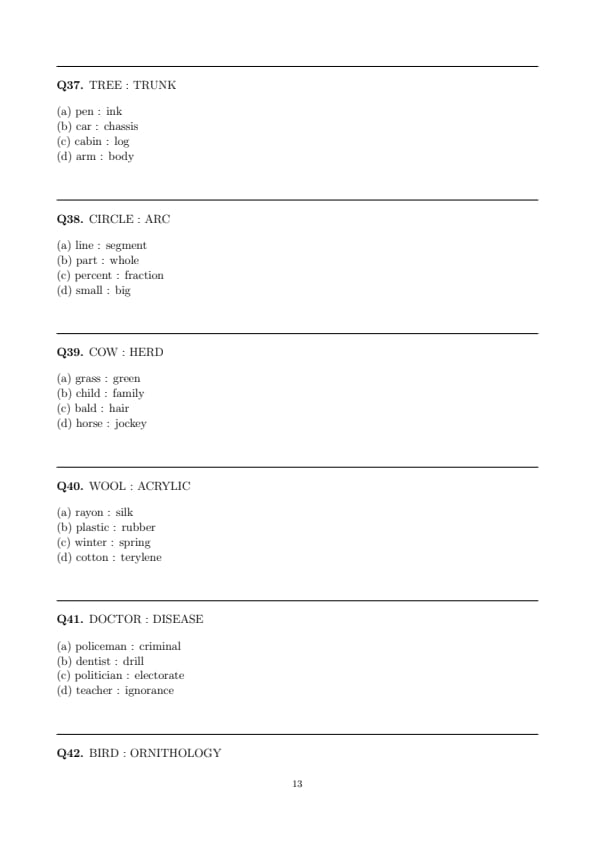
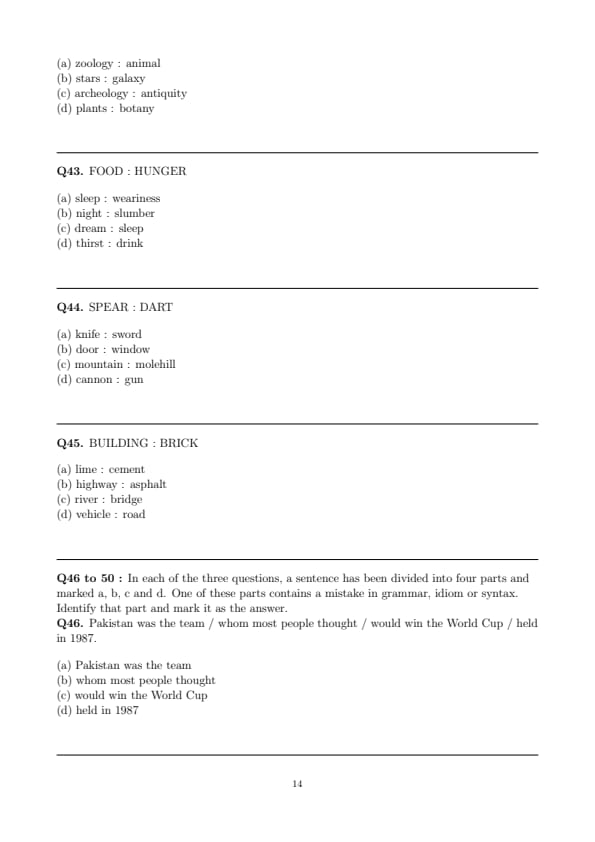
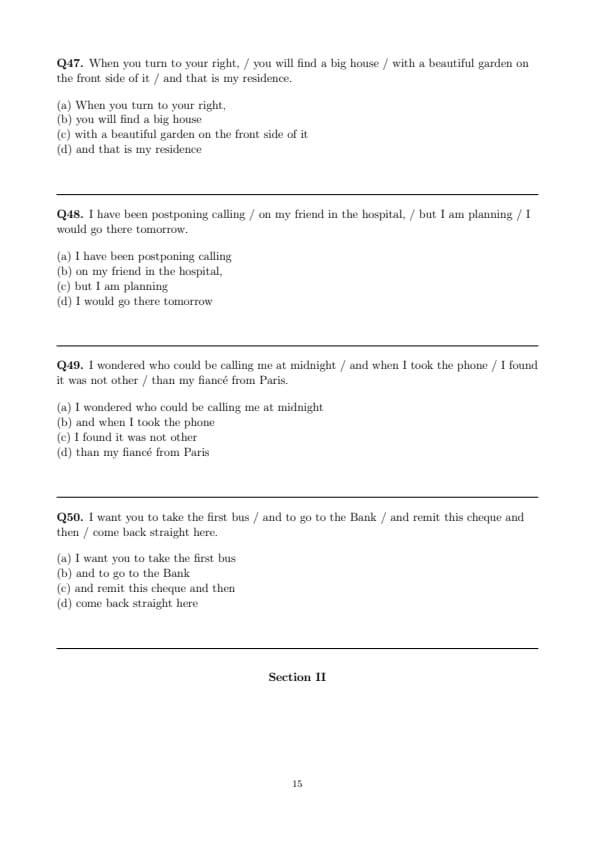
*The article might have information for the previous academic years, please refer the official website of the exam.