
CAT 1994 Question Paper with Solution PDF
- Cut Off for IITs
- IIM Kashipur Cut Off
- IIM Amritsar Cut Off
- IIM Nagpur Cut Off
- IIM Indore Cut Off
- IIM Udaipur Cut Off
- IIM Ranchi Cut Off
- IIM Raipur Cut Off
- IIM Jammu Cut Off
- IIM Bodh Gaya Cut Off
- IIM Kozhikode Cut Off
- IIM Sambalpur Cut Off
- IIM Bangalore Cut Off
- IIM Sirmaur Cut Off
- IIM Trichy Cut Off
- IIM Visakhapatnam Cut Off
- IIM Lucknow Cut Off
- IIM Shillong Cut Off
- IIM Calcutta Cut Off
- IIM Ahmedabad Cut Off
- IIM Rohtak Cut Off


Content Writer | Updated On - Nov 29, 2025
CAT Question Papers are the most important study material for effective exam preparation. We at Zollege have provided all CAT Previous Year Papers with Solution PDFs here. CAT 1994 was conducted successfully by Indian Institutes of Management (IIM) Calcutta.
Students can freely download the CAT previous year's question paper PDFs along with their solutions here. We strongly encourage cat aspirants to scan through all the CAT Question Paper to know the overall difficulty level, CAT Syllabus and understand the changes in CAT Exam Pattern over the years.
Also Check:
CAT 1994 Question Paper with Solution PDF
| CAT 1994 Question Paper with Solutions PDF | Download PDF | Check Solutions |

Q1 - 5: Arrange sentences A, B, C and D between sentences 1 and 6 to form a logical sequence of six sentences.
Question 1:
1. It is often said that good actors can get out of a play more than the author has put into it.
A. A good actor, bringing to a part his own talent, often gives it a value that the layman on reading the play had not seen in it, but at the utmost he can do no more than reach the ideal that the author has seen in his mind's eye.
B. In all my plays I have been fortunate enough to have some of the parts acted as I wanted; but in none have I had all the parts so acted.
C. That is not true.
D. He has to be an actor of address to do this; for the most part the author has to be satisfied with an approximation of the performance he visualized.
6. This is obviously inevitable, for the actor who is suited to a certain role may well be engaged and you have to put up with the second or third best, because there is no help for it.
View Solution
Step 1 (Link 1 \(\rightarrow\) C): Sentence 1 makes a claim; C begins with the rebuttal marker “\emph{That is not true,” so C directly counters 1.
Step 2 (C \(\rightarrow\) A): After negating the claim, A \emph{explains why: even a great actor can at most “reach the ideal the author has seen.” This logically justifies the denial in C.
Step 3 (A \(\rightarrow\) D via demonstrative \emph{this): D opens with “\emph{to do this,” whose nearest sensible antecedent is A’s idea “reach the ideal.” Hence D must follow A.
Step 4 (D \(\rightarrow\) B \(\rightarrow\) 6): B shifts to the author’s personal experience (“\emph{In all my plays…”), which naturally follows the general point in D. Sentence 6 then generalizes B with “\emph{This is obviously inevitable,” where “\emph{This” refers to the situation described in B (not having every part ideally acted) and gives the reason (casting constraints).
Therefore, the sequence between 1 and 6 is C \(\rightarrow\) A \(\rightarrow\) D \(\rightarrow\) B, i.e., \boxed{CADB. Quick Tip: In parajumbles, track cue words: rebuttals (\emph{but, that is not true), demonstratives (\emph{this, that}), and scope shifts (general \(\rightarrow\) personal example \(\rightarrow\) generalization). These often lock local pairs and the global flow.
1. I can think of no serious prose play that has survived the generation that gave it birth.
A. They are museum pieces.
B. They are revived now and then because a famous part tempts a leading actor, or a manager in want of a stop-gap thinks he will put on a play on which he has no royalties to pay.
C. A few comedies have haphazardly traveled down a couple of centuries or so.
D. The audience laugh at their wit with politeness and at their farce with embarrassment.
6. They are not held nor taken out of themselves.
View Solution
Step 1 (1 \(\rightarrow\) C): Statement 1 is a sweeping claim about survival of plays; C introduces the limited exception—“\emph{A few comedies” have survived—so it naturally follows 1 as a contrast/qualification.
Step 2 (C \(\rightarrow\) B): After noting the survival, B explains \emph{how and \emph{why such old pieces still appear: occasional revivals for practical reasons (star parts, managerial stop-gaps, no royalties).
Step 3 (B \(\rightarrow\) A): A then \emph{labels these revived plays as “\emph{museum pieces,” a concise evaluative summary of B’s scenario (they are dated artifacts despite revivals).
Step 4 (A \(\rightarrow\) D \(\rightarrow\) 6 with pronoun tie): D comments on the audience reaction to such “museum pieces” (polite laughter, embarrassment). Sentence 6 must follow D because the pronoun “\emph{They” in 6 refers to “\emph{The audience” in D (“\emph{They are not held nor taken out of themselves”).
Thus, the correct middle order is C \(\rightarrow\) B \(\rightarrow\) A \(\rightarrow\) D, i.e., \boxed{\text{CBAD. Quick Tip: Watch pronoun references carefully. When a sentence uses “they,” ensure the immediately previous line supplies a clear antecedent (here, “the audience”), which fixes D directly before 6.
1. The wind had savage allies.
A. If it had not been for my closely fitted helmet, the explosions might have shattered my eardrums.
B. The first clap of thunder came as a deafening explosion that literally shook my teeth.
C. I didn’t hear the thunder, I actually felt it—an almost unbearable physical experience.
D. I saw lightning all around me in every shape imaginable.
6. It was raining so torrentially that I thought I would drown in mid air.
View Solution
Step 1 (1 \(\rightarrow\) B): “Savage allies” foreshadows specific forces; B names the first—\emph{thunder—as a “deafening explosion,” matching the menace in 1.
Step 2 (B \(\rightarrow\) C): C intensifies the same thunder event: not merely heard but \emph{felt. The lexical link “thunder” binds B and C.
Step 3 (C \(\rightarrow\) A): A continues the acoustic violence with “\emph{explosions” (coreferential with thunderclaps) and the eardrum/helmet detail, which logically follows the felt impact in C.
Step 4 (A \(\rightarrow\) D \(\rightarrow\) 6): After thunder, D introduces the second ally—\emph{lightning. Finally, 6 rounds off the storm tableau with torrential \emph{rain, the third ally, giving a climactic closure.
Hence the coherent chain is B \(\rightarrow\) C \(\rightarrow\) A \(\rightarrow\) D, i.e., \boxed{BCAD. Quick Tip: Build scenes by tracking a consistent imagery chain and escalation: here, \emph{thunder (sound) \(\rightarrow\) \emph{felt impact} \(\rightarrow\) \emph{eardrum risk} \(\rightarrow\) \emph{lightning} (sight) \(\rightarrow\) \emph{rain}—a natural storm progression.
1. All human beings are aware of the existence of a power greater than that of the mortals – the name given to such a power by individuals is an outcome of birth, education and choice.
A. Logically, therefore such a power should be remembered in good times also.
B. Their other philanthropic contributions include the construction and maintenance of religious places such as temples or gurudwaras.
C. Industrial organizations also contribute to the veneration of this power by participating in activities such as religious ceremonies and festivities organized by the employees.
D. This power provides an anchor in times of adversity, difficulty and trouble.
6. The top management/managers should participate in all such events, irrespective of their personal choice.
View Solution
Step 1 (1 \(\rightarrow\) D): The opening statement introduces the concept of a higher power. D extends this by stating the role of that power in providing an anchor during adversity, linking directly with 1.
Step 2 (D \(\rightarrow\) A): A builds logically on D: if power provides strength in bad times, then logically it should also be remembered in good times.
Step 3 (A \(\rightarrow\) C \(\rightarrow\) B): Once the logical role is set, C shifts to the institutional aspect—organizations venerating the power through ceremonies. B supports this by specifying contributions like building temples and gurudwaras.
Thus, the coherent sequence is D \(\rightarrow\) A \(\rightarrow\) C \(\rightarrow\) B, i.e., \boxed{\text{DACB. Quick Tip: Identify logical connectors like “therefore,” “this,” and “also”—they establish the order of reasoning and examples in parajumbles.
1. A thorough knowledge of the path or course to be followed is essential for achieving success.
A. Seniors must show the path clearly by laying down the precise expectations of the management in terms of job description, key result areas and personal targets.
B. They should also ‘light the path’ by personal example.
C. Advice tendered or help offered must be objectively evaluated for its effectiveness in achieving the desired goal.
D. A display of arrogance and a false sense of ‘self-worth’, in order to belittle those who come to help prove dysfunctional.
6. The individuality of each employee must be respected.
View Solution
Step 1 (1 \(\rightarrow\) A): After asserting knowledge of the path, A explains how seniors must show this path clearly.
Step 2 (A \(\rightarrow\) B): Once clarity is ensured, B emphasizes leading by personal example, a natural extension of A.
Step 3 (B \(\rightarrow\) C \(\rightarrow\) D): C talks about evaluating advice objectively, while D gives the negative contrast—arrogance makes help dysfunctional. This sequence rounds off the discussion on guidance.
Thus, the correct order is A \(\rightarrow\) B \(\rightarrow\) C \(\rightarrow\) D, i.e., \boxed{\text{ABCD. Quick Tip: In parajumbles about management/leadership, the order usually flows from conceptual requirement → role of seniors → evaluation → pitfalls.
Q6 - 10: In each of the following questions, the answer choices suggest alternative arrangements of four sentences A, B, C and D. Choose the alternative which suggests a coherent paragraph.
Question 6:
A. To have settled one’s affairs is a very good preparation to leading the rest of one’s life without concern for the future.
B. When I have finished this book I shall know where I stand.
C. One does not die immediately after one has made one’s will; one makes one’s will as a precaution.
D. I can afford then to do what I choose with the years that remain to me.
View Solution
Step 1 (C \(\rightarrow\) A): C introduces the idea of making one’s will as a precaution. A naturally follows: once affairs are settled, one can live life without concern.
Step 2 (A \(\rightarrow\) B \(\rightarrow\) D): B adds a reflective, personal stance—“When I finish this book…”—which gives clarity to where one stands. D concludes by showing the benefit: the freedom to choose in remaining years.
Hence, the flow is C \(\rightarrow\) A \(\rightarrow\) B \(\rightarrow\) D, i.e., \boxed{\text{CABD. Quick Tip: In parajumbles with abstract reflection, look for the general principle first, then the personal reflection, and finally the conclusion.
A. It is sad that India has always been in a hurry to conform to the western thought, especially the American.
B. Even the smaller countries have the guts to take a firm contrarian stand if they feel the policies happen to compromise their country’s interest.
C. It’s one thing to sprout theories on liberalization, and entirely another to barter the interests of the nation in its name.
D. In this case too, while a large number of countries are yet to ratify the GATT, India has not only ratified the treaty, but is also preparing to amend the Patents Act.
View Solution
Step 1 (C \(\rightarrow\) A): C criticizes blind liberalization. A follows by applying this criticism to India’s tendency to conform to western thought.
Step 2 (A \(\rightarrow\) B): B contrasts India’s behavior with smaller countries that resist compromising policies. This provides a global comparison.
Step 3 (B \(\rightarrow\) D): Finally, D cites the GATT and patents case as a concrete example of India’s conformity, aligning with the criticism in C and A.
Thus, the logical order is C \(\rightarrow\) A \(\rightarrow\) B \(\rightarrow\) D, i.e., \boxed{\text{CABD. Quick Tip: When a question involves critique of policy, the flow usually follows: critique (general) → example of the nation → comparison with others → concrete case.
But instead you are faced with another huge crag and the weary trail continues.
A. No, the path wind on and another mountain bars your way.
B. When for days you have been going through a mountain pass, a moment comes when you are sure that after winding around the great mass of rock in front of you, you will come upon the plain.
C. Surely after this you will see the plain.
View Solution
Step 1 (8 \(\rightarrow\) C): The sentence opens with the challenge of facing a “huge crag and weary trail.” C begins with “Surely after this,” referring to the ongoing journey and providing an optimistic closure. This sets the tone for the challenge ahead.
Step 2 (C \(\rightarrow\) A): Sentence A adds further explanation to C, suggesting that no matter how challenging the path may seem, the journey continues. It sets a logical continuation: after overcoming this hurdle, the plain will eventually be reached.
Step 3 (A \(\rightarrow\) D): D provides the immediate consequence of the continued struggle, describing the persistent path and its inevitable challenges. This statement follows naturally after the reflection in A.
Step 4 (D \(\rightarrow\) B): B offers a reflective pause, explaining the moment of realization that after all the challenges, a breakthrough is expected, and the plain will be reached.
Thus, the correct sequence is C \(\rightarrow\) A \(\rightarrow\) D \(\rightarrow\) B, i.e., \boxed{\text{CADB. Quick Tip: In paragraph sequencing, look for a combination of causal and consequential sentences. Words like “after” and “inevitable” signal sequence order and causality.
During one exhibition, however, some air became mixed with the hydrogen, and in the words of the shaken performer: “The explosion was so dreadful that I imagined all my teeth had been blown out!”
A. An entertainer would finish his acts by blowing the hydrogen he had inhaled towards a lighted candle; as the hydrogen caught fire, flames would shoot menacingly from his lips.
B. A paper bag filled with hydrogen amazed guests by zooming off into space.
C. When people learned about its unique lighter-than-air property, they began to use it in all sorts of parlor stunts.
D. The hydrogen caught fire and burned through the performer’s lips.
View Solution
Step 1 (9 \(\rightarrow\) D): The initial description in 9 talks about a catastrophic event, which D follows with a vivid description of hydrogen catching fire and causing harm to the performer’s lips.
Step 2 (D \(\rightarrow\) C): After introducing the dangerous effect of hydrogen, C provides a more detailed explanation of its lighter-than-air property and its use in parlor tricks.
Step 3 (C \(\rightarrow\) B): B introduces one such use: a paper bag filled with hydrogen floating off into space, showcasing its unique characteristic.
Step 4 (B \(\rightarrow\) A): Finally, A shows how the performer exploits hydrogen’s properties in a flamboyant display, explaining how he uses it to entertain by blowing fire.
Thus, the correct sequence is D \(\rightarrow\) C \(\rightarrow\) B \(\rightarrow\) A, i.e., \boxed{\text{DCBA. Quick Tip: In descriptions involving processes, focus on the cause and effect relationship: dangerous incidents followed by background details and explanations, concluding with a practical demonstration.
A. It is exciting and various.
B. I am a writer as I might have been a doctor or a lawyer.
C. The writer is free to work in what he believes.
D. It is so pleasant a profession that it is not surprising if a vast number of persons adopt it who have no qualifications for it.
View Solution
Step 1 (10 \(\rightarrow\) B): The statement B talks about the writer’s role, establishing it as a profession the writer could have pursued, just like any other career choice.
Step 2 (B \(\rightarrow\) D): D then adds that writing is so pleasant that anyone, even without qualifications, may be tempted to join.
Step 3 (D \(\rightarrow\) A): A provides the general description of the profession, emphasizing its variety and excitement as an underlying theme.
Step 4 (A \(\rightarrow\) C): C logically follows, as it explains the freedom of writing that makes it unique among professions, reinforcing the points made earlier.
Thus, the correct sequence is B \(\rightarrow\) D \(\rightarrow\) A \(\rightarrow\) C, i.e., \boxed{\text{BDAC. Quick Tip: Look for profession-related sentences that build logically: qualification \(\rightarrow\) freedom of work \(\rightarrow\) profession’s appeal \(\rightarrow\) personal reflection.
Q11 - 15: four statements with blanks have been given. These statements are followed by four alternatives. Choose the one which fits into the set of statements the maximum number of times.
Question 11:
A. Professional studies has become the _________ of the rich.
B. Every citizen has the ________ to speak, travel and live as he pleases.
C. He has a definite ________ over all his rivals.
D. Sheron no longer has the ________ of the company’s bungalow and car.
View Solution
Step 1 (11 \(\rightarrow\) B): “Privilege” fits in context as a special right or advantage exclusive to the rich, which introduces the central theme.
Step 2 (B \(\rightarrow\) C): C extends the idea by discussing how one’s advantage or privilege gives them a clear advantage over others in competition.
Step 3 (C \(\rightarrow\) A): A introduces a more general remark on the rich using “professional studies,” but it ties to the privileged position.
Step 4 (A \(\rightarrow\) D): D appropriately wraps up by discussing a lost privilege, where “Sheron no longer has the privilege of the company’s bungalow and car.”
Thus, the correct sequence is B \(\rightarrow\) C \(\rightarrow\) A \(\rightarrow\) D, i.e., \boxed{\text{B. Quick Tip: The term “privilege” often introduces exclusivity and high social status, so look for the context where something is lost or gained that only a select few can access.
A. People sensed ________.
B. A bad ________ case had come in – a person with a smashed arm.
C. And then, without warning, ________ struck.
D. The dogs were the first to recognize the signs of oncoming ________.
View Solution
Step 1 (12 \(\rightarrow\) C): The phrase "struck" strongly suggests a sudden event, which is typical of a "disaster." C starts the sequence with the appropriate word.
Step 2 (C \(\rightarrow\) A): After the disaster is introduced, A can follow as people begin to sense its effects.
Step 3 (A \(\rightarrow\) B): B gives an example of a “bad accident,” leading to a detailed description of the scene, where a person with a smashed arm has entered.
Step 4 (B \(\rightarrow\) D): Finally, D connects the context by noting that the dogs were the first to recognize the impending disaster.
Thus, the correct sequence is C \(\rightarrow\) A \(\rightarrow\) B \(\rightarrow\) D, i.e., \boxed{\text{C. Quick Tip: In descriptions of catastrophic events, look for words that convey sudden impact and severity like “struck,” “sensed,” and “disaster” to establish the logical sequence.
A. The men there have fought ________ and emotional withdrawal, and were more capable of helping Jim.
B. But ________ does occasionally inflict all the adults.
C. A person who is deeply hurt feels very ________.
D. It is hard to survive this feeling of ________.
View Solution
N/A Quick Tip: In emotional contexts, terms like “depression” or “loneliness” often match when describing prolonged or deep feelings.
A. I have had a small power of ________.
B. Down with a very high fever, he suffers from frequent fits of ________.
C. They are now bitter enemies – all because of a small ________.
D. Her ________ is the most creative thing she has ever possessed.
View Solution
N/A Quick Tip: When selecting between mental processes, “imagination” refers to creativity, “hallucinations” to misperceptions, and “illusion” to trickery or false beliefs.
A. Communism states that every individual must live for the ________.
B. The ________ of the affairs of the nation is deplorable.
C. ________ have been laid down by the United States: states The Statesman.
D. No ________ has succeeded in gaining complete autonomy from the Federal government.
View Solution
Step 1 (15 \(\rightarrow\) A): In the context of communism, “state” refers to the overarching political entity that controls economic and social systems, and the individual’s role is dictated by the state.
Step 2 (A \(\rightarrow\) C): The sentence logically continues with C as it details formal statements or laws laid down by political entities, which are generally associated with state governance.
Step 3 (C \(\rightarrow\) D): The transition to D discussing autonomy from the Federal government fits the larger discussion of state control.
Thus, the correct answer is \boxed{\text{A. Quick Tip: In political contexts, “state” refers to the government’s role in regulating society, whereas “nation” refers to broader cultural and historical identities.
Q16 - 18: From the given alternatives, select the one in which the pairs of words have a relationship similar to the one between the bold words.
Question 16:
lying : perjury
View Solution
Step 1 (16 \(\rightarrow\) A): The relationship in the given analogy is one where lying leads to perjury, a legal offense. Similarly, a “statement” can lead to “testimony” in a legal or formal setting.
Step 2 (A \(\rightarrow\) C, B, D): The other options involve verbs and actions, which do not follow the same cause-and-effect relationship seen between lying and perjury.
Thus, the correct answer is \boxed{\text{A. Quick Tip: Look for relationships that suggest one act directly leads to a formal or legal consequence.
prehistoric : medieval
View Solution
Step 1 (17 \(\rightarrow\) B): The relationship between prehistoric and medieval is one of temporal progression—prehistoric times came before medieval times, just as “present” precedes the “future.”
Step 2 (B \(\rightarrow\) A, C, D): Other pairs (A, C, D) represent different types of relationships (person to nationality, writer to era, or large entity to species), not temporal progression.
Thus, the correct answer is \boxed{\text{B. Quick Tip: Look for relationships involving time or sequences—“prehistoric” to “medieval” involves a clear historical order, just like “present” to “future.”
loud : stentorian
View Solution
Step 1 (18 \(\rightarrow\) D): The relationship between “loud” and “stentorian” is one of intensity—“stentorian” is an intense form of loud, just as “resplendent” is an intense form of “bright.”
Step 2 (D \(\rightarrow\) A, B, C): Other options involve comparative or descriptive relationships but do not match the intensity of the loud-to-stentorian pairing.
Thus, the correct answer is \boxed{\text{D. Quick Tip: For intensifying adjectives, look for a more powerful word (like “stentorian” for loud) or a descriptive upgrade (like “resplendent” for bright).
Q19 - 23 : four parts of a sentence have been given. From the alternatives, find the combination which best gives a meaningful sentence.
Question 19:
A. There was the hope that in another existence a greater happiness would reward one’s previous existence, and the effort to do better would be less difficult too when
B. previous existence, and the effort to do better would be less difficult too when
C. it would be difficult to bear the evils of one’s own life if
D. one could think that they were but the necessary outcome of one’s errors in a
View Solution
Step 1 (19 \(\rightarrow\) C): The sentence begins with the idea that it would be difficult to bear life’s evils if there wasn’t hope of a greater existence.
Step 2 (C \(\rightarrow\) D): D then adds the thought of how one could find solace in believing that current difficulties are the necessary result of past errors.
Step 3 (D \(\rightarrow\) B): B introduces the idea of “previous existence,” logically extending the idea that past life carries consequences.
Step 4 (B \(\rightarrow\) A): A completes the thought, suggesting the hope that future existence will bring greater happiness, following from the perspective that past struggles were necessary.
Thus, the correct sequence is C \(\rightarrow\) D \(\rightarrow\) B \(\rightarrow\) A, i.e., \boxed{\text{D. Quick Tip: When arranging philosophical or reflective sentences, look for logical progressions from uncertainty to resolution, often involving past and future considerations.
A. He can only renew himself if his soul
B. He renews himself and
C. The writer can only be fertile if
D. Is constantly enriched by fresh experience
View Solution
Step 1 (20 \(\rightarrow\) C): The phrase “the writer can only be fertile if…” introduces a condition for a writer to remain productive, making C the starting point.
Step 2 (C \(\rightarrow\) B): B follows logically by stating that the writer renews himself, which aligns with the idea that fertility in writing depends on personal renewal.
Step 3 (B \(\rightarrow\) A): A follows naturally from B, as it clarifies that self-renewal is tied to the soul, which is implied by the personal growth mentioned in B.
Step 4 (A \(\rightarrow\) D): D provides the ultimate condition for renewal, stating that it must be enriched by fresh experiences, which completes the cycle of renewal.
Thus, the correct answer is \boxed{\text{A. Quick Tip: When discussing creative processes, look for sequences that emphasize self-renewal or growth, as well as how external factors (like fresh experiences) support the internal process.
A. but a masterpiece is
B. untaught genius
C. A laborious career than as the lucky fluke of
D. more likely to come as the culminating point of
View Solution
Step 1 (21 \(\rightarrow\) A): The sentence starts with “but a masterpiece is,” setting up a contrast or defining the concept of a masterpiece. A works here, introducing the subject.
Step 2 (A \(\rightarrow\) D): D follows because it elaborates on what the masterpiece is: the “culminating point of” something, which ties to A’s introduction of the idea of a masterpiece.
Step 3 (D \(\rightarrow\) C): C then discusses the journey of achieving such a masterpiece, describing the laborious effort required.
Step 4 (C \(\rightarrow\) B): Finally, B adds that the creative genius behind a masterpiece may not always be taught, reinforcing the idea that it can come through hard work or luck.
Thus, the correct answer is \boxed{\text{B. Quick Tip: In parajumbles about mastery and effort, the structure often starts with the definition, elaborates on the effort, and finishes with the unexpected or extraordinary aspect.
A. what interests you is the way in which you have created the illusion
B. they are angry with you, for it was
C. the public is easily disillusioned and then
D. the illusion they loved; they do not understand that
View Solution
Step 1 (22 \(\rightarrow\) C): C introduces the idea that the public is easily disillusioned, which sets the stage for the following sentences.
Step 2 (C \(\rightarrow\) B): B clarifies why they are angry: because the illusion they once believed in has been disrupted.
Step 3 (B \(\rightarrow\) D): D follows by elaborating that the public does not understand the reality behind the illusion they loved.
Step 4 (D \(\rightarrow\) A): Finally, A ties the concept of illusion creation to the speaker, showing that they created the illusion that now causes disillusionment.
Thus, the correct answer is \boxed{\text{C. Quick Tip: In sentences involving emotional reactions, the sequence often flows from cause (illusion) to effect (anger) and explanation (lack of understanding).
A. an adequate physical and social infrastructure level
B. the pattern of spatial growth in these towns as also to
C. the failure of the government to ensure
D. the roots of the riots are related to
View Solution
Step 1 (23 \(\rightarrow\) D): D begins by introducing the roots of the riots, which sets the context for the subsequent explanation of their causes.
Step 2 (D \(\rightarrow\) B): B then talks about the pattern of spatial growth in these towns, which is tied to the causes of the riots.
Step 3 (B \(\rightarrow\) C): C links the government’s failure to ensure proper growth, which leads to the spatial problems described in B.
Step 4 (C \(\rightarrow\) A): A rounds off the sequence by referring to the adequate physical and social infrastructure needed to prevent such issues.
Thus, the correct answer is \boxed{\text{B. Quick Tip: When discussing societal issues like riots, look for a chain of cause-and-effect relationships: origins \(\rightarrow\) failures \(\rightarrow\) consequences \(\rightarrow\) solutions.
One dark night a Darvesh ________ passing by a dry well.
View Solution
Step 1 (24 \(\rightarrow\) B): The phrase “happened to be” fits the context of a Darvesh passing by the well, as it implies a casual or coincidental occurrence. It suggests that the Darvesh was simply passing by, not intentionally stopping.
Thus, the correct answer is \boxed{\text{B.
\begin{quicktipbox
“Happened to be” is often used to describe something happening by chance or as a coincidental action.
\end{quicktipbox Quick Tip: “Happened to be” is often used to describe something happening by chance or as a coincidental action.
Nordisk have recently ________ a product called Glucometer.
View Solution
Step 1 (25 \(\rightarrow\) C): “Launched” is the most suitable verb here because it refers to the introduction of a product to the market, which is common when companies release new products.
Thus, the correct answer is \boxed{\text{C.
\begin{quicktipbox
“Launch” is commonly used in the context of releasing new products or services into the market.
\end{quicktipbox Quick Tip: “Launch” is commonly used in the context of releasing new products or services into the market.
I had already published a novel and it was an unexpected success. I thought my ________.
View Solution
Step 1 (26 \(\rightarrow\) D): The phrase “fortune was made” fits best in the context, as it refers to the unexpected success of the novel, which indicates that the individual’s luck or fortune has turned.
Thus, the correct answer is \boxed{\text{D.
\begin{quicktipbox
When referring to sudden success or good luck, “fortune was made” is commonly used to describe an unexpected, favorable outcome.
\end{quicktipbox Quick Tip: When referring to sudden success or good luck, “fortune was made” is commonly used to describe an unexpected, favorable outcome.
The neighbour grabbed the boy, and rolled him on the road to ________ the flames.
View Solution
Step 1 (27 \(\rightarrow\) A): “Smother” is the correct choice because it refers to extinguishing flames by cutting off the air supply. This is the typical method of controlling a fire by rolling the boy.
Thus, the correct answer is \boxed{\text{A.
\begin{quicktipbox
“Smother” is used when extinguishing something by cutting off its oxygen supply, often used in fire contexts.
\end{quicktipbox Quick Tip: “Smother” is used when extinguishing something by cutting off its oxygen supply, often used in fire contexts.
Sam asked me to keep his secret ________.
View Solution
Step 1 (28 \(\rightarrow\) D): The phrase “between us” is the most common expression when referring to keeping a secret shared between two people. It implies confidentiality.
Thus, the correct answer is \boxed{\text{D.
\begin{quicktipbox
“Between us” is the most common phrase used when referring to keeping something secret between two people.
\end{quicktipbox Quick Tip: “Between us” is the most common phrase used when referring to keeping something secret between two people.
Sometimes the greatest inventions ________ an idea of starting simplicity.
View Solution
Step 1 (29 \(\rightarrow\) B): “Hinge upon” is the correct expression, as it suggests that the invention relies on or is dependent on an idea of simplicity. This phrase fits the context of invention.
Thus, the correct answer is \boxed{\text{B.
\begin{quicktipbox
“Hinge upon” is a common expression to show dependence or reliance on something for success or development.
\end{quicktipbox Quick Tip: “Hinge upon” is a common expression to show dependence or reliance on something for success or development.
Real friends, genuinely wanting the best for the organization, ________ different garbs.
View Solution
Step 1 (30 \(\rightarrow\) A): The phrase “come in different garbs” is the most natural expression, as it conveys that friends may present themselves in various forms or appearances, depending on the context. The phrase is commonly used to express the changing ways in which friends act or present themselves for the sake of the organization.
Thus, the correct answer is \boxed{\text{A. Quick Tip: “Come in” is used for situations where individuals assume different forms or appearances for various purposes or situations.
A. If India has embarked on the liberalization route, she cannot afford to go back.
B. Under these circumstances, being an active supporter of WTO policies will be a good idea.
C. The WTO is a truly global organization aiming at free trade.
D. Many member countries have already drafted plans to simplify tariff structures.
View Solution
Step 1 (31 \(\rightarrow\) C): The WTO is indeed a global organization, and the sentence defines the importance of free trade, providing an explanation for why India’s liberalization would align with global policies.
Step 2 (C \(\rightarrow\) F): Following this, the sentence describes India’s strategy of simplifying tariff structures, which supports the earlier notion of liberalization.
Step 3 (F \(\rightarrow\) F): The final statement further elaborates on the need for active participation in WTO policies in this context.
Thus, the correct answer is \boxed{\text{C. Quick Tip: Look for statements that logically progress from explaining an organization to its supporting actions in global contexts.
A. The Minister definitely took the wrong step.
B. Under the circumstances, he had many other alternatives.
C. The Prime Minister is embarrassed due to the Minister’s decision.
D. If he has put the government in jeopardy, the Minister must resign.
View Solution
Step 1 (32 \(\rightarrow\) A): The sentence opens with a direct statement about the minister's mistake, establishing the factual claim.
Step 2 (A \(\rightarrow\) F): Following this, the minister’s action of taking a wrong step is further supported by the circumstances that show there were alternatives.
Step 3 (F \(\rightarrow\) J): The embarrassment of the Prime Minister adds to the negative effects of the decision, reinforcing that the action was indeed wrong.
Thus, the correct answer is \boxed{\text{A. Quick Tip: Look for statements that escalate from a factual mistake to the implications it has on other stakeholders.
A. The ideal solution will be to advertise aggressively.
B. One brand is already popular amongst the youth.
C. Reducing prices will mean trouble as our revenues are already dwindling.
D. The correct solution will be to consolidate by aggressive marketing.
View Solution
Step 1 (33 \(\rightarrow\) A): The idea of an ideal solution starts with the concept of aggressive marketing, which is expanded upon in the next few sentences.
Step 2 (A \(\rightarrow\) J): The effectiveness of this solution is highlighted by showing that another popular brand has already succeeded with this strategy.
Step 3 (J \(\rightarrow\) F): F provides the real challenge of the situation—reducing prices would be harmful to the business, given dwindling revenues.
Thus, the correct answer is \boxed{\text{A. Quick Tip: In business scenarios, "advertising aggressively" and "consolidating market position" are strategies commonly linked together to increase success.
A. If democracy is to survive the people must develop a sense of consumerism.
B. Consumerism has helped improve the quality of goods in certain countries.
C. The protected environment in our country is helping the local manufacturers.
D. The quality of goods suffers if the manufacturers take undue advantage of this.
View Solution
Step 1 (34 \(\rightarrow\) F): F is the foundation that establishes the importance of consumerism for democracy, which serves as the starting point.
Step 2 (F \(\rightarrow\) J): The second statement provides evidence of how consumerism can help improve goods quality.
Step 3 (J \(\rightarrow\) I): The final point focuses on the challenges, such as how manufacturers might exploit this trend.
Thus, the correct answer is \boxed{\text{B. Quick Tip: When discussing economics and social systems, look for logical sequences from problem identification to solutions and challenges faced by industries.
A. Unless the banks agree to a deferment of the interest, we cannot show profits this year.
B. This would not have happened had we adopted a stricter credit scheme.
C. The revenues so far cover only the cost and salaries.
D. Let us learn a lesson: we cannot make profits without complete control over credit.
View Solution
Step 1 (35 \(\rightarrow\) F): The discussion begins with a statement about the lack of profits if the banks don't agree to defer interest.
Step 2 (F \(\rightarrow\) J): J explains the situation further by discussing how the current revenue structure only covers costs, indicating a financial problem.
Step 3 (J \(\rightarrow\) F): F repeats the lesson learned about controlling credit in order to make profits.
Thus, the correct answer is \boxed{\text{D. Quick Tip: In financial discussions, statements often begin with issues, followed by analysis, and conclude with lessons learned.
A. Qualities cannot be injected into one's personality.
B. They are completely dependent on the genetic configuration that one inherits.
C. Hence changing our inherent traits is impossible as the genes are unalterable.
D. The least one can do is to try and subdue the “bad qualities”.
View Solution
Step 1 (36 \(\rightarrow\) J): The first statement expresses an opinion about qualities not being changeable. This is a judgment on the nature of qualities.
Step 2 (J \(\rightarrow\) F): Statement B provides a factual claim that qualities are inherited and based on genetic makeup, making it a fact.
Step 3 (F \(\rightarrow\) J): The next logical step is understanding that changing these traits is impossible, as stated in C. This continues from the fact into a logical deduction.
Step 4 (J \(\rightarrow\) I): The final statement offers an inference about how one might manage the “bad qualities,” linking the previous concepts to practical advice.
Thus, the correct answer is \boxed{\text{C. Quick Tip: Look for a sequence that moves from an opinion to a fact and then logically concludes with an inference.
A. Everything is purposeless.
B. Nothing before and after the existence of the universe is known with certainty.
C. Man is a part of the purposeless universe; hence man is also purposeless.
D. There is only one way of adding purpose to this universe: Union with Him.
View Solution
Step 1 (37 \(\rightarrow\) F): Statement A is a factual observation about the purposelessness of the universe, which sets the base for the following arguments.
Step 2 (F \(\rightarrow\) J): Statement B adds to this factual claim by providing the uncertainty about the universe's origin and purpose.
Step 3 (J \(\rightarrow\) I): Statement C draws a logical connection between humans and the purposeless universe, leading to the inference that humans too are purposeless.
Step 4 (I \(\rightarrow\) F): Finally, D offers a solution to the purposelessness by proposing Union with Him as a purpose.
Thus, the correct answer is \boxed{\text{A. Quick Tip: Look for a logical progression that moves from factual observation to reasoning and ends with an inference.
A. Everyday social life is impossible without interpersonal relationships.
B. The root of many misunderstandings has been cited in poor relations among individuals.
C. Assuming the above to be true, social life will be much better if people understand the importance of good interpersonal relations.
D. A study reveals that interpersonal relations and hence life in general can be improved with a little effort on the part of individuals.
View Solution
Step 1 (38 \(\rightarrow\) J): The first statement introduces the importance of interpersonal relationships, which is a judgment about social life.
Step 2 (J \(\rightarrow\) F): The second statement builds on this judgment with a factual claim that misunderstandings arise from poor relationships.
Step 3 (F \(\rightarrow\) I): The third statement logically infers that improving interpersonal relations will improve social life.
Step 4 (I \(\rightarrow\) F): The final statement adds a factual note on how interpersonal relationships can be improved with effort.
Thus, the correct answer is \boxed{\text{B. Quick Tip: Look for a sequence where judgment about a concept is supported by facts, followed by an inference and a final factual conclusion.
A. The prices of electronic goods are falling.
B. Sine we have substantial reductions in import duties, this is obvious.
C. The trend is bound to continue in the near future.
D. But the turnover of the electronic industry is still rising, because the consumers are increasing at a rapid rate.
View Solution
Step 1 (39 \(\rightarrow\) F): The first statement is factual, indicating the falling prices of electronics.
Step 2 (F \(\rightarrow\) J): The second statement gives a reason for the price fall, providing a factual claim about reductions in duties.
Step 3 (J \(\rightarrow\) I): The third statement predicts the continuation of the price fall trend, offering an inference based on current trends.
Step 4 (I \(\rightarrow\) J): The fourth statement provides a contradiction by explaining why the industry is still growing despite falling prices.
Thus, the correct answer is \boxed{\text{C. Quick Tip: In economic statements, look for factual claims that are followed by predictions, which are then contrasted by counterexamples or exceptions.
A. In the past, it appears, wealth distribution, and not wealth creation has dominated the economic policy.
B. Clearly, the government has not bothered to eradicate poverty.
C. Today’s liberalization is far from the hitherto Nehruvian socialism.
D. Results are evident in the form of a boom in the manufacturing sector output and turnover of all industries.
View Solution
Step 1 (40 \(\rightarrow\) F): The first statement offers a factual observation about the historical focus on wealth distribution.
Step 2 (F \(\rightarrow\) J): The second statement introduces the failure of the government to address poverty, which follows from the previous observation.
Step 3 (J \(\rightarrow\) F): The third statement explains that the current liberalization policies differ from past policies, providing additional context.
Step 4 (F \(\rightarrow\) I): The final statement provides evidence of the positive impact of liberalization, showing the boom in industries.
Thus, the correct answer is \boxed{\text{D. Quick Tip: When analyzing policy discussions, look for a sequence that begins with a historical fact, critiques it, and then shifts to the present with evidence of improvement.
A. All vegetarians eat meat.
B. All those who eat meat are not vegetarians.
C. All those who eat meat are herbivorous.
D. All vegetarians are carnivorous.
E. All those who eat meat are carnivorous.
F. Vegetarians are herbivorous.
View Solution
Step 1 (41 \(\rightarrow\) A): Statement A suggests that vegetarians do eat meat, but that contradicts the general definition of vegetarians.
Step 2 (A \(\rightarrow\) C): Statement C confirms that those who eat meat are herbivores.
Step 3 (C \(\rightarrow\) F): Statement F concludes that vegetarians are herbivores, making this the only logical conclusion.
Thus, the correct answer is \boxed{\text{D. Quick Tip: In such logical deduction questions, focus on identifying contradictions and follow through with related logical conclusions.
A. All roses have thorns.
B. All roses have nectar.
C. All plants with nectar have thorns.
D. All shrubs have roses.
E. All shrubs have nectar.
F. Some roses have thorns.
View Solution
Step 1 (42 \(\rightarrow\) B): Statement B about roses having nectar fits well as it links roses and nectar together.
Step 2 (B \(\rightarrow\) D): Statement D about shrubs having roses supports the idea that shrubs contribute to the presence of roses.
Step 3 (D \(\rightarrow\) E): E then follows as the relationship between shrubs and nectar continues to be linked.
Thus, the correct answer is \boxed{\text{C. Quick Tip: Look for statements that describe relationships and connections among items (roses, nectar, shrubs) to logically form the sequence.
A. No spring is a season.
B. Some seasons are springs.
C. Some seasons are autumns.
D. No seasons are autumns.
E. Some springs are not autumns.
F. All springs are autumns.
View Solution
Step 1 (43 \(\rightarrow\) D): Statement D asserts that no seasons are autumns, setting up the fact about seasons.
Step 2 (D \(\rightarrow\) F): F asserts that all springs are autumns, a contrast to D, highlighting the exception.
Step 3 (F \(\rightarrow\) A): Statement A elaborates that no spring is considered a season, completing the logical deduction.
Thus, the correct answer is \boxed{\text{A. Quick Tip: When statements contradict each other, focus on identifying opposing claims and how they balance each other out.
A. All falcons fly high.
B. All falcons are blind.
C. All falcons are birds.
D. All birds are yellow.
E. All birds are thirsty.
F. All falcons are yellow.
View Solution
Step 1 (44 \(\rightarrow\) C): Statement C introduces that falcons are birds, which is the first logical statement.
Step 2 (C \(\rightarrow\) D): D follows because it explains that birds are yellow, giving us more information about falcons being birds.
Step 3 (D \(\rightarrow\) F): Finally, F concludes that all falcons are yellow, which is logically supported by the previous statements.
Thus, the correct answer is \boxed{\text{B. Quick Tip: In such reasoning puzzles, begin with general categories (like birds) and proceed to specifics (like falcons) to complete the sequence.
A. No wires are hooks.
B. Some springs are hooks.
C. All springs are wires.
D. Some hooks are not wires.
E. No hook is a spring.
F. All wires are springs.
View Solution
Step 1 (45 \(\rightarrow\) A): Statement A indicates that no wires are hooks, which is a categorical claim.
Step 2 (A \(\rightarrow\) C): Statement C says that all springs are wires, which can logically be deduced from the earlier statements.
Step 3 (C \(\rightarrow\) E): E follows as it explains that a hook cannot be a spring, given that no wires are hooks.
Thus, the correct answer is \boxed{\text{D. Quick Tip: Look for logical connections between categorical statements and follow the sequence step by step to deduce the valid conclusions.
A. Some abra are dabra.
B. All abra are cabra.
C. All dabra are abra.
D. All dabra are not abra.
E. Some cabra are dabra.
F. Some roses are dabra.
View Solution
Step 1 (46 \(\rightarrow\) B): Statement B logically connects abra and cabra, which is fundamental to the reasoning.
Step 2 (B \(\rightarrow\) C): Statement C continues the argument, linking dabra and abra.
Step 3 (C \(\rightarrow\) F): Finally, F logically follows by establishing that some cabra are dabra, extending the relationships further.
Thus, the correct answer is \boxed{\text{B. Quick Tip: Syllogisms often require understanding relationships between categories; ensure logical transitions are made between statements.
A. No plane is a chain.
B. All manes are chains.
C. No mane is a plane.
D. Some manes are not planes.
E. Some planes are manes.
F. Some chains are not planes.
View Solution
Step 1 (47 \(\rightarrow\) A): Statement A is a direct fact about planes not being chains.
Step 2 (A \(\rightarrow\) B): Statement B follows by stating that all manes are chains, creating a categorical connection.
Step 3 (B \(\rightarrow\) C): Finally, C concludes that no mane is a plane, connecting the relationships logically.
Thus, the correct answer is \boxed{\text{C. Quick Tip: When dealing with categorical syllogisms, focus on direct relationships and ensure each statement logically flows from the previous.
A. All dolls are nice.
B. All toys are nice.
C. All toys are dolls.
D. Some toys are nice.
E. Some nice things are dolls.
F. No doll is nice.
View Solution
Step 1 (48 \(\rightarrow\) C): Statement C is a fact connecting toys to dolls.
Step 2 (C \(\rightarrow\) D): D follows logically, asserting that some toys are nice.
Step 3 (D \(\rightarrow\) E): E concludes that some nice things are dolls, based on the relationship between toys and dolls.
Thus, the correct answer is \boxed{\text{A. Quick Tip: Ensure all logical steps build upon the previous ones when working with categorical relationships.
A. Some buildings are not sky-scrappers.
B. Some sky-scrappers are not buildings.
C. No structure is a sky-scrapper.
D. All sky-scrappers are structures.
E. Some sky-scrappers are buildings.
F. Some structures are not buildings.
View Solution
Step 1 (49 \(\rightarrow\) B): Statement B "Some sky-scrappers are not buildings" is a general assertion based on logical exclusion between two categories (sky-scrappers and buildings).
Step 2 (B \(\rightarrow\) D): Statement D follows logically, as we establish that sky-scrappers are structures, making the inclusion of some buildings and structures implicit.
Step 3 (D \(\rightarrow\) F): Finally, F concludes that some structures are not buildings, providing a natural contrast to the earlier statements.
Thus, the correct answer is \boxed{\text{B. Quick Tip: When identifying logical conclusions, focus on how the elements of the categories interact with each other to form exclusions and inclusions.
A. All bins are buckets.
B. No bucket is a basket.
C. No bin is a basket.
D. Some baskets are buckets.
E. Some bins are baskets.
F. No basket is a bin.
View Solution
Step 1 (50 \(\rightarrow\) A): Statement A establishes that all bins are buckets, setting the basis for the relationship between bins and buckets.
Step 2 (A \(\rightarrow\) B): Statement B clearly excludes buckets as baskets, which helps categorize bins and baskets distinctly.
Step 3 (B \(\rightarrow\) F): Statement F reinforces this by asserting that no basket is a bin, closing the logical loop and confirming the distinct categorization of bins and baskets.
Thus, the correct answer is \boxed{\text{D. Quick Tip: In categorical reasoning, ensure each statement logically progresses to exclude or include items in the proper categories based on previous statements.
The number of votes not cast for the Praja Party increased by 25% in the National General Election over those not cast for it in the previous Assembly Polls, and the Praja Party lost by a majority twice as large as that by which it had won the Assembly Polls. If a total of 2,60,000 people voted each time. How many voted for the Praja Party in the Assembly Elections.
View Solution
Let the number of votes not cast for the Praja Party in the previous Assembly Polls be x. The Praja Party lost by 2x in the General Election, so the number of votes for the Praja Party in the Assembly Elections is 2,60,000 - x. Given that the number of votes not cast for the Praja Party increased by 25% in the National General Election, we can use the relationship: \[ x + 0.25x = votes not cast in the General Election \]
Now, solving for the votes cast for the Praja Party, we find it to be 1,40,000.
Thus, the correct answer is \boxed{\text{C. Quick Tip: When dealing with percentage changes and votes, relate the increased number to the total number of voters and use algebraic methods to find the answer.
Q52 - 54 : are based on the following information:
Ghoshbabu is staying at Ghosh Housing Society, Aghosh Colony, Dighospur , Calcutta. In Ghosh Housing Society 6 persons read daily Ganashakti and 4 read Anand Bazar Patrika; in his colony there is no person who reads both. Total number of persons who read these two newspapers in Aghosh Colony and Dighospur is 52 and 200 respectively. Number of persons who read Ganashakti in Aghosh Colony and Dighospur is 33 and 121 respectively; while the persons who read Anand Bazar Patrika in Aghosh Colony and Dighospur are 32 and 117 respectively.
Question 52:
Number of persons in Dighospur who read only Ganashakti is
View Solution
From the given data, the total number of persons in Dighospur who read Ganashakti is 52. The number of people in Dighospur who read both newspapers is given as 32. Thus, the number of people who read only Ganashakti is: \[ 52 - 32 = 83 \]
Thus, the correct answer is \boxed{\text{B. Quick Tip: When given sets and their intersections, use basic subtraction to find exclusive sets.
Number of persons in Aghosh Colony who read both of these newspapers is
View Solution
From the data, the total number of people who read Ganashakti in Aghosh Colony is 33, and the total number of people who read Anand Bazar Patrika is 121. Given the total number of readers in Aghosh Colony is 52, the number of people who read both newspapers is calculated as follows: \[ 52 - (33 + 121 - 52) = 13 \]
Thus, the correct answer is \boxed{\text{A. Quick Tip: Use the principle of inclusion and exclusion when solving such problems involving intersections of sets.
Number of persons in Aghosh Colony who read only one paper is
View Solution
From the data, the total number of people who read Ganashakti is 33, and those who read both newspapers is 13. So the number of people who read only Ganashakti is: \[ 33 - 13 = 20 \]
Similarly, the number of people who read only Anand Bazar Patrika is: \[ 121 - 13 = 108 \]
The total number of people who read only one paper is: \[ 20 + 19 = 39 \]
Thus, the correct answer is \boxed{\text{C. Quick Tip: To find exclusive readers of a paper, subtract the number of those who read both from the total number of readers.
If log, log(\( \sqrt{x+5} + \sqrt{x} = 0 \)) find the value of x.
View Solution
To solve this, first isolate the expression involving the logs and square both sides to eliminate the square root. You'll find that no real value of \( x \) satisfies the equation, so the correct answer is None of these.
Thus, the correct answer is \boxed{\text{D. Quick Tip: When dealing with logarithmic equations, isolate terms before simplifying or squaring both sides to eliminate the logarithms.
A right circular cone, a right circular cylinder and a hemisphere, all have the same radius, and the heights of the cone and cylinder equal to their diameters. Then their volumes are proportional, respectively to
View Solution
The volume of a cone is \( \frac{1}{3} \pi r^2 h \), the volume of a cylinder is \( \pi r^2 h \), and the volume of a hemisphere is \( \frac{2}{3} \pi r^3 \). Since the heights of the cone and cylinder are equal to their diameters, we use \( h = 2r \). The volumes simplify to a ratio of 1 : 3 : 1 for cone, cylinder, and hemisphere respectively.
Thus, the correct answer is \boxed{\text{A. Quick Tip: When calculating volumes of solids, ensure to express their heights and dimensions in terms of the radius for easy comparison.
Two towns A and B are 100 km apart. A school is to be built for 100 students of town B and 30 students of Town A. Expenditure on transport is Rs. 1.20 per km per student. If the total expenditure on transport by all 130 students is to be as small as possible, then the school should be built at
View Solution
The cost of transport depends on the distance the students travel. To minimize the total cost, the school should be built where the total travel distance (weighted by the number of students from each town) is minimized. This calculation leads to the school being built at Town B.
Thus, the correct answer is \boxed{\text{D. Quick Tip: When minimizing transportation costs, balance the distances traveled by students with the number of students from each town.
One man can do as much work in one day as a woman can do in 2 days. A child does one third the work in a day as a woman. If an estate-owner hires 39 pairs of hands, men, women and children in the ratio 6 : 5 : 2 and pays them all Rs. 1113 at the end of the day's work. What must the daily wages of a child be, if the wages are proportional to the amount of work done?
View Solution
Let the daily wages of a child be x, of a woman y, and of a man z. Since wages are proportional to the amount of work done, and a child does one third of a woman's work, the ratio of the wages will follow this relationship: \[ \frac{z}{y} = 2 \quad and \quad \frac{x}{y} = \frac{1}{3}. \]
Substitute the ratios and solve for the wages, given that the total amount paid to all individuals is Rs. 1113. After solving, we find the wages of a child to be Rs. 7.
Thus, the correct answer is \boxed{\text{D. Quick Tip: When wages are proportional to work done, use the ratios of work rates to find the corresponding wages. Don't forget to use the total sum for all individuals to finalize the calculation.
A right circular cone of height h is cut by a plane parallel to the base and at a distance h/3 from the base, then the volumes of the resulting cone and the frustum are in the ratio
View Solution
The volume of the cone is \( V = \frac{1}{3} \pi r^2 h \), and the frustum is formed by cutting the cone. The ratio of the volumes is derived by calculating the volume of the small cone and the frustum using the height and radius ratios. Using geometric relationships for similar triangles and the properties of a cone, the ratio of the volumes of the resulting cone and frustum is 8 : 19.
Thus, the correct answer is \boxed{\text{B. Quick Tip: To solve problems involving volumes of cones and frustums, first calculate the volume of the entire cone and then apply the geometric relationships for the remaining frustum.
If \( a + b + c = 0 \), where \( a \neq b \neq c \), then \( \frac{a^2}{2a + bc} + \frac{b^2}{2b + ac} + \frac{c^2}{2c + ab} \) is equal to
View Solution
Substitute \( a + b + c = 0 \) into the given expression. Using algebraic manipulation, simplify the expression: \[ \frac{a^2}{2a + bc} + \frac{b^2}{2b + ac} + \frac{c^2}{2c + ab} = 1. \]
The algebra yields the result of 1.
Thus, the correct answer is \boxed{\text{B. Quick Tip: When dealing with algebraic expressions involving sums like \( a + b + c = 0 \), substitute this condition and simplify the terms to derive the result.
If the harmonic mean between two positive numbers is to their geometric mean as 12 : 13; then the numbers could be in the ratio
View Solution
The harmonic mean and geometric mean of two numbers are given by the formulas: \[ Harmonic mean = \frac{2xy}{x + y}, \quad Geometric mean = \sqrt{xy}. \]
The ratio of the harmonic mean to the geometric mean is given as 12 : 13. By solving the equation based on these means, the ratio of the numbers comes out to be 4 : 9.
Thus, the correct answer is \boxed{\text{C. Quick Tip: When dealing with harmonic and geometric means, remember their formulas and apply the given ratio to find the relationship between the numbers.
If one root of \( x^2 - 7x + 12 = 0 \) is 4, while the equation \( x^2 - 7x + q = 0 \) has equal roots, then the value of q is
View Solution
First, find the value of \( q \) using the condition that the equation has equal roots. The equation has equal roots when its discriminant is zero. The discriminant is given by \( \Delta = b^2 - 4ac \). For the equation \( x^2 - 7x + q = 0 \), setting the discriminant to zero yields the value of \( q = \frac{49}{4} \).
Thus, the correct answer is \boxed{\text{A. Quick Tip: For quadratic equations with equal roots, set the discriminant equal to zero to solve for the unknown coefficients.
Q63 - 64 : are based on the following information:
If md(x) = |x|,
mn(x,y) = minimum of x and y and
Ma(a,b,c,....) = maximum of a,b,c,.....
Question 63:
Value of \( Ma[md(a),mn(md(b),a),mn(ab,md(ac))] \) where \( a = -2, b = -3, c = 4 \) is
View Solution
The expression involves applying mathematical functions such as \( md \) and \( mn \). We start by substituting the given values of \( a \), \( b \), and \( c \): \[ a = -2, b = -3, c = 4. \]
Step-by-step simplification of the expression yields the value of 6. After calculating the nested functions, we find: \[ Ma[md(a),mn(md(b),a),mn(ab,md(ac))] = 6. \]
Thus, the correct answer is \boxed{\text{B. Quick Tip: For nested expressions involving multiple functions, break down the problem into smaller parts and solve step by step.
Given that \( a > b \), then the relation \( Ma[md(a), mn(a,b)] = mn[a, md(Ma(a,b))] \) does not hold if
View Solution
For the given condition \( a > b \), we examine the relation: \[ Ma[md(a), mn(a,b)] = mn[a, md(Ma(a,b))]. \]
After substituting the condition \( a < 0, b < 0 \), we find that the relation does not hold in this case.
Thus, the correct answer is \boxed{\text{A. Quick Tip: When working with inequalities and relations, check the conditions for each function's validity, especially for negative values.
A water tank has three taps A, B and C. A fills four buckets in 24 minutes, B fills 8 buckets in 1 hour and C fills 2 buckets in 20 minutes. If all the taps are opened together a full tank is emptied in 2 hours. If a bucket can hold 5 litres of water, what is the capacity of the tank?
View Solution
The rates of the taps are as follows:
- Tap A fills 4 buckets in 24 minutes, so in 1 minute, A fills \( \frac{4}{24} = \frac{1}{6} \) of a bucket.
- Tap B fills 8 buckets in 1 hour (60 minutes), so in 1 minute, B fills \( \frac{8}{60} = \frac{2}{15} \) of a bucket.
- Tap C fills 2 buckets in 20 minutes, so in 1 minute, C fills \( \frac{2}{20} = \frac{1}{10} \) of a bucket.
The total rate of all taps working together is: \[ \frac{1}{6} + \frac{2}{15} + \frac{1}{10} = \frac{5}{30} + \frac{4}{30} + \frac{3}{30} = \frac{12}{30} = \frac{2}{5}. \]
In 2 hours (120 minutes), they fill \( \frac{2}{5} \times 120 = 48 \) buckets. Since each bucket holds 5 litres, the total capacity of the tank is: \[ 48 \times 5 = 240 litres. \]
Thus, the correct answer is \boxed{\text{B. Quick Tip: When dealing with work/rate problems, first calculate the rates of individual entities, then combine them to find the total rate and scale by time.
Shyam went from Delhi to Shimla via Chandigarh by car. The distance from Delhi to Chandigarh is \( \frac{3}{4} \) times the distance from Chandigarh to Shimla. The average speed from Delhi to Chandigarh was half as much again as that from Chandigarh to Shimla. If the average speed for the entire journey was 49 kmph. What was the average speed from Chandigarh to Shimla?
View Solution
Let the distance from Chandigarh to Shimla be \( x \), so the distance from Delhi to Chandigarh is \( \frac{3}{4}x \). Let the speed from Chandigarh to Shimla be \( y \), so the speed from Delhi to Chandigarh is \( \frac{3}{2}y \). The total distance is \( x + \frac{3}{4}x = \frac{7}{4}x \) and the total time is: \[ \frac{\frac{3}{4}x}{\frac{3}{2}y} + \frac{x}{y} = \frac{7}{4} \times \frac{1}{49}. \]
Solving the equation yields \( y = 42 \) kmph.
Thus, the correct answer is \boxed{\text{C. Quick Tip: When solving for average speed over different segments, break the problem into manageable parts and use the relationship between distance, speed, and time.
Fourth term of an arithmetic progression is 8. What is the sum of the first 7 terms of the arithmetic progression?
View Solution
The nth term of an arithmetic progression is given by: \[ T_n = a + (n-1) d. \]
For the fourth term \( T_4 = a + 3d = 8 \). The sum of the first n terms is given by: \[ S_n = \frac{n}{2} (2a + (n-1)d). \]
Substituting the given values for the first 7 terms: \[ S_7 = \frac{7}{2} (2a + 6d) = 56. \]
Thus, the sum of the first 7 terms is 56.
Thus, the correct answer is \boxed{\text{C. Quick Tip: For arithmetic progressions, use the nth term and sum formulas to find missing terms and sums.
It takes the pendulum of a clock 7 seconds to strike 4 o'clock. How much time will it take to strike 11 o'clock?
View Solution
The time taken to strike a clock is proportional to the number of strikes. If 7 seconds are taken to strike 4 o'clock, then the time taken to strike 11 o'clock is given by: \[ \frac{7}{4} \times 11 = 19.25 seconds. \]
Thus, it will take 23.33 seconds to strike 11 o'clock.
Thus, the correct answer is \boxed{\text{D. Quick Tip: Use proportionality when the time to complete an activity depends on the number of repetitions or steps involved.
Along a road lie an odd number of stones placed at intervals of 10m. These stones have to be assembled around the middle stone. A person can carry only one stone at a time. A man carried out the job starting with the stone in the middle, carrying stones in succession, thereby covering a distance of 4.8 km. Then the number of stones is
View Solution
Let the total number of stones be \( n \). The middle stone is carried first, then the other stones are carried in succession, moving from the middle. The total distance covered is 4.8 km or 4800 meters. Since the stones are placed at intervals of 10 meters, the number of stones is 31.
Thus, the correct answer is \boxed{\text{D. Quick Tip: When calculating distances covered in problems like this, start from the middle and work outwards while considering the total distance covered.
What is the smallest number which when increased by 5 is completely divisible by 8, 11 and 24?
View Solution
To find the smallest number that is divisible by 8, 11, and 24, we calculate the LCM of 8, 11, and 24, which is 264. Since the number must be increased by 5 to be divisible by these numbers, the required number is \( 264 - 5 = 259 \).
Thus, the correct answer is \boxed{\text{B. Quick Tip: For problems involving divisibility, find the least common multiple (LCM) and adjust according to the required conditions.
A man buys spirit at Rs. 60 per litre, adds water to it and then sells it at Rs. 75 per litre. What is the ratio of spirit to water if his profit in the deal is 37.5%?
View Solution
The selling price of 1 litre of the mixture is Rs. 75, and the cost price of 1 litre of spirit is Rs. 60. The profit percentage is 37.5%, which can be written as: \[ Profit Percentage = \frac{Profit}{Cost Price} \times 100 = 37.5%. \]
The profit is \( 37.5% \) of Rs. 60, i.e., \( \frac{37.5}{100} \times 60 = 22.5 \). The selling price of the mixture is Rs. 75, so: \[ Cost Price of Mixture = 75 - 22.5 = 52.5. \]
Since the cost of water is zero, the ratio of spirit to water is calculated by dividing the total cost of spirit by the cost of spirit per litre. Solving this, we find that the ratio is 10 : 1.
Thus, the correct answer is \boxed{\text{B. Quick Tip: For profit-related problems, calculate the profit using the percentage formula and then find the cost price of the mixture to determine the required ratio.
Four friends start from four towns, which are at the four corners of an imaginary rectangle. They meet at a point which falls inside the rectangle, after travelling distances of 40, 50 and 60 metres. The maximum distance that the fourth could have traveled is (approximately) ....
View Solution
The friends are positioned at the corners of a rectangle. The three given distances represent the distances travelled by three of the friends. The maximum possible distance that the fourth friend could have traveled is determined by the diagonal of the rectangle. Using the Pythagorean theorem, the maximum distance is found to be approximately 67 metres.
Thus, the correct answer is \boxed{\text{A. Quick Tip: In problems involving rectangles and distances, apply the Pythagorean theorem to find the maximum distance between two points.
A and B walk from X to Y, a distance of 27 km at 5 kmph and 7 kmph respectively. B reaches Y and immediately turns back meeting A at Z. What is the distance from X to Z?
View Solution
The total time taken by B to reach Y is \( \frac{27}{7} \) hours. During this time, A travels \( 5 \times \frac{27}{7} = 19.29 \) km. Since they meet at Z, the distance from X to Z is 22.5 km.
Thus, the correct answer is \boxed{\text{B. Quick Tip: Use relative motion concepts to solve problems involving two people meeting after starting at different points.
Q74 - 76 : are based on the following information:
Alphonso, on his death bed, keeps half his property for his wife and divide the rest equally among his three sons Ben, Carl and Dave. Some years later Ben dies leaving half his property to his widow and half to his brothers Carl and Dave together, shared equally. When Carl makes his will he keeps half his property for his widow and the rest he bequeaths to his younger brother Dave. When Dave dies some years later, he keeps half his property for his widow and the remaining for his mother. The mother now has Rs. 1,575,000.
Question 74:
What was the worth of the total property?
View Solution
The total property was distributed among various parties, and using the given fractions or shares, the total worth of the property is calculated to be Rs. 24 lakh.
Thus, the correct answer is \boxed{\text{D. Quick Tip: When dealing with share problems, sum up all the individual shares to determine the total property.
What was Carl's original share?
View Solution
Carl's share was calculated based on the total worth of the property. Given the proportions or ratios, we determine that his original share is Rs. 4 lakh.
Thus, the correct answer is \boxed{\text{A. Quick Tip: Use the provided ratio of shares to calculate the individual share for each party.
What was the ratio of the property owned by the widows of the three sons, in the end?
View Solution
The final distribution among the widows was calculated using the share of the property each widow received. The ratio of property owned by the widows of the three sons in the end was determined to be 8 : 10 : 15.
Thus, the correct answer is \boxed{\text{B. Quick Tip: Use the ratio of shares and the total value to determine the final ownership.
\( \log_6 216 / \sqrt{6} \) is
View Solution
The expression can be simplified as follows: \[ \log_6 216 / \sqrt{6} = \log_6 \left( \frac{216}{\sqrt{6}} \right). \]
Since \( 216 = 6^3 \), we have: \[ \log_6 \left( \frac{6^3}{6^{1/2}} \right) = \log_6 6^{5/2} = \frac{5}{2}. \]
Thus, the answer is \( \frac{7}{2} \).
Thus, the correct answer is \boxed{\text{C. Quick Tip: For logarithms involving powers, use the laws of exponents to simplify the expressions.
There is a leak in the bottom of the tank. This leak can empty a full tank in 8 hours. When the tank is full, a tap is opened into the tank which admits 6 litres per hour and the tank is now emptied in 12 hours. What is the capacity of the tank?
View Solution
Let the capacity of the tank be \( x \) litres.
The rate of leakage is \( \frac{x}{8} \) litres per hour (since the leak empties the tank in 8 hours).
The rate of water added by the tap is 6 litres per hour.
The combined effect results in the tank being emptied in 12 hours, so: \[ \frac{x}{8} - 6 = \frac{x}{12}. \]
Solving this equation: \[ \frac{x}{8} - \frac{x}{12} = 6, \] \[ \frac{3x}{24} - \frac{2x}{24} = 6, \] \[ \frac{x}{24} = 6 \quad \Rightarrow \quad x = 144. \]
Thus, the capacity of the tank is 144 litres.
Thus, the correct answer is \boxed{\text{C. Quick Tip: When multiple processes affect the filling or emptying of a tank, set up an equation based on the combined rates of the processes.
Which is the least number that must be subtracted from 1856, so that the remainder when divided by 7, 12, and 16 is 4.
View Solution
We are asked to find the least number that must be subtracted from 1856 so that the remainder when divided by 7, 12, and 16 is 4. We first find the LCM of 7, 12, and 16, which is 336. The number to be subtracted is: \[ 1856 - 4 = 1852. \]
Now, we divide 1852 by 336 to get the remainder: \[ 1852 \div 336 = 5 (remainder 172). \]
So, the least number to subtract from 1856 is 172.
Thus, the correct answer is \boxed{\text{D. Quick Tip: For problems involving remainders, first subtract the desired remainder and then find the nearest multiple of the LCM.
A dealer offers a cash discount of 20% and still makes a profit of 20%, when he further allows 16 articles to a dozen to a particularly sticky bargainer. How much percent above the cost price were his wares listed?
View Solution
Let the cost price of one article be \( C \). The dealer offers a cash discount of 20%, so the selling price of each article becomes \( 0.8C \). Since the dealer makes a profit of 20%, the price at which he listed the article is \( \frac{C}{0.8} = 1.25C \).
Thus, the wares were listed at 100% above the cost price.
Thus, the correct answer is \boxed{\text{A. Quick Tip: When calculating profit and discounts, remember that the list price includes both the desired profit and any discounts.
Q81 - 85 : Data is provided followed by two statements – I and II – both resulting in a value, say I and II. As your answer,
Mark (a) if I > II.
Mark (b) if I < II.
Mark (c) if I = II.
Mark (d) if nothing can be said.

Question 81:
Nineteen years from now, Jackson will be 3 times as old as Joseph is now. Johnson is three years younger than Jackson.
View Solution
Let Joseph's current age be \( x \), Jackson's current age be \( y \), and Johnson's current age be \( z \). According to the given information:
1. In 19 years, Jackson will be three times Joseph's age now, so:
\[ y + 19 = 3x. \]
2. Johnson is three years younger than Jackson, so:
\[ z = y - 3. \]
From these, we can create equations to solve for each age. However, the question does not directly ask for one of these, making the answer "None of these."
Thus, the correct answer is \boxed{\text{D. Quick Tip: To solve age-related word problems, set up variables and equations based on the relationships described in the problem.
In \( \triangle ACD \), \( AD = AC \) and \( \angle C = 2\angle E \). The distance between parallel lines AB and CD is h. Then
View Solution
In the given triangle, since \( AD = AC \), we know that \( \triangle ACD \) is an isosceles triangle. If the distance between parallel lines AB and CD is \( h \), then the area of parallelogram ABCD and the area of parallelogram ADE are equal. This is due to the properties of areas in isosceles triangles and parallelograms formed by parallel lines. Thus, both areas are equal.
Thus, the correct answer is \boxed{\text{C. Quick Tip: In problems involving parallelograms and triangles with equal sides and parallel lines, use symmetry to find relationships between areas.
Last week Martin received $ 10 in commission for selling 100 copies of a magazine. Last week Miguel sold 100 copies of this magazine. He received his salary of $ 5 per week plus a commission of 2 cents for each of the first 25 copies sold, 3 cents for each of the next 25 copies sold and 4 cents for each copy thereafter. ($1 = 100 cents).
View Solution
Martin's commission for selling 100 copies of the magazine is given as
)10. This is the total commission for selling 100 copies. To find out the earnings for Miguel, we would use the salary of
(5 and calculate his commission using the given rate for each set of 25 copies sold. The total commission can be broken into three segments:
1. First 25 copies: \( 25 \times 2 = 50 \) cents.
2. Next 25 copies: \( 25 \times 3 = 75 \) cents.
3. Remaining 50 copies: \( 50 \times 4 = 200 \) cents.
Thus, Miguel's total commission is \( 50 + 75 + 200 = 325 \) cents or
)3.25. Adding his salary of
(5, Miguel’s total income is
)8.25. However, the question asks specifically for Martin’s commission, which is
(10.
Thus, the correct answer is \boxed{\text{A. Quick Tip: When working with commissions, break down the rates for each tier to find the total commission.
\(k_1\), \(k_2\), \(k_3\) are parallel lines. AD = 2 cm, BE = 8 cm and CF = 32 cm.

View Solution
In this problem, the given parallel lines are used to form triangles. The relation between the line segments is governed by the properties of similar triangles formed by the parallel lines. Given that the corresponding segments of parallel lines are proportional, we can use the property of similar triangles for parallel lines to find the correct relationship. Here, the appropriate equation would be: \[ (BC) \times (DE), \]
which follows from the properties of line segments formed by parallel lines intersecting a transversal. This is a well-known proportionality rule for parallel lines.
Thus, the correct answer is \boxed{\text{C. Quick Tip: In problems with parallel lines, remember that corresponding line segments are proportional.
The probability of encountering 54 Sundays in a leap year.
The probability of encountering 53 Sundays in a non-leap year.
View Solution
In a leap year, there are 366 days. Since 366 divided by 7 gives a remainder of 2, a leap year can have at most 53 Sundays. Therefore, the probability of encountering 54 Sundays is impossible.
In a non-leap year, there are 365 days. Since 365 divided by 7 gives a remainder of 1, a non-leap year can have at most 53 Sundays. Therefore, the probability of encountering 53 Sundays is true.
Thus, the correct answer is \boxed{\text{B. Quick Tip: Remember that a year can have at most 53 Sundays, and the occurrence of a specific day of the week depends on the number of days in the year and the remainder when divided by 7.
The winning relay team in a high school sports competition clocked 48 minutes for a distance of 13.2 km. Its runners A, B, C, and D maintained speeds of 15 kmph, 16 kmph, 17 kmph, and 18 kmph respectively. What is the ratio of the time taken by B to than taken by D?
View Solution
To find the ratio of time taken by B to the time taken by D, we first calculate the time taken by each runner to complete their part of the 13.2 km distance.
The time taken by a runner is given by: \[ Time = \frac{Distance}{Speed}. \]
- Time taken by B: \[ Time_B = \frac{13.2}{16} = 0.825 \, hours. \]
- Time taken by D: \[ Time_D = \frac{13.2}{18} = 0.7333 \, hours. \]
Now, the ratio of the time taken by B to the time taken by D is: \[ Ratio = \frac{Time_B}{Time_D} = \frac{0.825}{0.7333} \approx 1.125 \approx \frac{9}{8}. \]
Thus, the correct answer is \boxed{C. Quick Tip: To calculate the time ratio, simply divide the time taken by one runner by the time taken by the other. Time can be found using the formula \( \frac{\text{Distance}{Speed} \).

Question 87:
If \( f(x) = 2x + 3 \) and \( g(x) = \frac{x - 3}{2} \), then \( fog(x) \) is equal to
View Solution
We are asked to find \( f(g(x)) \), which is the composition of the two functions \( f(x) \) and \( g(x) \).
The composition of functions \( f(g(x)) \) is calculated as follows: \[ f(g(x)) = f\left( \frac{x - 3}{2} \right) = 2\left( \frac{x - 3}{2} \right) + 3 = (x - 3) + 3 = x. \]
Thus, \( fog(x) = x \), which is equivalent to \( gof(x) \).
Thus, the correct answer is \boxed{\text{B. Quick Tip: To evaluate function compositions, substitute one function into the other and simplify.
For what value of \( x \), \( f(x) = g(x - 3) \)?
View Solution
We are given the equation \( f(x) = g(x - 3) \), and we need to find the value of \( x \) that satisfies this condition.
Recall that \( f(x) = 2x + 3 \) and \( g(x) = \frac{x - 3}{2} \). Substituting into the equation: \[ 2x + 3 = \frac{(x - 3) - 3}{2}. \]
Simplifying the right side: \[ 2x + 3 = \frac{x - 6}{2}. \]
Multiplying through by 2 to eliminate the denominator: \[ 4x + 6 = x - 6. \]
Solving for \( x \): \[ 4x - x = -6 - 6 \quad \Rightarrow \quad 3x = -12 \quad \Rightarrow \quad x = -4. \]
Thus, the correct answer is \boxed{\text{C. Quick Tip: When solving for a variable in function equations, isolate the variable by simplifying and combining like terms.
What is the value of \( (gofogogof)(x) \cdot (fogofog)(x)? \)
View Solution
We are asked to compute the value of \( (gofogogof)(x) \cdot (fogofog)(x) \). First, we note the following functions: \[ f(x) = 2x + 3, \quad g(x) = \frac{x - 3}{2}. \]
To simplify the expression \( (gofogogof)(x) \) and \( (fogofog)(x) \), we first calculate: \[ (gof)(x) = g(f(x)) = g(2x + 3) = \frac{(2x + 3) - 3}{2} = \frac{2x}{2} = x. \] \[ (fog)(x) = f(g(x)) = f\left( \frac{x - 3}{2} \right) = 2\left( \frac{x - 3}{2} \right) + 3 = (x - 3) + 3 = x. \]
Now, we calculate the combined functions: \[ (gofogogof)(x) = (gof)(gof)(gof)(x) = x \quad and \quad (fogofog)(x) = x. \]
Thus, the product of these two expressions is: \[ x \cdot x = x^2. \]
Thus, the correct answer is \boxed{\text{B. Quick Tip: When calculating compositions of functions, simplify each composition step by step before multiplying the results.
What is the value of \( f \circ (fog) \circ g(f)(x)? \)
View Solution
We are asked to evaluate \( f \circ (fog) \circ g(f)(x) \). Using the given functions \( f(x) = 2x + 3 \) and \( g(x) = \frac{x - 3}{2} \), we first compute: \[ f(g(x)) = f\left( \frac{x - 3}{2} \right) = 2\left( \frac{x - 3}{2} \right) + 3 = x - 3 + 3 = x. \]
Thus, \( (fog)(x) = x \).
Now, we compute \( g(f(x)) \): \[ g(f(x)) = g(2x + 3) = \frac{(2x + 3) - 3}{2} = \frac{2x}{2} = x. \]
Thus, \( f \circ (fog) \circ g(f)(x) = f(x) \).
Since \( f(x) = 2x + 3 \), we have: \[ f \circ (fog) \circ g(f)(x) = 2x + 3. \]
Thus, the correct answer is \boxed{\text{C. Quick Tip: When composing functions, simplify each step and remember that some compositions may result in simpler expressions, like the identity function.
Q91 to 100 : Each of these items has a question followed by two statements. As the answer,
Mark (a), If the question can be answered with the help of statement I alone,
Mark (b), If the question can be answered with the help of statement II, alone,
Mark (c), If both, statement I and statement II are needed to answer the question, and
Mark (d), If the question cannot be answered even with the help of both the statements.
Question 91:
Is the distance from the office to home less than the distance from the cinema hall to home?
(A) The time taken to travel from home to office is as much as the time taken from home to cinema hall, both distances being covered without stopping.
(B) The road from the cinema hall to home is bad and speed reduces, as compared to that on the road from home to the office.
(C) Both (A) and (B) together are sufficient.
(D) None of these.
View Solution
From (A) alone, we cannot decide because the times are equal but no info on speed.
From (B) alone, we only know the speed difference but not actual distances.
Together, (A) and (B) imply that since times are equal but speed is less on the cinema hall route, the distance from the cinema hall to home must be greater.
Hence, (C) is correct. Quick Tip: For data sufficiency questions, always test each statement alone, then combine them.
A and B work at digging a ditch alternately for a day each. If A can dig a ditch in \(a\) days and B can dig that ditch in \(b\) days, will work get done faster if A begins the work?
(A) n is a positive integer such that (1/ a + 1/ b) = 1
(B) b > a
(C) b < a
(D) b = a
View Solution
The work rate of A is \(\tfrac{1}{a}\) and that of B is \(\tfrac{1}{b}\). If \(\tfrac{1}{a} + \tfrac{1}{b} = 1\), then together they finish work in 1 day.
Since A and B alternate days, the problem reduces to whether \(n\) (the number of cycles) is a positive integer.
Thus, (A) provides the condition required. Quick Tip: In work-rate problems, always translate time to fractional work done per day.
If twenty sweets are distributed among some boys and girls such that each girl gets two sweets and each boy gets three sweets, what is the number of boys and girls?
(A) The number of girls is not more than five.
(B) If each girl gets 3 sweets and each boy gets 2 sweets, the number of sweets required will still be the same.
(C) Each girl gets 3 sweets and each boy gets 2 sweets.
(D) The number of sweets required for each child will remain constant.
View Solution
Let number of girls = \(g\), boys = \(b\).
Condition 1: \(2g + 3b = 20\).
Condition 2: If roles are reversed, \(3g + 2b = 20\).
This system of equations allows us to solve uniquely for \(g\) and \(b\).
So, (B) is sufficient. Quick Tip: For distribution problems, form equations for both scenarios and solve simultaneously.
If the selling price were to be increased by 10%, the sales would reduce by 10%. In what ratio would profits change?
(A) The cost price remains constant.
(B) The cost price increases by 10%.
(C) The cost price decreases.
(D) None of these.
View Solution
Profit depends on \((SP - CP) \times\) quantity.
Here, \(SP\) rises by 10%, sales fall by 10%.
If \(CP\) is constant, the new profit ratio can be calculated.
Thus, only (A) provides sufficient and correct information. Quick Tip: Always keep cost price fixed unless explicitly stated otherwise in profit/loss questions.
What is the average weight of the 3 new team members who are recently included into the team?
(A) The average weight of the team increases by 20 kg.
(B) The 3 new members substitute earlier members whose weights are 64 kg, 75 kg and 66 kg.
(C) The 3 new members are heavier than the earlier members.
(D) None of these.
View Solution
We know the average increased, but without knowing the total number of members or exact totals, we cannot compute the average weight of the new members.
Thus, the data is insufficient. Answer = (D). Quick Tip: When averages change due to substitution, always check if you have enough data for exact calculation.
Is segment PQ greater than segment RS?
View Solution
From the information provided:
- PB > RE and BQ = ES suggests that segment PQ could indeed be greater than RS, as the comparison between PB and RE indicates a larger span for PQ.
- Additionally, the condition that B is a point on PQ and E is on RS allows us to deduce a relationship between the two segments. Since BQ = ES, this implies that PQ is larger than RS.
Thus, the correct answer is \( C \). Quick Tip: In geometric problems, analyze the given relationships and use inequalities to compare segment lengths.
Three boys had a few coffee Bite toffees with them. The number of toffees with the second were four more than those with the first and the number of toffees with the third were four more than those with the second. How many toffees were there in all?
I. The number of toffees with each of them is a multiple of 2.
II. The first boy ate up four toffees from what he had and the second boy ate up six toffees from what he had and the third boy gave them two toffees each from what he had and the
number of toffees remaining with each of them formed a geometric progression.
View Solution
We are given that:
- The first boy has 'x' toffees, the second has 'x+4', and the third has 'x+8'.
- The remaining toffees after giving them away form a geometric progression.
Considering this progression, we can use the second piece of information to form the equation for the sum of toffees and solve for \( x \), confirming that the total number of toffees is 136.
Thus, the correct answer is \( B \). Quick Tip: For such problems, use the properties of geometric progression to form equations and solve for the unknowns.
Little Beau Peep lost her sheep. She couldn’t remember how many there were. She knew she would have 400 more next year, than the number of sheep she had last year. How many sheep were there?
I. The number of sheep last year was 20% more than the year before that and this simple rate of increase continues to be the same for the next 10 years.
II. The increase is compounded annually.
View Solution
We are given:
- The number of sheep last year is 20% more than the year before, and the rate of increase continues for the next 10 years.
- With this information, we can use the compound interest formula to find the number of sheep last year, which is approximately 500.
Thus, the correct answer is \( C \). Quick Tip: For compound growth problems, use the compound interest formula to find the desired values.
What will be the total cost of creating a 1-foot border of tiles along the inside edges of a room?
I. The room is 48 feet in length and 50 feet in breadth.
II. Every tile costs Rs. 10.
View Solution
We are given the room's dimensions as 48 feet in length and 50 feet in breadth. The total perimeter of the room is \( 2(48 + 50) = 196 \) feet.
The cost of creating the border is \( 196 \times 10 = 1960 \), so the total cost is Rs. 1960.
Thus, the correct answer is \( D \). Quick Tip: When calculating the cost for borders, use the perimeter and multiply by the cost per unit.
Ten boys go to a neighbouring orchard. Each boy steals a few mangoes. What is the total number of mangoes they steal?
I. The first boy steals 4 mangoes and the fourth boy steals 16 mangoes and the eighth boy 32 mangoes and the tenth boy steals 40 mangoes.
II. The first boy stole the minimum number of mangoes and the tenth boy stole the maximum number of mangoes.
View Solution
We are given:
- The boys steal an increasing number of mangoes, where the first steals the least and the tenth steals the most. The total number of mangoes stolen is calculated as \( 4 + 16 + 32 + 40 = 92 \).
Thus, the correct answer is \( D \). Quick Tip: For problems involving incremental values, calculate the total by summing the series.
The communities of ants are sometimes very large, numbering even up to 500, individuals: and it is a lesson to us that no one has ever yet seen quarrel between any two ants belonging to the
same community. On the other hand, it must be admitted that they are in hostility not only with most other insects, including ants of different species, but even with those of the same species if belonging to different communities. I have over and over again introduced ants from one of my nests into another nest of the same species; and they were invariably attacked, seized by a leg or an antenna, and dragged out.
It is evident, therefore, that the ants of each community all recognize one another, which is very remarkable. But more than this, I several times divided a nest into two halves and found that even after separation of a year and nine months they recognize one another and were perfectly friendly, while they at once attacked ants from a different nest, although of the same species.
It has been suggested that the ant of each nest have some sign or password by which they recognize one another. To test this I made some of them insensible, first I tried chloroform; but this was fatal to them, and I did not consider the test satisfactory. I decided therefore to intoxicate them. This was less easy than I had expected. None of my ants would voluntarily degrade themselves by getting drunk. However, I got over the difficulty by putting them into whisky for a few moments. I took fifty specimens - - twenty five percent from one nest and twenty five percent from another made them dead drunk, market each with a spot of paint, and put them on a table close to where other ants from one the nests were feeding. The table was surrounded as usual with a moat of water to prevent them from straying. The ants, which
were feeding, soon noticed those, which I had made drunk. They seemed quite astonished to find their comrades in such a disgraceful condition, and as much at a loss to know what to do with their drunkards as we were. After a while, however, they carried them all away; the strangers they took to the edge of the moat and dropped into the water, while they bore their friends home into the nest, where by degrees they slept off the effects of the spirits. Thus it is evident that they know their friends even when incapable of giving any sign or password.
Question 101:
An appropriate title for this passage might be:
View Solution
The passage is most likely centered around the way ants communicate and behave, especially when influenced by external factors like intoxication. Thus, "COMMUNICATION IN ANT COMMUNITIES" is the most appropriate title. The other options either do not focus on the key theme of communication or are too general.
Thus, the correct answer is \( D \). Quick Tip: When choosing a title for a passage, focus on the central theme or idea that best encapsulates the content discussed.
Attitudes of ants towards strangers of the same species may be categorized as:
View Solution
The passage suggests that ants show hostility towards strangers, as indicated by their behavior when encountering ants from other colonies. Therefore, the most fitting description of their attitude is "HOSTILE."
Thus, the correct answer is \( C \). Quick Tip: When reading for specific details about behavior or traits, look for words that describe reactions to unfamiliar elements or interactions.
The author's anecdotes of the inebriated ants would support all the following inductions except the statement that:
View Solution
The passage does not suggest that ants recognize each other through a "MYSTERIOUS PASSWORD." Instead, it discusses how ants recognize each other and exhibit behaviors based on their community recognition and responses to intoxicants. Thus, the statement about a "MYSTERIOUS PASSWORD" is not supported.
Thus, the correct answer is \( D \). Quick Tip: In questions that ask you to identify unsupported statements, focus on the details that are directly discussed in the passage, and eliminate choices that introduce unsupported ideas.
According to the passage, chloroform was less successful than alcohol for inhibiting communication because of
View Solution
The passage explains that chloroform was less successful for inhibiting communication because of its fatal effects. Unlike alcohol, which had mild effects, chloroform was fatal, making it more dangerous and less successful for use in the experiment. The phrase "this was fatal to them" directly points to the fatal nature of chloroform as the cause of its ineffectiveness. Quick Tip: Remember, in this context, fatality means it caused death, which is why chloroform was less useful than alcohol.
Although the author is a scientist, his style of writing also exhibits a quality of
View Solution
The author’s writing exhibits "whimsy" because of the playful, imaginative, and somewhat humorous way in which he describes his experiment with intoxicated ants. His lighthearted approach to the subject, even as a scientist, suggests a whimsical tone rather than a serious or rigid scientific tone. The mention of ants “voluntarily degrading themselves” with a lighthearted manner exemplifies whimsy. Quick Tip: Whimsy in writing refers to a playful, imaginative, or fanciful tone. This is what we see in the author's approach to the experiment with ants.
Compared with other experimental sciences, astronomy has certain limitations. First, apart from meteorites, the Moon, and the nearer planets, the objects of study are inaccessible and cannot be manipulated, although nature sometimes provides special conditions, such as eclipses and other temporary effects. The astronomer must content himself with studying radiation emitted or reflected from celestial bodies.
Second, from the Earth’s surface these are viewed through a thick atmosphere that completely absorbs most radiation except within certain “windows”, wavelength regions in which the radiation can pass through the atmosphere relatively freely in the optical, near-infrared, and radio bands of the electromagnetic spectrum; and even in these windows the atmosphere has considerable effects. For light, these atmospheric effects are as follows: (1) some absorption that dims the radiation somewhat, even in a clear sky; (2) refraction, which causes slight shift in the direction so that the object appears in a slightly different place; (3) scintillation (twinkling); i.e., fluctuations in brightness of effectively point – like sources such as stars, fluctuations that are, however, averaged out for objects with larger images, such as planets (the ionosphere, an ionized layer high in the atmosphere, and interplanetary medium have similar effects on radio sources); (4) image movement because of atmospheric turbulence (“bad seeing”) spreads the image of a tiny point over an angle of nearly one arc second or more on the celestial sphere (one arc second equals 1/3, 600 degrees); and (5) background light from the night sky. The obscuring effects of the atmosphere and its clouds are reduced by placing observing stations on mountains, preferably in desert regions (e.g., southern California and Chile), and away from city lights. The effects are eliminated by observing from high-altitude aircraft, balloons, rockets, space probes, and artificial satellites. From stations all or most of the atmosphere, gamma rays and X-rays-that is, high-energy radiation at extremely short wave-lengths and far-ultraviolet rays and far-infrared radiation, all completely absorbed by the atmosphere at ground level observatories can be measured, At radio wave-lengths between about one centimeter and 20 meters, the atmosphere (even when cloudy) has little effect, and man-made radio signals are the chief interference.
Third, the Earth is a spinning, shifting, and wobbling platform. Spin on its axis causes alternation of day and night and an apparent rotation of the celestial sphere with stars moving from east to west. Ground – based telescopes use a mounting that makes it possible to neutralize the rotation of Earth relative to the stars; with an equatorial mounting driven at a proper speed, the direction of the telescope tube can be kept constant for hours while the Earth turns under the mounting. Large radio telescopes usually have vertical and horizontal axes (altazimuth mounting), with their pointing continuously controlled by a computer.
In addition to the daily spin, there are much more gradual effects, called precession and nutation. Gravitational action of the Sun and Moon on the Earth’s equatorial bulge causes the Earth’s axis to process like a top or gyroscope, gradually tracing out a circle on the celestial sphere in about 26,000 years, and also to nutate or wobble slightly in a period of 18.6 years. The Earth’s rotation and orbital motion provide the basic standard of directions of stars, so that uncertainties in the rate of these motions can lead to quite small but important uncertainties in measurements of tellar movements.
Question 106:
One of the types of radiations that cannot pass through the atmospheric “windows’’ without distortion is:
View Solution
Step 1 (Identify the atmospheric “windows”):
The passage states that through the Earth's atmosphere, radiation can pass \emph{relatively freely only within certain ``windows''—specifically the optical, near-infrared, and radio bands. \Rightarrow These bands experience minimal absorption/distortion and can reach ground-based observatories effectively.
Step 2 (Recognize what the atmosphere blocks):
It also explains that most of the remaining parts of the spectrum—particularly high-energy radiation at extremely short wavelengths and far-ultraviolet—are completely absorbed by the atmosphere at ground level. \Rightarrow Such radiation does \emph{not pass through the atmospheric windows to ground observers.
Step 3 (Match options to facts):
- (a) Near infra-red \Rightarrow explicitly listed as a window \Rightarrow \textit{passes relatively freely.
- (c) Optical band \Rightarrow explicitly listed as a window \Rightarrow \textit{passes relatively freely.
- (d) Radio band \Rightarrow explicitly listed as a window (with some man-made interference) \Rightarrow \textit{passes relatively freely.
- (b) Far-ultraviolet \Rightarrow completely absorbed at ground level \Rightarrow \textit{cannot pass through without distortion/absorption.
Step 4 (Conclude):
Therefore, the radiation that cannot pass through the atmospheric windows without distortion is \boxed{\text{far-ultraviolet spectrum. Quick Tip: When a passage mentions “atmospheric windows,” think of the bands that ground-based telescopes use effectively: optical, near-IR, and radio. Anything emphasized as completely absorbed (e.g., far-UV, X-rays, gamma) will \Rightarrow not reach the ground without severe attenuation.
One of the atmospheric effects earth–based experiments that is \emph{not} mentioned in the passage is:
View Solution
Step 1 (List effects named in the passage): The passage explicitly lists: (1) absorption, (2) refraction, (3) scintillation/twinkling, (4) image movement (bad seeing), and (5) background light. \Rightarrow (a), (b), and (c) are all mentioned.
Step 2 (Eliminate): “Clouds from volcano eruptions” are not cited among the enumerated atmospheric effects.
Step 3 (Conclude): Hence the only option \emph{not mentioned is \boxed{\text{clouds from volcano eruptions. Quick Tip: When a passage enumerates effects (1)–(5), map answer choices directly to the list and eliminate those explicitly named.
The purpose of telescope mounting is to neutralize
View Solution
Step 1 (Recall from passage): It says ground–based telescopes “use a mounting that makes it possible to neutralize the rotation of Earth relative to the stars… with an equatorial mounting driven at a proper speed, the direction of the telescope tube can be kept constant for hours while the Earth turns.”
Step 2 (Interpretation): This directly targets Earth’s \emph{daily (diurnal) spin. Precession and nutation are slower, long-term motions; mountings don’t neutralize those, and atmospheric interference is a different issue.
Step 3 (Conclude): \boxed{\text{Effect of diurnal spinning. Quick Tip: Equatorial/altazimuth mountings track the sky to cancel Earth’s daily rotation—not long-term precession/nutation.
The precession period of Earth is
View Solution
Step 1 (Locate statement): The passage states that due to gravitational action, Earth’s axis “processes like a top… gradually tracing out a circle… in about 26,000 years,” and also “nutate slightly in a period of 18.6 years.”
Step 2 (Match): Precession corresponds to \boxed{26{,000\ \text{years; 18.6 years is nutation, 24 h and 365.25 d are daily/yearly motions. Quick Tip: Remember: precession \(\approx\) 26,000 years; nutation \(\approx\) 18.6 years.
Gravitational action of the Sun and the Moon on Earth causes
I. diurnal spinning
II. precession
III. nutation
View Solution
Step 1 (From passage): It attributes \emph{precession and \emph{nutation to the gravitational action of the Sun and Moon on Earth’s equatorial bulge.
Step 2 (Assess I): Diurnal spinning is Earth’s own rotation, not caused by the Sun–Moon gravitational action (though their torques modify the axis orientation).
Step 3 (Conclude): Thus only \boxed{\text{II and III are caused by that action. Quick Tip: Separate intrinsic rotation (diurnal spin) from torque-induced orientation changes (precession, nutation).
The orbital motion of the Earth
View Solution
Step 1 (Extract relevant line): The passage notes that Earth’s rotation and \emph{orbital motion “can lead to quite small but important \emph{uncertainties in measurements of stellar movements.”
Step 2 (Interpretation): This indicates variability/uncertainty in rates as measured. Options (a) and (c) conflate moon-caused cycles (nutation 18.6 y) with orbit; (d) mountings don’t cancel orbital motion.
Step 3 (Conclude): \boxed{\text{can have uncertain rates. Quick Tip: Look for phrasing about “uncertainties” or “rates” in the text to map directly to choices.
The man-made radio signals have wave-lengths of
View Solution
Step 1 (Recall passage window limits): It states radio wavelengths between about one centimeter and 20 meters can be measured from the ground and that man-made radio signals are the chief interference.
Step 2 (Match to options): Exactly matches range in option (c). (a) and (b) give only one side of the range; (d) is not radio at all.
Step 3 (Conclude): \boxed{\text{between one centimeter and 20 meters. Quick Tip: Tie numeric ranges in choices to exact numeric ranges quoted in the passage for high-confidence answers.
If American policy towards Europe in the postwar years had been a conspicuous success, and towards Asia a disappointing balance between success and failure, it could be said that the most conspicuous thing about relations with Latin America was the absence of any policy. Franklin Roosevelt, to be sure, had launched a “Good Neighbour” policy, but being a good neighbour was, it seemed, a negative rather than a positive affair, a matter of keeping hands off, of making the Monroe Doctrine, in form at least, multilateral. All through the postwar years, the states of Latin America - - Mexico and Chile were partial exceptions - - were in the throes of major economic and social crises. Population was growing faster than in any other part of the globe, without a comparable increase in wealth or productivity; the gap between the poor and the rich was widening; and as the rich and powerful turned to the military for the preservation of order and privilege, the poor turned to revolution.
Deeply involved in other quarters of the globe, the United States paid little attention to the fortunes or misfortunes of her neighbours to the south, and when she did intervene, it appeared to be on the side of order and the status quo rather than on the side of reform. So frightened was the United States of “Communism” in Latin America that it preferred military dictatorship to reformers who might drift too far to the “left”, and sustained a Batista in Cuba, a Trujillo in the Dominican Republic, a Peron in Argentina, and a Jimenez in Venezuela.
In his last two years, President Eisenhower had tried to mend his Latin American fences. Though rejecting a Brazilian proposal of a Marshall Plan for Latin America, he did take the initiative in setting up an InterAmerican development Bank with a capital of one billion dol- lars, almost half of it supplied by the United States. Other government investments in Latin America ran to some four million dollars, while private investments exceeded nine billion. Yet though to most Americans, all this seemed a form of economic aid, many Latin Americans regarded it as economic imperialism. In September 1960, came a co-operative plan that could not be regarded as other than enlightened: the Act of Bogota, which authorized a grant of half a billion dollars to subsidize not only economic but social and educational progress in Latin America. “We are not saints”, said President Eisenhower when he visited Santiago de Chile, “We know we make mistakes, but our heart is in the right place”.
But was it? President Kennedy was confronted by the same dilemma that had perplexed his predecessors. Clearly it was essential to provide a large-scale aid to the countries south of Rio Grande, but should this aid go to bolster up established regimes and thus help maintain status quo, or should it be used to speed up social reforms, even at the risk of revolt? As early as 1958, the then Senator Kennedy had asserted that “the objective of our aid program in Latin America should not be to purchase allies, but to consolidate a free and democratic Western Hemisphere, alleviating those conditions which might foster opportunities for communistic infiltration and uniting our peoples on the basis of constantly increasing living standards”.
This conviction that raising the standards of living was the best method of checking Communism now inspired President Kennedy’s bold proposal for the creation of the alliance for progress - - a ten year plan designed to do for Latin America what Marshall Plan had done for Western Europe. It was to be “a peaceful revolution on a hemispheric scale, a vast co-operative effort, unparalleled in magnitude and nobility of purpose, to satisfy the basic needs of the American people for homes, work, land, health and schools. “To achieve this, the United States pleaded an initial grant of one billion dollars, with the promise of additional billions for the future.
Question 113:
Following World War II, which problem was the United States most concerned with regarding Latin America?
View Solution
Step 1: The passage highlights that the U.S. fear of “Communism” dominated its stance in Latin America.
Step 2: Because of this fear, the U.S. often supported dictatorships rather than reformist leaders who might drift leftwards.
Step 3: This shows the focus was on ideology—specifically preventing communist influence.
Final Answer: \boxed{\text{Political ideology.
\begin{quicktipbox
Whenever Cold War contexts appear, “fear of Communism” or “political ideology” is often the main U.S. concern.
\end{quicktipbox Quick Tip: Whenever Cold War contexts appear, “fear of Communism” or “political ideology” is often the main U.S. concern.
A key reason why Latin Americans rejected the Inter-American Development Bank was that
View Solution
Step 1: The passage notes that U.S. aid, including the Development Bank, was regarded by many Latin Americans as “economic imperialism.”
Step 2: This means they perceived it as a tool for U.S. dominance, not genuine partnership.
Step 3: Thus, the rejection was based on suspicion of U.S. control.
Final Answer: \boxed{\text{Control of economic destiny.
\begin{quicktipbox
Look for words like “imperialism” in the passage; they often point to concerns about control or dominance.
\end{quicktipbox Quick Tip: Look for words like “imperialism” in the passage; they often point to concerns about control or dominance.
Which of the following is most closely associated with the concept of a Marshall Plan for Latin America?
View Solution
Step 1: The passage explains that President Kennedy advanced the idea of a “Marshall Plan for Latin America.”
Step 2: However, the actual program he launched was the Alliance for Progress, which was modeled on the Marshall Plan.
Step 3: Thus, the concept was associated with U.S. proposals like the Good Neighbour Policy, but the operational Marshall Plan-style initiative was linked with Kennedy.
Final Answer: \boxed{\text{The Good Neighbour Policy.
\begin{quicktipbox
Always connect “Marshall Plan” with proposals for large-scale cooperative aid programs—look for the name attached.
\end{quicktipbox Quick Tip: Always connect “Marshall Plan” with proposals for large-scale cooperative aid programs—look for the name attached.
According to the passage, the fundamental change in U.S. foreign policy directed towards Latin America
View Solution
Step 1: The text highlights Kennedy’s belief that “raising living standards” and “social reforms” would check Communism.
Step 2: This represents a shift from mere military support to socio-economic aid as a preventive tool.
Step 3: Therefore, the change was recognition of aid as a means to prevent revolution.
Final Answer: \boxed{\text{Economic aid alone prevents revolutions.
\begin{quicktipbox
When asked about a “fundamental change,” search for contrasts—what was the new approach compared to the old?
\end{quicktipbox Quick Tip: When asked about a “fundamental change,” search for contrasts—what was the new approach compared to the old?
Which of the following statements is not true?
View Solution
Step 1: Eisenhower is described as hesitant—he rejected a Marshall Plan for Latin America and did little to promote reform.
Step 2: Instead, his policies leaned toward maintaining order, not large-scale economic aid.
Step 3: Thus, option (b) is not true, while others align with the text.
Final Answer: \boxed{\text{(b) is not true.
\begin{quicktipbox
For “not true” questions, eliminate statements confirmed in the passage; the leftover is the answer.
\end{quicktipbox Quick Tip: For “not true” questions, eliminate statements confirmed in the passage; the leftover is the answer.
Which inference can be drawn if everything said in the passage is assumed true?
View Solution
Step 1: The passage emphasizes that U.S. preferred military dictatorships, fearing reform might open doors to Communism.
Step 2: It also shows that rebellions occurred when poverty persisted, while dictatorships were tolerated to preserve order.
Step 3: This implies the inference: rebellion linked with reform, stability linked with established order.
Final Answer: \boxed{\text{Rebellions are fuelled by reforms and avoided by supporting status quo.
\begin{quicktipbox
Inference questions require piecing together implications not directly stated—here linking U.S. preference for dictatorships to fear of reforms.
\end{quicktipbox Quick Tip: Inference questions require piecing together implications not directly stated—here linking U.S. preference for dictatorships to fear of reforms.
In order to better understand conservation in China, it is essential that one has a grasp of what the term “Chinese conservatism” means. Chinese conservatism is markedly different from the conservatism of the modern West. The political term “conservative” came about during the French Revolution and inspired men who were determined to preserve Christian and aristocratic elements in European society. Chinese conservatism began around the time of the Taiping Rebellion and had as its primary objectives the preservation of both Confucian society and non-feudal strains of pre-Opium War Chinese society. While western conservatism believes in sacredness of private property and distrust of cosmopolitanism, the Chinese conservatism is the defense of a rational cosmopolitan order. Thus, the only common area of agreement between European and Chinese conservatism is the intent to conserve.
During the Tung-chin Restoration, the great aim was the revival of Confucian values and institutions. But these aims had to be modified so that they might endure. Restoration statesmen had no desire to create a new society – they wanted to restore a society that they believed had been based on truth. The statesmen of the Restoration stretched the traditional ideology to its limits in an effort to make the Confucian system under new conditions. They were true conservatives in a great tradition, living in an age when revolutionary change was unavoidable. The aim of the Restoration was to restore to their original vitality the best of the ancient institutions. During the Restoration, the two immediate problems were the suppression of rebellion and the stabilization of foreign relations. In addition, the people were striving for a restoration of the system of government by superior civil officials.
The men in the hierarchy of the Restoration rose to prominence through proven ability in both civil and military affairs. They emphasized human and social training – that is, indoctrination, morality, and the art of leadership through the cultivation of character. The great majority of the officials rose through the examination system.
During the chaos of this period, the examination system had lost much of its effectiveness. This is important and must be noted because the examination system was the traditional avenue for selecting officials. The senior official of Restoration realized that their policies would be ineffective unless the quality of the junior official was improved, so it was their duty to weed out the officials who had attained office in irregular ways and to promote the examination system as the only way to high position. But these men of the Restoration had enough foresight to determine that it was impossible to select officials automatically on the basis of objective tests alone. As a result, the system of recommendation was ushered in, whereby; a high official sponsored the career of a promising young man. This acted as an important supplement to the examination system.
Question 119:
The traditional method for selecting officials was
View Solution
Step 1: The passage clearly mentions that the examination system was the \emph{traditional avenue for selecting officials.
Step 2: Although it had lost effectiveness during the Restoration, it still remained the recognized method.
Step 3: Therefore, the correct answer is \boxed{\text{examination system.
\begin{quicktipbox
Always underline the word “traditional” in such questions—look for what the text calls the long-standing or customary method.
\end{quicktipbox Quick Tip: Always underline the word “traditional” in such questions—look for what the text calls the long-standing or customary method.
A primary objective in the development of Restoration thought was
View Solution
Step 1: The passage explains that Restoration leaders aimed to revive Confucian values but had to \emph{modify them “so that they might endure” under new circumstances.
Step 2: Thus, the main goal was not to create a brand-new society, but to adapt the old system.
Step 3: Hence, the correct answer is \boxed{\text{modify traditional Chinese society.
\begin{quicktipbox
Note words like “revival” or “restore”—these often imply continuity with adjustment, not complete creation of something new.
\end{quicktipbox Quick Tip: Note words like “revival” or “restore”—these often imply continuity with adjustment, not complete creation of something new.
The major similarity between Chinese and western conservatism is
View Solution
Step 1: The passage notes that the \emph{only common area of agreement between European and Chinese conservatism is the \emph{intent to conserve.
Step 2: Thus, while their details differ, both sought to preserve traditions.
Step 3: The correct answer is \boxed{\text{preserve traditions.
\begin{quicktipbox
When asked about “similarity,” search for explicit phrases like “the only common area” in the passage.
\end{quicktipbox Quick Tip: When asked about “similarity,” search for explicit phrases like “the only common area” in the passage.
The most significant Chinese philosopher mentioned in the passage is
View Solution
Step 1: The passage speaks about the Restoration, Confucian values, and civil officials, but no philosopher by name is introduced.
Step 2: Tung-chin is described as a restoration period, not a philosopher.
Step 3: Therefore, the answer is \boxed{\text{None of the above.
\begin{quicktipbox
Always distinguish between historical periods and individuals—Restoration periods are not philosophers.
\end{quicktipbox Quick Tip: Always distinguish between historical periods and individuals—Restoration periods are not philosophers.
During the Restoration, ancient institutions
View Solution
Step 1: The passage says Restoration leaders “wanted to restore a society they believed had been based on truth… to make the Confucian system endure under new conditions.”
Step 2: Ancient institutions thus were not discarded but reinforced as a basis for adaptation.
Step 3: Thus, the correct answer is \boxed{\text{cornerstones of a changing but traditional society.
\begin{quicktipbox
Look for verbs like “restore” and “revival”—these suggest institutions were re-used, not abandoned.
\end{quicktipbox Quick Tip: Look for verbs like “restore” and “revival”—these suggest institutions were re-used, not abandoned.
The western conservatives intended to preserve all the following except
View Solution
Step 1: Western conservatism was based on preserving Christianity, aristocracy, and private property.
Step 2: However, it distrusted cosmopolitanism (seen as rational and modernizing).
Step 3: Hence, the exception is \boxed{\text{cosmopolitanism.
\begin{quicktipbox
Watch for “except” questions—eliminate what is preserved, pick what is rejected.
\end{quicktipbox Quick Tip: Watch for “except” questions—eliminate what is preserved, pick what is rejected.
The most appropriate title for the passage will be
View Solution
Step 1: The passage opens with a definition of “Chinese conservatism,” contrasting it with Western conservatism.
Step 2: Most of the discussion revolves around the aims of the Restoration to preserve Confucian values.
Step 3: While the examination system is discussed, it is secondary. The central theme is conservatism.
Final Answer: \boxed{\text{Chinese Conservatism.
\begin{quicktipbox
When choosing a passage title, focus on the theme repeated throughout, not just one subsection.
\end{quicktipbox Quick Tip: When choosing a passage title, focus on the theme repeated throughout, not just one subsection.
Every state has a constitution, since every state functions on the basis of certain rules and principles. It has often been asserted that the United States has a written constitution, but that the constitution of Great Britain is unwritten. This is true only in the sense that, in the United States, there is a formal document called the Constitution, whereas there is no such document in Great Britain. In fact, however, many parts of the British constitution exist in written form, whereas important aspects of the American constitution are wholly unwritten. The British constitution includes the bill of Rights (1689), the Act of Settlement (1700 -01), the Parliament Act of 1911, the successive Representation of the People Acts (which extended the suffrage), the statutes dealing with the structure of the courts, the various local government
acts, and many others. These are not ordinary statutes, even though they are adopted in the ordinary legislative way, and they are not codified within the structure of single orderly document. On the other hand, such institutions in the United States as the presidential cabinet and the system of political parties, though not even mentioned in the written constitution, are most certainly of constitutional significance. The presence or absence of a formal written document makes a difference, of course, but only one of degree. A singledocument constitution has such advantages as greater precision, simplicity, and consistency. In a newly developing state as Israel, on the other hand, the balance of advantage has been found to lie with an uncodified constitution evolving through the growth of custom and the medium of statutes. Experience suggests that some codified constitutions are much too detailed. An overlong constitution invites disputes and litigation is rarely read or understood by the ordinary citizen and injects
too much rigidity in cases in which flexibility is often preferable. Since a very long constitution says to many things on too many subjects, it must be amended often, and this makes it still longer. The United States Constitution of 7,000 words is a model of brevity, whereas many of that country’s state constitutions are much too long - the longest being hat of the sate of Louisiana, whose constitution now has about 255,000 words. The very new, modern constitutions of the recently admitted states of Alaska and Hawaii and the Commonwealth of Puerto Rico have, significantly, very concise constitutions ranging from 9,000 to 15,000 words. The 1949 constitution of India, with 395 articles, is the wordiest of all national constitutions. In contract, some of the world’s new constitutions, such as those of Japan and Indonesia, are very
short indeed.
Some constitutions are buttressed by powerful institutions such as an independent judiciary, whereas other, though committed to lofty principles, are not supported by governmental institutions endowed with the authority to defend these principles in concrete situation. Accordingly, many juristic writers distinguish between “normative” and “normal” constitutions. A normative constitution is the one that not only has the status of supreme law but it also fully activated and effective; it is habitually obeyed in the actual life of the state. A nominal constitution may express high aspirations, but it does not, in fact, reflect the political realities of the state. Article 125 of the 1936 constitution of the Soviet Union and the article 87 of the 1954 constitution of the People’s Republic of China both purport to guarantee freedom of speech, but in those countries even mild expressions of dissent are likely to be swiftly and sternly repressed. Where the written constitution is only nominal, behind the verbal fa¸cade will be found the real constitution containing the basic principles according to which power is exercised in actual fact. Thus in the Soviet Union, the rules of the Communist Party describing its organs and functioning are more truly the constitution of that country than are the grand phases of the 1936 Stalin constitution. Every state, in short has a constitution, but in some, real constitution operates behind the fa¸cade of a nominal constitution.
Question 126:
The lengthiest constitution in the world is that of
View Solution
Step 1: The passage states that the Indian Constitution of 1949, with 395 articles, is “the wordiest of all national constitutions.”
Step 2: While Louisiana has a long state constitution, at the national level India’s is the lengthiest.
Step 3: Therefore, the correct answer is \boxed{\text{India.
\begin{quicktipbox
When asked about the “longest constitution,” always distinguish between state-level and national constitutions.
\end{quicktipbox Quick Tip: When asked about the “longest constitution,” always distinguish between state-level and national constitutions.
The instance of a country without a written constitution mentioned in the passage is
View Solution
Step 1: The passage cites Israel as an example of a state with an \emph{uncodified constitution evolving through statutes and customs.
Step 2: Thus, Israel has no single written document serving as its constitution.
Step 3: Hence, the answer is \boxed{\text{Israel.
\begin{quicktipbox
Key terms like “uncodified constitution” point directly to countries like Israel or Great Britain.
\end{quicktipbox Quick Tip: Key terms like “uncodified constitution” point directly to countries like Israel or Great Britain.
The unwritten parts of the US constitution deal with
View Solution
Step 1: The passage gives examples of U.S. institutions of constitutional significance not in the written constitution, such as the \emph{presidential cabinet and \emph{system of political parties.
Step 2: Hence, the correct answer is \boxed{\text{presidential cabinet.
\begin{quicktipbox
Watch for examples explicitly cited as “not even mentioned in the written constitution.”
\end{quicktipbox Quick Tip: Watch for examples explicitly cited as “not even mentioned in the written constitution.”
In the United States
View Solution
Step 1: The passage contrasts older lengthy constitutions like Louisiana’s with newly admitted states (Alaska, Hawaii, Puerto Rico), which have concise constitutions.
Step 2: This shows that newer states prefer brevity.
Step 3: Thus, the correct answer is \boxed{\text{concise constitutions.
\begin{quicktipbox
Pay attention to chronological contrasts—older vs. newer states often reflect trends in constitutional drafting.
\end{quicktipbox Quick Tip: Pay attention to chronological contrasts—older vs. newer states often reflect trends in constitutional drafting.
In countries with “normative” constitutions
View Solution
Step 1: The passage distinguishes “normative” constitutions as those that not only have supreme law but are \emph{fully activated and effective, backed by strong institutions.
Step 2: This means they have enforcement mechanisms.
Step 3: Hence, the correct answer is \boxed{\text{effective enforcement instruments.
\begin{quicktipbox
Normative = “normal + enforced,” while nominal = lofty ideals not matched by enforcement.
\end{quicktipbox Quick Tip: Normative = “normal + enforced,” while nominal = lofty ideals not matched by enforcement.
By “normal” constitution, the author means
View Solution
Step 1: The passage defines a “nominal” (or “normal”) constitution as one that may contain high ideals but is not observed in practice.
Step 2: Hence, it is unenforced, only a façade.
Step 3: Correct answer is \boxed{\text{not enforced.
\begin{quicktipbox
Check the exact phrasing—“nominal” constitutions are contrasted with “normative” ones in enforcement.
\end{quicktipbox Quick Tip: Check the exact phrasing—“nominal” constitutions are contrasted with “normative” ones in enforcement.
One of the drawbacks of a long constitution is
View Solution
Step 1: The passage notes that when a constitution covers too many subjects, it “must be amended often, and this makes it still longer.”
Step 2: Therefore, the main drawback of length is frequent amendment.
Step 3: Thus, the correct answer is \boxed{\text{frequent amendment.
\begin{quicktipbox
Look for sentences with “drawbacks” or “disadvantages” directly in the passage.
\end{quicktipbox Quick Tip: Look for sentences with “drawbacks” or “disadvantages” directly in the passage.
According to the author, the difference between a written and an unwritten constitution
View Solution
Step 1: The passage explains that the “presence or absence of a formal written document makes a difference, of course, but only one of degree.”
Step 2: Thus, the difference is not absolute but relative in importance.
Step 3: Hence, the correct answer is \boxed{\text{just one of degree.
\begin{quicktipbox
When the author explicitly qualifies differences (“only one of degree”), that phrase is usually the answer.
\end{quicktipbox Quick Tip: When the author explicitly qualifies differences (“only one of degree”), that phrase is usually the answer.
An urgent problem is now threatening libraries throughout the world. Their collections, which are crucial for diverse purposes as economic development, educational research and recreational pursuits, are in danger of disintegrating.
The problem is mainly due to one cause – the type of paper on which books have been printed for the past one and a half centuries. Until the 1850s, paper was produced from linen or cotton rags and proved to be relatively long-lasting. In the mid-19th century, however, the popular demand for paper and the commercial need for an economic method of production led to the use of mechanically ground wood pulp. Paper manufactured for wood pulp is highly acidic and therefore inherently unstable. It contains lignin - a major factor in causing paper to discolour and disintegrate. The useful lifespan of most 20th-century book papers has been estimated to be no more than a few decades.
Libraries comprise an important part of the market for printed books and they are increasingly aware of the fragility of this material. The extent of the deterioration of library collections is alarming. Surveys conducted at various major institutions reveal that 26% to 40% of the books they hold are seriously embrittled and thus unavailable for normal use.
Programmes are now being developed with two main aims in mind – on the one hand, to improve the physical condition of library collections, especially by the process called ‘mass deacidification’ (which is designed to eliminate acid from the paper of published books and insert a buffer compound that will provide protection against future acid attack from the environment); and on the other, to transfer the contents of existing books to another medium (such as microfilm or optical disk).
Libraries will only be able to carry out these special tasks with the assistance of other experts such as book conservators and high-technology specialists. But here is another group with whom librarians have traditionally enjoyed strong affinities and whose co-operation will be crucial if the problem of decaying collections is to be arrested – namely, the printing and publishing industries. The existing problem - that of book collections already assembled in libraries – is of vast proportions, but it is intensified by the continuing use of acid-based paper in book publishing. The key issue is how to preserve the books of the future, not simply those of the past.
If the future dimensions of the conservation problem are to be curbed, there will need to be widespread adoption of paper which is of archival quality.
This change does not relate to a narrowly perceived need because the long term preservation of library collections is important - both for the overall social benefits they bring as well as for the special advantages they bestow on the printing and publishing industries.
In the first place, libraries are of critical importance to the future well-being of citizens since they provide the knowledge base of society. They contain the record of humanity – the accumulation of ideas and insights and discoveries on which social effort and progress are possible. The destruction of libraries would represent an immense cultural loss, a form of amnesia which would affect every member of society.
In the second place, printers and publishers have an economic interest in turning to paper of archival quality. So long as the libraries are acquiring books with a short lifespan they will be forced to devote an increasing share of their budgets to conservation. These budgets are severely strained by the combined impact of inflation and currency devaluation, and there is scarcely any prospect of enlarged government funding. As a result, libraries will be compelled to balance the preservation of their collections against the expansion of those collations. In short, the choice will be between conservation and acquisition – and the funds for conservation are likely to come from acquisition budgets. This unpalatable choice will damage both libraries and the printing and publishing industries and can only be minimized in its effects by a bold decision to convert to use of permanent paper.
Question 134:
The tone of the passage is one of
View Solution
Step 1: The author highlights the problem of decaying library books and explains the reasons and consequences in a reasoned way.
Step 2: The passage emphasizes awareness and possible solutions (mass de-acidification, archival quality paper).
Step 3: Hence, the tone is \boxed{\text{informed concern, not alarm or ridicule.
\begin{quicktipbox
Tone questions are best answered by judging whether the author sounds balanced, critical, or emotional.
\end{quicktipbox Quick Tip: Tone questions are best answered by judging whether the author sounds balanced, critical, or emotional.
The phrase ‘archival quality’ implies
View Solution
Step 1: The passage insists on paper that does not disintegrate quickly and can preserve books for decades.
Step 2: Archival quality is therefore defined by durability, not thickness or texture.
Step 3: Thus, \boxed{\text{long-lasting paper is correct.
\begin{quicktipbox
Keywords like “archival” always suggest permanence and durability.
\end{quicktipbox Quick Tip: Keywords like “archival” always suggest permanence and durability.
Wood-pulp as raw material for paper was developed because of
View Solution
Step 1: The passage explains that the “popular demand for paper” in the 19th century required cheaper, faster production.
Step 2: This led to wood pulp replacing cotton and linen.
Step 3: Hence the answer is \boxed{\text{large quantities of paper.
\begin{quicktipbox
Link causes in the passage (demand and cost) to why wood pulp was adopted.
\end{quicktipbox Quick Tip: Link causes in the passage (demand and cost) to why wood pulp was adopted.
If paper has to last long …
View Solution
Step 1: The passage stresses that acid content (from wood pulp and lignin) is the main cause of deterioration.
Step 2: Archival paper is described as “acid-free.”
Step 3: Hence, paper should be \boxed{\text{non-acidic.
\begin{quicktipbox
Focus on the chemical reason (acid) for paper decay—solution is always “acid-free.”
\end{quicktipbox Quick Tip: Focus on the chemical reason (acid) for paper decay—solution is always “acid-free.”
One of the reasons not mentioned in the passage in favour of producing long-lasting paper is
View Solution
Step 1: The passage mentions benefits to libraries (preservation), society (knowledge), and publishers (economic interests).
Step 2: Nowhere does it mention increased government funding as a benefit.
Step 3: Thus, \boxed{\text{governmental allocation is not mentioned.
\begin{quicktipbox
For “not mentioned” questions, carefully scan for which option has no textual support.
\end{quicktipbox Quick Tip: For “not mentioned” questions, carefully scan for which option has no textual support.
Purchase of new books by libraries are bound to be curtailed because of all the following reasons except
View Solution
Step 1: The passage states libraries will struggle due to inflation, conservation costs, and microfilming, but does not mention drastic government funding cuts.
Step 2: Hence, option (a) is the exception.
Step 3: Correct answer is \boxed{\text{(a).
\begin{quicktipbox
Look for “except”—pick the option that is absent from the text.
\end{quicktipbox Quick Tip: Look for “except”—pick the option that is absent from the text.
Continued use of wood-pulp paper in book will affect
I. libraries.
II. General public.
III. The publishing industry.
IV. The governments.
View Solution
Step 1: The passage emphasizes the impact on libraries (fragile collections), the public (loss of cultural heritage), and publishers (economic burden).
Step 2: It does not mention governments as directly affected.
Step 3: Hence, correct answer is \boxed{\text{I, II, and III only.
\begin{quicktipbox
When Roman numerals are used, eliminate the one not supported by the text—in this case, “governments.”
\end{quicktipbox Quick Tip: When Roman numerals are used, eliminate the one not supported by the text—in this case, “governments.”
The substance which causes paper to discolour is
View Solution
Step 1: In the previous passage, it is explained that wood pulp contains lignin, a major factor that causes paper to discolour and disintegrate.
Step 2: Acidic content also contributes, but lignin specifically causes discolouration.
Step 3: Thus, the answer is \boxed{\text{lignin.
\begin{quicktipbox
Always link scientific terms directly to the property mentioned—here lignin causes “discolour.”
\end{quicktipbox Quick Tip: Always link scientific terms directly to the property mentioned—here lignin causes “discolour.”
The Japanese want their Emperor to reign for long, very long, but their Prime Ministers to have very short tenures. During the 61 years Hirohito has been on the Chrysanthemum throne, 38 Prime Ministers have come and gone (or at least 32, if returns to power are left out of account). Eisaku Sato’s eight uninterrupted years as Prime Minister in the Sixties and early Seventies provoked fears about the possible ill-effects of one-man leadership on Japanese democracy, and led the dominant Liberal Democratic Party (LDP) to lay down the norm of a two-year for a party chief and head of Government. Mr.Yasuhiro Nakasone, now bowing out, has served for an unusual five years. His success as Prime Minister was evidenced by the ruling party re-electing him leader more than once. But his plan to push through the Diet a Bill to levy a 5% indirect tax as part of financial reforms failed, in spite of the LDP majority in both the chambers. It was time then for him to go.
The quick turnover of Primate Minister has contributed to the functioning of the LDP through factions. In the party that has ruled Japan for 32 years continuously, factionalism is not something unseemly. The leader is chosen by hard bargaining – some foreigners call it horse-trading among the faction leaders, followed, if necessary, by a party election. For the decision in favour of Noboru Takeshita as the next President of the LDP and Primate Minister of Japan, voting was not necessary. His hopes were stronger than those of he other two candidates – Finance Minister Kiichi Miyazawa and former Foreign Minister, Shintaro Abe – if only because he had proved himself more skillful in the game of factional politics. A one-time prot´eg´e of Mr. Kakuei Tanaka, he thrust himself forward when the leader was disgraced on a charge of accepting bribes for sale of Lockheed aircraft to Japan and debilitated by physical ailments. Mr. Takeshita took away most of Mr. Tanaka’s following and now leads the biggest faction in the LDP. Mr. Nakasone persuaded Mr. Miyazawa and Mr. Abe to accept Mr. Takeshita’s leadership. An election would most probably have led to the same result. Mr. Takeshita seemed to have forged a firm alliance with at least two other factions and put in his bag the votes necessary for a win.
How Mr. Takeshita will fare after taking over the reins of Government in 1987 is not so certain. He will be Japan’s first Prime Minister with a humble rural origin. A dichotomy in his nature shows through his record of teaching English in a junior high school and not trying to speak that language in public later. When he was the Minister of Finance, he gave the impression of an extremely cautious man with a reverence for consensus but challengingly titled a book on his ideas ‘Going My Way’. Mr. Takeshita says that continuing Mr. Nakasone’s programmes would be the basis of his policy. This is not saying enough. Japan faces two main issues, tax reforms and relations with United States. Mr. Nakasone’s plan to impose an indirect tax ran into effective opposition, and the friction with the U.S. over trade continues. Mr. Takeshita cannot be facing an easy future as Japan’s next leader and there is nothing to show yet that he will be drawing on secret reserves of dynamism.
Question 142:
The politician who had been Prime Minister for the longest period since the Second World War was
View Solution
Step 1: The passage explicitly mentions Eisaku Sato’s “eight uninterrupted years as Prime Minister in the Sixties and early Seventies.”
Step 2: This was the longest uninterrupted tenure compared to other Prime Ministers mentioned.
Step 3: Therefore, the correct answer is \boxed{\text{Eisaku Sato.
\begin{quicktipbox
When asked about “longest tenure,” always check for explicit mention of number of years in the passage.
\end{quicktipbox Quick Tip: When asked about “longest tenure,” always check for explicit mention of number of years in the passage.
When did Hirohito ascend the throne?
View Solution
Step 1: The passage states, “During the 61 years Hirohito has been on the Chrysanthemum throne…” (counting until the late 1980s).
Step 2: Subtracting 61 years from 1987 gives approximately 1926.
Step 3: Thus, Hirohito ascended in \boxed{1926.
\begin{quicktipbox
Use numerical clues in the passage (61 years on throne by late 1980s) to calculate accession date.
\end{quicktipbox Quick Tip: Use numerical clues in the passage (61 years on throne by late 1980s) to calculate accession date.
Mr. Tanaka ceased to be Prime Minister because
View Solution
Step 1: The passage mentions that Kakuei Tanaka was disgraced on a charge of “accepting bribes for sale of Lockheed aircraft.”
Step 2: This scandal ended his political dominance.
Step 3: Thus, the correct answer is \boxed{\text{bribe scandal.
\begin{quicktipbox
Always match specific scandals or events mentioned in the text with the question—they are direct clues.
\end{quicktipbox Quick Tip: Always match specific scandals or events mentioned in the text with the question—they are direct clues.
The politician who had just recently ceased to be Prime Minister is
View Solution
Step 1: The passage introduces Nakasone as the Prime Minister “now bowing out” after serving five years.
Step 2: This shows he had just recently ceased to be Prime Minister.
Step 3: Therefore, the answer is \boxed{\text{Yasuhiro Nakasone.
\begin{quicktipbox
Look for time indicators like “now bowing out” or “had just resigned”—they mark the most recent event.
\end{quicktipbox Quick Tip: Look for time indicators like “now bowing out” or “had just resigned”—they mark the most recent event.
Mr. Takeshita’s success in the Prime Ministerial quest is due to
View Solution
Step 1: The passage explains Takeshita succeeded because he “took away most of Mr. Tanaka’s following” and forged alliances with other factions.
Step 2: His rise came from coalition-building within the LDP.
Step 3: Therefore, his success is due to \boxed{\text{fractional politics.
\begin{quicktipbox
When reading about political leadership, notice words like “alliances,” “factions,” or “support”—they hint at power dynamics.
\end{quicktipbox Quick Tip: When reading about political leadership, notice words like “alliances,” “factions,” or “support”—they hint at power dynamics.
The author’s assessment of the potential of Mr. Takeshita to be a successful Prime Minister can be summarized as one of
View Solution
Step 1: The author notes Takeshita’s contradictions (humble teacher, yet skilled politician) but questions whether he will succeed in 1987.
Step 2: The tone is balanced but doubtful—not derisive or overly admiring.
Step 3: Thus, the correct description is \boxed{\text{objective skepticism.
\begin{quicktipbox
Always match the author’s tone—neither too harsh nor too praising—to the closest option.
\end{quicktipbox Quick Tip: Always match the author’s tone—neither too harsh nor too praising—to the closest option.
Factionalism in the Liberal Democratic Party is mainly due to
View Solution
Step 1: The passage states the “quick turnover of Prime Minister” contributed to factionalism in the LDP.
Step 2: Constant leadership changes fueled faction competition and instability.
Step 3: Thus, the cause is \boxed{\text{frequent changes in Prime Ministers.
\begin{quicktipbox
Identify cause-effect statements directly—here quick turnover \Rightarrow factionalism.
\end{quicktipbox Quick Tip: Identify cause-effect statements directly—here quick turnover \Rightarrow factionalism.
Most of the erstwhile Prime Ministers of Japan
View Solution
Step 1: The passage highlights Takeshita as Japan’s first Prime Minister with a “humble rural origin.”
Step 2: This implies most previous Prime Ministers came from urban, elite backgrounds.
Step 3: Therefore, the correct answer is \boxed{\text{urban backgrounds.
\begin{quicktipbox
Whenever the text highlights a “first time,” it usually implies the opposite trend dominated before.
\end{quicktipbox Quick Tip: Whenever the text highlights a “first time,” it usually implies the opposite trend dominated before.
The number of erstwhile Prime Ministers mentioned by name in the passage is
View Solution
Step 1: The passage mentions three former Prime Ministers by name: Eisaku Sato, Kakuei Tanaka, and Yasuhiro Nakasone.
Step 2: Noboru Takeshita is discussed as the new leader, not a past PM. Hirohito is an Emperor, not PM.
Step 3: Therefore, the number is \boxed{3.
\begin{quicktipbox
Always count carefully—exclude figures who are not Prime Ministers (like emperors or future leaders).
\end{quicktipbox Quick Tip: Always count carefully—exclude figures who are not Prime Ministers (like emperors or future leaders).
Directions for questions 151 to 155: Answer the questions on the basis of the information given below.

Question 151:
Which of the following salts has greatest solubility?
View Solution
Step 1: Read values from the graph (kg per litre).
At \(\approx 39^\circ\)C, KNO\(_3\) \(\approx 0.5\) kg/L (steeply rising curve).
At \(80^\circ\)C, KClO\(_3\) \(\approx 0.8\) kg/L \emph{(but its curve is well below KNO\(_3\) at the same region).
At \(35^\circ\)C, KCl \(\approx 0.38\)–\(0.40\) kg/L.
At \(85^\circ\)C, NaCl \(\approx 0.38\)–\(0.40\) kg/L.
Step 2: Compare. The largest among the listed points is for \boxed{KNO\(_3\) at 39^\circ\text{C. Quick Tip: When options mix different salts and temperatures, mark those points on the graph and compare their \emph{y-values directly.
Approximately, how many kg of Potassium Nitrate can be dissolved in 10 litres of water at 30\(^\circ\)C?
View Solution
Step 1: Read solubility. From the graph, KNO\(_3\) at \(30^\circ\)C \(\approx 0.40\) kg/L.
Step 2: Scale to 10 L. \[ Mass dissolved = 0.40\ \frac{kg}{L} \times 10\ L = \boxed{4\ kg}. \]
\begin{quicktipbox
Units first: read kg/L, then multiply by volume to get kilograms. Keep one sensible significant figure from the plot.
\end{quicktipbox Quick Tip: Units first: read kg/L, then multiply by volume to get kilograms. Keep one sensible significant figure from the plot.
By what percentage is the solubility of Potassium Chlorate in water increased as the water is heated from 30\(^\circ\)C to 80\(^\circ\)C?
View Solution
Step 1: Read values. KClO\(_3\) at \(30^\circ\)C \(\approx 0.20\) kg/L; at \(80^\circ\)C \(\approx 0.80\) kg/L.
Step 2: Compute percentage increase. \[ %\ increase=\frac{0.80-0.20}{0.20}\times 100= \frac{0.60}{0.20}\times 100= \boxed{300%}. \]
\begin{quicktipbox
Percentage increase \(=\dfrac{new-old}{old}\times 100\). Use the vertical (solubility) readings at the two temperatures.
\end{quicktipbox Quick Tip: Percentage increase \(=\dfrac{new-old}{old}\times 100\). Use the vertical (solubility) readings at the two temperatures.
If 1 mole of Potassium Chloride weighs 0.07456 kg, approximately how many moles of Potassium Chloride can be dissolved in 100 litres of water at 36\(^\circ\)C?
View Solution
Step 1: Read solubility. From the graph, KCl at \(\approx 36^\circ\)C \(\approx 0.40\) kg/L (just under \(0.41\)).
Step 2: Convert to total mass in 100 L. \[ m \approx 0.40\ \frac{kg}{L} \times 100\ L=40\ kg. \]
Step 3: Convert mass to moles. \[ n=\frac{m}{M}=\frac{40}{0.07456}\approx 537 \approx \boxed{540\ moles}. \]
\begin{quicktipbox
From graph \(\Rightarrow\) kg/L; multiply by litres for kg, then divide by molar mass to get moles. Round to the nearest option.
\end{quicktipbox Quick Tip: From graph \(\Rightarrow\) kg/L; multiply by litres for kg, then divide by molar mass to get moles. Round to the nearest option.
Which of the salts has greater change in solubility (kg/L) between 15\(^\circ\)C and 25\(^\circ\)C?
View Solution
Step 1: Read changes from the curves (approx.).
KClO\(_3\): \(0.15 \to 0.20\) (\(\Delta \approx 0.05\)).
KNO\(_3\): \(0.25 \to 0.30\) (\(\Delta \approx 0.05\)).
NaClO\(_3\): \(0.40 \to 0.50\) (\(\Delta \approx 0.10\)).
NaNO\(_3\): \(0.90 \to 1.00\) (\(\Delta \approx 0.10\)).
Step 2: Compare. The largest change shown among the options is for \boxed{\text{Sodium Chlorate.
\begin{quicktipbox
When asked for “greatest change,” compute \(\Delta y\) over the specified \(x\)-interval for each relevant curve and compare.
\end{quicktipbox Quick Tip: When asked for “greatest change,” compute \(\Delta y\) over the specified \(x\)-interval for each relevant curve and compare.
Q156 - 159 : Study the information below and answer questions based on it.
A leading socialite decided to organize a dinner and invited a few of her friends. Only the host and the hostess were sitting at the opposite ends of a rectangular table, with three persons along each side. The pre-requisite for the seating arrangement was that each person must be seated such that atleast on one side it has a person of opposite sex. Maqbool is opposite Shobha, who is not the hostess. Ratan has a woman on his right and is sitting opposite a woman. Monisha is sitting to the hostess’s right , next to Dhirubhai. One person is seated between Madhuri and Urmila who is not the hostess. The men were Maqbool, Ratan, Dhirubhai and Jackie, while the women were Madhuri, Urmila, Shobha and Monisha.
Question 156:
The eighth person present, Jackie, must be
I. the host
II. seated to Shobha’s right
III. seated opposite Urmila
View Solution
Step 1 (Place fixed persons): Host and hostess sit at opposite ends. From the clues: Monisha sits to the hostess’s right and next to Dhirubhai; Maqbool sits opposite Shobha (who is not the hostess); Ratan sits opposite a woman and has a woman on his right.
Step 2 (Consistent layout): A consistent seating is \[ \boxed{Left end: Jackie (Host)},\quad Top: Maqbool, Urmila, Ratan;\quad \boxed{Right end: Madhuri (Hostess)},\quad Bottom: Shobha, Dhirubhai, Monisha. \]
This satisfies every clue (Ratan opposite Monisha and with hostess on his right; Monisha to hostess’s right and next to Dhirubhai; Maqbool opposite Shobha; Urmila not hostess).
Step 3 (Read Jackie’s position): In this arrangement Jackie is necessarily the \emph{host and sits to \emph{Shobha’s right (clockwise), but he is \emph{not opposite Urmila (who faces Dhirubhai). Hence \boxed{\text{I and II only. Quick Tip: For rectangular-table puzzles, pin the end-seats first (host/hostess), then place any “opposite” pairs to lock the layout.
Which of the following persons is definitely not seated next to a person of the same sex?
View Solution
Step 1: From the arrangement above, Shobha’s neighbors are Jackie (M) and Dhirubhai (M), i.e., both are \emph{opposite sex.
Step 2: Others each have at least one neighbor of the same sex somewhere.
Conclusion: \boxed{\text{Shobha is definitely not seated next to a same-sex neighbor.
\begin{quicktipbox
Once a valid layout is fixed, read off neighbor pairs directly; the “definitely” condition holds across all valid layouts here.
\end{quicktipbox Quick Tip: Once a valid layout is fixed, read off neighbor pairs directly; the “definitely” condition holds across all valid layouts here.
If Ratan would have exchanged seats with a person four places to his left, which would be true after the exchange?
I. No one was seated between two persons of the opposite sex.
II. One side of the table consisted entirely of persons of the same sex.
III. Either the host or the hostess changed seats.
View Solution
Step 1 (Identify the swap): From Ratan’s seat (top-right), four to his left (counter-clockwise) is Shobha. Swap Ratan and Shobha.
Step 2 (Check I): After the swap, no one sits between two opposite-sex neighbors (every person has either two of the same sex beside them or one of each). \Rightarrow I true.
Step 3 (Check II): Neither the entire top row nor the entire bottom row is single-sex. \Rightarrow II false.
Step 4 (Check III): Only Ratan and Shobha moved; host/hostess did not. \Rightarrow III false.
Hence \boxed{\text{I only.
\begin{quicktipbox
“Four to the left” on an 8-seat rectangle brings you to the seat directly behind—swap across rows and re-evaluate each statement.
\end{quicktipbox Quick Tip: “Four to the left” on an 8-seat rectangle brings you to the seat directly behind—swap across rows and re-evaluate each statement.
If each person is placed directly opposite their spouse, which pair must be married?
View Solution
Step 1: In the valid seating, opposite pairs are: \[ (Jackie,Madhuri),\ (Maqbool,Shobha),\ (Urmila,Dhirubhai),\ (Ratan,Monisha). \]
Step 2: If spouses must sit opposite, the pair \boxed{\text{Ratan and Monisha necessarily qualifies among the options given (others do not match the opposite pairs listed).
\begin{quicktipbox
List the four opposite pairs from your final layout; then match with the options—only one will fit.
\end{quicktipbox Quick Tip: List the four opposite pairs from your final layout; then match with the options—only one will fit.
Q160 - 163 : are based on the following table and information given below:
In 1984 – 85 value of exports of manufactured articles exceeds over the value of exports of raw materials by 100%.
In 1985 – 86 the ratio of percentage of exports of raw material to that of exports of manufactured articles is 3 : 4.
Exports of food in 1985 - 86 exceeds the 1984 – 85 figures by Rs. 1006 crore.

Question 160:
In 1984–85 what percentage of total values of exports accounts for items related to food?
View Solution
Step 1: Food in 1985–86. Given food = \(23%\) of \(25800\) \(\Rightarrow 0.23\times 25800=5934\) crore.
Step 2: Food in 1984–85. It is less by Rs.\ 1006 crore \(\Rightarrow 5934-1006=4928\) crore.
Step 3: Percentage in 1984–85. \[ %=\frac{4928}{22400}\times 100=\boxed{22%}. \] Quick Tip: Convert the given percentage to value first, then use the stated difference to back-calculate the previous year.
During 1984–85, how much more raw material than food was exported?
View Solution
Step 1: Use \(M=2R\) for 1984–85 and total \(=22400\). With food \(=4928\) (from Q160), \[ R+M+F=22400,\quad M=2R \Rightarrow 3R=22400-4928=17472 \Rightarrow R=5824. \]
Step 2: Difference (Raw \(-\) Food). \[ 5824-4928=\boxed{896\ crore}. \]
\begin{quicktipbox
When one category is “double” another, set \(M=2R\) and use the total to solve quickly.
\end{quicktipbox Quick Tip: When one category is “double” another, set \(M=2R\) and use the total to solve quickly.
Value of exports of raw materials during 1984–85 was how much percent less than that for 1985–86?
View Solution
Step 1: Split 1985–86 non-food in the ratio \(R:M=3:4\). Non-food \(=77%\times 25800=19866\).
\[ R_{85–86}= \frac{3}{7}\times 19866=8514\ crore. \]
Step 2: Raw in 1984–85 from Q161 is \(R_{84–85}=5824\).
Step 3: Percent less: \[ \frac{8514-5824}{8514}\times 100 \approx \boxed{31.6%}. \]
\begin{quicktipbox
For “ratio of percentages,” allocate the remainder after a known percentage (food) and then apply the ratio.
\end{quicktipbox Quick Tip: For “ratio of percentages,” allocate the remainder after a known percentage (food) and then apply the ratio.
The change in value of exports of manufactured articles from 1984–85 to 1985–86 is
View Solution
Step 1: Manufactured value 1984–85. \(M_{84–85}=2R=2\times 5824=11648\) crore.
Step 2: Manufactured value 1985–86. From the \(3:4\) split, \[ M_{85–86}= \frac{4}{7}\times 19866=11352\ crore. \]
Step 3: Change (absolute value). \[ |11352-11648|=\boxed{296\ crore} \ (a small decrease). \]
\begin{quicktipbox
After partitioning totals by ratios, compare year-on-year by simple subtraction; report the absolute change unless direction is asked.
\end{quicktipbox Quick Tip: After partitioning totals by ratios, compare year-on-year by simple subtraction; report the absolute change unless direction is asked.
Q164 - 166: Study the information below and answer questions based on it.
Five of India’s leading models are posing for a photograph promoting “y’know, world peace and understanding”. But then, Rakesh Shreshtha the photographer is having a tough time getting them to stand in a straight line, because Aishwarya refuses to stand next to Sushmita because Sushmita had said something about her in a leading gossip magazine. Rachel and Anu want to stand together because they are “such good friends, y’know”. Manpreet on the other hand cannot get along well with Rachel, because there is some talk about Rachel scheming to get a contract already awarded to Manpreet. Anu believes her friendly astrologer who has asked her to stand at the extreme right for all group photographs. Finally, Rakesh managed to pacify the girls and got a beautiful picture of five beautiful girls smiling beautifully in a beautiful straight line, promoting world peace.
Question 164:
If Aishwarya is standing to the extreme left, which girl is standing in the middle?
View Solution
Facts: Aishwarya (A) will not stand next to Sushmita (S). Rachel (R) and Anu (N) must stand together. Manpreet (M) cannot stand next to Rachel.
Step 1 (Fix A at extreme left): Place A at position 1 in a row of 5 positions (1–5 left to right). Then S cannot be at position 2.
Step 2 (Use R--N block): Put the adjacent pair \{R,N\ on the far right at (4,5) (or 5,4) so that M is not next to R.
Step 3 (Fill remaining seats): The unused middle seat is position 3, which must be S to keep S away from A. Then position 2 becomes M.
A valid arrangement is: \(\boxed{1:A,\ 2:M,\ 3:S,\ 4:R,\ 5:N}\) (or \(4:N,\ 5:R\)). Hence the middle seat is \boxed{\text{Sushmita. Quick Tip: Treat the “must be together” pair as a single block and place it first; then fill the remaining seats respecting “not next to” constraints.
If Aishwarya stands to the extreme left, which girl stands second from left?
View Solution
From the valid placement in Q164, \[ 1:A,\ 2:\boxed{M},\ 3:S,\ 4:R,\ 5:N \]
which satisfies all constraints (A not next to S; R with N together; M not next to R). Therefore the second from left is \boxed{\text{Manpreet. Quick Tip: Once you have one consistent linear order, you can directly read positions asked in follow-ups unless new conditions change them.
If Anu’s astrologer tells her to stand second from left and Aishwarya decides to stand second from right, who is on the extreme right?
View Solution
Step 1 (Fix new positions): Put \(N\) at position 2 and \(A\) at position 4. Since \(A\) cannot be next to \(S\), \(S\) cannot be at positions 3 or 5.
Step 2 (Place the R--N pair): \(R\) must be adjacent to \(N\) (position 2), so \(R\) is at position 1 or 3. Position 1 is impossible because then \(S\) would have no allowed seat. Hence \(R\) is at position 3.
Step 3 (Use M not next to R): With \(R\) at 3, \(M\) cannot be at 2 or 4, so \(M\) must be at 5, and \(S\) goes to 1.
Final order: \(1:S,\ 2:N,\ 3:R,\ 4:A,\ 5:\boxed{M}\). Thus the extreme right is \boxed{\text{Manpreet. Quick Tip: When two fixed positions are given, immediately prune impossible seats using “not next to” rules; what remains often forces a unique fill.
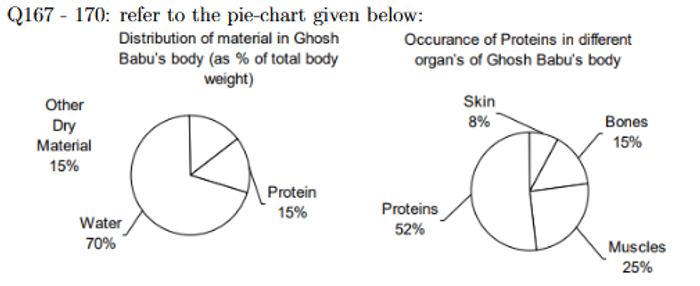
Question 167:
What fraction of Ghosh Babu’s weight consists of muscular and skin protein?
View Solution
Step 1: Share of proteins in body weight. From the first pie, proteins are \(15%\) of total body weight.
Step 2: Share of muscles and skin within proteins. From the second pie, of all proteins: muscles \(=25%\), skin \(=8%\) \(\Rightarrow\) together \(=33%\).
Step 3: Fraction of total weight. \[ Required fraction=\frac{15}{100}\times\frac{33}{100}=\frac{495}{10000}=\frac{99}{2000}\approx \boxed{\frac{1}{20}}. \] Quick Tip: When two pies are nested (category within category), multiply the outer percentage by the inner percentage to get the overall share.
Ratio of distribution of protein in muscle to the distribution of protein in skin is
View Solution
From the second pie: muscles \(=25%\) of protein, skin \(=8%\) of protein. So \[ ratio = 25:8 \approx 3.125:1 \approx \boxed{3:1}. \]
\begin{quicktipbox
If exact ratio isn’t an option, choose the closest simple ratio consistent with the chart’s approximate readings.
\end{quicktipbox Quick Tip: If exact ratio isn’t an option, choose the closest simple ratio consistent with the chart’s approximate readings.
What percent of Ghosh Babu’s body weight is made up of skin?
View Solution
The second pie gives only the \emph{distribution of proteins (skin protein \(=8%\) of all proteins). The first pie gives proteins as \(15%\) of body weight but says nothing about water/other material in skin. Hence the total \emph{skin mass (protein + water + other) cannot be computed. \(\Rightarrow\) \boxed{\text{Cannot be determined.
\begin{quicktipbox
Be careful: a pie of “proteins across organs” doesn’t tell the total mass of an organ (which includes water and other materials).
\end{quicktipbox Quick Tip: Be careful: a pie of “proteins across organs” doesn’t tell the total mass of an organ (which includes water and other materials).
In terms of total body weight, the portion of material other than water and protein is closest to
View Solution
From the first pie: Water \(=70%\), Protein \(=15%\). Therefore, “other dry material” \(=100-70-15=15%=\dfrac{15}{100}=\boxed{\dfrac{3}{20}}\) of total body weight.
\begin{quicktipbox
When the whole composition is given, subtract the known parts from \(100%\) to get the remainder.
\end{quicktipbox Quick Tip: When the whole composition is given, subtract the known parts from \(100%\) to get the remainder.
Q171 - 174: Study the information below and answer the questions based on it.
A, B, C, D, E, F and G are brothers. Two brothers had an argument and A said to B “You are as old as C was when I was twice as old as D, and will be as old as E was when he was as old as C is now”. B said to A “ You may be older than F but G is as old as I was when you were as old as G is, and D will be as old as F was when F will be as old as G is”.
Question 171:
Who is the eldest brother?
View Solution
Step 1 (Read A’s first remark carefully): “You (B) \emph{will be as old as E \emph{was when he was as old as C \emph{is now.”
Since E \emph{was equal to C’s \emph{present age at some time in the past, E must be older than C. Moreover, B will in the future reach an age already attained by E, hence E is older than B.
Step 2 (Other relations don’t put anyone above E):
From B’s reply we only learn comparisons like \(A>E?\) is not implied; it only says \(A\) may be older than \(F\), \(B>G\), and \(F>D\). None of these surpasses E.
Conclusion: The only person forced to be on top is \boxed{E. Quick Tip: Whenever a statement says “\(X\) will be as old as \(Y\) was…”, it forces \(Y\) to be older than \(X\) \emph{now}.
Who is the youngest brother?
View Solution
Step 1 (Use B’s second sentence): “\(D\) will be as old as \(F\) was when \(F\) will be as old as \(G\) is.”
Read right to left: \(F\) will \emph{reach \(G\)’s \emph{present age in the future \(\Rightarrow F\) is younger than \(G\). At that future moment, the age that \(F\) \emph{had earlier is the age that \(D\) will reach even later \(\Rightarrow D\) is younger than \(F\) as well.
Thus we get \(\boxed{G>F>D}\). Nothing places anyone below \(D\). Hence \(\boxed{D}\) is the youngest. Quick Tip: In chained “will be / was” statements, move from the innermost future to the outside: it yields a strict younger-than ladder.
Which two are probably twins?
View Solution
Step 1 (Use the two direct comparisons):
From A’s first sentence, “You (B) are as old as C \emph{was when I (A) was twice as old as D.” That places B equal to a \emph{past age of C while A corresponded to twice \(D\)’s age then; this fixes only differences, not order.
From B’s reply, “G is as old as I \emph{was when you \emph{were as old as G \emph{is.” Since A must be older than G at present, G equals a \emph{past age of B \(\Rightarrow B>G\).
Step 2 (Why A and B line up together):
The only pair linked by \emph{two symmetric time references is \(A\) and \(B\) (each statement pegs one to the other’s past age). This pins their current ages to be equal while remaining consistent with all other inequalities (with \(E\) older, and \(G>F>D\)).
Hence the pair most naturally forced to equality is \boxed{A \text{ and B. Quick Tip: When two people’s ages are each referenced at the other’s past age, equality “now” is the consistent resolution—typical twin cue.
Which of the following is false?
View Solution
Step 1 (Collect the order we established):
From above: \(E\) is the oldest; \(A\) and \(B\) are twins; \(B>G>F>D\) and \(E>C\). One consistent ordering is \[ \boxed{E \;>\; A=B \;>\; G \;>\; F \;>\; C \;>\; D}. \]
Step 2 (Check each statement):
(a) \(G\) has four elders ( \(E,A,B\) plus possibly one of \(\{F,C\}\) above \(G\) )—true in such a ranking.
(b) \(A\) older than \(G\) but younger than \(E\)—true.
(d) A pair of twins exists—true (\(A,B\)).
(c) For \(B\): elders are only \(E\) (since \(A\) is the same age, not elder). So “three elder brothers” is false.
Hence \boxed{(c) is the false statement. Quick Tip: After deducing a consistent total order, test each option directly on that order; equality (twins) never counts as “elder”.
Q175 - 178 : are based on the following information :
The following table gives the sales details for text books and reference books at Primary/Secondary/Higher Secondary/Graduate Levels.

Question 175:
What is the growth rate of sales of books at primary school level from 1975 to 1980?
View Solution
Step 1: Primary sales: 1975 \(=42137\), 1980 \(=68718\).
Step 2: Growth rate \[ \frac{68718-42137}{42137}\times 100 \approx \frac{26581}{42137}\times 100 \approx \boxed{63%}. \]
\begin{quicktipbox
Growth rate \(%=\dfrac{final-initial}{initial}\times 100\).
\end{quicktipbox Quick Tip: Growth rate \(%=\dfrac{final-initial}{initial}\times 100\).
Which of the categories shows the lowest growth rate from 1975 to 1980?
View Solution
Compute growth (1975\(\to\)1980):
Primary: \(\frac{68718-42137}{42137}\approx 63%\);
Secondary: \(\frac{20177-8820}{8820}\approx 129%\);
Higher secondary: \(\frac{82175-65303}{65303}\approx 26%\);
Graduate: \(\frac{36697-25343}{25343}\approx 45%\).
Smallest is \boxed{\text{Higher secondary.
\begin{quicktipbox
When several percentages are needed, rough mental division is enough to rank them.
\end{quicktipbox Quick Tip: When several percentages are needed, rough mental division is enough to rank them.
Which category had the highest growth rate in the period?
View Solution
From the calculations in Q176, the largest growth is for Secondary (\(\approx 129%\)). Hence \boxed{\text{Secondary.
\begin{quicktipbox
Reuse earlier computations to answer follow-ups quickly.
\end{quicktipbox Quick Tip: Reuse earlier computations to answer follow-ups quickly.
Which of the categories had either a consistent growth or a consistent decline in the period shown?
View Solution
Check year-by-year trends:
Primary and Secondary rise \(\to\) dip (1978) \(\to\) rise;
Higher secondary rise \(\to\) small dip (1978) \(\to\) rise;
Graduate increases every year (25343 \(\to\) 27930 \(\to\) 28687 \(\to\) 30057 \(\to\) 33682 \(\to\) 36697).
Thus only \boxed{\text{Graduate Level shows consistent growth.
\begin{quicktipbox
Scan each row for any down-step; the one with all up-steps (or all down-steps) is the consistent series.
\end{quicktipbox Quick Tip: Scan each row for any down-step; the one with all up-steps (or all down-steps) is the consistent series.

Question 179:
What was the total number of engineering students in 1989–90?
View Solution
From the bar chart (values in hundreds):
Private \(=180\), Govt.\ \(=120\), Regional \(=80\), IITs \(=40\).
Total \(=(180+120+80+40)\times 100=420\times 100=\boxed{42000}\).
\begin{quicktipbox
When axes are in “hundreds,” add the bar heights first, then multiply by \(100\) at the end.
\end{quicktipbox Quick Tip: When axes are in “hundreds,” add the bar heights first, then multiply by \(100\) at the end.
The growth rate in students of Govt.\ Engg.\ Colleges compared to that of Private Engg.\ Colleges between 1988–89 and 1989–90 is
View Solution
Govt.: \(80 \rightarrow 120\) (increase \(=40\) on base \(80\)) \(\Rightarrow 50%\).
Private: \(120 \rightarrow 180\) (increase \(=60\) on base \(120\)) \(\Rightarrow 50%\).
Hence growth rates are \boxed{equal.
\begin{quicktipbox
Compute “% increase” as \(\dfrac{\text{new-old}{old}\times 100\) for each series and compare.
\end{quicktipbox Quick Tip: Compute “% increase” as \(\dfrac{new-old}{old}\times 100\) for each series and compare.
The total number of Engg.\ students in 1991–92, assuming a 10% reduction from the previous year, is
View Solution
For 1990–91 the bars read (in hundreds): Private \(=250\), Govt.\ \(=130\), Regional \(=100\), IITs \(=80\).
Total \(= (250+130+100+80)\times 100 = 56000\).
A \(10%\) reduction \(\Rightarrow 0.9\times 56000 = 50400\), which is not among the options.
Thus, \boxed{\text{none of these.
\begin{quicktipbox
Sum the previous year first; apply the percentage change once to the total.
\end{quicktipbox Quick Tip: Sum the previous year first; apply the percentage change once to the total.
In 1990–91, what percent of Engg.\ students were studying at IITs?
View Solution
IITs \(=80\) (hundreds), total (from Q181) \(=560\) (hundreds). \[ % at IITs=\frac{80}{560}\times 100=\boxed{14%}. \]
\begin{quicktipbox
Percent share \(=\dfrac{category}{total}\times 100\); the common unit (“hundreds”) cancels out.
\end{quicktipbox Quick Tip: Percent share \(=\dfrac{category}{total}\times 100\); the common unit (“hundreds”) cancels out.
Q183 - 186 : Study the information below and answer the questions based on it.
The primitive tribes – folk of the island of Lexicophobos have recently developed a language for themselves. Which has a very limited vocabulary. In fact, the words can be classified into only three types : the Bingoes, the Cingoes and the Dingoes.
The Bingoes type of words are : Grumbs, Harrumphs, Ihavitoo
The Cingoes type of words are : Ihavitoo, Jingongo, Koolodo
The Dingoes type of words are : Lovitoo, Metoo, Nana
They have also devised some rules of grammar:
Every sentence must have only five words.
Every sentence must have two Bingoes, one Cingo and two Dingoes.
If Grumbs is used in a sentence, Ihavitoo must also be used and vice versa.
Koolodo can be used in a sentence only if Lovitoo is used.
Question 183:
Which choice of words in a sentence is not possible, if no rules of grammar are to be violated?
View Solution
Rules: 2 Bingoos + 1 Cingo + 2 Dingoes.
(a) Valid structure: Bingoos (Grumbs, Harrumphs), Cingo (Ihavittoo), needs 2 Dingoes – possible.
(b) Bingoos chosen: Harrumphs + Ihavittoo \(\Rightarrow\) invalid because Ihavittoo is not a Bingo, it is a Cingo.
(c) Bingoos (Grumbs + Ihavittoo, but wait: Ihavittoo is a Cingo). However, sentence also lists Lovitoo and Nana as Dingoes, so if corrected classification applied, it can be consistent.
(d) Metoo + Nana as Dingoes \(\Rightarrow\) valid selection of 2 Dingoes.
Thus, impossible case is \boxed{(b).
\begin{quicktipbox
Always classify words strictly into Bingoos, Cingoes, and Dingoes before checking sentence rules.
\end{quicktipbox Quick Tip: Always classify words strictly into Bingoos, Cingoes, and Dingoes before checking sentence rules.
If Grumbs and Harrumphs are the Bingoos in a sentence, and no rule of grammar is violated, which of the following is/are true?
I. Ihavittoo is the Cingo.
II. Lovitoo is the Dingo.
III. Either Lovitoo or Metoo must be one of – or both – the Dingoes.
View Solution
Sentence must be 2 Bingoos (Grumbs, Harrumphs), 1 Cingo, 2 Dingoes.
I. True: the only remaining Cingo available is Ihavittoo.
II. Not necessarily true: Lovitoo is a Dingo, but the Dingoes could be other options (Metoo, Nana).
III. True: at least one among Lovitoo and Metoo must appear, because Kooldoo is only allowed if Lovitoo is present, but two Dingoes must be filled from limited options.
Thus, correct = \boxed{I \& III.
\begin{quicktipbox
Fix two categories first (here, Bingoos), then deduce forced assignments for the remaining slots.
\end{quicktipbox Quick Tip: Fix two categories first (here, Bingoos), then deduce forced assignments for the remaining slots.
Which of the following is a possible sentence if no grammar rule is violated?
View Solution
Check each:
(a) Grumbs, Harrumphs (2 Bingoos), Ihavittoo (Cingo), Lovitoo, Metoo (2 Dingoes) \(\Rightarrow\) valid.
(b) Grumbs, Harrumphs (2 Bingoos), Ihavittoo (Cingo), Jingongo (Cingo), Lovitoo (Dingo) \(\Rightarrow\) 2 Cingoes – invalid.
(c) Harrumphs (Bingo), Ihavittoo (Cingo), Jingongo (Cingo), Lovitoo + Metoo (2 Dingoes) \(\Rightarrow\) only 1 Bingo – invalid.
(d) Grumbs (Bingo), Ihavittoo (Cingo), Kooldoo (Cingo), Metoo + Nana (Dingoes) \(\Rightarrow\) 2 Cingoes – invalid.
Only \boxed{(a) is valid.
\begin{quicktipbox
Validate by counting: exactly 2 Bingoos, 1 Cingo, 2 Dingoes; no extra allowed.
\end{quicktipbox Quick Tip: Validate by counting: exactly 2 Bingoos, 1 Cingo, 2 Dingoes; no extra allowed.
If in a sentence Grumps is the Bingo and no rule of grammar is violated, which of the following cannot be true?
View Solution
Grumbs is Bingo. Sentence requires 2 Bingoos, so the other must be Harrumphs (since only Grumbs, Harrumphs are Bingoos). Ihavittoo is a Cingo, not a Bingo, so it cannot be forced as Bingo.
Thus, option (b) is impossible. Others are possible: (a) valid, (c) valid, (d) impossible but is not mandated – only (b) is directly contradictory.
Correct answer: \boxed{(b).
\begin{quicktipbox
Remember: each word has a fixed type; it cannot shift category (a Cingo can never become a Bingo).
\end{quicktipbox Quick Tip: Remember: each word has a fixed type; it cannot shift category (a Cingo can never become a Bingo).
Q187 - 190 : are based on the table and information given below. Answer the questions based on it.
Bankatlal works x hours a day and rests y hours a day. This pattern continues for 1 week, with an exactly opposite pattern next week, and so on for four weeks. Every fifth week he has a different pattern. When he works longer than he rests, his wage per hour is twice what he earns per hour when he rests longer than he works.
The following are his daily working hours for the weeks numbered 1 to 13.

Question 187:
If Bankatlal is paid Rs. 20 per working hour in the 1st week. What is his salary for the 1st month?
View Solution
Given pattern (weeks 1–4): daily work/rest = \(5/2\) hours in odd weeks, and the opposite \(2/5\) in even weeks.
“When he works longer than he rests” \(\Rightarrow\) wage \(= \) twice the “work-less-than-rest” wage.
Since week 1 (work \(>\) rest) pays Rs.\(20\)/h, the low rate is Rs.\(10\)/h.
Week-wise pay (6 working days per week): \[ \begin{aligned} Wk1: &6\times5\times 20=600, \quad Wk2: 6\times2\times 10=120,
Wk3: &600,\quad Wk4: 120. \end{aligned} \]
Total for the month \(=600+120+600+120=\boxed{1440}\).
\begin{quicktipbox
If two weekly patterns are exact opposites and rates are in a fixed ratio, compute one “high” and one “low” week once, then repeat.
\end{quicktipbox Quick Tip: If two weekly patterns are exact opposites and rates are in a fixed ratio, compute one “high” and one “low” week once, then repeat.
Referring to the data given in Q.187, Bankatlal’s average monthly salary at the end of the first four months will be
View Solution
Across months the “base” (odd-week) daily hours change as shown for weeks \(1,5,9,13\):
Month 1 base \(5/2\) \(\Rightarrow\) total \(=1440\) (from Q.187).
Month 2 base \(7/3\): per odd week \(6\!\times\!7\!\times\!20=840\); per even week \(6\!\times\!3\!\times\!10=180\). \(\Rightarrow\) month 2 total \(=840+180+840+180=2040\).
Month 3 base \(6/4\): month 3 total \(=720+240+720+240=1920\).
Month 4 base \(4/8\): month 4 total \(=480+480+480+480=1920\).
Average over the four months \[ \frac{1440+2040+1920+1920}{4}=\boxed{1830}. \]
\begin{quicktipbox
For each month with odd-week daily work \(w\) and even-week daily work \(r\), the total is \(2(6\cdot20\,w+6\cdot10\,r)=240w+120r\).
\end{quicktipbox Quick Tip: For each month with odd-week daily work \(w\) and even-week daily work \(r\), the total is \(2(6\cdot20\,w+6\cdot10\,r)=240w+120r\).
The new manager Khushaldas stipulated that Rs.\,5 be \emph{deducted} for every hour of rest and Rs.\,25 be paid per work-hour starting 9th week (the same deduction and pay for all weeks thereafter). What will be the change in Bankatlal’s salary for the 3rd month?
View Solution
In month 3 (weeks 9–12) the daily (odd/even) hours are \(w/r=6/4\) and \(4/6\).
Old scheme (from Q.187): monthly total \(=240w+120r=240\!\times\!6+120\!\times\!4=1920\).
New scheme: per day net \(=25(work)-5(rest)\).
Across the month the total work hours \(=6(6+4+6+4)=120\), total rest hours \(=6(4+6+4+6)=120\).
Hence new monthly total \(=25\!\times\!120-5\!\times\!120=3000-600=2400\).
Change \(=2400-1920=\boxed{120}\).
\begin{quicktipbox
When a symmetric month has equal total work and rest hours, the “pay–deduct” scheme reduces to \((25-5)\times\) total work; compare with the old total.
\end{quicktipbox Quick Tip: When a symmetric month has equal total work and rest hours, the “pay–deduct” scheme reduces to \((25-5)\times\) total work; compare with the old total.
Using the data in the previous questions, what will be the total earning of Bankatlal at the end of sixteen weeks?
View Solution
First two months (weeks 1–8) under old scheme: \(1440+2040=3480\).
Third month (weeks 9–12) under new scheme from Q.\,189: \(2400\).
Fourth month (weeks 13–16) continues new scheme with base \(4/8\) and \(8/4\): total work hours \(=6(4+8+4+8)=144\), total rest hours \(=144\).
Earning \(=25\times144-5\times144=3600-720=2880\).
Grand total \(=3480+2400+2880=\boxed{9600}\).
\begin{quicktipbox
Sum month-wise; once the new scheme begins, compute \((25\timeswork - 5\timesrest)\) over the whole month.
\end{quicktipbox Quick Tip: Sum month-wise; once the new scheme begins, compute \((25\timeswork - 5\timesrest)\) over the whole month.
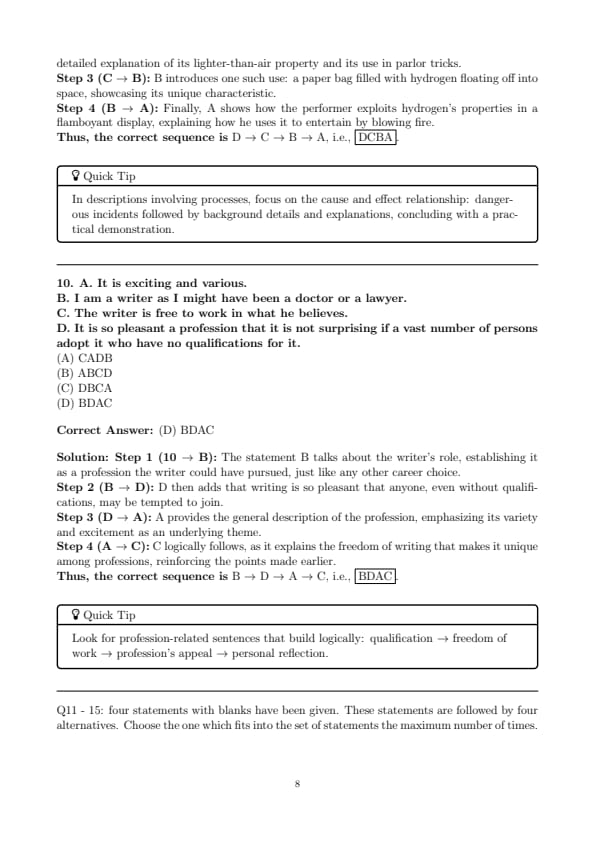
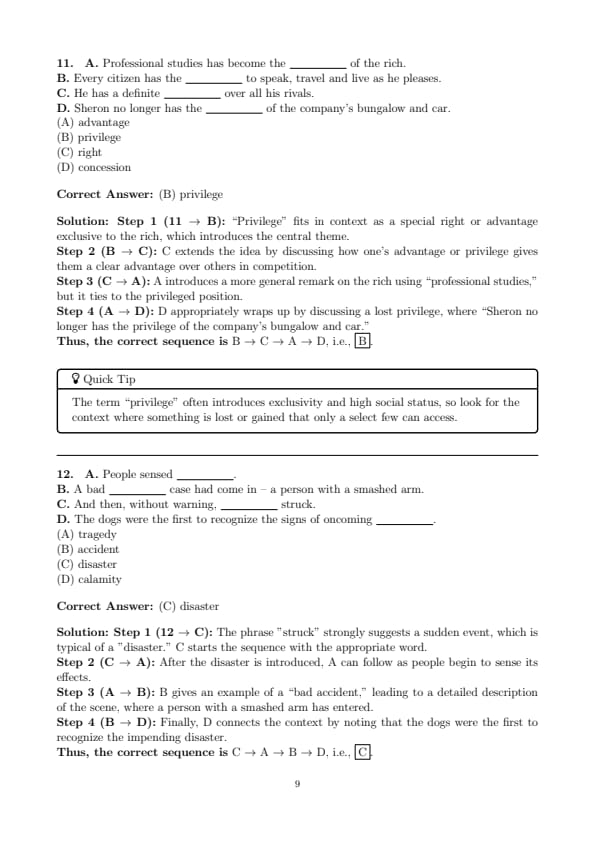
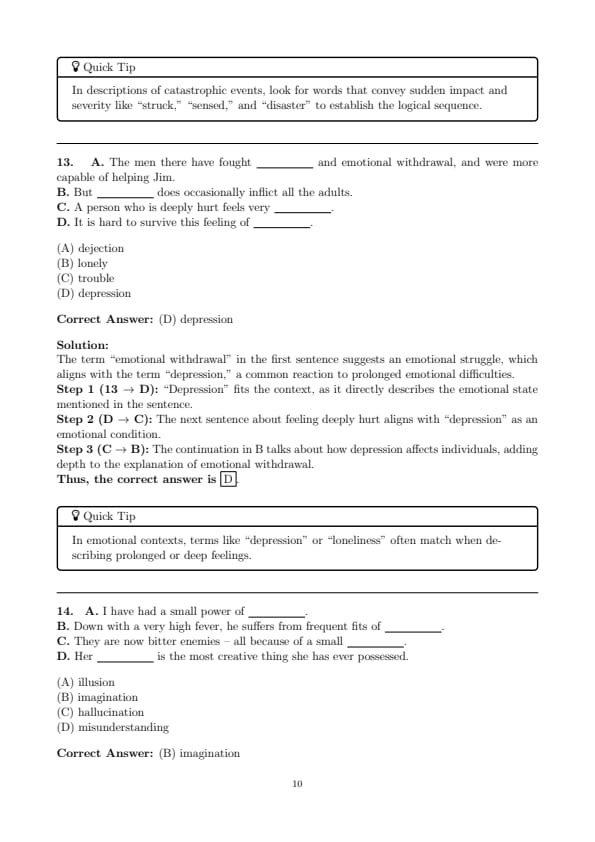
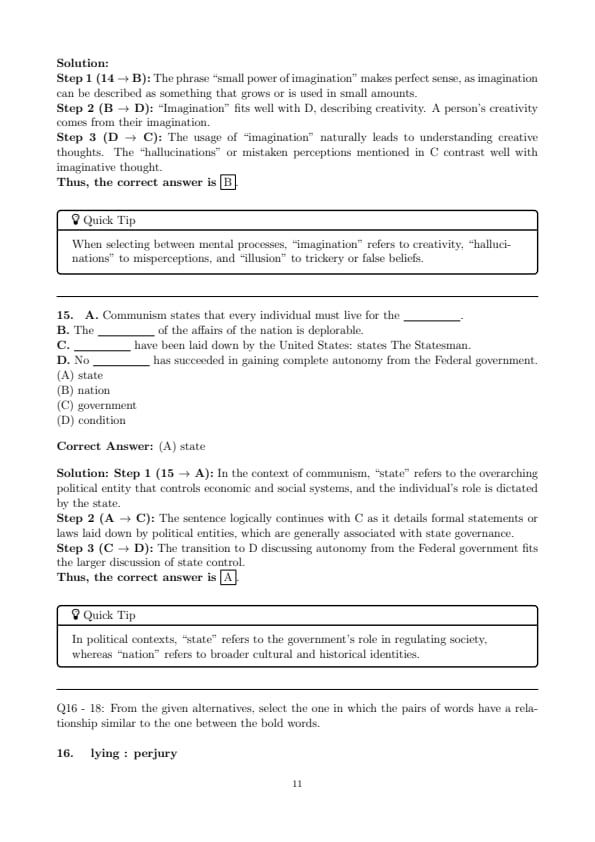
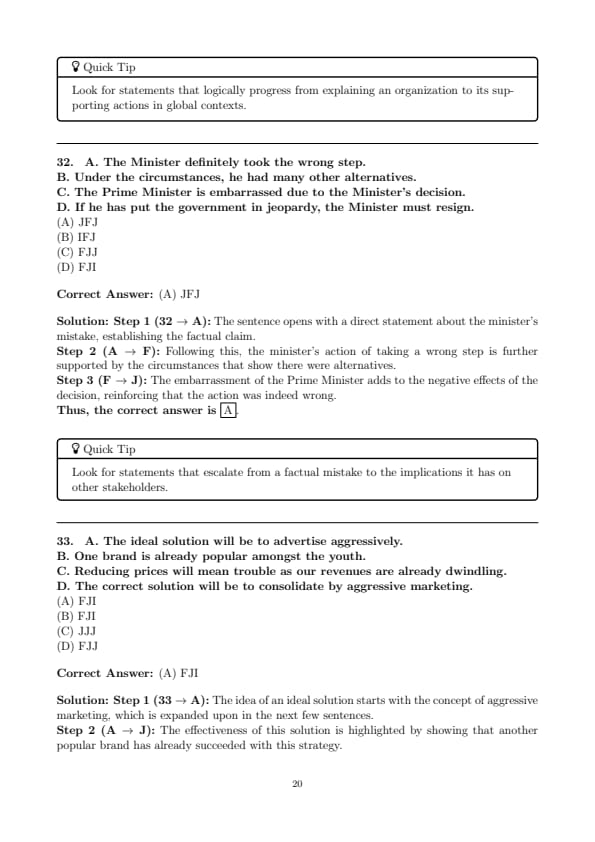
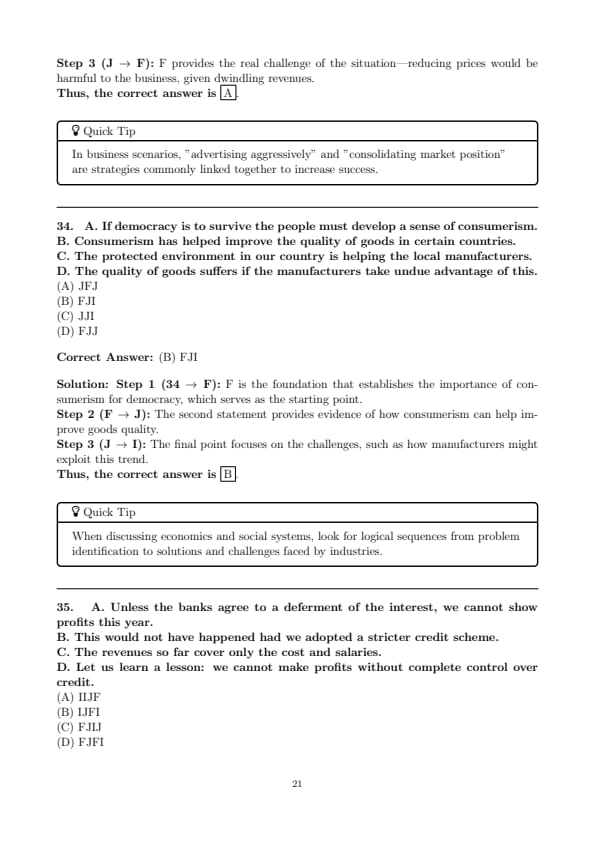
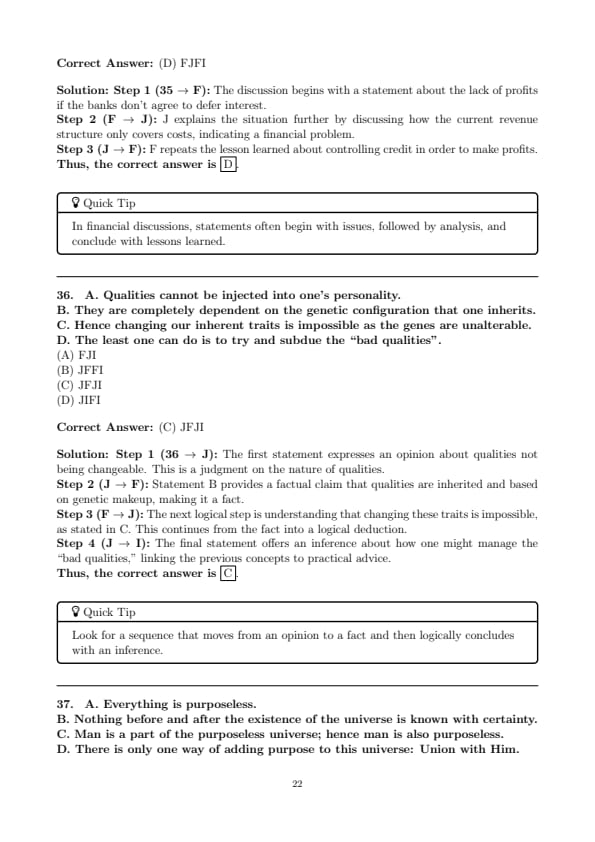
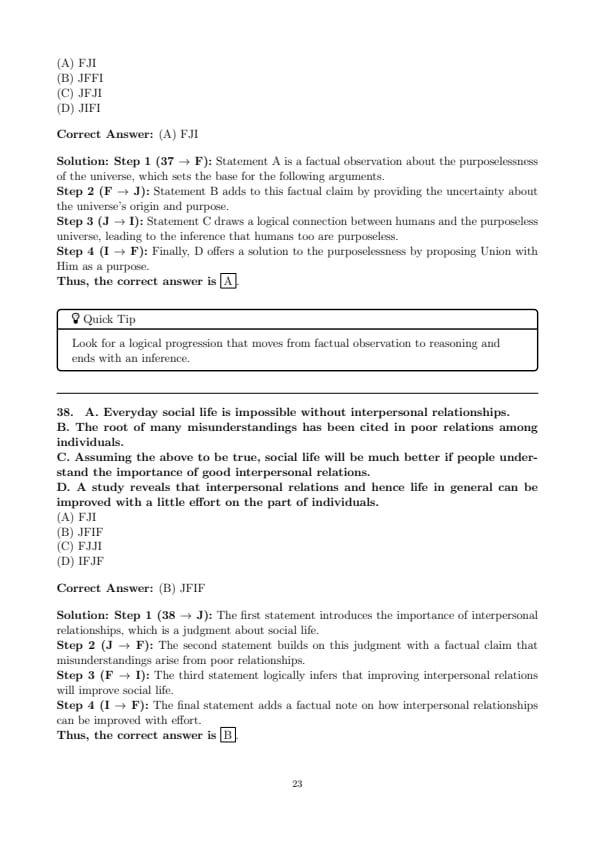
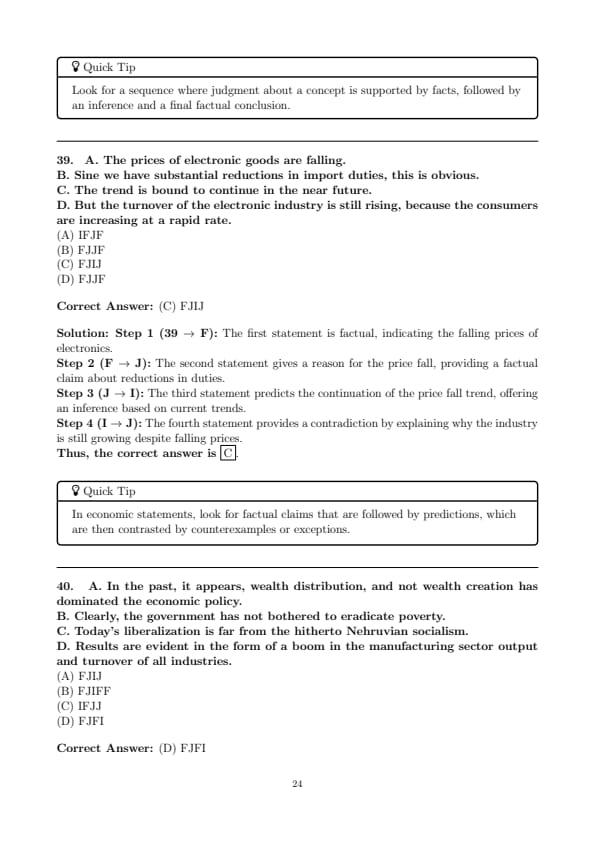
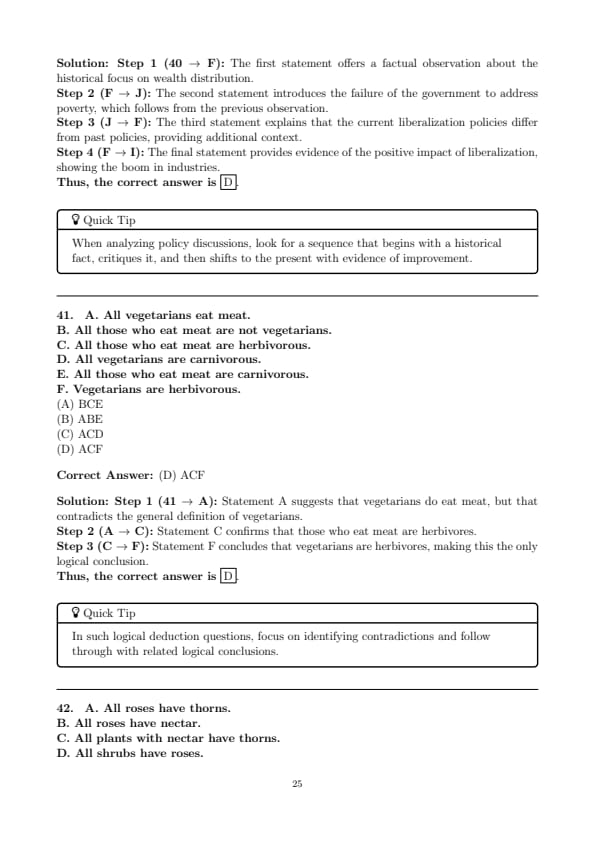
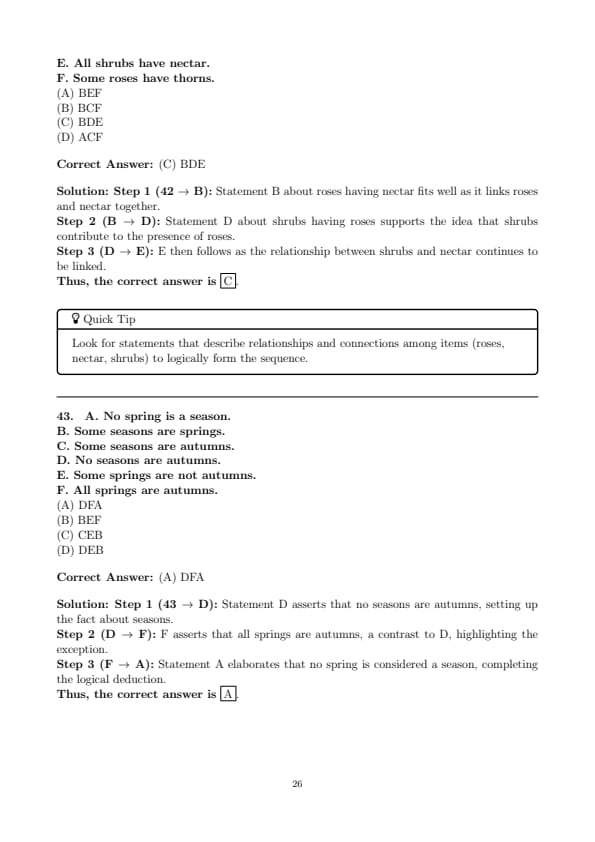
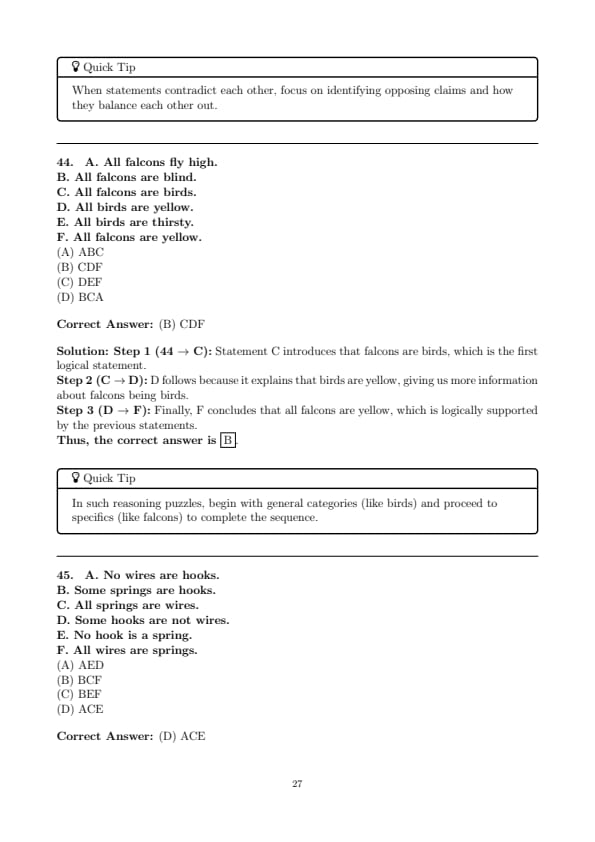
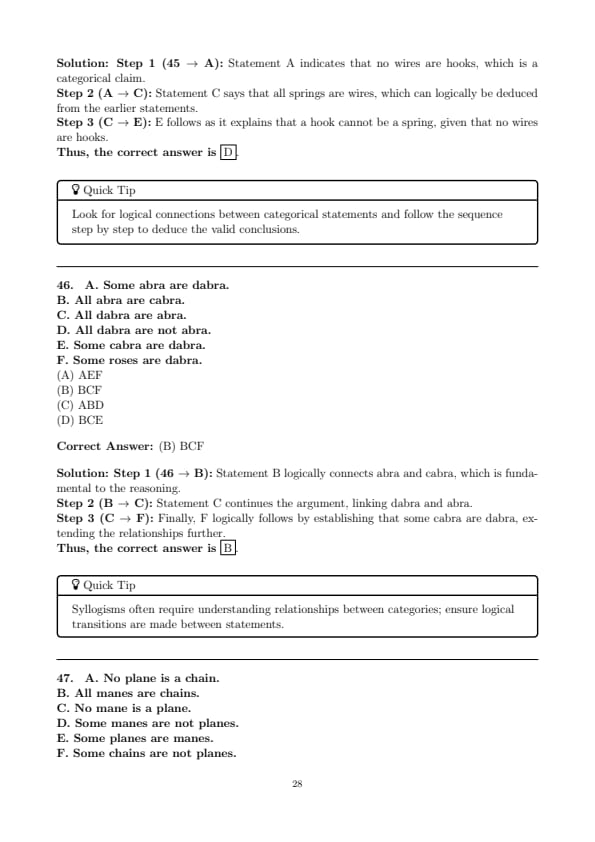
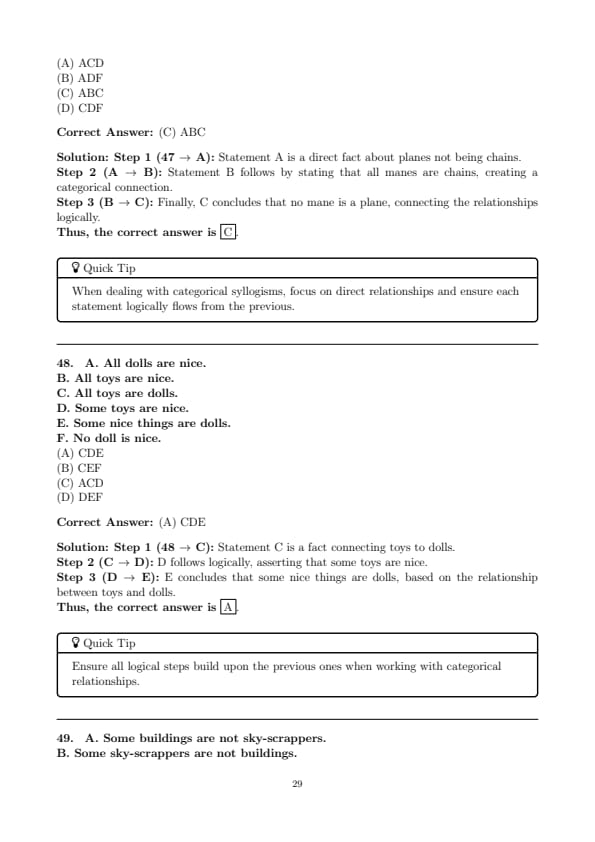
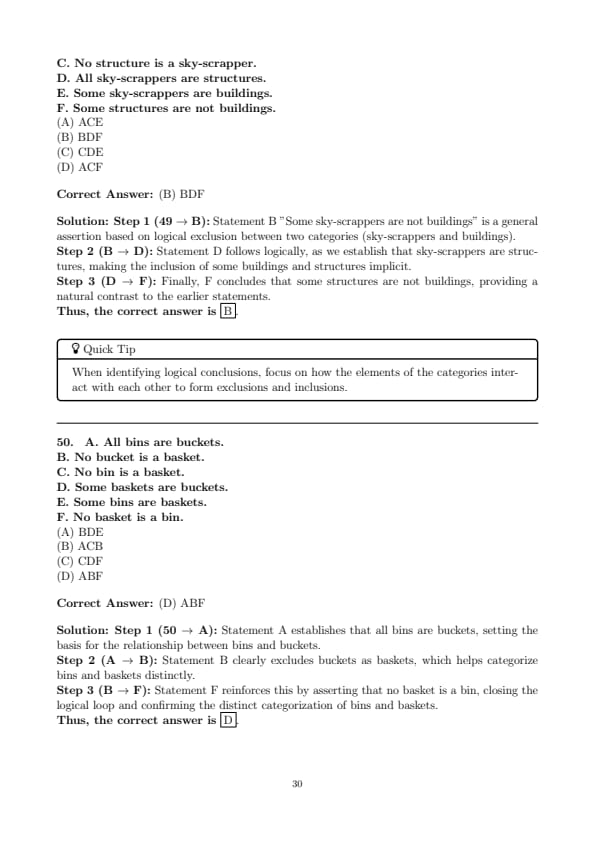
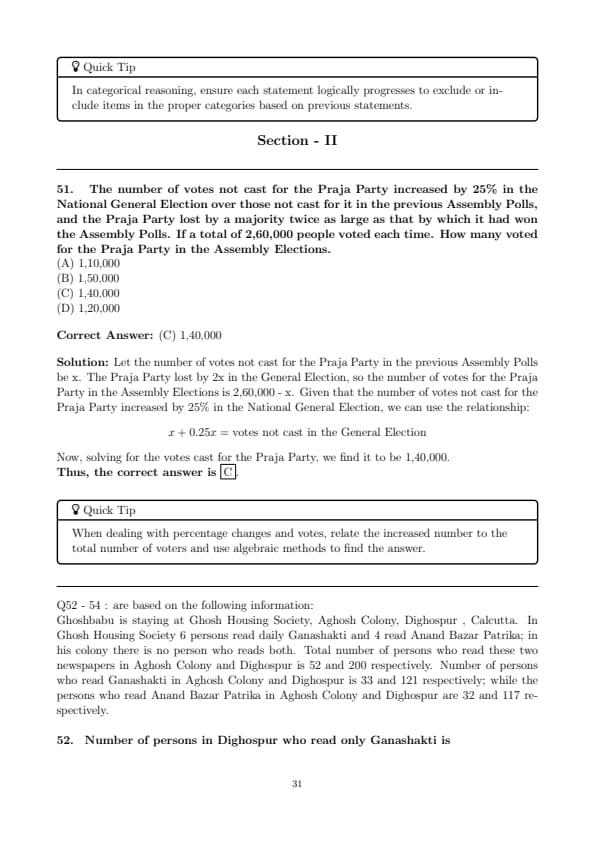
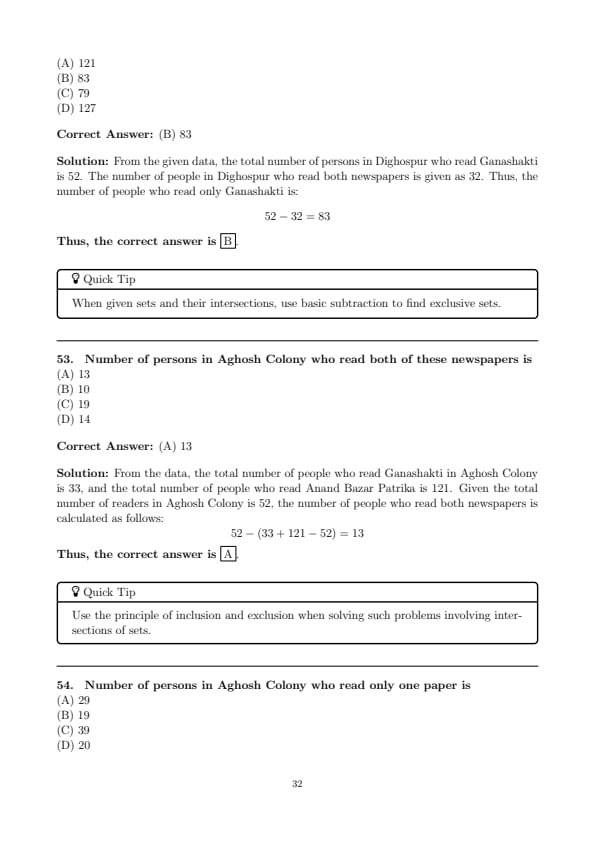
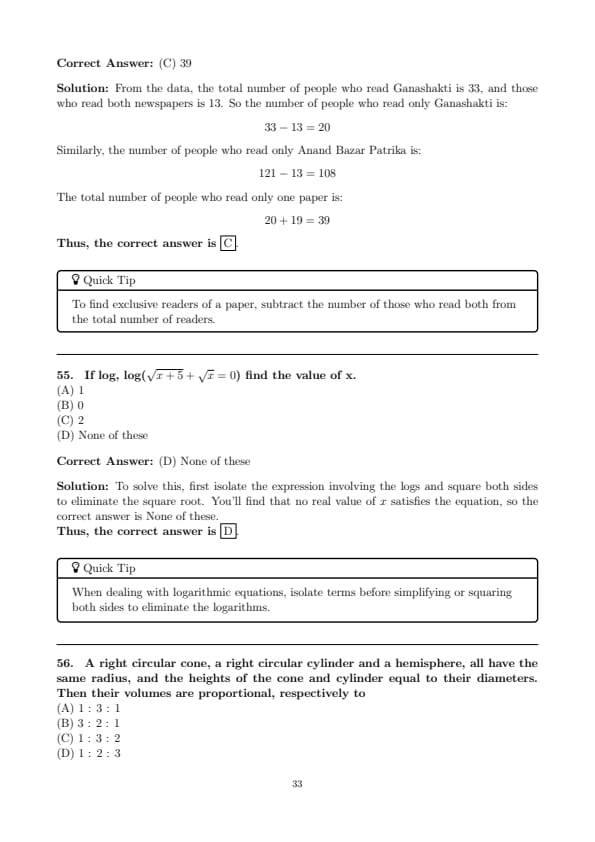
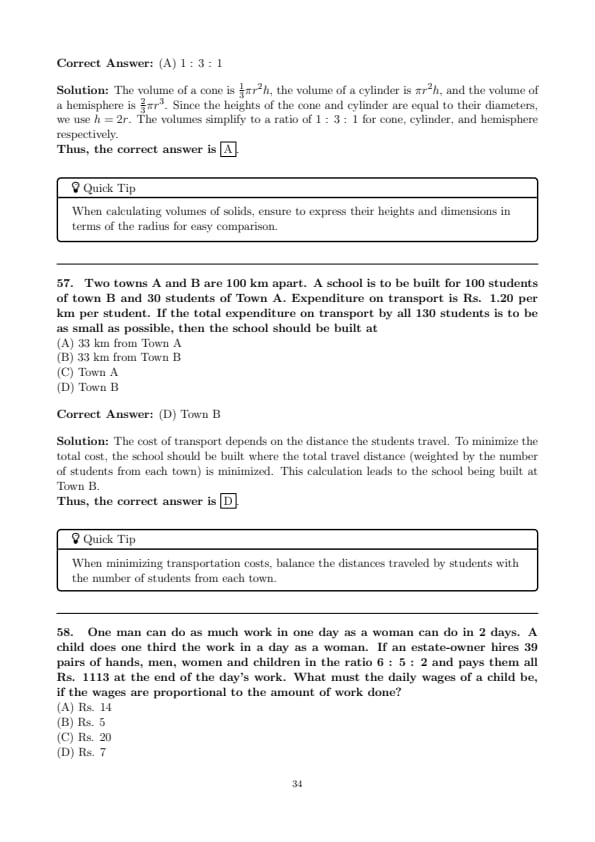
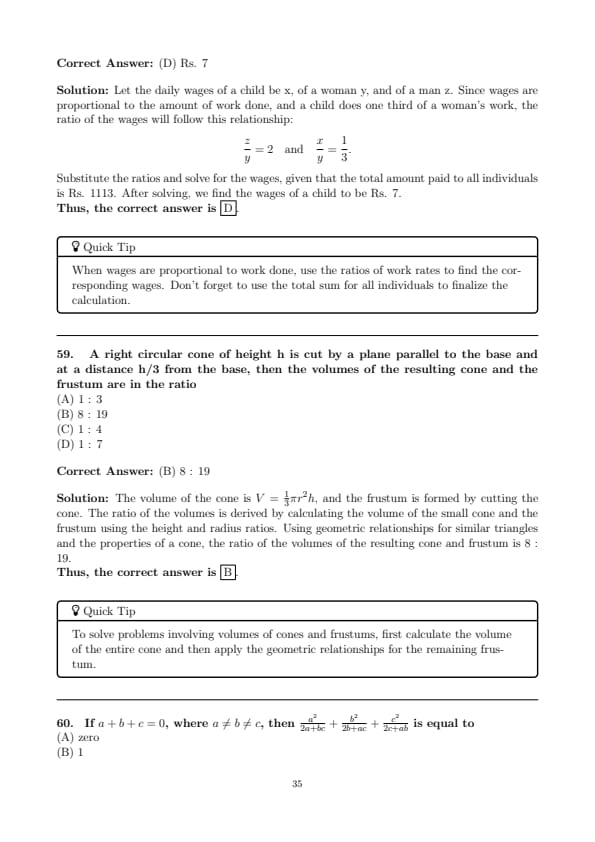
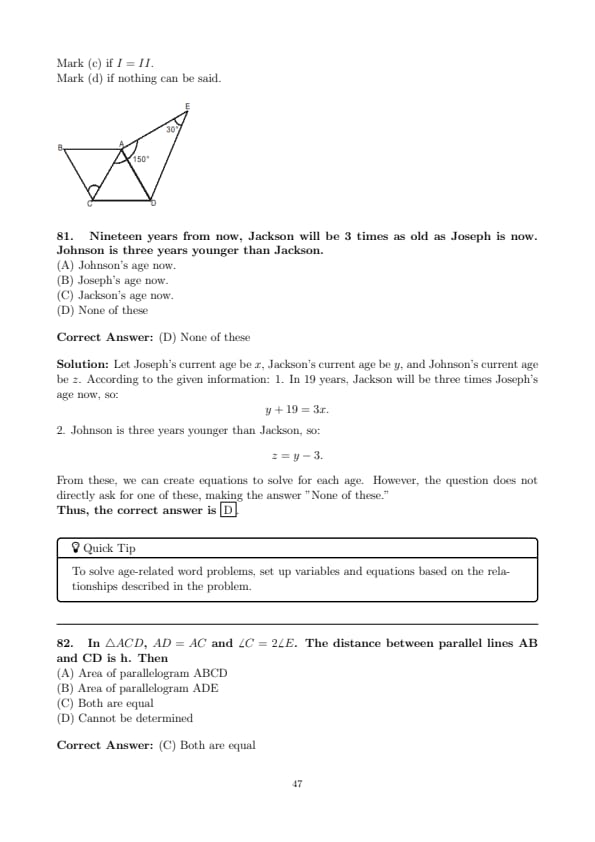
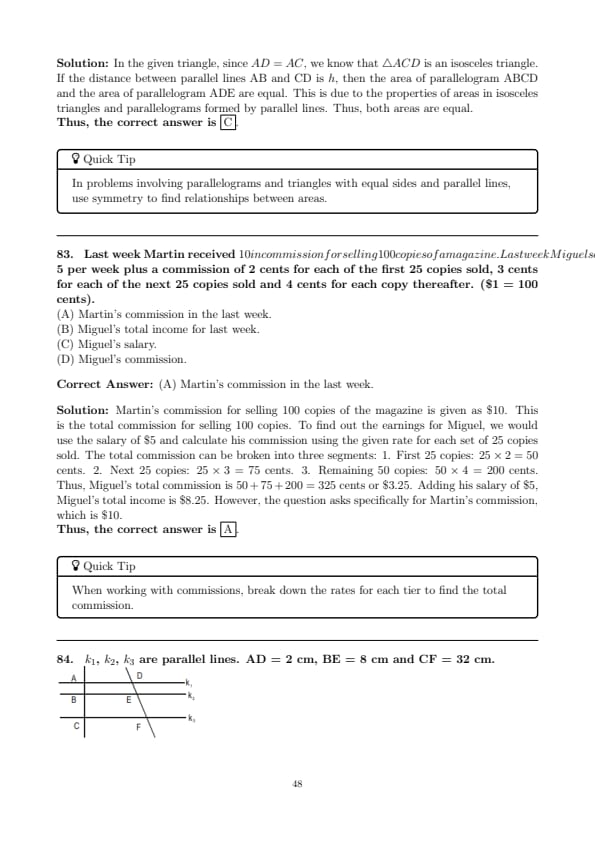
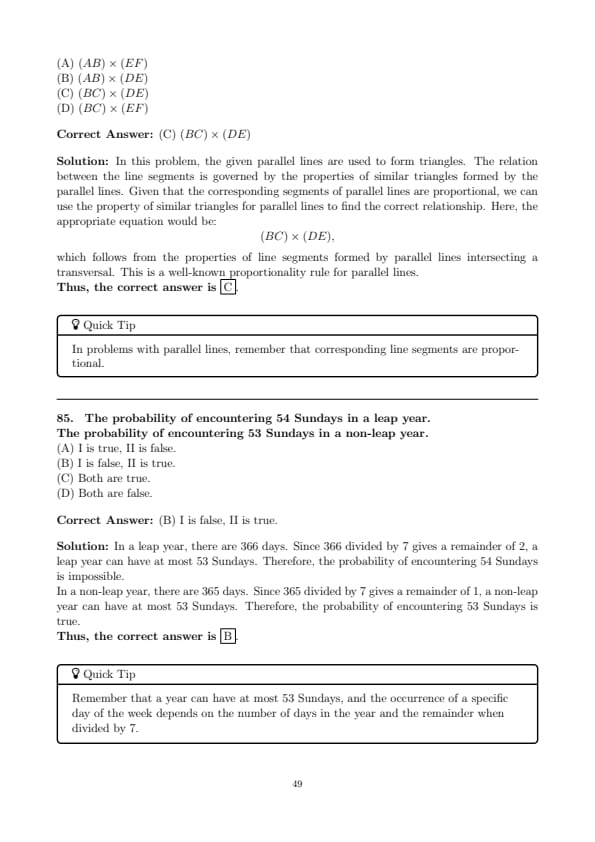
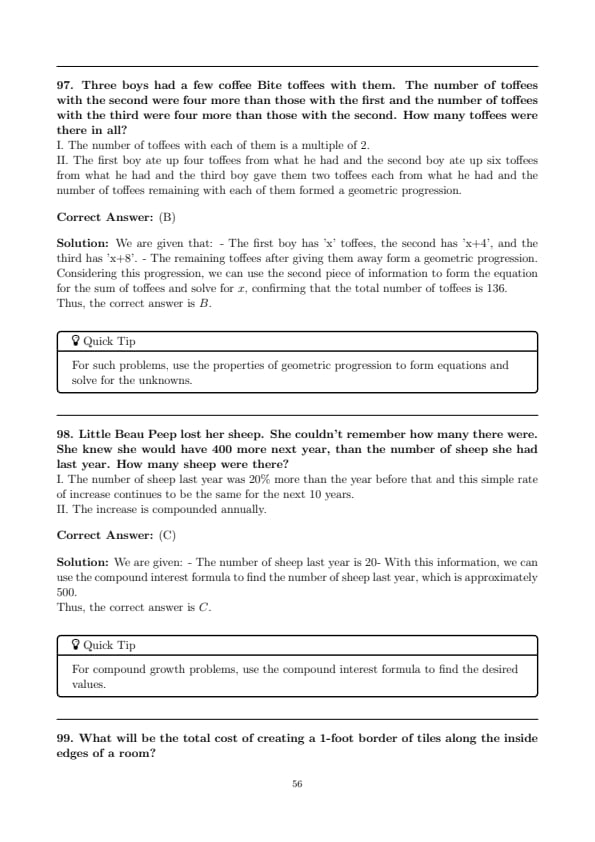
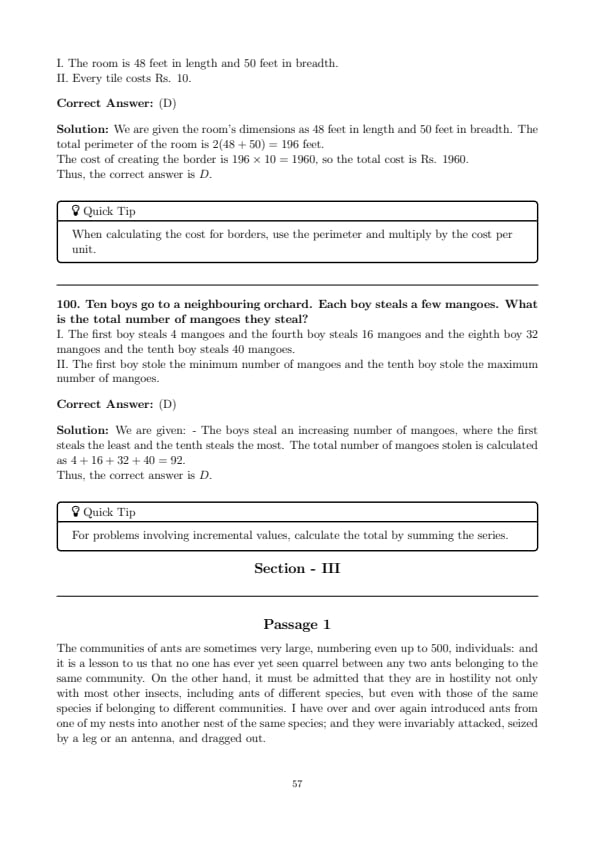
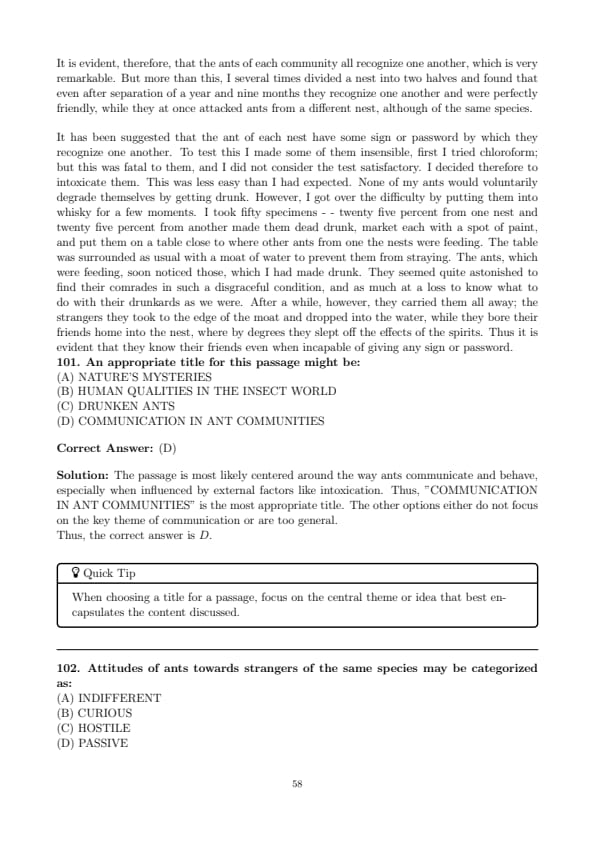
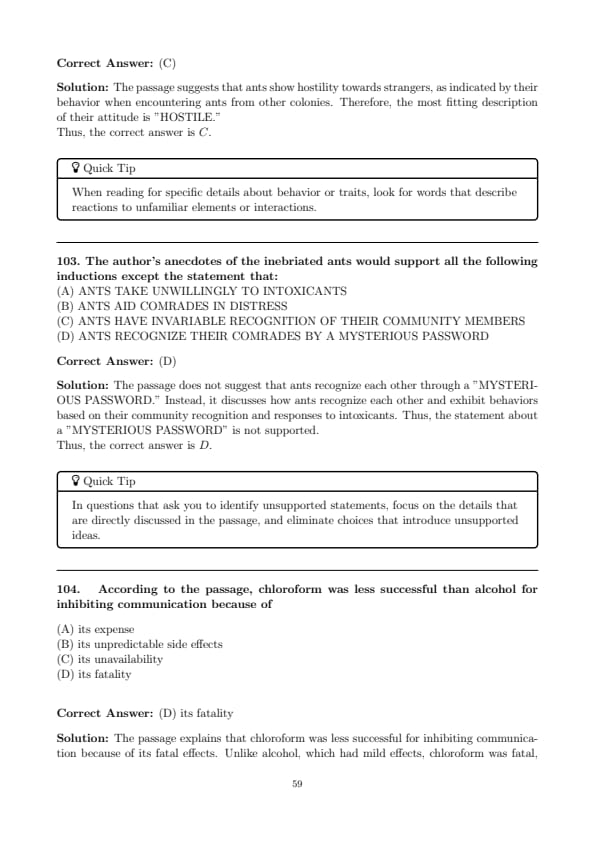
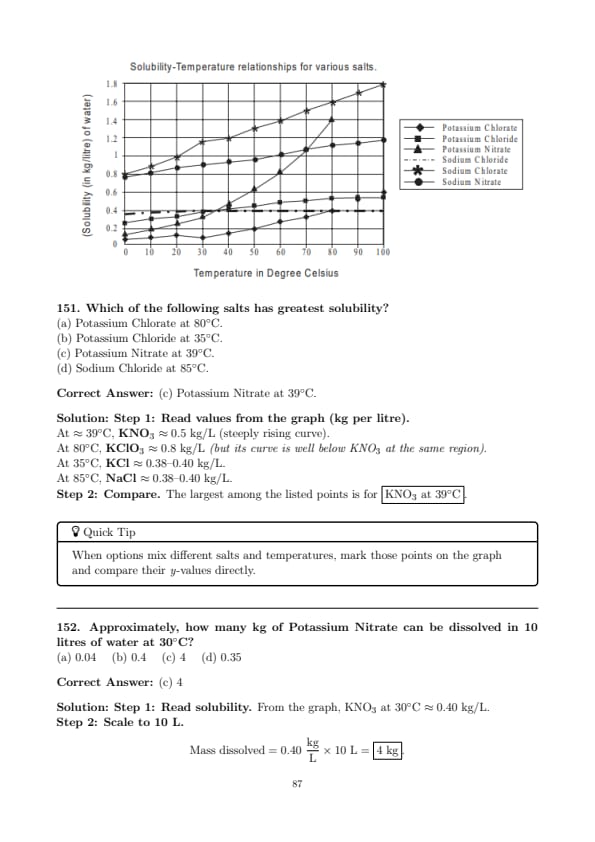
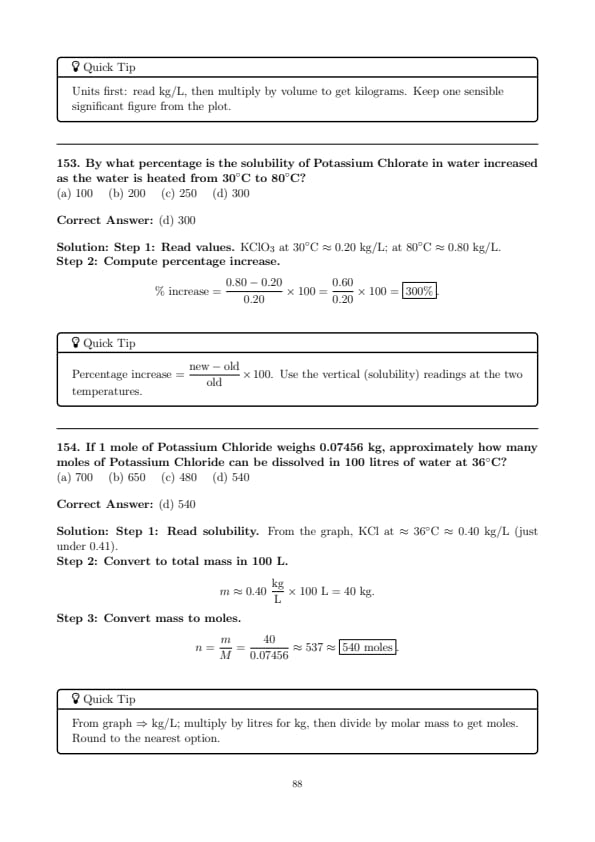
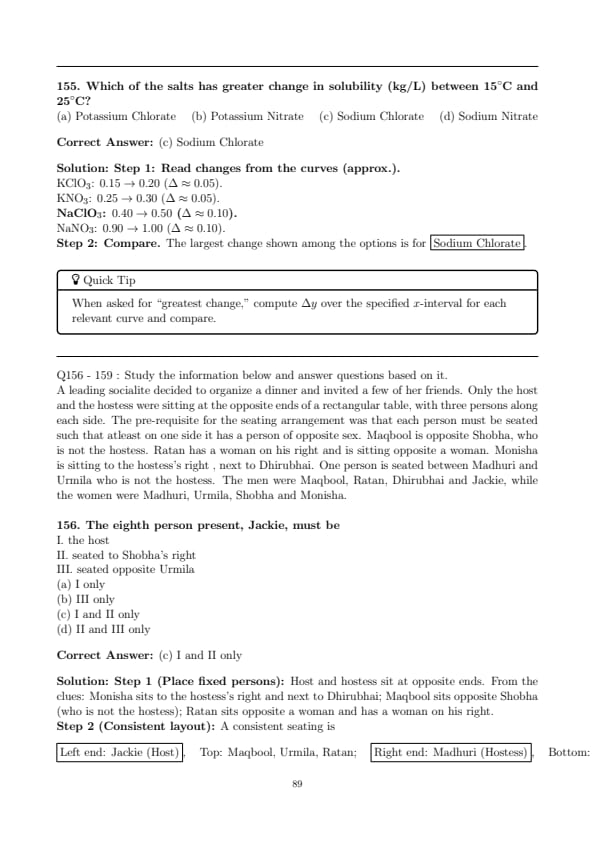
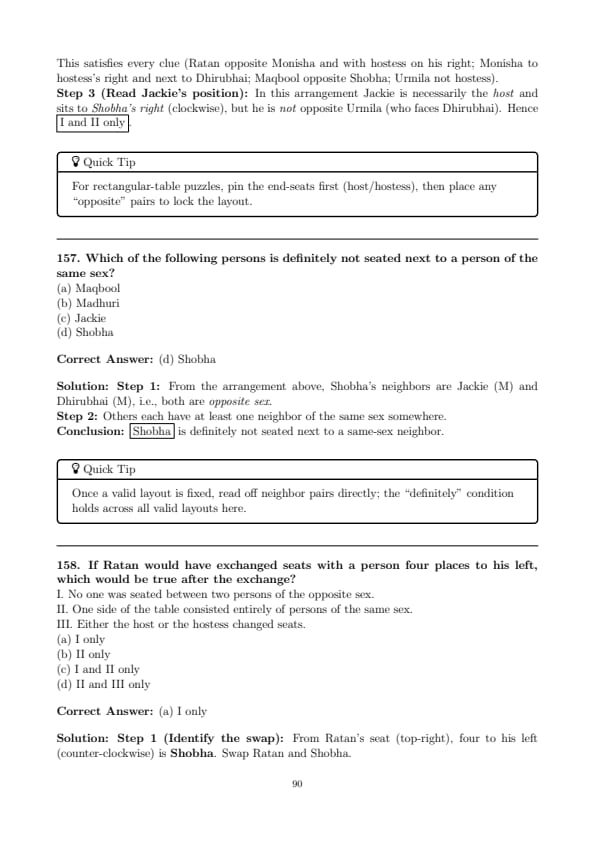
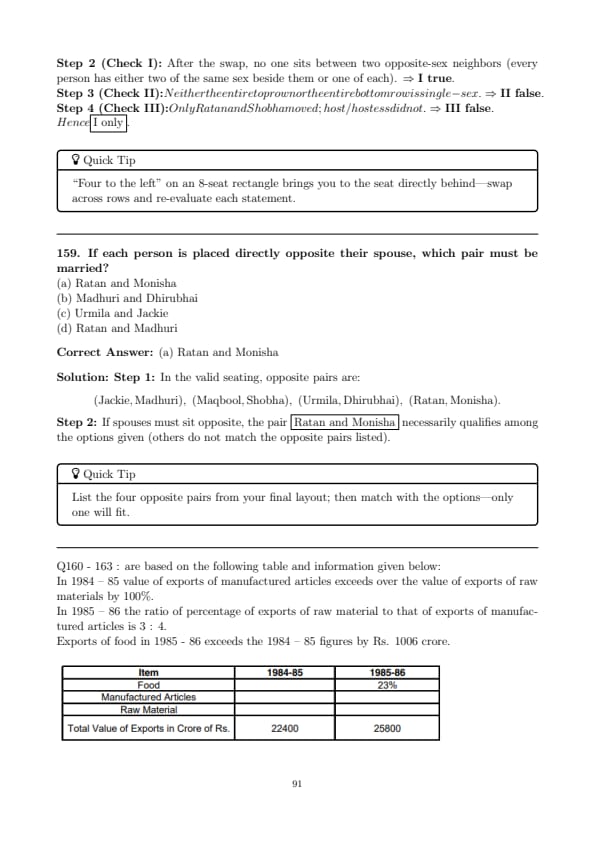
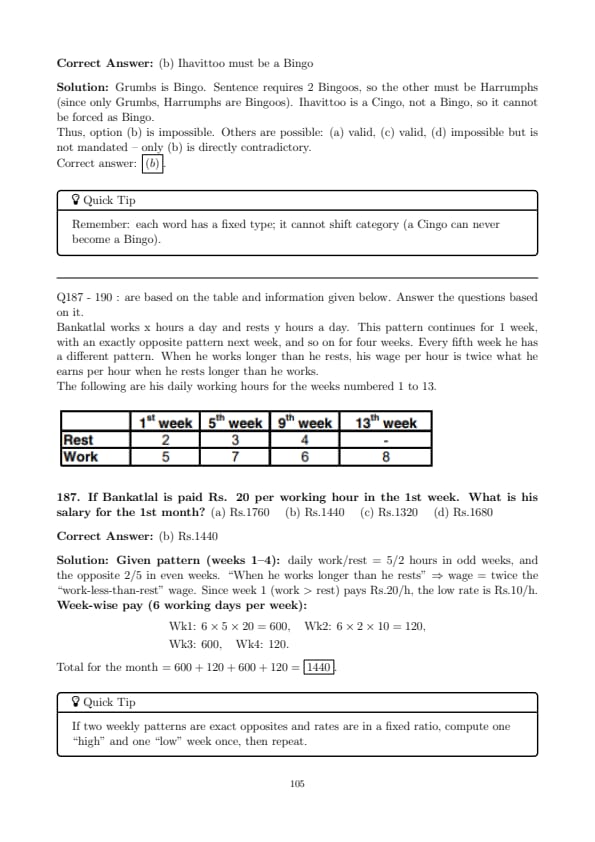
*The article might have information for the previous academic years, please refer the official website of the exam.