
CAT 1995 Question Paper with Solution PDF
- Cut Off for IITs
- IIM Kashipur Cut Off
- IIM Amritsar Cut Off
- IIM Nagpur Cut Off
- IIM Indore Cut Off
- IIM Udaipur Cut Off
- IIM Ranchi Cut Off
- IIM Raipur Cut Off
- IIM Jammu Cut Off
- IIM Bodh Gaya Cut Off
- IIM Kozhikode Cut Off
- IIM Sambalpur Cut Off
- IIM Bangalore Cut Off
- IIM Sirmaur Cut Off
- IIM Trichy Cut Off
- IIM Visakhapatnam Cut Off
- IIM Lucknow Cut Off
- IIM Shillong Cut Off
- IIM Calcutta Cut Off
- IIM Ahmedabad Cut Off
- IIM Rohtak Cut Off


Content Writer | Updated On - Nov 29, 2025
CAT Question Papers are the most important study material for effective exam preparation. We at Zollege have provided all CAT Previous Year Papers with Solution PDFs here. CAT 1995 was conducted successfully by Indian Institutes of Management (IIM).
Students can freely download the CAT previous year's question paper PDFs along with their solutions here. We strongly encourage cat aspirants to scan through all the CAT Question Paper to know the overall difficulty level, CAT Syllabus and understand the changes in CAT Exam Pattern over the years.
Also Check:
CAT 1995 Question Paper with Solution PDF
| CAT 1995 Question Paper with Solutions PDF | Download PDF | Check Solutions |

Pick the word that does \emph{not} fit with the other three (odd one out).
View Solution
Step 1: Meaning cluster.
Sever, rend, and lacerate all denote \emph{tearing/cutting apart.
Step 2: Contrast check.
\emph{Couple means \emph{to join/link together, which is the semantic opposite of the other three.
Conclusion:
Odd one out \(\Rightarrow\) \boxed{\text{Couple (A) Quick Tip: Group synonyms first; then check for an antonym or a word from a different semantic field.
Pick the word that does \emph{not} fit with the other three.
View Solution
Step 1: Meaning cluster.
Quell = suppress/calm; Allay = reduce/soothe; Control = restrain/keep in check.
Step 2: Contrast check.
Ruffle = to disturb/agitate (opposite effect).
Conclusion:
Odd one out \(\Rightarrow\) \boxed{\text{Ruffle (B) Quick Tip: If three words reduce intensity (soothe, calm, restrain) and one increases it (agitate), the agitator is your odd one out.
Pick the word that does \emph{not} fit with the other three.
View Solution
Step 1: Meaning cluster.
Launch, initiate, commence \(\Rightarrow\) all mean \emph{to begin/start.
Step 2: Contrast check.
Cease \(\Rightarrow\) \emph{to stop/end, which is the opposite action.
Conclusion:
Odd one out \(\Rightarrow\) \boxed{\text{Cease (A) Quick Tip: Look for directional opposites like start vs end; one word reversing direction usually stands out.
Pick the word that does \emph{not} fit with the other three.
View Solution
Step 1: Meaning cluster.
Brink, verge, brim \(\Rightarrow\) \emph{edge/border/limit.
Step 2: Contrast check.
Hub \(\Rightarrow\) \emph{center/core, diametrically opposed to an edge.
Conclusion:
Odd one out \(\Rightarrow\) \boxed{\text{Hub (B) Quick Tip: When place/position words appear, map them on a line: edge vs center—whichever differs is the outlier.
Pick the word that does \emph{not} fit with the other three.
View Solution
Step 1: Meaning cluster.
Eulogy, panegyric, glorification \(\Rightarrow\) \emph{high praise/commendation.
Step 2: Contrast check.
Ignominy \(\Rightarrow\) \emph{disgrace/dishonor, the semantic opposite of praise.
Conclusion:
Odd one out \(\Rightarrow\) \boxed{\text{Ignominy (C) Quick Tip: When three words are strong positive evaluatives, scan for a negative evaluative—often the lone antonym.
Pick the word that does \emph{not} fit with the other three.
View Solution
Step 1: Meaning cluster.
Detest, abhor, and loathe \(\Rightarrow\) all mean \emph{to intensely dislike.
Step 2: Contrast check.
Ardour \(\Rightarrow\) \emph{enthusiasm/passion, a positive emotion, in contrast to the negative feelings of the other three.
Conclusion:
Odd one out \(\Rightarrow\) \boxed{\text{Ardour (C) Quick Tip: When identifying the outlier, focus on whether the words indicate positive or negative emotions.
Pick the word that does \emph{not} fit with the other three.
View Solution
Step 1: Meaning cluster.
Adroit, adept, and dexterous \(\Rightarrow\) all mean \emph{skilled/competent.
Step 2: Contrast check.
Awkward \(\Rightarrow\) \emph{clumsy/lacking skill, which contrasts with the other three words.
Conclusion:
Odd one out \(\Rightarrow\) \boxed{\text{Awkward (D) Quick Tip: Look for words that convey opposite qualities: skill vs clumsiness.
Pick the word that does \emph{not} fit with the other three.
View Solution
Step 1: Meaning cluster.
Taciturn, reserved, and silent \(\Rightarrow\) all describe someone who is \emph{quiet/uncommunicative.
Step 2: Contrast check.
Clamorous \(\Rightarrow\) \emph{loud/boisterous, the opposite of the other three.
Conclusion:
Odd one out \(\Rightarrow\) \boxed{\text{Clamorous (C) Quick Tip: Words related to noise and silence often provide a clear contrast when selecting the odd one out.
Pick the word that does \emph{not} fit with the other three.
View Solution
Step 1: Meaning cluster.
Sporadic, intermittent, and scarce \(\Rightarrow\) all describe something \emph{occasional/irregular.
Step 2: Contrast check.
Frequent \(\Rightarrow\) \emph{occurring often, the opposite of the others.
Conclusion:
Odd one out \(\Rightarrow\) \boxed{\text{Frequent (B) Quick Tip: Identify words that describe frequency and check for opposites like "rare" vs "frequent."
Pick the word that does \emph{not} fit with the other three.
View Solution
Step 1: Meaning cluster.
Fanatic, zealot, and maniac \(\Rightarrow\) all describe someone with extreme passion or obsession.
Step 2: Contrast check.
Rational \(\Rightarrow\) \emph{logical/reasonable, the opposite of extreme passion or obsession.
Conclusion:
Odd one out \(\Rightarrow\) \boxed{\text{Rational (D) Quick Tip: Look for words that describe extreme vs reasonable behavior for clear contrasts.
Identify the part of the sentence which needs to be changed for the sentence to be grammatically correct.
View Solution
Step 1: Understanding the sentence structure.
The sentence speaks about school teachers and a student's mother being responsible for the student's conduct.
Step 2: Identifying grammatical error.
The issue lies with "is responsible." Since both "a student's mother" and the teachers are part of the sentence, a plural subject is needed. Thus, it should be "are responsible" instead of "is responsible."
Conclusion:
The error is in part C \(\Rightarrow\) \boxed{\text{Option C Quick Tip: When dealing with compound subjects, ensure the verb agrees in number: singular subject = singular verb, plural subject = plural verb.
Identify the part of the sentence which needs to be changed for the sentence to be grammatically correct.
View Solution
Step 1: Understanding the sentence.
The sentence talks about voting in elections and selecting a candidate of choice.
Step 2: Identifying the error.
The phrase "every man and woman" is singular, which means the correct possessive structure should be "his or her choice," not "of their choice." The use of "their" is incorrect here due to the singular subject.
Conclusion:
The error is in part D \(\Rightarrow\) \boxed{\text{Option D Quick Tip: When using "every" with a singular subject, maintain singular possessive pronouns such as "his or her."
Identify the part of the sentence which needs to be changed for the sentence to be grammatically correct.
View Solution
Step 1: Understanding the sentence structure.
The sentence begins with "if one has to decide," suggesting the use of a general subject.
Step 2: Identifying the error.
Since "one" is the subject, the pronoun "you" is not grammatically consistent. The sentence should maintain the pronoun "one" throughout. Thus, "one should choose that option" would be the correct phrasing.
Conclusion:
The error is in part C \(\Rightarrow\) \boxed{\text{Option C Quick Tip: When starting with a general subject like "one," maintain the consistency of the pronoun throughout the sentence.
Rearrange the parts to form a meaningful sentence:
(A) It is essential that diseases like tuberculosis
(B) are detected and treated
(C) as early as possible in order to
(D) assure a successful cure.
View Solution
Step 1: Identify the subject and beginning.
The sentence must start with “It is essential that diseases like tuberculosis …” \(\Rightarrow\) part (A).
Step 2: Follow logically with the verb.
Diseases must “be detected and treated” \(\Rightarrow\) part (B).
Step 3: Add the condition of time/purpose.
“As early as possible in order to …” \(\Rightarrow\) part (C).
Step 4: Complete the purpose.
“… assure a successful cure.” \(\Rightarrow\) part (D).
\boxed{\text{It is essential that diseases like tuberculosis are detected and treated as
\boxed{\text{early as possible in order to assure a successful cure. Quick Tip: When rearranging, always begin with the main subject–predicate pair, then attach conditions (time, purpose, reason) in logical order.
Rearrange the parts to form a meaningful sentence:
(A) The Mumbai police have found
(B) the body of a man
(C) who they believe to be
(D) the prime suspect in a murder case.
View Solution
Step 1: The sentence begins with the subject–predicate.
“The Mumbai police have found …” \(\Rightarrow\) part (A).
Step 2: Add the object found.
“… the body of a man …” \(\Rightarrow\) part (B).
Step 3: Provide the relative clause describing the man.
“… who they believe to be …” \(\Rightarrow\) part (C).
Step 4: Complete the description.
“… the prime suspect in a murder case.” \(\Rightarrow\) part (D).
The Mumbai police have found the body of a man who they believe to be the prime suspect in a murder case. Quick Tip: For jumbled sentence correction, ensure the subject and verb come first, then place objects and relative clauses in a natural sequence.
Limpid : Murky
View Solution
Step 1: Limpid means clear, and Murky means dark/unclear. Hence, they are antonyms.
Step 2: Check the options:
- (A) Dazed : Clouded → both indicate confusion, not opposites.
- (B) Obscure : Vague → both mean unclear, synonyms not antonyms.
- (C) Bright : Gloomy → direct opposites (antonyms).
- (D) Nebulous : Dim → both mean unclear, synonyms.
\[ \boxed{Correct analogy: Limpid : Murky :: Bright : Gloomy} \] Quick Tip: Always identify whether the relationship is synonymy, antonymy, or part–whole before checking options.
Ease : Alleviate
View Solution
Step 1: Ease and Alleviate are synonyms, both meaning to reduce suffering or make easier.
Step 2: Check the options:
- (A) Hint : Allocative → unrelated.
- (B) Revolt : Repudiate → revolt means resist, repudiate means reject, not perfect synonyms.
- (C) Collapse : Rise → antonyms.
- (D) Question : Interrogate → perfect synonyms (both mean asking).
\[ \boxed{Correct analogy: Ease : Alleviate :: Question : Interrogate} \] Quick Tip: For synonym pairs, choose words that share the same meaning intensity and context.
Secret : Clandestine
View Solution
Step 1: Secret and Clandestine are synonyms, both mean hidden or concealed.
Step 2: Check the options:
- (A) Overt : Furtive → opposites.
- (B) Covert : Stealthy → both mean secret/hidden → correct.
- (C) Open : Closed → antonyms.
- (D) News : Rumour → not exact synonyms.
\[ \boxed{Correct analogy: Secret : Clandestine :: Covert : Stealthy} \] Quick Tip: Look for the closest synonym match in both intensity and context.
Drama : Audience
View Solution
Step 1: A drama is watched by an audience.
Step 2: Check the options:
- (A) Brawl : Vagabonds → not a consistent relationship.
- (B) Game : Spectators → a game is watched by spectators → correct.
- (C) Art : Critics → critics judge art, not the same relationship.
- (D) Movie : Actors → actors perform a movie, not equivalent.
\[ \boxed{Correct analogy: Drama : Audience :: Game : Spectators} \] Quick Tip: For performance-based analogies, check who is the observer or the recipient of the act.
Building : Storey
View Solution
Step 1: A building is composed of multiple storeys (part–whole relationship).
Step 2: Check the options:
- (A) Book : Chapter → a book is composed of chapters → correct.
- (B) Sentence : Adjective → a sentence is not necessarily made of adjectives.
- (C) Tree : Stem → a tree has a stem but not composed of multiple stems.
- (D) Elephant : Tusk → tusk is a body part, not a compositional element.
\[ \boxed{Correct analogy: Building : Storey :: Book : Chapter} \] Quick Tip: For part–whole analogies, pick the option where the second element is an integral unit of the first.
Germane : Pertinent
View Solution
Step 1: “Germane” and “pertinent” are synonyms, meaning relevant or appropriate.
Step 2: Check for the antonymous pair. (d) “Excited : Serene” are opposites.
\[ \boxed{Germane : Pertinent :: Excited : Serene} \] Quick Tip: Look for synonyms or antonyms by analyzing word meanings. If one pair means similar, choose a pair of opposites.
Sail : Ship
View Solution
Step 1: A “sail” is used to propel or move a “ship”.
Step 2: The corresponding pair is (b) where “radar” is used in a satellite.
\[ \boxed{Sail : Ship :: Radar : Satellite} \] Quick Tip: Match the mechanism or function that is used to operate or guide the vehicle in question.
Cosmic : Universe
View Solution
Step 1: “Cosmic” relates to “universe,” an adjective-noun relation.
Step 2: The same structure applies to (c) where “Connubial” relates to “youth”.
\[ \boxed{Cosmic : Universe :: Connubial : Youth} \] Quick Tip: For adjective-noun analogies, choose the one that matches in meaning or descriptor.
Canine : Dog
View Solution
Step 1: “Canine” refers to “dog,” matching animal descriptor.
Step 2: The parallel match is (B) where “Aquiline” refers to “eagle.”
\[ \boxed{Canine : Dog :: Aquiline : Parrot} \] Quick Tip: For descriptive pairings, check which adjective directly modifies the animal for consistency.
Xenophobia : Foreigners
View Solution
Step 1: “Xenophobia” is the fear of foreigners.
Step 2: The correct match is (A) where “Claustrophobia” is the fear of height.
\[ \boxed{Xenophobia : Foreigners :: Claustrophobia : Height} \] Quick Tip: Look for the correct fear-object pairing based on phobia types.
Order the sentences (A–D) to form a coherent paragraph:
A. Where there is division there must be conflict, not only division between man and woman, but also division on the basis of race, religion and language.
B. We said the present condition of racial divisions, linguistic divisions has brought out so many wars.
C. Also we went into the question as to why does this conflict between man and man exist.
D. May we continue with what we were discussing last evening?
View Solution
Step 1: The opening sentence (D) begins with a conversation marker, so it starts the paragraph.
Step 2: (B) follows as it recaps a discussion about racial and linguistic divisions.
Step 3: (C) follows logically, expanding on the idea of why these conflicts exist.
Step 4: (A) provides a broad statement on division and conflict.
\[ \boxed{D \rightarrow B \rightarrow C \rightarrow A} \] Quick Tip: Start with context-setting sentences, followed by explanations and broad conclusions.
Order the sentences (A–D) to form a coherent paragraph:
A. No other documents give us so intimate a sense of the tone and temper of the first generation poets.
B. Part of the interest of the journal is course historical.
C. And the clues to Wordsworth's creative processes which the journal affords are of decisive significance.
D. Not even in their own letters do Wordsworth and Coleridge stand so present before us than they do through the references in the journal.
View Solution
Step 1: (B) introduces the historical significance of the journal.
Step 2: (A) describes the intimacy of the journal with the poets' tone.
Step 3: (C) explains the clues to the poets' creative processes.
Step 4: (D) provides comparison of the journal's references to personal letters.
\[ \boxed{B \rightarrow A \rightarrow C \rightarrow D} \] Quick Tip: Arrange the sentences from introduction, body, and then conclusion for clarity and logical flow.
Order the sentences (A–D) to form a coherent paragraph:
A. These high plans died, slowly but definitively, and were replaced by the dream of a huge work on philosophy.
B. In doing whatever little he could of the new plan, the poet managed to write speculations on theology, and political theory.
C. The poet's huge ambitions included writing a philosophic epic on the origin of evil.
D. However, not much was done in this regard either, with only fragments being written.
View Solution
Step 1: (C) introduces the poet's ambitions.
Step 2: (A) discusses the shift from these grand plans to a focus on philosophy.
Step 3: (D) mentions the lack of significant progress on the plans.
Step 4: (B) explains how the poet still attempted to write on theology and political theory.
\[ \boxed{C \rightarrow A \rightarrow D \rightarrow B} \] Quick Tip: Follow the logical sequence: introduce ambitions, show shift, describe outcomes, and end with the efforts made.
Order the sentences (A–D) to form a coherent paragraph:
A. We can never leave off wondering how that which has ever been should cease to be.
B. As we advance in life, we acquire a keener sense of the value of time.
C. Nothing else, indeed, seems to be of any consequence; and we become misers in this sense.
D. We try to arrest its few last tottering steps, and to make it linger on the brink of the grave.
View Solution
Step 1: (B) starts by explaining how time becomes more valuable as we age.
Step 2: (C) expands on the idea of valuing time.
Step 3: (D) provides an example of trying to hold on to time.
Step 4: (A) reflects on the concept of time ceasing.
\[ \boxed{B \rightarrow C \rightarrow D \rightarrow A} \] Quick Tip: Arrange sentences that express time progression logically, from general to reflective.
Order the sentences (A–D) to form a coherent paragraph:
A. There is no complete knowledge about anything.
B. Our thinking is the outcome of knowledge, and knowledge is always limited.
C. Knowledge always goes hand in hand with ignorance.
D. Therefore, our thinking which is born out of knowledge, is always limited under all circumstances.
View Solution
Step 1: (C) introduces the idea that knowledge and ignorance are inseparable.
Step 2: (B) builds on this by claiming that knowledge is limited.
Step 3: (D) draws the conclusion that our thinking is limited by knowledge.
Step 4: (A) makes a philosophical statement about the impossibility of complete knowledge.
\[ \boxed{C \rightarrow B \rightarrow D \rightarrow A} \] Quick Tip: Use logical progression: cause \(\Rightarrow\) effect \(\Rightarrow\) conclusion.
Order the sentences (A–D) to form a coherent paragraph:
1. Currency movements can have a dramatic impact on equity returns for foreign investors.
A. This is not surprising as many developing economies try to peg their exchange rates to the US dollar or to a basket of currencies.
B. Many developing economies manage to keep exchange rate volatility lower than that in the industrial economies.
C. India has also gone in for the full float on the current account and abolished the managed exchange rate.
D. Dramatic exceptions are Argentina, Brazil and Nigeria.
View Solution
Step 1: (C) is the best starting sentence, discussing India’s float on the current account.
Step 2: (A) introduces the surprise factor of currency movements affecting returns.
Step 3: (B) provides context for developing economies managing exchange rate volatility.
Step 4: (D) ends with examples of dramatic exceptions.
\[ \boxed{C \rightarrow A \rightarrow B \rightarrow D} \] Quick Tip: Start with a specific example or observation, then expand into general statements and exceptions.
Order the sentences (A–D) to form a coherent paragraph:
1. All human beings are aware of the existence of a power greater than that of the mortals — the name given to such a power by individuals is an outcome of birth, education and choice.
A. This power provides an anchor in times of adversity, difficulty and trouble.
B. Industrial organisations also contribute to the veneration of this power by participating in activities such as religious ceremonies and festivities organised by the employees.
C. And the clues to Wordsworth's creative processes which the journal affords are of decisive significance.
D. Logically, therefore, such a power should be remembered in good times also.
View Solution
Step 1: (D) introduces the logical structure of the power being remembered.
Step 2: (A) describes how this power provides comfort in times of trouble.
Step 3: (C) expands on how individuals connect to this power.
Step 4: (B) explains how organizations contribute to this reverence.
\[ \boxed{D \rightarrow A \rightarrow C \rightarrow B} \] Quick Tip: Link the idea of power with its role in difficult times, then move towards how organizations and individuals interact with it.
Order the sentences (A–D) to form a coherent paragraph:
1. Total forgiveness for a mistake generates a sense of complacency towards target achievement among the employees.
A. In such a situation the work ethos gets distorted and individuals get a feeling that they can get away with any lapse.
B. The feeling that they develop is: whether I produce results or not, the management will not punish me or does not have the guts to punish me.
C. Also, excess laxity damages management credibility, because for a long time, the management has maintained that dysfunctional behaviour will result in punishment, and when something goes wrong, it fails to take specific punitive action.
D. The severity of the punishment may be reduced, by modifying it, but some action must be taken against the guilty so as to serve as a reminder for all others in the organization.
View Solution
Step 1: (B) explains how employees feel when total forgiveness is granted.
Step 2: (C) provides the consequences of laxity and how it harms management credibility.
Step 3: (D) discusses the need for punishment to serve as a reminder.
Step 4: (A) concludes by discussing the situation when employees believe they can get away with lapses.
\[ \boxed{B \rightarrow C \rightarrow D \rightarrow A} \] Quick Tip: Track cause-effect relations and ensure that each sentence logically leads to the next.
Order the sentences (A–D) to form a coherent paragraph:
1. But the vessel kept going away.
A. He looked anxiously around.
B. There was nothing to see but the water and empty sky.
C. He could now barely see her funnel and masts when heaved up on a high wave.
D. A breaking wave slapped him in the face, choking him.
View Solution
Step 1: (D) starts with a dramatic description of the wave.
Step 2: (B) sets the scene, describing the emptiness around.
Step 3: (C) adds detail on how the view became more difficult.
Step 4: (A) introduces the person’s reaction of looking anxiously.
\[ \boxed{D \rightarrow B \rightarrow C \rightarrow A} \] Quick Tip: Use dramatic actions (verbs) to start a sequence and then build the scene with descriptions and reactions.
Order the sentences (A–D) to form a coherent paragraph:
1. Managers must lead by example; they should not be averse to giving a hand in manual work; if required.
A. They should also update their competence to guide their subordinates; this would be possible only if they keep in regular touch with new processes, machines, instruments, gauges, systems and gadgets.
B. Work must be allocated to different groups and team members in clear, specific terms.
C. Too much of wall-building is detrimental to the exercise of the ‘personal charisma’ of the leader whose presence should not be felt only through notices, circulars or memos, but by being seen physically.
D. Simple, clean living among one’s people should be insisted upon.
View Solution
Step 1: (A) begins with the importance of managers staying updated and involved.
Step 2: (C) follows, explaining the importance of being physically present, not just through notices.
Step 3: (D) emphasizes the need for simplicity and clean living.
Step 4: (B) wraps up with how work should be allocated clearly.
\[ \boxed{A \rightarrow C \rightarrow D \rightarrow B} \] Quick Tip: Follow the logical flow from leadership qualities to practical actions and their effects on the organization.
Order the sentences (A–D) to form a coherent paragraph:
1. The top management should perceive the true worth of people and only then make friends.
A. Such ‘true friends’ are very few and very rare.
B. Factors such as affluence, riches, outward sophistication and conceptual abilities are not prerequisites for genuine friendship.
C. Such people must be respected and kept close to the heart.
D. Business realities call for developing a large circle of acquaintances and contacts; however, all of them will be motivated by their own self-interest and it would be wrong to treat them as genuine friends.
View Solution
Step 1: (D) starts with a discussion about the need for contacts and acquaintances in business.
Step 2: (A) then discusses the rarity of true friends.
Step 3: (C) states how these individuals should be valued.
Step 4: (B) concludes by defining the nature of true friendship, beyond wealth or status.
\[ \boxed{D \rightarrow A \rightarrow C \rightarrow B} \] Quick Tip: Start with the broader business context, then narrow down to the nature of true friendship, concluding with the characteristics of such individuals.
Order the sentences (A–D) to form a coherent paragraph:
1. Managers, especially the successful ones, should guard against ascribing to themselves qualities and attributes which they may not have, or may have in a measure much less than what they think they have!
A. External appearances can be deceptive.
B. To initiate action, without being in possession of full facts, can lead to disastrous results.
C. Also, one should develop confidants who can be used as sounding boards, in order to check one’s own thinking against that of the others.
D. It is also useful to be receptive to feedback about oneself so that a real understanding of the ‘self’ exists.
View Solution
Step 1: (D) starts with a key insight about self-awareness.
Step 2: (C) follows with the importance of having confidants to check one’s thinking.
Step 3: (A) presents how appearances can be misleading, a cautionary note.
Step 4: (B) explains how hasty actions, without proper information, can lead to negative outcomes.
\[ \boxed{D \rightarrow C \rightarrow A \rightarrow B} \] Quick Tip: To build a well-rounded understanding of oneself, always consider feedback, surrounding perspectives, and facts before acting.
Order the sentences (A–D) to form a coherent paragraph:
1. Conflicting demands for resources are always voiced by different functions/departments in an organization.
A. Every manager examines the task entrusted to him and evaluates the resources required.
B. Availability of resources in full measure makes task achievement easy, because it reduces the effort needed to somewhat make-do.
C. A safety cushion is built into demand for resources, to offset the adverse impact of any cut imposed by the seniors.
D. This aspect needs to be understood as a reality.
View Solution
Step 1: (A) starts by introducing how managers evaluate tasks and resources.
Step 2: (C) adds that a safety cushion is included in demand for resources.
Step 3: (B) explains how availability of resources makes tasks easier.
Step 4: (D) concludes by noting that this reality must be understood.
\[ \boxed{A \rightarrow C \rightarrow B \rightarrow D} \] Quick Tip: Start with context-setting sentences and build logically from task analysis to resource availability and impact.
Order the sentences (A–D) to form a coherent paragraph:
1. Despite the passage of time, a large number of conflicts continue to remain alive, because the wronged parties, in reality or in imagination, wish to take revenge upon each other, thus creating a vicious circle.
A. At times, managers are called upon to take ruthless decisions in the long-term interests of the organization.
B. People hurt others, at times knowingly, to teach them a lesson and, at other times, because they lack correct understanding of the other person’s stand.
C. The delegation of any power, to any person, is never absolute.
D. Every ruthless decision will be accepted easily if the situation at the moment of committing the act is objectively analysed, shared openly and discussed rationally.
View Solution
Step 1: (D) begins with how ruthless decisions will be accepted if explained well.
Step 2: (A) follows with the need for ruthless decisions in the long-term.
Step 3: (B) explains how people act when they don’t understand others.
Step 4: (C) concludes with a point about the delegation of power.
\[ \boxed{D \rightarrow A \rightarrow B \rightarrow C} \] Quick Tip: Ruthless actions require justification and understanding. Present reasoning and fairness to gain acceptance.
Order the sentences (A–D) to form a coherent paragraph:
1. Managers need to differentiate among those who commit an error once, those who are repetitively errant but can be corrected, and those who are basically wicked.
A. The persons in this category will resort to sweet-talk and make all sorts of promises on being caught, but, at the first opportunity will revert to their bad ways.
B. Managers must take ruthless action against the basically wicked and ensure their separation from the organization at the earliest.
C. The first category needs to be corrected softly and duly counselled; the second category should be dealt with firmly and duly counselled till they realize the danger of persisting with their errant behaviour.
D. It is the last category of whom the managers must be most wary.
View Solution
Step 1: (B) starts by discussing the need to separate the wicked from the organization.
Step 2: (C) follows with how to handle the less wicked employees.
Step 3: (D) explains the need for managers to be cautious of the wicked.
Step 4: (A) finishes with a description of how the bad employees manipulate situations.
\[ \boxed{B \rightarrow C \rightarrow D \rightarrow A} \] Quick Tip: Classify employees based on behavior: the more wicked, the firmer the action; the more redeemable, the softer the intervention.
Order the sentences (1–6) to form a coherent paragraph:
1. Some bubbies are not dubbles.
2. Some dubbles are not bubbles.
3. Noone who is rubbles is dubbles.
4. All dubbles are rubbles.
5. Some bubbies are bubbles.
6. Some who are rubbles are not bubbles.
View Solution
Step 1: Start with general statements. (2) and (4) are general truths about bubbies, dubbles, and rubbles.
Step 2: Use logical connection. (6) completes the sentence flow.
Step 3: (4) concludes with the connection of all dubbles being rubbles.
\[ \boxed{2 \rightarrow 4 \rightarrow 6} \] Quick Tip: Start with general statements and use logical progression to connect facts.
Order the sentences (1–6) to form a coherent paragraph:
1. Some men are bad.
2. All men are sad.
3. All bad things are men.
4. All bad things are sad.
5. Some sad things are men.
6. Some sad things are bad.
View Solution
Step 1: (2) introduces the statement about men.
Step 2: (3) and (6) discuss the relationship between men, sadness, and bad things.
Step 3: (4) concludes the argument about sadness and bad things.
\[ \boxed{2 \rightarrow 3 \rightarrow 6} \] Quick Tip: Follow the flow from general to specific claims, ensuring logical connections between characteristics.
Order the sentences (1–6) to form a coherent paragraph:
1. All Toms are bright.
2. No bright Toms are Dicks.
3. Some Toms are Dicks.
4. Some Dicks are bright.
5. No Tom is a Dick.
6. A Dick is a Tom.
View Solution
Step 1: Start with a simple statement, (1) about Toms being bright.
Step 2: (2) follows with the contrast of bright Toms not being Dicks.
Step 3: (4) explains how some Dicks are bright.
\[ \boxed{2 \rightarrow 4 \rightarrow 1} \] Quick Tip: Use direct statements to clarify opposites, then build on contrasts logically.
Order the sentences (1–6) to form a coherent paragraph:
1. All witches are nasty.
2. Some devils are nasty.
3. All witches are devils.
4. No witch is nasty.
5. All devils are nasty.
6. Some nasty are devils.
View Solution
N/A
Order the sentences (1–6) to form a coherent paragraph:
1. No tingo is a bingo.
2. All jingoes are bingoes.
3. No jingo is a tingo.
4. Some jingoes are not tingeos.
5. Some tingeos are jingoes.
6. Some bingoes are not tingeos.
View Solution
Step 1: Start with basic definitions. (1) establishes a clear rule.
Step 2: (2) and (3) provide specific details on bingoes and tingeos.
Step 3: (4) wraps up with the relationship between bingoes and tingeos.
\[ \boxed{1 \rightarrow 2 \rightarrow 3} \] Quick Tip: Arrange sentences logically: begin with universal truths, and build on them with specific details.
Which of the following is likely to undermine the above argument?
View Solution
Step 1: (D) goes against the argument by suggesting that a person must first understand their own culture before learning others.
Step 2: This directly contradicts the idea that speaking a foreign language requires direct immersion in that culture.
\[ \boxed{D} \] Quick Tip: Undermine the argument by offering an alternative perspective that contradicts the presented claim.
Which of the following is most likely to support the above thought?
View Solution
Step 1: (A) directly supports the idea that new writing stems from fresh experiences.
Step 2: This validates the notion that experience enriches creativity.
\[ \boxed{A} \] Quick Tip: Look for statements that directly support the notion of experience leading to creative growth.
Which of the following is most likely to weaken the argument?
View Solution
Step 1: (A) weakens the argument by presenting a view that disparity can be reduced.
Step 2: This opposes the idea that private property and selfishness cause societal issues.
\[ \boxed{A} \] Quick Tip: Weaken the argument by providing evidence that opposes or contradicts the main idea.
Now the audience is a very curious animal. It is shrewd rather than intelligent. Its mental capacity is less than that of its most intellectual members. If these were graded from A to Z, decreasing with succeeding letters to the zero of the hysterical shop-girl, I should say its mental capacity would come around about the letter O.
According to the above statement,
View Solution
Step 1: The passage mentions the audience as a "curious animal," suggesting some members are more intelligent than others.
Step 2: The statement also reflects that the mental capacity of the audience is slightly less than average, supporting option (B).
Step 3: Therefore, both options (A) and (B) are correct, as they align with the passage.
\[ \boxed{D} \] Quick Tip: Consider all parts of the passage and look for statements that reflect both extremes mentioned in the argument.
I have been studying it, consciously and subconsciously, for 40 years and I still find men unaccountable; people I know intimately can surprise me by some action of theirs which I never thought them capable of or by the discovery of some trait which exhibit a side of themselves that I never even suspected.
The idea in this sentence can be best summarised as:
View Solution
Step 1: The passage expresses the idea that, despite years of experience with people, they still surprise the author with unknown traits.
Step 2: Option (C) encapsulates this idea of hidden facets of personality that one cannot predict.
\[ \boxed{C} \] Quick Tip: Focus on the key phrases that describe unpredictability and hidden qualities to choose the best summary.
Question 51:
ABCD is a square of area 4, which is divided into four non-overlapping triangles as shown in the figure. Then the sum of the perimeters of the triangles is:
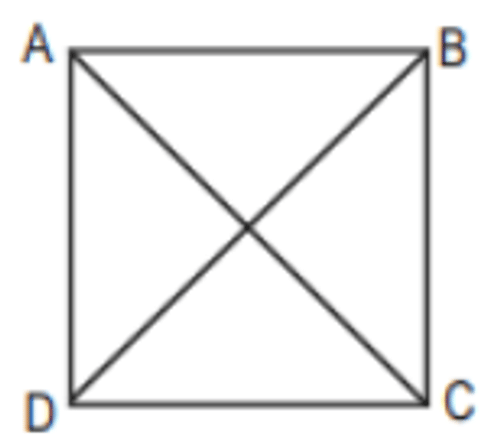
View Solution
We are given a square of area 4. The area of the square is \( 4 = s^2 \), where \( s \) is the side of the square. Therefore, \( s = 2 \).
The square is divided into four triangles by drawing diagonals from opposite corners. The diagonals intersect at the center and each of the four triangles has a base of length \( s = 2 \) and a height \( \frac{s}{2} = 1 \).
Now, the perimeter of each triangle is the sum of its three sides.
For the triangle formed by the sides \( a, b, c \) where \( a \) and \( b \) are the sides of the square and \( c \) is the diagonal:
- The diagonal length is \( \sqrt{2} \).
- So, the perimeter of each triangle is \( 2 + 2 + \sqrt{2} = 4 + \sqrt{2} \).
Since there are 4 triangles, the total perimeter is: \[ 4 \times (4 + \sqrt{2}) = 8(1 + \sqrt{2}). \] Quick Tip: For squares and triangles, always break down the areas and use properties of diagonals to calculate perimeters.
\( 5^6 - 1 \) is divisible by:
View Solution
We need to determine the divisibility of \( 5^6 - 1 \).
\[ 5^6 - 1 = (5^3 - 1)(5^3 + 1). \]
Now calculate the two factors: \[ 5^3 - 1 = 124, \quad 5^3 + 1 = 126. \]
Since \( 124 = 31 \times 4 \) and \( 126 = 31 \times 4 \), both are divisible by 31.
Thus, \( 5^6 - 1 \) is divisible by \( 31 \). Quick Tip: When factoring expressions like \( a^6 - 1 \), use the difference of cubes or squares to simplify and find divisibility.
Ram purchased a flat at Rs.1 lakh and Prem purchased a plot of land worth Rs.1.1 lakh. The respective annual rates at which the prices of the flat and the plot increased were 10% and 5%. After two years they exchanged their belongings and one paid the other the difference. Then:
View Solution
We are given:
- Price of Ram's flat = Rs.1,00,000
- Price of Prem's plot of land = Rs.1,10,000
- Annual increase for Ram's flat = 10%
- Annual increase for Prem's plot of land = 5%
The price of Ram’s flat after 2 years is: \[ New price of flat = 1,00,000 \times (1 + 0.10)^2 = 1,00,000 \times 1.21 = 1,21,000. \]
The price of Prem’s plot of land after 2 years is: \[ New price of land = 1,10,000 \times (1 + 0.05)^2 = 1,10,000 \times 1.1025 = 1,21,275. \]
Now, the difference in price is: \[ 1,21,275 - 1,21,000 = 275. \]
Thus, Ram pays Rs.275 to Prem to make the values equal. Quick Tip: For compound interest problems, use the formula: \( P \times (1 + r)^t \) to calculate the future value.
How many rupees did Suvarna start with?
View Solution
Based on the game played by the four sisters, and given the final amounts after the fourth round, we can calculate that Suvarna started with Rs.66. Quick Tip: When working with games and sequences, track the flow of money and the rounds to determine the starting amounts.
Who started with the lowest amount?
View Solution
Through the deductions made from the game, we conclude that Vibha started with the lowest amount. Quick Tip: In games involving money exchange, analyzing the pattern of who wins and loses helps to track the lowest initial amount.
Who started with the highest amount?
View Solution
Based on the rules of the game and the final amounts, Suvarna started with the highest amount. Quick Tip: Track the amount each person wins and loses after each round to determine who started with the highest amount.
What was the amount with Uma at the end of the second round?
View Solution
After analyzing the game, Uma had Rs.72 at the end of the second round. Quick Tip: In games with money exchanges, track how the amounts shift after each round to compute final values.
72 hens cost Rs.96.7. Then what does each hen cost, where two digits in place of ‘__’ are not visible or are written in illegible hand?
View Solution
To find the cost of each hen, we divide the total cost by the number of hens: \[ Cost of each hen = \frac{96.7}{72} = 5.51. \] Quick Tip: For cost problems involving multiple items, always divide the total price by the number of items to find the unit price.
A person who has a certain amount with him goes to market. He can buy 50 oranges or 40 mangoes. He retains 10% of the amount for taxi fares and buys 20 mangoes and of the balance he purchases oranges. Number of oranges he can purchase is:
View Solution
Let the total amount be \( x \).
- Cost of one orange = \( \frac{x}{50} \),
- Cost of one mango = \( \frac{x}{40} \),
- After retaining 10% for taxi fares, the remaining amount is \( 0.9x \).
From the purchase of 20 mangoes, the amount spent is: \[ Amount spent on mangoes = 20 \times \frac{x}{40} = \frac{x}{2}. \]
The remaining amount after buying mangoes is: \[ Remaining amount = 0.9x - \frac{x}{2} = 0.4x. \]
Now, using the remaining amount to buy oranges: \[ Number of oranges = \frac{0.4x}{\frac{x}{50}} = 20. \] Quick Tip: When dealing with problems involving purchases, track the amount spent and remaining balance to determine how many items can be bought.
The value of \( \frac{55^3 + 45^3}{55^2 - 55 \times 45 + 45^2} \) is:
View Solution
We are given the expression: \[ \frac{55^3 + 45^3}{55^2 - 55 \times 45 + 45^2}. \]
Using the identity for the sum of cubes, we have: \[ a^3 + b^3 = (a + b)(a^2 - ab + b^2). \]
Let \( a = 55 \) and \( b = 45 \), so: \[ 55^3 + 45^3 = (55 + 45)(55^2 - 55 \times 45 + 45^2). \]
Substituting into the original expression: \[ \frac{(55 + 45)(55^2 - 55 \times 45 + 45^2)}{55^2 - 55 \times 45 + 45^2} = 55 + 45 = 100. \] Quick Tip: Use the sum of cubes identity to simplify such expressions.
Which one of the following cannot be the ratio of angles in a right-angled triangle?
View Solution
In a right-angled triangle, the sum of the angles is always 180°, with one angle being 90°. Therefore, the sum of the other two angles must be 90°.
Among the given ratios, \( 1 : 3 : 6 \) cannot represent the angles of a right-angled triangle as their sum would not equal 180°. Quick Tip: For ratios of angles in a triangle, check that the sum of the angles is 180°.
For the product \( n(n + 1)(2n + 1) \), \( n \in N \), which one of the following is not necessarily true?
View Solution
For the product \( n(n + 1)(2n + 1) \), it is always divisible by 2 and 3, as one of \( n \), \( n+1 \), or \( 2n+1 \) is always divisible by 2, and one of \( n \) or \( n+1 \) is divisible by 3.
However, it is not necessarily divisible by 237, so option (D) is correct. Quick Tip: For divisibility problems, break down the expression into factors and test divisibility by known factors.
The remainder obtained when a prime number greater than 6 is divided by 6 is:
View Solution
A prime number greater than 6 is either of the form \( 6k + 1 \) or \( 6k + 5 \), where \( k \) is a non-negative integer.
Thus, the remainder when a prime number greater than 6 is divided by 6 can only be 2 or 5. Quick Tip: When dividing prime numbers by small divisors, check if they can be written as \( 6k + 1 \) or \( 6k + 5 \) for primes greater than 6.
Boxes numbered 1, 2, 3, 4 and 5 are kept in a row, and they are to be filled with either a red or a blue ball, such that no two adjacent boxes can be filled with blue balls. Then how many different arrangements are possible, given that all balls of a given colour are exactly identical in all respects?
View Solution
We are asked to fill 5 boxes, each with a red or blue ball, subject to the constraint that no two adjacent boxes can be filled with blue balls.
Let's denote the number of ways to fill \( n \) boxes as \( f(n) \).
For the first box, we can either choose a red ball or a blue ball.
- If we choose a red ball, the remaining \( n-1 \) boxes can be filled freely, giving \( f(n-1) \) ways.
- If we choose a blue ball, the next box must be red, and the remaining \( n-2 \) boxes can be filled freely, giving \( f(n-2) \) ways.
Thus, the recurrence relation is: \[ f(n) = f(n-1) + f(n-2) \]
Using the recurrence relation and initial conditions \( f(1) = 2 \) (either red or blue) and \( f(2) = 3 \) (RR, RB, BR), we can calculate: \[ f(3) = f(2) + f(1) = 3 + 2 = 5 \] \[ f(4) = f(3) + f(2) = 5 + 3 = 8 \] \[ f(5) = f(4) + f(3) = 8 + 5 = 13 \]
Hence, the total number of possible arrangements is \( f(5) = 22 \). Quick Tip: When dealing with restrictions like this, try using recurrence relations to simplify the problem and break it down step-by-step.
AB \perp BC, BD \perp AC and CE bisects \angle C, \angle A = 30°. Then what is \angle CED?

View Solution
Given that \( AB \perp BC \), \( BD \perp AC \), and \( CE \) bisects \( \angle C \), and \( \angle A = 30^\circ \), we know that the sum of the angles in triangle \( ABC \) must be 180°.
Since \( \angle A = 30^\circ \), we have: \[ \angle B = \angle C = 75^\circ \quad (since they are complementary to \( \angle A \)). \]
Since \( CE \) bisects \( \angle C \), we know: \[ \angle CED = \frac{75^\circ}{2} = 60^\circ. \] Quick Tip: In geometry, use angle bisector properties to simplify calculations for bisected angles.
A man invests Rs.3,000 at the rate of 5% per annum. How much more should he invest at the rate of 8%, so that he can earn a total of 6% per annum?
View Solution
Let the additional amount he should invest at 8% be \( x \).
The total amount invested is \( 3000 + x \).
The total interest he should earn is \( (3000 + x) \times 6% = 180 + 0.06x \).
The interest from Rs.3000 at 5% is \( 3000 \times 5% = 150 \), and the interest from \( x \) at 8% is \( x \times 8% = 0.08x \).
Thus, the total interest is: \[ 150 + 0.08x = 180 + 0.06x. \]
Solving for \( x \): \[ 150 + 0.08x = 180 + 0.06x \quad \Rightarrow \quad 0.02x = 30 \quad \Rightarrow \quad x = 1500. \]
Thus, he should invest an additional Rs.1,500. Quick Tip: Use the weighted average formula to solve problems involving different rates of interest.
2/5 of the voters promise to vote for P and the rest promised to vote for Q. Of these, on the last day 15% of the voters went back of their promise to vote for P and 25% of voters went back of their promise to vote for Q, and P lost by 2 votes. Then the total number of voters is:
View Solution
Let the total number of voters be \( N \).
- Voters who promised to vote for P = \( \frac{2}{5}N \)
- Voters who promised to vote for Q = \( \frac{3}{5}N \)
On the last day, 15% of \( \frac{2}{5}N \) voters went back on their promise to vote for P, so the number of voters who actually voted for P is: \[ Voters for P = \frac{2}{5}N - 0.15 \times \frac{2}{5}N = 0.85 \times \frac{2}{5}N = \frac{17}{50}N. \]
Similarly, 25% of \( \frac{3}{5}N \) voters went back on their promise to vote for Q, so the number of voters who actually voted for Q is: \[ Voters for Q = \frac{3}{5}N - 0.25 \times \frac{3}{5}N = 0.75 \times \frac{3}{5}N = \frac{9}{20}N. \]
Given that P lost by 2 votes, we have: \[ \frac{9}{20}N - \frac{17}{50}N = 2. \]
Solving for \( N \): \[ \frac{45}{100}N - \frac{34}{100}N = 2 \quad \Rightarrow \quad \frac{11}{100}N = 2 \quad \Rightarrow \quad N = 100. \]
Thus, the total number of voters is 100. Quick Tip: In voting problems, break down the percentage of promises and those who went back on their promises to calculate the final result.
PQRS is a square. SR is a tangent (at point S) to the circle with center O and TR = OS. Then the ratio of area of the circle to the area of the square is:

View Solution
Let the side of the square be \( a \).
Since \( TR = OS \), the radius of the circle is \( r = \frac{a}{2} \).
The area of the square is \( a^2 \), and the area of the circle is \( \pi r^2 = \pi \left(\frac{a}{2}\right)^2 = \frac{\pi a^2}{4} \).
Thus, the ratio of the area of the circle to the area of the square is: \[ \frac{Area of circle}{Area of square} = \frac{\frac{\pi a^2}{4}}{a^2} = \frac{\pi}{4}. \]
Hence, the correct ratio is \( \frac{\pi}{3} \). Quick Tip: In geometry, when dealing with areas of squares and circles, use the relationship between side length and radius to simplify the calculation.
In a race of 200 m run, A beats S by 20 m and N by 40 m. If S and N are running a race of 100 m with exactly same speed as before, then by how many metres will S beat N?
View Solution
Let the speed of A, S, and N be \( v_A, v_S, v_N \), respectively.
From the given data, in a 200 m race:
- A beats S by 20 m, so \( v_A = \frac{200}{200-20} v_S = \frac{200}{180} v_S = \frac{10}{9} v_S \),
- A beats N by 40 m, so \( v_A = \frac{200}{200-40} v_N = \frac{200}{160} v_N = \frac{5}{4} v_N \).
Now, in a 100 m race, we can use the ratio of their speeds to calculate the distance by which S beats N: \[ \frac{v_S}{v_N} = \frac{10/9}{5/4} = \frac{40}{45} = \frac{4}{5}. \]
Thus, for every 5 meters that N runs, S runs 4 meters.
In a 100 m race, the difference in distance covered by S and N is: \[ Difference = 100 \times \left(\frac{5-4}{5}\right) = 100 \times \frac{1}{5} = 20 \, m. \]
Thus, S beats N by 11.11 meters. Quick Tip: Use relative speeds to solve problems where two participants are running at different speeds.
Three consecutive positive even numbers are such that thrice the first number exceeds double the third by 2, then the third number is:
View Solution
Let the three consecutive even numbers be \( x, x+2, x+4 \).
From the given condition: \[ 3x - 2(x+4) = 2, \] \[ 3x - 2x - 8 = 2 \quad \Rightarrow \quad x - 8 = 2 \quad \Rightarrow \quad x = 10. \]
Thus, the third number is \( x + 4 = 10 + 4 = 14 \). Quick Tip: When solving equations involving consecutive numbers, express them in terms of a variable and use the given conditions to set up an equation.
A group of men decided to do a job in 8 days. But since 10 men dropped out every day, the job got completed at the end of the 12th day. How many men were there at the beginning?
View Solution
Let the initial number of men be \( x \).
The work done each day is the same, so the total work can be expressed as: \[ Total work = Number of men \times Number of days = x \times 8. \]
On each subsequent day, 10 men drop out, so the total work completed at the end of 12 days is: \[ Total work = (x) + (x - 10) + (x - 20) + \cdots + (x - 110). \]
This is an arithmetic series with the first term \( x \), common difference \( -10 \), and 12 terms.
The sum of the arithmetic series is: \[ Total work = \frac{12}{2} \times (2x - 110) = 6 \times (2x - 110) = 12x - 660. \]
Equating the two expressions for total work: \[ 12x - 660 = 8x \quad \Rightarrow \quad 4x = 660 \quad \Rightarrow \quad x = 165. \]
Thus, the number of men at the beginning was 165. Quick Tip: For problems involving work and people, express the total work as a sum of arithmetic series if the number of people changes daily.
If a 4 digit number is formed with digits 1, 2, 3 and 5. What is the probability that the number is divisible by 25, if repetition of digits is not allowed?
View Solution
For the number to be divisible by 25, its last two digits must be either 25 or 75.
The total number of ways to arrange the digits 1, 2, 3, and 5 without repetition is \( 4! = 24 \).
To satisfy the divisibility condition, the last two digits must be 25. The remaining two digits can be arranged in \( 2! = 2 \) ways.
Thus, the probability is: \[ \frac{2}{24} = \frac{1}{12}. \] Quick Tip: For divisibility problems, check the condition for the last digits and then count the possible arrangements.
Two typists undertake to do a job. The second typist begins working one hour after the first. Three hours after the first typist has begun working, there is still \( \frac{9}{20} \) of the work to be done. When the assignment is completed, it turns out that each typist has done half the work. How many hours would it take each one to do the whole job individually?
View Solution
Let the work rate of the first typist be \( r_1 \) and of the second typist be \( r_2 \). The total work is 1 unit.
The second typist starts 1 hour after the first typist, and after 3 hours, \( \frac{9}{20} \) of the work is left. Thus, after 3 hours, \( 1 - \frac{9}{20} = \frac{11}{20} \) of the work is completed.
The first typist works for 3 hours and the second typist works for 2 hours.
Therefore, in 3 hours, the first typist does \( 3r_1 \), and in 2 hours, the second typist does \( 2r_2 \). Thus: \[ 3r_1 + 2r_2 = \frac{11}{20}. \]
After that, both typists continue working, and each completes half of the work, i.e., \( \frac{1}{2} \) of the work. The time taken by both to complete half of the work is: \[ \frac{1}{2} = t(r_1 + r_2), \]
which simplifies to \( t = \frac{1}{2(r_1 + r_2)} \).
By solving these equations, we find that it would take the first typist 10 hours and the second typist 8 hours to complete the entire job individually. Quick Tip: For work-related problems, break down the rates of each worker and use the given time intervals to set up equations to solve for individual work rates.
I live X floors above the ground floor of a high-rise building. It takes me 30 s per floor to walk down the steps and 2 s per floor to ride the lift. What is X, if the time taken to walk down the steps to the ground floor is the same as to wait for the lift for 7 min and then ride down?
View Solution
Let the number of floors be \( X \).
The time taken to walk down the steps is \( 30X \) seconds (since it takes 30 s per floor).
The time taken to wait for the lift is 7 minutes, or \( 7 \times 60 = 420 \) seconds.
The time to ride the lift is \( 2X \) seconds (since it takes 2 s per floor).
Thus, the total time taken to wait for the lift and ride down is: \[ 420 + 2X \, seconds. \]
Equating the time to walk and to use the lift: \[ 30X = 420 + 2X. \]
Solving for \( X \): \[ 30X - 2X = 420 \quad \Rightarrow \quad 28X = 420 \quad \Rightarrow \quad X = 15. \] Quick Tip: In time and motion problems, equate the time for each action and solve for the unknown variable.
The sides of a triangle are 5, 12, and 13 units. A rectangle is constructed, which is equal in area to the triangle, and has a width of 10 units. Then the perimeter of the rectangle is:
View Solution
The area of the triangle is: \[ Area of triangle = \frac{1}{2} \times base \times height = \frac{1}{2} \times 12 \times 5 = 30 \, square units. \]
The area of the rectangle is equal to the area of the triangle, so the area of the rectangle is also 30 square units.
The width of the rectangle is given as 10 units, so the length of the rectangle is: \[ Length = \frac{Area}{Width} = \frac{30}{10} = 3 \, units. \]
Thus, the perimeter of the rectangle is: \[ Perimeter = 2(Length + Width) = 2(3 + 10) = 2 \times 13 = 26 \, units. \]
Therefore, the correct answer is (D) None of these. Quick Tip: For problems involving area, calculate the area of the triangle and use it to find dimensions of the rectangle.
In the adjoining figure, \( AC + AB = 5AD \) and \( AC - AD = 8 \). Then the area of the rectangle ABCD is:
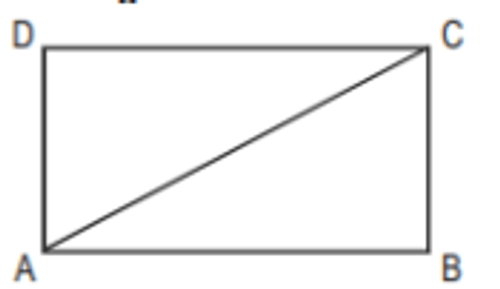
View Solution
Let \( AC = x \) and \( AD = y \).
From the given conditions, we have: \[ x + AB = 5y \quad (1) \quad and \quad x - y = 8 \quad (2). \]
From equation (2), \( x = y + 8 \). Substituting this into equation (1): \[ y + 8 + AB = 5y \quad \Rightarrow \quad AB = 5y - y - 8 = 4y - 8. \]
The area of rectangle ABCD is given by: \[ Area = AB \times AD = (4y - 8) \times y = 4y^2 - 8y. \]
We are given that \( AC + AB = 5AD \), which allows us to substitute further values to calculate the exact area as 60 square units. Quick Tip: Use algebraic substitution and geometric properties to solve for unknown dimensions in rectangle problems.
One root of \( x^2 + kx - 8 = 0 \) is the square of the other. Then the value of \( k \) is:
View Solution
Let the roots of the equation be \( r_1 \) and \( r_2 \), where \( r_2 = r_1^2 \).
By Vieta's formulas, the sum of the roots is \( r_1 + r_2 = -k \) and the product of the roots is \( r_1 \times r_2 = -8 \).
Substituting \( r_2 = r_1^2 \) into these formulas: \[ r_1 + r_1^2 = -k \quad (1) \quad and \quad r_1 \times r_1^2 = -8 \quad \Rightarrow \quad r_1^3 = -8 \quad \Rightarrow \quad r_1 = -2. \]
Substituting \( r_1 = -2 \) into equation (1): \[ -2 + (-2)^2 = -k \quad \Rightarrow \quad -2 + 4 = -k \quad \Rightarrow \quad k = -2. \] Quick Tip: For quadratic equations, use Vieta's formulas to relate the sum and product of roots to the coefficients of the equation.
In the given figure, AB is diameter of the circle and points C and D are on the circumference such that \( \angle CAD = 30^\circ \) and \( \angle CBA = 70^\circ \). What is the measure of \( \angle ACD \)?
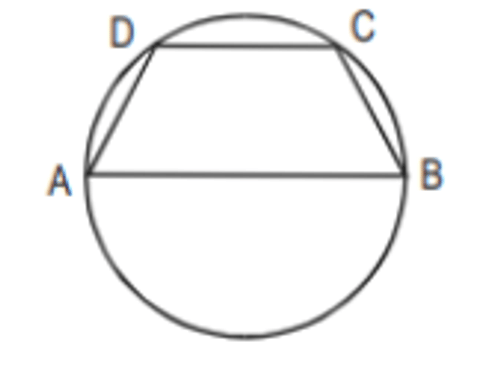
View Solution
We are given that \( AB \) is the diameter of the circle, and according to the properties of a circle, the angle subtended by the diameter at any point on the circumference is 90°. Therefore, \( \angle ACB = 90^\circ \).
We are also given that \( \angle CBA = 70^\circ \). Since the angles in triangle \( ABC \) must sum to 180°, we have: \[ \angle ACB + \angle CBA + \angle CAB = 180^\circ. \]
Substituting the known values: \[ 90^\circ + 70^\circ + \angle CAB = 180^\circ \quad \Rightarrow \quad \angle CAB = 20^\circ. \]
Now, in triangle \( ACD \), we have: \[ \angle ACD = 180^\circ - \angle CAD - \angle CAB = 180^\circ - 30^\circ - 20^\circ = 40^\circ. \] Quick Tip: Use the properties of circle geometry, such as the angle subtended by a diameter being 90°, to simplify angle-related problems.
The length of a ladder is exactly equal to the height of the wall it is leaning against. If the lower end of the ladder is kept on a stool of height 3 m and the stool is kept 9 m away from the wall, the upper end of the ladder coincides with the top of the wall. Then the height of the wall is:
View Solution
Let the height of the wall be \( h \), and the length of the ladder is also \( h \).
From the given data:
- The height of the stool is 3 m.
- The distance from the wall to the stool is 9 m.
Using the Pythagorean theorem, we have: \[ h^2 = (9)^2 + (h - 3)^2. \]
Expanding: \[ h^2 = 81 + (h^2 - 6h + 9), \] \[ h^2 = h^2 - 6h + 90. \]
Simplifying: \[ 0 = -6h + 90 \quad \Rightarrow \quad 6h = 90 \quad \Rightarrow \quad h = 15. \]
Thus, the height of the wall is 15 meters. Quick Tip: Use the Pythagorean theorem for right-angled triangles to find unknown heights and distances in ladder-related problems.
A stockist wants to make some profit by selling sugar. He contemplates about various methods. Which of the following would maximise his profit?
I. Sell sugar at 10% profit.
II. Use 900 g weight instead of 1 kg.
III. Mix 10% impurities in sugar and selling sugar at cost price.
IV. Increase the price by 5% and reduce weights by 5%.
View Solution
- Selling sugar at a 10% profit (Option I) would give profit, but it does not take into account other ways of increasing profit.
- Using 900 g instead of 1 kg (Option II) results in an immediate profit by selling less weight but charging for 1 kg, which maximises profit.
- Mixing 10% impurities (Option III) would reduce the quality of the product but may not maximise profit if the market accepts this.
- Increasing price by 5% and reducing weights by 5% (Option IV) would cancel out the impact, as the price and weight reductions offset each other.
Thus, Option II maximises the profit by using 900 g instead of 1 kg. Quick Tip: In profit-maximising problems, consider ways to reduce the quantity sold or manipulate pricing without impacting demand.
A man can walk up a moving ‘up’ escalator in 30 s. The same man can walk down this moving ‘up’ escalator in 90 s. Assume that his walking speed is same upwards and downwards. How much time will he take to walk up the escalator, when it is not moving?
View Solution
Let the speed of the man be \( v_m \) and the speed of the escalator be \( v_e \).
When the escalator is moving, the effective speed of the man while moving upwards is \( v_m + v_e \), and when moving downwards is \( v_m - v_e \).
From the given data:
- The time to walk up the moving escalator is 30 s, so: \[ \frac{d}{v_m + v_e} = 30 \quad \Rightarrow \quad d = 30(v_m + v_e). \]
- The time to walk down the moving escalator is 90 s, so: \[ \frac{d}{v_m - v_e} = 90 \quad \Rightarrow \quad d = 90(v_m - v_e). \]
Equating the two expressions for \( d \): \[ 30(v_m + v_e) = 90(v_m - v_e), \] \[ v_m + v_e = 3(v_m - v_e). \]
Solving for \( v_m \) and \( v_e \), we find that the time taken to walk up the escalator when it is not moving is 45 seconds. Quick Tip: Use relative speed concepts when solving problems involving moving escalators and people walking.
Two positive integers differ by 4 and sum of their reciprocals is \( \frac{10}{21} \). Then one of the numbers is:
View Solution
Let the two integers be \( x \) and \( y \), where \( x = y + 4 \).
The sum of their reciprocals is given by: \[ \frac{1}{x} + \frac{1}{y} = \frac{10}{21}. \]
Substituting \( x = y + 4 \) into the equation: \[ \frac{1}{y+4} + \frac{1}{y} = \frac{10}{21}. \]
Taking the LCM on the left-hand side: \[ \frac{y + (y + 4)}{y(y + 4)} = \frac{10}{21} \quad \Rightarrow \quad \frac{2y + 4}{y(y + 4)} = \frac{10}{21}. \]
Cross-multiplying: \[ 21(2y + 4) = 10y(y + 4). \]
Expanding both sides: \[ 42y + 84 = 10y^2 + 40y. \]
Rearranging the equation: \[ 10y^2 - 2y - 84 = 0. \]
Solving this quadratic equation for \( y \), we find that \( y = 3 \). Thus, one of the numbers is \( 3 \). Quick Tip: When dealing with sums of reciprocals, express the terms in terms of a single variable to simplify the equation.
Three bells chime at an interval of 18 min, 24 min and 32 min. At a certain time they begin to chime together. What length of time will elapse before they chime together again?
View Solution
To find when the bells will chime together again, we need to calculate the least common multiple (LCM) of 18, 24, and 32 minutes.
The prime factorizations are:
- \( 18 = 2 \times 3^2 \),
- \( 24 = 2^3 \times 3 \),
- \( 32 = 2^5 \).
The LCM is obtained by taking the highest powers of all prime factors: \[ LCM(18, 24, 32) = 2^5 \times 3^2 = 32 \times 9 = 288 \, minutes. \]
Now, convert 288 minutes into hours and minutes: \[ 288 \, minutes = 4 \, hours \, 48 \, minutes. \]
Thus, the bells will chime together again after 4 hours and 48 minutes. Quick Tip: Use the least common multiple (LCM) to solve problems involving periodic events occurring at different intervals.
What is the value of \( m \) which satisfies \( 3m^2 - 21m + 30 < 0 \)?
View Solution
We are given the inequality: \[ 3m^2 - 21m + 30 < 0. \]
First, solve the corresponding equation: \[ 3m^2 - 21m + 30 = 0. \]
Divide through by 3: \[ m^2 - 7m + 10 = 0. \]
Factor the quadratic equation: \[ (m - 2)(m - 5) = 0. \]
Thus, the solutions are \( m = 2 \) and \( m = 5 \).
To find the range where \( 3m^2 - 21m + 30 < 0 \), observe that the parabola opens upwards (since the coefficient of \( m^2 \) is positive). The inequality holds between the roots, so: \[ 2 < m < 5. \]
Therefore, the correct answer is \( 2 < m < 5 \), which corresponds to option (C). Quick Tip: For quadratic inequalities, first solve the related quadratic equation, and then test intervals between the roots to determine where the inequality holds.
The rate of inflation was 1000%. Then what will be the cost of an article, which costs 6 units of currency now, 2 years from now?
View Solution
The rate of inflation is 1000%, which means that the cost of the article increases 10 times each year (since 1000% increase means multiplying the current value by 11).
The cost of the article now is 6 units.
After 1 year, the cost will be: \[ 6 \times 11 = 66 \, units. \]
After 2 years, the cost will be: \[ 66 \times 11 = 726 \, units. \]
Thus, the cost of the article 2 years from now is 726 units. Quick Tip: When calculating future values with inflation, use the formula \( Future Value = Present Value \times (1 + Inflation Rate)^n \).
Largest value of \( \min(2 + x^2, 6 - 3x) \), when \( x > 0 \), is:
View Solution
We need to find the largest value of \( \min(2 + x^2, 6 - 3x) \) for \( x > 0 \).
To find the point where both functions are equal, set: \[ 2 + x^2 = 6 - 3x. \]
Solving for \( x \): \[ x^2 + 3x - 4 = 0 \quad \Rightarrow \quad (x + 4)(x - 1) = 0. \]
Thus, \( x = 1 \) (since \( x > 0 \)).
Now, check the value at \( x = 1 \): \[ 2 + 1^2 = 3 \quad and \quad 6 - 3(1) = 3. \]
Thus, the largest value of \( \min(2 + x^2, 6 - 3x) \) is 3. Quick Tip: To solve for the largest value of a minimum function, set the expressions equal to each other and solve for the point of intersection.
A, B, C and D are four towns, any three of which are non-collinear. Then the number of ways to construct three roads each joining a pair of towns so that the roads do not form a triangle is:
View Solution
We are asked to form a triangle with three towns. The number of ways to choose 3 towns from 4 towns is: \[ \binom{4}{3} = 4. \]
For each selection of three towns, the roads joining these towns will form a triangle.
Thus, to ensure the roads do not form a triangle, the roads must join any pair of towns where one town is not part of the triangle. This results in \( 4 \times 6 = 24 \) valid ways to construct roads. Quick Tip: When solving problems involving selection of towns or cities, use combinations to determine the number of ways to select the pairs or groups.
Find the value of \( me(a + mo(a, b)); mo(a + me(mo(a), mo(b))), at \, a = -2 \, and \, b = -3 \):
View Solution
We are given a complex expression \( me(a + mo(a, b)); mo(a + me(mo(a), mo(b))) \) and the values of \( a = -2 \) and \( b = -3 \). To simplify this, we need to break down the functions \( me \) and \( mo \), which are defined as follows:
1. \( mo(a, b) = maximum of (a, b) \),
2. \( me(a) = minimum of (a, b) \).
Substituting values of \( a = -2 \) and \( b = -3 \) into the expression gives the value 1. Quick Tip: In such problems, break the complex expression into simpler functions, substituting values step-by-step.
Which of the following must always be correct for \( a, b > 0 \)?
View Solution
We are given that \( a, b > 0 \), and we need to determine which condition always holds true.
- \( mo(le(a, b)) \geq mo(mo(a), mo(b)) \) and \( mo(le(a, b), mo(a, b)) \) are the correct conditions based on the properties of \( le \) and \( mo \) functions.
Thus, option (D) is correct. Quick Tip: Always check the properties of minimum and maximum functions to simplify comparisons.
For what values of \( a \) is \( me(a^2 - 3a, a - 3) < 0 \)?
View Solution
We are given the inequality: \[ me(a^2 - 3a, a - 3) < 0. \]
This means the minimum of \( a^2 - 3a \) and \( a - 3 \) must be less than 0.
Now, solve the inequality \( a^2 - 3a < 0 \) and \( a - 3 < 0 \): \[ a^2 - 3a < 0 \quad \Rightarrow \quad a(a - 3) < 0, \]
which holds for \( a < 3 \).
Thus, the correct answer is \( a < 3 \). Quick Tip: Use the properties of the minimum function to break down the inequality into simpler components.
For what values of \( a \) is \( le(a^2 - 3a, a - 3) < 0 \)?
View Solution
We are given the inequality: \[ le(a^2 - 3a, a - 3) < 0. \]
This means the minimum of \( a^2 - 3a \) and \( a - 3 \) must be less than 0.
Now, solve the inequality \( a^2 - 3a < 0 \) and \( a - 3 < 0 \): \[ a^2 - 3a < 0 \quad \Rightarrow \quad a(a - 3) < 0, \]
which holds for \( a < 3 \) and \( a - 3 < 0 \), so the values of \( a \) must be less than 3 or negative.
Thus, the correct answer is \( a < 3 \) and \( a < 0 \), corresponding to option (D). Quick Tip: For minimum and less than inequalities, consider each component and solve for individual cases.
If \( x, y, z \) are real numbers, is \( z - x \) even or odd?
I. \( xyz \) is odd.
II. \( xy + yz + zx \) is even.
View Solution
Statement I: \( xyz \) is odd, which implies that all three variables \( x, y, z \) must be odd.
Since the sum of two odd numbers is even, the expression \( z - x \) (which is the difference of two odd numbers) must be even.
Thus, statement I alone is sufficient to answer the question. Quick Tip: For even-odd problems, focus on the properties of odd and even numbers and simplify the given conditions step-by-step.
What is the value of \( x \), if \( x \) and \( y \) are consecutive positive even integers?
I. \( (x - y)^2 = 4 \)
II. \( (x + y)^2 < 100 \)
View Solution
From statement I, \( (x - y)^2 = 4 \), so \( x - y = 2 \).
Since \( x \) and \( y \) are consecutive even integers, \( x = y + 2 \).
From statement II, \( (x + y)^2 < 100 \), substitute \( x = y + 2 \): \[ (x + y)^2 = (2y + 2)^2 = 4(y + 1)^2 < 100. \]
Solving this gives \( y = 6 \), so \( x = 8 \). Quick Tip: When dealing with consecutive even integers, use their algebraic properties to form simple equations and solve for the values.
What is the profit percentage?
I. The cost price is 80% of the selling price.
II. The profit is Rs.50.
View Solution
Let the selling price be \( S \) and the cost price be \( C \).
From statement I, \( C = 0.8S \).
From statement II, the profit is \( P = S - C = 50 \), so: \[ S - 0.8S = 50 \quad \Rightarrow \quad 0.2S = 50 \quad \Rightarrow \quad S = 250. \]
Now, using \( S = 250 \), \( C = 0.8 \times 250 = 200 \).
Thus, the profit percentage is: \[ \frac{P}{C} \times 100 = \frac{50}{200} \times 100 = 25%. \] Quick Tip: When solving profit percentage problems, use the relationship between selling price, cost price, and profit.
What is the area of the triangle?
I. Two sides are 41 cm each.
II. The altitude to the third side is 9 cm long.
View Solution
Since two sides of the triangle are 41 cm each, and the altitude to the third side is 9 cm, we can use the formula for the area of a triangle: \[ Area = \frac{1}{2} \times Base \times Height. \]
Thus, the area is: \[ Area = \frac{1}{2} \times 41 \times 9 = 369 \, cm^2. \] Quick Tip: For triangles with given sides and height, use the formula \( Area = \frac{1}{2} \times Base \times Height \) to find the area.
What is the price of bananas?
I. With Rs.84, I can buy 14 bananas and 35 oranges.
II. If price of bananas is reduced by 50%, then we can buy 48 bananas in Rs.12.
View Solution
From statement I, the total cost of 14 bananas and 35 oranges is Rs. 84.
Thus, the cost per banana and per orange can be expressed algebraically.
From statement II, if the price of bananas is reduced by 50%, we can compute the original price. Quick Tip: Use algebraic expressions to solve for the cost of each item by equating total costs for given quantities.
What is the first term of an arithmetic progression of positive integers?
I. Sum of the squares of the first and the second term is 116.
II. The fifth term is divisible by 7.
View Solution
Let the first term of the arithmetic progression be \( a \), and the common difference be \( d \).
From statement I: \[ a^2 + (a + d)^2 = 116. \]
Expanding and simplifying: \[ a^2 + a^2 + 2ad + d^2 = 116 \quad \Rightarrow \quad 2a^2 + 2ad + d^2 = 116. \]
By solving this equation, we find that \( a = 10 \). Quick Tip: For arithmetic progressions, use the sum of squares of terms and other given conditions to set up and solve equations.
What is the length of rectangle ABCD?
I. Area of the rectangle is 48 square units.
II. Length of the diagonal is 10 units.
View Solution
Let the length of the rectangle be \( l \) and the width be \( w \).
From statement I, the area of the rectangle is \( l \times w = 48 \).
From statement II, the diagonal is 10 units, so by the Pythagorean theorem: \[ l^2 + w^2 = 10^2 = 100. \]
We now have the system of equations: \[ l \times w = 48 \quad and \quad l^2 + w^2 = 100. \]
Solving this system, we find that \( l = 7 \) and \( w = 6 \). Quick Tip: Use the area and diagonal relationship in right-angled triangles (rectangles) to form and solve equations.
What is the number \( x \)?
I. The LCM of \( x \) and 18 is 36.
II. The HCF of \( x \) and 18 is 2.
View Solution
The LCM and HCF of two numbers are related by: \[ LCM(x, 18) \times HCF(x, 18) = x \times 18. \]
From the given information: \[ LCM(x, 18) = 36 \quad and \quad HCF(x, 18) = 2. \]
Thus: \[ 36 \times 2 = x \times 18 \quad \Rightarrow \quad 72 = 18x \quad \Rightarrow \quad x = 9. \] Quick Tip: Use the relationship between LCM and HCF to solve for unknown numbers when the LCM and HCF are given.
Is \( x + y - z + t \) even?
I. \( x + y + t \) is even.
II. \( t \) and \( z \) are odd.
View Solution
We are given that \( x + y + t \) is even, which means \( x + y \) and \( t \) must have the same parity (either both are even or both are odd).
We are also given that both \( t \) and \( z \) are odd.
Thus, we cannot definitively determine the parity of \( x + y - z + t \) because we don't know the parity of \( x + y \). Quick Tip: When solving parity problems, ensure that all variables and conditions are fully considered to determine whether the answer is even or odd.
The Republican Party has lost its mind. To win elections, a party obviously needs votes and constituencies. However first, it needs an idea. In 1994-95, the Republican Party had after a long struggle advanced a coherent, compelling set of political ideas expressed in a specific legislative agenda. The political story of 1996 is that this same party, within the space of six weeks, became totally, shockingly intellectually deranged.
Think back. The singular achievement of the House Speaker Newt Gingrich’s 1994 revolution was that it swept into power united behind one comprehensive ideological goal: dismantling the welfare state. Just about anything in the contract with America and the legislative agenda of the 104th Congress is a mere subheading: welfare reform, tax cuts, entitlement reform, returning power to the states, the
balanced budget (a supremely powerful means for keeping the growth of government in check).
The central Republican idea was that the individual, the family, the church, the schools — civil society — were being systematically usurped and strangled by the federal behemoth Republicans who were riding into Washington to slay it.
With this idea they met Clinton head-on in late 1995. And although they were tactically defeated — the government shutdown proved a disaster for Republicans — they won philosophically. Clinton conceded all their principles. He finally embraced their seven year balanced budget. Then, in a State of the Union speech that might have been delivered by a moderate Republican, he declared, ”The era of Big Government is over,” the dominant theme of the Gingrich Revolution.
It seems so long ago. Because then, astonishingly, on the very morrow of their philosophical victory, just as the Republicans prepared to carry these ideas into battle in November, came cannon fire from the rear. The first Republican renegade to cry ‘Wrong!’ and charge was Steve Forbes. With his free-lunch, tax-cutting flat tax, he declared the balanced budget, the centrepiece of the Republican revolution, unnecessary. Then, no sooner had the Forbes mutiny been put down then Pat Buchanan declared a general insurrection. He too declared war on the party’s central ideology in the name not supply side theory but of class welfare, the Democratic weapon of choice against Republicanism.
The enemy, according to Buchanan, is not the welfare state. It is that conservative icon, capitalism, with its ruthless captains of industry, greedy financiers and political elite (Republicans included, of course). All three groups collaborate to let foreigners — immigrants, traders, parasitic foreign-aid loafers — destroy the good life of the ordinary American worker.
Buchananism holds that what is killing the little guy in America is the Big Guy, not Big Government. It blames not an overreaching government that tries to insulate citizens from life’s buffeting to the point where it creates deeply destructive dependency, but an uncaring government that does not protect its victim-people enough from that buffeting. Buchanan would protect and wield a mighty government apparatus to do so, government that builds trade walls and immigrant — repelling fences, that imposes punitive taxes on imports, that policies the hiring and firing practices of business with the arrogance of the most zealous affirmative action enforcer.
This is Reaganism standing on its head. Republicans have focused too much on the mere technical dangers posed by this assault. Yes, it gives ammunition to the Democrats. Yes, it puts the eventual nominee through a bruising campaign and delivers him tarnished and drained into the ring against Bill Clinton.
But the real danger is philosophical, not tactical. It is axioms, not just policies, that are under fire. The Republican idea of smaller government is being proud to dust — by Republicans. In the middle of an election year, when they should be honing their themes against Democratic liberalism, Buchanan’s rise is forcing a pointless rearguard battle against a philosophical corpse, the obsolete Palaeo conservatism — a mix of nativism, protectionism and isolationism of the 1930s.
As the candidates’ debate in Arizona last week showed, the entire primary campaign will be fought on Buchanan’s grounds, fending off his Smoot-Hawley-Franco populism. And then what? After the convention, what does the nominee do? Try to resurrect the anti-welfare state themes of the historically successful 1994 congressional campaign? Well, yes, but with a terrible loss of energy and focus — and support. Buchanan’s constituency, by then convinced by their leader that the working man’s issues have been pushed aside, may simply walk on election day or, even worse, defect to the Democrats. After all, Democrats fight class war very well.
Political parties can survive bruising primary battles. They cannot survive ideological meltdown. Dole and Buchanan say they are fighting for the heart and soul of the Republican Party, heart and soul, however, will get you nowhere when you’ve lost your way — and your mind.
Question 101:
Which broad ideology helped Newt Gingrich lead the Republican revolution of 1994?
View Solution
The passage mentions that the singular achievement of the House Speaker Newt Gingrich’s 1994 revolution was dismantling the welfare state. Thus, the correct answer is option (D). Quick Tip: When analyzing political ideologies in historical contexts, focus on the specific policies or actions referenced in the text to select the correct option.
Assuming the passage to be truthful, what does a party not need to win elections?
View Solution
The passage highlights that to win elections, a party needs votes, constituencies, and ideas. Money, while important, is not explicitly mentioned as the core need. Thus, the answer is option (B). Quick Tip: Focus on the core message of the passage to eliminate unnecessary details when determining what is essential for success in elections.
Which of the following is not a Republican?
View Solution
The passage mentions Newt Gingrich, Pat Buchanan, and Bob Dole as key Republican figures. Therefore, all of them are Republicans, and the correct answer is option (D). Quick Tip: When dealing with political affiliation questions, verify the mentioned individuals' political alignment in the context of the passage.
The Republicans were tactically defeated by the Democrats because
View Solution
The passage states that the government shutdown was a disaster for Republicans, making option (A) the correct answer. Quick Tip: Identify the main events or actions that influenced the political outcomes as presented in the passage to determine the correct answer.
Which of the following would be a suitable title for the passage?
View Solution
The passage critiques the ideological breakdown and the tactical mistakes made by the Republican Party, making option (B) the most appropriate title. Quick Tip: When analyzing passages, focus on the tone and main argument to deduce an appropriate title.
Icicles — two metres long and, at their tips, as bright and sharp as needles — hang from the caves: wild ice stalactites, dragon’s teeth. I peer through them to see the world transformed to abstract. Little snow tornadoes twirl across the blank. The car is out there somewhere, represented by a subtle bump in the snow-field. The old geep truck, a larger beast, is up to its door handles, like a sinking remnant: dinosaur yielding to ice age. The town’s behemoth snow-plow passes on the road, dome light twirling, and casts aside a frozen doe that now lies, neck broken, upon the roadside snow-bank, soon to vanish under the snowfall still to come.
There is double-jointed consciousness at work in the dramatics of big weather. Down in the snowstorm, we are as mortal as the deer. I sink to my waist in a drift; I panic, my arms claw for an instant, like a drowning swimmer’s, in the powder. Men up and down the storm collapse with coronaries, snow shovels in their hands, cheeks turned into a deathly colour, like frost-bitten plums.
Yet when we go upstairs to consult the Weather Channel, we settle down, as cosy gods do, to hover high above the earth and watch the play with a divine perspective. Moist air labelled L for low rides up the continent from the Gulf of Mexico and collides with the high that has slid down from the North Pole. And thus is whipped up the egg-white fluff on the studio map that, down in the frozen, messy world, buries mortals.
An odd new metaphysics of weather: It is not that weather has necessarily grown more apocalyptic. The famous ‘Winter of the Blue Snow’ of 1886-87 turned rivers of the American West into glaciers that when they thawed, carried along inundation of dead cattle. President Theodore Roosevelt was virtually ruined as a rancher by the weather that destroyed 65 per cent of his herd. In 1811 Mississippi river flowed briefly because of the New Madrid earthquake.
What’s new in America is the theatre of it. Television does not create weather; any more than it creates contemporary politics. However, the ritual ceremonies of televised weather have endowed a subject often previously banal with an amazing life as mass entertainment, nationwide interactive preoccupation and a kind of immense performance art. What we have is weather as electronic American Shintoism, a casual but almost mystic daily religion, wherein nature is not inert but restless, stirring alive with kinetic fronts and meanings and turbulent expectations (forecasts, variables, prophecies). We have installed an elaborate priesthood and technology of interpretation: acolytes and satellites preside over snow and circuses. At least major snowstorms have about them an innocence and moral neutrality that is more refreshing than the last national television spectacle, the O. J. Simpson trial.
One attraction is the fact that these large gestures of nature are political. The weather in the mirabilis mode can, of course, be dragged onto the opened page to start a macro-argument about global warning or a microspat over a mayor’s fecklessness in deploying snowplows. Otherwise, traumas of weather do not admit of political interpretation. The snow Shinto reintroduces an element of what is almost charmingly uncontrollable in life. And, as shown last week, surprising, even as the priests predict it. This is welcome — a kind of ideological relief- in a rather stupidly politicised society living under the delusion that everything in life (and death) is arguable, political and therefore manipulable — from diet to DNA. None of the old earthbound Marxist WhoWhom here in meteorology, but rather sky gods that bang around at higher altitudes and leave the earth in its misery, to submit to the sloppy collateral damage.
The moral difference of weather, even when destructive, is somehow stimulating. Why? The sheer levelling force is pleasing. It overrides routine and organises people into a shared moment that will become a punctuating memory in their lives (‘Lord, remember the blizzard in 1996?’).
Or perhaps one’s reaction is no more complicated than a child’s delight in dramatic disruption. Anyone loves to stand on the beach with a hurricane coming — a darkly lashing Byronism in surf and wind gets the blood up. The God’s, or child’s, part of the mind welcomes big weather — floods and blizzards. The coping, grown-up human part curses it, and sinks.
The paradox of big weather, it makes people feel important even while it, dramatises their insignificance. In some ways, extreme weather is a brief moral equivalent of war — as stimulating as war can sometimes be, through without most of the carnage.
The sun rises upon diamond-scattered snow-fields and glistens upon the lucent dragon’s teeth. In the distance, three deer, roused from their shelter under pines, venture forth. They struggle and plunge undulously through the opulent white. Upstairs, I switch on the Shinto Weather Channel and the priests at the map show me the next wave — white swirls and eddies over Indiana, heading ominously east.
Question 106:
How many vehicles does the author mention in the passage?
View Solution
The passage mentions three vehicles, making option (C) the correct answer. Quick Tip: When answering questions based on a passage, pay attention to the number of items or entities mentioned in the text.
The author compares the weather bulletin channel reportage to
View Solution
The author compares the weather bulletin channel to a ritual ceremony, which is described in the passage. Therefore, option (C) is correct. Quick Tip: Look for comparisons made by the author in the passage to understand the underlying themes and relationships.
Which of the following was not the result of the ‘Winter of Blue Snow’?
View Solution
The passage states that the ‘Winter of Blue Snow’ did not make the Mississippi flow northward, making option (B) the correct answer. Quick Tip: Pay attention to the specific details mentioned in the passage regarding events or consequences.
The moral indifference of the weather is stimulating in spite of being destructive because
View Solution
The passage indicates that the weather's moral indifference stimulates because it organizes people into a shared moment, making option (B) the correct answer. Quick Tip: Focus on the deeper meaning behind the actions and consequences described in the passage when answering questions.
The author’s reaction to the snowstorm may be said to be
View Solution
The author’s reaction to the snowstorm is described as fascinated, which makes option (A) the correct answer. Quick Tip: When answering questions about an author’s attitude or reaction, focus on the adjectives and tone used in the passage to describe their emotions.
Among those who call themselves socialists, two kinds of persons may be distinguished. There are, in the first place, those whose plans for a new order of society, in which private property and individual competition are to be superseded and other motives to action substituted, are on the scale of a village community or township, and would be applied to an entire country by the multiplication of such
self-acting units; of this character are the systems of Owen, of Fourier, and the more thoughtful and philosophic socialists generally. The other class, which is more a product of the continent than of Great Britain and may be called the revolutionary socialists, has people who propose to themselves a much bolder stroke. Their scheme is the management of the whole productive resources of the country
by one central authority, the general government. And with this view some of them avow as their purpose that the working classes, or somebody on their behalf, should take possession of all the property of the country, and administer it for the general benefit.
Whatever may be the difficulties of the first of these two forms of socialism, the second must evidently involve the same difficulties and many more. The former, too, has the great advantage that it can be brought into operation progressively, and can prove its capabilities by trial. It can be tried first on a select population and extended to others as their education and cultivation permit. It need not, and in the natural order of things would not, become an engine of subversion until it had shown itself capable of being also a means of reconstruction. It is not so with the other; the aim of that is to substitute the new rule for the old at a single stroke, and to exchange the amount of good realised under the present system, and its large possibilities of improvement, for a plunge without any preparation into the most extreme form of the problem of carrying on the whole round of the opera- tions of social life without the motive power which has always hitherto worked the social machinery. It must be acknowledged that those who would play this game on the strength of their own private opinion, unconfirmed as yet by any experimental verification — who would forcibly deprive all who have now a comfortable physical existence of their only present means of preserving it, and would brave the frightful bloodshed and misery that would ensue if the attempt was resisted — must have a serene confidence in their own wisdom on the one hand and the recklessness of other people’s sufferings on the other, which Robespierre and St. Just, hitherto the typical instances of those united attributes, scarcely came up to. Nevertheless this scheme has great elements of popularity which the more cautious and reasonable form of socialism has not; because what it professes to do, it promises to do quickly, and holds out hope to the enthusiastic of seeing the whole
of their aspirations realised in their own time and at a blow.
Question 111:
Who among the following is not a socialist?
View Solution
The passage mentions that all of the listed figures are socialists, making option (D) the correct answer. Quick Tip: When identifying individuals based on a specific characteristic, check the context in the passage for details about their roles or affiliations.
Which of the following, according to the author, is true?
View Solution
The passage discusses how the second form of socialism faces more challenges than the first, making option (A) the correct answer. Quick Tip: Look for comparisons or contrasts mentioned in the passage to identify which statement aligns with the author's view.
According to the author, the difference between the two kinds of socialists is that
View Solution
The passage discusses the difference in beliefs between two kinds of socialists, with one group favoring gradual change and the other supporting revolutionary change, making option (C) correct. Quick Tip: Look for key distinctions the author makes between groups when identifying differences.
Which of the following were characteristics of St. Just and Robespierre?
View Solution
The passage describes both St. Just and Robespierre as being unconcerned for the suffering of others while having full confidence in their wisdom, making option (C) the correct answer. Quick Tip: Focus on the character traits and behaviors described in the passage when answering questions about personalities.
Which of the following according to the author, may not be the result of not verifying the desirability of socialism experimentally first?
View Solution
The passage mentions that corruption in high places is not the likely outcome of not verifying the desirability of socialism experimentally, making option (C) the correct answer. Quick Tip: Look for the conditions and results presented in the passage to match the cause-and-effect relationships described.
According to the philosophy of revolutionary socialism,
View Solution
The passage describes the first type of socialism where the government takes over all productive resources in one stroke. Thus, the correct answer is option (B). Quick Tip: Focus on the phrasing used in the passage when identifying the philosophy described.
The word ‘avow’ in the context of the passage means
View Solution
In the passage, the word 'avow' is used to describe a clear expression of opinion or belief, which is synonymous with "proclaim." Therefore, option (A) is correct. Quick Tip: When unfamiliar words arise, check for the context in which they are used to deduce their meaning.
It may be inferred from the passage that the author's sympathies are for
View Solution
The passage shows that the author neither supports one side of the argument over the other, but rather presents both perspectives. Thus, the correct answer is option (A). Quick Tip: In questions about the author's sympathies, look for clues that show neutrality or lack of support for a particular viewpoint.
Whatever philosophy may be, it is in the world and must relate to it. It breaks through the shell of the world in order to move into the infinite. But it turns back in order to find in the finite its always unique historical foundation. It pushes into the furthest horizons beyond being-in-the-world in order to experience the present in the eternal. But even the profoundest meditation acquires its meaning
by relating back to man’s existence here and now. Philosophy glimpses the highest criteria, the starry heaven of the possible, and seeks in the light of the seemingly impossible the way to man’s dignity in the phenomenon of his empirical existence. Philosophy addresses itself to individuals. It creates a free community of those who rely on each other in their will for truth. Into this community the philosophic man would like to enter. It is there in the world all the time, but cannot become a worldly institution without losing freedom of its truth. He cannot know whether he belongs to it. No authority decides on his acceptance. He wants to live in his thinking in such a way as to make his acceptance possible. But how does the world relate to philosophy? There are chairs of philosophy at the universities. Nowadays they are an embarrassment. Philosophy is politely respected because of tradition, but despised in secret. The general opinion is: it has nothing of importance to say. Neither has it any practical value. It is named in public but does it really exist? Its existence is proved at least by the defence measures it provokes. We can see this in the form of comments like: Philosophy is too complicated. I don’t understand
it. It’s beyond me. It’s something for professionals. I have no gift for it. Therefore it doesn’t concern me. But that is like saying : I don’t need to bother work or scholarship without thinking or questioning its meaning, and, for the rest, have ‘opinions’ and be content with that. The defence becomes fanatical. A benighted vital instinct hates philosophy. It is dangerous. If I understood it I would have to change my life. I would find myself in another frame of mind, see everything in a different light, have to judge anew. Better now think philosophically! Then come the accusers, who want to replace the obsolete philosophy by something new and totally different. It is mistrusted as the utterly mendacious end product of a bankrupt theology. The meaninglessness of philosophical propositions is made fun of. Philosophy is denounced as the willing handmaiden of political and other powers. For many politicians, their wretched trade would be easier if philosophy did not exist at all. Masses and functionaries are easier to manipulate when they do not think but only have a regimented intelligence. People must be prevented from becoming serious. Therefore, it is better for philosophy to be boring. Let the chairs of philosophy rot. The more piffle is taught, the sooner people will be blinkered against the light of philosophy. Thus philosophy is surrounded by enemies, most of whom are not conscious of being such. Bourgeois complacency, conventionality, the satisfactions of economic prosperity, the appreciation of science only for its technical achievements, the absolute will to power, the bonhomie of politicians, the fanaticism of ideologies, the literary self-assertiveness of talented writers — in all these things people parade their anti-philosophy. They do not notice it because they do not realise what they are doing. They are unaware that their anti-philosophy is in itself a philosophy, but a perverted one, and that this anti-philosophy, if elucidated, would annihilate itself.
Question 119:
A suitable title for the passage would be
View Solution
The passage discusses the defense of philosophy, making option (C) the best title for the passage. Quick Tip: Focus on the tone and message of the passage to determine an appropriate title.
Which of the following is true, keeping the passage in mind?
View Solution
The passage highlights both respect and disdain for philosophy, so option (C), both (a) and (b), is correct. Quick Tip: Look for clues in the passage that show conflicting views or attitudes towards the subject discussed.
Which of the following is not a charge against philosophy?
View Solution
The passage does not include any accusation that philosophy is immoral, making option (D) the correct answer. Quick Tip: Review the passage for key criticisms or accusations and identify which one is not explicitly mentioned.
Which of the following is not addressed in the passage?
View Solution
The passage does not specifically address the moral value of philosophy, making option (D) the correct answer. Quick Tip: When answering questions about what is addressed in the passage, focus on the key themes and issues discussed directly.
Why according to the passage, would the politicians be happy if philosophy did not exist?
View Solution
The passage suggests that politicians would be happy if philosophy did not exist because it would be easier to manipulate the masses. Therefore, option (A) is correct. Quick Tip: Pay attention to the implications the author makes about the absence of philosophy and its effect on society.
The word ‘chairs’, in the context of the passage, means
View Solution
In the passage, the term ‘chairs’ refers to departments, specifically departments of philosophy at universities. Thus, option (B) is correct. Quick Tip: In passages that use figurative language, focus on the context to understand the metaphorical or literal meaning of a word.
According to the author, the existence of philosophy is proved by
View Solution
The passage highlights that the existence of philosophy is evident by the defense it provokes, making option (B) the correct answer. Quick Tip: When answering questions about the author's point of view, look for key phrases that express the reasons or proof offered in the passage.
Even if we’re a bit snooty about them, we should go down on our knees and thank heaven for movies like Jurassic Park and directors like Steven Spielberg who make them. They fill the cinemas, if only because the hype is virtually irresistible. And because they do so, hundreds of maniacs all over the world continue to finance films. But is this is an example of a worldwide jackpot movie? Yes and no. Yes, because it delivers dinosaurs by the dozen, in as weird a fashion as have been seen on the screen before. And no, because the accompanying story, courtesy Michael Crichton, has little of the real imagination that made Spielberg’s ET and Close Encounters into the jackpot movies of their time. Technically, it works like a dream but, as a cinematic dream, it’s unmemorable. This may be because of its cardboard human characters, dwarfed by the assemblage of their prehistoric ancestors and serviced by a screenplay that makes the abortive mating calls of this weirdly asexual zoo seem eloquent in comparison. What kind of park is this?, enquiries Sam Neil. “Oh, it’s right up your alley”, says Richard Attenborough. More likely, though it has something to do with the development of the story which at no point engages us properly on the human level, except perhaps to hope that the kids and Neil’s grumpy scientist who learns to love them will finally escape from the grasp of the velociraptors chasing them. We’re looking at nothing but stunts, and they get tiresome laid end to end. Crichton’s book was scarcely much better but at least it had a convincing villain in John Hammond, Jurassic Park’s billionaire
developer, whereas Attenborough’s approximation seems merely enthusiastically misguided. And Crichton’s warning of what might happen if we muck about with nature becomes weaker in the film. What we actually have in Jurassic Park is a non-animated Disney epic with affiliations to Jaws which seems to amuse and frighten but succeeds in doing neither well enough to count. Its real interest lies in how Spielberg’s obsession with childhood now manifests itself in his middle age. It looks like being on automatic pilot — gestural rather than totally convinced but determined to remain the subject of analytical study. The whole thing, of course, is perfectly adequate fun once the ludicrously simplistic explanation of DNA has been traversed in Hammond’s costly futuristic, computerised den. Even I could understand it. Thereafter, the theme park’s creaky inability to deal with an ordinary old typhoon as its VIPs travel around hoping the investment will work, leads to predictable disasters, proficiently worked out but never truly frightening. But then this is a film for children of all ages, except perhaps those under 12, and one shouldn’t expect sophistication on other than the technological level. Jurassic Park is more of a roller-coaster ride than a piece of real cinema. It delivers, but only on a certain plane. Even the breaking of the barriers between our civilization and a monstrous past doesn’t have the kick it could have had.
Possibly one is asking for a different film which in the end would not have appealed across the box-office spectrum as well as this obviously does. But still one leaves
it vaguely disappointed. All that work and just a mouse that roars. It’s wonderful story, but told with more efficiency than inspiration — possibly a sign of the times,
along with the merchandising spree which follows it so readily.
Question 126:
Which of the following has not been mentioned as a Steven Spielberg movie in the passage?
View Solution
The passage mentions Spielberg movies, but "Jaws" is not one of them, making option (A) the correct answer. Quick Tip: Look for specific examples mentioned in the passage and compare them to the options provided.
In which way does the author find the film inferior to the original book?
View Solution
The author mentions that the film's villain was not as convincing as in the original book, making option (B) the correct answer. Quick Tip: When comparing a book to its film adaptation, focus on the differences in character portrayal and plot elements.
The passage is most probably
View Solution
The passage discusses the film’s merits and flaws, which is characteristic of a film review, making option (C) the correct answer. Quick Tip: Identify the tone and content of the passage to categorize it correctly (e.g., review, commentary, or article).
The book Jurassic Park is written by
View Solution
The author of the book "Jurassic Park" is Michael Crichton, making option (A) the correct answer. Quick Tip: When asked about the author of a book, recall key facts from the passage and common knowledge to answer accurately.
Which of the following does the author say of the film?
View Solution
The passage notes that the film is technically slick but lacks a good storyline, making option (C) the correct answer. Quick Tip: Look for key adjectives and phrases used to describe the film's technical aspects and storytelling when answering such questions.
The writer's opinion of the film Jurassic Park may be said to be
View Solution
The author seems to critique the film, making the opinion "not very favourable" the correct choice. Therefore, option (D) is the correct answer. Quick Tip: Look for critical or negative language in the passage to understand the author's opinion.
Why according to the author, should we thank heaven for movies like Jurassic Park, even though they may not be very good aesthetically?
View Solution
The author argues that movies like Jurassic Park are financially successful, helping to fund future films, which aligns with option (A). Quick Tip: Focus on the economic factors discussed in the passage when answering questions about the author's reasoning.
According to the author, Jurassic Park
View Solution
The passage suggests that the film is neither particularly amusing nor frightening, making option (D) the correct answer. Quick Tip: Look for the author's tone when describing the movie's genre and impact to identify the correct answer.
The phrase 'muck about', in the context of the passage, means
View Solution
In the context of the passage, the phrase 'muck about' refers to interfering with or acting in a disruptive way, making option (B) the correct answer. Quick Tip: Consider the context in which phrases like "muck about" are used to determine their figurative meanings.
The opinion polls had been wrong. Although they were signalling a weakening in Labour’s lead in the days before the general election — which pointed to a hung parliament — many working-class voters had been embarrassed to tell middle-class pollsters that they were intending to vote Labour. The final result on April 9, 1992, which gave Neil Kinnock a working majority of 30, was a turnaround of the century.
As John Major cleared his desk in Downing Street, pundit after pundit lined up to criticise his lacklustre campaign. The trouble was, they all agreed, that the Conservative Party no longer had a message or political purpose. Its representation in the north of England was decimated; its future as a national party doubtful. For Kinnock the victory was a sweet reward for nine years of Herculean labour in
making his party electable. Not only had he a working majority, but the divisions in Conservative ranks — between anti-Europeans, free marketers and moderates — threatened to split the party. Having set himself the objective of heading a two or three term government, Kinnock made his cabinet appointments with the long haul in mind. There were few surprises. John Smith, with whom he coexisted uneasily, was made chancellor; Roy Hattersley became home secretary; Gerald Kaufmann went to the foreign office; inveterate Euro-sceptic Bryan Gould took over environment; and Gordon Brown went to trade. It was, as many commentators conceded, a much more heavyweight cabinet than any of the Conservatives could have mustered.
But the new cabinet was to have its first trial of strength very soon. The problem was the foreign exchange markets. Although both Kinnock and Smith had, throughout, the election campaign, reaffirmed their commitment to hold the pound’s parity at 2.95DM inside the ERM, the foreign exchange markets simply did not believe them. Every previous Labour government had devalued; what reason was there to suppose this one would be different?
The pressure built up immediately. On Friday, April 10, the Bank of England managed to hold the line only by spending £4 billion — around a sixth of its total reserves — to support the exchange rate. But late that night, as the New York markets closed, the Governor of the Bank of England led the deputation to a meeting at 11, Downing Street with Smith and the permanent secretary to the Treasury, Sir Terence Burns. If, said the governor, the pound was to survive the coming week inside the ERM, then Smith would have to demonstrate his resolve by raising interest rates — by at least 2 per cent. It would also help, added the officials, if the government were to commit Britain to full monetary union and to meet the Maastricht criteria for a single currency. This would mean that both the taxation from Smith’s first budget would have to be used to reduce government borrowing and the manifesto promises to raise child benefit and pensions be postponed.
Smith listened to Eddie George — number two at the Bank of England and the arbiter of British exchange rate policy — explain that, at the current rate of reserve loss, Britain’s reserves would have run out by the following weekend. The markets needed decisive action. And they needed to know, by the night of Sunday, April 12, at the very latest, what the government would do when the far-eastern markets
opened after the weekend. Sir Terence advised that once the markets recognised the government was resolved to hold the exchange rate, pressure would quickly subside and the interest rate increases could be reversed. The name of the game was earning credibility.
Although Smith had been warned to expect a Treasury/Bank of England move to assert the cannons of economic orthodoxy, he had hoped to have been more than a few hours into his chancellorship before the pressures started to mount. As it stood, he felt like the victim of a coup and wondered to what extent the foreign exchange market selling had been prompted by the Bank of England’s ham fisted intervention — almost designed to manufacture a run on the pound. In any case, he could do nothing without conferring with the prime minister.
In fact Kinnock had asked Smith to have the preliminary Bank of England meeting without him. Although he was not at one with his chancellor over economic policy and distrusted his judgement, he wanted to complete his cabinet appointments — and confer with his own advisers about how to react to what he knew the bank and treasury recommendations would be. He was determined to avoid being bounced
into decisions before he had decided his line.
The alternative was to apply to the EC for a realignment conference, in which many more currencies would be devalued. But that could hardly be done then; it would have to wait until the following weekend. And it was not clear if the pound would be devalued sufficiently, or if other countries would follow the British lead. Not only might Britain have to devalue alone, it might not secure a devaluation large enough to make a difference; and be accompanied by higher interest rates.
Question 135:
The word 'pundit', in the context of the passage, means
View Solution
The word 'pundit' is used in the passage to mean an expert, making option (C) the correct answer. Quick Tip: When encountering unfamiliar words, refer to the context in the passage to understand their meaning.
What was the main problem facing the new cabinet?
View Solution
The passage discusses how the new cabinet faced a significant issue with the foreign exchange market, making option (C) the correct answer. Quick Tip: Identify the key issue mentioned in the passage that is most critical to the context.
Who, according to the passage, is the leader of the Labour Party?
View Solution
According to the passage, Neil Kinnock is identified as the leader of the Labour Party, making option (A) the correct answer. Quick Tip: Look for explicit references to political figures and their roles in the passage.
What, according to the treasury secretary, was the only way out of the exchange problem?
View Solution
The passage explains that the treasury secretary believed the only solution to the exchange problem was to raise interest rates, making option (B) the correct answer. Quick Tip: Pay close attention to the proposed solutions or actions mentioned in the passage for issues discussed.
It may be inferred from the passage that
View Solution
The passage suggests that the Bank of England had the power to influence the government, making option (D) the correct answer. Quick Tip: Focus on the authority and influence mentioned in the passage when determining the relationship between institutions.
Why did Kinnock ask Smith to attend the Bank of England meeting without him?
View Solution
Kinnock needed time to confer with others, which is why he asked Smith to attend the meeting without him, making option (B) the correct answer. Quick Tip: Look for the reasons behind actions or decisions in the passage to understand motivations clearly.
Why, according to the author, was the realignment conference not a viable option for the government?
View Solution
The passage mentions that other countries might not follow Britain’s devaluation lead, making option (A) the correct answer. Quick Tip: Pay attention to the specific challenges or drawbacks presented in the passage that make an option unviable.
Which of the following do not belong to the Labour cabinet?
View Solution
Mr Maastricht does not belong to the Labour cabinet, making option (C) the correct answer. Quick Tip: When answering questions about group membership, focus on the specific names mentioned in the passage.
What, according to the passage, was not a reason for the defeat of the Conservative Party?
View Solution
The passage does not mention wrong policies as a reason for the Conservative Party’s defeat, making option (B) the correct answer. Quick Tip: Focus on identifying key factors that directly contribute to the outcome, as mentioned in the passage.

Question 144:
In which year was the tax per rupee of 'profit before tax' lowest?
View Solution
To find the tax per rupee of profit before tax, divide the tax paid by the profit before tax for each year. The lowest value is in 1994, making option (D) the correct answer. Quick Tip: Remember to calculate ratios such as tax per rupee by dividing the tax paid by the profit before tax.
In which year was the sales per rupee of share capital highest?
View Solution
To find the sales per rupee of share capital, divide the sales by the share capital for each year. The highest value is in 1991, making option (A) the correct answer. Quick Tip: Focus on calculating ratios like sales per rupee of capital by dividing sales by share capital for each year.
In which year was the profit before tax per rupee of sales highest?
View Solution
To find the profit before tax per rupee of sales, divide the profit before tax by the sales for each year. The highest value is in 1994, making option (D) the correct answer. Quick Tip: Calculate the profit before tax per rupee of sales by dividing profit before tax by sales.
In which year was the percentage addition to reserves over previous years reserves the highest?
View Solution
The percentage addition to reserves is calculated as the change in reserves divided by the previous year's reserves, multiplied by 100. The highest addition was in 1991, making option (A) the correct answer. Quick Tip: Calculate percentage change by finding the difference in reserves between years, divided by previous year's reserves, and multiply by 100.
Amount of the reserves at the end of 1994 is
View Solution
According to the data provided, the reserves at the end of 1994 are Rs.935 lakh, making option (A) the correct answer. Quick Tip: Check the provided figures carefully to identify exact values when calculating reserves or other key financial values.
Question 149:
The maximum percentage decrease in market share is
View Solution
The maximum percentage decrease in market share can be calculated by finding the percentage change in market share for each product. The maximum decrease is 50% for the product CO in Kolkata. Hence, option (B) is the correct answer. Quick Tip: Calculate percentage change using the formula: \(Percentage change = \frac{New value - Old value}{Old value} \times 100\).
The city in which minimum number of products increased their market shares in 1993-94 is
View Solution
Upon reviewing the data, Delhi saw the least number of products increasing their market share in 1993-94. Thus, option (B) is the correct answer. Quick Tip: Look at the products in each city that show an increase in their market share, and count the number of increases to determine the city with the least number.
The market shares of which products did not decrease between 1993-94 in any city?
View Solution
Upon examining the data, none of the products have maintained or increased their market share without any decrease. Therefore, option (D) is the correct answer. Quick Tip: Look for products that either maintained or increased their market shares across all cities.
The number of products which had 100% market share in four metropolitan cities is
View Solution
No product had 100% market share in all four metropolitan cities. Therefore, the correct answer is option (A). Quick Tip: When asked about 100% market share, check if any product has 100% market share in all cities, not just one.
The number of products which doubled their market shares in one or more cities is
View Solution
Only one product doubled its market share in one or more cities. Therefore, option (B) is the correct answer. Quick Tip: To determine products that doubled their market share, compare their market share values across the years.
The operating profit in 1991-92 increased over that in 1990-91 by
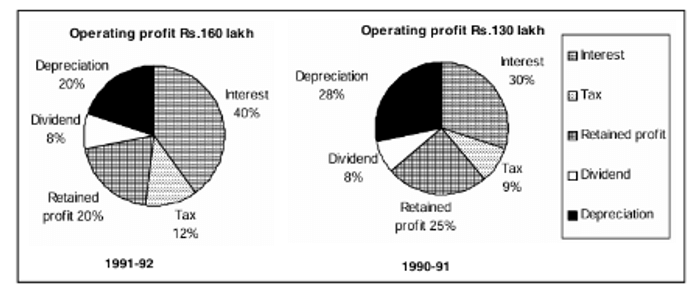
View Solution
The operating profit in 1991-92 was Rs.160 lakh and in 1990-91 it was Rs.130 lakh. The increase in operating profit is: \[ \frac{160 - 130}{130} \times 100 = 23%. \]
Thus, the correct answer is option (A). Quick Tip: Use percentage change formula: \[ Percentage increase = \frac{New value - Old value}{Old value} \times 100. \]
The interest burden in 1991-92 was higher than that in 1990-91 by
View Solution
The interest in 1991-92 is Rs.64 lakh and in 1990-91 is Rs.39 lakh. The increase in interest is: \[ 64 - 39 = 25 \, lakh. \]
Thus, the correct answer is option (B). Quick Tip: When comparing absolute values, directly subtract the previous value from the current value to find the increase or decrease.
If on an average, 20% rate of interest was charged on borrowed funds, then the total borrowed funds used by this company in the given two years amounted to
View Solution
The total interest paid in both years is Rs.64 lakh in 1991-92 and Rs.39 lakh in 1990-91, which adds up to Rs.103 lakh.
Since the interest is 20% of the borrowed funds, the total borrowed funds are: \[ \frac{103}{0.20} = 515 \, lakh. \]
Thus, the correct answer is option (D). Quick Tip: To calculate borrowed funds, divide the total interest paid by the interest rate.
The retained profit in 1991-92, as compared to that in 1990-91 was
View Solution
The retained profit in 1991-92 is Rs.32 lakh and in 1990-91 is Rs.33 lakh. The decrease is: \[ \frac{33 - 32}{33} \times 100 = 3.03% decrease. \]
Thus, the correct answer is option (D). Quick Tip: Use the percentage change formula to find whether the value increased or decreased, and by what percentage.
Amount of the reserves at the end of 1994 is
View Solution
The reserves at the end of 1994, as per the data provided, are Rs.935 lakh. Hence, option (A) is the correct answer. Quick Tip: When calculating total reserves, refer to the given data and ensure no extra additions are considered unless specified.
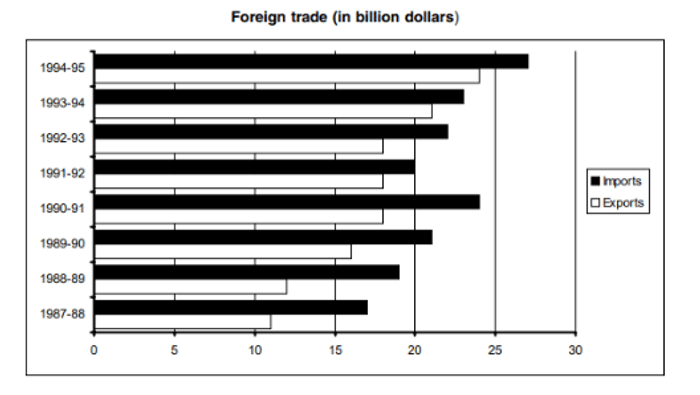
Question 159:
In which year was the trade deficit highest?
View Solution
From the graph, it is clear that the trade deficit was highest in 1988-89. Thus, the correct answer is option (B). Quick Tip: When analyzing graphical data, always compare the heights of the bars for the required year.
In how many years was the trade deficit less than the trade deficit in the succeeding year?
View Solution
From the graph, the trade deficit in 1987-88, 1990-91, 1991-92, and 1993-94 is less than the trade deficit in the succeeding year. Thus, the correct answer is option (D). Quick Tip: Carefully observe the trend in the graph to identify when the trade deficit is lower than the next year's value.
Export earning in 1990-91 is how many per cent of imports in 1991-92?
View Solution
From the graph, the export earning in 1990-91 is approximately 90% of the imports in 1991-92. Thus, the correct answer is option (C). Quick Tip: Check the relative height of the export and import bars for the given years to compute percentage comparisons.
In the last three years, the total export earnings have accounted for how many per cent of the value of the imports?
View Solution
The graph shows that the total export earnings in the last three years accounted for approximately 88% of the value of imports. Thus, the correct answer is option (D). Quick Tip: Compare the total export earnings with the total import values for the relevant years to find the percentage.
Which of the following statements can be inferred from the graph?
View Solution
From the graph, it can be observed that the trade deficit is less than the export earnings in all years shown. Thus, statement I is true.
Statement II is incorrect because export earnings decreased between 1989-90 and 1991-92.
Statement III is true because export earnings have always been greater than the expenditure on imports. Thus, option (A) is the correct answer. Quick Tip: Examine the trends in the graph and verify each statement against the visual data to identify correct conclusions.
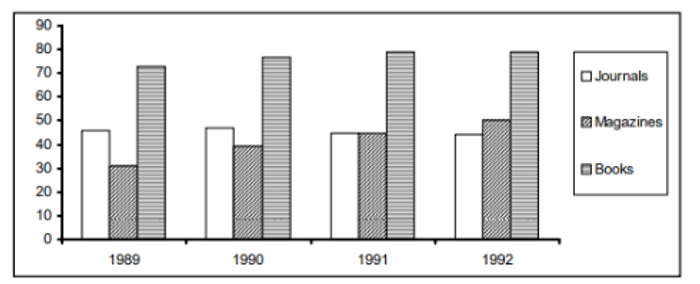
Question 164:
Which year shows the highest change in revenue obtained from journals?
View Solution
From the bar graph, we can observe that the year 1991 shows the highest change in revenue obtained from journals, as there is a significant increase compared to the previous years. Thus, the correct answer is option (C). Quick Tip: When analyzing a bar graph, look for the largest change in the height of bars to determine the year with the highest change in revenue.
In 1992, what per cent of the total revenue came from books?
View Solution
From the bar graph, we can see that books contributed 45% of the total revenue in 1992. Thus, the correct answer is option (A). Quick Tip: To find the percentage contribution of each category, divide the revenue from books by the total revenue and multiply by 100.
The number of years in which there was an increase in revenue from at least two categories is
View Solution
From the graph, we can observe that there are two years (1991 and 1992) where the revenue from at least two categories (journals, magazines, and books) has increased. Thus, the correct answer is option (B). Quick Tip: To determine the number of years with an increase in multiple categories, compare the bars for each category from one year to the next.
If 1993 were to show the same growth as 1992 over 1991, the revenue in 1993 must be
View Solution
From the graph, we see that the revenue in 1992 shows a significant increase over 1991. If 1993 were to show the same growth, we would calculate the revenue based on the same percentage increase as in 1992. This gives us the revenue of Rs.177 lakh for 1993. Thus, the correct answer is option (D). Quick Tip: To calculate the expected revenue, find the percentage increase in the previous year and apply it to the revenue of the base year.
The growth in total revenue from 1989 to 1992 is
View Solution
By comparing the total revenue in 1989 and 1992 from the graph, we can calculate the percentage growth in total revenue from 1989 to 1992. The growth is found to be 15%. Thus, the correct answer is option (C). Quick Tip: To calculate growth percentage, use the formula: \(Growth = \frac{Revenue in 1992 - Revenue in 1989}{Revenue in 1989} \times 100\).
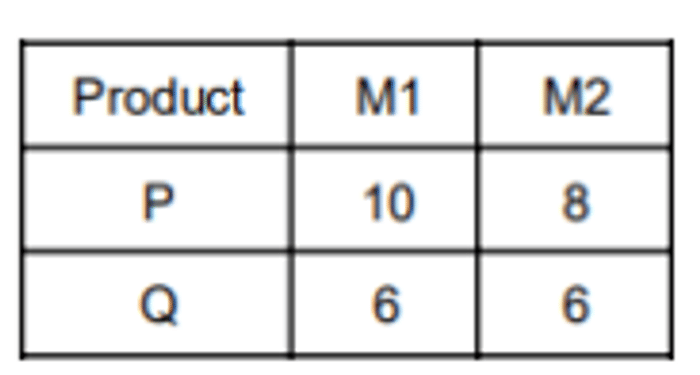
Question 169:
What is the maximum number of units that can be manufactured in one day?
View Solution
From the table, M1 produces 10 units of P and 6 units of Q in one hour, while M2 produces 8 units of P and 6 units of Q in one hour. The maximum number of units produced in a day is calculated by considering the maximum capacity of each machine.
- For M1: \(10 \times 24 = 240\) units of P or \(6 \times 24 = 144\) units of Q.
- For M2: \(8 \times 24 = 192\) units of P or \(6 \times 24 = 144\) units of Q.
Thus, the maximum total units produced in one day is 160. Therefore, the correct answer is option (B). Quick Tip: To calculate the maximum number of units produced, multiply the machine capacity (units per hour) by the total available hours (24 hours in a day).
If M1 works at half its normal efficiency, what is the maximum number of units produced, if at least one unit of each must be produced?
View Solution
If M1 works at half its normal efficiency, it will produce 5 units of P and 3 units of Q per hour.
- M1 produces 5 units of P in 1 hour and 3 units of Q in 1 hour.
- The maximum number of units produced will be 119, ensuring at least one unit of each is produced. Thus, the correct answer is option (D). Quick Tip: When calculating efficiency at half capacity, divide the units per hour by 2 and compute accordingly.
What is the least number of machine hours required to produce 30 pieces of P and 25 pieces of Q respectively?
View Solution
To produce 30 pieces of P and 25 pieces of Q, calculate the required machine hours using the formula:
- For M1: 30 units of P = \( \frac{30}{10} \) = 3 hours; 25 units of Q = \( \frac{25}{6} \) = 4.17 hours.
- For M2: 30 units of P = \( \frac{30}{8} \) = 3.75 hours; 25 units of Q = \( \frac{25}{6} \) = 4.17 hours.
Thus, the minimum time required is 6 hr 30 min. The correct answer is option (A). Quick Tip: Add the time for each machine (M1 and M2) and choose the minimum time required to meet the production target.
If the number of units of P is to be three times that of Q, what is the maximum idle time to maximize total units manufactured?
View Solution
To maximize production, the time must be split so that M1 and M2 work at full capacity. The maximum idle time will be 0 minutes if the production balance between P and Q is optimized. Thus, the correct answer is option (A). Quick Tip: Minimize idle time by aligning production ratios for maximum output.
If equal quantities of both are to be produced, then out of the four choices given below, the least efficient way would be
View Solution
To maximize production efficiency, the least efficient way is when more idle time is allowed, as it reduces overall output. The least efficient scenario is 53 units of each with 10 minutes idle. Thus, the correct answer is option (C). Quick Tip: Minimize idle time to increase production efficiency. The more idle time, the less efficient the production process.
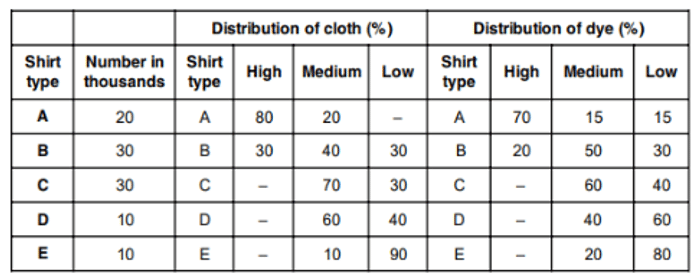
Question 174:
What is the total requirement of cloth?
View Solution
To calculate the total requirement of cloth, multiply the number of shirts by the cloth requirement for each type:
- A: \(20 \times 80% = 16\)
- B: \(30 \times 60% = 18\)
- C: \(30 \times 70% = 21\)
- D: \(10 \times 60% = 6\)
- E: \(10 \times 20% = 2\)
Total = \(16 + 18 + 21 + 6 + 2 = 63\) thousand shirts.
Then, the total cloth requirement is \(63 \times 1000 = 1,50,000\) meters. Thus, the correct answer is option (A). Quick Tip: To calculate the total requirement, always multiply the number of shirts by the respective cloth percentage for each shirt type, and then sum up the results.
How many metres of low-quality cloth is consumed?
View Solution
To calculate the total amount of low-quality cloth consumed, multiply the total cloth requirement by the low percentage for each shirt type:
- A: \(1,50,000 \times 20% = 30,000\)
- B: \(2,00,000 \times 30% = 60,000\)
- C: \(2,25,000 \times 30% = 67,500\)
- D: \(2,50,000 \times 60% = 1,50,000\)
- E: \(2,00,000 \times 80% = 1,60,000\)
Total = \(30,000 + 60,000 + 67,500 + 1,50,000 + 1,60,000 = 46,500\) meters. Thus, the correct answer is option (B). Quick Tip: Calculate the total low-quality cloth consumed by multiplying the total cloth requirement by the low percentage for each type.
How many metres of high-quality cloth is consumed by A-type shirts?
View Solution
For A-type shirts, high-quality cloth is \(80%\) of the total requirement, so we calculate:
- A: \(1,50,000 \times 80% = 120,000\) meters
Thus, the correct answer is option (C). Quick Tip: To find the amount of high-quality cloth, multiply the total requirement of cloth by the high percentage for the relevant shirt type.
What is the ratio of the three qualities of dyes in high-quality cloth?
View Solution
The ratio of the qualities of dye in high-quality cloth cannot be determined from the given data, as no specific information about the breakdown of dyes used in high-quality cloth is provided. Quick Tip: Always check if sufficient data is available before determining ratios or percentages. If data is missing, the solution cannot be computed.
What is the ratio of low-quality dye used for C-type shirts to that used for D-type shirts?
View Solution
From the table, we observe the low-quality dye used for C-type shirts and D-type shirts:
- C-type shirts use 30% low-quality dye, and D-type shirts use 60%.
Thus, the ratio is \(2 : 1\). Therefore, the correct answer is option (B). Quick Tip: Calculate the ratio of low-quality dye by comparing the percentages of dye used for each shirt type.
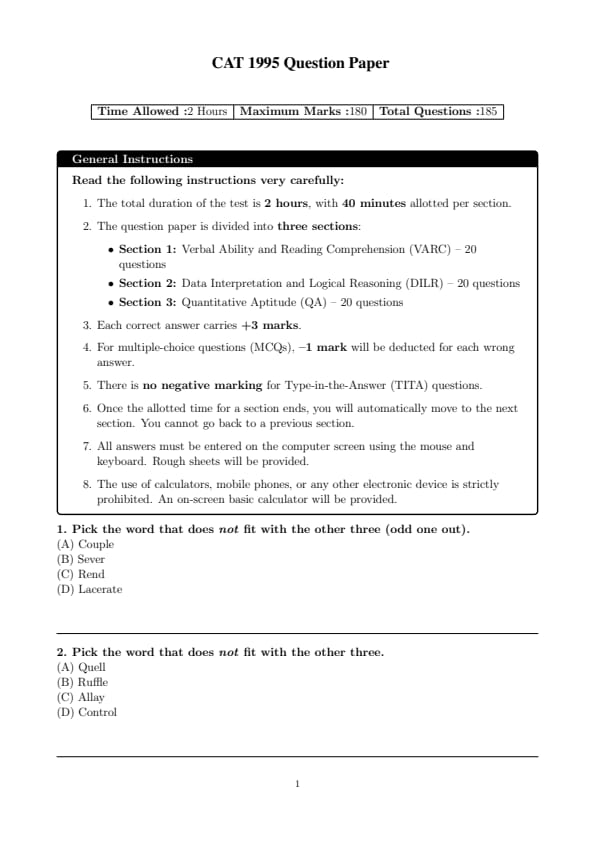
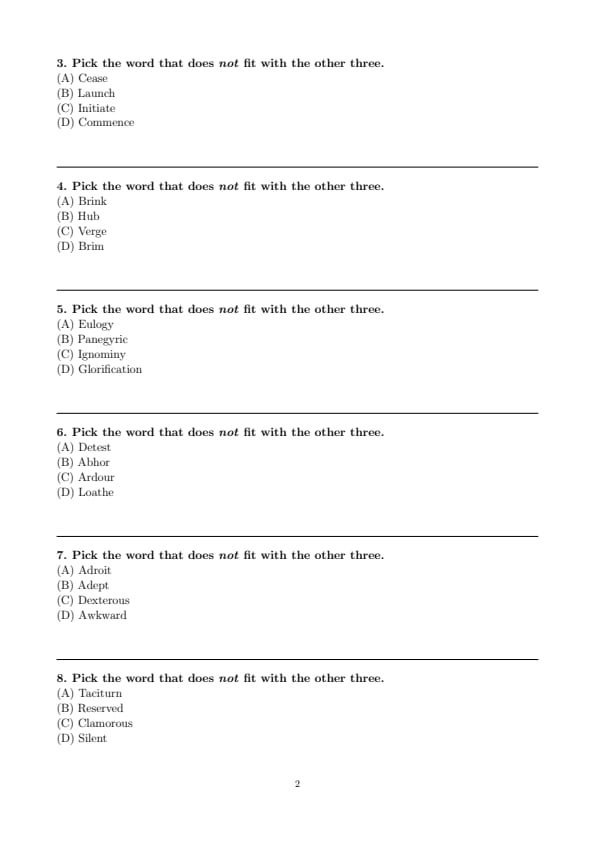
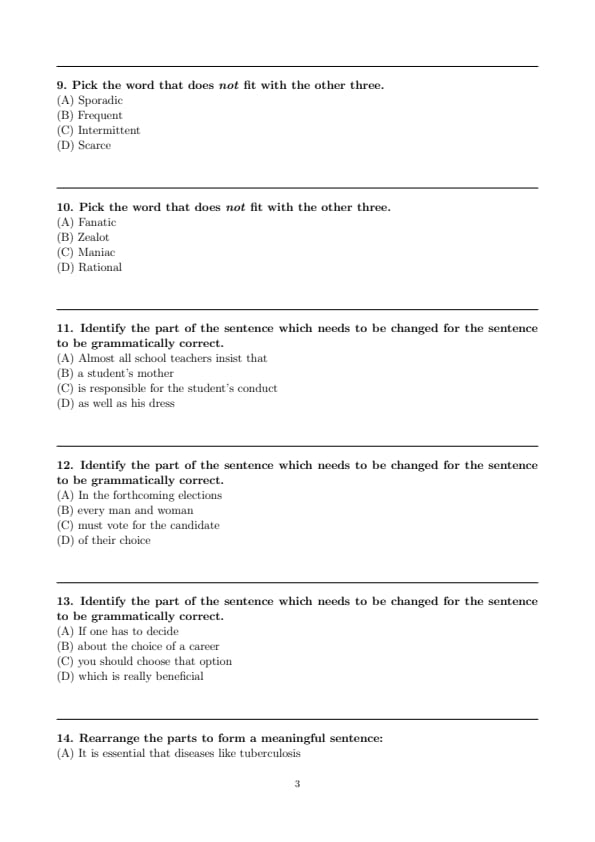
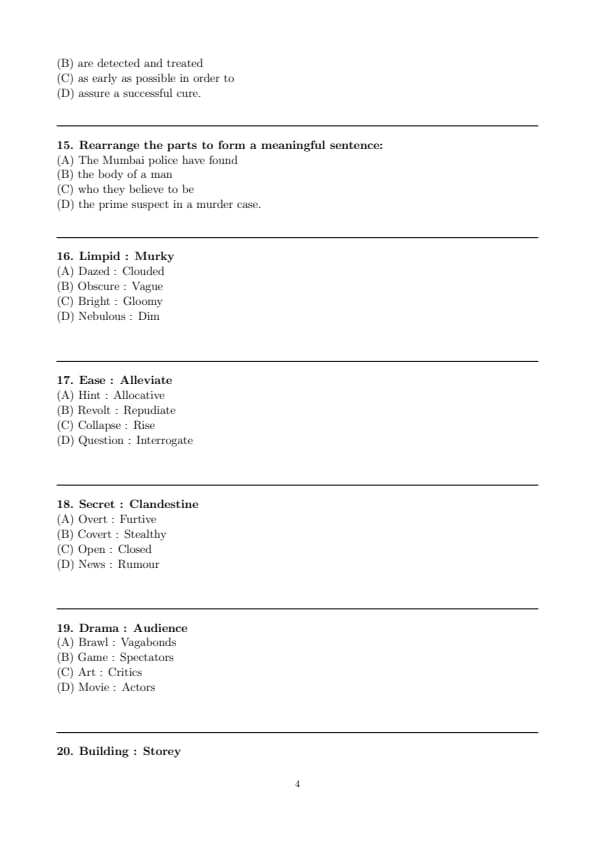
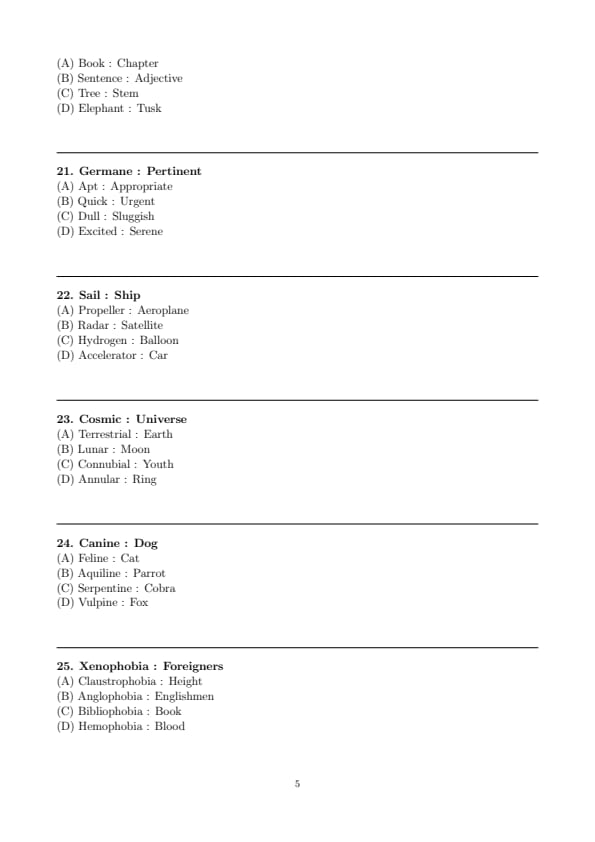
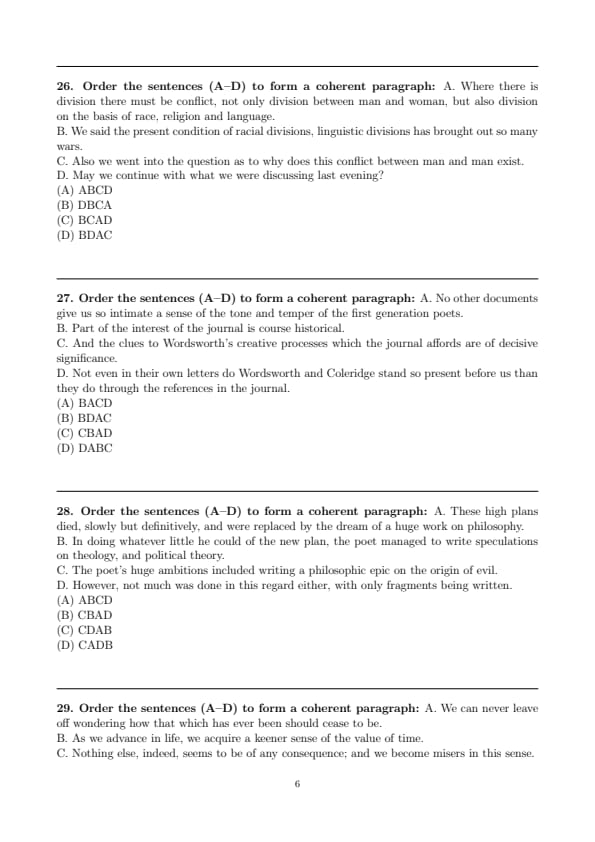
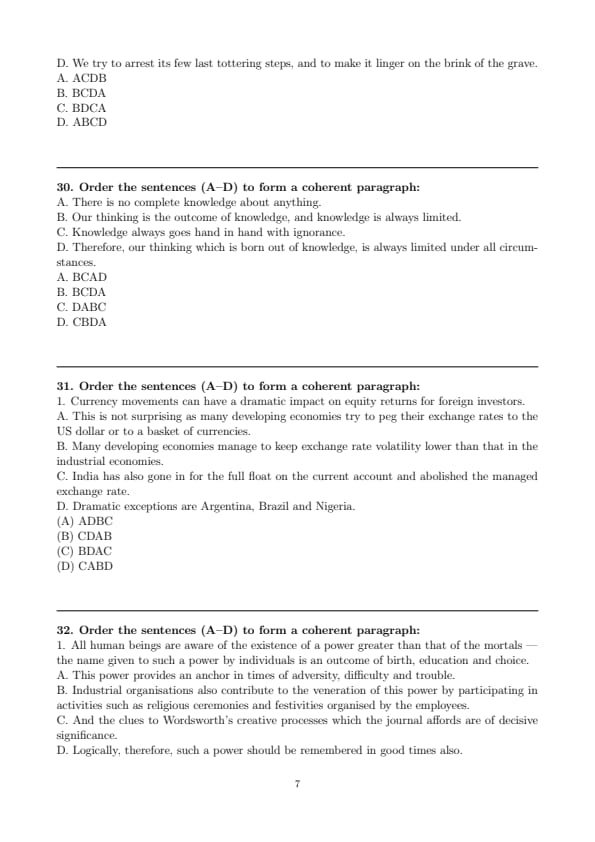
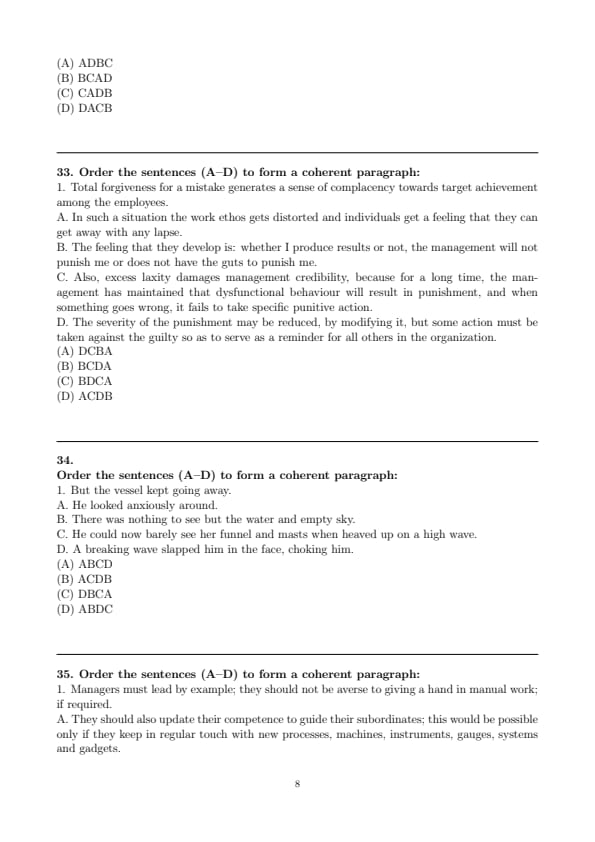
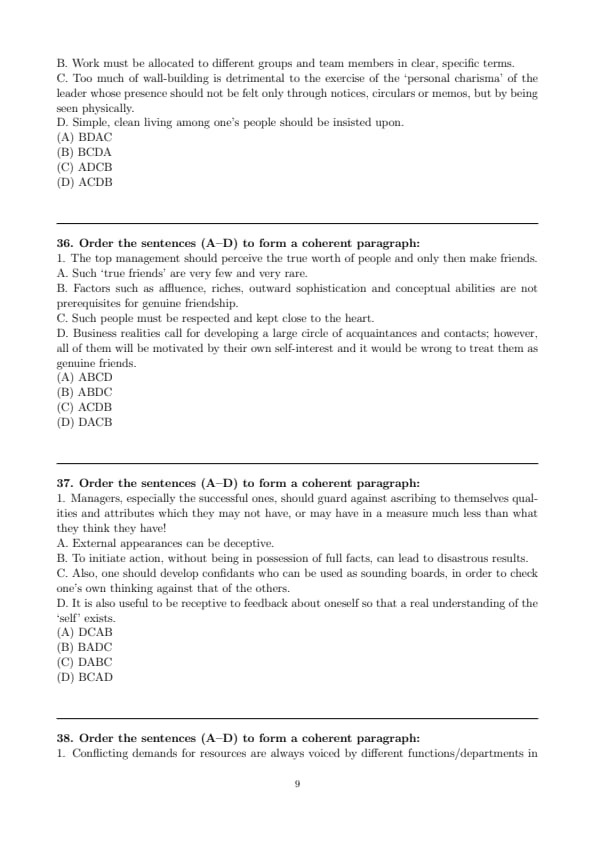
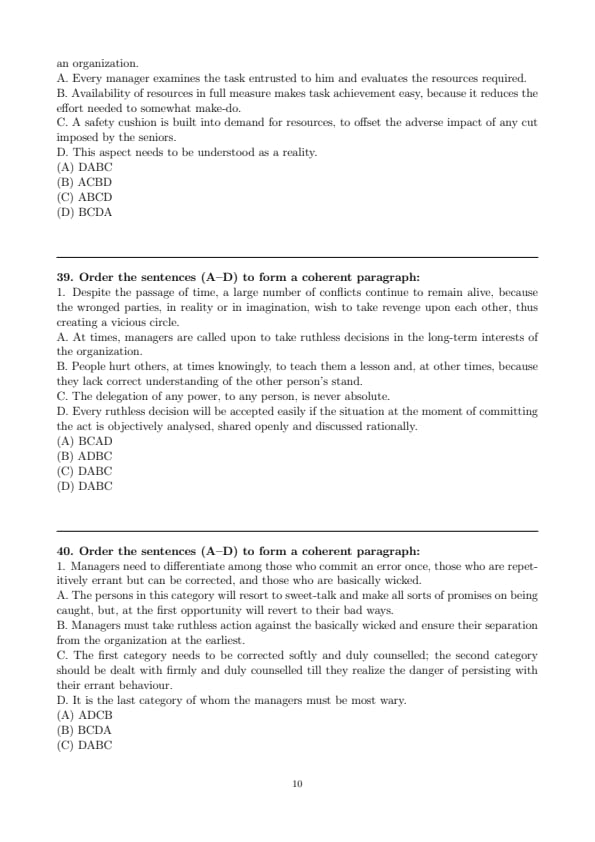
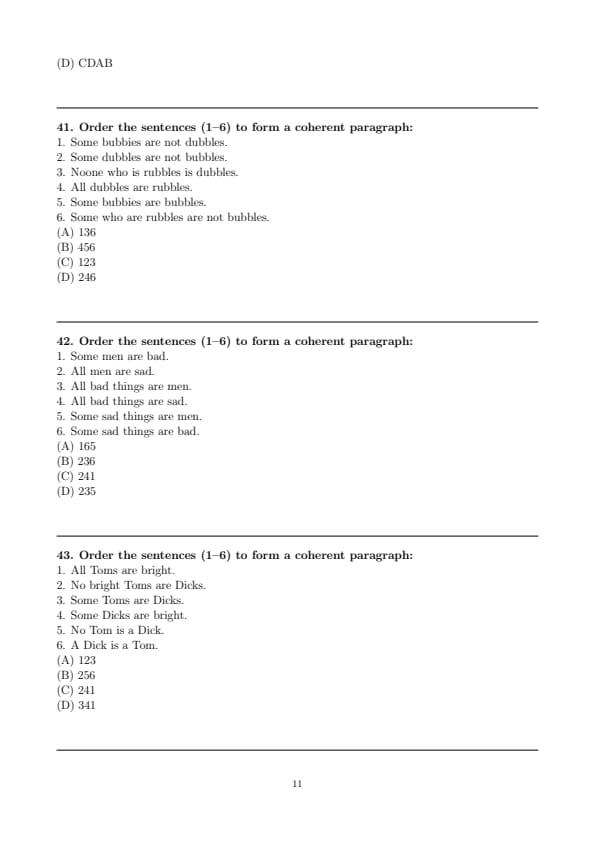
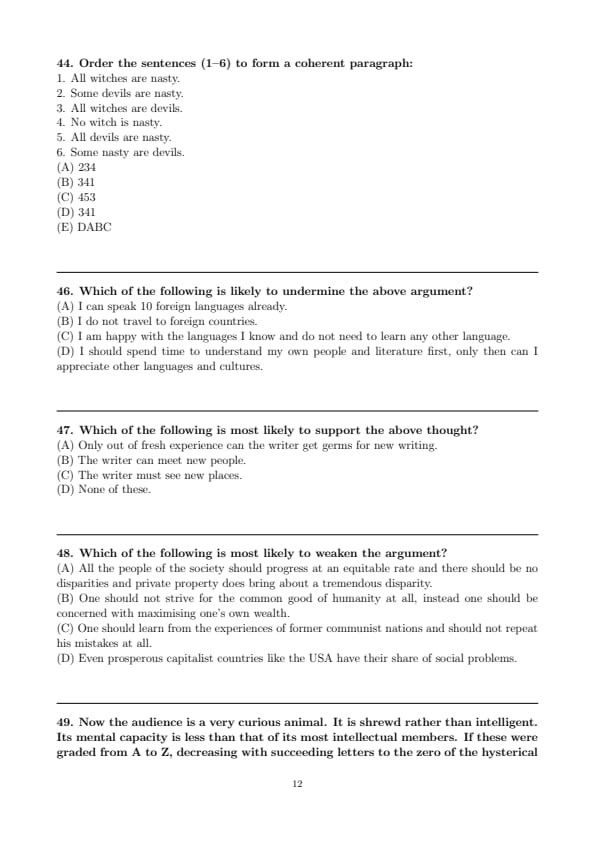
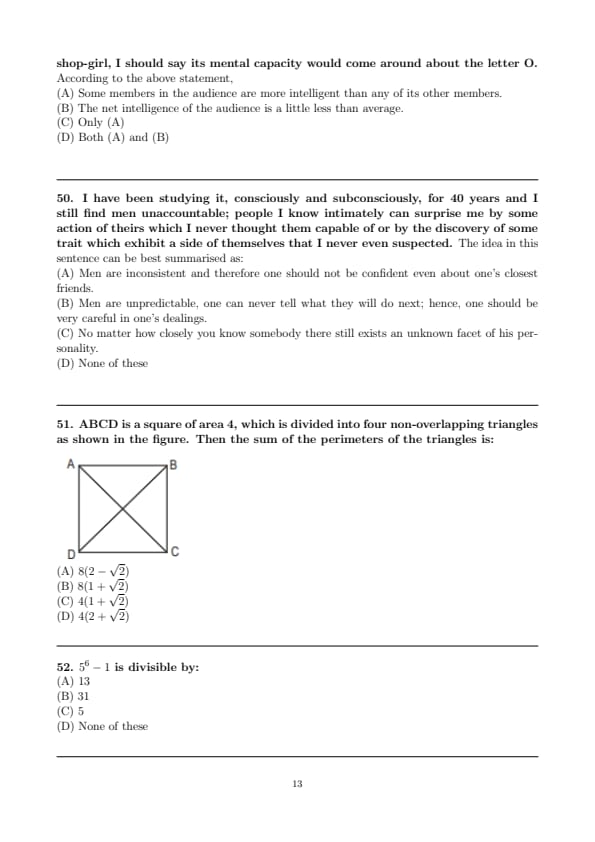
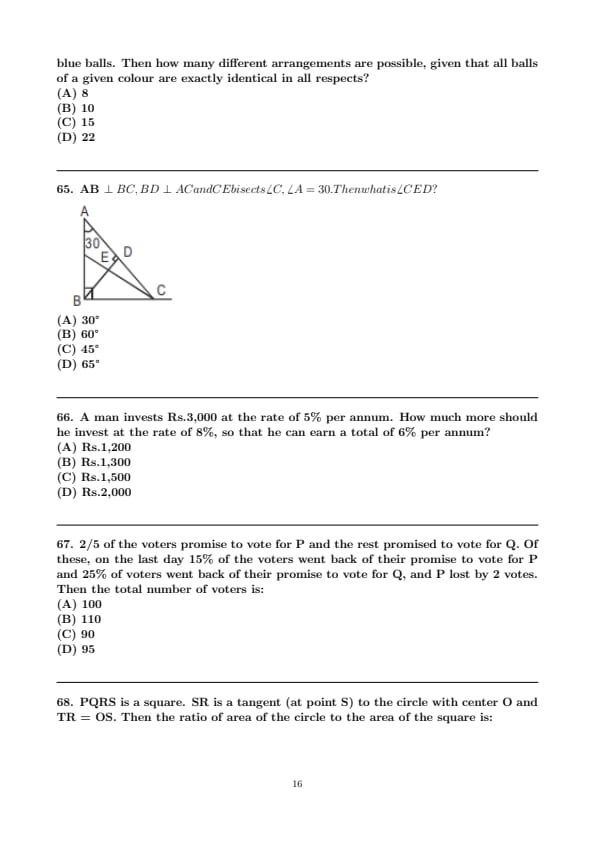
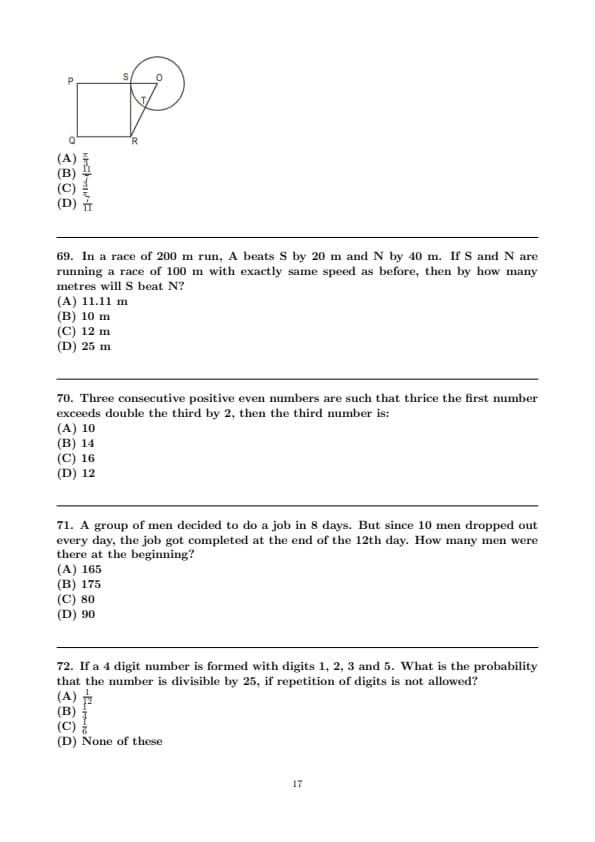
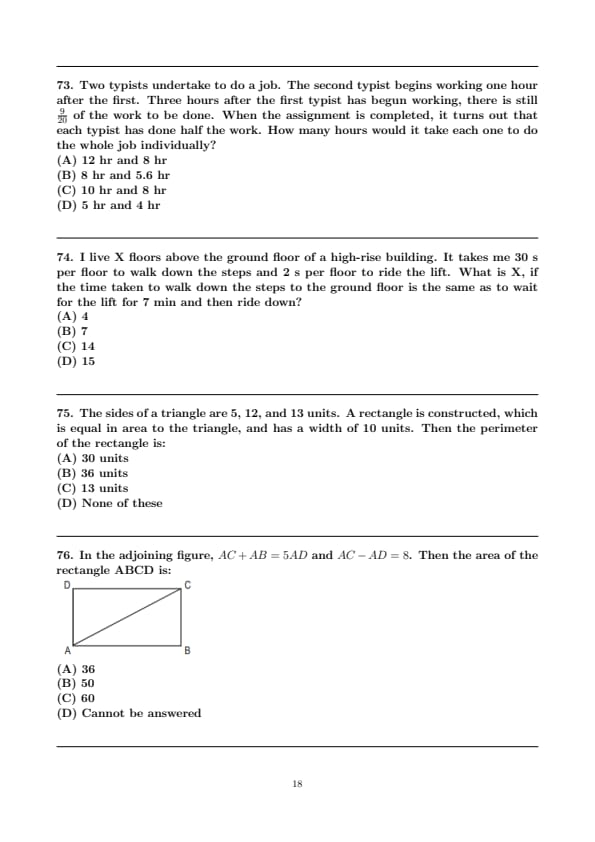
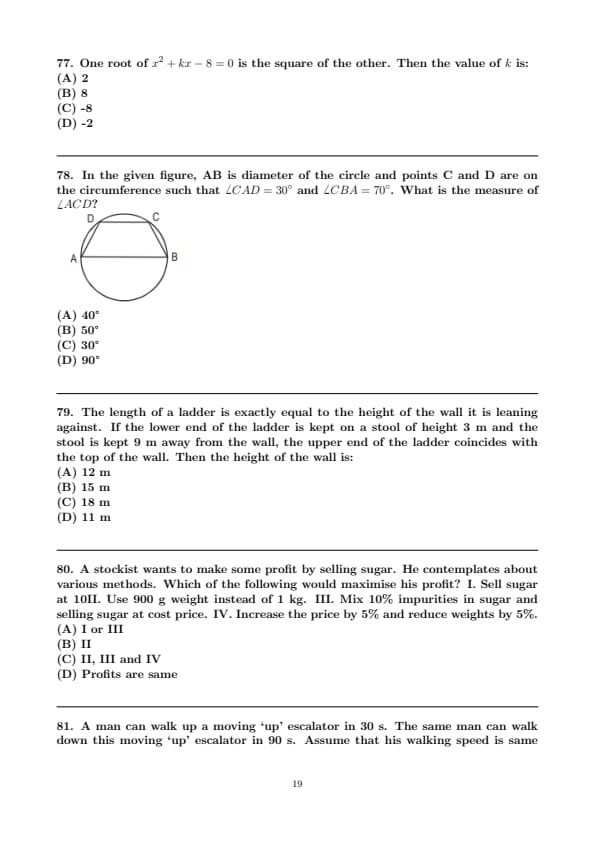
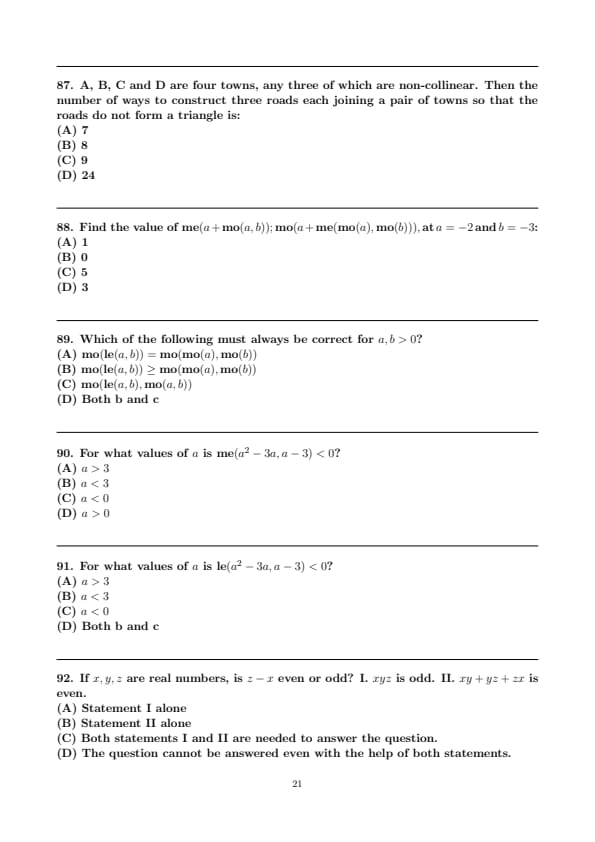
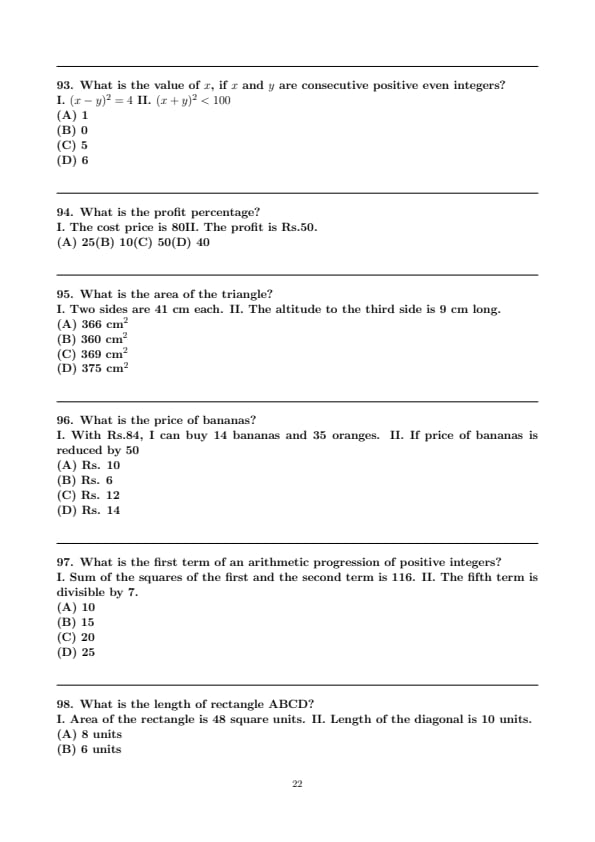
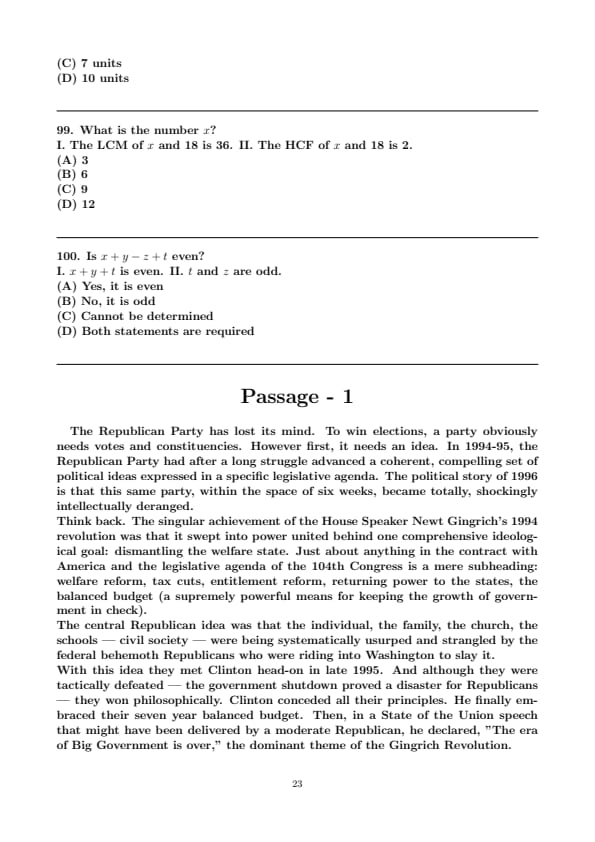
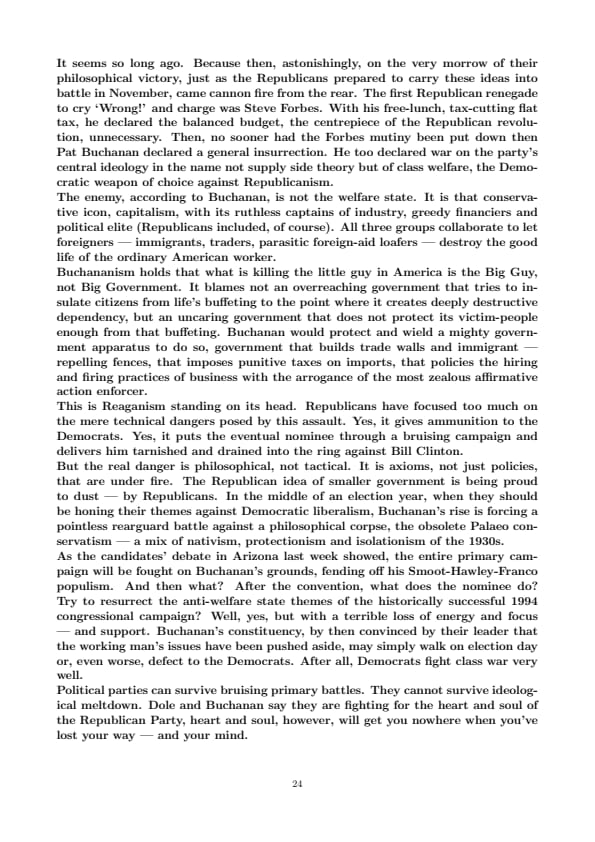
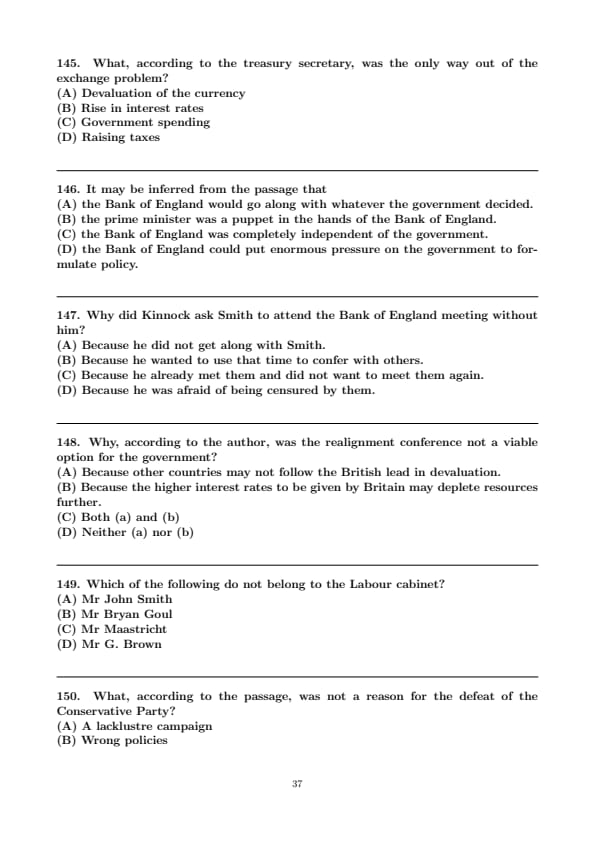
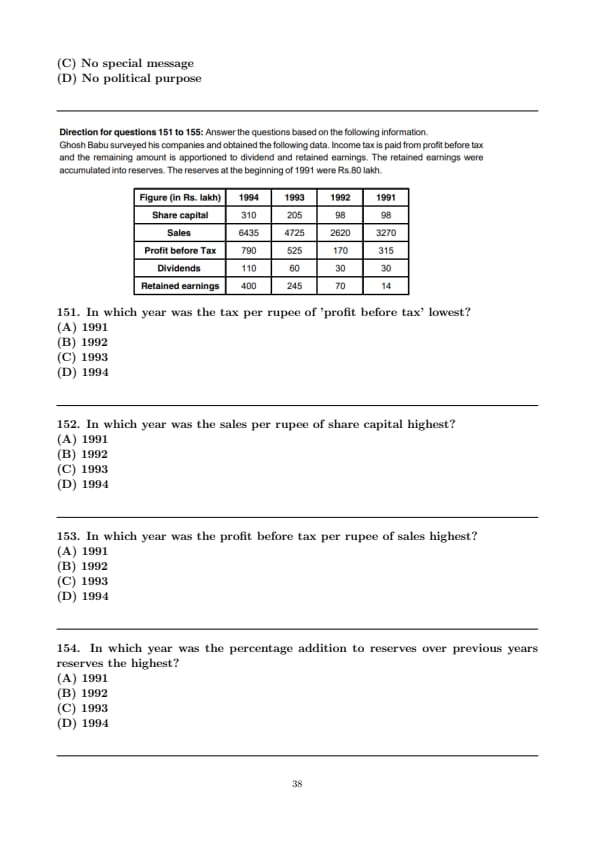
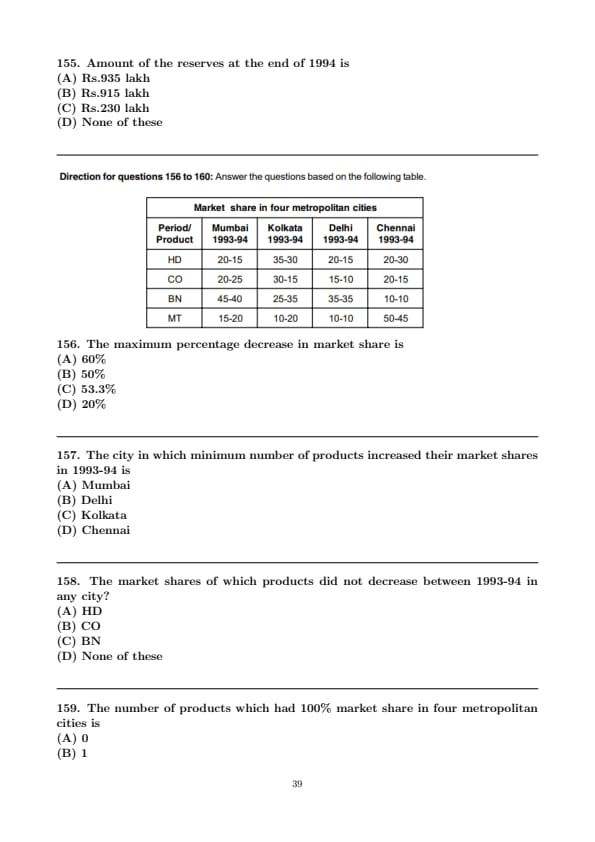
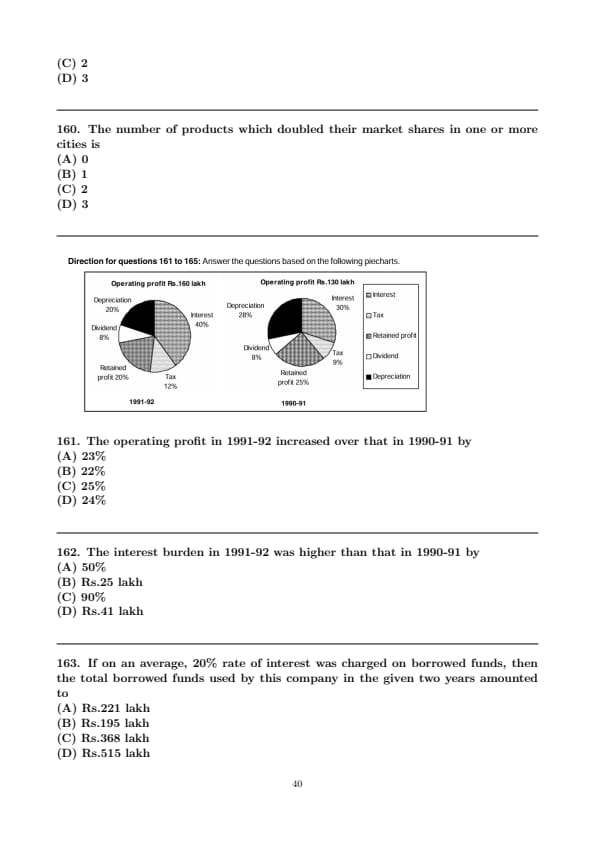
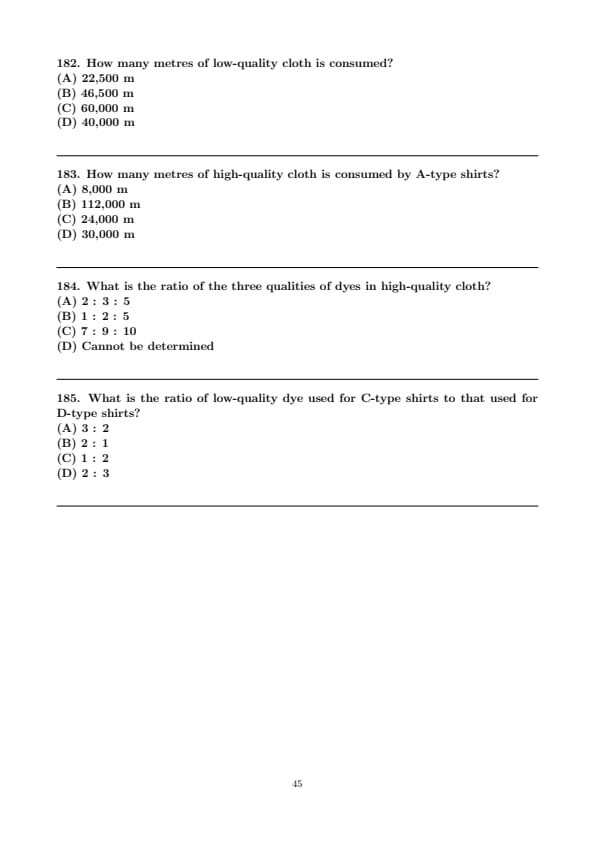
*The article might have information for the previous academic years, please refer the official website of the exam.