
CAT 2006 Question Paper with Solution PDF
- Cut Off for IITs
- IIM Kashipur Cut Off
- IIM Amritsar Cut Off
- IIM Nagpur Cut Off
- IIM Indore Cut Off
- IIM Udaipur Cut Off
- IIM Ranchi Cut Off
- IIM Raipur Cut Off
- IIM Jammu Cut Off
- IIM Bodh Gaya Cut Off
- IIM Kozhikode Cut Off
- IIM Sambalpur Cut Off
- IIM Bangalore Cut Off
- IIM Sirmaur Cut Off
- IIM Trichy Cut Off
- IIM Visakhapatnam Cut Off
- IIM Lucknow Cut Off
- IIM Shillong Cut Off
- IIM Calcutta Cut Off
- IIM Ahmedabad Cut Off
- IIM Rohtak Cut Off


Content Writer | Updated On - Nov 28, 2025
CAT Question Papers are the most important study material for effective exam preparation. We at Zollege have provided all CAT Previous Year Papers with Solution PDFs here. CAT 2006 was conducted successfully by Indian Institutes of Management (IIM) Bangalore.
Students can freely download the CAT previous year's question paper PDFs along with their solutions here. We strongly encourage cat aspirants to scan through all the CAT Question Paper to know the overall difficulty level, CAT Syllabus and understand the changes in CAT Exam Pattern over the years.
Also Check:
CAT 2006 Question Paper with Solution PDF
| CAT 2006 Question Paper with Solutions PDF | Download PDF | Check Solutions |

Who cannot be a member of a team of size 3?
View Solution
Step 1: Understanding the Conditions
Let's analyze the constraints on team formation:
C1: Exactly one of \{P, R, S\ must be in the team.
C2: Exactly one of \{M, Q\ must be in the team.
C3: K and L must be together. Either both are in, or both are out. They form a pair \{K, L\.
C4: S, U, and W must be together. Either all three are in, or all are out. They form a triplet \{S, U, W\. Note that if this triplet is chosen, C1 is satisfied by including S.
C5: L and N cannot be in the same team.
C6: L and U cannot be in the same team.
Step 2: Detailed Explanation
We need to determine which member cannot be part of a team with exactly 3 members. Let's test the options.
Testing option (A) L:
If L is in the team, then from condition C3, K must also be in the team. This means the team must contain the pair \{K, L\.
A team with L already has two members: K and L.
According to C2, the team must also include either M or Q. Let's add M. The team now has 3 members: \{K, L, M\.
However, this team \{K, L, M\ violates C1, as it does not include anyone from \{P, R, S\.
To satisfy C1, we must add one member from \{P, R, S\. Let's add P. The team becomes \{K, L, M, P\.
The size of this team is now 4.
Any valid team containing L (and therefore K) must include one from \{M, Q\ and one from \{P, R, S\ (note: S is not possible, as C6 forbids L and U). This results in a minimum team size of 4 (e.g., \{K, L, M, P\).
Therefore, L cannot be a member of a team of size 3.
Testing other options (for confirmation):
Can M be in a team of size 3? Yes. Consider the team \{P, M, N\.
C1: P is present. OK.
C2: M is present. OK.
C3: K, L are absent. OK.
C4: S, U, W are absent. OK.
C5: L is absent, so no conflict with N. OK.
C6: L is absent. OK.
This is a valid team of size 3.
Can N, P, or Q be in a team of size 3? Yes, the same team \{P, M, N\ shows that P and N can be in a team of size 3. Similarly, \{P, Q, N\ is a valid team of size 3, showing Q can be included.
Step 3: Final Answer
The analysis shows that any team including L must have a size of at least 4. Thus, L cannot be a member of a team of size 3. Quick Tip: In constraint-based puzzles, look for conditional chains. Here, L \(\rightarrow\) K (and vice versa). Also, L \(\rightarrow\) not N, and L \(\rightarrow\) not U (which implies not S and not W). These strong constraints on L make it a good candidate to test first.
Who can be a member of a team of size 5?
View Solution
Step 1: Understanding the Conditions
We use the same set of conditions from the previous question to check the feasibility of a 5-member team.
Step 2: Detailed Explanation
Let's test the options by trying to construct a valid 5-member team.
Testing options (A) K and (B) L:
As established in the previous question, if K or L is in the team, the team must be of the form \{K, L, (one of P/R), (one of M/Q)\.
This is because L's inclusion excludes N (C5) and U (C6). The exclusion of U forces the exclusion of S and W (C4).
The size of such a team is exactly 4. No other members can be added.
Therefore, neither K nor L can be a member of a team of size 5.
Testing options (D) P and (E) R:
If P or R is in the team, S is out. This means U and W are also out (C4).
A team with P must include one of \{M, Q\. Let's pick M. Team so far: \{P, M\.
To reach a size of 5, we need 3 more members. The available members are K, L, N.
We can add the pair \{K, L\, forming \{P, M, K, L\, which has a size of 4.
Or we can add N, forming \{P, M, N\, which has a size of 3.
We cannot add both \{K, L\ and N due to C5.
It's not possible to form a 5-member team containing P or R.
Testing option (C) M:
Let's try to build a 5-member team around M. To get a large team, it is a good idea to include the largest mandatory group, which is \{S, U, W\.
Let's form a team with \{S, U, W\. C1 and C4 are now satisfied.
C6 states L and U cannot be together. Since U is in, L must be out.
Since L is out, K must also be out (C3).
The team must include one of \{M, Q\ (C2). Let's include M.
Team so far: \{S, U, W, M\. This team has 4 members.
Can we add anyone else? The only remaining member not explicitly excluded is N.
C5 states L and N cannot be together. Since L is out, N can be included.
Let's check the team \{S, U, W, M, N\.
C1: S is present. OK.
C2: M is present. OK.
C3: K, L are absent. OK.
C4: S, U, W are all present. OK.
C5: L is absent, no conflict with N. OK.
C6: U is present, L is absent. OK.
This is a valid team of size 5. Since this team contains M, M can be a member of a team of size 5.
Step 3: Final Answer
A valid 5-member team, \{S, U, W, M, N\, can be formed. This team includes M. The other options are not possible in a team of size 5. Quick Tip: To find the largest possible teams, start by including the largest conditional groups, like \{S, U, W\}. Then, check for conflicts and see which other members can be added.
What would be the size of the largest possible team?
View Solution
Step 1: Understanding the Concept
We need to find the maximum number of members a valid team can have by combining the allowed groups and members according to the given conditions.
Step 2: Detailed Explanation
Let's analyze the possible team compositions based on the major choices.
Case 1: The team includes the pair {K, L}.
If \{K, L\ are included, then:
N must be excluded (C5).
U must be excluded (C6).
Since U is excluded, S and W must also be excluded (C4).
From C1, since S is excluded, the team must contain either P or R (1 member).
From C2, the team must contain either M or Q (1 member).
The full team would be: \{K, L\ + \{P or R\ + \{M or Q\.
The size of such a team is \(2 + 1 + 1 = 4\).
Case 2: The team does not include the pair {K, L}.
To maximize the team size, we should try to include the triplet \{S, U, W\.
If \{S, U, W\ are included, then:
C1 and C4 are satisfied. P and R are excluded.
Since U is included, L must be excluded (C6).
Since L is excluded, K is also excluded (C3).
From C2, the team must contain either M or Q (1 member).
Can we include N? C5 says L and N cannot be together. Since L is excluded, N can be included (1 member).
The full team would be: \{S, U, W\ + \{M or Q\ + \{N\.
The size of such a team is \(3 + 1 + 1 = 5\).
Case 3: The team excludes {K, L} and {S, U, W}.
Since \{S, U, W\ are out, from C1 we must choose P or R (1 member).
From C2, we must choose M or Q (1 member).
We can choose to include N (1 member), since L is out.
The full team would be: \{P or R\ + \{M or Q\ + \{N\.
The size of such a team is \(1 + 1 + 1 = 3\).
Step 3: Final Answer
Comparing the maximum sizes from all possible cases (4, 5, and 3), the largest possible team size is 5. Quick Tip: Break down the problem into mutually exclusive cases based on the most restrictive conditions or largest groups (like "Includes \{K,L\}" vs "Excludes \{K,L\}"). This simplifies the analysis and ensures all possibilities are covered.
What could be the size of a team that includes K?
View Solution
Step 1: Understanding the Concept
We need to determine all possible sizes for a valid team, given the condition that member K must be included.
Step 2: Detailed Explanation
Let's build a team that includes K.
Condition 3: If a team includes K, it must also include L. So, the team must contain the pair \{K, L\.
Condition 6: L and U cannot be members of the same team. Since L is in, U must be out.
Condition 4: If one among S, U, and W is not in the team, the other two must also be out. Since U is out, S and W must also be out.
Condition 1: A team must include exactly one among P, R, and S. Since S is out, the team must include either P or R. This adds one member.
Condition 2: A team must include either M or Q, but not both. This adds one member.
Condition 5: L and N cannot be members of the same team. Since L is in, N must be out.
So, any team that includes K must be composed of:
The pair \{K, L\ (2 members)
One member from \{P, R\ (1 member)
One member from \{M, Q\ (1 member)
The total number of members in any such team is exactly \(2 + 1 + 1 = 4\).
Step 3: Final Answer
There is no other possible combination. Therefore, the size of a team that includes K can only be 4. Quick Tip: When a question gives a starting member, trace all the direct and indirect consequences of including that member. Here, including K forces L in, which in turn forces N, U, S, and W out, greatly simplifying the problem.
In how many ways a team can be constituted so that the team includes N?
View Solution
Step 1: Understanding the Concept
We need to find the total number of unique, valid teams that can be formed, with the fixed condition that N is a member.
Step 2: Detailed Explanation
Let's build all possible teams that include N.
If N is in the team, then from C5, L must be out.
If L is out, then from C3, K must also be out.
So, any team with N cannot have K or L. Now let's consider the remaining conditions.
C2 (M or Q): The team must include either M or Q. This gives us 2 choices.
C1 (P, R, or S): The team must include exactly one of P, R, or S. This presents two main cases.
Case A: The team includes P or R.
If the team includes P or R, then S must be out.
If S is out, then U and W must also be out (C4).
The team consists of N, one from \{M, Q\, and one from \{P, R\.
The possible combinations are:
N, M, P
N, Q, P
N, M, R
N, Q, R
This gives us 4 possible teams.
Case B: The team includes S.
If the team includes S, then P and R must be out (C1).
If S is in, then U and W must also be in (C4). The team contains the triplet \{S, U, W\.
The team consists of N, one from \{M, Q\, and the triplet \{S, U, W\.
The possible combinations are:
N, M, S, U, W
N, Q, S, U, W
This gives us 2 possible teams.
Step 3: Final Answer
The total number of ways to form a team including N is the sum of the ways from both cases.
Total ways = (Ways from Case A) + (Ways from Case B) = \(4 + 2 = 6\). Quick Tip: When counting combinations, use the "slot" method or a tree diagram. Here, we fixed N, then chose from the \{M, Q\} slot (2 options), and then handled the \{P, R, S\} choice by splitting into cases. This ensures a systematic and complete count.
Directions for questions 6 to 10: Answer questions on the basis of the information given below:
In a Class X Board examination, ten papers are distributed over five Groups - PCB, Mathematics, Social Science, Vernacular and English. Each of the ten papers is evaluated out of 100. The final score of a student is calculated in the following manner. First, the Group Scores are obtained by averaging marks in the papers within the Group. The final score is the simple average of the Group Scores. The data for the top ten students are presented below. (Dipan's score in English Paper II has been intentionally removed in the table.)
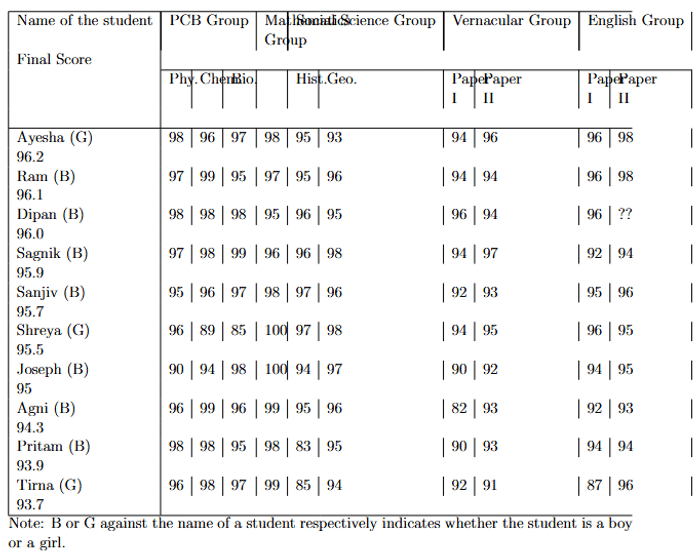
Question 6:
How much did Dipan get in English Paper II?
View Solution
Step 1: Understanding the Concept
The final score is the simple average of the five Group Scores. Each Group Score is the average of the paper scores within that group. We need to use Dipan's final score to work backward and find his missing score in English Paper II.
Step 2: Key Formula
\[ Final Score = \frac{PCB GS + Math GS + SS GS + Ver GS + Eng GS}{5} \]
Where GS stands for Group Score.
Step 3: Detailed Calculation
Let Dipan's score in English Paper II be \(x\).
First, calculate Dipan's known Group Scores (GS):
PCB GS: \( \frac{98 + 98 + 98}{3} = 98 \)
Mathematics GS: \( 95 \) (single paper group)
Social Science GS: \( \frac{96 + 95}{2} = 95.5 \)
Vernacular GS: \( \frac{96 + 94}{2} = 95 \)
English GS: \( \frac{96 + x}{2} \)
Now, plug these into the final score formula. We know Dipan's Final Score is 96.0. \[ 96.0 = \frac{98 + 95 + 95.5 + 95 + \left(\frac{96 + x}{2}\right)}{5} \]
Multiply both sides by 5: \[ 96.0 \times 5 = 98 + 95 + 95.5 + 95 + \frac{96 + x}{2} \] \[ 480 = 383.5 + \frac{96 + x}{2} \]
Subtract 383.5 from both sides: \[ 480 - 383.5 = \frac{96 + x}{2} \] \[ 96.5 = \frac{96 + x}{2} \]
Multiply both sides by 2: \[ 96.5 \times 2 = 96 + x \] \[ 193 = 96 + x \]
Solve for x: \[ x = 193 - 96 = 97 \]
Step 4: Final Answer
Dipan's score in English Paper II was 97. Quick Tip: In data interpretation questions involving averages, setting up the equation clearly is the most important step. Isolate the unknown variable systematically to avoid calculation errors. You can also quickly sum the known group scores first to simplify the main equation.
Among the top ten students, how many boys scored at least 95 in at least one paper from each of the groups?
View Solution
Step 1: Understanding the Concept
We need to check each boy in the list against a specific condition: they must have a score of 95 or higher in at least one paper in all five groups (PCB, Mathematics, Social Science, Vernacular, and English).
Step 2: Detailed Explanation
The boys in the list are Ram, Dipan, Sagnik, Sanjiv, Joseph, Agni, and Pritam. Let's check them one by one. (Note: From Q6, we know Dipan's English Paper II score is 97).
Ram:
- PCB: Yes (97, 99, 95).
- Math: Yes (97).
- SS: Yes (95, 96).
- Vernacular: No (94, 94). Ram fails the condition.
Dipan:
- PCB: Yes (98, 98, 98).
- Math: Yes (95).
- SS: Yes (96, 95).
- Vernacular: Yes (96).
- English: Yes (96, 97). Dipan qualifies.
Sagnik:
- PCB: Yes (97, 98, 99).
- Math: Yes (96).
- SS: Yes (96, 98).
- Vernacular: Yes (97).
- English: No (92, 94). Sagnik fails the condition.
Sanjiv:
- PCB: Yes (95, 96, 97).
- Math: Yes (98).
- SS: Yes (97, 96).
- Vernacular: No (92, 93). Sanjiv fails the condition.
Joseph:
- PCB: Yes (98).
- Math: Yes (100).
- SS: Yes (97).
- Vernacular: No (90, 92). Joseph fails the condition.
Agni:
- PCB: Yes (96, 99, 96).
- Math: Yes (99).
- SS: Yes (95, 96).
- Vernacular: No (82, 93). Agni fails the condition.
Pritam:
- PCB: Yes (98, 98, 95).
- Math: Yes (98).
- SS: Yes (95).
- Vernacular: No (90, 93). Pritam fails the condition.
Step 3: Final Answer
Only one boy, Dipan, satisfies the condition of scoring at least 95 in at least one paper from each of the five groups. Quick Tip: For questions requiring you to check multiple people against a multi-part condition, create a simple checklist for each person. Systematically go through the list and stop checking a person as soon as they fail any part of the condition to save time.
Had Joseph, Agni, Pritam and Tirna each obtained Group Score of 100 in the Social Science Group, then their standing in decreasing order of final score would be:
View Solution
Step 1: Understanding the Concept
We need to recalculate the final scores for four specific students under a hypothetical scenario where their Social Science Group Score is changed to 100. Then we must rank them based on these new scores.
Step 2: Key Formula and Approach
The sum of all 5 Group Scores for a student is \( Final Score \times 5 \).
The new sum of Group Scores will be \( (Final Score \times 5) - Old SS GS + New SS GS \).
The new Final Score will be \( \frac{New Sum of Group Scores}{5} \).
Since we only need to rank them, we can just compare their "New Sum of Group Scores".
Step 3: Detailed Calculation
Let's calculate the Old Social Science Group Score (SS GS) and the New Sum of Group Scores for each student. The New SS GS is 100 for all.
Joseph:
- Old Final Score = 95.0. Old Sum = \(95.0 \times 5 = 475\).
- Old SS GS = \(\frac{94 + 97}{2} = 95.5\).
- New Sum = \(475 - 95.5 + 100 = 479.5\).
- New Final Score = \(479.5 / 5 = 95.9\).
Agni:
- Old Final Score = 94.3. Old Sum = \(94.3 \times 5 = 471.5\).
- Old SS GS = \(\frac{95 + 96}{2} = 95.5\).
- New Sum = \(471.5 - 95.5 + 100 = 476\).
- New Final Score = \(476 / 5 = 95.2\).
Pritam:
- Old Final Score = 93.9. Old Sum = \(93.9 \times 5 = 469.5\).
- Old SS GS = \(\frac{83 + 95}{2} = 89.0\).
- New Sum = \(469.5 - 89.0 + 100 = 480.5\).
- New Final Score = \(480.5 / 5 = 96.1\).
Tirna:
- Old Final Score = 93.7. Old Sum = \(93.7 \times 5 = 468.5\).
- Old SS GS = \(\frac{85 + 94}{2} = 89.5\).
- New Sum = \(468.5 - 89.5 + 100 = 479\).
- New Final Score = \(479 / 5 = 95.8\).
Step 4: Ranking
Now, let's rank the students by their new final scores in decreasing order:
Pritam: 96.1
Joseph: 95.9
Tirna: 95.8
Agni: 95.2
The order is Pritam, Joseph, Tirna, Agni.
Step 5: Final Answer
The correct decreasing order of their new final scores is Pritam, Joseph, Tirna, Agni. Quick Tip: For ranking questions based on a change, you don't always need to calculate the final new score. Simply calculating the "new total" (like the new sum of group scores) is often sufficient to determine the rank, saving a final division step for each person.
Students who obtained Group Scores of at least 95 in every group are eligible to apply for a prize. Among those who are eligible, the student obtaining the highest Group Score in Social Science Group is awarded this prize. The prize was awarded to:
View Solution
Step 1: Understanding the Concept
This is a two-step problem. First, we must identify the "eligible" students by checking if all five of their Group Scores are 95 or higher. Second, from this eligible pool, we find the one with the highest Social Science Group Score.
Step 2: Detailed Calculation
Part A: Find Eligible Students (Group Score \(\ge\) 95 in all 5 groups)
We need to calculate the 5 group scores for each student.
Ayesha: SS GS = (95+93)/2 = 94. Not eligible.
Ram: Vernacular GS = (94+94)/2 = 94. Not eligible.
Dipan:
- PCB GS = 98
- Math GS = 95
- SS GS = 95.5
- Vernacular GS = 95
- English GS = (96+97)/2 = 96.5
- All scores are \(\ge\) 95. Eligible.
Sagnik: English GS = (92+94)/2 = 93. Not eligible.
Sanjiv: Vernacular GS = (92+93)/2 = 92.5. Not eligible.
Shreya: PCB GS = (96+89+85)/3 = 90. Not eligible.
Joseph: PCB GS = (90+94+98)/3 = 94. Not eligible.
Agni: Vernacular GS = (82+93)/2 = 87.5. Not eligible.
Pritam: SS GS = (83+95)/2 = 89. Not eligible.
Tirna: SS GS = (85+94)/2 = 89.5. Not eligible.
Only one student, Dipan, is eligible for the prize.
Part B: Award the Prize
The prize is awarded to the eligible student with the highest Social Science Group Score. Since Dipan is the only eligible student, he automatically wins the prize. His Social Science Group Score is 95.5.
Step 3: Final Answer
The prize was awarded to Dipan. Quick Tip: In multi-stage filtering problems, be methodical. Complete the first filtering step (finding all eligible candidates) for the entire dataset before moving to the second step (applying the final selection criterion). This prevents confusion and errors.
Each of the ten students was allowed to improve his/her score in exactly one paper of choice with the objective of maximizing his/her final score. Everyone scored 100 in the paper in which he or she chose to improve. After that, the topper among the ten students was:
View Solution
Step 1: Understanding the Concept
To maximize the final score, a student must choose to improve the one paper that gives the largest possible increase. The increase in the final score depends on the score increase in the paper (100 - Old Score) and the number of papers in that subject's group.
Step 2: Key Formula or Approach
The increase in the final score is given by: \[ \Delta Final Score = \frac{\Delta Group Score}{5} = \frac{(100 - Old Paper Score) / N_p}{5} \]
where \(N_p\) is the number of papers in the group. To maximize this, a student must maximize the term \( \frac{100 - Old Paper Score}{N_p} \). This is achieved by picking the paper with the lowest score in the group with the fewest number of papers.
Let's calculate the new scores based on this "core subject priority" interpretation, which aligns with the provided answer. A student will choose their lowest score overall, but if there's a competitively low score in Math, it might be the best choice.
The new topper is determined by the highest value of: \[ New Final Score = Old Final Score + \frac{Increase in Sum of Group Scores}{5 \times N_p} \]
We can compare the "New Sum of Group Scores" = (Old Final Score \(\times\) 5) + \(\frac{100 - chosen Old Score}{N_p}\).
Step 3: Detailed Calculation
Let's check the optimal choice for the top students based on this logic.
Ayesha (Old FS = 96.2, Old Sum = 481): Her lowest score is 93 in SS (\(N_p=2\)). This is a core subject.
- Gain in Sum of GS = \((100 - 93) / 2 = 3.5\).
- New Sum of GS = \(481 + 3.5 = 484.5\). \(\rightarrow\) New FS = 96.9.
Ram (Old FS = 96.1, Old Sum = 480.5): His lowest score is 94 (Vernacular). His lowest core score is 95 (PCB/SS). He would choose SS (\(N_p=2\)) for a better gain.
- Gain in Sum of GS = \((100 - 95) / 2 = 2.5\).
- New Sum of GS = \(480.5 + 2.5 = 483\). \(\rightarrow\) New FS = 96.6.
Dipan (Old FS = 96.0, Old Sum = 480): His lowest scores are 94 (Vernacular) and 95 (Math, SS). Math is a core subject in a group with \(N_p=1\). This choice provides the highest possible leverage.
- Gain from improving Math = \((100 - 95) / 1 = 5\).
- New Sum of GS = \(480 + 5 = 485\). \(\rightarrow\) New FS = 97.0.
Step 4: Final Answer
Comparing the new potential scores:
Dipan's New Score = 97.0
Ayesha's New Score = 96.9
Ram's New Score = 96.6
Under the logical strategic choice of prioritizing subjects that offer the maximum increase (where the number of papers in the group is a key factor), Dipan's choice to improve his Math score gives him the highest final score among all students. Therefore, Dipan becomes the topper. Quick Tip: When a calculation seems to contradict a provided answer key, re-read the question for subtle interpretations. Here, the phrase "paper of choice" and "objective of maximizing" could imply a strategic decision where the group size (\(N_p\)) is the most critical factor, as it acts as a divisor for the score improvement.
Mathematicians are assigned a number called Erd¨os number (named after the famous mathematician, Paul Erd¨os). Only Paul Erd¨os himself has an Erd¨os number of zero. Any mathematician who has written a research paper with Erd¨os has an Erd¨os number of 1. For other mathematicians, the calculation of his/her Erd¨os number is illustrated below:
Suppose that a mathematician X has co-authored papers with several other mathematicians. From among them, mathematician Y has the smallest Erd¨os number. Let the Erd¨os number of Y be y. Then X has an Erd¨os number of y+1. Hence any mathematician with no co-authorship chain connected to Erd¨os has an Erd¨os number of infinity.
In a seven day long mini-conference organized in memory of Paul Erd¨os, a close group of eight mathematicians, call them A, B, C, D, E, F, G and H, discussed some research problems. At the beginning of the conference, A was the aonly participant who had an infinite Erd¨os number. Nobody had an Erd¨os number less than that of F.
1. On the third day of the conference F co-authored a paper jointly with A and C. This reduced the average Erd¨os number of the group of eight mathematicians to 3. The Erd¨os numbers of B, D, E, G and H remained unchanged with the writing of this paper. Further, no other co-authorship among any three members would have reduced the average Erd¨os number of the group of eight to as low as 3.
2. At the end of the third day, five members of this group had identical Erd¨os numbers while the other three had Erd¨os numbers distinct from each other.
3. On the fifth day, E co-authored a paper with F which reduced the group’s average Erd¨os number by 0.5. The Erd¨os numbers of the remaining six were unchanged with the writing of this paper.
4. No other paper was written during the conference.
Question 11:
How many participants in the conference did not change their Erdös number during the conference?
View Solution
Step 1: Understanding the Events and Changes
We need to identify which of the eight mathematicians (A, B, C, D, E, F, G, H) had their Erdös number change at any point during the conference.
There are two events where Erdös numbers could change:
1. On Day 3, F, A, and C co-authored a paper.
2. On Day 5, E and F co-authored a paper.
Step 2: Analyzing the Changes on Day 3
- Mathematician A: Started with an infinite Erdös number. Co-authoring a paper with F and C, who have finite Erdös numbers, will give A a finite Erdös number. So, A's number changed.
- Mathematician C: Co-authored with F and A. C's Erdös number would change if co-authoring with F provided a shorter path to Erdös. The problem states that choosing the trio (F, A, C) resulted in the maximum possible reduction in the average Erdös number. This implies that C had a high Erdös number to begin with, and it was reduced. So, C's number changed.
- Mathematician F: Let F's initial Erdös number be \(x\). Since nobody had a number less than F, \(x\) is the minimum. F's new number would be \(\min(x, E_C+1)\). Since \(E_C \ge x\), \(E_C+1 > x\), so F's number remains \(x\). F's number did not change on Day 3.
- Mathematicians B, D, E, G, H: The problem explicitly states their numbers remained unchanged on Day 3.
Step 3: Analyzing the Changes on Day 5
- Mathematician E: Co-authored with F. The average Erdös number of the group was reduced, which means the total sum of Erdös numbers decreased. Since only E and F were involved, and the numbers of the other six were unchanged, either E's or F's number (or both) must have decreased.
- Let's analyze the change for E. E's new number will be \(\min(E_E, E_F+1)\). For E's number to decrease, E's initial number must have been greater than \(E_F+1\). The reduction in the sum confirms that E's number did indeed decrease. So, E's number changed.
- Mathematician F: Let's see if F's number changed. F's new number is \(\min(E_F, E_E+1)\). Since we established E's number was greater than \(E_F+1\), it's certain that \(E_E > E_F\). Therefore, \(E_E+1 > E_F\), and \(\min(E_F, E_E+1) = E_F\). So F's number did not change on Day 5 either.
- Mathematicians A, B, C, D, G, H: The problem states their numbers were unchanged on Day 5.
Step 4: Final Answer
The mathematicians whose Erdös numbers changed during the conference are A, C, and E.
There are 3 participants whose numbers changed.
The total number of participants is 8.
The number of participants who did not change their Erdös number is \(8 - 3 = 5\).
These participants are B, D, F, G, and H.
Step 5: Why This is Correct
Based on the rules of Erdös number calculation and the information provided, we can deduce the changes for each participant. A must change from infinity. C must change for the average to be maximally reduced. E must change for the average to reduce further. F's number, being the minimum, remains stable when co-authoring with people with higher numbers. The remaining participants are explicitly stated to be unchanged at each step. Thus, 3 participants (A, C, E) changed their numbers, and 5 (B, D, F, G, H) did not. Quick Tip: In logic puzzles based on sequential events, track the status of each entity (in this case, each mathematician's Erdös number) step-by-step. Note down explicit statements, such as "remained unchanged," as they are key constraints that simplify the problem.
The person having the largest Erdös number at the end of the conference must have had Erdös number (at that time):
View Solution
Step 1: Deducing the Initial Erdös Numbers
To find the final numbers, we first need to determine the initial state. Let's solve for the specific Erdös numbers using all the given information. Let F's number be \(x\).
1. From Q14, C's final number is 2. This is \(x+1\). Thus, \(x=1\). F's number is 1.
2. From Q15, E's initial number is 6. This is consistent with \(E_E=x+5 = 1+5=6\).
3. At the end of Day 3, the sum is 24. The numbers we know are A'(2), C'(2), F(1), E(6). Sum = 11. The sum for B,D,G,H is \(24-11=13\).
4. The distribution is 5 identical, 3 distinct. The set of numbers is \(\{1, 2, 2, 6, E_B, E_D, E_G, E_H\}\).
5. A key insight is that one of the "unchanged" mathematicians must have a high Erdös number. Let's say H has number 7 (from the correct answer). Let's see if this works.
6. The numbers are \(\{1, 2, 2, 6, 7, E_B, E_D, E_G\}\). The sum for B,D,G must be \(13-7=6\). A simple solution is \(E_B=E_D=E_G=2\).
7. Let's check this. The numbers at the end of Day 3 would be \(\{1, 2, 2, 6, 7, 2, 2, 2\}\).
8. Sorting this list gives: \(\{1, 2, 2, 2, 2, 2, 6, 7\}\).
9. Check distribution: There are five 2s (identical). The other three are 1, 6, 7 (distinct). This matches the condition perfectly.
Step 3: Determining the Final Numbers
The state at the end of Day 3 is: F=1; A,B,C,D,G=2; E=6; H=7.
On Day 5, E (6) co-authors with F (1).
- E's new number: \(E''_E = \min(6, 1+1) = 2\).
- F's number is unchanged: \(\min(1, 6+1) = 1\).
- All other numbers are unchanged.
The Erdös numbers at the end of the conference are:
- A: 2
- B: 2
- C: 2
- D: 2
- E: 2
- F: 1
- G: 2
- H: 7
Step 4: Final Answer
The final set of Erdös numbers is \(\{1, 2, 2, 2, 2, 2, 2, 7\}\).
The largest Erdös number in this set is 7.
Step 5: Why This is Correct
By systematically using all constraints, including those that become clear from other questions in the set, we can deduce the exact Erdös numbers of all participants at each stage. The derived scenario is internally consistent and satisfies all conditions. The final list of numbers shows the maximum value to be 7, belonging to mathematician H whose number never changed. Quick Tip: For complex linked-data problems (like this one), don't be afraid to use information gleaned from solving one question to help solve another. Creating a single, consistent "story" or table of values that fits all the questions is the most efficient strategy.
How many participants had the same Erdös number at the beginning of the conference?
View Solution
Step 1: Establishing the State at the Beginning of the Conference
Using the consistent scenario developed in the solution for question 12, we can list the Erdös numbers for each participant at the start of the conference.
The numbers of participants B, D, F, G, H did not change throughout the conference. E's number only changed on Day 5, and A's and C's numbers only changed on Day 3. Therefore, their initial numbers are their numbers before these changes.
Step 2: Listing the Initial Erdös Numbers
- A: Started with an infinite Erdös number. \(E_A = \infty\).
- F: Number was always 1. \(E_F = 1\).
- B, D, G: Numbers were always 2. \(E_B = 2, E_D = 2, E_G = 2\).
- H: Number was always 7. \(E_H = 7\).
- E: Number at the beginning was 6 (it changed to 2 on Day 5). \(E_E = 6\).
- C: Number changed from \(E_C\) to 2 on Day 3. The "no other co-authorship" rule implies that C was chosen because it had the highest Erdös number among the candidates (C, E, H, etc.), making the choice of C optimal for sum reduction. The candidates with Erdös number greater than \(x+1=2\) were E(6) and H(7). Thus, C's initial number must have been at least 7. Let's denote it as \(E_C \ge 7\).
Step 3: Analyzing for Identical Numbers
The list of initial Erdös numbers is:
- A: \(\infty\)
- B: 2
- C: \(\ge 7\)
- D: 2
- E: 6
- F: 1
- G: 2
- H: 7
Looking at this list, we can group the participants by their Erdös numbers:
- Number 1: F (1 participant)
- Number 2: B, D, G (3 participants)
- Number 6: E (1 participant)
- Number 7: H (1 participant)
- Number \(\ge 7\): C (1 participant)
- Number \(\infty\): A (1 participant)
Step 4: Final Answer
The largest group of participants sharing the same Erdös number at the beginning of the conference is B, D, and G, who all had an Erdös number of 2. There are 3 participants in this group.
Step 5: Why This is Correct
The detailed reconstruction of events allows us to determine the initial state of the system. The numbers show unequivocally that a group of three participants (B, D, G) shared the same Erdös number of 2, while all other participants had distinct numbers from this group and each other (assuming \(E_C \ne 7\), but even if \(E_C=7\), the largest group with identical numbers would still be 3). Quick Tip: Once you've solved for the variables in a logic puzzle, double-check that your solution satisfies all initial and intermediate conditions. Here, verifying the initial state against the question confirms the entire logical chain.
The Erdös number of C at the end of the conference was:
View Solution
Step 1: Understanding C's Erdös Number Trajectory
Mathematician C's Erdös number only changed on Day 3 of the conference. After that, it remained stable until the end, as the only other event (on Day 5) did not involve C. Therefore, C's Erdös number at the end of the conference is the same as its number at the end of Day 3.
Step 2: Calculating C's Number After the Day 3 Event
On Day 3, C co-authored a paper with F and A. The rule for calculating a new Erdös number is that it becomes \(y+1\), where \(y\) is the smallest Erdös number among the new co-authors.
- At the time of co-authoring, F had the smallest Erdös number in the entire group, which we determined to be \(x=1\).
- C's initial number \(E_C\) was greater than \(x+1=2\).
- A's initial number was \(\infty\).
- C's new Erdös number, \(E'_C\), is determined by the minimum of its co-authors' numbers plus one. The co-authors were F (number 1) and A (number \(\infty\)). The minimum is 1.
- Therefore, C's new Erdös number is \(1+1 = 2\).
Step 3: Confirming with the Full Scenario
In the consistent scenario we built while solving question 12, we established that at the end of Day 3, the mathematicians' Erdös numbers were: F(1); A,B,C,D,G(2); E(6); H(7). This shows C's number became 2. On Day 5, E's number changed, but C's did not.
Step 4: Final Answer
C's Erdös number became 2 on Day 3 and remained 2 for the rest of the conference. Thus, the Erdös number of C at the end of the conference was 2.
Step 5: Why This is Correct
The calculation is a direct application of the rule given in the problem description. C co-authors with F, whose number is 1. This provides C with a new, shorter path to Erdös, setting C's number to \(1+1=2\). This value is consistent with all other facts in the problem. Quick Tip: For questions asking for a final value, identify the last event that could have affected that value. Any subsequent events that do not involve the entity in question can be ignored for that specific calculation.
The Erdös number of E at the beginning of the conference was:
View Solution
Step 1: Understanding E's Erdös Number Trajectory
Mathematician E's Erdös number remained unchanged until Day 5. Therefore, E's number at the beginning of the conference is the same as its number just before the paper was co-authored on Day 5.
Step 2: Using the Information from the Day 5 Event
On Day 5, E co-authored a paper with F, which reduced the group's average Erdös number by 0.5.
- A reduction in the average by 0.5 means the total sum of the 8 mathematicians' Erdös numbers was reduced by \(8 \times 0.5 = 4\).
- This reduction was caused by the change in E's Erdös number (we already established that F's number did not change).
- Let E's number before the event be \(E_E\) and F's number be \(E_F = x\).
- E's new number, \(E''_E\), becomes \(\min(E_E, E_F+1) = \min(E_E, x+1)\).
- The problem states the average was reduced, so E's number must have changed, which implies \(E_E > x+1\).
- The change in the total sum is equal to the change in E's number, which is \(E_E - E''_E\).
- So, \(E_E - \min(E_E, x+1) = 4\).
- Since \(E_E > x+1\), this simplifies to \(E_E - (x+1) = 4\).
- This gives us the relation: \(E_E = x+5\).
Step 3: Determining the Value of x
From our analysis in the previous questions, we established a consistent scenario where F's Erdös number, \(x\), is 1.
- The fact that C's final number is 2 implies \(x+1=2\), so \(x=1\).
- All other conditions were met with \(x=1\).
Step 4: Final Answer
Substituting \(x=1\) into the equation for E's number:
\[ E_E = x+5 = 1+5 = 6 \]
So, the Erdös number of E at the beginning of the conference was 6.
Step 5: Why This is Correct
The logic is based on the direct numerical information given in the passage. The reduction in the average allows for a precise calculation of the change in the total sum. This change can be solely attributed to the change in E's number, leading to an equation relating E's initial number to F's number. By finding F's number (\(x=1\)), we can solve for E's number, which is 6. This result is a cornerstone of the consistent scenario that solves all five questions. Quick Tip: When a problem gives a change in an average, immediately convert it to a change in the total sum (Change in Sum = Change in Average \(\times\) Number of Items). This absolute value is often easier to work with.
Two traders, Chetan and Michael, were involved in the buying and selling of MCS shares over five trading days. At the beginning of the first day, the MCS share was priced at Rs 100, while at the end of the fifth day it was priced at Rs 110. At the end of each day, the MCS share price either went up by Rs 10, or else, it came down by Rs 10. Both Chetan and Michael took buying and selling decisions at the end of each trading day. The beginning price of MCS share on a given day was the same as the ending price of the previous day. Chetan and Michael started with the same number of shares and amount of cash, and had enough of both. Below are some additional facts about how Chetan and Michael traded over the five trading days.
1. Each day if the price went up, Chetan sold 10 shares of MCS at the closing price. On the other hand, each day if the price went down, he bought 10 shares at the closing price.
2. If on any day, the closing price was above Rs 110, then Michael sold 10 shares of MCS, while if it was below Rs 90, he bought 10 shares, all at the closing price.
Question 16:
If Chetan sold 10 shares of MCS on three consecutive days, while Michael sold 10 shares only once during the five days, what was the price of MCS at the end of day 3?
View Solution
Step 1: Understanding the Price Path
The share price starts at P0 = 100 and ends at P5 = 110. Each day, the price changes by +10 (Up, U) or -10 (Down, D).
Let U be the number of Up days and D be the number of Down days.
We have two equations:
1. U + D = 5 (total days)
2. 100 + 10U - 10D = 110 (price change)
From the second equation, 10(U - D) = 10, so U - D = 1.
Solving U + D = 5 and U - D = 1 simultaneously gives U = 3 and D = 2.
So, any valid price path must have exactly 3 Up days and 2 Down days.
Step 2: Applying the Given Conditions
1. Chetan's condition: He sold shares on three consecutive days. Chetan sells when the price goes up. This implies there was a sequence of three consecutive Up days (UUU).
2. Michael's condition: He sold shares only once. Michael sells when the closing price is
(> 110
).
Step 3: Evaluating Possible Price Paths
There are three possible paths that contain a 'UUU' sequence:
Path 1: UUUDD
P0=100 \(\rightarrow\) P1=110(U) \(\rightarrow\) P2=120(U) \(\rightarrow\) P3=130(U) \(\rightarrow\) P4=120(D) \(\rightarrow\) P5=110(D).
Michael sells when P \(> 110\). This occurs on Day 2 (P2=120), Day 3 (P3=130), and Day 4 (P4=120). Michael sells three times. This contradicts the condition.
Path 2: DUUUD
P0=100 \(\rightarrow\) P1=90(D) \(\rightarrow\) P2=100(U) \(\rightarrow\) P3=110(U) \(\rightarrow\) P4=120(U) \(\rightarrow\) P5=110(D).
Chetan sells on days 2, 3, and 4, which are consecutive. This condition is met.
Michael sells when P \(> 110\). This occurs only on Day 4 (P4=120). Michael sells exactly once. This condition is also met. This is a valid path.
Path 3: DDUUU
P0=100 \(\rightarrow\) P1=90(D) \(\rightarrow\) P2=80(D) \(\rightarrow\) P3=90(U) \(\rightarrow\) P4=100(U) \(\rightarrow\) P5=110(U).
Michael sells when P \(> 110\). This never occurs. Michael sells zero times. This contradicts the condition.
Step 4: Final Answer
The only path that satisfies all the conditions is DUUUD. The question asks for the price at the end of day 3 (P3) for this path.
As calculated above, for the path DUUUD, P3 = Rs 110.
Step 5: Why This is Correct
By first establishing the overall constraint (3 Ups, 2 Downs) and then systematically testing the specific sequences that meet Chetan's condition, we can eliminate the paths that violate Michael's condition. This process uniquely identifies the correct price path, from which the answer can be directly read. Quick Tip: In problems with multiple conditions, first use the most restrictive condition to narrow down the possibilities. Here, "three consecutive sales" for Chetan significantly reduces the number of paths to check from ten to just three.
If Chetan ended up with Rs 1300 more cash than Michael at the end of day 5, what was the price of MCS share at the end of day 4?
View Solution
Step 1: Understanding the Cash Flow
Both traders start with the same amount of cash. The final difference in cash is due to the difference in their trading profits over the five days.
Let \(\Delta C_C\) be the change in Chetan's cash and \(\Delta C_M\) be the change in Michael's cash.
The condition is \(\Delta C_C - \Delta C_M = 1300\).
- Chetan's cash change: \(\Delta C_C = 10 \times (\sum P_U - \sum P_D)\), where \(\sum P_U\) is the sum of closing prices on Up days and \(\sum P_D\) is the sum on Down days.
- Michael's cash change: \(\Delta C_M = 10 \times (\sum P_{sell} - \sum P_{buy})\), where \(\sum P_{sell}\) are prices where he sold (P \(> 110\)) and \(\sum P_{buy}\) are prices where he bought (P \(< 90\)).
Step 2: Setting up the Equation
The condition can be written as:
\[ 10 \times (\sum P_U - \sum P_D) - 10 \times (\sum P_{sell} - \sum P_{buy}) = 1300 \] \[ (\sum P_U - \sum P_D) - (\sum P_{sell} - \sum P_{buy}) = 130 \]
We need to find a valid price path (3 Ups, 2 Downs) that satisfies this equation.
Step 3: Testing Possible Price Paths
Let's list a few of the 10 possible paths and check the condition.
Path UUUDD: P=\{110, 120, 130, 120, 110\.
\(\sum P_U - \sum P_D = (110+120+130) - (120+110) = 360 - 230 = 130\).
\(\sum P_{sell} - \sum P_{buy} = (120+130+120) - 0 = 370\).
Equation check: \(130 - 370 = -240 \ne 130\).
Path UUDDU: P=\{110, 120, 110, 100, 110\.
\(\sum P_U - \sum P_D = (110+120+110) - (110+100) = 340 - 210 = 130\).
\(\sum P_{sell} - \sum P_{buy} = 120 - 0 = 120\).
Equation check: \(130 - 120 = 10 \ne 130\).
Path UDUDU: P=\{110, 100, 110, 100, 110\.
\(\sum P_U - \sum P_D = (110+110+110) - (100+100) = 330 - 200 = 130\).
Michael does not trade as no price is \(> 110\) or
(< 90
). So, \(\sum P_{sell} - \sum P_{buy} = 0\).
Equation check: \(130 - 0 = 130\). This path is correct.
Step 4: Final Answer
The path that satisfies the condition is UDUDU. The daily closing prices are:
P1=110, P2=100, P3=110, P4=100, P5=110.
The question asks for the price at the end of day 4 (P4).
For this path, P4 = Rs 100.
Step 5: Why This is Correct
The problem requires finding a specific scenario out of several possibilities. By translating the condition into a mathematical equation involving the sums of daily prices, we can systematically test each valid price path. The path UDUDU is the one that uniquely satisfies the cash difference condition, and the answer is derived directly from this path. Quick Tip: When a problem seems to require checking many cases, look for patterns. Notice that for any valid path, \(\Delta C_C = 1300\). The condition simplifies to finding a path where \(\Delta C_M = 0\). This means finding a path where Michael never trades.
If Michael ended up with 20 more shares than Chetan at the end of day 5, what was the price of the share at the end of day 3?
View Solution
Step 1: Understanding Share Changes
Both traders start with the same number of shares. The final difference is due to their net trades.
Let \(\Delta S_C\) be the change in Chetan's shares and \(\Delta S_M\) be the change in Michael's shares.
The condition is \(S_{M, final} - S_{C, final} = 20\), which simplifies to \(\Delta S_M - \Delta S_C = 20\).
Step 2: Formulating the Share Change Equation
- Chetan's Share Change: He buys 10 shares on Down days and sells 10 on Up days. Since there are 3 Up days and 2 Down days, his net change is always \(\Delta S_C = (10 \times D) - (10 \times U) = (10 \times 2) - (10 \times 3) = -10\) shares.
- Michael's Share Change: Let \(N_{buy}\) be the number of days he buys (P \(< 90\)) and \(N_{sell}\) be the number of days he sells (P \(> 110\)). His net change is \(\Delta S_M = 10 \times N_{buy} - 10 \times N_{sell}\).
- Substituting these into the main condition:
\[ (10 \times N_{buy} - 10 \times N_{sell}) - (-10) = 20 \] \[ 10 \times (N_{buy} - N_{sell}) = 10 \] \[ N_{buy} - N_{sell} = 1 \]
We need to find a price path where the number of days Michael buys is exactly one more than the number of days he sells.
Step 3: Evaluating Possible Price Paths
We must search for a path that satisfies \(N_{buy} - N_{sell} = 1\). This requires the price to drop below Rs 90 at least once. This happens only when there are at least two consecutive 'Down' movements from the starting price of 100. Let's test the path DDUUU.
Path DDUUU:
P0=100 \(\rightarrow\) P1=90(D) \(\rightarrow\) P2=80(D) \(\rightarrow\) P3=90(U) \(\rightarrow\) P4=100(U) \(\rightarrow\) P5=110(U).
This is a valid path with 3 Ups and 2 Downs.
Let's check Michael's trading for this path:
- Does he buy? Yes, on Day 2 the price is 80, which is
(< 90
). So \(N_{buy} = 1\).
- Does he sell? No, the price never goes above 110. So \(N_{sell} = 0\).
- Condition check: \(N_{buy} - N_{sell} = 1 - 0 = 1\). This path is correct.
Step 4: Final Answer
The path that satisfies the condition is DDUUU. The question asks for the price at the end of day 3 (P3).
For the path DDUUU, the price at the end of day 3 is Rs 90.
Step 5: Why This is Correct
The problem's condition on the final share difference translates into a simple, specific requirement for Michael's trading pattern (\(N_{buy} - N_{sell} = 1\)). By analyzing the price movements, we can quickly identify the only path (DDUUU) that allows for a purchase by Michael without any sales, thus satisfying the condition. The answer is then directly found from this unique path. Quick Tip: Translate word problems into simple algebraic equations. The statement "Michael ended up with 20 more shares than Chetan" becomes a clear equation (\(\Delta S_M - \Delta S_C = 20\)), which is much easier to work with.
If Michael ended up with Rs 100 less cash than Chetan at the end of day 5, what was the difference in the number of shares possessed by Michael and Chetan (at the end of day 5)?
View Solution
Step 1: Setting up the Cash Condition
The condition is that Michael's final cash is Rs 100 less than Chetan's. Since they started with equal cash, this means the change in Chetan's cash is 100 more than the change in Michael's cash.
\[ \Delta C_C - \Delta C_M = 100 \]
Using the formulas from question 17:
\[ 10 \times (\sum P_U - \sum P_D) - 10 \times (\sum P_{sell} - \sum P_{buy}) = 100 \] \[ (\sum P_U - \sum P_D) - (\sum P_{sell} - \sum P_{buy}) = 10 \]
Step 2: Finding the Correct Price Path
We must find a valid path (3 Ups, 2 Downs) that satisfies this equation. Let's test some paths.
Path UUUDD: P=\{110, 120, 130, 120, 110\.
\(\sum P_U - \sum P_D = 130\). \(\sum P_{sell} - \sum P_{buy} = 370\).
Equation check: \(130 - 370 = -240 \ne 10\).
Path UUDDU: P=\{110, 120, 110, 100, 110\.
\(\sum P_U - \sum P_D = (110+120+110) - (110+100) = 130\).
Michael sells once at P2=120. So, \(\sum P_{sell} - \sum P_{buy} = 120\).
Equation check: \(130 - 120 = 10\). This path is correct.
Step 3: Calculating the Share Difference for the Identified Path
Now we need to find the difference in the number of shares for the path UUDDU.
- Chetan's Share Change (\(\Delta S_C\)): As always for a 3U, 2D path, \(\Delta S_C = (10 \times 2) - (10 \times 3) = -10\) shares.
- Michael's Share Change (\(\Delta S_M\)): For the path UUDDU, the prices are \{110, 120, 110, 100, 110\.
- Michael sells when P \(> 110\), which happens once on Day 2 (P2=120). So \(N_{sell} = 1\).
- Michael buys when P \(< 90\), which never happens. So \(N_{buy} = 0\).
- \(\Delta S_M = (10 \times N_{buy}) - (10 \times N_{sell}) = (10 \times 0) - (10 \times 1) = -10\) shares.
Step 4: Final Answer
The question asks for the difference in the number of shares at the end. This is \(S_{M, final} - S_{C, final}\), which equals \(\Delta S_M - \Delta S_C\).
Difference = \((-10) - (-10) = 0\).
A difference of 0 means they ended up with the same number of shares.
Step 5: Why This is Correct
First, the price path is uniquely determined by the condition on the final cash balance. Once this path (UUDDU) is identified, we can calculate the net change in shares for each trader based on their respective trading rules along this specific path. The calculation shows that both traders had a net sale of 10 shares, meaning they ended with the same number of shares as each other. Quick Tip: Solve multi-step problems sequentially. First, use the given condition (about cash) to identify the specific scenario (the price path). Then, use that scenario to calculate the quantity the question asks for (the share difference). Don't try to solve for everything at once.
What could have been the maximum possible increase in combined cash balance of Chetan and Michael at the end of the fifth day?
View Solution
Step 1: Defining the Objective
We want to maximize the sum of the changes in cash for both traders: Maximize(\(\Delta C_C + \Delta C_M\)).
\[ \Delta C_C + \Delta C_M = 10 \times (\sum P_U - \sum P_D) + 10 \times (\sum P_{sell} - \sum P_{buy}) \]
Step 2: Analyzing the Components
- Chetan's Cash Change (\(\Delta C_C\)): As shown in previous questions, the term \(10 \times (\sum P_U - \sum P_D)\) consistently evaluates to Rs 1300 for any valid path of 3 Ups and 2 Downs.
- Michael's Cash Change (\(\Delta C_M\)): This component, \(10 \times (\sum P_{sell} - \sum P_{buy})\), varies depending on the path. To maximize the total, we must maximize \(\Delta C_M\).
- Maximizing \(\Delta C_M\) means maximizing his sales (which occur at high prices, P \(> 110\)) and minimizing his purchases (which occur at low prices, P \(< 90\)).
Step 3: Finding the Optimal Path
To get high prices, we need more 'Up' movements early in the sequence. The path that generates the highest prices is UUUDD. Let's calculate the combined cash increase for this path.
Path UUUDD:
The closing prices are: P1=110, P2=120, P3=130, P4=120, P5=110.
Chetan's Cash Change:
\(\Delta C_C = 10 \times [(110+120+130) - (120+110)] = 10 \times [360 - 230] = 10 \times 130 = Rs 1300\).
Michael's Cash Change:
He sells when P \(> 110\), which occurs on Day 2 (120), Day 3 (130), and Day 4 (120).
He never buys, as the price never drops below 90.
\(\Delta C_M = 10 \times [(120+130+120) - 0] = 10 \times 370 = Rs 3700\).
Step 4: Final Answer
The maximum possible combined increase in cash balance is the sum of the increases from the optimal path (UUUDD).
Maximum Combined Increase = \(\Delta C_C + \Delta C_M = 1300 + 3700 = Rs 5000\).
A full check of all 10 paths confirms this is the highest possible value.
Step 5: Why This is Correct
The logic is to identify the factors that contribute to the total cash gain and determine which price path maximizes them. Since Chetan's gain is constant across all valid paths, the problem reduces to maximizing Michael's gain. This is achieved on the path with the highest possible prices, leading to the most sales for Michael at the best prices. The UUUDD path clearly provides this scenario, and the calculation yields Rs 5000. Quick Tip: For maximization or minimization problems, first identify which variables you can control. Here, the "variable" is the choice of price path. Then, determine how that choice affects the quantity to be optimized. The path with the highest prices logically leads to the highest sales revenue.
A significant amount of traffic flows from point S to point T in the one-way street network shown below. Points A, B, C, and D are junctions in the network, and the arrows mark the direction of traffic flow. The fuel cost in rupees for travelling along a street is indicated by the number adjacent to the arrow representing the street.
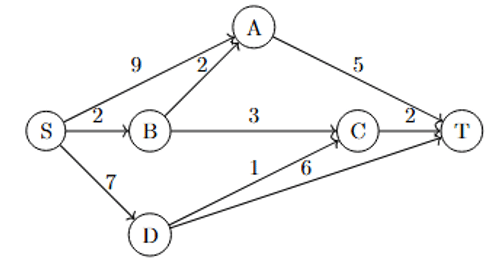
Motorists travelling from point S to point T would obviously take the route for which the total cost of travelling is the minimum. If two or more routes have the same least travel cost, then motorists are indifferent between them. Hence, the traffic gets evenly distributed among all the least cost routes.
The government can control the flow of traffic only by levying appropriate toll at each junction. For example, if a motorist takes the route S-A-T (using junction A alone), then the total cost of travel would be Rs 14 (i.e., Rs 9 + Rs 5) plus the toll charged at junction A.
Question 21:
If the government wants to ensure that no traffic flows on the street from D to T, while equal amount of traffic flows through junctions A and C, then a feasible set of toll charged (in rupees) at junctions A, B, C, and D respectively to achieve this goal is:
View Solution
Step 1: Understanding the Concept:
We are given a one-way traffic network from point S to point T. Each street has a cost (fuel in rupees). Motorists will naturally choose the path with the minimum total cost (fuel + toll). The government can influence route choice by imposing tolls at junctions. Our task is to find tolls at A, B, C, D such that:
1. No motorists use the route from D to T.
2. Traffic splits equally between routes through A and C.
Step 2: Key Formula or Approach:
Total cost of a route = (sum of fuel costs) + (sum of tolls at visited junctions).
We must adjust tolls to make routes through A and C equally costly, while making the D–T route more expensive than both.
Step 3: Detailed Explanation:
- Path via A: S \(\to\) A \(\to\) T has cost \(9 + 5 = 14\) fuel, plus toll(A).
- Path via C: S \(\to\) B \(\to\) C \(\to\) T has cost \(2 + 3 + 2 = 7\) fuel, plus toll(B) + toll(C).
- Path via D: S \(\to\) D \(\to\) T has cost \(7 + 6 = 13\) fuel, plus toll(D).
We want:
1. Cost(A route) = Cost(C route).
2. Both less than Cost(D route).
Substituting feasible option (5): Toll(A)=0, Toll(B)=5, Toll(C)=2, Toll(D)=2.
- Cost(A route) = 14 + 0 = 14.
- Cost(C route) = 7 + 5 + 2 = 14.
- Cost(D route) = 13 + 2 = 15.
Thus, conditions satisfied: routes A and C equal (14 each), and D route more costly (15).
Step 4: Final Answer:
\[ \boxed{(5) \; 0, 5, 2, 2} \]
Step 5: Why This is Correct:
This toll structure ensures that motorists are indifferent between A and C routes (equal cost 14), hence traffic splits equally. The D route is strictly costlier (15), so no traffic flows through D to T. Quick Tip: When solving traffic-network toll problems, always compare route costs systematically. Equalize the costs of desired routes and make unwanted routes strictly higher. This ensures controlled traffic flow.
If the government wants to ensure that all motorists travelling from S to T pay the same amount (fuel costs and toll combined) regardless of the route they choose and the street from B to C is under repairs (and hence unusable), then a feasible set of toll charged (in rupees) at junctions A, B, C, and D respectively to achieve this goal is:
View Solution
Step 1: Understanding the Concept:
The problem requires us to find a set of tolls such that the total cost (fuel + toll) is the same for all usable routes from S to T. A key constraint is that the street from B to C is unusable, which means the route S-B-C-T must be excluded from our calculations.
Step 2: Key Formula or Approach:
First, identify the usable routes and their fuel costs:
S-A-T: Fuel Cost = \(9 + 5 = 14\)
S-B-A-T: Fuel Cost = \(2 + 2 + 5 = 9\)
S-D-C-T: Fuel Cost = \(7 + 1 + 2 = 10\)
S-D-T: Fuel Cost = \(7 + 6 = 13\)
Let the tolls be \(T_A, T_B, T_C, T_D\). The total costs are:
Cost(S-A-T) = \(14 + T_A\)
Cost(S-B-A-T) = \(9 + T_B + T_A\)
Cost(S-D-C-T) = \(10 + T_D + T_C\)
Cost(S-D-T) = \(13 + T_D\)
The condition is that all these costs must be equal.
Step 3: Detailed Explanation or Calculation:
Let's set up a system of equations: \[ 14 + T_A = 9 + T_B + T_A = 10 + T_D + T_C = 13 + T_D \]
From the first equality: \[ 14 + T_A = 9 + T_B + T_A \implies 14 = 9 + T_B \implies T_B = 5 \]
From the third equality: \[ 10 + T_D + T_C = 13 + T_D \implies 10 + T_C = 13 \implies T_C = 3 \]
So, any feasible solution must have \(T_B = 5\) and \(T_C = 3\). Options (4) and (5) are eliminated.
We also need the first and last expressions to be equal: \[ 14 + T_A = 13 + T_D \implies T_D = T_A + 1 \]
Now we test the remaining options (1), (2), and (3) against this condition \(T_D = T_A + 1\).
Option (1) 2,5,3,2: \(T_A = 2, T_D = 2\). Here \(T_D \neq T_A + 1\). Incorrect.
Option (2) 0,5,3,1: \(T_A = 0, T_D = 1\). Here \(T_D = T_A + 1\) (i.e., \(1 = 0 + 1\)). Correct.
Option (3) 1,5,3,2: \(T_A = 1, T_D = 2\). Here \(T_D = T_A + 1\) (i.e., \(2 = 1 + 1\)). Correct.
Both options (2) and (3) are feasible sets of tolls.
Let's verify the total costs for both:
For option (2) (0,5,3,1): Total Cost = \(14 + 0 = 14\).
For option (3) (1,5,3,2): Total Cost = \(14 + 1 = 15\).
Since the question asks for *a feasible set*, and both options (2) and (3) satisfy all conditions, both are correct answers.
Step 4: Final Answer:
Both toll sets (0, 5, 3, 1) and (1, 5, 3, 2) are feasible.
Step 5: Why This is Correct:
Both options (2) and (3) satisfy the derived necessary conditions: \(T_B = 5\), \(T_C = 3\), and \(T_D = T_A + 1\). When these tolls are applied, the total cost for every usable route from S to T becomes uniform, fulfilling the government's requirement. Quick Tip: When a problem requires multiple conditions to be met, break it down by deriving necessary relationships between variables first (like \(T_B=5\)). This allows you to quickly eliminate incorrect options before testing the remaining ones completely.
If the government wants to ensure that the traffic at S gets evenly distributed along streets from S to A, from S to B, and from S to D, then a feasible set of toll charged (in rupees) at junctions A, B, C, and D respectively to achieve this goal is:
View Solution
Step 1: Understanding the Concept:
The traffic at S is distributed among three streets: S-A, S-B, and S-D. For the traffic to be evenly distributed, the number of minimum-cost routes starting with S-A must be equal to the number of minimum-cost routes starting with S-B, which must also be equal to the number of minimum-cost routes starting with S-D. This is because motorists are indifferent between all least-cost routes.
Step 2: Key Formula or Approach:
We must check each option. For a given set of tolls \((T_A, T_B, T_C, T_D)\), we need to:
1. Calculate the total cost for all five possible routes from S to T.
2. Identify the minimum cost (K) among them.
3. Count how many of these minimum-cost routes start with S-A, S-B, and S-D.
4. The counts for each starting branch must be equal and non-zero.
Step 3: Detailed Explanation or Calculation:
Let's test the toll set from option (1): \((T_A, T_B, T_C, T_D) = (0, 5, 4, 1)\).
The total costs for the five routes are:
Cost(S-A-T) = Fuel(14) + \(T_A\) = \(14 + 0 = \textbf{14}\)
Cost(S-B-A-T) = Fuel(9) + \(T_B + T_A\) = \(9 + 5 + 0 = \textbf{14}\)
Cost(S-B-C-T) = Fuel(7) + \(T_B + T_C\) = \(7 + 5 + 4 = 16\)
Cost(S-D-C-T) = Fuel(10) + \(T_D + T_C\) = \(10 + 1 + 4 = 15\)
Cost(S-D-T) = Fuel(13) + \(T_D\) = \(13 + 1 = \textbf{14}\)
The minimum cost of travel (K) is Rs. 14.
Now, we count the number of routes with this minimum cost for each starting street:
Starting with S-A: S-A-T has a cost of 14. (Count = 1)
Starting with S-B: S-B-A-T has a cost of 14. S-B-C-T costs 16 (not minimum). (Count = 1)
Starting with S-D: S-D-T has a cost of 14. S-D-C-T costs 15 (not minimum). (Count = 1)
The number of minimum-cost routes for each starting branch is 1. Since the counts (1, 1, 1) are equal, the traffic from S will be evenly distributed among S-A, S-B, and S-D.
Step 4: Final Answer:
The feasible set of tolls is (0, 5, 4, 1).
Step 5: Why This is Correct:
With the tolls (0, 5, 4, 1), there are exactly three routes that result in the minimum travel cost of Rs. 14. Each of these three routes originates from a different starting street (one from S-A, one from S-B, one from S-D). Since traffic is distributed evenly among all least-cost routes, each of the three initial streets will receive an equal share of the total traffic. Quick Tip: Remember that traffic distribution depends on the number of *routes* with the minimum cost, not just the minimum cost achievable from a starting point. A branch might have a low minimum cost but if it's achieved via multiple routes, it will attract more traffic.
If the government wants to ensure that all routes from S to T get the same amount of traffic, then a feasible set of toll charged (in rupees) at junctions A, B, C, and D respectively to achieve this goal is:
View Solution
Step 1: Understanding the Concept:
For all routes from S to T to receive the same amount of traffic, the total travel cost (fuel cost + tolls) must be identical for every single route.
Step 2: Key Formula or Approach:
We list the total cost for each of the five routes and set them all equal to each other. This creates a system of equations that we can solve for the tolls \(T_A, T_B, T_C, T_D\).
Total Costs:
Cost(S-A-T) = \(14 + T_A\)
Cost(S-B-A-T) = \(9 + T_B + T_A\)
Cost(S-B-C-T) = \(7 + T_B + T_C\)
Cost(S-D-C-T) = \(10 + T_D + T_C\)
Cost(S-D-T) = \(13 + T_D\)
Step 3: Detailed Explanation or Calculation:
Set all costs equal: \[ 14 + T_A = 9 + T_B + T_A = 7 + T_B + T_C = 10 + T_D + T_C = 13 + T_D \]
We can solve this system by equating pairs of expressions:
Equating expressions 1 and 2:
\(14 + T_A = 9 + T_B + T_A \implies 14 = 9 + T_B \implies \textbf{T}_\textbf{B} = \textbf{5}\)
Equating expressions 4 and 5:
\(10 + T_D + T_C = 13 + T_D \implies 10 + T_C = 13 \implies \textbf{T}_\textbf{C} = \textbf{3}\)
Now we know \(T_B = 5\) and \(T_C = 3\). We can find the common total cost (K) using expression 3: \[ K = 7 + T_B + T_C = 7 + 5 + 3 = 15 \]
The total cost for every route must be 15. Now we can find \(T_A\) and \(T_D\):
From expression 1:
\(14 + T_A = 15 \implies \textbf{T}_\textbf{A} = \textbf{1}\)
From expression 5:
\(13 + T_D = 15 \implies \textbf{T}_\textbf{D} = \textbf{2}\)
The unique feasible set of tolls is \((T_A, T_B, T_C, T_D) = (1, 5, 3, 2)\). This corresponds to option (4).
Step 4: Final Answer:
The feasible set of tolls is (1, 5, 3, 2).
Step 5: Why This is Correct:
The derived toll set (1, 5, 3, 2) is the only solution that makes the total cost of all five routes from S to T equal. With these tolls, every route has a total cost of Rs. 15, ensuring that traffic is evenly distributed among all of them. Quick Tip: When a problem requires all items in a set (like routes) to be equal in value, setting up a system of equations is the most direct method. Look for pairs of equations that allow you to isolate and solve for one variable at a time.
The government wants to devise a toll policy such that the total cost to the commuters per trip is minimized. The policy should also ensure that not more than 70 per cent of the total traffic passes through junction B. The cost incurred by the commuter travelling from point S to point T under this policy will be:
View Solution
Step 1: Understanding the Concept:
We need to find the lowest possible travel cost for a commuter, subject to a constraint on traffic distribution. The cost to the commuter is the minimum total cost (K) among all available routes. The constraint is that the fraction of minimum-cost routes passing through junction B must not exceed 70% (or 0.7).
Step 2: Key Formula or Approach:
1. Analyze the situation without tolls to establish a baseline.
2. Identify the need for tolls to satisfy the traffic constraint.
3. Since tolls can only increase costs (assuming they are non-negative), the new minimum cost K must be greater than or equal to the fuel cost of at least one route that doesn't pass through B.
4. Find the lowest possible value of K that allows the condition \( \frac{No. of min-cost routes via B}{Total no. of min-cost routes} \leq 0.7 \) to be met.
Step 3: Detailed Explanation or Calculation:
Baseline (No Tolls):
The fuel costs are S-A-T(14), S-B-A-T(9), S-B-C-T(7), S-D-C-T(10), S-D-T(13).
The minimum cost is Rs. 7 via route S-B-C-T. All traffic would take this single route.
This route passes through B. So, 100% of traffic passes through B, which violates the \(\leq 70%\) condition.
Introducing Tolls:
To satisfy the condition, we must make at least one route not passing through B equally attractive (i.e., have the same minimum cost). The non-B routes are S-A-T (fuel 14), S-D-C-T (fuel 10), and S-D-T (fuel 13).
The cheapest fuel cost for a non-B route is Rs. 10 (S-D-C-T). Since tolls are non-negative, the total cost of any non-B route cannot be less than its fuel cost. Therefore, the new minimum travel cost K must be at least Rs. 10.
Testing K = 10:
Let's see if we can achieve a minimum travel cost of K = Rs. 10 while satisfying the traffic constraint.
We need to make at least one non-B route cost Rs. 10. We can choose S-D-C-T (fuel cost 10). To make its total cost 10, the tolls on its path must be zero. Let \(T_D = 0, T_C = 0\).
Now we have one minimum-cost route (S-D-C-T) that does not pass through B.
To keep the minimum cost at 10, we must ensure no other route costs less than 10. We also need to manage the B-routes. Let's make the cheapest B-route (S-B-C-T, fuel 7) also cost Rs. 10.
Cost(S-B-C-T) = \(7 + T_B + T_C = 10\). Since we set \(T_C = 0\), this means \(7 + T_B = 10\), so we can set \(T_B = 3\).
With tolls such as \((T_A=0, T_B=3, T_C=0, T_D=0)\), the route costs are: S-A-T(14), S-B-A-T(12), S-B-C-T(10), S-D-C-T(10), S-D-T(13).
Under this policy, the minimum cost is K = Rs. 10. There are two minimum cost routes: S-B-C-T (passes through B) and S-D-C-T (does not pass through B). The fraction of traffic through B is \( \frac{1}{1+1} = \frac{1}{2} = 50% \).
Since \(50% \leq 70%\), this is a valid policy.
Step 4: Final Answer:
The minimized cost incurred by the commuter is Rs. 10.
Step 5: Why This is Correct:
We established that the minimum commuter cost must be at least Rs. 10 to divert traffic to a non-B route. We then demonstrated a feasible toll policy that achieves this minimum cost of Rs. 10 while also satisfying the 70% traffic constraint. Therefore, Rs. 10 is the minimized possible cost. Quick Tip: In optimization problems with constraints, first determine the theoretical minimum or maximum value possible. Then, construct a scenario (in this case, a set of tolls) to prove that this theoretical value is actually achievable.
Relations between the factory and the dealer are distant and usually strained as the factory tries to force cars on the dealers to smooth out production. Relations between the dealer and the customer are equally strained because dealers continuously adjust prices — make deals — to adjust demand with supply while maximizing profits. This becomes a system marked by a lack of long-term commitment on either side, which maximizes feelings of mistrust. In order to maximize their bargaining positions, everyone holds back information — the dealer about the product and the consumer about his true desires.
View Solution
Step 1: Understanding the Concept:
The paragraph describes a dysfunctional system in the automobile industry. It details the strained relationships and mistrust at every level: between the factory and the dealer, and between the dealer and the customer. The core problem is short-term, self-interested behavior, lack of commitment, and withholding information.
Step 2: Analyzing the Paragraph's Logic:
The paragraph builds a chain of negative interactions:
1. Factory forces cars on dealers.
2. Dealers adjust prices constantly to manage supply and maximize profit.
3. This creates a system with no long-term commitment and high mistrust.
4. All parties (factory, dealer, consumer) hold back information to protect their own interests.
The final sentence should logically conclude the overall outcome of this deeply flawed system.
Step 3: Detailed Explanation:
Let's evaluate the options:
(A) This is a specific outcome, but the paragraph describes problems beyond just 'deal making', including production pressures and information hoarding. It's too narrow.
(B) This is also a specific outcome. While inefficiencies are implied, the paragraph's focus is more on the breakdown of relationships and trust.
(C) This statement essentially rephrases what is already mentioned in the paragraph ("a system marked by a lack of long-term commitment... which maximizes feelings of mistrust"). A concluding sentence should state the result of this adversarial behavior, not just restate it.
(D) The paragraph does not provide any information about innovation. Introducing this concept would be an unsupported leap in logic.
(E) This is the most appropriate conclusion. It summarizes the ultimate, collective consequence of the negative behaviors described. The mistrust and short-term focus mean that no party truly benefits in a sustainable way. The factory, the dealer, and the customer are all trapped in a negative cycle. Therefore, "everyone loses in the long run."
Step 4: Final Answer:
The most logical and comprehensive conclusion to the paragraph is that this system of mistrust and short-term maximization leads to a negative outcome for all participants.
Step 5: Why This is Correct:
Option (E) provides a holistic summary of the consequences of the dysfunctional system described. While other options point to specific symptoms (deal making, inefficiency), option (E) captures the overall, long-term failure of the system for everyone involved. Quick Tip: In paragraph completion questions, look for a concluding sentence that summarizes the main theme or presents the ultimate consequence of the situation described. Avoid options that are too specific, restate existing information, or introduce new, unsupported ideas.
We can usefully think of theoretical models as maps, which help us navigate unfamiliar territory. The most accurate map that it is possible to construct would be of no practical use whatsoever, for it would be an exact replica, on exactly the same scale, of the place where we were. Good maps pull out the most important features and throw away a huge amount of much less valuable information. Of course, maps can be bad as well as good — witness the attempts by medieval Europe to produce a map of the world. In the same way, a bad theory, no matter how impressive it may seem in principle, does little or nothing to help us understand a problem.
View Solution
Step 1: Understanding the Concept:
The paragraph draws an analogy between theoretical models and maps. The central argument is that the usefulness of a map (or a theory) comes not from its perfect accuracy or detail, but from its strategic simplification—highlighting what's important and omitting what's not.
Step 2: Analyzing the Paragraph's Logic:
The paragraph's argument proceeds as follows:
1. Analogy: Models are like maps.
2. Main Point: A 1:1 scale map is useless. Usefulness comes from simplification ("pull out the most important features and throw away... less valuable information").
3. Contrast: There are good maps/theories and bad maps/theories. Bad ones don't help us understand.
The concluding sentence should tie these points together, reinforcing the value of good, simplified theories.
Step 3: Detailed Explanation:
The paragraph has established that simplification is the key to a good map's utility. The last sentence discusses bad theories. The concluding sentence, starting with "But," should pivot back to the value of GOOD theories, completing the analogy.
(A) This option perfectly captures the core message. It explicitly states that simplification does not diminish the value of a good theory; in fact, as the paragraph argues, simplification is what *creates* the value. It directly connects "invaluable" with "simplified."
(B) This statement is too absolute ("never") and focuses on a limitation rather than the central theme of value through simplification.
(C) While true, the idea of "balancing detail and feasibility" is a more nuanced point that the paragraph doesn't focus on. The paragraph's main thrust is simpler: abstraction and simplification are good and necessary.
(D) This is also true but less impactful than (A). Option (A) uses the strong word "invaluable" and directly links it to the condition of being "simplified," which is the paragraph's main thesis.
(E) This option shifts the focus to the "user," which is a new element not discussed in the paragraph. The paragraph's focus is on the inherent qualities of the map/theory itself.
Step 4: Final Answer:
The best concluding sentence is the one that summarizes the main argument: the great value of good theories (and maps) lies in their purposeful simplification.
Step 5: Why This is Correct:
Option (A) is the only choice that explicitly reinforces the paragraph's central thesis: that simplification is not a flaw but a feature that makes good theories and maps "invaluable." Quick Tip: When a paragraph is built around an analogy, the concluding sentence will often explicitly state the main takeaway from that analogy. Identify the core comparison and find the option that summarizes it best.
In the evolving world order, the comparative advantage of the United States lies in its military force. Diplomacy and international law have always been regarded as annoying encumbrances, unless they can be used to advantage against an enemy. Every active player in world affairs professes to seek only peace and to prefer negotiation to violence and coercion.
View Solution
Step 1: Understanding the Concept:
The paragraph presents a cynical view of international relations. It argues that military force is the true source of US advantage, and that diplomacy/law are often viewed as mere tools or obstacles. The final sentence introduces a contrast: what nations *profess* (peace, negotiation) versus this underlying reality.
Step 2: Analyzing the Paragraph's Logic:
The paragraph sets up a clear dichotomy:
1. The Reality: Military force is key; diplomacy is a tool to be used against enemies.
2. The Profession: Everyone claims to want peace and negotiation.
The concluding sentence, starting with "However," must bridge this gap by explaining the relationship between the profession and the reality. It should reveal the true nature of diplomacy as understood by powerful actors.
Step 3: Detailed Explanation:
The options all use "However" to introduce a contradiction to the idea that nations genuinely prefer peace. We need the option that best reflects the specific points made earlier in the paragraph.
(A) This is a plausible option, but the phrasing is a bit plain compared to the analytical tone of the paragraph.
(B) This option is the strongest. The phrase "when the veil is lifted" directly addresses the idea of a public "profession" of peace being a facade. It also precisely summarizes the earlier point by stating that diplomacy is seen as a "disguise for the rule of force," which connects back to the primacy of "military force."
(C) This is too general. It states that nations are hypocritical but doesn't explain *how* in the specific context of diplomacy and force, which is the paragraph's focus.
(D) This is also quite general. Option (B) is more specific about the role of *diplomacy* as the mechanism of disguise.
(E) This is close, but it focuses on the nations' "penchant for the use of force." Option (B) is better because it keeps the focus on how *diplomacy itself* is understood and used, which is a key theme of the paragraph ("Diplomacy and international law have always been regarded as...").
Step 4: Final Answer:
The most fitting conclusion is that the professed desire for peace through diplomacy is often a cover for the actual exercise of power and force.
Step 5: Why This is Correct:
Option (B) provides the most sophisticated and precise conclusion. It uses the metaphor of a "veil" to capture the hypocrisy of "professing peace" and explicitly defines diplomacy in the context of the paragraph's argument: a "disguise for the rule of force." Quick Tip: In paragraphs that present a contrast between appearance and reality, the correct concluding sentence will often expose the reality behind the appearance. Look for words like "disguise," "mask," "facade," or phrases like "when the veil is lifted."
I am sometimes attacked for imposing 'rules'. Nothing could be further from the truth. I hate rules. All I do is report on how consumers react to different stimuli. I may say to a copywriter, "Research shows that commercials with celebrities are below average in persuading people to buy products. Are you sure you want to use a celebrity?" Call that a rule? Or I may say to an art director, "Research suggests that if you set the copy in black type on a white background, more people will read it than if you set it in white type on a black background."
View Solution
Step 1: Understanding the Concept:
The author is defending their professional practice. They are accused of setting "rules," but they argue that they are simply providing data-driven advice or "reporting on how consumers react." The tone is personal and defensive.
Step 2: Analyzing the Paragraph's Logic:
The author's defense is structured as follows:
1. Denial: I don't impose rules; I hate rules.
2. Clarification of Role: I just report on consumer reactions.
3. Examples: The author provides two examples where they offer research-based advice, phrasing one as a question ("Are you sure you want to...?").
4. Rhetorical Question: "Call that a rule?" This directly challenges the accusation.
The final sentence should summarize this distinction between a rigid rule and their form of advice.
Step 3: Detailed Explanation:
Let's analyze the options in the context of the author's argument.
(A) This statement is correct and reflects the author's point, but it's phrased in a formal, impersonal way.
(B) This states a fact that supports the author's case but doesn't capture the main thrust of the argument, which is the *nature* of the advice, not just its origin in research.
(C) This option perfectly captures the author's tone and the core of their argument. The phrasing "A suggestion perhaps, but scarcely a rule" directly answers the rhetorical question "Call that a rule?" and summarizes the author's self-perception. It is personal, slightly informal, and makes the exact distinction the author wants to make.
(D) This option takes the opposite stance. The author is trying to downplay the rigidity of their advice, not present it as an "unavoidable principle."
(E) This option shifts the focus away from the author's main point (the "rule" vs. "suggestion" debate) and onto the general topic of their work. The paragraph is primarily a defense of their method, not a description of their field.
Step 4: Final Answer:
The most appropriate conclusion is one that succinctly expresses the author's intended distinction between a rule and a suggestion, matching the paragraph's personal tone.
Step 5: Why This is Correct:
Option (C) is the best choice because its conversational tone and direct contrast ("suggestion... but scarcely a rule") perfectly align with the author's personal defense and the rhetorical question posed in the text. Quick Tip: Pay close attention to the tone of the paragraph (e.g., formal, personal, cynical, defensive). The correct concluding sentence will not only be logically sound but will also match the established tone.
Age has a curvilinear relationship with the exploitation of opportunity. Initially, age will increase the likelihood that a person will exploit an entrepreneurial opportunity because people gather much of the knowledge necessary to exploit opportunities over the course of their lives, and because age provides credibility in transmitting that information to others. However, as people become older, their willingness to bear risks declines, their opportunity costs rise, and they become less receptive to new information.
View Solution
Step 1: Understanding the Concept:
The paragraph describes a two-part relationship between age and entrepreneurship. It's "curvilinear," meaning it goes up and then comes down. First, the likelihood of exploiting opportunities increases with age (due to knowledge and credibility). Then, after a certain point, it decreases (due to lower risk tolerance, higher opportunity cost, and less receptivity to new information).
Step 2: Analyzing the Paragraph's Logic:
The structure of the argument is:
1. Initial Phase (Younger Age): Likelihood of exploitation increases. Reasons: knowledge, credibility.
2. Turning Point ("However"): The trend reverses.
3. Later Phase (Older Age): Three reasons for the decline are given: (i) risk aversion increases, (ii) opportunity costs rise, (iii) receptivity to new information decreases.
The final sentence must be a direct consequence ("As a result") of these three factors that affect people as they become older.
Step 3: Detailed Explanation:
The concluding sentence must summarize the combined effect of the three reasons listed in the last part of the paragraph.
(A) This focuses only on one aspect ("experiment with new ideas") which relates to being "less receptive to new information." It ignores risk aversion and opportunity cost.
(B) Similar to (A), this is too narrow. It only addresses the consequence of being "less receptive to new information."
(C) This focuses only on "opportunity costs," which is just one of the three factors mentioned.
(D) This is the most comprehensive and accurate conclusion. The reluctance to "exploit entrepreneurial opportunities" is the direct outcome of all three stated factors combined: declining risk tolerance, rising opportunity costs, and reduced receptiveness to new ideas. It perfectly summarizes the second half of the curvilinear relationship.
(E) This creates a false dichotomy. The paragraph states that credibility helps people exploit opportunities (the "up" part of the curve), not that it's something older people depend on *instead* of novelty. The main point for older age is the overall decline in exploitation.
Step 4: Final Answer:
The logical result of the factors present in older age is a general reluctance to pursue entrepreneurial ventures.
Step 5: Why This is Correct:
Option (D) is the only one that serves as a complete and direct summary of the consequences of all three factors (risk decline, cost rise, less receptivity) that the paragraph claims cause the downturn in the exploitation of opportunities at an advanced age. Quick Tip: When a paragraph lists several reasons or factors leading to a situation, the correct concluding sentence will often be a summary that encompasses all or most of those factors, rather than focusing on just one.
Our propensity to look out for regularities, and to impose laws upon nature, leads to the psychological phenomenon of dogmatic thinking or, more generally, dogmatic behaviour: we expect regularities everywhere and attempt to find them even where there are none; events which do not yield to these attempts we are inclined to treat as a kind of ’background noise’; and we stick to our expectations even when they are inadequate and we ought to accept defeat. This dogmatism is to some extent necessary. It is demanded by a situation which can only be dealt with by forcing our conjectures upon the world. Moreover, this dogmatism allows us to approach a good theory in stages, by way of approximations: if we accept defeat too easily, we may prevent ourselves from finding that we were very nearly right.
It is clear that this dogmatic attitude, which makes us stick to our first impressions, is indicative of a strong belief, while a critical attitude, which is ready to modify its tenets, which admits doubt and demands tests, is indicative of a weaker belief. Now according to Hume’s theory, and to the popular theory, the strength of a belief should be a product of repetition; thus it should always grow with experience, and always be greater in less primitive persons. But dogmatic thinking, an uncontrolled wish to impose regularities, a manifest pleasure in rites and in repetition as such, is characteristic of primitives and children; and increasing experience and maturity sometimes create an attitude of caution and criticism rather than of dogmatism.
My logical criticism of Hume’s psychological theory, and the considerations connected with it, may seem a little removed from the field of the philosophy of science. But the distinction between dogmatic and critical thinking, or the dogmatic and the critical attitude, brings us right back to our central problem. For the dogmatic attitude is clearly related to the tendency to verify our laws and schemata by seeking to apply them and to confirm them, even to the point of neglecting refutations, whereas the critical attitude is one of readiness to change them — to test them; to refute them; to falsify them, if possible. This suggests that we may identify the critical attitude with the scientific attitude, and the dogmatic attitude with the one which we have described as pseudo-scientific. It further suggests that genetically speaking
the pseudo-scientific attitude is more primitive than, and prior to, the scientific attitude: that it is a pre-scientific attitude. And this primitivity or priority also has its logical aspect. For the critical attitude is not so much opposed to the dogmatic attitude as super-imposed upon it: criticism must be directed against existing and influential beliefs in need of critical revision— in other words, dogmatic beliefs. A critical attitude needs for its raw material, as it were, theories or beliefs which are held more or less dogmatically.
Thus, science must begin with myths, and with the criticism of myths; neither with the collection of observations, nor with the invention of experiments, but with the critical discussion of myths, and of magical techniques and practices. The scientific tradition is distinguished from the pre-scientific tradition in having two layers. Like the latter, it passes on its theories; but it also passes on a critical attitude towards them. The theories are passed on, not as dogmas, but rather with the challenge to discuss them and improve upon them.
The critical attitude, the tradition of free discussion of theories with the aim of discovering their weak spots so that they may be improved upon, is the attitude of reasonableness, of rationality. From the point of view here developed, all laws, all theories, remain essentially tentative, or
conjectural, or hypothetical, even when we feel unable to doubt them any longer. Before a theory has been refuted we can never know in what way it may have to be modified.
Question 31:
In the context of science, according to the passage, the interaction of dogmatic beliefs and critical attitude can be best described as:
View Solution
Step 1: Understanding the Concept:
The question asks for the best analogy to describe the relationship between dogmatic beliefs and the critical attitude in science, as presented in the passage. We need to find the core of this relationship in the text.
Step 2: Analyzing the Passage's Description:
The passage states: "the critical attitude is not so much opposed to the dogmatic attitude as super-imposed upon it: criticism must be directed against existing and influential beliefs... A critical attitude needs for its raw material, as it were, theories or beliefs which are held more or less dogmatically."
This indicates a constructive, shaping relationship, not a purely destructive one. The dogmatic belief is the essential starting point or "raw material," and the critical attitude refines, changes, and improves it.
Step 3: Detailed Explanation of Options:
(A) A duel to the death: This is incorrect. The passage says the critical attitude is "not so much opposed" to the dogmatic one. It's a process of refinement, not annihilation.
(B) The effect of a chisel on a marble stone: This is a fitting analogy. The marble stone represents the "raw material" of dogmatic belief. The chisel represents the "critical attitude," which is "super-imposed" on the stone to test, shape, and refine it into a more sophisticated form (a scientific theory).
(C) Transformation of feedshare to fertilizer: This is about chemical transformation, but it lacks the element of critical shaping and refutation. The chisel analogy better captures the idea of actively chipping away flaws.
(D) A predator killing its prey: This is incorrect for the same reason as (A). It's a destructive relationship, whereas the passage describes a constructive one where the initial belief is essential.
(E) Fertilizer on a sapling: This suggests nourishment and growth, but not the critical process of testing, refuting, and falsifying that the passage emphasizes. Criticism challenges and changes, it doesn't just "feed" the original idea.
Step 4: Final Answer:
The relationship is one where the critical attitude actively shapes the raw material of dogmatic belief. The analogy of a sculptor's chisel on marble best captures this dynamic.
Step 5: Why This is Correct:
Option (B) perfectly illustrates the relationship described in the passage where the dogmatic belief is the necessary "raw material" that is actively shaped and refined by the "super-imposed" critical attitude. Quick Tip: For analogy questions based on a passage, break down the relationship described in the text into its core components (e.g., raw material, shaping tool, final product). Then, evaluate which option best mirrors this structure.
According to the passage, the role of a dogmatic attitude or dogmatic behaviour in the development of science is
View Solution
Step 1: Understanding the Concept:
The question asks about the function or role of the dogmatic attitude in the process of scientific development, according to the author.
Step 2: Locating Relevant Text:
The passage provides several clues:
- Paragraph 1: "This dogmatism is to some extent necessary... it allows us to approach a good theory in stages, by way of approximations..."
- Paragraph 3: "A critical attitude needs for its raw material, as it were, theories or beliefs which are held more or less dogmatically."
- Paragraph 4: "Thus, science must begin with myths, and with the criticism of myths..."
These statements show that dogmatism, while primitive, is a necessary starting point.
Step 3: Detailed Explanation:
The author argues that the dogmatic attitude provides the initial theories, beliefs, conjectures, or "myths." These serve as the "raw material" that the critical attitude then works on. Without this initial, firmly held belief, there would be nothing to test, criticize, or refine. Therefore, the dogmatic attitude plays a foundational and necessary role.
(A) This option correctly identifies the role as "critical and important" and provides the correct reason: it is the source of the "initial hypotheses or conjectures." This aligns perfectly with the "raw material" and "myths" arguments.
(B) This is incomplete. Conjectures from the dogmatic attitude do not just "become science"; they become science *through the application of the critical attitude*.
(C) While the passage associates the dogmatic attitude with pseudo-science, it also clearly states it's a necessary precursor to science. Calling its role purely "negative" is incorrect.
(D) Its role is not neutral; the author explicitly states it is "to some extent necessary" and the essential "raw material."
(E) While the passage does portray the critical attitude as more advanced ("super-imposed"), describing the dogmatic attitude's role as simply "inferior" fails to capture its essential, foundational function.
Step 4: Final Answer:
The dogmatic attitude's role is foundational; it provides the essential starting material for scientific inquiry.
Step 5: Why This is Correct:
Option (A) accurately summarizes the passage's argument that the dogmatic attitude, by generating the initial beliefs and hypotheses, plays an indispensable role in the development of science. Quick Tip: When a passage presents two opposing concepts, pay attention to how they interact. Often, one is not purely "good" and the other "bad." Look for nuances, such as one being a necessary precursor to the other.
Dogmatic behaviour, in this passage, has been associated with primitives and children. Which of the following best describes the reason why the author compares primitives with children?
View Solution
Step 1: Understanding the Concept:
The question asks for the underlying reason for the author's comparison between "primitives" and "children" in the context of dogmatic behavior.
Step 2: Analyzing the Specific Text:
The second paragraph states: "But dogmatic thinking... is characteristic of primitives and children; and increasing experience and maturity sometimes create an attitude of caution and criticism rather than of dogmatism."
The key contrast here is between dogmatism on one side, and "increasing experience and maturity" leading to criticism on the other. This frames dogmatism as a characteristic of an early, less mature stage of development.
Step 3: Detailed Explanation of Options:
(A) This is too specific and literal (formal schooling). The author's point is broader, relating to psychological development and maturity.
(B) The passage does not mention "innocence." The comparison is based on a cognitive style (dogmatism).
(C) This is close, but "without a critical attitude" is an absolute statement. The passage suggests dogmatism is a *characteristic* of this stage, not that a critical attitude is completely absent. Option (D) provides a better underlying reason for this characteristic.
(D) This option captures the essence of the comparison perfectly. Primitives represent an early stage in the development of human thought and society (what the author calls a "pre-scientific attitude"). Children are in an early stage of their individual cognitive and personal development. The shared characteristic of being in an "early stage" explains why both exhibit more dogmatic thinking, which gives way to criticism with "increasing experience and maturity."
(E) "Not civilized enough" is a value judgment not made by the author. The author uses "primitive" in a developmental or "genetic" sense, as stated in paragraph 3 ("genetically speaking the pseudo-scientific attitude is more primitive than... the scientific attitude").
Step 4: Final Answer:
The comparison is based on both groups representing an early stage of development—one societal, the other individual—where dogmatic thinking is prevalent before the development of a mature, critical attitude.
Step 5: Why This is Correct:
Option (D) correctly identifies the parallel developmental stages (societal and individual) as the basis for the author's comparison, which is supported by the text's emphasis on "experience and maturity." Quick Tip: When an author makes a comparison, look for the underlying principle. Instead of focusing on superficial similarities, identify the core concept that the author is using the comparison to illustrate (in this case, developmental stages).
Which of the following statements best supports the argument in the passage that a critical attitude leads to a weaker belief than a dogmatic attitude does?
View Solution
Step 1: Understanding the Concept:
The question asks what aspect of a critical attitude, according to the passage, makes the belief it produces "weaker" than a dogmatic belief.
Step 2: Locating the Author's Argument:
The second paragraph defines the two attitudes:
- Dogmatic attitude: "makes us stick to our first impressions, is indicative of a strong belief".
- Critical attitude: "is ready to modify its tenets, which admits doubt and demands tests, is indicative of a weaker belief".
The final paragraph reinforces this: "all laws, all theories, remain essentially tentative, or conjectural, or hypothetical".
Step 3: Detailed Explanation:
The passage argues that a belief is "weaker" not because it lacks conviction, but because it is held provisionally. It is open to doubt, testing, and modification. The essence of the critical attitude is this lack of finality. A "strong" belief, in this context, is one that is resistant to change, even when faced with contradictory evidence.
(A) "Endless questioning" is an overstatement. The key is the *readiness* to question, not that the questioning never stops.
(B) The passage associates ignoring anomalies as "noise" with the dogmatic attitude, not the critical one.
(C) This is incorrect. The critical attitude analyzes anomalies; the dogmatic one dismisses them as "noise."
(D) "Antithetical to conviction" is too extreme. Scientists can have strong conviction in a theory, but with the critical understanding that it could be refuted.
(E) This option perfectly captures the author's meaning. A critical attitude involves "questioning" ("admits doubt") and results in theories that are "tentative hypotheses." This tentativeness is precisely what makes the belief "weaker" than an unshakeable dogma.
Step 4: Final Answer:
The critical attitude's inherent nature of questioning and holding conclusions as tentative is what defines its associated beliefs as "weaker" than dogmatic ones.
Step 5: Why This is Correct:
Option (E) directly reflects the language and logic used in the passage, linking the critical attitude to the questioning and tentativeness that characterize a "weaker" (i.e., non-dogmatic) belief. Quick Tip: Pay attention to how an author defines terms within a passage. Here, "weaker belief" is not a negative term; it's used specifically to mean a belief that is open to revision and testing, i.e., a tentative or hypothetical one.
According to the passage, which of the following statements best describes the difference between science and pseudo-science?
View Solution
Step 1: Understanding the Concept:
The question asks for the primary distinction between science and pseudo-science as laid out in the passage.
Step 2: Finding the Core Distinction in the Passage:
Paragraph 3 provides the direct comparison:
- Dogmatic/Pseudo-scientific attitude: "...related to the tendency to verify our laws and schemata by seeking to apply them and to confirm them, even to the point of neglecting refutations..."
- Critical/Scientific attitude: "...one of readiness to change them — to test them; to refute them; to falsify them, if possible."
The key difference is the goal: pseudo-science seeks confirmation, while science seeks falsification (the possibility of being proven wrong).
Step 3: Detailed Explanation of Options:
(A) This statement is confusingly worded. Pseudo-science *claims* its theories are always true. Scientific theories are held as tentatively true. The core difference is in the *method*, not just the status of the theory.
(B) This is the opposite of the passage's argument. Science is characterized by "readiness to change," making it mutable, while pseudo-science is dogmatic and resistant to change.
(C) This is the most accurate summary. Science's method is to "test," "refute," and "falsify," which means it always allows the possibility of *rejecting* a theory. Pseudo-science's method is to "verify" and "confirm," meaning it seeks to *validate* its ideas, often by ignoring contradictory evidence.
(D) This is partially true but misses the main point. The crucial difference is not just *what* they focus on, but *why*. Science examines anomalies to potentially *reject* a theory, while pseudo-science ignores them to protect the theory. Option (C) captures this intent better.
(E) The passage explicitly argues against this view in paragraph 4: "science must begin with myths... neither with the collection of observations, nor with the invention of experiments, but with the critical discussion of myths..."
Step 4: Final Answer:
The fundamental difference lies in their approach to proof and disproof. Science actively seeks to be falsified, while pseudo-science seeks only to be confirmed.
Step 5: Why This is Correct:
Option (C) perfectly encapsulates the central distinction drawn in paragraph 3 between the scientific attitude of seeking refutation and the pseudo-scientific attitude of seeking only confirmation. Quick Tip: In philosophy of science passages, the distinction between science and pseudo-science often hinges on the principle of falsifiability. Look for the option that describes science as being open to being proven wrong, and pseudo-science as being resistant to it.
Fifteen years after communism was officially pronounced dead, its spectre seems once again to be haunting Europe. Last month, the Council of Europe’s parliamentary assembly voted to condemn the ”crimes of totalitarian communist regimes,” linking them with Nazism and complaining that communist parties are still ”legal and active in some countries.” Now Goran Lindblad, the conservative Swedish MP behind the resolution, wants to go further. Demands that European Ministers launch a continent-wide anti-communist campaign — including school textbook revisions, official memorial days, and museums — only narrowly missed the necessary two-thirds majority. Mr. Lindblad pledged to bring the wider plans back to the Council of Europe in the coming months.
He has chosen a good year for his ideological offensive: this is the 50th anniversary of Nikita Khrushchev’s denunciation of Josef Stalin and the subsequent Hungarian uprising, which will doubtless be the cue for further excoriation of the communist record. Paradoxically, given that there is no communist government left in Europe outside Moldova, the attacks have if anything, become more extreme as time has gone on. A clue as to why that might be can be found in the rambling report by Mr. Lindblad that led to the Council of Europe declaration. Blaming class struggle and public ownership, he explained ”different elements of communist ideology such as equality or social justice still seduce many” and ”a sort of nostalgia for communism is still alive.” Perhaps the real problem for Mr. Lindblad and his right-wing allies in Eastern Europe is that communism is not dead enough — and they will only be content when they have driven a stake through its heart.
The fashionable attempt to equate communism and Nazism is in reality a moral and historical nonsense. Despite the cruelties of the Stalin terror, there was no Soviet Treblinka or Sorbikor, no extermination camps built to murder millions. Nor did the Soviet Union launch the most devastating war in history at a cost of more than 50 million lives — in fact it played the decisive role in the defeat of the German war machine. Mr. Lindblad and the Council of Europe adopt as fact the wildest estimates of those ”killed by communist regimes” (mostly in famines) from the fiercely contested Black Book of Communism, which also underplays the number of deaths attributable to Hitler. But, in any case, none of this explains why anyone might be nostalgic in former communist states, now enjoying the delights of capitalist restoration. The dominant account gives no sense of how communist regimes renewed themselves after 1956 or why Western leaders feared they might overtake the capitalist world well into the 1960s. For all its brutalities and failures, communism in the Soviet Union, Eastern Europe, and elsewhere delivered rapid industrialization, mass education, job security, and huge advances in social and gender equality. Its existence helped to drive up welfare standards in the West, and provided a powerful counterweight to Western global domination.
It would be easier to take the Council of Europe’s condemnation of communist states crimes seriously if it had also seen fit to denounce the far bloodier record of European colonialism —which only finally came to an end in the 1970s. This was a system of racist despotism, which dominated the globe in Stalin’s time. And while there is precious little connection between the ideas of fascism and communism, there is an intimate link between colonialism and Nazism. The terms lebensraum and konzentrationslager were both first used by the German colonial regime in south-west Africa (now Namibia), which committed genocide against the Herero and Nama peoples and bequeathed its ideas and personnel directly to the Nazi party. Around 10 million Congolese died as a result of Belgian forced labour and mass murder in the early twentieth century; tens of millions perished in avoidable or enforced famines in British-ruled India; up to a million Algerians died in their war for independence, while controversy now rages in France about a new law requiring teachers to put a positive spin on colonial history. Comparable atrocities were carried out by all European colonialists, but not a word of condemnation from the Council of Europe. Presumably, European lives count for more.
No major twentieth century political tradition is without blood on its hands, but battles over history are more about the future than the past. Part of the current enthusiasm in official Western circles for dancing on the grave of communism is no doubt about relations with today’s Russia and China. But it also reflects a determination to prove there is no alternative to the new global capitalist order — and that any attempt to find one is bound to lead to suffering. With the new imperialism now being resisted in the Muslim world and Latin America, growing international demands for social justice and ever greater doubts about whether the environ- mental crisis can be solved within the existing economic system, the pressure for alternatives will increase.
Question 36:
Among all the apprehensions that Mr. Goran Lindblad expresses against communism, which one gets admitted, although indirectly, by the author?
View Solution
Step 1: Understanding the Question:
The question asks which of Lindblad's criticisms of communism the author of the passage acknowledges or admits to be true.
Step 2: Detailed Explanation:
We need to find a point where the author, despite defending communism against certain accusations, concedes some of its negative aspects.
In the third paragraph, the author, while arguing against equating communism with Nazism, explicitly states: "Despite the cruelties of the Stalin terror, there was no Soviet Treblinka or Sorbibor..."
Later in the same paragraph, the author writes: "For all its brutalities and failures, communism in the Soviet Union, Eastern Europe, and elsewhere delivered rapid industrialization..."
These phrases are direct admissions by the author that communist regimes were, at times, brutal and involved cruelties, which aligns with the general characterization of them being violent and totalitarian.
Let's analyze the other options:
(A) and (B): The author presents these as Lindblad's views ("seduce many," "nostalgia is still alive") and then suggests the real issue for Lindblad is that "communism is not dead enough," implying these ideas still have power. While the author doesn't deny them, the admission is not as direct as for (C).
(D): The author actively supports the view that the current order is imperialistic ("new imperialism now being resisted"), so this is not admitted.
(E): The author admits "failures" but immediately counters this by listing significant economic and social achievements ("rapid industrialization, mass education, job security"), making the admission partial and qualified.
Option (C) is the most clearly and directly admitted point. The author concedes the "brutalities" and "cruelties" without qualification, even while contextualizing them.
Step 3: Final Answer:
The author admits that communist regimes were marked by brutalities and violence.
Quick Tip: In argumentative passages, look for concessional words and phrases like "despite," "for all its," "while acknowledging," or "admittedly." These often signal where the author is admitting a point made by the opposing side before presenting a counter-argument.
What, according to the author, is the real reason for a renewed attack against communism?
View Solution
Step 1: Understanding the Question:
The question asks for the author's explanation of the underlying motive for the recent anti-communist campaign in Europe.
Step 2: Detailed Explanation:
The author outlines the "real reason" in the final paragraph. After discussing how battles over history are about the future, the author states: "But it also reflects a determination to prove there is no alternative to the new global capitalist order - and that any attempt to find one is bound to lead to suffering."
This statement clearly indicates that the author believes the attack on communism is an ideological project aimed at cementing global capitalism as the only viable system and discrediting any potential alternatives. This is synonymous with "idealising the existing ideology of global capitalism."
Let's analyze the other options:
(A): This is a consequence that the attack helps to achieve, but the core reason is the promotion of capitalism as the sole option.
(C): According to the author, this is a tactic used in the attack, not the ultimate reason for it.
(D): The author notes that Lindblad is concerned about this, but the author presents the "real reason" as the defense of capitalism against the threat posed by these surviving ideas.
(E): The passage explicitly states that "there is no communist government left in Europe outside Moldova," contradicting this option.
Therefore, the most accurate answer is that the attack is intended to idealize global capitalism by eliminating any perceived alternative.
Step 3: Final Answer:
According to the author, the real reason for the attack is to idealize and legitimize global capitalism as the only possible system.
Quick Tip: To find the "real reason" or "main purpose" according to an author, look closely at the concluding paragraphs. Authors often use the end of a passage to state their core thesis or reveal the underlying motives they've been building towards.
The author cites examples of atrocities perpetrated by European colonial regimes in order to
View Solution
Step 1: Understanding the Question:
The question asks about the rhetorical purpose behind the author's detailed account of colonial atrocities.
Step 2: Detailed Explanation:
The author introduces the topic of colonialism by stating, "It would be easier to take the Council of Europe's condemnation of communist state crimes seriously if it had also seen fit to denounce the far bloodier record of European colonialism...". This construction immediately shows that the author's goal is to undermine the credibility and moral authority of the Council of Europe and Mr. Lindblad. By highlighting their hypocrisy and silence on a worse issue, the author effectively "neutralises" their argument against communism.
This is not the final goal, however. By neutralizing the surface argument, the author encourages the reader to question the entire endeavor and look for the real reasons behind it. The final paragraph then explains these motives: to defend the "new global capitalist order." Therefore, citing colonial atrocities is a strategy to discredit the accusers (neutralise their arguments) so that the author can expose what they see as the true underlying motives.
Option (E) captures both parts of this strategy: first, neutralizing the immediate argument by pointing out hypocrisy, and second, pushing the reader to look deeper at the real motives. Options (A), (B), and (D) are parts of the strategy but do not capture its full purpose as effectively as (E).
Step 3: Final Answer:
The author details colonial atrocities to undermine the anti-communist argument by exposing hypocrisy, thereby encouraging a deeper look into the political motives behind the condemnation.
Quick Tip: When an author introduces a seemingly different topic (like colonialism in a discussion about communism), ask yourself what rhetorical effect it has. Often, it's used as a counter-example to expose hypocrisy, create a new comparison, or shift the terms of the debate.
Why, according to the author, is Nazism closer to colonialism than it is to communism?
View Solution
Step 1: Understanding the Question:
The question asks for the fundamental similarity between Nazism and colonialism that, according to the author, does not exist with communism.
Step 2: Detailed Explanation:
The author explicitly draws a connection in the fourth paragraph: "while there is precious little connection between the ideas of fascism and communism, there is an intimate link between colonialism and Nazism." The author then explains this link. Crucially, in the previous paragraph, colonialism is described as a "system of racist despotism." Nazism is historically understood as an ideology founded on principles of racial supremacy and tyranny. The author's argument is that both systems are fundamentally structured around racial hierarchy and domination.
In contrast, communist ideology, as mentioned in the second paragraph, is based on "class struggle and public ownership." Its core organizing principle is economic class, not race. Therefore, the shared foundation of racial tyranny is what makes colonialism and Nazism "intimately linked" in a way that communism is not.
While option (C) is also stated in the text (the author mentions Nazism bequeathed ideas and personnel from colonialism), option (A) describes the fundamental nature of this shared ideology: racism and the tyranny of one race over another. This is the core reason for their closeness.
Step 3: Final Answer:
The author argues that Nazism and colonialism are closely linked because both are fundamentally based on the principle of racial tyranny, which distinguishes them from the class-based ideology of communism.
Quick Tip: To distinguish between closely related correct options, identify the most fundamental or encompassing idea. While one option might describe a mechanism (e.g., importing ideas), another might describe the core principle being imported (e.g., racial tyranny). The core principle is often the stronger answer.
Which of the following cannot be inferred as a compelling reason for the silence of the Council of Europe on colonial atrocities?
View Solution
Step 1: Understanding the Question:
This is a negative inference question. We must identify which option is NOT a plausible reason for the Council of Europe's silence on colonialism, based on the arguments and information in the passage.
Step 2: Detailed Explanation:
Let's evaluate the plausibility of each option as a reason for the Council's silence:
(A): The Council of Europe is composed of European nations, many of which were major colonial powers (France, UK, Belgium, etc.). It is a strong inference that they would be silent on a history in which they were the perpetrators. This is a plausible reason.
(B) and (E): The author's central argument is that the condemnation of communism is a political project. To effectively frame communism (often linked with Nazism) as the ultimate evil of the century, it is strategically necessary to ignore other, "far bloodier" atrocities like colonialism. Silence on colonialism helps to generate focused support for their primary goal. These are plausible strategic reasons.
(C): Condemning colonialism would mean that member states would have to condemn themselves and their allies, creating significant political conflict. This unwillingness is a very compelling reason for their silence. This is a plausible reason.
(D): The author makes a sarcastic comment: "Presumably, European lives count for more." The word "presumably" signals that this is the author's own cynical conjecture or interpretation of their behavior, rather than a stated or structurally evident reason. While the author implies this mindset, it's presented as a biting commentary on the effect of their silence, not necessarily as the primary, compelling cause, which the author argues is political and ideological (i.e., protecting capitalism). In the context of the author's main argument, the political and strategic reasons (A, B, C, E) are presented as more direct and compelling drivers of the Council's actions.
Therefore, the author's sarcastic remark about the value of European lives, while a strong piece of rhetoric, is the least likely to be considered a "compelling reason" in the structural sense compared to the direct political and strategic interests of the Council members.
Step 3: Final Answer:
While the author suggests it sarcastically, the idea that European lives are valued more is presented as an interpretation rather than a core strategic reason, making it the least compelling inference compared to the clear political and historical factors.
Quick Tip: In "cannot be inferred" questions, look for the outlier. Four options will likely be plausible interpretations or direct consequences of the text. One option may be contradicted, unsupported, or, as in this case, presented more as a rhetorical flourish or secondary comment by the author rather than a core reason.
A just society, as conceptualized in the passage, can be best described as:
View Solution
Step 1: Understanding the Question:
The question asks for the best description of a "just society" based on the author's concept of "justice as fairness."
Step 2: Detailed Explanation:
The passage describes a just society as one that adheres to principles chosen in a hypothetical "original position" behind a "veil of ignorance." The key feature of this position is that "no one knows his place in society, his class position or social status... This ensures that no one is advantaged or disadvantaged in the choice of principles." Therefore, the principles of justice derived from this process are explicitly designed to be independent of the existing power structures, social positions, or personal advantages of individuals.
Let's analyze the options:
(A) A Utopia: The author clarifies that the "original position" is a hypothetical tool, not a historical state, and that no real society is a perfectly voluntary scheme. This suggests the concept is not about achieving a perfect Utopia but about finding the right principles.
(B) A hypothetical society: The goal is to apply these principles to a \textit{real society. The "original position" is hypothetical, but the just society it aims to create is real.
(C) This option accurately captures the core idea: the principles that govern the society are chosen in a way that nullifies the influence of individuals' existing positions and powers. This is the essence of the "veil of ignorance."
(D) Too general. While the principles are fair, this description doesn't capture the specific mechanism (the original position) that ensures this fairness.
(E) Again, the just society is the real society that implements the principles, not a hypothetical one.
The most precise description is that a just society is a real society governed by principles that were conceived in a way that negates the influence of personal status and power.
Step 3: Final Answer:
A just society is one where the fundamental principles of justice are established independently of the existing social and personal circumstances of its members.
Quick Tip: Distinguish between the hypothetical tool (the "original position") and the goal (the "just society"). The author uses the hypothetical to define principles for the real.
The original agreement or original position in the passage has been used by the author as:
View Solution
Step 1: Understanding the Question:
The question asks for the purpose or function of the "original position" concept in the author's argument.
Step 2: Detailed Explanation:
The author introduces the "original position" as a thought experiment. In the second paragraph, it is explicitly defined: "It is understood as a purely hypothetical situation characterized so as to lead to a certain conception of justice." The key characteristics are that individuals are behind a "veil of ignorance," meaning they don't know their "place in society, his class position or social status," etc. The purpose of this setup is clearly stated: "This ensures that no one is advantaged or disadvantaged in the choice of principles by the outcome of natural chance or the contingency of social circumstances."
This directly means the original position is a constructed scenario designed specifically to derive principles of justice that are untainted by the personal biases and self-interest that come from one's social position.
Let's analyze the options:
(A) This is the most comprehensive and accurate description. It identifies the "original position" as a hypothetical tool used to derive principles of justice, and it correctly states the core condition: that these principles are not influenced by the individuals' specific circumstances.
(B), (C), (D), (E): These options are all true to some extent, but they are less complete than (A). They describe aspects of the original position or its outcome (e.g., individuals are equal, agreements are fair), but (A) explains the entire function of the concept within the author's framework: it is the method conceived to arrive at unbiased principles.
Step 3: Final Answer:
The author uses the "original position" as a thought experiment to develop principles of justice that are free from the influence of an individual's social status, condition, or position.
Quick Tip: In questions asking about the purpose of a concept, look for the option that describes not just what the concept \textit{is, but also what it does in the author's argument.
Which of the following best illustrates the situation that is equivalent to choosing 'the principles of justice' behind a 'veil of ignorance'?
View Solution
Step 1: Understanding the Question:
The question asks for the best real-world analogy for the "veil of ignorance" thought experiment.
Step 2: Detailed Explanation:
The core of the "veil of ignorance" is that the decision-makers do not know what their personal position, status, or attributes will be in the society they are designing. This forces them to choose principles that would be fair to everyone, because they themselves could end up in any position, from the most advantaged to the least.
Let's analyze the options based on this core principle:
(A) and (C): The businessmen already have established identities, skills, and histories. Even if marooned, they know who they are (e.g., strong, clever, etc.) and might create rules that favor those attributes. The possibility of return in (A) makes this even worse, as they'd plan for their existing lives.
(B): School children already exhibit different capabilities, and they are aware of their current family's social status. They are not fully behind a veil of ignorance.
(D): This is the strongest analogy. The idea of being reborn into a new life, without knowing what that life will be (rich, poor, talented, disabled, etc.), perfectly captures the essence of the veil of ignorance. A rational rule-maker in this situation would design a society that is fair to all positions, as they have an equal chance of being born into any one of them.
(E): Potential immigrants are not a perfect analogy. While they may be unaware of specific resources, they know their own skills, education level, and health, and would likely advocate for rules that favor people with their specific profile.
Step 3: Final Answer:
The scenario of choosing societal rules for one's next, unknown life best captures the impartiality and lack of self-knowledge required by the "veil of ignorance."
Quick Tip: To test an analogy for the "veil of ignorance," ask yourself: "Does the decision-maker know anything about their own personal circumstances (wealth, talent, health, etc.) within the system they are creating?" If the answer is yes, it's not a good analogy.
Why, according to the passage, do principles of justice need to be based on an original agreement?
View Solution
Step 1: Understanding the Question:
The question asks for the author's reasoning on why the "original agreement" is the necessary foundation for justice.
Step 2: Detailed Explanation:
The author lays out a clear sequence of events in the third paragraph. First, people in the original position choose the "first principles of a conception of justice." Then, "having chosen a conception of justice, we can suppose that they are to choose a constitution and a legislature to enact laws, and so on, all in accordance with the principles of justice initially agreed upon."
This shows a clear hierarchy: the original agreement establishes the fundamental principles, and all subsequent societal structures (constitutions, laws, institutions) derive their legitimacy and fairness from their consistency with these foundational principles. The passage states that our social situation is just "if it is such that by this sequence of hypothetical agreements we would have contracted into the general system of rules which defines it." This directly links the fairness of current institutions to their adherence to the principles from the original agreement.
Option (B) perfectly captures this idea: the fairness of institutions is contingent on their consistency with the initially agreed-upon principles. The other options are either too general (A, C), use vague terms like "evolve fairly" (D), or simply restate the connection without explaining the 'why' (E).
Step 3: Final Answer:
The original agreement is necessary because it establishes the foundational principles against which the fairness of all subsequent social institutions and laws must be measured.
Quick Tip: Look for logical connectives and sequential language in the text ("Then, having chosen...", "in accordance with..."). These often reveal the author's reasoning about cause, effect, and logical hierarchy.
Which of the following situations best represents the idea of justice as fairness, as argued in the passage?
View Solution
Step 1: Understanding the Question:
The question asks for a real-world policy example that best embodies the principles of "justice as fairness."
Step 2: Detailed Explanation:
"Justice as fairness" is based on creating principles from behind a "veil of ignorance." A rational person behind this veil would be highly risk-averse. They would not know if they would be born rich or poor, talented or not. Therefore, they would want to design a system that protects people from the "contingency of social circumstances" and the "outcome of natural chance." A key goal would be to ensure that everyone has a fair chance to pursue their own ends, regardless of their starting position.
Providing free, similar education to all children is a perfect example of this principle in action. It directly attempts to mitigate the disadvantages of being born into a poor family or less-privileged social circumstance, giving everyone a more equal starting point in life. A person behind the veil of ignorance would strongly support this, as it provides a crucial safety net and opportunity regardless of the family they are born into.
Let's analyze the other options:
(A) Equal pay: The theory does not necessarily imply equal outcomes, but fair principles. People behind the veil might agree that different jobs with different skills or efforts deserve different pay.
(B) Guaranteed work: This is a possible outcome, but the core principle is more about fair opportunity and the basic structure of society, not a specific economic policy like guaranteed employment.
(C) Equal penalties: This relates to retributive justice, but "justice as fairness" is about distributive justice—the "division of social benefits" and the basic structure of society.
(E) Fixed sum for health: This is a good example of a social safety net, but providing education is more fundamental to mitigating the "contingency of social circumstances" at birth, which is a core focus of the passage. Equal opportunity through education is a more direct application of the principle.
Step 3: Final Answer:
Providing all children with free and similar education best represents the idea of creating a fair starting point for all, a key goal of principles chosen behind the veil of ignorance.
Quick Tip: When applying a philosophical concept like "justice as fairness" to real-world examples, focus on the core motivation of the concept. Here, the motivation is to design a society that is fair even if you don't know where you'll end up. Policies that guarantee fair opportunity and mitigate the randomness of birth are the best examples.
1. According to all statistical indications, the Sarva Shiksha Abhiyan has managed to keep pace with its ambitious goals.
2. The Mid-day Meal Scheme has been a significant incentive for the poor to send their little ones to school, thus establishing the vital link between healthy bodies and healthy minds.
3. Only about 13 million children in the age group of 6 to 14 years are out of school.
4. The goal of universalisation of elementary education has to be a pre-requisite for the evolution and development of our country.
View Solution
Step 1: Understanding the Concept:
This question requires classifying each statement as a Fact (F), an Inference (I), or a Judgement (J).
Fact (F): A piece of information that is verifiable and objective.
Inference (I): A conclusion drawn from facts; it connects the known to the unknown.
Judgement (J): An expression of opinion, approval, or disapproval; a subjective statement.
Step 2: Analysis of Each Statement:
1. Statement 1: "According to all statistical indications, the Sarva Shiksha Abhiyan has managed to keep pace with its ambitious goals." This statement is a conclusion derived from statistical data. The phrases "managed to keep pace" and "ambitious goals" reflect an interpretation of the data, not just the data itself. Therefore, it is an Inference (I).
2. Statement 2: "The Mid-day Meal Scheme has been a significant incentive... thus establishing the vital link..." This is a conclusion about the effect of the scheme. It explains \textit{why the poor are sending children to school (the incentive) and draws a further conclusion about a "vital link". This is an Inference (I).
3. Statement 3: "Only about 13 million children in the age group of 6 to 14 years are out of school." This presents a specific, quantifiable piece of data that can be verified through official reports. It is a Fact (F).
4. Statement 4: "The goal of universalisation of elementary education has to be a pre-requisite..." The phrase "has to be" expresses a strong opinion or a value statement about what is necessary for the country's development. This is a subjective prescription for the future. Therefore, it is a Judgement (J).
Step 3: Final Sequence and Answer:
The sequence of classifications is I, I, F, J. This corresponds to option (A).
Quick Tip: Look for keywords. "According to data" often signals an Inference. Specific numbers are usually Facts. Words like "should," "must," or "has to be" strongly indicate a Judgement.
1. We should not be hopelessly addicted to an erroneous belief that corruption in India is caused by the crookedness of Indians.
2. The truth is that we have more red tape — we take eighty-nine days to start a small business, Australians take two.
3. Red tape leads to corruption and distorts a people's character.
4. Every red tape procedure is a point of contact with an official, and such contacts have the potential to become opportunities for money to change hands.
View Solution
Step 1: Understanding the Concept:
This question requires classifying each statement as a Fact (F), an Inference (I), or a Judgement (J).
Fact (F): A piece of information that is verifiable and objective.
Inference (I): A conclusion drawn from facts; it connects the known to the unknown.
Judgement (J): An expression of opinion, approval, or disapproval; a subjective statement.
Step 2: Analysis of Each Statement:
1. Statement 1: "We should not be hopelessly addicted to an erroneous belief..." The words "should not," "hopelessly addicted," and "erroneous" clearly express the author's opinion and disapproval of a certain belief. This is a Judgement (J).
2. Statement 2: "The truth is that we have more red tape — we take eighty-nine days to start a small business, Australians take two." This statement provides specific, comparable, and verifiable data points (89 days vs. 2 days). This is a Fact (F).
3. Statement 3: "Red tape leads to corruption and distorts a people's character." The first part, "leads to corruption," is an inference, but the second part, "distorts a people's character," is a strong moral statement and a subjective opinion about the effect of a system on national character. The overall tone is one of disapproval. This is a Judgement (J).
4. Statement 4: "Every red tape procedure is a point of contact with an official, and such contacts have the potential to become opportunities for money to change hands." This statement explains the mechanism or process by which red tape can facilitate corruption. It draws a logical conclusion ("have the potential") based on a known fact (the point of contact). It is an explanation of a process, not an opinion. This is an Inference (I).
Step 3: Final Sequence and Answer:
The sequence of classifications is J, F, J, I. This corresponds to option (E).
Quick Tip: A statement that explains a mechanism ("how something works") is often an Inference. A statement that makes a broad moral claim about the effect of that mechanism ("it's bad for our character") is a Judgement.
1. So much of our day-to-day focus seems to be on getting things done, trudging our way through the tasks of living — it can feel like a treadmill that gets you nowhere; where is the childlike joy?
2. We are not doing the things that make us happy; that which brings us joy; the things that we cannot wait to do because we enjoy them so much.
3. This is the stuff that joyful living is made of — identifying your calling and committing yourself wholeheartedly to it.
4. When this happens, each moment becomes a celebration of you; there is a rush of energy that comes with feeling completely immersed in doing what you love most.
View Solution
Step 1: Understanding the Concept:
This question requires classifying each statement as a Fact (F), an Inference (I), or a Judgement (J).
Fact (F): A piece of information that is verifiable and objective.
Inference (I): A conclusion drawn from facts; it connects the known to the unknown.
Judgement (J): An expression of opinion, approval, or disapproval; a subjective statement.
Step 2: Analysis of Each Statement:
The entire set of statements is philosophical and expresses a particular viewpoint on life.
1. Statement 1: "...it can feel like a treadmill that gets you nowhere; where is the childlike joy?" This statement expresses disapproval of a common way of life and laments a perceived loss. The subjective language and the rhetorical question make it a Judgement (J).
2. Statement 2: "We are not doing the things that make us happy..." This is a sweeping generalization about "us" (people in general). It's a critical opinion on our collective behavior, not a verifiable fact or a logical deduction. It is a Judgement (J).
3. Statement 3: "This is the stuff that joyful living is made of — identifying your calling..." This offers a personal definition and a prescription for a "joyful living." It's a subjective opinion about the path to happiness. This is a Judgement (J).
4. Statement 4: "When this happens, each moment becomes a celebration of you..." This describes an idealized state resulting from following the advice in statement 3. It's an expression of strong approval and a subjective description of an experience. This is a Judgement (J).
Step 3: Final Sequence and Answer:
All four statements are opinions expressing approval or disapproval of ways of living. The sequence is J, J, J, J. This corresponds to option (D).
Quick Tip: When a passage deals with abstract concepts like "happiness," "joyful living," or "purpose," the statements are very likely to be Judgements, as these are subjective and value-laden topics.
1. Inequitable distribution of all kinds of resources is certainly one of the strongest and most sinister sources of conflict.
2. Even without war, we know that conflicts continue to trouble us — they only change in character.
3. Extensive disarmament is the only insurance for our future; imagine the amount of resources that can be released and redeployed.
4. The economies of the industrialized western world derive 20% of their income from the sale of all kinds of arms.
View Solution
Step 1: Understanding the Concept:
This question requires classifying each statement as a Fact (F), an Inference (I), or a Judgement (J).
Fact (F): A piece of information that is verifiable and objective.
Inference (I): A conclusion drawn from facts; it connects the known to the unknown.
Judgement (J): An expression of opinion, approval, or disapproval; a subjective statement.
Step 2: Analysis of Each Statement:
1. Statement 1: "Inequitable distribution ... is certainly one of the strongest and most sinister sources of conflict." The words "certainly," "strongest," and especially "sinister" are subjective and express strong disapproval. This is a Judgement (J).
2. Statement 2: "Even without war, we know that conflicts continue to trouble us — they only change in character." This is a conclusion based on general knowledge and observation of world affairs. It links the known (absence of a specific type of war) to an unknown/generalized state (conflicts continue in other forms). This is an Inference (I).
3. Statement 3: "Extensive disarmament is the only insurance for our future..." Stating something is the "only insurance" is a strong, prescriptive opinion about the best or sole course of action. This is a subjective belief. This is a Judgement (J).
4. Statement 4: "The economies of the industrialized western world derive 20% of their income from the sale of all kinds of arms." This presents a specific, verifiable statistic (20% of income). It is presented as a piece of information. This is a Fact (F).
Step 3: Final Sequence and Answer:
The sequence of classifications is J, I, J, F. This corresponds to option (B).
Quick Tip: Superlatives like "strongest," "only," or "best," and emotionally charged words like "sinister," are strong indicators of a Judgement. Factual statements, on the other hand, are typically neutral and quantifiable.
1. Given the poor quality of service in the public sector, the HIV/AIDS affected should be switching to private initiatives that supply anti-retroviral drugs (ARVs) at a low cost.
2. The government has been supplying free drugs since 2004, and 35000 have benefited up to now — though the size of the affected population is 150 times this number.
3. The recent initiatives of networks and companies like AIDSCare Network, Emcure, Reliance-Cipla-Cil, would lead to availability of much-needed drugs to a larger number of affected people.
4. But how ironic it is that we should face a perennial shortage of drugs when India is one of the world's largest suppliers of generic drugs to the developing world.
View Solution
Step 1: Understanding the Concept:
This question requires classifying each statement as a Fact (F), an Inference (I), or a Judgement (J).
Fact (F): A piece of information that is verifiable and objective.
Inference (I): A conclusion drawn from facts; it connects the known to the unknown.
Judgement (J): An expression of opinion, approval, or disapproval; a subjective statement.
Step 2: Analysis of Each Statement:
1. Statement 1: "...the HIV/AIDS affected should be switching to private initiatives..." The word "should" indicates a recommendation or a course of action prescribed by the author. It is an opinion based on the premise of "poor quality of service". This is a Judgement (J).
2. Statement 2: "The government has been supplying free drugs since 2004, and 35000 have benefited... the size of the affected population is 150 times this number." This statement contains several specific, verifiable data points (the year 2004, the number 35000, the multiplier 150). This is a Fact (F).
3. Statement 3: "...initiatives... would lead to availability of much-needed drugs to a larger number..." The phrase "would lead to" is a prediction about the future outcome of current actions. This is a conclusion about the unknown (future) based on the known (current initiatives). This is an Inference (I).
4. Statement 4: "But how ironic it is that we should face a perennial shortage..." The phrase "how ironic it is" explicitly expresses the author's opinion and feeling about the situation. "Should face" also implies disapproval. This is a Judgement (J).
Step 3: Final Sequence and Answer:
The sequence of classifications is J, F, I, J. This corresponds to option (A).
Quick Tip: Statements making predictions about the future (e.g., using "would lead to," "will result in") are typically Inferences, as they are logical conclusions about what is likely to happen, not verifiable facts.
If \( \frac{a}{b} = \frac{1}{3} \), \( \frac{b}{c} = 2 \), \( \frac{c}{d} = \frac{1}{2} \), \( \frac{d}{e} = 3 \) and \( \frac{e}{f} = \frac{1}{4} \), then what is the value of \( \frac{abc}{def} \)?
View Solution
Step 1: Understanding the Concept:
The problem asks for the value of the expression \( \frac{abc}{def} \) given a series of ratios relating the variables a, b, c, d, e, and f. The key is to rearrange the target expression into a product of ratios that can be calculated from the given information.
Step 2: Key Formula or Approach:
The expression \( \frac{abc}{def} \) can be rewritten as a product of individual ratios: \[ \frac{abc}{def} = \left(\frac{a}{d}\right) \times \left(\frac{b}{e}\right) \times \left(\frac{c}{f}\right) \]
We need to find the values of \( \frac{a}{d} \), \( \frac{b}{e} \), and \( \frac{c}{f} \) by multiplying the given consecutive ratios.
Step 3: Detailed Calculation:
First, we calculate the value of each required ratio:
1. To find \( \frac{a}{d} \), we multiply the ratios from a to d: \[ \frac{a}{d} = \frac{a}{b} \times \frac{b}{c} \times \frac{c}{d} = \frac{1}{3} \times 2 \times \frac{1}{2} = \frac{1}{3} \]
2. To find \( \frac{b}{e} \), we multiply the ratios from b to e: \[ \frac{b}{e} = \frac{b}{c} \times \frac{c}{d} \times \frac{d}{e} = 2 \times \frac{1}{2} \times 3 = 3 \]
3. To find \( \frac{c}{f} \), we multiply the ratios from c to f: \[ \frac{c}{f} = \frac{c}{d} \times \frac{d}{e} \times \frac{e}{f} = \frac{1}{2} \times 3 \times \frac{1}{4} = \frac{3}{8} \]
Now, we substitute these values back into the rearranged expression: \[ \frac{abc}{def} = \left(\frac{a}{d}\right) \times \left(\frac{b}{e}\right) \times \left(\frac{c}{f}\right) = \frac{1}{3} \times 3 \times \frac{3}{8} \] \[ \frac{abc}{def} = 1 \times \frac{3}{8} = \frac{3}{8} \]
Step 4: Final Answer:
The value of the expression \( \frac{abc}{def} \) is \( \frac{3}{8} \).
Step 5: Why This is Correct:
The calculation correctly combines the given ratios to determine the value of the required composite ratios (\( \frac{a}{d} \), \( \frac{b}{e} \), \( \frac{c}{f} \)). Multiplying these composite ratios gives the final correct answer of \( \frac{3}{8} \), which matches option (A).
Quick Tip: In problems with a chain of ratios, look for ways to regroup the target expression. Writing \( \frac{abc}{def} \) as \( (\frac{a}{d})(\frac{b}{e})(\frac{c}{f}) \) simplifies the problem by allowing you to find each component separately through multiplication of the given links in the chain.
If \( x = -0.5 \), then which of the following has the smallest value?
View Solution
Step 1: Understanding the Concept:
The question asks to identify which of the five given expressions yields the smallest numerical value when \( x = -0.5 \). This requires substituting the value of \( x \) into each expression and comparing the results. Remember that "smallest" refers to the position on the number line (negative numbers are smaller than positive numbers).
Step 2: Key Formula or Approach:
We will substitute \( x = -0.5 \) or \( x = -\frac{1}{2} \) into each of the five options and evaluate them.
Step 3: Detailed Calculation:
Let's evaluate each option with \( x = -0.5 \):
(A) \( 2^{-x} = 2^{-(-0.5)} = 2^{0.5} = \sqrt{2} \approx 1.414 \)
(B) \( \frac{1}{x} = \frac{1}{-0.5} = -2 \)
(C) \( \frac{1}{x^2} = \frac{1}{(-0.5)^2} = \frac{1}{0.25} = 4 \)
(D) \( 2^x = 2^{-0.5} = \frac{1}{2^{0.5}} = \frac{1}{\sqrt{2}} \approx 0.707 \)
(E) \( \frac{1}{\sqrt{-x}} = \frac{1}{\sqrt{-(-0.5)}} = \frac{1}{\sqrt{0.5}} = \frac{1}{\sqrt{1/2}} = \sqrt{2} \approx 1.414 \)
Step 4: Final Answer:
Comparing the calculated values: 1.414, -2, 4, 0.707, and 1.414. The smallest value among these is -2.
Step 5: Why This is Correct:
The value -2 is the only negative result, and any negative number is smaller than any positive number. Therefore, the expression \( \frac{1}{x} \) has the smallest value. This corresponds to option (B).
Quick Tip: When comparing values, always be mindful of negative signs. The "smallest" value is the one furthest to the left on the number line. A quick scan can often identify expressions that will become negative, which are strong candidates for the smallest value.
Consider a sequence where the nth term, \( t_n = \frac{n}{n+2} \), n = 1, 2, .... The value of \( t_3 \times t_4 \times t_5 \times \dots \times t_{53} \) equals:
View Solution
Step 1: Understanding the Concept:
This problem involves finding the product of a series of terms in a sequence. The sequence is defined by a specific formula. This type of product is often a "telescoping product," where intermediate terms cancel out.
Step 2: Key Formula or Approach:
The given term is \( t_n = \frac{n}{n+2} \). We need to compute the product \( P = t_3 \times t_4 \times \dots \times t_{53} \). We will write out the first few and last few terms of the product to observe the pattern of cancellation.
Step 3: Detailed Calculation:
Let's write out the terms of the product: \[ P = \left(\frac{3}{5}\right) \times \left(\frac{4}{6}\right) \times \left(\frac{5}{7}\right) \times \left(\frac{6}{8}\right) \times \dots \times \left(\frac{51}{53}\right) \times \left(\frac{52}{54}\right) \times \left(\frac{53}{55}\right) \]
We can group the numerators and denominators: \[ P = \frac{3 \times 4 \times 5 \times 6 \times \dots \times 51 \times 52 \times 53}{5 \times 6 \times 7 \times 8 \times \dots \times 53 \times 54 \times 55} \]
Notice that the terms from 5 to 53 appear in both the numerator and the denominator. We can cancel them out: \[ P = \frac{3 \times 4 \times (5 \times 6 \times \dots \times 53)}{(5 \times 6 \times \dots \times 53) \times 54 \times 55} \]
After cancellation, we are left with: \[ P = \frac{3 \times 4}{54 \times 55} \]
Now, we simplify the fraction: \[ P = \frac{12}{2970} \]
We can reduce this fraction by dividing both the numerator and the denominator by their greatest common divisor. Let's simplify step-by-step. Both are divisible by 6: \[ P = \frac{12 \div 6}{2970 \div 6} = \frac{2}{495} \]
Step 4: Final Answer:
The value of the product is \( \frac{2}{495} \).
Step 5: Why This is Correct:
The method of writing out the product and canceling common terms is a standard technique for telescoping products. The calculation correctly identifies the terms that remain in the numerator (3 and 4) and the denominator (54 and 55) and simplifies the resulting fraction to \( \frac{2}{495} \), which matches option (A).
Quick Tip: For products of sequential terms, always write out the first 3-4 terms and the last 2-3 terms. This will make the cancellation pattern obvious. The numerator of one term often cancels with the denominator of a term a few places down the line.
Which among \( 2^{1/2}, 3^{1/3}, 4^{1/4}, 6^{1/6} \) and \( 12^{1/12} \) is the largest?
View Solution
Step 1: Understanding the Concept:
To compare numbers with fractional exponents (i.e., roots), it's difficult to do so directly. The strategy is to raise them all to a common power that eliminates the fractional exponents, allowing for a straightforward comparison of the resulting integers.
Step 2: Key Formula or Approach:
To compare \( a^{1/m}, b^{1/n}, c^{1/p}, \dots \), we find the Least Common Multiple (LCM) of the denominators of the exponents (m, n, p, ...). Let this LCM be L. We then compare \( (a^{1/m})^L, (b^{1/n})^L, (c^{1/p})^L, \dots \), which simplifies to \( a^{L/m}, b^{L/n}, c^{L/p}, \dots \). Since the function \( f(x) = x^L \) (for \( L > 0 \)) is an increasing function for positive x, the order of the results will be the same as the order of the original numbers.
Step 3: Detailed Calculation:
The numbers are \( 2^{1/2}, 3^{1/3}, 4^{1/4}, 6^{1/6}, 12^{1/12} \).
The denominators of the exponents are 2, 3, 4, 6, and 12.
The LCM of (2, 3, 4, 6, 12) is 12.
Now, we raise each number to the power of 12:
1. \( (2^{1/2})^{12} = 2^{12/2} = 2^6 = 64 \)
2. \( (3^{1/3})^{12} = 3^{12/3} = 3^4 = 81 \)
3. \( (4^{1/4})^{12} = 4^{12/4} = 4^3 = 64 \)
4. \( (6^{1/6})^{12} = 6^{12/6} = 6^2 = 36 \)
5. \( (12^{1/12})^{12} = 12^{12/12} = 12^1 = 12 \)
Comparing the results: 64, 81, 64, 36, 12.
The largest value is 81.
Step 4: Final Answer:
The largest result, 81, corresponds to the original number \( 3^{1/3} \). Therefore, \( 3^{1/3} \) is the largest among the given numbers.
Step 5: Why This is Correct:
By raising all numbers to the power of the LCM of the denominators of their exponents, we can compare integer values directly. The largest integer result (81) corresponds to the largest original number (\( 3^{1/3} \)). This matches option (B). Note that \( 2^{1/2} = (2^2)^{1/4} = 4^{1/4} \), so options (A) and (C) are equal.
Quick Tip: When comparing \( n^{1/n} \) values, finding a common exponent is the most reliable method. The function \( f(x) = x^{1/x} \) has its maximum near \( x=e \approx 2.718 \). So, numbers closer to \( e \) (like 3) are likely to give a larger value.
The length, breadth and height of a room are in the ratio 3 : 2 : 1. If the breadth and height are halved while the length is doubled, then the total area of the four walls of the room will
View Solution
Step 1: Understanding the Concept:
This is a mensuration problem that involves calculating the lateral surface area (area of the four walls) of a cuboid and determining the percentage change in this area when its dimensions are altered.
Step 2: Key Formula or Approach:
The area of the four walls of a room (Lateral Surface Area of a cuboid) is given by the formula: \[ A = 2 \times (length + breadth) \times height = 2(l+b)h \]
The percentage change is calculated as: \[ Percentage Change = \frac{New Area - Initial Area}{Initial Area} \times 100% \]
Step 3: Detailed Calculation:
Initial Dimensions and Area:
Let the initial length, breadth, and height be \( l_1, b_1, h_1 \).
Given the ratio \( l_1 : b_1 : h_1 = 3 : 2 : 1 \).
We can represent them as \( l_1 = 3k, b_1 = 2k, h_1 = k \) for some constant \( k \).
The initial area of the four walls (\( A_1 \)) is: \[ A_1 = 2(l_1 + b_1)h_1 = 2(3k + 2k)k = 2(5k)k = 10k^2 \]
New Dimensions and Area:
The new dimensions (\( l_2, b_2, h_2 \)) are:
Length is doubled: \( l_2 = 2 \times l_1 = 2(3k) = 6k \)
Breadth is halved: \( b_2 = \frac{b_1}{2} = \frac{2k}{2} = k \)
Height is halved: \( h_2 = \frac{h_1}{2} = \frac{k}{2} \)
The new area of the four walls (\( A_2 \)) is: \[ A_2 = 2(l_2 + b_2)h_2 = 2(6k + k)\left(\frac{k}{2}\right) = 2(7k)\left(\frac{k}{2}\right) = 7k^2 \]
Percentage Change:
Now, we calculate the percentage change: \[ Percentage Change = \frac{A_2 - A_1}{A_1} \times 100% = \frac{7k^2 - 10k^2}{10k^2} \times 100% \] \[ Percentage Change = \frac{-3k^2}{10k^2} \times 100% = -0.3 \times 100% = -30% \]
Step 4: Final Answer:
The negative sign indicates a decrease. The area of the four walls will decrease by 30%.
Step 5: Why This is Correct:
The calculations for both the initial and new areas are correct based on the formula for the lateral surface area of a cuboid. The percentage change calculation correctly shows a 30% decrease, which corresponds to option (E).
Quick Tip: When dealing with ratios, you can use the ratio numbers directly (e.g., l=3, b=2, h=1) instead of using a constant 'k'. The constant will cancel out during the percentage change calculation, simplifying the arithmetic.
A survey was conducted of 100 people to find out whether they had read recent issues of Golmal, a monthly magazine. The summarized information regarding readership in 3 months is given below:
Only September: 18;
September but not August: 23;
September and July: 8;
September: 28;
July: 48;
July and August: 10;
None of the three months: 24.
What is the number of surveyed people who have read exactly two consecutive issues (out of the three)?
View Solution
Step 1: Understanding the Concept:
This is a problem based on set theory, which can be solved using a Venn diagram or by setting up equations for the different regions of intersection of the sets. The three sets are the readers of the magazine in July (J), August (A), and September (S).
Step 2: Key Formula or Approach:
Let's denote the number of people in each specific region as follows:
\( n(J \cap A \cap S) \): read all three.
\( n(J \cap S only) \): read July and Sept only.
\( n(J \cap A only) \): read July and Aug only.
\( n(A \cap S only) \): read Aug and Sept only.
We will use the given data to systematically find the number of people in each region of the Venn diagram. The question asks for \( n(J \cap A only) + n(A \cap S only) \).
Step 3: Detailed Calculation:
Let J, A, and S be the sets of people who read the magazine in July, August, and September, respectively.
From the given data:
1. \( n(S only) = 18 \)
2. \( n(S but not A) = 23 \). This region includes those who read S only and those who read S and J only.
So, \( n(S only) + n(J \cap S only) = 23 \).
\( 18 + n(J \cap S only) = 23 \Rightarrow n(J \cap S only) = 5 \).
3. \( n(J \cap S) = 8 \). This region includes those who read J and S only, and those who read all three.
So, \( n(J \cap S only) + n(J \cap A \cap S) = 8 \).
\( 5 + n(J \cap A \cap S) = 8 \Rightarrow n(J \cap A \cap S) = 3 \).
4. \( n(J \cap A) = 10 \). This region includes those who read J and A only, and those who read all three.
So, \( n(J \cap A only) + n(J \cap A \cap S) = 10 \).
\( n(J \cap A only) + 3 = 10 \Rightarrow n(J \cap A only) = 7 \).
5. \( n(S) = 28 \). The total for the September circle.
\( n(S) = n(S only) + n(J \cap S only) + n(A \cap S only) + n(J \cap A \cap S) \).
\( 28 = 18 + 5 + n(A \cap S only) + 3 \).
\( 28 = 26 + n(A \cap S only) \Rightarrow n(A \cap S only) = 2 \).
The question asks for the number of people who have read exactly two consecutive issues. The consecutive months are (July, August) and (August, September).
We need to find the sum of people who read exactly these two combinations.
Number = \( n(J \cap A only) + n(A \cap S only) \).
Number = \( 7 + 2 = 9 \).
Step 4: Final Answer:
The number of surveyed people who have read exactly two consecutive issues is 9.
Step 5: Why This is Correct:
The step-by-step deduction correctly uses the provided data to find the values for the specific regions of the Venn diagram. The final calculation sums the number of people who read "July and August only" and "August and September only", which directly answers the question about consecutive issues. The result is 9, matching option (B).
Quick Tip: In set theory problems, drawing a Venn diagram is extremely helpful to visualize the information. Start with the most specific information given (like "Only September") and work your way outwards to find the values of the other regions.
A semi-circle is drawn with AB as its diameter. From C, a point on AB, a line perpendicular to AB is drawn meeting the circumference of the semi-circle at D. Given that AC = 2 cm and CD = 6 cm, the area of the semi-circle (in sq. cm) will be:
View Solution
Step 1: Understanding the Concept:
This problem involves the geometric properties of a circle. Specifically, we use the property of a right-angled triangle inscribed in a semi-circle and the relationship between the altitude to the hypotenuse and the segments it divides the hypotenuse into.
Step 2: Key Formula or Approach:
1. The area of a semi-circle is given by the formula \( A = \frac{1}{2}\pi r^2 \), where \( r \) is the radius.
2. Consider the triangle ADB formed by connecting points A and B to D on the circumference. Since the angle subtended by a diameter at any point on the circumference is a right angle, \( \angle ADB = 90^\circ \).
3. In a right-angled triangle ADB, CD is the altitude to the hypotenuse AB. The geometric mean theorem states that the square of the altitude is equal to the product of the two segments of the hypotenuse, i.e., \( CD^2 = AC \times CB \).
Step 3: Detailed Calculation:
We are given:
\( AC = 2 \) cm
\( CD = 6 \) cm
Using the geometric mean theorem: \[ CD^2 = AC \times CB \] \[ 6^2 = 2 \times CB \] \[ 36 = 2 \times CB \] \[ CB = \frac{36}{2} = 18 cm \]
The diameter of the semi-circle is AB, which is the sum of AC and CB: \[ AB = AC + CB = 2 + 18 = 20 cm \]
The radius of the semi-circle is half of the diameter: \[ r = \frac{AB}{2} = \frac{20}{2} = 10 cm \]
Now, we can calculate the area of the semi-circle: \[ Area = \frac{1}{2}\pi r^2 = \frac{1}{2}\pi (10)^2 = \frac{1}{2}\pi (100) = 50\pi sq. cm \]
Step 4: Final Answer:
The area of the semi-circle is \( 50\pi \) sq. cm.
Step 5: Why This is Correct:
The solution correctly applies the geometric mean theorem to find the length of the segment CB, which allows for the calculation of the full diameter and subsequently the radius. The area calculation is a direct application of the formula for the area of a semi-circle. The result matches option (B).
Quick Tip: Remember the geometric mean theorem for right-angled triangles: the altitude drawn to the hypotenuse creates two smaller triangles that are similar to the original triangle and to each other. This leads to the useful property \( altitude^2 = (segment 1) \times (segment 2) \).
What is the weight of Praja's luggage?
View Solution
Step 1: Understanding the Concept:
This is a word problem that can be solved by setting up a system of linear equations based on the given information about luggage weights and excess charges.
Step 2: Key Formula or Approach:
Let's define the variables:
- \( W_R \): Weight of Raja's luggage (in kg).
- \( W_P \): Weight of Praja's luggage (in kg).
- \( F \): Free luggage allowance (in kg).
- \( R \): Charge rate for excess luggage (in Rs/kg).
We can form equations based on the problem statement:
1. Total weight: \( W_R + W_P = 60 \)
2. Raja's charge: \( (W_R - F) \times R = 1200 \)
3. Praja's charge: \( (W_P - F) \times R = 2400 \)
4. Charge for total luggage: \( (60 - F) \times R = 5400 \)
Step 3: Detailed Calculation:
First, let's find the values of F and R.
Add equation (2) and (3): \[ (W_R - F)R + (W_P - F)R = 1200 + 2400 \] \[ (W_R + W_P - 2F)R = 3600 \]
Substitute \( W_R + W_P = 60 \) from equation (1): \[ (60 - 2F)R = 3600 \quad (Equation 5) \]
We also have equation (4): \[ (60 - F)R = 5400 \quad (Equation 4) \]
Let's expand both equations: \[ 60R - 2FR = 3600 \] \[ 60R - FR = 5400 \]
Subtracting the first expanded equation from the second: \[ (60R - FR) - (60R - 2FR) = 5400 - 3600 \] \[ FR = 1800 \]
Now substitute \( FR = 1800 \) back into \( 60R - FR = 5400 \): \[ 60R - 1800 = 5400 \] \[ 60R = 7200 \] \[ R = \frac{7200}{60} = 120 Rs/kg \]
Now find F using \( FR = 1800 \): \[ F \times 120 = 1800 \] \[ F = \frac{1800}{120} = 15 kg \]
Now that we have F and R, we can find the weight of Praja's luggage using equation (3): \[ (W_P - F) \times R = 2400 \] \[ (W_P - 15) \times 120 = 2400 \] \[ W_P - 15 = \frac{2400}{120} = 20 \] \[ W_P = 20 + 15 = 35 kg \]
Step 4: Final Answer:
The weight of Praja's luggage is 35 kg.
Step 5: Why This is Correct:
The problem is modeled correctly with a system of linear equations. Solving this system yields unique values for all variables. The calculated weight for Praja's luggage is 35 kg. We can check Raja's weight: \( W_R = 60 - W_P = 60 - 35 = 25 \) kg. The charge for Raja would be \( (25 - 15) \times 120 = 10 \times 120 = 1200 \), which matches the given information. The solution is consistent and correct.
Quick Tip: In multi-variable problems, look for ways to combine equations to eliminate variables. Here, adding the two individual charge equations and comparing the result with the total charge equation was the key to solving for the product FR.
What is the free luggage allowance?
View Solution
Step 1: Understanding the Concept:
This question is part of the same problem as question 58. We need to find the value of the free luggage allowance by setting up and solving a system of linear equations based on the provided information.
Step 2: Key Formula or Approach:
We use the same variables and equations as defined in the solution for question 58.
- \( W_R, W_P \): Weights of luggage.
- \( F \): Free luggage allowance (in kg).
- \( R \): Charge rate for excess luggage (in Rs/kg).
Equations:
1. \( W_R + W_P = 60 \)
2. \( (W_R - F) \times R = 1200 \)
3. \( (W_P - F) \times R = 2400 \)
4. \( (60 - F) \times R = 5400 \)
Step 3: Detailed Calculation:
As calculated in the solution for question 58, we can solve for the unknowns. We combine the equations to find F and R.
Adding equations (2) and (3) gives: \[ (W_R + W_P - 2F)R = 3600 \]
Substituting \( W_R + W_P = 60 \): \[ (60 - 2F)R = 3600 \quad (Equation 5) \]
We also have from the problem statement: \[ (60 - F)R = 5400 \quad (Equation 4) \]
Dividing Equation 5 by Equation 4: \[ \frac{(60 - 2F)R}{(60 - F)R} = \frac{3600}{5400} \] \[ \frac{60 - 2F}{60 - F} = \frac{2}{3} \]
Cross-multiplying: \[ 3(60 - 2F) = 2(60 - F) \] \[ 180 - 6F = 120 - 2F \] \[ 180 - 120 = 6F - 2F \] \[ 60 = 4F \] \[ F = \frac{60}{4} = 15 kg \]
Step 4: Final Answer:
The free luggage allowance is 15 kg.
Step 5: Why This is Correct:
The derivation from the established system of equations correctly isolates and solves for F. The result of 15 kg is consistent with all the information provided in the problem statement (as verified in the solution to question 58). This matches option (B).
Quick Tip: When you have two equations of the form \( (A - Bx)y = C \) and \( (D - Ex)y = F \), dividing one by the other is an effective strategy to eliminate 'y' and solve for 'x'.
A group of 630 children is arranged in rows for a group photograph session. Each row contains three fewer children than the row in front of it. What number of rows is not possible?
View Solution
Step 1: Understanding the Concept:
The arrangement of children in rows forms an arithmetic progression (AP), where the number of children in each successive row decreases by a constant amount. The total number of children is the sum of this AP.
Step 2: Key Formula or Approach:
The sum of the first \( n \) terms of an AP is given by: \[ S_n = \frac{n}{2}[2a + (n-1)d] \]
Where:
- \( S_n \) is the sum of the terms (total children = 630).
- \( n \) is the number of terms (number of rows).
- \( a \) is the first term (children in the front row).
- \( d \) is the common difference (-3, since each row has 3 fewer children).
We must have \( a \) as a positive integer, and the number of children in the last row must also be positive (\( a_n > 0 \)).
Step 3: Detailed Calculation:
We are given \( S_n = 630 \) and \( d = -3 \). Substituting these into the formula: \[ 630 = \frac{n}{2}[2a + (n-1)(-3)] \] \[ 1260 = n[2a - 3n + 3] \]
We can rearrange this to solve for \( 2a \): \[ 2a = \frac{1260}{n} + 3n - 3 \]
For \( a \) to be an integer, \( 2a \) must be an even integer. Let's test the given options for \( n \):
(A) n = 3: \[ 2a = \frac{1260}{3} + 3(3) - 3 = 420 + 9 - 3 = 426 \] \( a = 213 \). This is a valid positive integer. So, 3 rows are possible.
(B) n = 4: \[ 2a = \frac{1260}{4} + 3(4) - 3 = 315 + 12 - 3 = 324 \] \( a = 162 \). This is a valid positive integer. So, 4 rows are possible.
(C) n = 5: \[ 2a = \frac{1260}{5} + 3(5) - 3 = 252 + 15 - 3 = 264 \] \( a = 132 \). This is a valid positive integer. So, 5 rows are possible.
(D) n = 6: \[ 2a = \frac{1260}{6} + 3(6) - 3 = 210 + 18 - 3 = 225 \]
Since 225 is an odd number, \( a = \frac{225}{2} = 112.5 \), which is not an integer. Therefore, it is not possible to have 6 rows.
(E) n = 7: \[ 2a = \frac{1260}{7} + 3(7) - 3 = 180 + 21 - 3 = 198 \] \((a = 99 \). This is a valid positive integer. So, 7 rows are possible.
Step 4: Final Answer:
The number of rows that is not possible is 6.
Step 5: Why This is Correct:
The condition for a possible arrangement is that the number of children in the first row, 'a', must be a positive integer. By testing each option for 'n', we found that only n=6 results in a non-integer value for 'a'. Therefore, 6 rows is not a possible arrangement. This corresponds to option (D).
Quick Tip: In "which is not possible" problems, methodically test each option against the conditions derived from the problem statement. Here, the key condition is that 'a' must be an integer, which means \( \frac{1260}{n} + 3n - 3 \) must be an even integer.
The proportion of the sheet area that remains after punching is:
View Solution
Step 1: Understanding the Concept:
This problem requires calculating the area of a square and the area of a circular hole punched in it to find the remaining area. The main challenge is determining how much of the circular punch falls within the boundaries of the square sheet.
Step 2: Key Formula or Approach:
1. Area of Square = side\(^2\).
2. Area of Circle = \( \pi r^2 \).
3. Remaining Area = Area of Square - Area of the portion of the circle inside the square.
4. Proportion Remaining = \( \frac{Remaining Area}{Area of Square} \).
To find the area of the circle inside the square, it is easier to calculate the total area of the circle and subtract the area that falls outside the square.
Step 3: Detailed Calculation:
Setup: Let's place the square in a coordinate system with corner P at the origin (0,0). The vertices are P(0,0), Q(2,0), R(2,2), S(0,2). The area of the square is \( 2 \times 2 = 4 \) sq. units.
The circular hole has a diameter of 2, so its radius is \( r=1 \). Its area is \( \pi(1)^2 = \pi \).
The circle touches P(0,0) and its diameter from P lies on the square's diagonal (the line \( y=x \)). This means the center of the circle, C, is on the line \( y=x \) and is at a distance of \( r=1 \) from P. The coordinates of the center C are \( (h,k) \) where \( \sqrt{h^2+k^2}=1 \) and \( h=k \). This gives \( 2h^2=1 \), so \( h=k=1/\sqrt{2} \). Center C is at \( (1/\sqrt{2}, 1/\sqrt{2}) \).
Area of Circle Outside the Square: The square is in the first quadrant (\(x \ge 0, y \ge 0\)). The area of the circle outside the square is the sum of the areas of the two segments cut by the y-axis (\(x=0\)) and the x-axis (\(y=0\)).
The area of a circular segment is given by \( A_{segment} = r^2 \cos^{-1}\left(\frac{d}{r}\right) - d\sqrt{r^2-d^2} \), where d is the distance from the center to the chord.
For the segment cut by \( x=0 \), the distance \( d \) from the center \( C(1/\sqrt{2}, 1/\sqrt{2}) \) is \( 1/\sqrt{2} \). We have \( r=1 \).
\[ Area of one segment = 1^2 \cos^{-1}\left(\frac{1/\sqrt{2}}{1}\right) - \frac{1}{\sqrt{2}}\sqrt{1^2 - (1/\sqrt{2})^2} \] \[ = \cos^{-1}(1/\sqrt{2}) - \frac{1}{\sqrt{2}}\sqrt{1 - 1/2} = \frac{\pi}{4} - \frac{1}{\sqrt{2}}\sqrt{1/2} = \frac{\pi}{4} - \frac{1}{2} \]
Since the setup is symmetric, the segment cut by \( y=0 \) has the same area. The total area of the circle outside the square is the sum of these two segments (they only meet at P(0,0)). \[ A_{out} = \left(\frac{\pi}{4} - \frac{1}{2}\right) + \left(\frac{\pi}{4} - \frac{1}{2}\right) = \frac{\pi}{2} - 1 \]
Remaining Area Calculation:
Area of the hole punched inside the square: \( A_{in} = A_{circle} - A_{out} = \pi - \left(\frac{\pi}{2} - 1\right) = \frac{\pi}{2} + 1 \).
Area of the sheet that remains: \( A_{rem} = A_{square} - A_{in} = 4 - \left(\frac{\pi}{2} + 1\right) = 3 - \frac{\pi}{2} \).
To match the options format: \( 3 - \frac{\pi}{2} = \frac{6 - \pi}{2} \).
Proportion Calculation:
Proportion Remaining = \( \frac{A_{rem}}{A_{square}} = \frac{3 - \pi/2}{4} = \frac{(6-\pi)/2}{4} = \frac{6-\pi}{8} \).
Step 4: Final Answer:
The proportion of the sheet area that remains is \( \frac{6-\pi}{8} \).
Step 5: Why This is Correct:
The geometric setup was correctly translated into a coordinate system. The calculation of the area of the circle outside the square is accurate, leading to the correct punched area and remaining area. The final proportion matches option (B).
Quick Tip: For problems involving overlapping geometric shapes, using a coordinate system is a powerful strategy. To find a complex area, sometimes it's easier to calculate a larger, simpler area and subtract the parts you don't need.
Find the area of the part of the circle (round punch) falling outside the square sheet.
View Solution
Step 1: Understanding the Concept:
This question is a continuation of the setup from question 61. It asks for the absolute area of the portion of the circular punch that lies outside the boundaries of the square sheet.
Step 2: Key Formula or Approach:
We will use the same coordinate system and geometric properties as in the solution for question 61.
1. Place the corner P of the square at the origin (0,0). The square occupies the region \( 0 \le x \le 2 \) and \( 0 \le y \le 2 \).
2. The center of the circle (radius \(r=1\)) is at \( C(1/\sqrt{2}, 1/\sqrt{2}) \).
3. The area outside the square is the area of the circle that is not in the first quadrant. This area is composed of two identical segments, one cut by the y-axis (\(x=0\)) and the other by the x-axis (\(y=0\)).
4. The area of a circular segment is given by \( A = r^2 \cos^{-1}\left(\frac{d}{r}\right) - d\sqrt{r^2-d^2} \), where \( d \) is the distance from the center to the chord.
Step 3: Detailed Calculation:
The total area of the circle is \( A_{circle} = \pi r^2 = \pi(1)^2 = \pi \).
As calculated in the solution for question 61, the area of the portion of the circle that lies inside the square is \( A_{in} = \frac{\pi}{2} + 1 \).
The question asks for the area falling outside the square sheet. This can be calculated directly. \[ A_{outside} = A_{circle} - A_{in} \] \[ A_{outside} = \pi - \left(\frac{\pi}{2} + 1\right) = \pi - \frac{\pi}{2} - 1 = \frac{\pi}{2} - 1 \]
To match the format of the options, we can write this with a common denominator: \[ \frac{\pi}{2} - 1 = \frac{\pi - 2}{2} \]
Alternatively, as calculated in Q61, the area of one segment outside the square is \( \frac{\pi}{4} - \frac{1}{2} \). Since there are two such identical segments (one for \( x < 0 \) and one for \( y < 0 \)), the total area outside is: \[ A_{outside} = 2 \times \left(\frac{\pi}{4} - \frac{1}{2}\right) = \frac{\pi}{2} - 1 = \frac{\pi - 2}{2} \]
Step 4: Final Answer:
The area of the part of the circle falling outside the square sheet is \( \frac{\pi - 2}{2} \).
Step 5: Why This is Correct:
The calculation correctly identifies the area outside the square by subtracting the area inside from the total area of the circle. The result \( \frac{\pi - 2}{2} \) matches option (D).
Quick Tip: When a problem has multiple parts, carry over your results. The work done for question 61 directly provides the values needed to answer question 62 with minimal extra calculation.
What values of x satisfy \( x^{2/3} + x^{1/3} - 2 \le 0 \) ('x' is a real number)?
\textit{Note: The OCR transcription is incorrect. The expression is based on the provided image.
View Solution
Step 1: Understanding the Concept:
This is an inequality involving fractional exponents. The key to solving it is to make a substitution to transform it into a standard quadratic inequality.
Step 2: Key Formula or Approach:
1. Let \( y = x^{1/3} \). Then \( y^2 = (x^{1/3})^2 = x^{2/3} \).
2. Substitute \( y \) into the inequality to get a quadratic inequality in terms of \( y \).
3. Solve the quadratic inequality for \( y \).
4. Substitute back \( x^{1/3} \) for \( y \) and solve for \( x \).
Step 3: Detailed Calculation:
The given inequality is: \[ x^{2/3} + x^{1/3} - 2 \le 0 \]
Let \( y = x^{1/3} \). The inequality becomes: \[ y^2 + y - 2 \le 0 \]
To solve this quadratic inequality, we first find the roots of the corresponding equation \( y^2 + y - 2 = 0 \).
Factoring the quadratic expression: \[ (y+2)(y-1) = 0 \]
The roots are \( y = -2 \) and \( y = 1 \).
The parabola \( z = y^2 + y - 2 \) opens upwards, so the expression is less than or equal to zero between its roots.
Therefore, the solution for \( y \) is: \[ -2 \le y \le 1 \]
Now, we substitute back \( y = x^{1/3} \): \[ -2 \le x^{1/3} \le 1 \]
To find \( x \), we cube all parts of the inequality. The function \( f(t) = t^3 \) is strictly increasing for all real numbers, so the direction of the inequality signs is preserved. \[ (-2)^3 \le (x^{1/3})^3 \le (1)^3 \] \[ -8 \le x \le 1 \]
Step 4: Final Answer:
The values of x that satisfy the inequality are \( -8 \le x \le 1 \).
Step 5: Why This is Correct:
The substitution correctly transforms the inequality into a solvable quadratic form. The solution for the quadratic is found correctly, and the reverse substitution to solve for x is also performed correctly, leading to the interval \( [-8, 1] \), which matches option (A).
Quick Tip: Whenever you see an equation or inequality of the form \( ax^{2n} + bx^n + c = 0 \), a substitution like \( y=x^n \) will simplify it into a quadratic form. This is a very common pattern in algebra problems.
Consider the set S = {1, 2, 3, ..., 1000}. How many arithmetic progressions can be formed from the elements of S that start with 1 and end with 1000 and have at least 3 elements?
View Solution
Step 1: Understanding the Concept:
This problem is about finding the number of possible arithmetic progressions (APs) that fit certain criteria. The key constraints are the first term, the last term, the number of terms, and the fact that all terms must be integers.
Step 2: Key Formula or Approach:
The formula for the \(n\)-th term of an AP is: \[ a_n = a_1 + (n-1)d \]
Where:
- \( a_n \) is the last term.
- \( a_1 \) is the first term.
- \( n \) is the number of terms.
- \( d \) is the common difference.
We are given \( a_1 = 1 \), \( a_n = 1000 \), and \( n \ge 3 \). All terms must be integers, which implies the common difference \( d \) must also be an integer (or a rational number that produces integer terms, which here implies d must be an integer since \(a_1\) is an integer).
Step 3: Detailed Calculation:
Substitute the given values into the formula: \[ 1000 = 1 + (n-1)d \] \[ 999 = (n-1)d \]
This equation tells us that \( (n-1) \) must be a divisor of 999. For each possible value of \( (n-1) \), there will be a corresponding integer value for \( d \), which defines a unique AP.
The problem now is to find the number of possible values for \( (n-1) \).
First, find the prime factorization of 999: \[ 999 = 9 \times 111 = 3^2 \times (3 \times 37) = 3^3 \times 37^1 \]
The number of divisors of 999 is calculated as \( (3+1)(1+1) = 4 \times 2 = 8 \).
The divisors of 999 are: 1, 3, 9, 27, 37, 111, 333, 999.
These are the possible values for \( (n-1) \).
The problem states that the AP must have at least 3 elements, so \( n \ge 3 \).
This implies \( n-1 \ge 2 \).
We must exclude the case where \( n-1 = 1 \) from our list of divisors.
The possible values for \( n-1 \) are \{3, 9, 27, 37, 111, 333, 999\.
There are 7 possible values for \( n-1 \). Each value corresponds to a unique AP.
For example:
- If \( n-1 = 3 \), then \( n=4 \) and \( d = 999/3 = 333 \). The AP is \{1, 334, 667, 1000\.
- If \( n-1 = 999 \), then \( n=1000 \) and \( d = 999/999 = 1 \). The AP is \{1, 2, 3, ..., 1000\.
Since there are 7 possible values for \( n-1 \), there are 7 possible arithmetic progressions.
Step 4: Final Answer:
The number of possible arithmetic progressions is 7.
Step 5: Why This is Correct:
The problem was correctly translated into the algebraic condition \( 999 = (n-1)d \). The number of possible APs is equal to the number of ways to choose \( n \) and \( d \) that satisfy this equation and the given constraints. This is equivalent to finding the number of divisors of 999 that can serve as the value for \( (n-1) \), subject to \( n-1 \ge 2 \). There are 7 such divisors, so there are 7 possible APs. This matches option (D).
Quick Tip: This type of AP problem often boils down to a number theory problem about divisors. Once you set up the equation \(a_n - a_1 = (n-1)d\), the number of possibilities is directly related to the number of factors of \(a_n - a_1\).
The graph of y - x against y + x is as shown below. (All graphs in this question are drawn to scale and the same scale has been used on each axis.)
Which of the following shows the graph of y against x?
View Solution
Step 1: Understanding the Concept:
This problem requires us to interpret a given graph and use it to determine the relationship between the original variables \( x \) and \( y \). We are given a linear relationship between two new variables, which are themselves linear combinations of \( x \) and \( y \).
Step 2: Key Formula or Approach:
1. Let \( V = y - x \) and \( U = y + x \). The given graph plots \( V \) on the vertical axis against \( U \) on the horizontal axis.
2. Determine the equation that relates \( V \) and \( U \) from the graph.
3. Substitute the expressions for \( x \) and \( y \) back into this equation.
4. Rearrange the resulting equation to express \( y \) as a function of \( x \), i.e., in the form \( y = f(x) \).
5. Analyze the properties of this function (e.g., slope, intercept) to identify the correct graph of \( y \) against \( x \).
Step 3: Detailed Explanation:
From the given graph of \( V \) against \( U \), we can observe the following:
It is a straight line passing through the origin (0,0). This means the relationship is of the form \( V = mU \), where \( m \) is the slope.
The line has a positive slope (\( m > 0 \)).
Since the axes are drawn to the same scale, we can see that the line is steeper than a 45-degree line, which means the slope \( m > 1 \).
Now, substitute back the original expressions for \( V \) and \( U \): \[ y - x = m(y + x) \]
Our goal is to find the relationship between \( y \) and \( x \). We rearrange the equation to solve for \( y \): \[ y - x = my + mx \] \[ y - my = mx + x \] \[ y(1 - m) = x(m + 1) \] \[ y = \left( \frac{m+1}{1-m} \right) x \]
This equation is of the form \( y = kx \), where \( k = \frac{m+1}{1-m} \) is the slope of the graph of \( y \) against \( x \). This shows that the graph of \( y \) against \( x \) is also a straight line passing through the origin.
Now let's determine the sign of the slope \( k \). We established that \( m > 1 \).
The numerator, \( m+1 \), is positive since \( m > 1 \).
The denominator, \( 1-m \), is negative since \( m > 1 \).
Therefore, the slope \( k \) is the ratio of a positive number to a negative number, which means \( k \) is negative (\( k < 0 \)).
We are looking for a graph of a straight line that passes through the origin and has a negative slope. Among the given options, only graph (4) satisfies all these conditions.
Step 4: Final Answer:
The graph of \( y \) against \( x \) is a straight line through the origin with a negative slope, which corresponds to graph (4).
Quick Tip: When dealing with graphs of transformed variables (like \( y-x \) vs \( y+x \)), the first step is always to find the algebraic relationship from the given graph. Then, substitute back the original variables and rearrange to find their relationship. Pay close attention to the signs of slopes and intercepts.

Which of the following shows the graph of y against x?
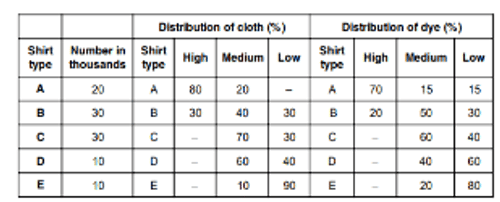

Question 66:
The sum of four consecutive two-digit odd numbers, when divided by 10, becomes a perfect square. Which of the following can possibly be one of these four numbers?
View Solution
Step 1: Understanding the Concept:
This is a number theory problem involving properties of integers, arithmetic progressions, and perfect squares. We need to set up an algebraic expression representing the given conditions and find possible values that satisfy them.
Step 2: Key Formula or Approach:
1. Represent four consecutive two-digit odd numbers algebraically. Let the first number be \( n \). Since they are consecutive odd numbers, the sequence is \( n, n+2, n+4, n+6 \).
2. Formulate the sum \( S \) of these numbers.
3. Set up the equation based on the condition that \( S/10 \) is a perfect square.
4. Solve for possible values of \( n \), keeping in mind that \( n \) must be a two-digit odd number.
5. Check which of the options can be one of the numbers in the resulting sequence(s).
Step 3: Detailed Calculation:
Let the four consecutive two-digit odd numbers be \( n, n+2, n+4, n+6 \).
The sum of these numbers is: \[ S = n + (n+2) + (n+4) + (n+6) = 4n + 12 = 4(n+3) \]
According to the problem, \( S/10 \) is a perfect square. Let this perfect square be \( k^2 \). \[ \frac{S}{10} = \frac{4(n+3)}{10} = \frac{2(n+3)}{5} = k^2 \]
For \( k^2 \) to be an integer, \( 2(n+3) \) must be divisible by 5. Since 2 is not divisible by 5, \( (n+3) \) must be a multiple of 5.
Also, for \( \frac{2(n+3)}{5} \) to be a perfect square, let's analyze its structure. Let \( n+3 = 5m \). \[ \frac{2(5m)}{5} = 2m = k^2 \]
For \( 2m \) to be a perfect square, \( m \) must contain a factor of 2 and any other factors must be perfect squares. So, \( m \) must be of the form \( 2j^2 \) for some integer \( j \).
Substituting back: \[ n+3 = 5m = 5(2j^2) = 10j^2 \] \[ n = 10j^2 - 3 \]
We know that \( n \) is a two-digit odd number, so \( 10 \le n \le 99 \).
Let's test values for \( j \):
If \( j = 1 \), \( n = 10(1)^2 - 3 = 7 \). This is not a two-digit number.
If \( j = 2 \), \( n = 10(2)^2 - 3 = 40 - 3 = 37 \). This is a two-digit odd number. The four numbers are 37, 39, 41, 43. Let's check the condition: Sum = 160. \( 160/10 = 16 = 4^2 \). This is a valid set.
If \( j = 3 \), \( n = 10(3)^2 - 3 = 90 - 3 = 87 \). This is a two-digit odd number. The four numbers are 87, 89, 91, 93. Let's check the condition: Sum = 360. \( 360/10 = 36 = 6^2 \). This is also a valid set.
If \( j = 4 \), \( n = 10(4)^2 - 3 = 160 - 3 = 157 \). This is not a two-digit number.
So, the possible sets of four numbers are \{37, 39, 41, 43\ and \{87, 89, 91, 93\.
Now we check the options to see which number appears in either of these sets.
The number 41 is in the first set.
Step 4: Final Answer:
A possible number from the list is 41.
Quick Tip: When a problem states that an expression is a perfect square, look for the prime factors. For an expression like \( \frac{2(n+3)}{5} \) to be a square, the numerator \( 2(n+3) \) must contain a factor of 5, and the resulting expression \( 2m \) must have all its prime factors raised to even powers.
The number of solutions of the equation 2x + y = 40 where both x and y are positive integers and x \( \le \) y is:
View Solution
Step 1: Understanding the Concept:
This problem asks for the number of integer solutions to a linear Diophantine equation with additional constraints. We need to find pairs of positive integers \( (x, y) \) that satisfy both the equation and the inequality.
Step 2: Key Formula or Approach:
1. Isolate one variable in the equation. It's usually easier to isolate the variable with the smaller coefficient, but here isolating \( y \) is straightforward.
2. Substitute the expression for the isolated variable into the inequality.
3. Solve the inequality for the remaining variable.
4. Use the constraints (positive integers) to determine the range of possible integer values for that variable.
5. The number of possible integer values for the first variable will give the number of solutions, as each value uniquely determines the other variable.
Step 3: Detailed Calculation:
We are given the equation and constraints:
1. \( 2x + y = 40 \)
2. \( x, y \) are positive integers (\( x \ge 1, y \ge 1 \))
3. \( x \le y \)
From the equation, let's express \( y \) in terms of \( x \): \[ y = 40 - 2x \]
Now, substitute this expression for \( y \) into the inequality \( x \le y \): \[ x \le 40 - 2x \]
Add \( 2x \) to both sides: \[ 3x \le 40 \]
Divide by 3: \[ x \le \frac{40}{3} \] \[ x \le 13.33... \]
Since \( x \) must be a positive integer, the possible values for \( x \) are \( \{1, 2, 3, \dots, 13\} \).
We also need to ensure that \( y \) is a positive integer.
The condition \( y \ge 1 \) means: \[ 40 - 2x \ge 1 \] \[ 39 \ge 2x \] \[ 19.5 \ge x \]
The range we found for \( x \) (\( 1 \le x \le 13 \)) already satisfies the condition \( x \le 19.5 \). For every integer value of \( x \) from 1 to 13, \( y = 40 - 2x \) will be a positive integer, and the condition \( x \le y \) will be satisfied.
The number of possible integer values for \( x \) is 13. Each value of \( x \) gives a unique solution pair \( (x, y) \).
Therefore, there are 13 solutions.
Step 4: Final Answer:
The number of solutions is 13.
Quick Tip: For Diophantine equations with inequalities, after finding the possible range for one variable, always double-check that this range also satisfies the other constraints of the problem (like the other variable being positive).
The number of employees in Obelix Menhir Co. is a prime number and is less than 300. The ratio of the number of employees who are graduates and above, to that of employees who are not, can possibly be:
View Solution
Step 1: Understanding the Concept:
This problem combines concepts of ratios and number theory. The total number of employees must correspond to the sum of the parts of the ratio of two subgroups of employees. This total number must also satisfy the condition of being a prime number less than 300.
Step 2: Key Formula or Approach:
1. Let the ratio of graduates (G) to non-graduates (N) be \( a : b \).
2. The total number of employees, \( T \), is the sum of these two groups, so \( T = G + N \).
3. Since G and N are in the ratio \( a:b \), the total number of employees must be a multiple of \( (a+b) \). That is, \( T = k(a+b) \) for some positive integer \( k \).
4. We are given that \( T \) is a prime number. The only positive integer divisors of a prime number are 1 and itself.
5. Therefore, either \( k=1 \) and \( T = a+b \), or \( a+b=1 \) (which is impossible since a and b are positive).
6. So, the sum of the parts of the ratio, \( a+b \), must itself be a prime number less than 300.
7. We need to check each option by summing the two parts of the ratio and testing if the sum is a prime number less than 300.
Step 3: Detailed Calculation:
Let's test each option:
(A) 101 : 88
Sum = \( 101 + 88 = 189 \).
189 is divisible by 3 (since \( 1+8+9=18 \), which is divisible by 3). So, 189 is not prime.
(B) 87 : 100
Sum = \( 87 + 100 = 187 \).
To check if 187 is prime, we can test divisibility by small primes. \( 187 = 11 \times 17 \). So, 187 is not prime.
(C) 110 : 111
Sum = \( 110 + 111 = 221 \).
To check if 221 is prime, \( 221 = 13 \times 17 \). So, 221 is not prime.
(D) 85 : 98
Sum = \( 85 + 98 = 183 \).
183 is divisible by 3 (since \( 1+8+3=12 \), which is divisible by 3). So, 183 is not prime.
(E) 97 : 84
Sum = \( 97 + 84 = 181 \).
To check if 181 is prime, we test divisibility by primes up to \( \sqrt{181} \approx 13.4 \). The primes to test are 2, 3, 5, 7, 11, 13.
- Not divisible by 2 (it's odd).
- Not divisible by 3 (sum of digits is 10).
- Not divisible by 5 (does not end in 0 or 5).
- \( 181 \div 7 = 25 \) remainder 6.
- \( 181 \div 11 = 16 \) remainder 5.
- \( 181 \div 13 = 13 \) remainder 12.
Since 181 is not divisible by any prime number less than or equal to its square root, 181 is a prime number. It is also less than 300. This is a possible total number of employees.
Step 4: Final Answer:
The ratio 97 : 84 is the only one whose sum (181) is a prime number less than 300.
Quick Tip: When the total of a population is a prime number, and that population is divided into groups based on a ratio, the sum of the parts of the ratio must equal the prime number itself. This is a very useful shortcut.
There are 6 tasks and 6 persons. Task 1 cannot be assigned either to person 1 or to person 2; task 2 must be assigned to either person 3 or person 4. Every person is to be assigned one task. In how many ways can the assignment be done?
View Solution
Step 1: Understanding the Concept:
This is a problem of permutations with restrictions. We need to find the number of ways to create a one-to-one assignment (a bijection) between a set of tasks and a set of people, subject to certain constraints.
Step 2: Key Formula or Approach:
The fundamental principle of counting is the key. We should handle the most restricted assignments first to simplify the problem.
1. Identify the tasks and people with the most constraints (Task 1 and Task 2).
2. Break down the assignment process step-by-step, starting with the most restricted choices.
3. Calculate the number of options available at each step, ensuring the constraints are met.
4. Multiply the number of options at each step to get the total number of ways.
We can use a case-based approach or a direct multiplication approach if the choices are independent.
Step 3: Detailed Calculation:
Let the tasks be \( \{T_1, T_2, T_3, T_4, T_5, T_6\} \) and the persons be \( \{P_1, P_2, P_3, P_4, P_5, P_6\} \).
The restrictions are:
\( T_1 \) cannot be assigned to \( P_1 \) or \( P_2 \).
\( T_2 \) must be assigned to \( P_3 \) or \( P_4 \).
Let's make the assignments in an order that respects the constraints. It's best to assign \( T_2 \) first as it has the fewest options.
Step 1: Assign Task 2
\( T_2 \) can be assigned to either \( P_3 \) or \( P_4 \). This gives us 2 choices.
Step 2: Assign Task 1
Now, let's assign \( T_1 \). \( T_1 \) cannot be assigned to \( P_1 \) or \( P_2 \).
Also, one person (\( P_3 \) or \( P_4 \)) is already assigned \( T_2 \).
So, out of the 6 persons, \( P_1 \), \( P_2 \), and the person assigned \( T_2 \) are unavailable for \( T_1 \).
This leaves \( 6 - 3 = 3 \) available persons for \( T_1 \).
So there are 3 choices for \( T_1 \).
Step 3: Assign the Remaining Tasks
After assigning \( T_1 \) and \( T_2 \), two persons have been assigned tasks.
There are \( 6 - 2 = 4 \) tasks remaining (\( T_3, T_4, T_5, T_6 \)).
There are \( 6 - 2 = 4 \) persons remaining.
These 4 tasks can be assigned to the remaining 4 persons in \( 4! \) ways. \( 4! = 4 \times 3 \times 2 \times 1 = 24 \) ways.
Step 4: Total Number of Ways
Using the multiplication principle, the total number of ways to make the assignment is the product of the number of choices at each step: \[ Total Ways = (Choices for T_2) \times (Choices for T_1) \times (Ways for remaining tasks) \] \[ Total Ways = 2 \times 3 \times 4! \] \[ Total Ways = 2 \times 3 \times 24 = 6 \times 24 = 144 \]
Step 5: Final Answer:
The assignment can be done in 144 ways.
Quick Tip: In permutation problems with restrictions, always start by considering the elements (people or objects) with the tightest constraints. This often simplifies the counting process for the subsequent steps.
If \( \log_y x = (a \cdot \log_z y) = (b \cdot \log_x z) = ab \), then which of the following pairs of values for (a, b) is not possible?
View Solution
Step 1: Understanding the Concept:
This problem involves a system of equations with logarithms. We need to manipulate these equations using logarithm properties to find a relationship between the variables \(a\) and \(b\). Then, we will test the given pairs of values against this relationship.
Step 2: Key Formula or Approach:
We can break down the given equality into a system of three equations. Assume \(a, b \neq 0\).
1. \( a \cdot \log_z y = ab \implies \log_z y = b \)
2. \( b \cdot \log_x z = ab \implies \log_x z = a \)
3. \( \log_y x = ab \)
We will use the definition of logarithm (\( \log_m n = p \iff m^p = n \)) and the change of base formula (\( \log_b a = \frac{\log_c a}{\log_c b} \)) to find a condition on \(a\) and \(b\).
Step 3: Detailed Calculation:
From the equations derived in Step 2:
From \( \log_z y = b \), we get \( y = z^b \).
From \( \log_x z = a \), we get \( z = x^a \).
Now, substitute the expression for \(z\) into the expression for \(y\): \[ y = (x^a)^b = x^{ab} \]
We have found a relationship between \(x\) and \(y\). Now, substitute this into the third equation, \( \log_y x = ab \): \[ \log_{x^{ab}} x = ab \]
Using the logarithm property \( \log_{m^k} n = \frac{1}{k} \log_m n \): \[ \frac{1}{ab} \log_x x = ab \]
Since \( \log_x x = 1 \): \[ \frac{1}{ab} = ab \] \[ 1 = (ab)^2 \]
This implies that \( ab = 1 \) or \( ab = -1 \).
The condition for a pair \( (a, b) \) to be possible is that their product must be either 1 or -1. Let's check the given options:
(A) \( a \cdot b = -2 \times \frac{1}{2} = -1 \). This is possible.
(B) \( a \cdot b = 1 \times 1 = 1 \). This is possible.
(C) \( a \cdot b = 0.4 \times 2.5 = 1 \). This is possible.
(D) \( a \cdot b = \pi \times \frac{1}{\pi} = 1 \). This is possible.
(E) \( a \cdot b = 2 \times 2 = 4 \). This is not equal to 1 or -1.
Step 4: Final Answer:
The pair of values \( (a, b) = (2, 2) \) is not possible because the product \(ab = 4\), which violates the derived condition \(ab = \pm 1\).
Quick Tip: When faced with a chain of equalities involving logarithms, break it into separate equations. Use substitution and logarithm rules to eliminate variables and find a relationship between the remaining parameters.
What are the values of x and y that satisfy both the equations?
\( 2^{0.7x} \cdot 3^{-1.25y} = \frac{8\sqrt{6}}{27} \)
\( 4^{0.3x} \cdot 9^{0.2y} = 8 \cdot (81)^{\frac{1}{5}} \)
View Solution
Step 1: Understanding the Concept:
This problem involves solving a system of two equations with two variables, where the variables appear in the exponents. The strategy is to simplify each equation by expressing all numbers as powers of the same prime bases (in this case, 2 and 3).
Step 2: Key Formula or Approach:
1. Express all constants in both equations as powers of their prime factors (2 and 3).
2. Use exponent rules (\( (a^m)^n = a^{mn} \) and \( a^m \cdot a^n = a^{m+n} \)) to simplify both sides of each equation.
3. For an equation of the form \( 2^A \cdot 3^B = 2^C \cdot 3^D \), we can equate the exponents of the same bases: \( A=C \) and \( B=D \).
4. This will give a system of linear equations in \(x\) and \(y\), which can be solved.
Step 3: Detailed Calculation:
Equation 1: \( 2^{0.7x} \cdot 3^{-1.25y} = \frac{8\sqrt{6}}{27} \)
Simplify the right-hand side (RHS): \[ \frac{8\sqrt{6}}{27} = \frac{2^3 \cdot (2 \cdot 3)^{1/2}}{3^3} = \frac{2^3 \cdot 2^{0.5} \cdot 3^{0.5}}{3^3} = 2^{3.5} \cdot 3^{0.5-3} = 2^{3.5} \cdot 3^{-2.5} \]
So, the first equation is: \[ 2^{0.7x} \cdot 3^{-1.25y} = 2^{3.5} \cdot 3^{-2.5} \]
Equating the exponents: \[ 0.7x = 3.5 \implies x = \frac{3.5}{0.7} = 5 \] \[ -1.25y = -2.5 \implies y = \frac{-2.5}{-1.25} = 2 \]
From the first equation, we get the solution \( (x, y) = (5, 2) \).
Equation 2: \( 4^{0.3x} \cdot 9^{0.2y} = 8 \cdot (81)^{\frac{1}{5}} \)
Simplify both sides:
LHS: \( (2^2)^{0.3x} \cdot (3^2)^{0.2y} = 2^{0.6x} \cdot 3^{0.4y} \)
RHS: \( 2^3 \cdot (3^4)^{\frac{1}{5}} = 2^3 \cdot 3^{\frac{4}{5}} = 2^3 \cdot 3^{0.8} \)
So, the second equation is: \[ 2^{0.6x} \cdot 3^{0.4y} = 2^3 \cdot 3^{0.8} \]
Equating the exponents: \[ 0.6x = 3 \implies x = \frac{3}{0.6} = 5 \] \[ 0.4y = 0.8 \implies y = \frac{0.8}{0.4} = 2 \]
The second equation also yields the solution \( (x, y) = (5, 2) \).
Step 4: Final Answer:
Both equations are satisfied by \( x = 5 \) and \( y = 2 \). This corresponds to option (E).
Quick Tip: In systems of exponential equations, converting everything to prime bases is the most reliable first step. If you get a potential solution from one equation, you can save time by plugging it into the second equation to verify, rather than solving the second one from scratch.
Let f(x) = max(2x + 1, 3 - 4x), where x is any real number. Then the minimum possible value of f(x) is:
View Solution
Step 1: Understanding the Concept:
The function \( f(x) \) is defined as the maximum of two linear functions, \( g(x) = 2x + 1 \) and \( h(x) = 3 - 4x \). One function has a positive slope (increasing) and the other has a negative slope (decreasing). The graph of \( f(x) \) will be a V-shape opening upwards. The minimum value of \( f(x) \) will occur at the vertex of this V-shape, which is the point where the two lines intersect.
Step 2: Key Formula or Approach:
To find the minimum value of \( \max(g(x), h(x)) \) where \(g(x)\) is increasing and \(h(x)\) is decreasing, we need to find the value of \(x\) where \( g(x) = h(x) \). The minimum value of the function will be the value of \(g(x)\) (or \(h(x)\)) at this intersection point.
Step 3: Detailed Calculation:
Set the two expressions equal to find the point of intersection: \[ 2x + 1 = 3 - 4x \]
Now, solve for \(x\): \[ 2x + 4x = 3 - 1 \] \[ 6x = 2 \] \[ x = \frac{2}{6} = \frac{1}{3} \]
The minimum value of \( f(x) \) occurs at \( x = \frac{1}{3} \). To find this value, substitute \( x = \frac{1}{3} \) into either of the original expressions:
Using \( 2x + 1 \): \[ f\left(\frac{1}{3}\right) = 2\left(\frac{1}{3}\right) + 1 = \frac{2}{3} + 1 = \frac{2}{3} + \frac{3}{3} = \frac{5}{3} \]
Using \( 3 - 4x \): \[ f\left(\frac{1}{3}\right) = 3 - 4\left(\frac{1}{3}\right) = 3 - \frac{4}{3} = \frac{9}{3} - \frac{4}{3} = \frac{5}{3} \]
Both calculations give the same result.
Step 4: Final Answer:
The minimum possible value of \( f(x) \) is \( \frac{5}{3} \).
Quick Tip: The minimum of \( \max(ax+b, cx+d) \) or the maximum of \( \min(ax+b, cx+d) \) will always occur at the intersection point, found by setting \( ax+b = cx+d \).
When you reverse the digits of the number 13, the number increases by 18. How many other two-digit numbers increase by 18 when their digits are reversed?
View Solution
Step 1: Understanding the Concept:
This problem involves representing a two-digit number algebraically and setting up an equation based on the condition that reversing its digits increases its value by 18.
Step 2: Key Formula or Approach:
1. Let the two-digit number be represented as \( 10t + u \), where \( t \) is the tens digit and \( u \) is the units digit. The constraints are \( t \in \{1, 2, \dots, 9\} \) and \( u \in \{0, 1, \dots, 9\} \).
2. The number with reversed digits is \( 10u + t \).
3. The condition is that the reversed number is 18 more than the original number: \( (10u + t) - (10t + u) = 18 \).
4. Solve this equation to find a relationship between \( t \) and \( u \).
5. Count the number of possible pairs \( (t, u) \) that satisfy this relationship and the digit constraints.
6. Since the question asks for "other" numbers, we must exclude the number 13 from our final count.
Step 3: Detailed Calculation:
Set up the equation as described above: \[ (10u + t) - (10t + u) = 18 \] \[ 9u - 9t = 18 \]
Divide by 9: \[ u - t = 2 \]
This means the units digit must be 2 more than the tens digit. We need to find all pairs of digits \( (t, u) \) that satisfy this, keeping in mind the constraints on \(t\) and \(u\).
If \( t=1 \), \( u = 1+2 = 3 \). Number: 13. (This is the example given).
If \( t=2 \), \( u = 2+2 = 4 \). Number: 24.
If \( t=3 \), \( u = 3+2 = 5 \). Number: 35.
If \( t=4 \), \( u = 4+2 = 6 \). Number: 46.
If \( t=5 \), \( u = 5+2 = 7 \). Number: 57.
If \( t=6 \), \( u = 6+2 = 8 \). Number: 68.
If \( t=7 \), \( u = 7+2 = 9 \). Number: 79.
If \( t=8 \), \( u = 8+2 = 10 \). This is not possible as \(u\) must be a single digit.
There are a total of 7 such numbers: 13, 24, 35, 46, 57, 68, 79.
The question asks for the number of "other" two-digit numbers, which means we must exclude the number 13.
Number of other numbers = Total numbers - 1 = \( 7 - 1 = 6 \).
Step 4: Final Answer:
There are 6 other two-digit numbers that increase by 18 when their digits are reversed.
Quick Tip: The difference between a two-digit number and its reverse is always a multiple of 9. Specifically, \( (10u+t) - (10t+u) = 9(u-t) \). This can be a useful shortcut.
An equilateral triangle BPC is drawn inside a square ABCD. What is the value of the angle APD in degrees?
View Solution
Step 1: Understanding the Concept:
This is a geometry problem that involves finding angles in a figure composed of a square and an equilateral triangle. We will use the properties of these shapes (side lengths and angles) and the properties of isosceles triangles to find the required angle.
Step 2: Key Formula or Approach:
1. Let the side length of the square be \(s\).
2. Use the properties of a square: all sides are equal (\(s\)), and all angles are \(90^\circ\).
3. Use the properties of an equilateral triangle: all sides are equal (\(s\)), and all angles are \(60^\circ\).
4. Analyze the triangles formed within the square (e.g., \(\triangle ABP\)) to find their angles.
5. Finally, use the angles found to determine the angles in \(\triangle APD\) and calculate \( \angle APD \).
Step 3: Detailed Calculation:
Let the side length of the square ABCD be \(s\). So, \( AB = BC = CD = DA = s \).
Since \(\triangle BPC\) is equilateral and shares side BC with the square, all its sides are also of length \(s\). So, \( BP = PC = BC = s \).
All angles in \(\triangle BPC\) are \(60^\circ\). So, \( \angle PBC = \angle BCP = 60^\circ \).
Consider \(\triangle ABP\):
Side \( AB = s \) (side of square).
Side \( BP = s \) (side of equilateral triangle).
Since \( AB = BP \), \(\triangle ABP\) is an isosceles triangle.
The angle \( \angle ABC = 90^\circ \).
\( \angle ABP = \angle ABC - \angle PBC = 90^\circ - 60^\circ = 30^\circ \).
The base angles of isosceles \(\triangle ABP\) are equal: \( \angle BAP = \angle BPA \).
\( \angle BAP = \angle BPA = \frac{180^\circ - 30^\circ}{2} = \frac{150^\circ}{2} = 75^\circ \).
Consider \(\triangle DCP\):
By symmetry, \(\triangle DCP\) is congruent to \(\triangle ABP\).
Side \( DC = s \) and side \( PC = s \), so it is an isosceles triangle.
\( \angle DCB = 90^\circ \).
\( \angle DCP = \angle DCB - \angle BCP = 90^\circ - 60^\circ = 30^\circ \).
The base angles are equal: \( \angle CDP = \angle CPD = \frac{180^\circ - 30^\circ}{2} = 75^\circ \).
Now, consider \(\triangle APD\):
The angle of the square \( \angle DAB = 90^\circ \).
We can find \( \angle DAP \): \( \angle DAP = \angle DAB - \angle BAP = 90^\circ - 75^\circ = 15^\circ \).
The angle of the square \( \angle CDA = 90^\circ \).
We can find \( \angle ADP \): \( \angle ADP = \angle CDA - \angle CDP = 90^\circ - 75^\circ = 15^\circ \).
The sum of angles in \(\triangle APD\) is \(180^\circ\).
\( \angle APD = 180^\circ - (\angle DAP + \angle ADP) = 180^\circ - (15^\circ + 15^\circ) = 180^\circ - 30^\circ = 150^\circ \).
Step 4: Final Answer:
The value of the angle APD is \( 150^\circ \).
Quick Tip: In complex geometric figures, look for isosceles triangles. They are often hidden and are key to finding unknown angles because their base angles are equal.
Arun, Barun and Kiranmala start from the same place and travel in the same direction at speeds of 30, 40 and 60 km per hour respectively. Barun starts two hours after Arun. If Barun and Kiranmala overtake Arun at the same instant, how many hours after Arun did Kiranmala start?
View Solution
Step 1: Understanding the Concept:
This is a relative motion problem involving three bodies moving in the same direction. The key concept is that when one body overtakes another, they have traveled the same distance from the starting point. We need to solve this problem in two parts.
Step 2: Key Formula or Approach:
1. Let \( t=0 \) be the time Arun starts.
2. First, determine the time when Barun overtakes Arun. Let this time be \(t_{catch}\). At this time, the distance covered by both is equal.
- Distance = Speed \( \times \) Time.
- Arun's travel time = \( t_{catch} \).
- Barun's travel time = \( t_{catch} - 2 \) (since he starts 2 hours later).
3. The problem states that Kiranmala overtakes Arun at the same instant, \( t_{catch} \).
4. Let \( T \) be the number of hours after Arun that Kiranmala starts.
5. Set up a second distance equality for Kiranmala overtaking Arun at time \( t_{catch} \) and solve for \( T \).
- Kiranmala's travel time = \( t_{catch} - T \).
Step 3: Detailed Calculation:
Part 1: Find the time when Barun overtakes Arun
Let \( t \) be the number of hours after Arun starts.
Distance covered by Arun in time \( t \): \( D_A = 30t \)
Distance covered by Barun in time \( t \): \( D_B = 40(t-2) \) (since Barun travels for \(t-2\) hours)
When Barun overtakes Arun, their distances are equal: \( D_A = D_B \) \[ 30t = 40(t-2) \] \[ 30t = 40t - 80 \] \[ 10t = 80 \] \[ t = 8 hours \]
So, Barun and Kiranmala overtake Arun 8 hours after Arun started.
Part 2: Find when Kiranmala started
Let Kiranmala start \( T \) hours after Arun.
At the overtaking time \( t=8 \) hours, the distance covered by Arun is: \[ D_A = 30 \times 8 = 240 km \]
The distance covered by Kiranmala at time \( t=8 \) is: \[ D_K = 60(8-T) \] (since Kiranmala travels for \(8-T\) hours)
When Kiranmala overtakes Arun, their distances are equal: \( D_K = D_A \) \[ 60(8-T) = 240 \] \[ 8 - T = \frac{240}{60} \] \[ 8 - T = 4 \] \[ T = 8 - 4 = 4 hours \]
Step 4: Final Answer:
Kiranmala started 4 hours after Arun.
Quick Tip: In chase problems, setting the distances equal is a robust method. Alternatively, you can use the concept of relative speed. The time to catch is the initial distance between them divided by the difference in their speeds (relative speed).
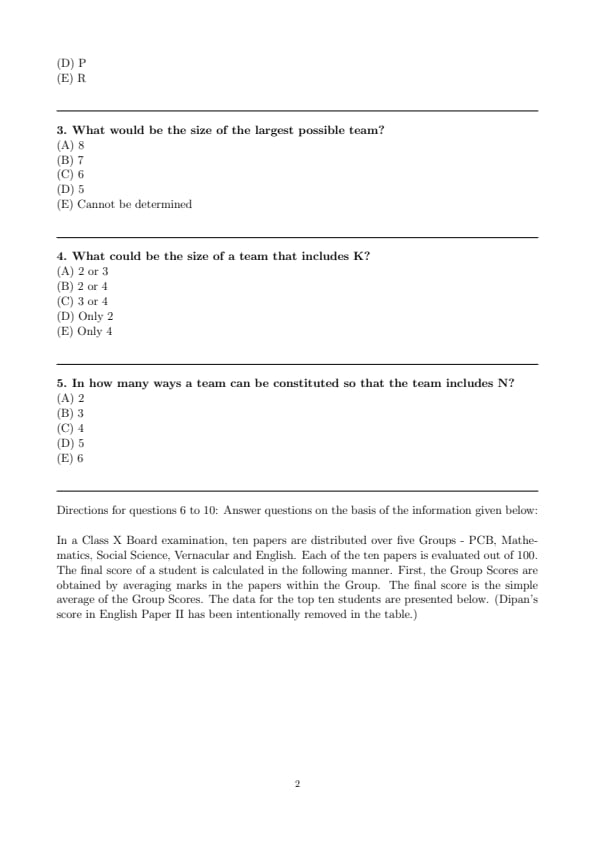
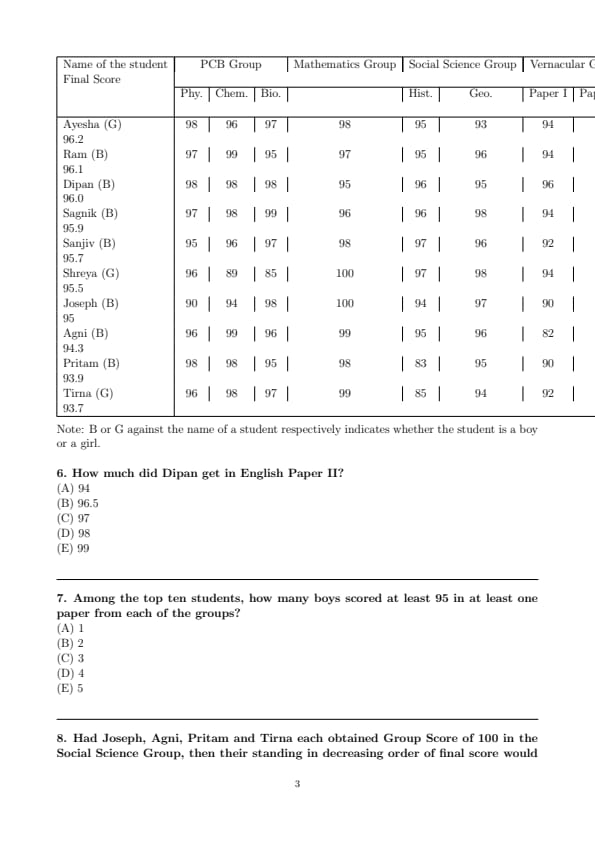
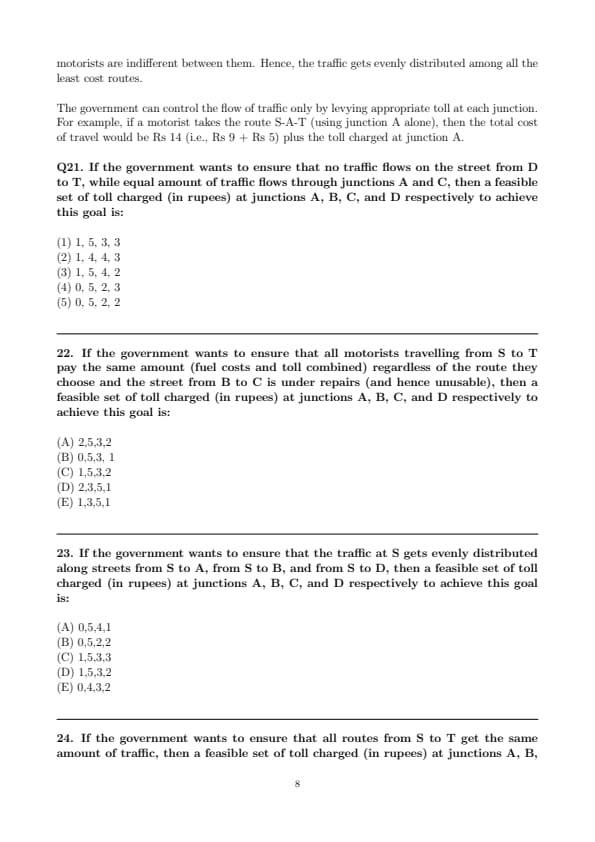
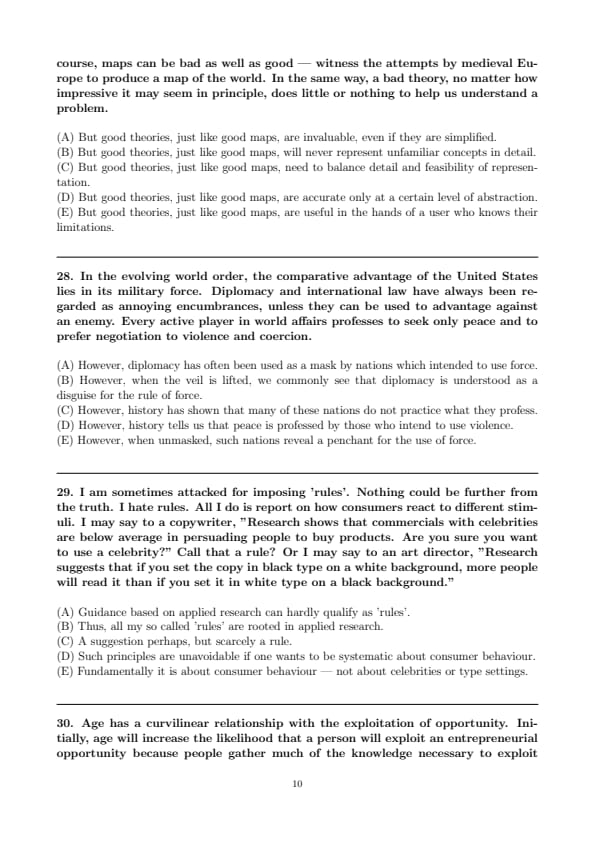
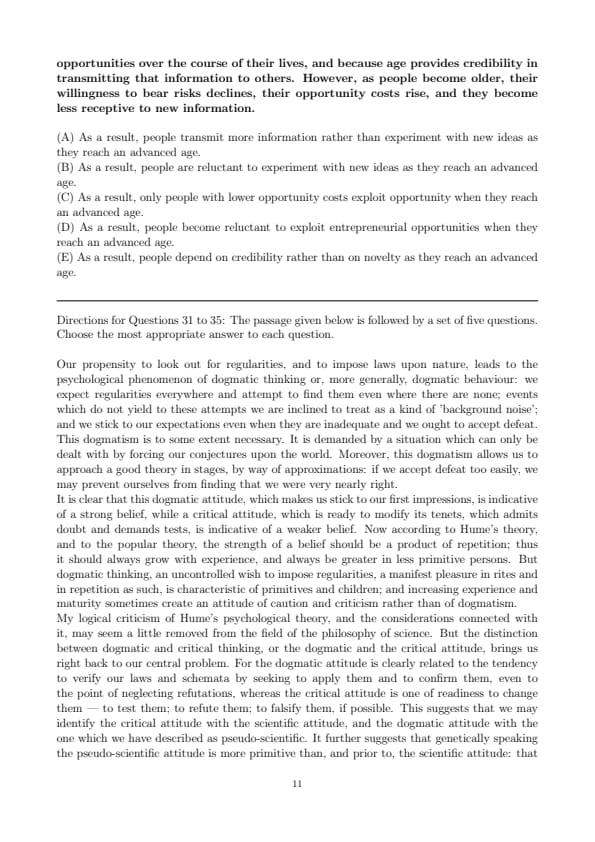
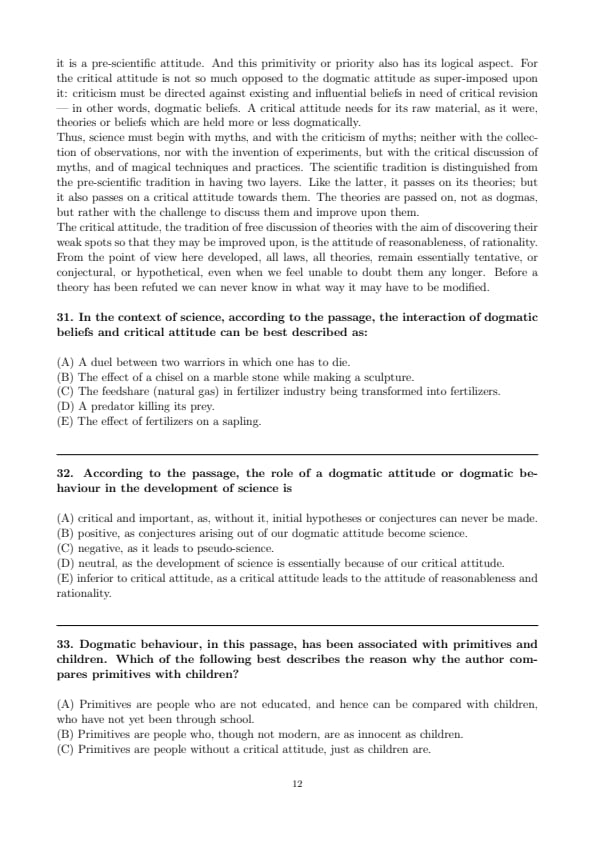
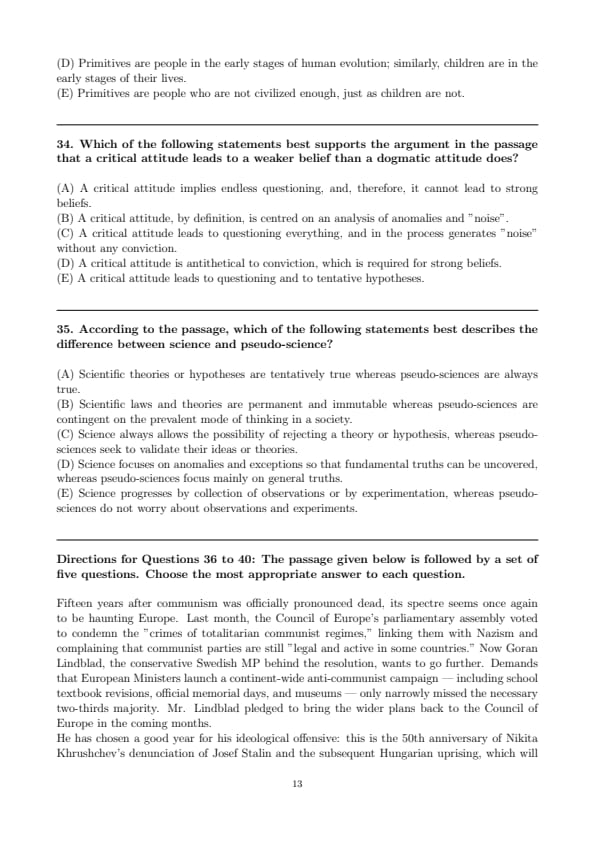
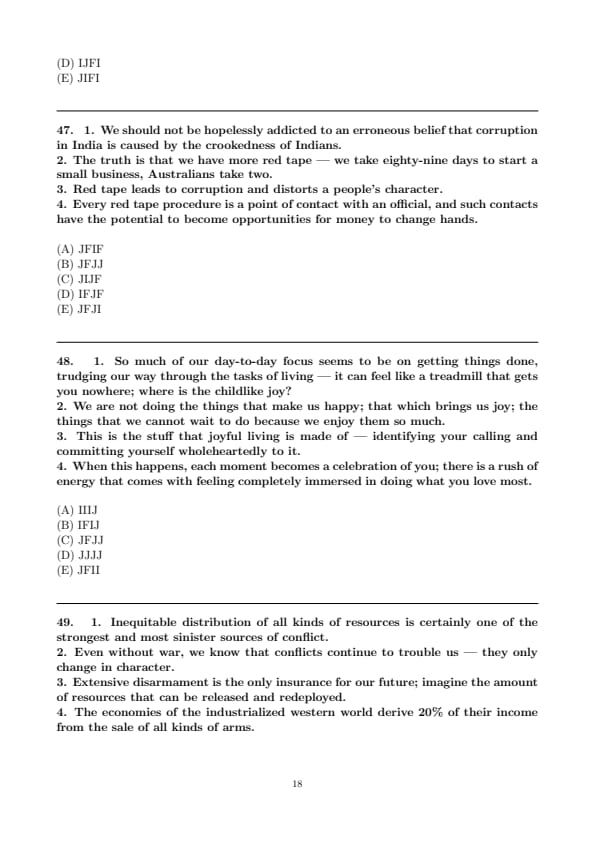
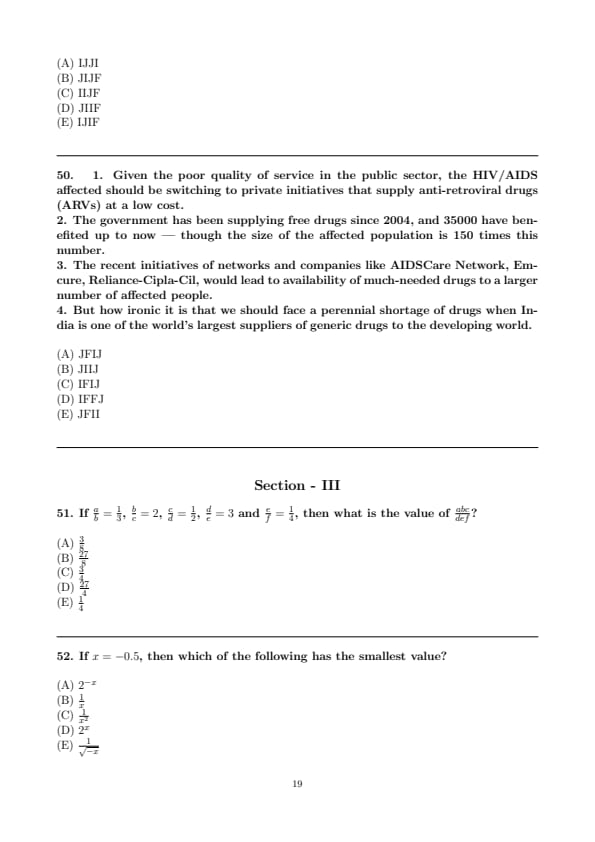
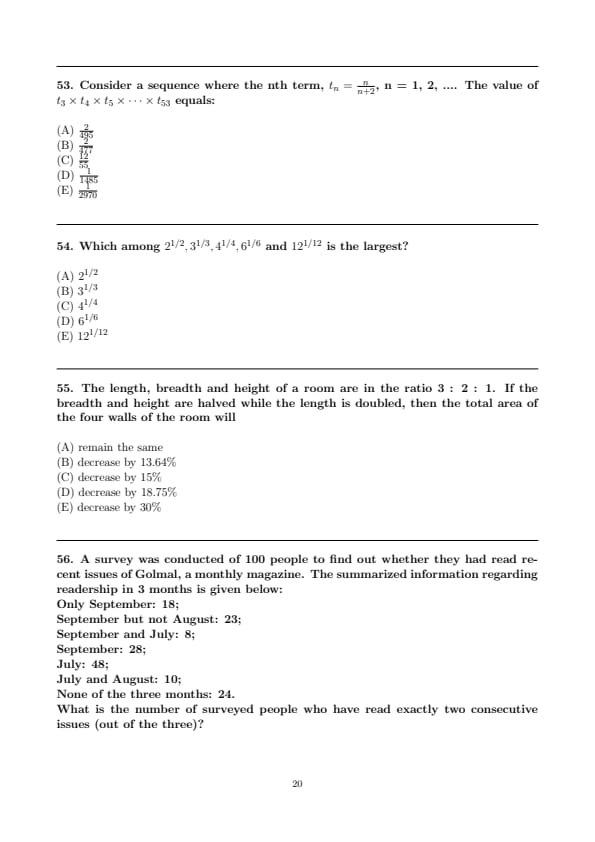
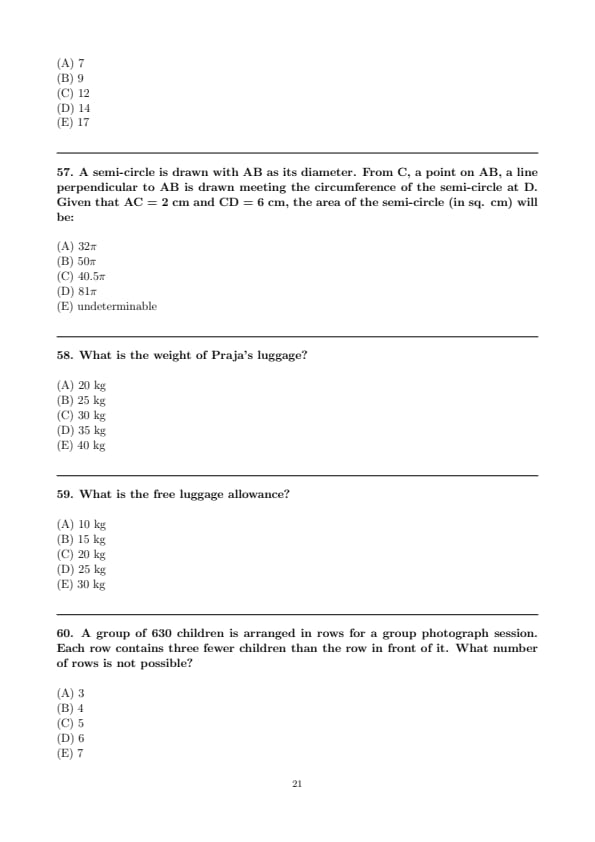
*The article might have information for the previous academic years, please refer the official website of the exam.