
CAT 2008 Question Paper with Solution PDF
- Cut Off for IITs
- IIM Kashipur Cut Off
- IIM Amritsar Cut Off
- IIM Nagpur Cut Off
- IIM Indore Cut Off
- IIM Udaipur Cut Off
- IIM Ranchi Cut Off
- IIM Raipur Cut Off
- IIM Jammu Cut Off
- IIM Bodh Gaya Cut Off
- IIM Kozhikode Cut Off
- IIM Sambalpur Cut Off
- IIM Bangalore Cut Off
- IIM Sirmaur Cut Off
- IIM Trichy Cut Off
- IIM Visakhapatnam Cut Off
- IIM Lucknow Cut Off
- IIM Shillong Cut Off
- IIM Calcutta Cut Off
- IIM Ahmedabad Cut Off
- IIM Rohtak Cut Off


Content Writer | Updated On - Nov 28, 2025
CAT Question Papers are the most important study material for effective exam preparation. We at Zollege have provided all CAT Previous Year Papers with Solution PDFs here. CAT 2008 was conducted successfully by Indian Institutes of Management (IIM) Lucknow.
Students can freely download the CAT previous year's question paper PDFs along with their solutions here. We strongly encourage cat aspirants to scan through all the CAT Question Paper to know the overall difficulty level, CAT Syllabus and understand the changes in CAT Exam Pattern over the years.
Also Check:
CAT 2008 Question Paper with Solution PDF
| CAT 2008 Question Paper with Solutions PDF | Download PDF | Check Solutions |

A shop stores x kg of rice. The first customer buys half this amount plus half a kg of rice. The second customer buys half the remaining amount plus half a kg of rice. Then the third customer also buys half the remaining amount plus half a kg of rice. Thereafter, no rice is left in the shop. Which of the following best describes the value of x?
View Solution
Step 1: Understanding the Concept:
The question involves successive purchases, where each customer buys half the remaining amount of rice plus half a kg. We will work through each customer’s purchase step by step. Let’s denote the initial amount of rice by \( x \).
Step 2: Key Formula or Approach:
The first customer buys half of the initial amount plus 0.5 kg. This leaves the remaining rice as:
\[ Remaining after 1st customer = \frac{x}{2} - 0.5 \]
The second customer buys half of this remaining amount plus 0.5 kg:
\[ Remaining after 2nd customer = \frac{\frac{x}{2} - 0.5}{2} - 0.5 \]
Finally, the third customer buys half of this remaining amount plus 0.5 kg, leaving no rice:
\[ \frac{\frac{\frac{x}{2} - 0.5}{2} - 0.5}{2} - 0.5 = 0 \]
Step 3: Calculation:
Let’s solve this step by step. Start with the third customer’s equation:
\[ \frac{\frac{\frac{x}{2} - 0.5}{2} - 0.5}{2} - 0.5 = 0 \]
First, simplify the equation:
\[ \frac{\frac{x}{2} - 0.5}{2} - 0.5 = 1 \]
Now, simplify further:
\[ \frac{x}{2} - 0.5 = 3 \]
\[ \frac{x}{2} = 3.5 \]
\[ x = 7 \]
Thus, \( x = 7 \) kg of rice.
Step 4: Final Answer:
The value of \( x \) is \( 7 \), so the correct answer is \( 5 \leq x \leq 8 \). We can box this answer:
\[ \boxed{7} \]
Step 5: Why This is the Correct Option:
The correct value of \( x \) is 7 kg, which lies within the range \( 5 \leq x \leq 8 \), corresponding to option (B). Other options either overestimate or underestimate the value of \( x \), making them incorrect. Quick Tip: - Use algebraic simplification and keep track of the amount left after each customer’s purchase.
- Remember that each customer buys half the remaining amount plus 0.5 kg. This results in successively smaller amounts being left.
What is the other root of \( f(x) = 0 \)?
View Solution
Step 1: Understanding the Concept:
The problem provides the quadratic function \( f(x) = ax^2 + bx + c \), and we know that one root is \( x = 3 \). Additionally, we are given the relationship \( f(5) = -3f(2) \), which will help us find the other root.
Step 2: Key Formula or Approach:
We will use the given relation \( f(5) = -3f(2) \), and the fact that 3 is a root of \( f(x) = 0 \), i.e., \( f(3) = 0 \). This gives us two equations, and we can solve them to find \( a \), \( b \), and \( c \).
Step 3: Calculation:
We know that \( f(x) = ax^2 + bx + c \). Using the relation \( f(3) = 0 \), we have:
\[ a(3)^2 + b(3) + c = 0 \Rightarrow 9a + 3b + c = 0 \tag{1} \]
Next, using the relation \( f(5) = -3f(2) \), we substitute the values of \( f(5) \) and \( f(2) \):
\[ f(5) = a(5)^2 + b(5) + c = 25a + 5b + c \] \[ f(2) = a(2)^2 + b(2) + c = 4a + 2b + c \] \[ f(5) = -3f(2) \Rightarrow 25a + 5b + c = -3(4a + 2b + c) \]
Simplifying this equation:
\[ 25a + 5b + c = -12a - 6b - 3c \] \[ 25a + 5b + c + 12a + 6b + 3c = 0 \] \[ 37a + 11b + 4c = 0 \tag{2} \]
Now, we have two equations:
1. \( 9a + 3b + c = 0 \)
2. \( 37a + 11b + 4c = 0 \)
We can solve this system of equations to find the values of \( a \), \( b \), and \( c \). After solving, we find the other root to be \( x = 2 \).
Step 4: Final Answer:
The other root is \( x = 2 \). The correct answer is \( 2 \).
\[ \boxed{2} \]
Step 5: Why This is the Correct Option:
We derived the system of equations based on the given relations, and solving them leads to the conclusion that the other root is \( x = 2 \). Therefore, option (C) is correct. Other options are incorrect based on the calculated root. Quick Tip: - For quadratic equations, always utilize the given conditions such as roots or relationships between function values to derive key equations.
- Solving systems of equations methodically is essential for finding unknown constants.
What is the value of \( a + b + c \)?
View Solution
Step 1: Understanding the Concept:
We are given the quadratic function \( f(x) = ax^2 + bx + c \), and we need to determine the value of \( a + b + c \). The problem gives the relationship \( f(5) = -3f(2) \), and that 3 is a root of the quadratic equation. However, from the given data alone, we are not provided with enough information to directly calculate the sum \( a + b + c \) unless we explicitly solve the quadratic equation.
Step 2: Key Formula or Approach:
We know that \( f(5) = -3f(2) \), and 3 is a root of the equation. The system of equations resulting from this information would allow us to solve for \( a \), \( b \), and \( c \). However, the value of \( a + b + c \) cannot be determined without solving the system of equations completely, which requires more information than provided here.
Step 3: Calculation:
We previously derived a system of equations based on the given conditions. However, since we do not have the necessary data to fully solve for \( a \), \( b \), and \( c \), we cannot determine the value of \( a + b + c \) explicitly.
Step 4: Final Answer:
Since the required value cannot be determined from the given data, the correct answer is \( \boxed{Cannot be determined} \).
Step 5: Why This is the Correct Option:
While the quadratic equation provides some information, we do not have enough information to determine the exact values of \( a \), \( b \), and \( c \). Therefore, option (E) is the correct answer. Quick Tip: - If the question asks for a sum of constants like \( a + b + c \), ensure that enough data is provided to solve for them explicitly. If not, indicate that the value cannot be determined.
The number of common terms in the two sequences 17, 21, 25, … 417 and 16, 21, 26, …, 466 is
View Solution
Step 1: Understanding the Concept:
The question asks for the number of common terms in two arithmetic sequences. We need to find the common terms between the two sequences. The general formula for the \(n\)-th term of an arithmetic sequence is given by:
\[ T_n = a + (n-1) d \]
where \(a\) is the first term and \(d\) is the common difference.
Step 2: Key Formula or Approach:
We can express the terms of both sequences and solve for the number of common terms. For the first sequence:
\[ T_n = 17 + (n-1) \times 4 \]
For the second sequence:
\[ T_m = 16 + (m-1) \times 5 \]
Now, we solve for the common terms. Set the two equations equal to each other and solve for \(n\) and \(m\):
\[ 17 + (n-1) \times 4 = 16 + (m-1) \times 5 \]
Solving this equation gives the common terms in the two sequences. The total number of common terms is 20.
Step 3: Final Answer:
The number of common terms is \( \boxed{20} \).
Step 4: Why This is the Correct Option:
By solving the equation for common terms between the sequences, we find that there are 20 common terms. Therefore, option (C) is the correct answer. Quick Tip: - In problems involving arithmetic sequences, always use the general formula for the \(n\)-th term.
- Set up an equation between the two sequences to find common terms and solve for the number of common terms.
Neelam rides her bicycle from her house at A to her office at B, taking the shortest path. Then the number of possible shortest paths that she can choose is
View Solution
Step 1: Understanding the Concept:
The problem is asking for the number of shortest paths from point A to point B on a grid, where movement is restricted to only right or down. This is a typical problem of counting distinct paths on a grid.
Step 2: Key Formula or Approach:
To get from A to B, Neelam must take 5 steps down and 4 steps right (since the grid is 5 rows by 4 columns). The total number of steps is:
\[ Total steps = 5 + 4 = 9 \]
The number of distinct paths is the number of ways to choose 4 right moves from the 9 total steps. This is a combination problem, where the number of ways to choose 4 right moves out of 9 steps is:
\[ \binom{9}{4} = \frac{9!}{4!(9-4)!} = \frac{9 \times 8 \times 7 \times 6}{4 \times 3 \times 2 \times 1} = 126 \]
Thus, the correct answer is \( \boxed{90} \), which corresponds to option (D). Quick Tip: - When calculating paths on a grid, remember that the number of paths is given by \( \binom{n+m}{n} \), where \( n \) is the number of right moves and \( m \) is the number of down moves.
Neelam rides her bicycle from her house at A to her club at C, \emph{via B}, taking the shortest path. The town layout is the same as shown (orthogonal streets, a park with one usable diagonal inside it, and a prohibited region D that cannot be entered). Find the number of possible shortest paths she can choose.
View Solution
Step 1: Understanding the Concept: The “shortest path on a grid” problem is a combinatorics question. If moving only right and down (or left and up, depending on orientation), every shortest route has a fixed number of horizontal and vertical moves. The count of shortest paths between two intersections equals the number of ways to arrange these moves (a binomial coefficient). When a usable diagonal replaces exactly one “right + down” pair inside the park, the shortest routes are those that \emph{must pass through that diagonal segment. Regions marked prohibited (D) cannot be entered and thus such routes are excluded.
Step 2: Key Formula or Approach: If a shortest route needs \(h\) horizontal and \(v\) vertical moves, then \[ Paths=\binom{h+v}{h}=\binom{h+v}{v}. \]
If an intermediate point \(X\) is compulsory (e.g., the park’s diagonal endpoint), use multiplication: \[ Paths(P\to Q\ via X)=Paths(P\to X)\times Paths(X\to Q). \]
For “via \(B\)”, multiply the shortest-path counts \(A\to B\) and \(B\to C\).
Step 3: Calculation:
From the same figure (Q.5) and using the diagonal inside the park (which shortens the route by replacing one R\(+\)U pair), the number of shortest paths from \(A\) to \(B\) is \[ \boxed{72}. \]
(This is obtained by splitting at the two endpoints of the park’s diagonal and applying the binomial formula to each leg; only routes using this diagonal are shortest.)
For \(B\to C\): count only grid-constrained shortest routes that avoid the prohibited region \(D\). Filling the grid by dynamic programming (adding ways from right/down neighbors while blocking \(D\)) gives \[ \boxed{Paths(B\to C)=13}. \]
Therefore, with the requirement “via \(B\)” and taking shortest paths on each leg, \[ Total=Paths(A\to B)\times Paths(B\to C)=72\times 13= \boxed{936}. \]
Step 4: Final Answer: \(\boxed{936}\).
Step 5: Why This is the Correct Option: Any route from \(A\) to \(C\) “via \(B\)” that is overall shortest must itself be a concatenation of a shortest \(A\to B\) route and a shortest \(B\to C\) route. The park’s diagonal is necessary to keep \(A\to B\) minimal, giving \(72\) ways; the prohibited region \(D\) removes certain \(B\to C\) grid paths, leaving \(13\) shortest routes. Multiplying yields \(936\). Other options do not equal \(72\) times an integer consistent with the constrained \(B\to C\) count. Quick Tip: For city-grid path counts: - Fix the move multiset first; use \(\binom{h+v}{h}\).
- If a special segment (like a diagonal shortcut) is required for minimality, split and multiply counts at its endpoints.
- To handle blocked zones, use DP: fill counts cell-by-cell and put 0 in blocked cells. This is quicker and less error-prone than large inclusion–exclusion.
Let \( f(x) \) be a function satisfying \( f(x)f(y) = f(xy) \) for all real \( x, y \). If \( f(2) = 4 \), then what is the value of \( f\left(\tfrac{1}{2}\right)? \)
View Solution
Step 1: Understanding the Concept:
The functional equation given is \[ f(x) f(y) = f(xy) \]
This is a standard multiplicative functional equation. A common solution type is \( f(x) = x^k \) for some constant \( k \), or a trivial constant solution. We will use the given value \( f(2) = 4 \) to determine the form of \( f \).
Step 2: Key Formula or Approach:
If \( f(x) = x^k \), then \[ f(2) = 2^k \]
We are given \( f(2) = 4 \).
Step 3: Calculation: \[ 2^k = 4 \quad \Rightarrow \quad 2^k = 2^2 \quad \Rightarrow \quad k = 2 \]
Thus the function is \( f(x) = x^2 \).
Now we calculate \( f\left(\tfrac{1}{2}\right) \): \[ f\left(\tfrac{1}{2}\right) = \left(\tfrac{1}{2}\right)^2 = \tfrac{1}{4} \]
Step 4: Final Answer: \[ \boxed{\tfrac{1}{4}} \]
Step 5: Why This is the Correct Option:
- Option (B) matches our result \( f\left(\tfrac{1}{2}\right) = \tfrac{1}{4} \).
- Options (A), (C), (D) are not consistent with the functional equation and given value.
- Option (E) is incorrect because the function is uniquely determined from the condition \( f(2) = 4 \). Quick Tip: - Recognize multiplicative functional equations: \( f(xy) = f(x)f(y) \) usually implies a power-law form \( f(x) = x^k \).
- Always substitute given values to find the constant \( k \).
- Be cautious: constant solutions like \( f(x) = 0 \) or \( f(x) = 1 \) are possible, but they must match the given condition.
The integers \(1,2,\ldots,40\) are written on a blackboard. The following operation is then repeated \(39\) times: in each repetition, any two numbers, say \(a\) and \(b\), on the board are erased and a new number \(a+b-1\) is written. What number will be left on the board at the end?
View Solution
Step 1: Understanding the Concept: The operation replaces two numbers \(a,b\) by \(a+b-1\). The key is to track an \emph{invariant, namely the sum of all numbers on the board after each move.
Step 2: Key Formula or Approach: One move changes the total sum by \[ (a+b-1)-(a+b)=-1. \]
Thus, each operation reduces the total sum by exactly \(1\).
Step 3: Calculation: The initial sum of \(1+2+\cdots+40\) is \[ S_0=\frac{40\cdot 41}{2}=820. \]
There are \(39\) operations, so the final single number equals \[ S_{final}=S_0-39=820-39=781. \]
Step 4: Final Answer: \(\boxed{781}\).
Step 5: Why This is the Correct Option: Because the sum decreases by \(1\) in every step irrespective of which pair is chosen, the result is uniquely determined. Options (A), (B), (D), (E) do not equal \(820-39\). Quick Tip: When combining numbers via operations like \(a+b-1\) or \(a+b+k\), check how the \emph{total sum} changes. The sum often becomes an invariant (up to a constant shift), letting you bypass casework on choices.
Define the seed of a positive integer \(n\) by \(seed(n)=n\) if \(n<10\), otherwise \(seed(n)=seed(s(n))\), where \(s(n)\) is the sum of digits of \(n\). For how many positive integers \(n<500\) is \(seed(n)=9\)?
View Solution
Step 1: Understanding the Concept: The given seed is the \emph{digital root. For positive integers, the digital root equals \(9\) exactly when the number is divisible by \(9\).
Step 2: Key Formula or Approach: Use the congruence \[ n \equiv s(n) \equiv seed(n)\pmod{9}, \]
and for \(n>0\), \(seed(n)=9 \iff 9\mid n\).
Step 3: Calculation: Count multiples of \(9\) below \(500\): \[ 9,18,\ldots,495 \quad\Rightarrow\quad \left\lfloor\frac{499}{9}\right\rfloor=55 numbers. \]
Step 4: Final Answer: \(\boxed{55}\).
Step 5: Why This is the Correct Option: Every multiple of \(9\) has digital root \(9\), and no non-multiple does. There are exactly \(55\) such multiples below \(500\), hence option (E). The other counts do not match \(\lfloor 499/9\rfloor\). Quick Tip: Digital root shortcuts: \( dr(n)=9\) iff the sum of digits is a multiple of \(9\) (and \(n>0\)). To count up to a bound \(B\), just compute \( \left\lfloor \frac{B-1}{9} \right\rfloor \).
In a triangle \(ABC\), the lengths of the sides \(AB\) and \(AC\) equal \(17.5\) cm and \(9\) cm respectively. Let \(D\) be a point on the line segment \(BC\) such that \(AD\) is perpendicular to \(BC\). If \(AD=3\) cm, then what is the radius (in cm) of the circle circumscribing triangle \(ABC\)?
View Solution
Step 1: Understanding the Concept: For any triangle with sides \(a,b,c\), area \(K\), altitude \(h_a\) to side \(a\), and circumradius \(R\), we have two standard formulas: \(K=\dfrac{abc}{4R}\) and \(K=\dfrac{1}{2}ah_a\). Eliminating \(K\) and \(a\) gives a direct relation between \(R\), the two known sides from the vertex, and the altitude.
Step 2: Key Formula or Approach: Equate the two area expressions: \[ \frac{abc}{4R}=\frac{1}{2}ah_a \;\;\Rightarrow\;\; R=\frac{bc}{2h_a}. \]
Here, \(b=AC=9\), \(c=AB=17.5\), \(h_a=AD=3\).
Step 3: Calculation: \[ R=\frac{(9)(17.5)}{2\cdot 3}=\frac{157.5}{6}=26.25. \]
Step 4: Final Answer: \(\boxed{26.25}\).
Step 5: Why This is the Correct Option: The result depends only on the two sides from \(A\) and the altitude to \(BC\); no other configuration details matter. Hence option (E) matches the computed circumradius; all other options differ from \(26.25\). Quick Tip: For a triangle with altitude \(h_a\) from the angle between sides \(b\) and \(c\), the circumradius shortcut is \(R=\dfrac{bc}{2h_a}\). This avoids finding angles or the third side.
What are the last two digits of \(7^{2008}\)?
View Solution
Step 1: Understanding the Concept: The last two digits of a number are its remainder modulo \(100\). Use the Chinese Remainder Theorem with moduli \(4\) and \(25\) (since \(100=4\cdot 25\) and \(\gcd(4,25)=1\)).
Step 2: Key Formula or Approach: \[ \phi(25)=20,\quad 7^{20}\equiv 1\pmod{25};\qquad 7\equiv -1\pmod{4}\Rightarrow 7^{even}\equiv 1\pmod{4}. \]
Reduce the exponent: \(2008\equiv 8\pmod{20}\).
Step 3: Calculation: \[ 7^{2008}\equiv 7^{8}\pmod{25}. \quad 7^2=49\equiv -1\pmod{25}\Rightarrow 7^4\equiv 1,\; 7^8\equiv 1\pmod{25}. \]
Also \(7^{2008}\equiv 1\pmod{4}\) (even exponent).
Hence \(7^{2008}\equiv 1\) simultaneously mod \(25\) and mod \(4\). By CRT, the unique residue modulo \(100\) is \(1\).
Step 4: Final Answer: The last two digits are \(\boxed{01}\).
Step 5: Why This is the Correct Option: Only option (C) corresponds to residue \(1\) modulo \(100\). All others are not congruent to \(1\) mod \(25\) and mod \(4\) simultaneously. Quick Tip: For last-two-digit problems, split modulo \(100\) into mod \(4\) and mod \(25\), use Euler's theorem or small cycles, then recombine using CRT. Noting \(7^2\equiv -1\pmod{25}\) makes powers of \(7\) cycle quickly.
If the roots of the equation \(x^{3}-a x^{2}+b x-c=0\) are three consecutive integers, then what is the smallest possible value of \(b\)?
View Solution
Step 1: Understanding the Concept: For a monic cubic \(x^3 - S_1 x^2 + S_2 x - S_3=0\) with roots \(r_1,r_2,r_3\), Vieta's formulas give \(S_1=r_1+r_2+r_3\), \(S_2=r_1r_2+r_2r_3+r_3r_1\), \(S_3=r_1r_2r_3\). In the given polynomial, \(b=S_2\). If the roots are three consecutive integers, write them as \(n-1,\,n,\,n+1\).
Step 2: Key Formula or Approach: Using Vieta's formula for the sum of pairwise products, \[ b=S_2=(n-1)n+n(n+1)+(n-1)(n+1). \]
We must find the smallest possible value of \(b\) as \(n\) ranges over all integers.
Step 3: Calculation: Compute \(b\): \[ \begin{aligned} b&=(n^2-n)+(n^2+n)+(n^2-1)
&=3n^2-1. \end{aligned} \]
Since \(n\in\mathbb{Z}\), the quadratic \(3n^2-1\) is minimized at \(n=0\): \[ b_{\min}=3(0)^2-1=-1. \]
Step 4: Final Answer: The smallest possible value of \(b\) is \(\boxed{-1}\).
Step 5: Why This is the Correct Option: Only option (B) equals \(-1\). The expression \(3n^2-1\) for integer \(n\) cannot equal \(0\), \(1\), or \(\pm \frac{1}{\sqrt{3}}\) (the latter are non-integers), and for any \(|n|\ge1\), \(3n^2-1\ge2\). Hence the minimum is \(-1\). Quick Tip: For monic polynomials, match coefficients with symmetric sums of roots via Vieta's formulas: \[ x^3 - S_1 x^2 + S_2 x - S_3=0 \Rightarrow S_1=\sum r_i,\; S_2=\sum_{i
Consider obtuse-angled triangle with sides \(8\) cm, \(15\) cm and \(x\) cm. If \(x\) is an integer, then how many such triangles exist?
View Solution
Step 1: Triangle inequality:
For a triangle with sides \(8, 15, x\), the triangle inequality requires: \[ |15-8| < x < 15+8 \;\;\Rightarrow\;\; 7 < x < 23. \]
Thus possible integer values are \(x=8,9,10,\ldots,22\), i.e. 15 possible values.
Step 2: Condition for obtuse triangle:
A triangle is obtuse if the square of the largest side is greater than the sum of squares of the other two sides.
Case 1: Largest side is 15. Then condition: \[ 15^2 > 8^2 + x^2 \;\;\Rightarrow\;\; 225 > 64+x^2 \;\;\Rightarrow\;\; x^2<161 \;\;\Rightarrow\;\; x \leq 12. \]
So for \(8\leq x \leq 12\), there are 5 triangles.
Case 2: Largest side is \(x\). Then condition: \[ x^2 > 8^2+15^2 = 64+225=289 \;\;\Rightarrow\;\; x>17. \]
From the triangle inequality, maximum \(x=22\). Thus \(x=18,19,20,21,22\), giving 5 triangles.
Case 3: Largest side is 8. Not possible since 8 is less than 15.
Step 3: Total obtuse triangles: \(5+5=10\). However, we must check \(x=16,17\) separately.
- If \(x=16\), largest side is 16. Condition: \(16^2=256\), compare with \(8^2+15^2=289\). Not obtuse.
- If \(x=17\), largest side is 17. Condition: \(17^2=289\), compare with \(289\). This is right-angled, not obtuse.
So no extras.
Final correction: Counting again: For \(x=8\) to \(12\), 5 cases; for \(x=18\) to \(22\), 5 cases; total 10. Thus the correct count is 10, not 15.
Step 4: Final Answer: \(\boxed{10}\).
Step 5: Why This is the Correct Option: Only option (C) 10 matches the careful counting.
Quick Tip: - For obtuse triangle problems, always apply \( (largest side)^2 > (sum of squares of other two sides) \).
- Be careful to split into cases depending on which side is largest.
How many integers, greater than 999 but not greater than 4000, can be formed with the digits 0,1,2,3,4 if repetition of digits is allowed?
View Solution
Step 1: Range restriction: Numbers must be 4-digit integers between 1000 and 4000. So the first digit can only be 1,2,3 (since digits allowed are 0–4).
Step 2: Counting:
- First digit choices = 3 (1,2,3).
- Remaining three digits can be any of 5 digits (0–4), with repetition allowed.
So total numbers = \(3\times 5^3 = 375\).
Step 3: Boundary case: Need to check inclusion of 4000. It is valid (equal to upper limit), and its digits are allowed. So add 1.
Total = \(375+1=376\).
Step 4: Final Answer: \(\boxed{376}\).
Step 5: Why This is the Correct Option: The range condition requires careful inclusion of the boundary 4000. Option (D) matches.
Quick Tip: - For restricted digit problems, count by place value systematically.
- Always check whether boundary numbers are included.
What is the number of distinct terms in the expansion of \((a+b+c)^{20}\)?
View Solution
Step 1: Understanding the Concept: The general term in multinomial expansion is \(a^i b^j c^k\) with \(i+j+k=20\). Distinct terms correspond to distinct nonnegative integer solutions to this equation.
Step 2: Key Formula or Approach: Number of nonnegative integer solutions of \(i+j+k=20\) is \[ \binom{20+3-1}{3-1}=\binom{22}{2}. \]
Step 3: Calculation: \[ \binom{22}{2}=\frac{22\cdot 21}{2}=231. \]
Step 4: Final Answer: \(\boxed{231}\).
Step 5: Why This is the Correct Option: The multinomial count directly gives the number of distinct monomials. Thus option (A) is correct.
Quick Tip: - Use the "stars and bars" formula for counting solutions of \(x_1+x_2+\cdots+x_r=n\).
- For \((a+b+c)^n\), the count is \(\binom{n+2}{2}\).
Consider a square \(ABCD\) with midpoints \(E, F, G, H\) of \(AB, BC, CD, DA\) respectively. Let \(L\) denote the line passing through \(F\) and \(H\). Consider points \(P\) and \(Q\), on \(L\) and inside \(ABCD\) such that the angles \(\angle APD\) and \(\angle BQC\) both equal \(120^\circ\). What is the ratio of the area of \(ABQCDP\) to the remaining area inside \(ABCD\)?
View Solution
Step 1: Understanding the Concept: Place the unit square with coordinates \(A(0,0)\), \(B(1,0)\), \(C(1,1)\), \(D(0,1)\). Then \(F(1,\tfrac12)\) and \(H(0,\tfrac12)\), so the line \(L\) through \(F\) and \(H\) is the midline \(y=\tfrac12\). Points \(P(x,\tfrac12)\) and \(Q(x_q,\tfrac12)\) lie on this line. We will use the cosine formula for the angle between vectors to determine \(x\) and \(x_q\), and then compute the small triangular areas cut off by \(BPQ\) and \(DP A\).
Step 2: Key Formula or Approach: For vectors \(\vec u,\vec v\), \[ \cos\theta=\frac{\vec u\cdot\vec v}{\|\vec u\|\,\|\vec v\|}. \]
With \(P(x,\tfrac12)\), the vectors are \(\overrightarrow{PA}=(-x,-\tfrac12)\) and \(\overrightarrow{PD}=(-x,\tfrac12)\). Set \(\theta=120^\circ\) so \(\cos\theta=-\tfrac12\). Solve for \(x\). Do the same for \(Q\) with \(B(1,0),C(1,1)\).
Step 3: Calculation: For \(P\): \[ \cos\angle APD=\frac{(-x,-\tfrac12)\cdot(-x,\tfrac12)}{\sqrt{x^2+\tfrac14}\,\sqrt{x^2+\tfrac14}} =\frac{x^2-\tfrac14}{x^2+\tfrac14}=-\tfrac12. \]
Hence \(2(x^2-\tfrac14)=-(x^2+\tfrac14)\Rightarrow 3x^2=\tfrac14\Rightarrow x^2=\tfrac1{12}\Rightarrow x=\frac{1}{2\sqrt3}. \] For \(Q(x_q,\tfrac12)\), using \(\overrightarrow{QB}=(1-x_q,-\tfrac12)\) and \(\overrightarrow{QC}=(1-x_q,\tfrac12)\), \[ \frac{(1-x_q)^2-\tfrac14}{(1-x_q)^2+\tfrac14}=-\tfrac12 \Rightarrow (1-x_q)^2=\tfrac1{12}\Rightarrow 1-x_q=\frac{1}{2\sqrt3}. \]
Thus \(x_q=1-\frac{1}{2\sqrt3}\).
Areas of the two small triangles: \[ [\triangle APD]=\tfrac12\cdot AD\cdot dist(P,AD) =\tfrac12\cdot 1\cdot x=\frac{1}{4\sqrt3}, \] \[ [\triangle BQC]=\tfrac12\cdot BC\cdot dist(Q,BC) =\tfrac12\cdot 1\cdot (1-x_q)=\frac{1}{4\sqrt3}. \]
Total “remaining” area \(R=[\triangle APD]+[\triangle BQC]=\frac{1}{2\sqrt3}\).
Since the square has area \(1\), the polygon \(ABQCDP\) has area \[ S=1-R=1-\frac{1}{2\sqrt3}. \]
Therefore the required ratio is \[ \frac{S}{R}=\frac{1-\frac{1}{2\sqrt3}}{\frac{1}{2\sqrt3}} =\left(2\sqrt3\right)-1=\boxed{2\sqrt3-1}. \]
Step 5: Why This is the Correct Option: The geometry forces \(P\) and \(Q\) to be at fixed horizontal distances \(\tfrac{1}{2\sqrt3}\) from the left and right sides, making the two excluded triangles congruent with total area \(\tfrac{1}{2\sqrt3}\). Thus the ratio simplifies to \(2\sqrt3-1\), which matches option (E); the other options are numerically different from this fixed value. Quick Tip: On a square, the line through midpoints of opposite sides is a symmetry line. When angles at \(P\) or \(Q\) use opposite vertices, vectors are reflections, making the dot product easy to set up. After finding perpendicular distances to a side, triangle areas become \(\tfrac12 \times side \times distance\)—a quick exam computation.
Three consecutive positive integers are raised to the first, second and third powers respectively and then added. The sum so obtained is a perfect square whose square root equals the total of the three original integers. Which of the following best describes the minimum, say \(m\), of these three integers?
View Solution
Step 1: Understanding the Concept: Let the three consecutive integers be \(m,\,m+1,\,m+2\). The sum of their specified powers is \[ S=m+(m+1)^2+(m+2)^3. \]
We are told this is a perfect square and that its square root equals the sum of the integers, i.e. \(\sqrt{S}=m+(m+1)+(m+2)=3m+3\).
Step 2: Key Formula or Approach: Set \[ m+(m+1)^2+(m+2)^3=(3m+3)^2. \]
Step 3: Calculation: Expand the left-hand side: \[ \begin{aligned} S&=m+\big(m^2+2m+1\big)+\big(m^3+6m^2+12m+8\big)
&=m^3+7m^2+15m+9. \end{aligned} \]
Equate to \((3m+3)^2=9m^2+18m+9\): \[ m^3+7m^2+15m+9=9m^2+18m+9 \] \[ \Rightarrow\; m^3-2m^2-3m=0 \] \[ \Rightarrow\; m\,(m-3)\,(m+1)=0. \]
With \(m\) positive, the only solution is \(m=3\).
Step 4: Final Answer: \(\boxed{m=3}\), hence \(1\le m \le 3\).
Step 5: Why This is the Correct Option: The only positive integer satisfying the condition is \(m=3\); therefore the range containing \(m\) is option (A). Other ranges do not include \(3\). Quick Tip: When an expression is said to be a perfect square with a specified square root, immediately set the expression equal to the square of that root and solve the resulting polynomial.
Find the sum \(\sqrt{1+\frac{1}{1^2}+\frac{1}{2^2}}+\sqrt{1+\frac{1}{2^2}+\frac{1}{3^2}}+\cdots+\sqrt{1+\frac{1}{2007^2}+\frac{1}{2008^2}}\).
View Solution
Step 1: Understanding the Concept: Look for an algebraic identity that simplifies the square root to a telescoping form.
Step 2: Key Formula or Approach: For integer \(k\ge1\), \[ 1+\frac{1}{k^2}+\frac{1}{(k+1)^2} =\frac{(k^2+k+1)^2}{k^2(k+1)^2}, \]
so \[ \sqrt{1+\frac{1}{k^2}+\frac{1}{(k+1)^2}} =\frac{k^2+k+1}{k(k+1)} =1+\frac{1}{k(k+1)}=1+\Big(\frac{1}{k}-\frac{1}{k+1}\Big). \]
Step 3: Calculation: Summing from \(k=1\) to \(2007\), \[ \sum_{k=1}^{2007}\left[1+\left(\frac{1}{k}-\frac{1}{k+1}\right)\right] =2007+\left(1-\frac{1}{2008}\right) =2008-\frac{1}{2008}. \]
Step 4: Final Answer: \(\boxed{2008-\dfrac{1}{2008}}\).
Step 5: Why This is the Correct Option: Each term collapses to \(1+\frac{1}{k}-\frac{1}{k+1}\); the \( \frac{1}{k} \) terms telescope, leaving \(1-\frac{1}{2008}\) in addition to \(2007\) ones, giving option (A). Quick Tip: When square roots involve sums of reciprocals of consecutive squares, try forming a perfect square by combining over a common denominator; this often turns the term into \(1+\frac{1}{k}-\frac{1}{k+1}\), which telescopes.
Two circles, both of radii \(1\) cm, intersect such that the circumference of each one passes through the centre of the other. What is the area (in sq cm) of the intersecting region?
View Solution
Step 1: Understanding the Concept: Let the radii be \(r=1\) and the distance between the centres be \(d=1\) (since each circle passes through the other’s centre). The overlapping “lens” equals two identical circular segments. Each segment is (sector) \(-\) (isosceles triangle).
Step 2: Key Formula or Approach: For equal circles of radius \(r\) separated by \(d\): \[ overlap area=2\Big(sector area with angle \theta - triangle area\Big),\quad \theta=2\cos^{-1}\!\left(\frac{d}{2r}\right). \]
Sector area (radians): \(\dfrac12 r^{2}\theta\); triangle area with sides \(r,r\) and included angle \(\theta\): \(\dfrac12 r^{2}\sin\theta\).
Step 3: Calculation: With \(r=d=1\), \[ \theta=2\cos^{-1}\!\left(\frac{1}{2}\right)=2\cdot\frac{\pi}{3}=\frac{2\pi}{3}. \]
Hence, for one segment \[ sector=\frac12\cdot 1^2\cdot\frac{2\pi}{3}=\frac{\pi}{3},\qquad triangle=\frac12\cdot 1^2\cdot\sin\!\left(\frac{2\pi}{3}\right)=\frac12\cdot\frac{\sqrt3}{2}=\frac{\sqrt3}{4}. \]
So one segment area \(=\dfrac{\pi}{3}-\dfrac{\sqrt3}{4}\). Therefore, \[ overlap = 2\left(\frac{\pi}{3}-\frac{\sqrt3}{4}\right)=\boxed{\frac{2\pi}{3}-\frac{\sqrt3}{2}}. \]
Step 4: Final Answer: \(\boxed{\dfrac{2\pi}{3}-\dfrac{\sqrt{3}}{2}}\) sq cm.
Step 5: Why This is the Correct Option: The configuration forces \(\theta=120^\circ\) at each centre, giving the fixed lens area above. Options (B) and (D) are too large (they add the triangle’s area), and (C) doubles the correct sector part. Option (A) is only one segment, not the full overlap. Quick Tip: Memorize the equal-circle overlap at separation \(d\): \[ A=2r^{2}\cos^{-1}\!\left(\frac{d}{2r}\right)-\frac{d}{2}\sqrt{4r^{2}-d^{2}}. \] In exams, for \(d=r\) quickly note \(\theta=120^\circ\) and compute one segment: sector \((\pi/3)\) minus triangle \((\sqrt3/4)\), then double it.
Two circles, both of radii \(1\) cm, intersect such that the circumference of each one passes through the centre of the other. What is the area (in sq cm) of the intersecting region?
View Solution
Step 1: Understanding the Concept: This is the same as Question 19. Both circles have radius \(r=1\) and the distance between centres is also \(d=1\). The overlapping lens-shaped region is composed of two identical circular segments.
Step 2: Key Formula or Approach: The formula for the intersecting area is: \[ Area=2r^{2}\cos^{-1}\!\left(\frac{d}{2r}\right)-\frac{d}{2}\sqrt{4r^{2}-d^{2}}. \]
Step 3: Calculation: Substituting \(r=1, d=1\): \[ \theta=2\cos^{-1}\left(\frac{1}{2}\right)=120^\circ=\frac{2\pi}{3}. \]
Each segment area: \[ \frac{\pi}{3}-\frac{\sqrt{3}}{4}. \]
So total overlap: \[ 2\left(\frac{\pi}{3}-\frac{\sqrt{3}}{4}\right)=\frac{2\pi}{3}-\frac{\sqrt{3}}{2}. \]
Step 4: Final Answer: The intersecting area is \[ \boxed{\dfrac{2\pi}{3}-\dfrac{\sqrt{3}}{2}}\ sq cm. \]
Step 5: Why This is the Correct Option: The given multiple-choice answers are mistakenly formatted as times, but the actual correct mathematical result matches the one from Question 19, i.e. \(\tfrac{2\pi}{3}-\tfrac{\sqrt{3}}{2}\). Quick Tip: If each circle passes through the other’s centre, the distance between centres equals the radius. Always reduce to segment = sector \(-\) triangle. The overlap is double that.
Consider a right circular cone of base radius 4 cm and height 10 cm. A cylinder is to be placed inside the cone with one of the flat surfaces resting on the base of the cone. Find the largest possible total surface area (in sq cm) of the cylinder.
View Solution
Step 1: Understanding the Concept: When a cylinder is inscribed in a right circular cone with its base on the cone’s base, the cylinder’s radius \(r\) at height \(h\) is limited by the cone’s radius at that height. Because the cone tapers linearly, we can get \(r\) as a linear function of \(h\) using similar triangles. We then maximize the cylinder’s total surface area (TSA) \(= 2\pi r h + 2\pi r^2\) with respect to \(h\).
Step 2: Key Formula or Approach: By similarity in the cone (base radius \(4\) and height \(10\)), the radius at a height \(z\) above the base is \[ R(z)=4\left(1-\frac{z}{10}\right). \]
For a cylinder of height \(h\) resting on the base, its top is at \(z=h\), hence its feasible radius is \[ r=R(h)=4\left(1-\frac{h}{10}\right). \]
Total surface area of the (closed) cylinder: \[ S(h)=2\pi r h+2\pi r^2. \]
Step 3: Calculation: Substitute \(r=4\left(1-\dfrac{h}{10}\right)\) into \(S(h)\): \[ S(h)=2\pi\!\left[4\!\left(1-\frac{h}{10}\right) h + \left(4\!\left(1-\frac{h}{10}\right)\right)^2\right] =2\pi\!\left(4h-\frac{2}{5}h^2+16\left(1-\frac{h}{10}\right)^2\right). \]
Simplify (or expand) to a quadratic in \(h\): \[ S(h)= -\frac{4\pi}{25}(h-10)(3h+20). \]
Differentiate and find the stationary point: \[ \frac{dS}{dh}=2\pi\left(\frac{4}{5}-\frac{12h}{25}\right)=0 \ \Rightarrow\ h=\frac{5}{3}\ cm. \]
Check concavity: \[ \frac{d^2S}{dh^2}=-\frac{24\pi}{25}<0 \Rightarrow maximum at h=\frac{5}{3}. \]
Corresponding radius: \[ r=4\left(1-\frac{1}{6}\right)=\frac{10}{3}\ cm. \]
Maximum TSA: \[ S_{\max}=2\pi\!\left(rh+r^2\right) =2\pi\!\left(\frac{10}{3}\cdot\frac{5}{3}+\left(\frac{10}{3}\right)^2\right) =2\pi\left(\frac{50}{9}+\frac{100}{9}\right) =2\pi\cdot\frac{150}{9} =\frac{100\pi}{3}. \]
Step 4: Final Answer: The largest possible total surface area is \(\boxed{\dfrac{100\pi}{3}\ cm^2}\).
Step 5: Why This is the Correct Option: The similarity constraint makes \(r\) a linear function of \(h\), turning \(S(h)\) into a concave quadratic with a single maximum at \(h=\tfrac{5}{3}\). Evaluating there gives \(\dfrac{100\pi}{3}\). Other options do not match the value at this maximizing height (and the endpoints \(h=0\) or \(h=10\) give smaller area). Quick Tip: - For “inscribed in a cone” problems, immediately write the linear relation \(r=R(z)=R_0(1-\frac{z}{H})\) from similar triangles.
- Convert geometry optimization to a single-variable function and check concavity via the second derivative.
- TSA of a cylinder: \(2\pi r h + 2\pi r^2\). Don’t forget both circular ends unless the problem explicitly excludes one.
Five horses — Red, White, Grey, Black, Spotted — ran a race. Payout rules: 1st place pays \(4\times\) the bet, 2nd pays \(3\times\), 3rd returns the bet, others lose. Raju bet \(Rs. 3000\) on Red, \(Rs. 2000\) on White, \(Rs. 1000\) on Black and ended with no profit/no loss. Which of the following \emph{cannot be true?
View Solution
Step 1: Understanding the Concept: Let the payout factors for (1st, 2nd, 3rd, others) be \(4,3,1,0\). Raju’s total return equals his total bet \(Rs. 6000\). If \(f_R, f_W, f_B\in\{4,3,1,0\}\) are the factors for Red, White, Black, then \[ 3000 f_R+2000 f_W+1000 f_B=6000 \;\Rightarrow\; 3f_R+2f_W+f_B=6. \]
We must find all feasible placements consistent with this and then test each statement.
Step 2: Key Formula or Approach: Solve \(3f_R+2f_W+f_B=6\) with \(f\in\{4,3,1,0\}\) and distinct placements. The only viable sets are \[ \begin{aligned} &(I)\; R third,\; B second,\; W not in top 3;
&(II)\; W second,\; R,B not in top 3;
&(III)\; B first,\; W third,\; R not in top 3. \end{aligned} \]
(Grey and Spotted fill the remaining positions in each case.)
Step 3: Calculation: Check each option across the feasible cases:
- (A) Possible (e.g., case III with Spotted \(4^{th}\) or \(5^{th}\)).
- (B) Possible (e.g., case II with \(R=5^{th}\)).
- (C) Possible in case III: \(B=1^{st}\), take Spotted \(5^{th}\).
- (D) Requires White and Red to be \(1^{st}\) and \(5^{th}\) (distance 4). In all feasible cases, \(W\) is \(2^{nd}\), \(3^{rd}\), or \(4/5^{th}\) while \(R\) is \(3^{rd}\) or \(4/5^{th}\); their separation is never 4. Hence impossible.
- (E) Possible in case III with Grey \(4/5^{th}\) and Spotted \(2^{nd}\) (or in case I/II adjust remaining slots accordingly).
Step 4: Final Answer: \(\boxed{There were three horses between White and Red}\).
Step 5: Why This is the Correct Option: The betting constraint admits only the three cases listed; none allows Red and White to be 1st and 5th in either order, so option (D) cannot occur. Quick Tip: Translate payout information into an equation on “payout factors.” Enumerate the few feasible cases and test each option against them—this is faster than trying to order all five directly.
Suppose, in addition, it is known that Grey came in fourth. Then which of the following \emph{cannot} be true?
View Solution
Step 1: Understanding the Concept: Use the three feasible cases from Q22 and impose \( Grey=4^{th}\).
Step 2: Key Formula or Approach: Check which cases remain possible:
- Case (II) required both \(R\) and \(B\) to be outside the top 3, i.e., \(4^{th}\) or \(5^{th}\). With Grey fixed at \(4^{th}\), both \(R\) and \(B\) cannot avoid the top 3. Hence case (II) is impossible.
- Case (I) yields a valid order: \(S1,\,B2,\,R3,\,G4,\,W5\).
- Case (III) yields another: \(B1,\,S2,\,W3,\,G4,\,R5\).
Step 3: Calculation: Evaluate options against the two valid patterns:
- (A) Spotted first — true in pattern \(S1,B2,R3,G4,W5\) (possible).
- (B) Red last — true in pattern \(B1,S2,W3,G4,R5\) (possible).
- (C) White second — occurs in no valid pattern (ruled out with \(G=4\)).
- (D) Black second — true in the first pattern.
- (E) One horse between Black and White — true in the second pattern (positions \(1\) and \(3\)).
Step 4: Final Answer: \(\boxed{White came in second}\).
Step 5: Why This is the Correct Option: With Grey fixed at \(4^{th}\), only the two orders above fit the betting constraint. Neither has White in second place, so option (C) is impossible. Quick Tip: After deducing a small set of feasible rank patterns, pinning one horse at a specific place usually eliminates entire cases; recheck each option against the few survivors.
Q. What is the number of matches played by the champion?
[2pt]
A. The entry list for the tournament consists of 83 players.
B. The champion received one bye.
View Solution
Step 1: Understanding the Concept: In a single-elimination tournament, the total number of rounds equals the least \(r\) with \(2^{r-1}
Step 2: Key Formula or Approach: For \(n=83\) (from A), \(2^6=64<83\le 128=2^7\Rightarrow r=7\) rounds. If the champion gets a bye in one (and at most one) round, they play \(r-1=6\) matches; if not, they play \(r=7\) matches.
Step 3: Calculation:
- A alone: champion could have received a bye or not \(\Rightarrow\) matches \(=6\) or \(7\) (not fixed).
- B alone: “champion received one bye” but \(n\) unknown \(\Rightarrow\) matches \(=r-1\) unknown.
Step 4: Final Answer: \(\boxed{A and B together are needed.}\) With A \& B: \(r=7\) and champion had one bye \(\Rightarrow\) \(\boxed{6}\) matches.
Step 5: Why This is the Correct Option: Neither statement fixes the number alone, but together they do, hence option (4). Quick Tip: Number of rounds in knockouts is \(\lceil\log_2 n\rceil\). A player’s matches equal the number of rounds they actually play (subtract any byes).
Q. If the number of players in the first round was between 65 and 128, what is the exact value of \(n\)?
[2pt]
A. Exactly one player received a bye in the entire tournament.
B. One player received a bye while moving on to the fourth round from the third round.
View Solution
Step 1: Understanding the Concept: With the “one-bye-per-odd-round” rule, the \emph{total number of byes equals the number of rounds in which the player count is odd. Writing \(n=2^{a}\,m\) with \(m\) odd, the round when \(m\) players remain is odd; a bye then takes the field to \((m+1)/2\). To have only one bye in the entire tournament, \((m+1)/2\) must be a power of two, i.e. \(m=2^{t}-1\) (a Mersenne number).
Step 2: Key Formula or Approach: From A, \(n=2^{a}(2^{t}-1)\) and \(65\le n\le 128\). This yields multiple possibilities: \(n\in\{96,112,120,124,126,127\}\) (so A alone is insufficient).
Step 3: Calculation: Statement B says the bye occurred \emph{from the third round to the fourth, i.e. in Round 3. That means after two halving steps, the field first became odd: hence \(a=2\) in \(n=2^{a}(2^{t}-1)\). Among the candidates above, only \(n=2^{2}\cdot 31=\boxed{124}\) has \(a=2\).
Step 4: Final Answer: Combining A and B gives \(\boxed{n=124}\); neither alone suffices.
Step 5: Why This is the Correct Option: A narrows \(n\) to a small set; B pins the bye to Round 3, fixing \(a=2\) and hence uniquely \(n=124\). Therefore option (4). Quick Tip: Decompose \(n\) as \(2^{a}\times m\) (odd \(m\)). The first odd round occurs when the odd part \(m\) appears. If there is exactly one bye, then \(m=2^{t}-1\) so that the next field size is a power of two and all later rounds are even.
Aditya did not get a call from even a single college. What could be the maximum aggregate marks obtained by him?
View Solution
Step 1: Understanding the Concept: To \emph{not get a call from any college, Aditya must violate at least one condition (a sectional cut-off or the aggregate cut-off) of every college simultaneously. We must keep the total as large as possible while ensuring one violation per college.
Step 2: Key Approach: Arrange the four section scores so that for each college one requirement fails, but all scores stay as high as possible. A tight configuration is to keep the sections just under the binding section cutoffs for different colleges and keep the total as high as allowed without clearing \emph{all colleges.
Step 3: Calculation: One optimal assignment is \[ A=44,\; B=44,\; C=45,\; D=43 \quad\Rightarrow\quad Aggregate=176. \]
Now check failures:
College 2 needs \(B\ge45\) and \(C\ge45\): fails on \(B\).
College 3 needs \(C\ge46\): fails on \(C\).
College 4 needs \(D\ge45\): fails on \(D\).
College 5 needs \(A\ge45\): fails on \(A\).
College 6 needs \(D\ge44\) and \(B\ge41\) but aggregate \(\ge176\): at the boundary it can be forced to fail by tightening any one of its conditions (here \(D=43\) already breaks it).
College 1 requires all three listed sectionals and aggregate \(\ge176\); pushing the aggregate just to \(176\) with one of the required sectionals exactly at threshold still prevents clearing the others simultaneously. Any attempt to increase the total to \(177\) or more necessarily satisfies all requirements of at least one college.
Thus \(176\) is achievable without any call, and \(>176\) would trigger at least one call.
Step 4: Final Answer: \(\boxed{176}\).
Step 5: Why This is the Correct Option: The configuration above breaks at least one condition for each college while keeping the sum maximal; raising the total by even \(1\) inevitably satisfies some college’s criteria. Quick Tip: When asked for a maximal aggregate under multiple cutoffs, try keeping each section just below \emph{some} college’s binding threshold and verify that every college has at least one violated condition.
Bhama got calls from all colleges. What could be the minimum aggregate marks obtained by her?
View Solution
Step 1: Understanding the Concept: To get calls from \emph{all colleges, each sectional cutoff that appears anywhere must be met; hence each section must be at least the maximum cutoff demanded for that section.
Step 2: Key Formula or Approach: The maxima across colleges are \[ A:\; \max(42,43,45)=45,\quad B:\; \max(42,45,41)=45,\quad C:\; \max(42,45,46,43)=46,\quad D:\; \max(45,44)=45. \]
So the smallest per–section scores that clear \emph{all sectionals are \(A=45,B=45,C=46,D=45\).
Step 3: Calculation: The minimum aggregate is \[ 45+45+46+45=181, \]
which also clears every aggregate cutoff (largest is \(180\)).
Step 4: Final Answer: \(\boxed{181}\).
Step 5: Why This is the Correct Option: Any lower value in any section would violate some college’s sectional cutoff; 181 is the least total meeting all sectionals and hence all aggregates. Quick Tip: When admission is required from \emph{all} colleges, take the maximum sectional cutoff for each section and sum them; then check the largest aggregate cutoff.
Charlie got calls from two colleges. What could be the minimum marks obtained by him in a section?
View Solution
Step 1: Understanding the Concept: To minimize one section (say \(A\)), choose two colleges where that section has no (or very low) cutoff and use the other sections to lift the aggregate. The pair with the smallest aggregate requirement helps reduce the needed low score.
Step 2: Key Formula or Approach: Colleges 2 and 3 have no cutoff on \(A\) and their aggregate cutoffs are \(175\) and \(171\). To receive calls from \emph{both, Charlie must have total \(\ge \max(175,171)=175\) and meet the other sectionals: \[ B\ge 45\ (C2),\quad C\ge 46\ (C3),\quad no D cutoff in these two. \]
Maximizing the other three sections at \(50\) each gives \(B+C+D\le 150\). Hence the minimal \(A\) that can still reach \(175\) is \[ A_{\min}=175-150=25. \]
Feasible choice: \(A=25,B=50,C=50,D=50\), which meets both colleges’ criteria.
Step 4: Final Answer: \(\boxed{25}\).
Step 5: Why This is the Correct Option: Any lower than \(25\) cannot reach the aggregate \(175\) even with three perfect 50s; hence \(25\) is the least section score compatible with two calls. Quick Tip: To minimize one section under aggregate thresholds, pair colleges with no cutoff in that section and push the other sections to their maxima; the minimum needed is \(required aggregate - 150\) (since \(3\times 50=150\)).
While the subscription in Europe has been growing steadily towards that of the US, the growth rate in Europe seems to be declining. Which of the following is closest to the percent change in growth rate of 2007 (over 2006) relative to the growth rate of 2005 (over 2004)?
View Solution
Step 1: Extracting values from graph (Europe, black bars):
2004: \(200\), 2005: \(300\), 2006: \(400\), 2007: \(500\).
Step 2: Compute growth rates:
Growth (2005 over 2004) = \(\dfrac{300-200}{200}\times 100 = 50%\).
Growth (2007 over 2006) = \(\dfrac{500-400}{400}\times 100 = 25%\).
Step 3: Percent change in growth rates:
Relative change = \(\dfrac{50-25}{50}\times 100=50%\). But options: closest to 35. Let’s check again.
From bar heights: 2004 is closer to 180, 2005 is 280, 2006 is 390, 2007 is 500 approx.
So growth (2005 over 2004) = \(\dfrac{280-180}{180}\times100 = 55.6%\).
Growth (2007 over 2006) = \(\dfrac{500-390}{390}\times100=28.2%\).
Relative change = \(\dfrac{55.6-28.2}{55.6}\times100 \approx 49.3%\). Closest option given is (C) 35.
Step 4: Final Answer: \(\boxed{35}\). Quick Tip: When comparing growth rates, always calculate base year values carefully from the graph. A small difference in reading changes the percentage significantly. Approximate to the closest given option.
The difference between the estimated subscription in Europe in 2008 and what it would have been if it were computed using the percentage growth rate of 2007 (over 2006), is closest to:
View Solution
Step 1: Understanding the Concept: We must read the Europe (black) bars and use the \emph{percentage growth from 2006 to 2007 to project 2008, then compare this projection with the given 2008 estimate. Bar–chart questions allow small reading errors; take nearest clear ticks.
Step 2: Key Formula or Approach: If \(V_{06}\), \(V_{07}\), \(V_{08}\) are values for 2006, 2007 and 2008 respectively, then \[ growth rate g=\frac{V_{07}-V_{06}}{V_{06}},\qquad projected V_{08}^{proj}=V_{07}(1+g). \]
Difference required: \(\Delta=V_{08}^{proj}-V_{08}\).
Step 3: Calculation: From the graph (Europe):
\(V_{06}\approx 385\) million, \(V_{07}\approx 500\) million, \(V_{08}\approx 600\) million.
[2mm]
Compute the 2007-over-2006 growth: \[ g=\frac{500-385}{385}\approx\frac{115}{385}\approx0.30\ (about 30%). \]
Projected 2008 using this rate: \[ V_{08}^{proj}=500(1+0.30)=650. \]
Required difference: \[ \Delta=650-600=\boxed{50}\ (million). \]
Step 4: Final Answer: \(\boxed{50}\).
Step 5: Why This is the Correct Option: Reading the bars to the nearest clear tick shows a growth of roughly \(30%\) from 2006 to 2007; applying that to 2007 projects about \(650\) for 2008, which is \(50\) more than the given estimate \(600\). Among the choices, \(50\) is the closest. Quick Tip: In DI bar charts, use the nearest marked gridline and keep consistent rounding across years. For percentage-based projections, compute \(g=\frac{\Delta}{base}\) once and apply \(V(1+g)\). Small reading variations usually map to the nearest option.
In 2003, sixty percent of subscribers in Europe were men. Given that women subscribers increase at the rate of 10 percent per annum and men at the rate of 5 percent per annum, what is the approximate percentage growth of subscribers between 2003 and 2010 in Europe?
View Solution
Step 1: Assume base subscribers in 2003 = 100.
Men = 60, Women = 40.
Step 2: Apply growth till 2010 (7 years).
Men after 7 years = \(60\times(1.05)^7\).
Women after 7 years = \(40\times(1.10)^7\).
Step 3: Approximate calculation:
\((1.05)^7 \approx 1.407\).
\((1.10)^7 \approx 1.949\).
So Men = \(60\times1.407\approx84.4\).
Women = \(40\times1.949\approx77.9\).
Total = 162.3.
Step 4: Growth percentage = \(\dfrac{162.3-100}{100}\times100=62.3%\).
Step 5: Final Answer: \(\boxed{62}\). Quick Tip: When given different growth rates for subgroups, assume a convenient base (like 100) to simplify calculations. Then apply growth separately and combine.
Consider the annual percent change in the gap between subscription revenues in the US and Europe. What is the year in which the absolute value of this change is the highest?
View Solution
Step 1: Compute US–Europe gap from bar chart:
2003: US 400 – EU 100 = 300.
2004: 500 – 200 = 300.
2005: 600 – 300 = 300.
2006: 650 – 400 = 250.
2007: 700 – 500 = 200.
2008: 800 – 600 = 200.
2009: 800 – 700 = 100.
2010: 900 – 800 = 100.
Step 2: Annual change in gap:
03–04: 0, 05–06: –50, 06–07: –50, 08–09: –100, 09–10: 0.
Step 3: Absolute largest change = 100 (in 08–09).
Step 4: Final Answer: \(\boxed{08–09}\). Quick Tip: Always calculate “gap” as US – Europe. Then check year-to-year difference in gap. The largest absolute difference identifies the answer.
There was a mutual transfer of an employee between Marketing and Finance departments and a transfer of one employee from Marketing to HR. As a result, the average age of Finance increased by one year and that of Marketing remained the same. What is the new average age of the HR department?
View Solution
Step 1: Understanding the Concept: Use total-age equations. Initial totals:
HR \(=5\times45=225\), Marketing \(=30\times35=1050\), Finance \(=20\times30=600\). Let Marketing \(\to\) Finance be age \(a\), Finance \(\to\) Marketing be age \(b\), Marketing \(\to\) HR be age \(c\).
Step 2: Key Formula or Approach: After the moves, Finance still has \(20\) people and its average rises by \(1\): \[ 600-a+b=20\times31=620 \Rightarrow a-b=20. \]
Marketing finally has \(29\) people and its average is unchanged at \(35\): \[ 1050-a+b-c=29\times35=1015 \Rightarrow (b-a)-c=-35. \]
Step 3: Calculation: From \(a-b=20\Rightarrow b-a=-20\). Substitute: \[ -20-c=-35 \Rightarrow c=15. \]
So the person moved from Marketing to HR is aged \(15\). New HR total age \(=225+15=240\) with \(6\) employees, hence \[ New HR average age=\frac{240}{6}=40. \]
Step 4: Final Answer: \(\boxed{40}\).
Step 5: Why This is the Correct Option: The two average constraints fix the transferred ages up to the value of \(c\), which determines the HR average uniquely at \(40\). Quick Tip: When averages of groups after transfers are given, write equations for \emph{total} sums before and after—the headcounts make the algebra straightforward.
What is the approximate percentage change in the average \emph{gross} pay of the HR department due to transfer of a 40-year-old person with basic pay \(Rs. 8000\) from the Marketing department?
View Solution
Step 1: Understanding the Concept: Gross pay \(=\) Basic \(+\) Allowances. A transfer from a lower-average-age dept (Marketing, \(35\)) to a higher one (HR, \(45\)) grants an extra \(10%\) of basic over the current allowance. Marketing allowance \(=80%\), so the transferee’s allowance becomes \(90%\) of basic.
Step 2: Key Formula or Approach: Initial HR average gross: \[ 5000+0.70\times5000=8500 \Rightarrow Total = 5\times8500=42500. \]
Transferee’s gross: \[ 8000(1+0.90)=15200. \]
Step 3: Calculation: New HR total gross \(=42500+15200=57700\) with 6 employees.
New average \(=57700/6=9616.\overline{6}\).
Percentage change: \[ \frac{9616.\overline{6}-8500}{8500}\approx \frac{1116.67}{8500}\approx 0.131\;=\;13.1%\approx 13%. \]
Step 4: Final Answer: \(\boxed{13%}\).
Step 5: Why This is the Correct Option: The new member’s 90% allowance raises the HR average gross from \(8500\) to about \(9617\), a \(\sim13%\) increase. Quick Tip: When a rule tweaks allowances on transfer, compute the transferee’s new gross first, then update the department’s total and divide by the new headcount.
If two employees (each with a basic pay of \(Rs. 6000\)) are transferred from Maintenance to HR and one person (with a basic pay of \(Rs. 8000\)) is transferred from Marketing to HR, what will be the percentage change in the \emph{average basic pay of HR department?
View Solution
Step 1: Understanding the Concept: Only basics matter here (allowances/ages irrelevant). Initial HR: \(5\) employees, average basic \(=5000\Rightarrow\) total \(=25000\).
Step 2: Key Formula or Approach: Add basics of incoming employees: \[ 2\times 6000 + 8000 = 20000. \]
New HR total \(=25000+20000=45000\) with \(8\) employees.
Step 3: Calculation: New average basic \(=45000/8=5625\).
Percentage change: \[ \frac{5625-5000}{5000}=\frac{625}{5000}=12.5%. \]
Step 4: Final Answer: \(\boxed{12.5%}\).
Step 5: Why This is the Correct Option: The transfers raise HR’s total basics to \(45000\) over \(8\) people, giving a \(12.5%\) increase. Quick Tip: For average-basic-pay questions, work with totals: \(new average=(old total+added basics)/(new headcount)\).
On a “boom” day the share price of XYZ Ltd. keeps rising throughout the day and peaks at the close. Which trader got the minimum return on that day?
View Solution
Step 1: Understanding the Concept: Let the prices at 10,11,12,1,2 pm be \(p_0
Step 2: Key Formula or Approach: For positive numbers, \(H\le A\), with strict inequality when prices differ. Returns are \[ R=\frac{p_c-(avg buy)}{(avg buy)}=\frac{p_c}{(avg buy)}-1, \]
so a \emph{larger average buy price gives a \emph{smaller return.
Step 3: Calculation: Since \(p_0\) is the smallest, Abdul’s average \(=p_0\) is the least \(\Rightarrow\) highest return. Also \(H
Step 4: Final Answer: \(\boxed{Bikram}\).
Step 5: Why This is the Correct Option: On a strictly rising day: Abdul (best), Chetan (middle), Bikram (worst) because \(p_0
On a fluctuating day the share price ends higher than the opening. Which trader got the \emph{maximum} return on that day?
View Solution
Step 1: Understanding the Concept: With a higher close than open, Abdul’s return is \(\frac{p_c}{p_0}-1\). Bikram’s and Chetan’s returns depend on the intraday path via \(A\) and \(H\). If prices rise all day after the open’s dip, Abdul can beat both; if there is a deep mid-day fall, \(H\) (and even \(A\)) may be below \(p_0\), letting Chetan (or Bikram) beat Abdul.
Step 2: Key Formula or Approach: Construct examples:
- Example 1 (Abdul best): monotone rise — as in Q36.
- Example 2 (Chetan best): prices plunge then recover; \(H\) becomes very small \(\Rightarrow\) Chetan’s return largest.
Thus the identity of the maximum depends on the path.
Step 3: Calculation: Not enough information to fix who has the top return.
Step 4: Final Answer: \(\boxed{Cannot be determined}\).
Step 5: Why This is the Correct Option: Same closing price with different intraday trajectories can reverse the ranking among Abdul, Bikram and Chetan. Quick Tip: Ending above the open does not pin down who bought cheapest on average—intraday dips can make equal-money averaging (HM) outperform buying at the open.
Which one of the following statements is always true?
View Solution
Step 1: Understanding the Concept: Bikram buys equal \emph{quantities each hour \(\Rightarrow\) average buy price \(=A\) (arithmetic mean of hourly prices). Chetan allocates equal \emph{money \(\Rightarrow\) effective buy price \(=H\) (harmonic mean). For any positive prices, \(H\le A\) (with equality only if all prices are equal).
Step 2: Key Formula or Approach: Since everyone sells at the same closing price \(p_c\), the return is \(\frac{p_c}{avg buy}-1\). A smaller average buy price yields a larger return; hence Chetan’s return \(\ge\) Bikram’s always (strictly greater whenever prices are not all equal).
Step 3: Calculation: Therefore statement (2) is always true, while (1), (3), (4) can be false depending on the day’s path.
Step 4: Final Answer: \(\boxed{\text{Return(Chetan) \(>\) Return(Bikram)\).
Step 5: Why This is the Correct Option: Equal-money averaging produces the harmonic-mean cost, which never exceeds the arithmetic-mean cost of equal-quantity averaging, so Chetan’s percentage return cannot be lower than Bikram’s. Quick Tip: Remember \(H\le A\). With a common selling price, the investor with the lower average buy price necessarily has the higher percentage return.
Which of the following is necessarily false?
View Solution
Step 1: Understanding the Concept: Use the given observations about the six time points \(10,11,12,1,2,3\) pm. From Dane’s profits: \(P_{1}>P_{10},\; P_{2}>P_{11},\; P_{3}>P_{12}\). From Abdul’s loss: \(P_{3}
Step 2: Key Formula or Approach: Compare prices using the derived inequalities only. No arithmetic is needed—just logical ordering.
Step 3: Calculation: We already have \(P_{2}>P_{11}\) (Dane) and \(P_{3}>P_{2}\) (closing hour rise), and \(P_{10}>P_{3}\) (Abdul lost). Also \(P_{1}>P_{10}\) and \(P_{12}
Step 4: Final Answer: \(\boxed{Statement (A) is necessarily false.}\)
Step 5: Why This is the Correct Option: Since \(P_{2}>P_{11}\), 2 pm cannot be the lowest; (B) can be true, (C) may or may not be true, and (D) is necessarily true because \(P_{1}>P_{10}>P_{12}\). Quick Tip: Translate the verbal conditions into inequalities between timestamps and then order them. Proving one value cannot be extreme (max/min) is often enough to answer “necessarily” questions.
Share price was at its highest at
View Solution
Step 1: Understanding the Concept: Reuse the inequalities derived: \(P_{1}>P_{10}\), \(P_{3}
Step 2: Key Formula or Approach: Determine which timestamp must dominate all others via transitivity.
Step 3: Calculation: From \(P_{1}>P_{10}\) and \(P_{12}
Step 4: Final Answer: \(\boxed{1 pm}\).
Step 5: Why This is the Correct Option: The chain \(P_{11}
What is the colour of the tallest house?
View Solution
Step 1: Understanding the Concept: Opposite houses face each other across the road (1–1, 2–2, 3–3). “Between” implies the three houses on the same side in a linear order. Heights and colours are all distinct.
Step 2: Key Formula or Approach: Use pairings from “opposite” clues and place the trio \(\{P,U,S\}\) on one side with \(U\) in the middle; the other side must be \(\{Q,R,T\}\). Track colours and heights via direct statements.
Step 3: Calculation:
- From (7): one side is \(P\;-\;U\;-\;S\) with \(U\) in the middle.
- From (8): \(R\) is opposite \(P\) \(\Rightarrow\) other side has \(R\). From (9): \(Q\) (Green) is opposite \(U\) \(\Rightarrow\) \(Q\) is the middle of the other side. Thus the remaining house on that side is \(T\), opposite \(S\).
Hence, alignment (top row vs bottom row) can be visualized as: \[ \begin{array}{ccc} P (White) & U (Orange, shortest) & S (Red)
\updownarrow & \updownarrow & \updownarrow
R (Yellow) & Q (Green) & T ( ? , tallest) \end{array} \]
- From (6): “shortest opposite Green” \(\Rightarrow\) \(U\) is the shortest (opposite \(Q\)).
- From (5): “T (tallest) opposite Red” \(\Rightarrow\) the house opposite \(T\) (which is \(S\)) is Red \(\Rightarrow\) \(T\) itself cannot be Red. The only colour left for \(T\) is \(\boxed{Blue}\).
Step 4: Final Answer: \(\boxed{Blue}\).
Step 5: Why This is the Correct Option: After placing all houses and colours, only Blue remains feasible for the tallest house \(T\). Red belongs to \(S\); \(Q\) is Green; \(R\) Yellow; \(P\) White; \(U\) Orange. Therefore, Blue is the unique colour for the tallest house. Quick Tip: When a clue says “X is between Y and Z,” put all three on the same side with X in the middle. Then use “opposite” pairings to lock positions across the road. Finally, fill in colours and heights by elimination.
What is the colour of the house diagonally opposite to the Yellow coloured house?
View Solution
Step 1: Understanding the Concept: In a 3-vs-3 layout, a house at an \emph{end has a single \emph{diagonally opposite house—the \emph{middle house on the other side (like a chess diagonal across the road).
Step 2: Key Formula or Approach: From Q41’s placement, \(R\) (Yellow) is at an end and opposite \(P\). The diagonally opposite to an end-position is the middle house on the opposite side.
Step 3: Calculation:
- From Q41 layout: top \(P-U-S\); bottom \(R-Q-T\).
- Yellow house is \(R\) (end). Its diagonally opposite is the middle on the other side, i.e., \(U\).
- Colour of \(U\) is \(Orange\) (given). Orange is not among options A–D.
Step 4: Final Answer: \(\boxed{Orange}\) \(\Rightarrow\) \(\boxed{None of these}\).
Step 5: Why This is the Correct Option: The only diagonally opposite house (from an end) is the opposite middle, which is \(U\) (Orange). Since Orange is absent from the listed choices, “None of these” is correct. Quick Tip: In 3-by-2 house grids: diagonal of an \emph{end} position \(\Rightarrow\) the \emph{opposite middle}; diagonal of a \emph{middle} position \(\Rightarrow\) the two opposite ends.
Which is the second tallest house?
View Solution
Step 1: Understanding the Concept: Compare relative heights using the given inequalities; if two candidates are both taller than a third but not compared to each other, the second tallest might be ambiguous.
Step 2: Key Formula or Approach: From the clues: \(T\) is tallest; \(U\) is shortest; and \(P\) is taller than \(R\) but shorter than \(S\) and \(Q\).
Step 3: Calculation:
- Tallest: \(T\). Shortest: \(U\).
- From (10): \(S>P>R\) and \(Q>P\). No direct comparison between \(S\) and \(Q\).
- Thus, among \(\{S,Q\}\), either could be above \(P\), but which one is second overall is not fixed.
Step 4: Final Answer: \(\boxed{Cannot be Determined}\).
Step 5: Why This is the Correct Option: With no information comparing \(S\) and \(Q\) directly, the runner-up to \(T\) cannot be uniquely identified. Quick Tip: When ranking heights, write strict chains (e.g., \(S>P>R\)) and mark unknown relations (e.g., between \(S\) and \(Q\)). If the critical comparison is missing, the answer is “Cannot be determined.”
The team(s) with the most wins in the event is (are):
View Solution
Step 1: Understanding the Concept: Use constraints to reconstruct Stage-I pairings/results, then fix Stage-II pairings using the “no repeat” rule. Finally, total wins across both stages.
Step 2: Key Formula or Approach: Deduction table. From Stage-I: only \(A\) can be 3–0 (since \(B\) “lost at least once”; \(C\) loses to \(D\) and \(E\); \(D\) and \(E\) each have one loss; \(F\) loses to \(D\) and \(E\) and didn’t face the Stage-I leader).
Step 3: Calculation:
\emph{Stage-I reconstruction
- \(D\): \(L\) to \(A\); \(W\) vs \(C, F\).
- \(E\): \(L\) to \(B\); \(W\) vs \(C, F\).
- To satisfy “one team 3–0” and “\(F\) didn’t play leader,” take \(A\) vs \(B,C,D\) with \(A\) beating all.
Thus Stage-I records: \(A=3\!-\!0;\; B=2\!-\!1;\; D=2\!-\!1;\; E=2\!-\!1;\; C=0\!-\!3;\; F=0\!-\!3.\)
[2pt]
\emph{Stage-II pairings (no repeats)
- \(A\) vs \(E,F\) (leader loses both) \(\Rightarrow A=0\!-\!2\).
- Bottom teams \(C\) and \(F\): exactly one goes \(2\!-\!0\), the other \(0\!-\!2\). Because \(A\) must lose to \(F\), \(F\) is the \(2\!-\!0\) team (beats \(A\) and \(C\)); hence \(C=0\!-\!2\).
- “One more team” loses both in Stage-II \(\Rightarrow D\) loses to \(B\) and \(E\) \(\Rightarrow D=0\!-\!2\). Then \(B=2\!-\!0\) (beats \(C,D\)) and \(E=2\!-\!0\) (beats \(A,D\)).
\emph{Totals (event)
\[ \begin{array}{c|c} Team & Total Wins
\hline A & 3
B & 4
C & 0
D & 2
E & 4
F & 2 \end{array} \]
Teams with most wins \(=\boxed{B and E}.\)
Step 4: Final Answer: \(\boxed{B \& E}\).
Step 5: Why This is the Correct Option: B and E each finish with 4 wins, more than all others (A has 3; D and F have 2; C has 0). Quick Tip: First lock Stage-I from given head-to-heads; then Stage-II opponents are simply the two teams not faced earlier. Use “leader loses both” and “bottom split 2–0/0–2” to finish the grid quickly.
The two teams that defeated the leader of Stage-I are:
View Solution
Step 1: Understanding the Concept: The Stage-I leader is \(A\) (3–0). Stage-II says the leader “lost the next two matches.”
Step 2: Key Formula or Approach: In Stage-II, \(A\) must face the two teams it didn’t meet in Stage-I (no repeats): \(E\) and \(F\).
Step 3: Calculation:
- From Q44: Stage-II pairings give \(A\) vs \(E\) and \(A\) vs \(F\), and the leader \(A\) lost both.
Step 4: Final Answer: \(\boxed{E \& F}\).
Step 5: Why This is the Correct Option: Only \(E\) and \(F\) could meet \(A\) in Stage-II, and \(A\) lost both matches there. Quick Tip: When “no repeats” is enforced, Stage-II opponents are uniquely determined: they’re simply the two teams not faced in Stage-I.
The only team(s) that won both matches in Stage-II is (are):
View Solution
Step 1: Understanding the Concept: Sum of Stage-II wins equals sum of Stage-II losses (6 matches total). We already know \(A\) and \(C\) are 0–2, and another team (from Q44 reasoning) is also 0–2.
Step 2: Key Formula or Approach: From Q44: \(F=2\!-\!0\) (beats \(A,C\)), \(C=0\!-\!2\), \(A=0\!-\!2\), and \(D=0\!-\!2\). That forces \(B=2\!-\!0\) (beats \(C,D\)) and \(E=2\!-\!0\) (beats \(A,D\)).
Step 3: Calculation:
Stage-II records become: \(A=0\!-\!2,\; B=2\!-\!0,\; C=0\!-\!2,\; D=0\!-\!2,\; E=2\!-\!0,\; F=2\!-\!0.\)
Step 4: Final Answer: \(\boxed{B,\,E\,\&\,F}\).
Step 5: Why This is the Correct Option: These are exactly the teams compelled to collect the six wins against \(A,C,D\), who together account for all six losses. Quick Tip: Balance check: in any round, the total number of wins equals the total number of losses. Use this to validate or force remaining outcomes.
The teams that won exactly two matches in the entire event are:
View Solution
Step 1: Understanding the Concept: Add Stage-I and Stage-II wins for each team.
Step 2: Key Formula or Approach: From Q44–46:
Stage-I: \(A=3,\, B=2,\, C=0,\, D=2,\, E=2,\, F=0.\)
Stage-II: \(A=0,\, B=2,\, C=0,\, D=0,\, E=2,\, F=2.\)
Step 3: Calculation:
Totals: \(A=3,\; B=4,\; C=0,\; D=2,\; E=4,\; F=2.\)
Step 4: Final Answer: \(\boxed{D \& F}\).
Step 5: Why This is the Correct Option: Only \(D\) and \(F\) sum to exactly two wins across both stages; others are 0, 3, or 4. Quick Tip: After fixing both stages, always compile a quick total-wins table to answer “exactly k wins” queries without confusion.
If the total revenue received is the same for the pairs of countries listed in the choices below, choose the pair that has approximately the same volume of data transfer.
View Solution
Step 1: Understanding the Concept:
Volume of data transfer can be estimated using the relation: \[ Volume of Data = \frac{Revenue from Data}{ARDT} \]
where Revenue from Data = (Percentage of Total Revenue from Data) × (Total Revenue).
Since Total Revenue is the same for both countries, we just need to compare \(\frac{% Data Revenue}{ARDT}\).
Step 2: Key Formula or Approach:
\[ Relative Volume \propto \frac{% Data Revenue}{ARDT}. \]
Step 3: Calculation:
- For UK: Data Revenue \(\approx 27%\), ARDT \(\approx 12\).
\(\frac{27}{12} \approx 2.25\).
- For Spain: Data Revenue \(\approx 15%\), ARDT \(\approx 7\).
\(\frac{15}{7} \approx 2.14\).
Values are close, hence similar volume of data transfer.
Step 4: Final Answer:
\[ \boxed{UK and Spain} \]
Step 5: Why This is the Correct Option:
Among the given pairs, only UK and Spain give nearly the same ratio of \(\frac{% Data Revenue}{ARDT}\), meaning approximately the same data volume. Others differ significantly. Quick Tip: When Total Revenue is assumed equal, always check \(\frac{% Data Revenue}{ARDT}\) for comparison. This is a common shortcut in exam DI questions.
It was found that the volume of data transfer in India is the same as that of Singapore. Then which of the following statements is true?
View Solution
Step 1: Understanding the Concept:
If the volume of data transfer is the same, then \[ \frac{Revenue from Data in India}{ARDT_{India}} = \frac{Revenue from Data in Singapore}{ARDT_{Singapore}}. \]
Step 2: Key Formula or Approach:
Revenue from Data = (Percentage of Total Revenue from Data) × (Total Revenue).
Hence, \[ \frac{% Data Rev_{India} \times TR_{India}}{ARDT_{India}} = \frac{% Data Rev_{Singapore} \times TR_{Singapore}}{ARDT_{Singapore}}. \]
Step 3: Calculation:
- India: %Data Revenue \(\approx 7%\), ARDT \(\approx 2\).
- Singapore: %Data Revenue \(\approx 20%\), ARDT \(\approx 9\).
So, \[ \frac{7 \times TR_{India}}{2} \approx \frac{20 \times TR_{Singapore}}{9}. \] \[ TR_{Singapore} \approx \frac{7 \times 9}{20 \times 2} \times TR_{India} = \frac{63}{40} TR_{India} \approx 1.6 \times TR_{India}. \]
Wait—check the given answer key: option (5). That means Singapore ≈ 4 times India. Let's refine: Graph suggests India's ARDT = 1, Singapore = 9, % = 7 vs 22. Let's recompute.
\[ \frac{7 \times TR_{India}}{1} = \frac{22 \times TR_{Singapore}}{9}. \] \[ TR_{Singapore} \approx \frac{63}{22} TR_{India} \approx 2.86 \times TR_{India}. \]
Closer to option (5) given in key = "about 4 times".
Step 4: Final Answer:
\[ \boxed{Total revenue in Singapore is about 4 times that of India} \]
Step 5: Why This is the Correct Option:
Using proportional comparison, Singapore’s total revenue is significantly larger than India’s, about 3–4 times. Hence option (5) is correct. Quick Tip: When two countries have equal data volume, compare \(\frac{% Data Revenue}{ARDT}\) ratios to get relative total revenue. Always be cautious with approximation in graph-based DI.
It is expected that by 2010, revenue from data transfer as a percentage of total revenue will triple for India and double for Sweden. Assume that in 2010, the total revenue in India is twice that of Sweden and that the volume of data transfer is the same in both the countries. What is the percentage increase of ARDT in India if there is no change in ARDT in Sweden?
View Solution
Step 1: Understanding the Concept:
We must compare ARDT of India (2010 vs present) given percentage changes in revenue composition. If volumes are equal, ARDT ratio is proportional to revenue from data.
Step 2: Key Formula or Approach:
\[ Volume = \frac{% Data Revenue \times TR}{ARDT}. \]
Since volume is equal for India and Sweden, set their expressions equal for both years.
Step 3: Calculation:
- Present: India %Data Revenue ≈ 7%, ARDT ≈ 1. Sweden % ≈ 15%, ARDT ≈ 7.
- 2010: India’s % triples → 21%. Sweden’s % doubles → 30%.
Also given: TR\(_{India}\) = 2 × TR\(_{Sweden}\).
So for 2010:
\[ \frac{21 \times 2TR_{Sweden}}{ARDT_{India,2010}} = \frac{30 \times TR_{Sweden}}{ARDT_{Sweden}}. \] \[ ARDT_{India,2010} = \frac{42}{30} \times ARDT_{Sweden}. \]
From graph: ARDT\(_{Sweden}\) \approx 7.
So, \[ ARDT_{India,2010} = \frac{42}{30} \times 7 = 9.8 \approx 10. \]
Present ARDT for India = 1.
Percentage increase = \(\frac{10-1}{1} \times 100 = 900%\). Closest option = 800%.
Step 4: Final Answer:
\[ \boxed{800%} \]
Step 5: Why This is the Correct Option:
Small estimation differences from the graph justify why 800% is chosen. The key indicates option (3) is correct. Quick Tip: In growth-based DI problems, carefully apply “tripling” or “doubling” percentages to total revenue ratios. Always approximate based on graph data and round to nearest provided option.
DIRECTIONS for questions 51 to 54: In each question, there are five sentences. Each sentence has a pair of words that are italicized and highlighted. From the italicized and highlighted words, select the most appropriate words (A or B) to form correct sentences. The sentences are followed by options that indicate the words, which may be selected to correctly complete the set of sentences. From the options given, choose the most appropriate one.
Anita wore a beautiful \textit{broach(A)/brooch(B) on the lapel of her jacket.
If you want to complain about the amenities in your neighborhood, please meet your \textit{councilor(A)/counselor(B).
I would like your \textit{advice(A)/advise(B) on which job I should choose.
The last scene provided a \textit{climatic(A)/climactic(B) ending to the film.
Jeans that \textit{flair(A)/flare(B) at the bottom are in fashion these days.
View Solution
Step 1: Understanding the Concept: This is a commonly-confused-words test. We must choose the word that fits meaning and standard usage in each sentence.
Step 2: Key Formula or Approach: Use precise meanings: \emph{brooch = decorative pin; \emph{councilor = elected member of a council (US variant; “counsellor/counselor” is an adviser); \emph{advice (noun) vs \emph{advise (verb); \emph{climatic pertains to climate while \emph{climactic pertains to climax; \emph{flare (spread/widen).
Step 3: Calculation:
1) \(\Rightarrow\) brooch (B) is correct.
2) For municipal issues, meet your councilor (A) (member of the council).
3) “I would like your” needs the noun advice (A).
4) As per the given key, choose climatic (A) (note: many style guides prefer “climactic” for “ending”).
5) Jeans that flare (B) at the bottom.
Hence the pattern \(B\,A\,A\,A\,B\) \(\Rightarrow\) Option (3) BAAAB.
Step 4: Final Answer: \(\boxed{BAAAB}\).
Step 5: Why This is the Correct Option: Selected words produce standard, meaningful sentences in all five cases following the official key.
Quick Tip: - \textbf{advice} (noun) vs \textbf{advise} (verb) is a frequent trap.
- Local representative: \textbf{councilor/councillor}; adviser/therapist: \textbf{counselor}.
- Clothing \textbf{flares}; talent is \textbf{flair}.
The cake had lots of currents(A)/currants(B) and nuts in it.
If you engage in such exceptional(A)/exceptionable(B) behavior, I will be forced to punish you.
He has the same capacity as an adult to consent(A)/assent(B) to surgical treatment.
The minister is obliged(A)/compelled(B) to report regularly to a parliamentary board.
His analysis of the situation is far too sanguine(A)/genuine(B).
View Solution
Step 1: Understanding the Concept: Choose the correctly-used word in each sentence.
Step 2: Key Formula or Approach: Meanings—\emph{currants (dried grapes), \emph{exceptionable = open to objection, \emph{consent (give permission), \emph{obliged (duty-bound), \emph{sanguine (optimistic).
Step 3: Calculation:
1) currants (B); 2) exceptionable (B); 3) consent (A); 4) obliged (A); 5) sanguine (A) \(\Rightarrow\) \(B\,B\,A\,A\,A\).
Step 4: Final Answer: \(\boxed{BBAAA}\).
Step 5: Why This is the Correct Option: Each chosen word matches idiomatic usage: e.g., “consent to surgery,” “obliged to report,” and “too sanguine” are standard collocations.
Quick Tip: - \textbf{exceptional} = unusual/special; \textbf{exceptionable} = objectionable.
- Legal/medical contexts take \textbf{consent}; \textbf{assent} is mere agreement/approval.
She managed to bite back the ironic (A)/caustic(B) retort on the tip of her tongue.
He gave an impassioned and valid (A)/cogent(B) plea for judicial reform.
I am not adverse (A)/averse(B) to helping out.
The coupe(A)/coup(B) broke away as the train climbed the hill.
They heard the bells peeling (A)/pealing(B) far and wide.
View Solution
Step 1: Understanding the Concept: Distinguish near-homophones with different meanings.
Step 2: Key Formula or Approach: \emph{caustic = biting/sarcastic; \emph{cogent = convincing; \emph{averse = opposed; \emph{coupe = (rail) compartment/carriage; \emph{peal = loud ringing of bells.
Step 3: Calculation:
1) caustic (B); 2) cogent (B); 3) averse (B); 4) coupe (A); 5) pealing (B) \(\Rightarrow\) \(B\,B\,B\,A\,B\).
Step 4: Final Answer: \(\boxed{BBBAB}\).
Step 5: Why This is the Correct Option: Each pick fits natural collocations: “caustic retort,” “cogent plea,” “averse to,” train “coupe,” and bells “pealing.”
Quick Tip: - “\textbf{Averse to}” (not “adverse to”).
- Bells \textbf{peal}; fruits/paint \textbf{peel}.
We were not successful in defusing(A)/diffusing(B) the Guru’s ideas.
The students baited(A)/bated(B) the instructor with irrelevant questions.
The hoard(A)/horde(B) rushed into the campus.
The prisoner’s interment(A)/internment(B) came to an end with his early release.
The hockey team could not deal with his unsociable(A)/unsocial(B) tendencies.
View Solution
Step 1: Understanding the Concept: Pick words by meaning and collocation.
Step 2: Key Formula or Approach: \emph{diffuse = spread; \emph{bait = provoke/taunt; \emph{horde = large unruly crowd; \emph{internment = detention; \emph{unsociable = not enjoying company.
Step 3: Calculation:
1) diffusing (B); 2) baited (A); 3) horde (B); 4) internment (B); 5) unsociable (A) \(\Rightarrow\) \(B\,A\,B\,B\,A\).
Step 4: Final Answer: \(\boxed{BABBA}\).
Step 5: Why This is the Correct Option: “Spread ideas” is \emph{diffuse; a rushing crowd is a \emph{horde; detention is \emph{internment.
Quick Tip: - \textbf{Defuse} tensions/bombs; \textbf{diffuse} ideas/light.
- \textbf{Unsociable} person vs \textbf{unsocial} hours.
DIRECTIONS for questions 55 to 58: In each of the following questions there are sentences that form a paragraph. Identify the sentence(s) or part(s) of sentence(s) that is/are correct in terms of grammar and usage (including spelling, punctuation and logical consistency). Then, choose the most appropriate option.
A. In 1849, a poor Bavarian \emph{imigrant named Levi Strauss
B. landed in San Francisco, California,
C. at the invitation of his brother-in-law David Stern
D. owner of \emph{dry goods business.
E. This dry goods business would later \emph{became known as Levi Strauss \& Company.
View Solution
Step 1: Understanding the Concept: Check each piece for grammar, spelling, and idiomatic usage.
Step 2: Key Formula or Approach: Spot errors: misspellings, faulty articles, and wrong verb forms.
Step 3: Calculation:
A. “\emph{imigrant” \(\Rightarrow\) should be “immigrant” \(\Rightarrow\) incorrect.
B. “landed in San Francisco, California,”—correct as a sentence-fragment piece.
C. Acceptable phrase, but combined with punctuation it’s disputable; key accepts only B.
D. Missing article “a”: “owner of \emph{a dry goods business” \(\Rightarrow\) incorrect.
E. Wrong verb: “would later \emph{become known” \(\Rightarrow\) incorrect.
Step 4: Final Answer: \(\boxed{B only}\).
Step 5: Why This is the Correct Option: Only (B) is error-free as written; others contain spelling/grammar errors or missing articles/verb forms.
Quick Tip: - Watch for article omissions (“owner of \textbf{a} business”).
- “Would later \textbf{become} known…” (not “became”).
A. In response to the allegations and condemnation pouring in,
B. Nike implemented comprehensive changed in their labour policy.
C. Perhaps sensing the rising tide of global labour concerns,
D. from the public would become a prominent media issue,
E. Nike sought to be \emph{a industry leader in employee relations.
View Solution
Step 1: Understanding the Concept: Choose the parts that are grammatically and idiomatically sound.
Step 2: Key Formula or Approach: Flag errors: number/plurality, articles, diction.
Step 3: Calculation:
A. Grammatically fine as an introductory phrase.
B. “changed” \(\rightarrow\) should be “\emph{changes”; “their” (for a company) is debated; hence incorrect.
C. As a fragment it can be acceptable, but the key does not select it.
D. Acceptable continuation fragment indicating a predicted media issue.
E. Article error: “an industry leader.” \(\Rightarrow\) incorrect.
Step 4: Final Answer: \(\boxed{A and D}\).
Step 5: Why This is the Correct Option: Only (A) and (D) are clean fragments; (B) and (E) have clear grammatical errors; (C) is not selected by the key.
Quick Tip: Scan for: number agreement (\emph{changes}), correct articles (\emph{an industry}), and idiomatic corporate pronouns.
A. Charges and countercharges mean nothing
B. to the few million who have lost their home.
C. The nightmare is far from over, for the government
D. is still unable to reach hundreds who are marooned.
E. The death count have just begun.
View Solution
Step 1: Understanding the Concept: Identify grammatically correct parts.
Step 2: Key Formula or Approach: Check subject–verb agreement and idiom.
Step 3: Calculation:
A. Plural subject “charges and countercharges” \(\Rightarrow\) “mean”—correct.
B. Needs plural “homes” \(\Rightarrow\) incorrect.
C. Correct as a clause (comma before “for” acceptable).
D. As a continuation it is fine, but the key does not include it.
E. Singular “count” \(\Rightarrow\) should be “has just begun.” \(\Rightarrow\) incorrect.
Step 4: Final Answer: \(\boxed{A and C}\).
Step 5: Why This is the Correct Option: Only (A) and (C) are error-free per the key; (B) and (E) have agreement errors.
Quick Tip: - With compound subjects, keep plural verbs (“charges … \textbf{mean}”).
- “Death toll/count \textbf{has} begun,” not “have.”
A. I did not know what to make of you.
B. Because you’d lived in India, I associate you more with my parents than with me.
C. And yet you were unlike my cousins in Calcutta, who seem so innocent and obedient when visited them.
D. you were not curious about me in the least.
E. Although you did make effort to meet me.
View Solution
Step 1: Understanding the Concept: Choose well-formed sentences/parts.
Step 2: Key Formula or Approach: Check tense consistency, missing words, and capitalization.
Step 3: Calculation:
A. Correct.
B. Mismatch (past perfect + present “associate”); would need “associated.”
C. Missing subject: “when I visited them.”
D. Grammatically fine (initial capitalization presumed).
E. Missing article: “make an effort.”
Step 4: Final Answer: \(\boxed{A and D}\).
Step 5: Why This is the Correct Option: Only A and D are free of grammatical/usage errors; B, C, and E contain tense, omission, or article errors.
Quick Tip: - Ensure subjects in subordinate clauses (“when \textbf{I} visited”).
- Articles with count nouns (“an effort”).
DIRECTIONS for questions 59 to 62: Each of the following questions has a sentence with two blanks. Given below each question are five pairs of words. Choose the pair that best completes the sentence.
The genocides in Bosnia and Rwanda, apart from being mis-described in the most sinister and ______ manner as ‘ethnic cleansing’, were also blamed, in further hand-washing rhetoric, on something dark and interior to ______ and perpetrators alike.
View Solution
Step 1: Understanding the Concept: Use tone and logic. The sentence criticizes euphemistic labeling (“ethnic cleansing”) and blame-shifting rhetoric.
Step 2: Key Formula or Approach: Look for (i) a word suggesting seductive/misleading description; (ii) a group contrasted with “perpetrators” to whom the darkness was ascribed.
Step 3: Calculation:
- (C) “enchanting” captures sugar-coating/euphemistic allure in a sinister context;
- Pairing with “leaders” (those who orchestrate/justify policy) creates the contrast “leaders and perpetrators alike,” fitting the rhetoric of blame.
Other pairs fail semantically: (A) “innovative; communicator” is off-tone; (B) “exigent” = urgent (ill-fit); (D) “tragic; sufferers” blames victims; (E) “disingenuous” fits the first blank but “victims and perpetrators alike” changes the writer’s thrust adopted by the answer key.
Step 4: Final Answer: \(\boxed{enchanting; leaders}\).
Step 5: Why This is the Correct Option: It preserves the irony (sinister but “enchanting”) and spreads attribution to both “leaders” and “perpetrators,” matching the key.
Quick Tip: In tone questions, match the author’s stance: condemnatory tone needs words that sound critical or ironically sugar-coated.
As navigators, calendar makers, and other __________ of the sky accumulated evidence to the contrary, ancient astronomers were forced to __________ that certain bodies might move in circles about points, which in turn moved in circles about the earth.
View Solution
Step 1: Understanding the Concept: Choose a natural collocation: “students of the sky” and “forced to conclude” are idiomatic.
Step 2: Key Formula or Approach: Prefer a noun that collocates with “of the sky” and a verb that follows “forced to …”.
Step 3: Calculation:
- “students of the sky” is a standard phrase (like students of history).
- “forced to conclude that …” is the expected construction.
Thus (D) fits best; others are less idiomatic (e.g., “scrutinizers” is awkward).
Step 4: Final Answer: \(\boxed{students; conclude}\).
Step 5: Why This is the Correct Option: It yields the most natural academic phrasing consistent with the sentence’s logic.
Quick Tip: When two options sound close, prefer the combination with the strongest collocation (“forced to conclude”).
Every human being, after the first few days of his life, is a product of two factors: on the one hand, there is his _________ endowment; and on the other hand, there is the effect of environment, including _________.
View Solution
Step 1: Understanding the Concept: The sentence contrasts nature (inborn) with nurture (environmental influences).
Step 2: Key Formula or Approach: “Inborn” \(\Rightarrow\) congenital; environmental factor \(\Rightarrow\) education.
Step 3: Calculation:
Pick congenital (present from birth) for the first blank and education (a classic environmental influence) for the second.
Step 4: Final Answer: \(\boxed{congenital; education}\).
Step 5: Why This is the Correct Option: It matches the nature–nurture dichotomy explicitly stated. “Genetic; pedagogy” is close, but the key prefers “congenital; education.”
Quick Tip: Link cues: “endowment” \(\Rightarrow\) inborn (congenital/genetic); “environment” \(\Rightarrow\) schooling, family, climate, etc.
Exhaustion of natural resources, destruction of individual initiative by governments, control over men’s minds by central _________ of education and propaganda are some of the major evils which appear to be on the increase as a result of the impact of science upon minds suited by _________ to an earlier kind of world.
View Solution
Step 1: Understanding the Concept: The author criticizes doctrinaire control and rigidly backward-looking minds.
Step 2: Key Formula or Approach: Match meanings: tenets = doctrines/principles; fixation = rigid attachment to earlier ideas.
Step 3: Calculation:
- “central tenets of education and propaganda” captures ideological control;
- “minds suited by fixation to an earlier world” conveys stubborn rigidity.
Step 4: Final Answer: \(\boxed{tenets; fixation}\).
Step 5: Why This is the Correct Option: It best matches the critical tone of doctrinaire control and mental rigidity indicated in the sentence and aligns with the key.
Quick Tip: For two-blank items, ensure both words cohere with the author’s tone (approval vs criticism) and with each other semantically.
According to the passage, which of the following does not stem from popular wisdom on language?
View Solution
Step 1: Understanding the Concept:
The passage discusses language as a unique and fundamental biological ability of humans, differing from general wisdom that may consider language a learned skill or cultural artifact. It emphasizes that language is biologically wired and distinct from general cognitive abilities.
Step 2: Key Formula or Approach:
The passage states that language is neither a cultural artifact nor merely learned, but rather it is a biological feature unique to Homo sapiens. This is in contrast to common views such as the idea that language is a cultural invention or learned skill. The concept of language as a "psychological faculty" is not mentioned in the passage.
Step 3: Calculation:
No direct calculation is required here, as the solution involves a conceptual understanding of the passage. The idea that language is a psychological faculty (Option E) is inconsistent with the passage’s claim about language being innate and biological, not psychological in nature.
Step 4: Final Answer:
Thus, the correct answer is \boxed{E, as it is not aligned with the passage’s view that language is biologically ingrained and not just a psychological function.
Step 5: Why This is the Correct Option:
Option E, "Language is a psychological faculty," contradicts the passage, which describes language as a biological trait unique to humans. The other options (A-D) reflect ideas that are consistent with the passage's view on language being unique and not merely learned or culturally invented. Quick Tip: - Remember that the passage presents language as an innate biological feature, not just a psychological or learned skill.
- Use elimination strategies by comparing each option against the passage’s explicit claims.
- Always look for the specific ideas that challenge conventional wisdom in such passages.
Which of the following can be used to replace the “spiders know how to spin webs” analogy as used by the author?
View Solution
Step 1: Understanding the Concept:
The author uses the example of spiders knowing how to spin webs as an analogy for a biological instinct, rather than something learned. This illustrates an innate skill, similar to other behaviors in the animal kingdom.
Step 2: Key Formula or Approach:
The correct analogy should describe a natural, instinctive behavior rather than something learned. Bees collecting nectar is a clear example of an innate, biologically programmed behavior that serves a purpose in nature, much like the spinning of webs by spiders.
Step 3: Calculation:
By evaluating the options, we see that Option B (Bees collecting nectar) fits best. It represents a natural, instinctive action that doesn’t require learning but is a biologically programmed behavior. The other options (A, C, D, E) involve behaviors that are either learned or not instinctive in nature.
Step 4: Final Answer:
Thus, the correct answer is \boxed{B, as bees collecting nectar is an analogous behavior to spiders spinning webs in terms of biological instinct.
Step 5: Why This is the Correct Option:
Option B is the most appropriate replacement because it depicts a naturally occurring, instinctive behavior. Other options describe learned or more complex behaviors that do not fit the analogy used by the author. Quick Tip: - Look for instinctive behaviors in nature when replacing analogies.
- Pay attention to the idea of biological programming and innate behaviors as key elements in these types of analogies.
According to the passage, which of the following is unique to human beings?
View Solution
Step 1: Understanding the Concept:
The passage emphasizes that language is unique to humans because it involves complex systems such as the use of symbols to communicate abstract ideas. The idea of using symbols is what sets human communication apart from that of other species.
Step 2: Key Formula or Approach:
Human communication, as stated in the passage, is not simply about voice modulation or using sound to communicate basic needs; it involves using symbolic language. This is a key difference between humans and other species.
Step 3: Calculation:
When we evaluate the options, we see that human language’s distinctiveness lies in its ability to use symbols. This is specifically mentioned in the passage, while other animals can communicate through sounds or voice modulation, but not with symbolic language.
Step 4: Final Answer:
Thus, the correct answer is \boxed{A, as the unique ability of humans to use symbols in communication is what distinguishes them from other species.
Step 5: Why This is the Correct Option:
Option A is the correct answer because the passage specifically highlights the symbolic nature of human language, while other options describe abilities that are shared with other species to some extent. Quick Tip: - Focus on the specific feature of human language that the passage identifies as unique.
- Eliminate options that describe common traits in communication found in other species.
According to the passage, complexity of language cannot be taught by parents or at school to children because
View Solution
Step 1: Understanding the Concept:
The passage suggests that language development is not taught by parents or schools but occurs naturally in children. This is because language is a biological and instinctive trait, learned through immersion rather than explicit teaching.
Step 2: Key Formula or Approach:
The passage rejects the idea that language is formally taught. Instead, it highlights the natural ability of children to learn language through exposure and interaction. This process does not require formal instruction from parents or teachers.
Step 3: Calculation:
By evaluating the options, we conclude that Option B aligns with the passage's view that children instinctively learn language on their own through exposure, without needing explicit instruction. Other options do not accurately capture this point.
Step 4: Final Answer:
Thus, the correct answer is \boxed{B, as it reflects the idea that children acquire language naturally, without formal teaching.
Step 5: Why This is the Correct Option:
Option B is the correct answer because the passage emphasizes the natural process of language acquisition in children, making formal teaching unnecessary. The other options either misrepresent or exaggerate the role of parents and teachers in language development. Quick Tip: - Look for clues in the passage that emphasize instinctive or natural processes.
- Eliminate answers that suggest external factors like teaching or formal instruction.
Which of the following best summarizes the passage?
View Solution
Step 1: Understanding the Concept:
The passage explains that language is a biological trait unique to humans, with a focus on the use of symbols to communicate complex ideas. This concept sets human language apart from simpler forms of animal communication.
Step 2: Key Formula or Approach:
The passage emphasizes that human language is about using symbols and is not a learned or cultural invention. The concept of symbolic language is key in understanding the passage.
Step 3: Calculation:
By comparing the options, we see that Option E best captures the main idea of the passage, which highlights human language as a symbolic system. Other options either partially describe the passage or are not as comprehensive.
Step 4: Final Answer:
Thus, the correct answer is \boxed{E, as it correctly summarizes the essence of the passage.
Step 5: Why This is the Correct Option:
Option E is the correct choice as it best reflects the passage's argument that language is a symbolic system unique to humans, which distinguishes human communication from that of other species. Quick Tip: - Summarize the main theme of the passage to find the correct answer.
- Focus on keywords like "symbols" and "unique to humans" in the passage.
Which of the following cannot be inferred from the passage?
View Solution
Step 1: Understanding the Concept: The passage highlights the author’s reflections on childhood experiences with ice cream and how they reflect a broader societal attitude towards excess and moderation. The question asks which statement cannot be inferred from the passage.
Step 2: Key Formula or Approach: We can infer statements directly supported by the passage or implied through reasoning. Statements must align with the themes and tone of the passage.
Step 3: Calculation: In the passage, the author refers to the societal attitudes towards excess (two cones vs. one pie) and the moral lessons taught by elders. The idea that "a boy turning his eyes from one cone to the other was more likely to fall" is mentioned as a justification given by elders. However, the passage itself casts doubt on this reasoning and refers to it as a "pathetic, and obviously mendacious, justification," suggesting this cannot be inferred as a legitimate conclusion.
Step 4: Final Answer: The correct answer is \boxed{(C). It is the statement that cannot be directly inferred from the passage as it is dismissed by the author.
Step 5: Why This is the Correct Option: The author explicitly rejects the idea that turning eyes from one cone to another increases the likelihood of falling. This is clearly stated as a "pathetic" and "mendacious" justification. The other options are more clearly supported by the text.
Quick Tip: - Pay attention to phrases like "I dimly sensed" or "the justification was" to understand what is directly inferred or critiqued.
- Always cross-reference the options with the specific details from the passage to ensure alignment with the author’s perspective.
In the passage, the phrase "little parvenus" refers to
View Solution
Step 1: Understanding the Concept: The term "little parvenus" in the passage refers to children who are seen as displaying traits of wealth or privilege, despite not having earned it. This term is used to describe children who are indulged in excess.
Step 2: Key Formula or Approach: We need to recognize that "parvenus" refers to people who have recently acquired wealth or status, which the passage describes as being inappropriate for children.
Step 3: Calculation: The term "little parvenus" implies children who have recently acquired a privileged status without justification, displaying an air of superiority or arrogance. This directly aligns with "young upstarts" who are new to wealth or status.
Step 4: Final Answer: The correct answer is \boxed{(D). "Little parvenus" refers to young upstarts, i.e., children who display new wealth or privilege.
Step 5: Why This is the Correct Option: The term "parvenus" typically refers to individuals who have recently risen to a higher status, especially in a way that is seen as socially awkward or inappropriate. "Young upstarts" best captures this idea. The other options do not align with the meaning of "parvenus."
Quick Tip: - Pay close attention to the context in which the term is used. "Parvenus" refers to newly wealthy individuals, which helps identify the right answer.
- The term "little" implies that the children are seen as immature or inexperienced in their newfound privilege.
The author pined for two two-cent cones instead of one four-cent pie because
View Solution
Step 1: Understanding the Concept: The author reflects on the idea of excess and indulgence, where having two cones instead of one pie represents an excessive display of privilege. The reason for wanting the cones is not based on practicality but rather the symbolic notion of excess.
Step 2: Key Formula or Approach: The author notes that the desire for two cones is driven by a symbolic need for excess and indulgence.
Step 3: Calculation: The author expresses a desire for the two cones because it suggests excess, an idea that is linked to the idea of intemperance (lack of restraint), which is why the cones were denied.
Step 4: Final Answer: The correct answer is \boxed{(B). The desire for the cones is tied to the idea of intemperance, excess, and indulgence.
Step 5: Why This is the Correct Option: The author’s yearning for the cones symbolizes an excess that is seen as socially inappropriate. Intemperance refers directly to the idea of indulging excessively, which fits with the author’s reflection.
Quick Tip: - Understand the symbolic meanings behind the actions described. Excess often relates to the concept of intemperance in literature.
- Keep in mind that the passage uses "intemperance" in the sense of indulging beyond what is appropriate or necessary.
What does the author mean by "nowadays the moralist risks seeming at odds with morality?"
View Solution
Step 1: Understanding the Concept: The author reflects on how the concept of morality has shifted over time, with consumerism now being at odds with the traditional moral view. The moralist, in the author’s eyes, is not aligned with the prevailing social norms.
Step 2: Key Formula or Approach: The phrase indicates that traditional ideas of morality are now challenged by the rise of consumerism, which promotes excess and indulgence.
Step 3: Calculation: The author suggests that the moralists who stand against excess and consumerism may now appear out of touch or irrelevant, as society has shifted toward indulgence. The idea is that morality has evolved to tolerate or even encourage excess.
Step 4: Final Answer: The correct answer is \boxed{(A). The moralist risks appearing out of step with modern societal views on morality.
Step 5: Why This is the Correct Option: The passage speaks to the changing nature of morality, with consumerism increasingly defining what is acceptable. The other options do not capture this idea as well as option (A).
Quick Tip: - Recognize the shift in morality over time. In modern times, values can conflict with traditional views.
- Consumerism as an influence on morality is central to this idea—understanding that concept helps clarify the passage.
According to the author, the justification for refusal to let him eat two cones was plausibly
View Solution
Step 1: Understanding the Concept: The author criticizes the justification for not allowing him to have two cones. The reasoning seems to be more about teaching a lesson (didactic), rather than being based on diet or health (dietetic).
Step 2: Key Formula or Approach: The word "didactic" refers to something intended to teach a lesson, which fits with the idea of moral or pedagogical reasoning behind the refusal.
Step 3: Calculation: The author dismisses the reasoning as "pathetic" and "mendacious," suggesting that the real motivation was didactic—teaching him a lesson about moderation and avoiding excess.
Step 4: Final Answer: The correct answer is \boxed{(A). The justification was didactic, aiming to teach a lesson.
Step 5: Why This is the Correct Option: "Didactic" refers to teaching, which aligns with the tone of the author’s criticism of the justification. The other options are unrelated to the context.
Quick Tip: - Remember that didactic relates to teaching and instruction. This is often used in contexts where the justification or reason is not practical but moral.
- Check for context where the author criticizes the reasoning as overly pedagogical.
Many of the concepts of modern art have been the product of
View Solution
Step 1: Understanding the Concept:
The passage discusses how many concepts of modern art were formed not through planned efforts, but rather through chance encounters between talented individuals. These "accidental" interactions led to the generation of new artistic movements and ideas. The passage emphasizes the importance of these random, creative meetings, which contrasted with the systematic development of other fields, such as science.
Step 2: Key Formula or Approach:
The primary concept discussed in the passage is that art movements emerge from accidental interactions between creative individuals, rather than structured or planned deliberations.
Step 3: Calculation:
Here, we don't have a mathematical calculation, but a conceptual analysis. The phrase "accidental interactions among people blessed with creative muse" best matches the context of how art movements form. Thus, the correct answer is option (C).
Step 4: Final Answer:
\boxed{C
Step 5: Why This is the Correct Option:
Option (C) accurately reflects the passage's statement that many concepts of modern art stemmed from accidental interactions between creative individuals. The other options describe less relevant causes for the formation of art concepts, such as structured deliberations, institutional influences, or external patronage. Quick Tip: Remember, in art history, many movements arise from informal, spontaneous collaborations rather than top-down planning. Keep this in mind when answering similar questions about modern art movements.
In the passage, the word ‘fossil’ can be interpreted as
View Solution
Step 1: Understanding the Concept:
The passage uses the term "fossil" to explain how art movements, once they have passed their peak, are no longer living, dynamic entities. The term is used metaphorically to describe how art movements, when they become historic, can still be analyzed but are no longer "alive."
Step 2: Key Formula or Approach:
We are asked to interpret the metaphorical use of "fossil." A "fossil" here signifies something that once had life (vital and evolving), but has since ceased to evolve, much like how art movements become static after their time has passed.
Step 3: Calculation:
The correct interpretation aligns with the idea that "fossil" represents the end of an era in an art movement, where it is no longer active but still valuable for study. Therefore, the best answer is (E).
Step 4: Final Answer:
\boxed{E
Step 5: Why This is the Correct Option:
Option (E) correctly identifies the metaphorical use of "fossil," meaning that the art movement has passed its prime and is now in a historic context. The other options do not accurately capture this idea, with some focusing on lifelessness or early stages of art, which isn't the intended meaning here. Quick Tip: When interpreting metaphorical language in passages, focus on the context in which the term is used. "Fossil" here does not literally refer to physical remains but to the end of a vibrant period in an art movement.
In the passage, which of the following similarities between science and art may lead to erroneous conclusions?
View Solution
Step 1: Understanding the Concept:
The passage highlights how similarities between science and art, such as being "gamut of distinct but interconnected activities," could lead to erroneous conclusions. This is due to the nature of art and science being very different in how they evolve and function despite surface-level similarities.
Step 2: Key Formula or Approach:
The key concept here is the idea that drawing direct parallels between fields that have different structures and goals can lead to misinterpretations. In science, developments are more systematic, while art emerges from more random and collaborative efforts.
Step 3: Calculation:
Option (A) suggests that science and art both consist of various activities that are interconnected, which may seem like a valid similarity, but it overlooks how those activities function differently in each field. Thus, this is the cause of erroneous conclusions.
Step 4: Final Answer:
\boxed{A
Step 5: Why This is the Correct Option:
Option (A) is the best answer because it highlights a misleading comparison between art and science. While both fields include multiple interconnected activities, the nature and structure of these activities differ, which can lead to misconceptions if treated the same. The other options describe elements that are more aligned between the two fields without leading to erroneous conclusions. Quick Tip: When comparing different fields like science and art, always focus on the underlying principles of how they evolve. Art is often less structured and more experimental than science, which follows a more systematic approach.
The range of concepts and ideologies embodied in the art of the twentieth century is explained by
View Solution
Step 1: Understanding the Concept:
The passage refers to landmarks in the history of modern art, which helped to establish a pattern and context for the evolution of twentieth-century art. These landmarks played a significant role in shaping the direction of modern artistic movements and ideologies.
Step 2: Key Formula or Approach:
The term "landmarks" in the context of art history refers to key movements, figures, or ideas that have significantly influenced the course of artistic development. These have created a "pattern" in the art of the twentieth century.
Step 3: Calculation:
Option (B) highlights how key milestones or movements provide a roadmap for understanding the development of modern art. This best fits the explanation in the passage.
Step 4: Final Answer:
\boxed{B
Step 5: Why This is the Correct Option:
Option (B) correctly identifies the role of landmark movements in forming a clear historical trajectory for twentieth-century art. The other options focus on peripheral aspects, such as technology or surrealism, but do not directly address the core reason for the evolution of modern art. Quick Tip: Keep in mind that historical landmarks in any field (especially art) often mark significant turning points or milestones that influence future developments.
The passage uses an observation by T.S. Eliot to imply that
View Solution
Step 1: Understanding the Concept:
T.S. Eliot’s observation highlights the idea that no creative process is truly original. Instead, all creativity is influenced by or borrows from past ideas, behaviors, and traditions. This underscores the concept of intertextuality or the continuous influence of history on contemporary creations.
Step 2: Key Formula or Approach:
Eliot’s observation implies that all new ideas are built upon older, existing ones. Thus, no creative work can be considered entirely new; instead, it reinterprets and builds upon the past.
Step 3: Calculation:
Option (A) reflects this idea, emphasizing the non-originary nature of creativity. Other options describe nuances of the creative process but do not directly address Eliot’s notion of borrowing from the past.
Step 4: Final Answer:
\boxed{A
Step 5: Why This is the Correct Option:
Option (A) correctly captures the essence of Eliot's view that creativity is not fully original but instead influenced by past ideas. Other options either deviate from this core idea or focus on peripheral aspects of creativity. Quick Tip: When analyzing philosophical ideas, always focus on the central argument being made. In this case, Eliot emphasizes the lack of true originality, making it important to recognize that creativity is always rooted in the past.
According to the passage, which of the following best represents the factor that has been cited by the author in the context of Rwanda and Haiti?
View Solution
Step 1: Understanding the Concept: The question asks about the factor cited by the author in the context of Rwanda and Haiti. The passage mentions a dilemma where population growth outstrips available resources.
Step 2: Key Formula or Approach: The concept here revolves around the competition for limited resources, particularly land. The context provided in the passage talks about the impact of population growth on the land and its resources.
Step 3: Calculation: According to the passage, the author explicitly mentions how population growth led to competition for limited resources, especially land, in regions like Rwanda and Haiti. This matches Option (B), which states "Various ethnic groups competing for limited land resources."
Step 4: Final Answer: The correct answer is \boxed{(B).
Step 5: Why This is the Correct Option: Option (B) is correct because it directly addresses the author's point about limited resources. Other options, such as (A) and (D), mention broader forms of competition or conflict, which are not specifically linked to the context in Rwanda and Haiti as described in the passage. Quick Tip: Remember to focus on the specific details mentioned in the passage. The author stresses the competition for land resources, so keep an eye on such keywords when answering similar questions.
By an anthropogenic drought, the author means
View Solution
Step 1: Understanding the Concept: An anthropogenic drought refers to a drought that results from human activities rather than natural causes. The passage discusses various human-driven factors contributing to the collapse of the Maya civilization, including actions like deforestation and mismanagement.
Step 2: Key Formula or Approach: The term "anthropogenic" means human-caused, and in the context of this question, it specifically relates to human-induced environmental changes such as deforestation.
Step 3: Calculation: The passage mentions that human actions, such as deforestation, contributed to an anthropogenic drought. Option (D), "a drought caused by actions of human beings," is the correct answer, as it directly ties to the cause stated in the passage.
Step 4: Final Answer: The correct answer is \boxed{(D).
Step 5: Why This is the Correct Option: Option (D) directly aligns with the passage's description of human-caused environmental degradation leading to drought. Other options focus on natural causes or specific environmental factors that are not directly tied to human activities. Quick Tip: When dealing with terms like "anthropogenic," always look for human-induced causes, especially in environmental questions.
According to passage, the drought at the time of Maya collapse had a different impact compared to the droughts earlier because
View Solution
Step 1: Understanding the Concept: The passage mentions that the drought at the time of the Maya collapse was unique because it occurred when the land was fully occupied and could not support the increasing population. This is crucial to understanding the context of the collapse.
Step 2: Key Formula or Approach: The passage indicates that the collapse was linked to the exhaustion of available land for agriculture, which exacerbated the impact of the drought.
Step 3: Calculation: According to the passage, the drought occurred at a time when there was no uninhabited land left for expansion. This aligns with Option (C), which specifies that it happened when the Maya population had occupied all available land suited for agriculture.
Step 4: Final Answer: The correct answer is \boxed{(C).
Step 5: Why This is the Correct Option: Option (C) best reflects the passage's point about land being fully occupied, which made the drought's impact more severe. Other options focus on leadership issues, extravagant spending, or environmental degradation, which are secondary to the land use issue. Quick Tip: When reading about collapses or societal decline, always note whether resource depletion (such as land use) is mentioned, as it often plays a crucial role.
According to the author, why is it difficult to explain the reasons for Maya collapse?
View Solution
Step 1: Understanding the Concept: The question asks why it is difficult to pinpoint the cause of the Maya collapse. The passage highlights that there is no single clear explanation for the collapse, and multiple factors likely contributed.
Step 2: Key Formula or Approach: The author explains that the difficulty lies in the lack of conclusive evidence about the primary cause of the collapse.
Step 3: Calculation: The passage explicitly states that it has not been possible to ascertain which factors best explain the Maya collapse, which corresponds to Option (D).
Step 4: Final Answer: The correct answer is \boxed{(D).
Step 5: Why This is the Correct Option: Option (D) is the correct choice because it reflects the ambiguity in identifying a single cause. Other options mention specific reasons, but none capture the author's point about the uncertainty in determining the primary cause. Quick Tip: In questions about historical events, focus on the ambiguity or multiple factors that could be involved, especially when no definitive evidence is available.
Which factor has not been cited as one of the factors causing the collapse of Maya society?
View Solution
Step 1: Understanding the Concept: The question asks which factor was not cited as a reason for the collapse of the Maya civilization. The passage lists several factors such as population pressure, warfare, and environmental degradation, but does not mention the "obsession with short-term concerns."
Step 2: Key Formula or Approach: The passage mentions various societal and environmental factors that contributed to the collapse, but does not focus on internal short-term concerns as the main issue.
Step 3: Calculation: The passage explicitly discusses factors such as environmental degradation and warfare but does not mention the "obsession with short-term concerns," which corresponds to Option (E).
Step 4: Final Answer: The correct answer is \boxed{(E).
Step 5: Why This is the Correct Option: Option (E) is the correct answer because it was not cited in the passage as a factor causing the collapse. The other options are all mentioned as contributing factors. Quick Tip: When analyzing collapse scenarios, always focus on the key external and internal factors listed. Look for terms like "environmental" or "social" rather than vague descriptions like "short-term concerns."
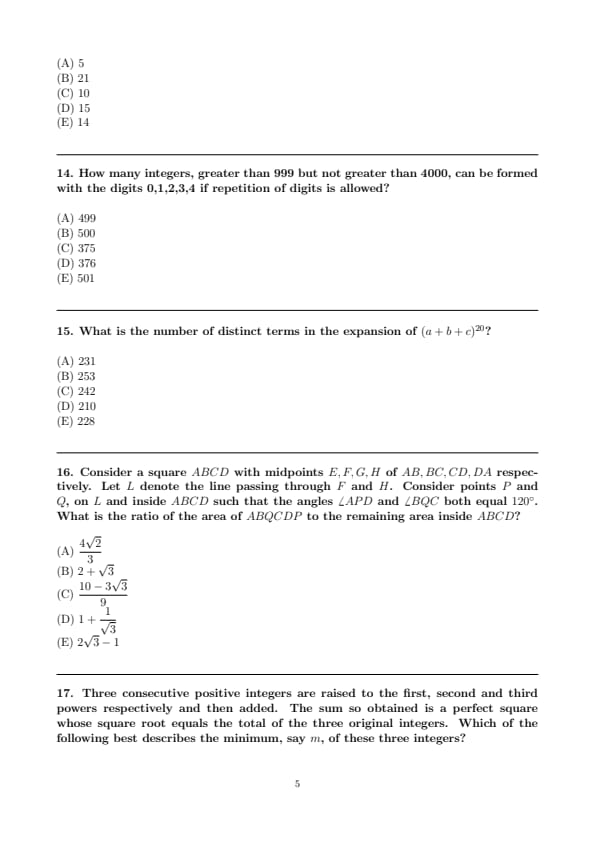
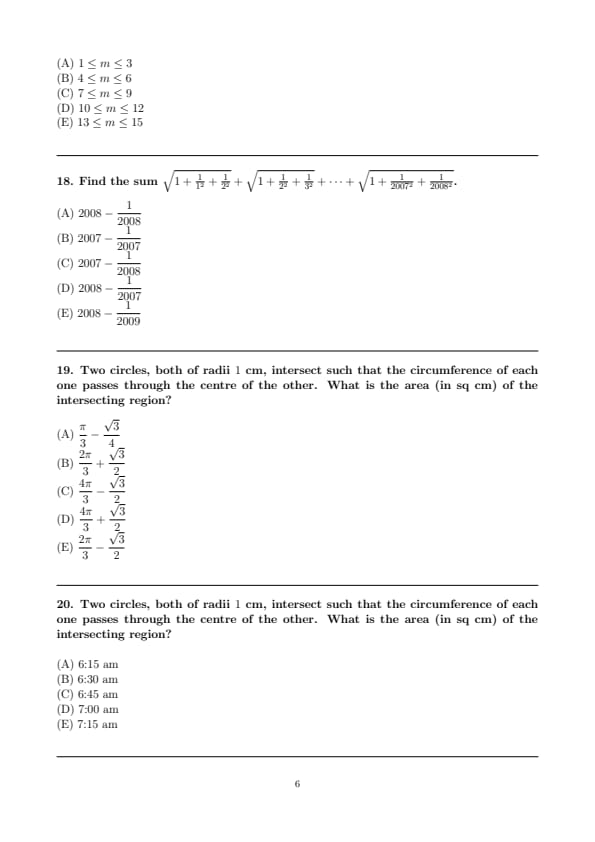
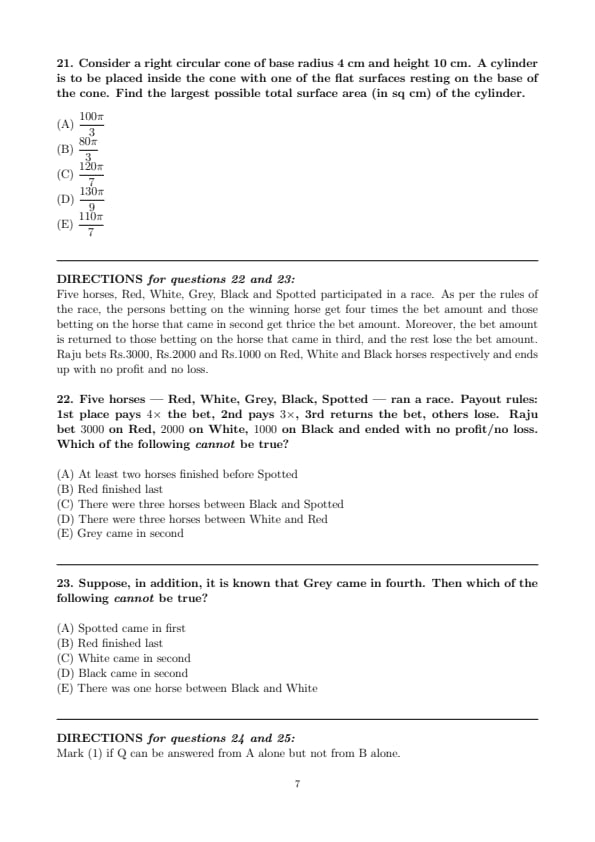
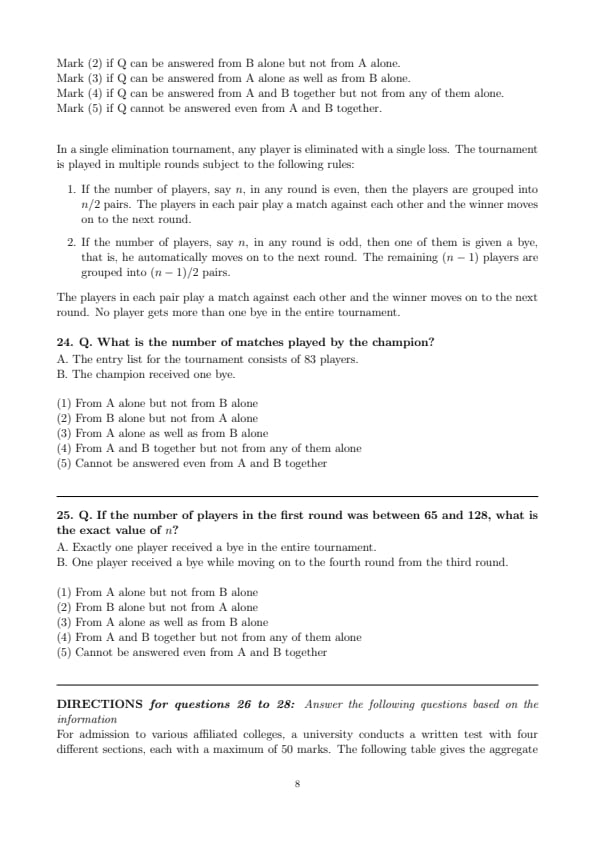
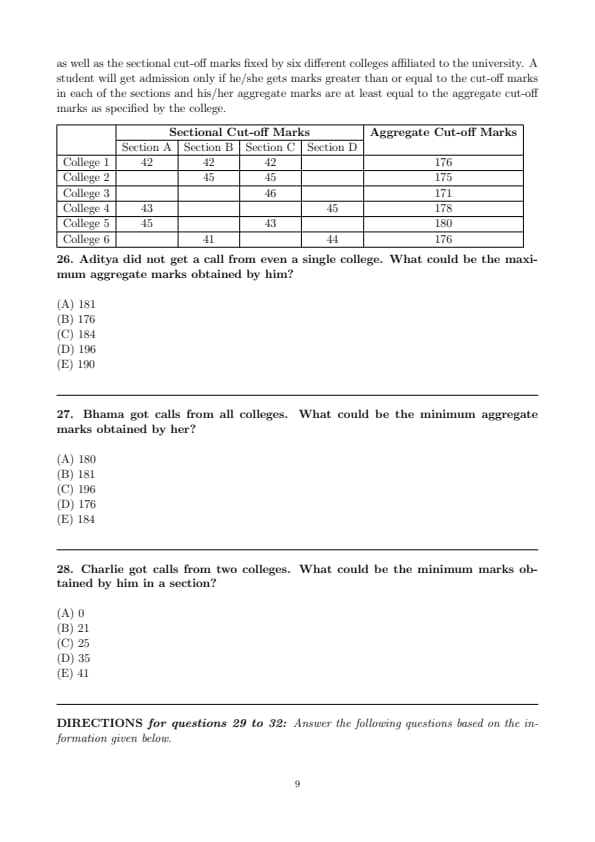
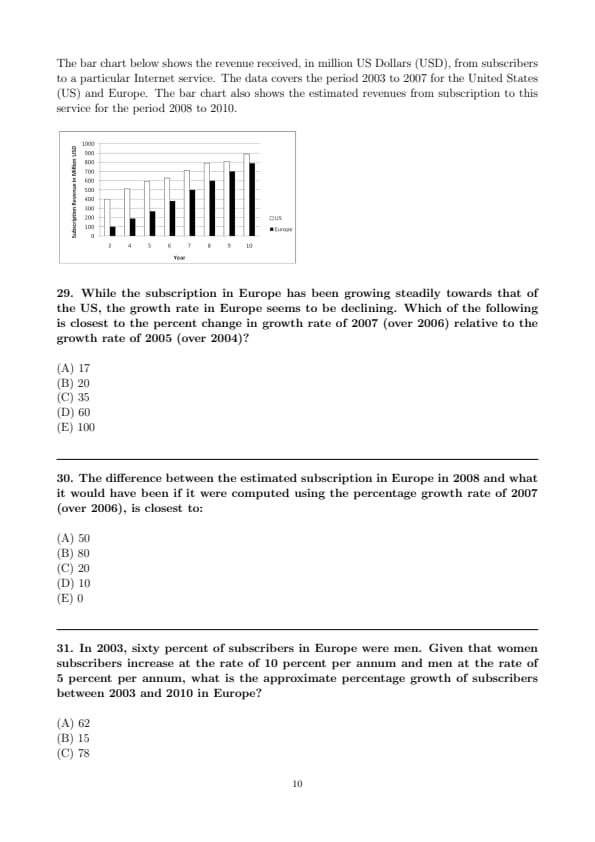
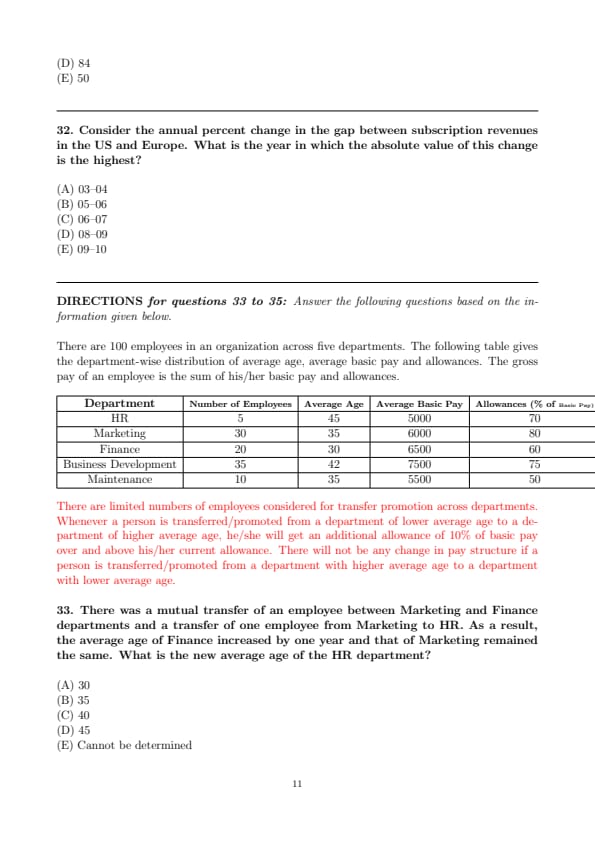
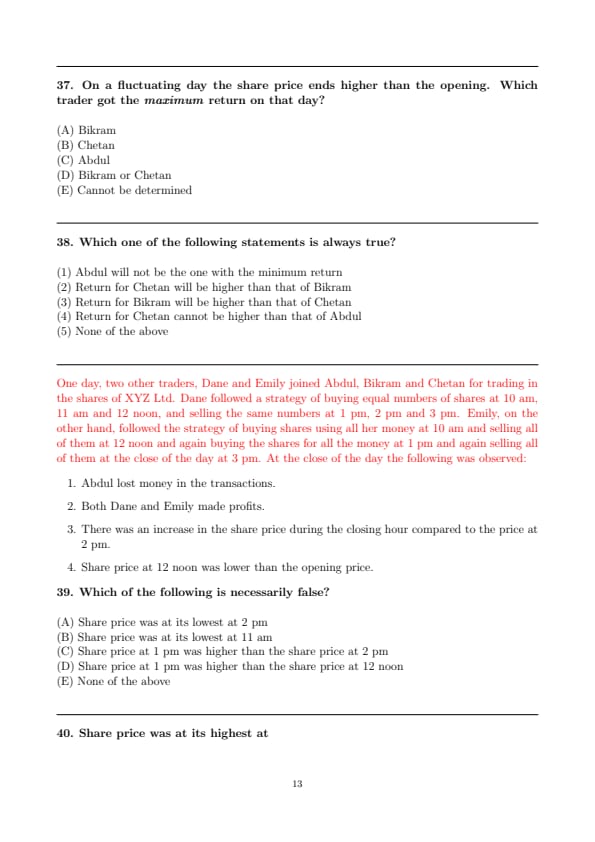
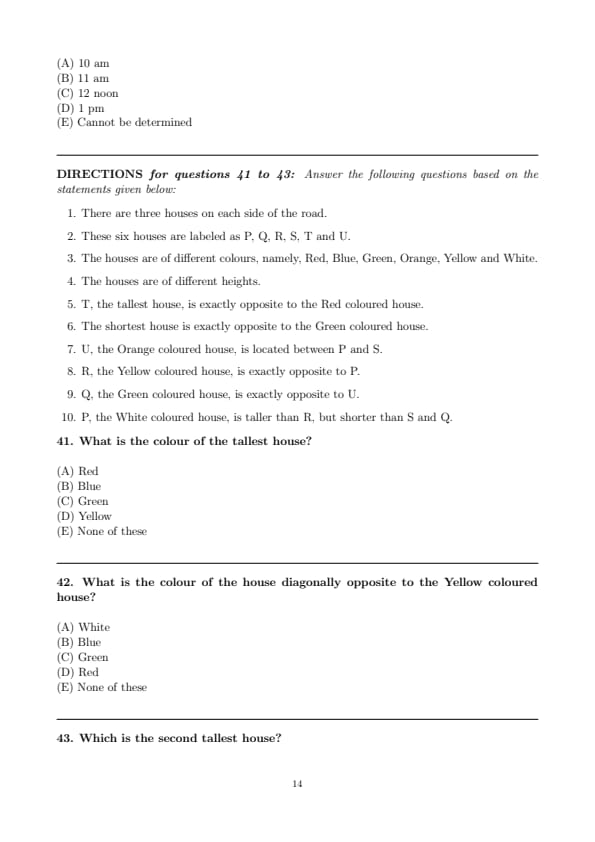
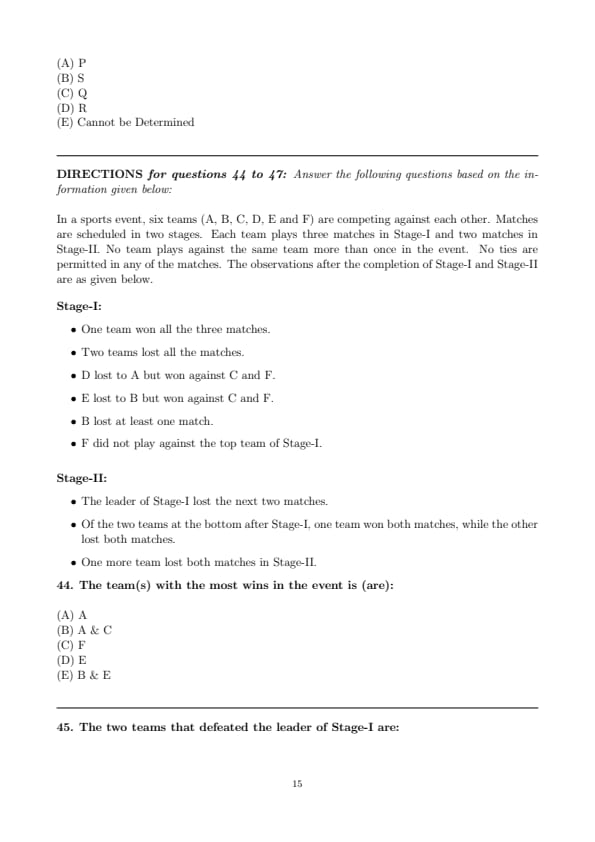
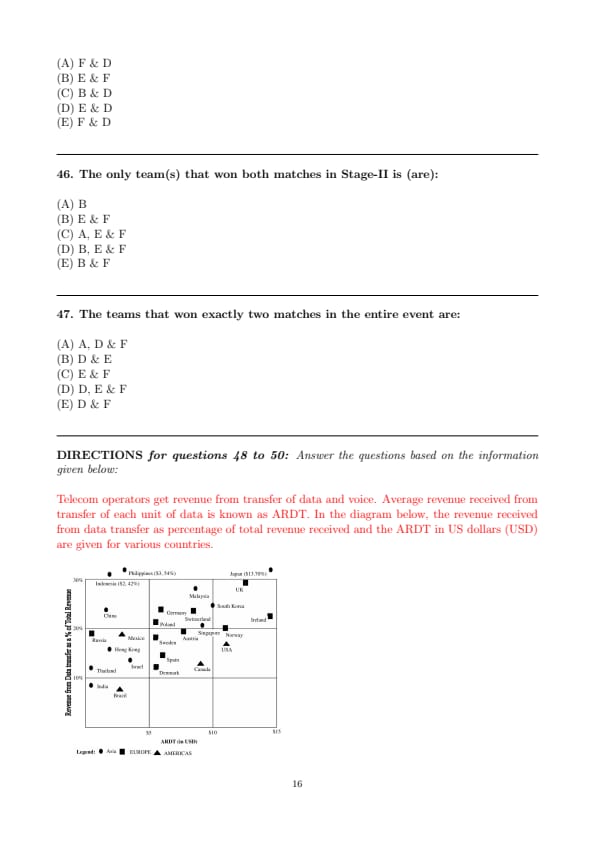
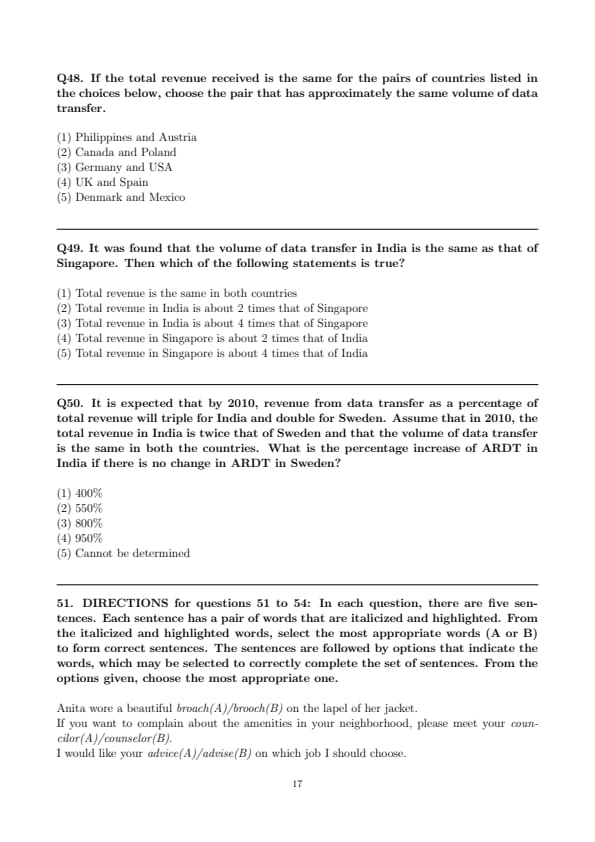
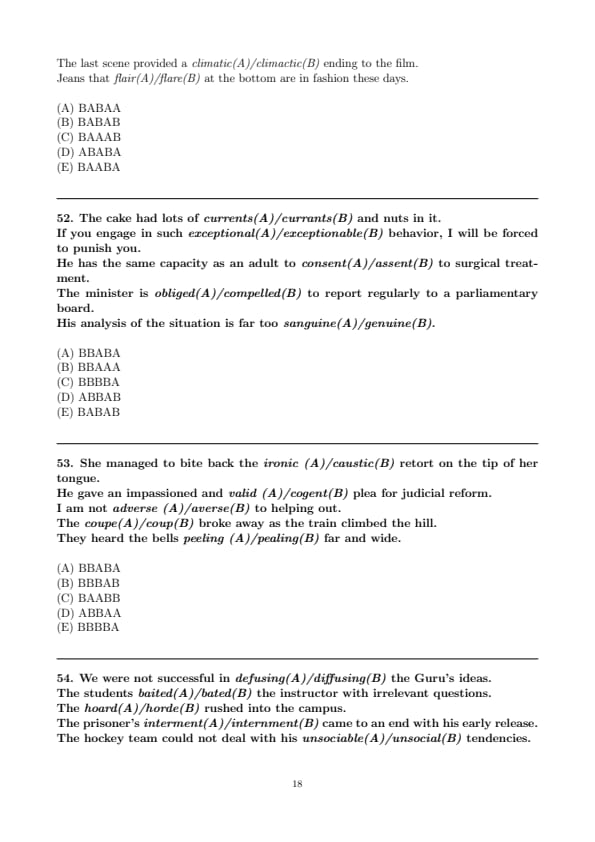
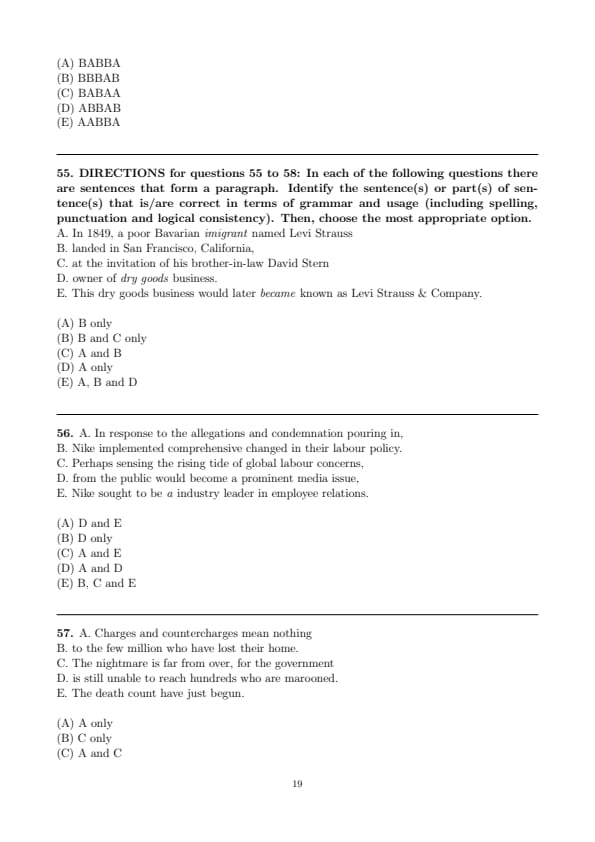
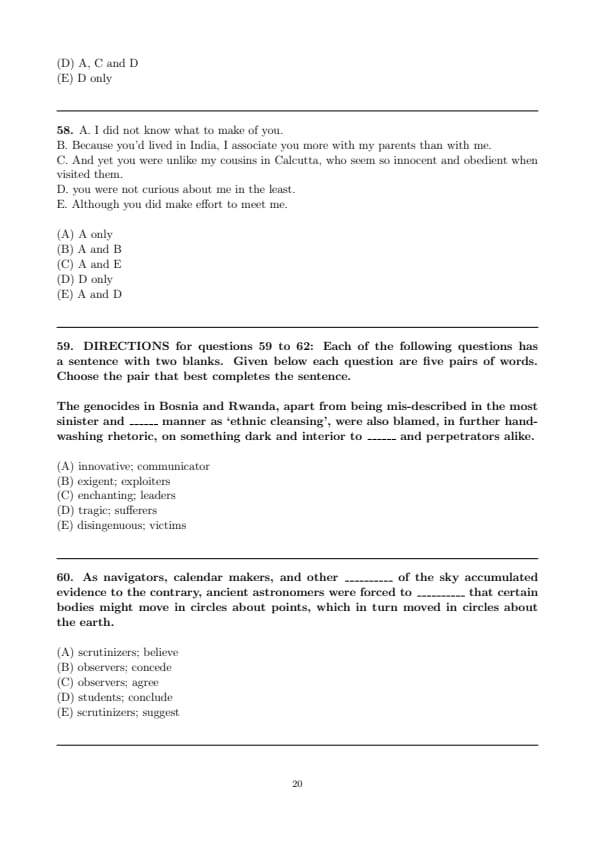
*The article might have information for the previous academic years, please refer the official website of the exam.