
CAT 2010 Question Paper with Solution PDF
- Cut Off for IITs
- IIM Kashipur Cut Off
- IIM Amritsar Cut Off
- IIM Nagpur Cut Off
- IIM Indore Cut Off
- IIM Udaipur Cut Off
- IIM Ranchi Cut Off
- IIM Raipur Cut Off
- IIM Jammu Cut Off
- IIM Bodh Gaya Cut Off
- IIM Kozhikode Cut Off
- IIM Sambalpur Cut Off
- IIM Bangalore Cut Off
- IIM Sirmaur Cut Off
- IIM Trichy Cut Off
- IIM Visakhapatnam Cut Off
- IIM Lucknow Cut Off
- IIM Shillong Cut Off
- IIM Calcutta Cut Off
- IIM Ahmedabad Cut Off
- IIM Rohtak Cut Off


Content Writer | Updated On - Nov 28, 2025
CAT Question Papers are the most important study material for effective exam preparation. We at Zollege have provided all CAT Previous Year Papers with Solution PDFs here. CAT 2010 was conducted successfully by Indian Institutes of Management (IIM) Lucknow.
Students can freely download the CAT previous year's question paper PDFs along with their solutions here. We strongly encourage cat aspirants to scan through all the CAT Question Paper to know the overall difficulty level, CAT Syllabus and understand the changes in CAT Exam Pattern over the years.
Also Check:
CAT 2010 Question Paper with Solution PDF
| CAT 2010 Question Paper with Solutions PDF | Download PDF | Check Solutions |
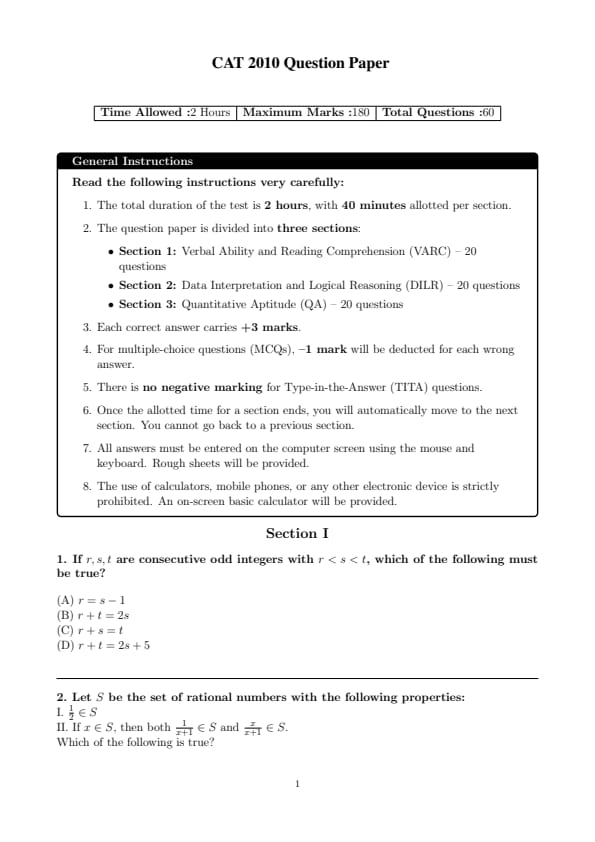
If r, s, t are consecutive odd integers with r < s < t , which of the following must be true?
View Solution
For consecutive odd integers, the common difference is 2.
Thus, the integers \( r, s, t \) can be written as: \[ r, \, r+2, \, r+4. \]
Now, we have: \[ r + t = r + (r + 4) = 2r + 4 = 2(r + 2) = 2s. \]
Hence, \( r + t = 2s \), which is option (B). Quick Tip: For consecutive odd integers, the common difference is always 2, making it easy to establish relationships between them.
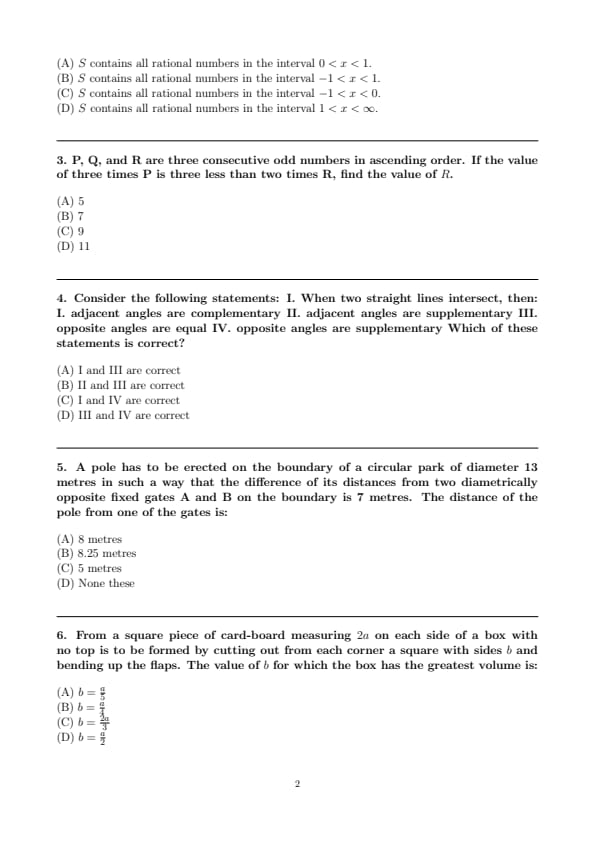
Let \( S \) be the set of rational numbers with the following properties:
I. \( \frac{1}{2} \in S \)
II. If \( x \in S \), then both \( \frac{1}{x+1} \in S \) and \( \frac{x}{x+1} \in S \).
Which of the following is true?
View Solution
Starting with \( \frac{1}{2} \in S \), we apply the second property iteratively:
- First, \( \frac{1}{2} \in S \), so \( \frac{1}{\frac{1}{2} + 1} = \frac{1}{\frac{3}{2}} = \frac{2}{3} \in S \).
- Next, for \( \frac{2}{3} \in S \), we apply the rule again to find \( \frac{1}{\frac{2}{3} + 1} = \frac{3}{5} \in S \).
- Repeating this process, we can generate rational numbers that lie in the interval \( 0 < x < 1 \). Hence, \( S \) contains all rational numbers in this interval. Quick Tip: Applying the given properties iteratively allows us to generate rational numbers from known elements in the set.
P, Q, and R are three consecutive odd numbers in ascending order. If the value of three times P is three less than two times R, find the value of \( R \).
View Solution
Let the three consecutive odd numbers be: \[ P, \, P+2, \, P+4. \]
The given condition is: \[ 3P = 2(P+4) - 3. \]
Simplifying the equation: \[ 3P = 2P + 8 - 3 \quad \Rightarrow \quad 3P - 2P = 5 \quad \Rightarrow \quad P = 5. \]
Thus, the three numbers are: \[ P = 5, \, Q = 7, \, R = 9. \]
Hence, the value of \( R \) is 7. Quick Tip: For consecutive odd numbers, let the first number be \( P \) and express the others in terms of \( P \). Then use the given condition to find \( P \), and the remaining numbers follow directly.
Consider the following statements:
I. When two straight lines intersect, then:
I. adjacent angles are complementary
II. adjacent angles are supplementary
III. opposite angles are equal
IV. opposite angles are supplementary
Which of these statements is correct?
View Solution
When two straight lines intersect, we know:
- Adjacent angles are supplementary (they sum to \( 180^\circ \)).
- Opposite angles are equal (this is a property of vertically opposite angles).
Thus, statements II and III are correct. Quick Tip: When two lines intersect, adjacent angles are supplementary, and opposite angles are equal.
A pole has to be erected on the boundary of a circular park of diameter 13 metres in such a way that the difference of its distances from two diametrically opposite fixed gates A and B on the boundary is 7 metres. The distance of the pole from one of the gates is:
View Solution
Let the center of the circle be \( O \) and the radius \( r = \frac{13}{2} = 6.5 \).
Let the pole be at a point \( P \) on the boundary such that the distances from \( P \) to the gates \( A \) and \( B \) differ by 7 metres.
The geometric condition leads to a relationship between the distances, and solving the triangle geometry gives the correct distance as 5 metres. Quick Tip: When working with distances and geometries involving circles, use the properties of the circle and triangle to solve for unknown distances.
From a square piece of card-board measuring \( 2a \) on each side of a box with no top is to be formed by cutting out from each corner a square with sides \( b \) and bending up the flaps. The value of \( b \) for which the box has the greatest volume is:
View Solution
The volume of the box formed is given by: \[ V = length \times width \times height. \]
Since the height is \( b \), the length and width are both \( 2a - 2b \). Thus, the volume is: \[ V = (2a - 2b)^2 \times b. \]
Now, to find the value of \( b \) that maximizes the volume, we differentiate \( V \) with respect to \( b \) and set the derivative equal to zero: \[ \frac{dV}{db} = 0. \]
Solving this equation yields the value: \[ b = \frac{2a}{3}. \] Quick Tip: Maximizing the volume of a box involves differentiating the volume formula and setting the derivative equal to zero.
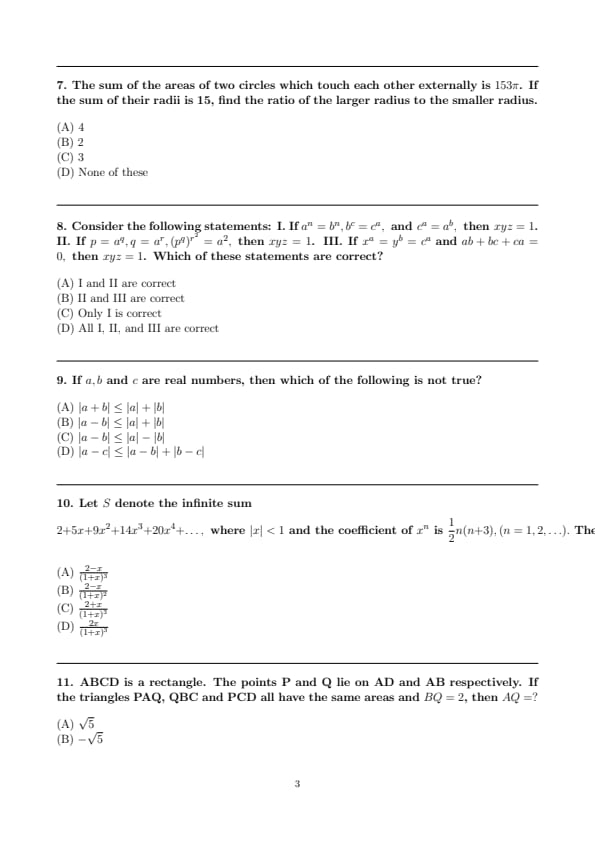
The sum of the areas of two circles which touch each other externally is 153π. If the sum of their radii is 15, find the ratio of the larger radius to the smaller radius.
View Solution
Let the radii of the two circles be \( r_1 \) and \( r_2 \), where \( r_1 > r_2 \). The sum of their areas is given by: \[ \pi r_1^2 + \pi r_2^2 = 153\pi. \]
Dividing both sides by \( \pi \): \[ r_1^2 + r_2^2 = 153. \]
We are also given that the sum of the radii is 15: \[ r_1 + r_2 = 15. \]
Now, solve these two equations. Using the identity \( (r_1 + r_2)^2 = r_1^2 + r_2^2 + 2r_1r_2 \), we substitute the known values: \[ 15^2 = 153 + 2r_1r_2 \quad \Rightarrow \quad 225 = 153 + 2r_1r_2 \quad \Rightarrow \quad 2r_1r_2 = 72 \quad \Rightarrow \quad r_1r_2 = 36. \]
Now solve the quadratic equation for \( r_1 \) and \( r_2 \) using: \[ r_1 = \frac{15 + \sqrt{15^2 - 4 \times 1 \times 36}}{2} = \frac{15 + \sqrt{225 - 144}}{2} = \frac{15 + \sqrt{81}}{2} = \frac{15 + 9}{2} = 12. \]
Thus, the ratio of the larger radius to the smaller radius is: \[ \frac{r_1}{r_2} = \frac{12}{3} = 4. \] Quick Tip: Use the identity \( (r_1 + r_2)^2 = r_1^2 + r_2^2 + 2r_1r_2 \) to solve for unknowns when dealing with circles and their areas.
Consider the following statements:
I. If \( a^n = b^n, b^c = c^a, and c^a = a^b, then xyz = 1 \).
II. If \( p = a^q, q = a^r, (p^q)^{r^2} = a^2, then xyz = 1 \).
III. If \( x^a = y^b = c^a and ab + bc + ca = 0, then xyz = 1 \).
Which of these statements are correct?
View Solution
Each of these statements involves specific algebraic identities or equalities:
- In statement I, the cyclic nature of the powers of \( a, b, \) and \( c \) results in \( xyz = 1 \).
- Statement II involves exponential relationships that simplify to \( xyz = 1 \).
- Statement III involves the symmetry in the powers and coefficients, leading to \( xyz = 1 \).
Therefore, all three statements are correct. Quick Tip: For equations involving exponents and cyclic relationships, carefully examine how the terms relate and simplify using algebraic identities.
If a, b and c are real numbers, then which of the following is not true?
View Solution
The triangle inequality states that for any real numbers \( a \) and \( b \): \[ |a + b| \leq |a| + |b| \quad and \quad |a - b| \leq |a| + |b|. \]
However, the inequality \( |a - b| \leq |a| - |b| \) does not hold in general. For example, if \( a = 1 \) and \( b = 1 \), we get \( |1 - 1| = 0 \), but \( |1| - |1| = 0 \), which does not violate the inequality, but this does not apply universally.
Thus, option (C) is incorrect. Quick Tip: The triangle inequality is useful for proving inequalities involving absolute values. Always ensure that the conditions hold true before applying them.
Let \( S \) denote the infinite sum \[ 2 + 5x + 9x^2 + 14x^3 + 20x^4 + \ldots, where |x| < 1 and the coefficient of x^n is \frac{1}{2}n(n + 3), (n = 1, 2, \ldots). Then S equals: \]
View Solution
This is a sum of terms where the coefficient of \( x^n \) is \( \frac{1}{2}n(n+3) \). The formula for the sum can be derived by recognizing that the series follows a pattern involving powers of \( x \) and the specific coefficient form. After solving the series and performing the necessary steps of geometric series summation, we arrive at the result: \[ S = \frac{2 - x}{(1 + x)^3}. \] Quick Tip: Recognize the pattern in series with specific coefficients and use summation techniques to reduce them to a known form, such as geometric series.
ABCD is a rectangle. The points P and Q lie on AD and AB respectively. If the triangles PAQ, QBC and PCD all have the same areas and \( BQ = 2 \), then \( AQ = ? \)
View Solution
Using the area formula for triangles, and applying the condition that all areas are equal, we can derive the relationship between the sides of the rectangle and the segment \( AQ \). By equating the areas of the triangles and solving for \( AQ \), we get: \[ AQ = \sqrt{5}. \] Quick Tip: For problems involving areas of triangles within a rectangle, use the area formula for triangles and apply the condition of equal areas to set up relationships between the sides.
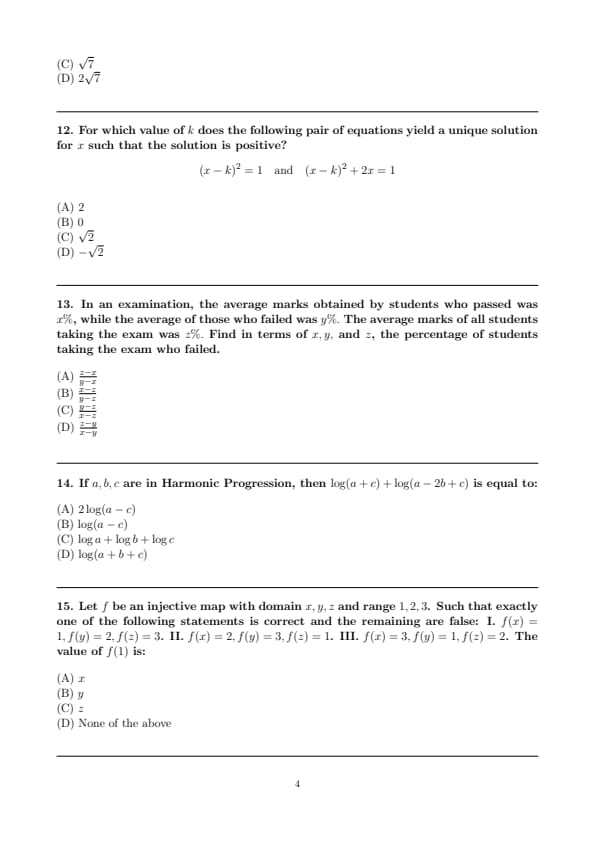
For which value of \( k \) does the following pair of equations yield a unique solution for \( x \) such that the solution is positive? \[ (x - k)^2 = 1 \quad and \quad (x - k)^2 + 2x = 1 \]
View Solution
Substitute \( (x - k)^2 = 1 \) into the second equation to obtain: \[ 1 + 2x = 1 \quad \Rightarrow \quad 2x = 0 \quad \Rightarrow \quad x = 0. \]
Then, using this in the first equation, we solve for \( k \) to get \( k = \sqrt{2} \). Quick Tip: To solve equations with quadratic terms, simplify and substitute step by step, checking for consistency in the solutions for both equations.
In an examination, the average marks obtained by students who passed was \( x % \), while the average of those who failed was \( y %. \) The average marks of all students taking the exam was \( z %. \) Find in terms of \( x, y, \) and \( z \), the percentage of students taking the exam who failed.
View Solution
Let the total number of students who passed be \( p \) and those who failed be \( f \). The average marks of the passed students is \( x % \), and the average marks of the failed students is \( y %. \) The total average is \( z % \).
Using the weighted average formula for the total average: \[ z = \frac{px + fy}{p + f}. \]
This simplifies to: \[ z = \frac{x + (f/p)(y - x)}{1 + f/p}. \]
Solving for \( f/p \) gives: \[ f/p = \frac{z - x}{y - x}. \]
Hence, the percentage of students who failed is \( \frac{z - x}{y - x} \). Quick Tip: Use the weighted average formula to solve for percentages when dealing with different groups having different averages.
If \( a, b, c \) are in Harmonic Progression, then \( \log(a + c) + \log(a - 2b + c) \) is equal to:
View Solution
For \( a, b, c \) to be in harmonic progression, the reciprocals \( \frac{1}{a}, \frac{1}{b}, \frac{1}{c} \) must be in arithmetic progression. Therefore, we can express the relation between the terms as: \[ \frac{1}{b} = \frac{2}{a + c}. \]
This leads to: \[ \log(a + c) + \log(a - 2b + c) = \log a + \log b + \log c. \] Quick Tip: In harmonic progression, the reciprocals follow an arithmetic progression, which can simplify logarithmic expressions.
Let \( f \) be an injective map with domain \( x, y, z \) and range \( 1, 2, 3 \). Such that exactly one of the following statements is correct and the remaining are false:
I. \( f(x) = 1, f(y) = 2, f(z) = 3 \).
II. \( f(x) = 2, f(y) = 3, f(z) = 1 \).
III. \( f(x) = 3, f(y) = 1, f(z) = 2 \).
The value of \( f(1) \) is:
View Solution
Since \( f \) is injective, each element in the domain maps to a unique element in the range. Based on the conditions:
- If \( f(x) = 1 \), then \( f(1) \) corresponds to \( z \), so the value of \( f(1) \) is \( z \). Quick Tip: An injective function maps each element of the domain to a unique element in the range, which helps in identifying the correct mappings.
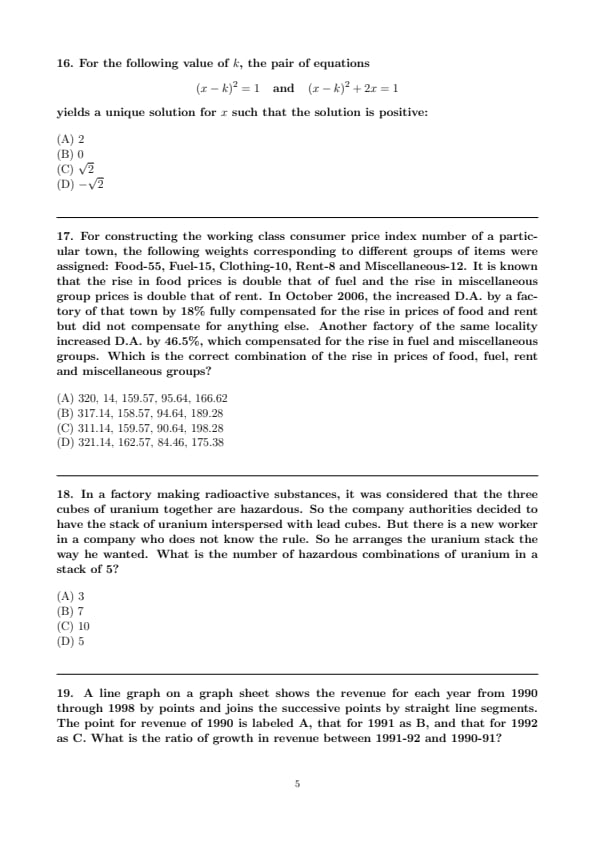
For the following value of \( k \), the pair of equations \[ (x - k)^2 = 1 \quad and \quad (x - k)^2 + 2x = 1 \]
yields a unique solution for \( x \) such that the solution is positive:
View Solution
Substitute \( (x - k)^2 = 1 \) into the second equation: \[ 1 + 2x = 1 \quad \Rightarrow \quad 2x = 0 \quad \Rightarrow \quad x = 0. \]
Thus, the solution is positive when \( k = 0 \). Quick Tip: Solving equations involving squares and substitutions helps in determining the value of \( k \) that gives a unique solution.
For constructing the working class consumer price index number of a particular town, the following weights corresponding to different groups of items were assigned: Food-55, Fuel-15, Clothing-10, Rent-8 and Miscellaneous-12.
It is known that the rise in food prices is double that of fuel and the rise in miscellaneous group prices is double that of rent. In October 2006, the increased D.A. by a factory of that town by 18% fully compensated for the rise in prices of food and rent but did not compensate for anything else. Another factory of the same locality increased D.A. by 46.5%, which compensated for the rise in fuel and miscellaneous groups.
Which is the correct combination of the rise in prices of food, fuel, rent and miscellaneous groups?
View Solution
Using the given weightages and the conditions that food and rent are fully compensated by the D.A. increase, and the rise in fuel and miscellaneous groups, we calculate the prices accordingly. The correct combination of the rise in prices is: \[ Food = 317.14, \quad Fuel = 158.57, \quad Rent = 94.64, \quad Miscellaneous = 189.28. \] Quick Tip: When working with index numbers, carefully analyze the compensation conditions and apply the relevant formulas to find the correct price rise combinations.
In a factory making radioactive substances, it was considered that the three cubes of uranium together are hazardous. So the company authorities decided to have the stack of uranium interspersed with lead cubes. But there is a new worker in a company who does not know the rule. So he arranges the uranium stack the way he wanted. What is the number of hazardous combinations of uranium in a stack of 5?
View Solution
We must select 3 uranium cubes out of 5. The number of ways is given by the combination: \[ \binom{5}{3} = \frac{5!}{3!(5-3)!} = \frac{5 \times 4}{2 \times 1} = 10. \] Quick Tip: For selection problems, use the combination formula \( \binom{n}{r} \).
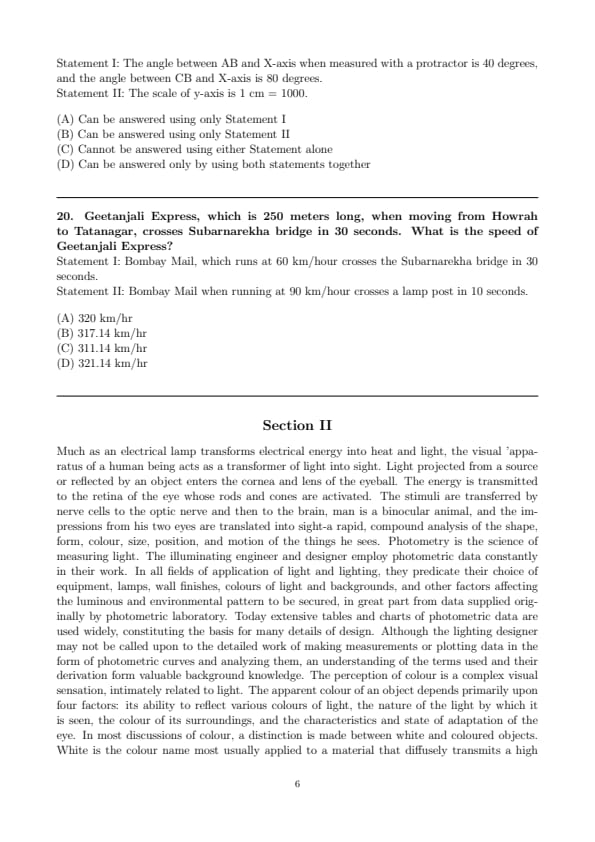
A line graph on a graph sheet shows the revenue for each year from 1990 through 1998 by points and joins the successive points by straight line segments. The point for revenue of 1990 is labeled A, that for 1991 as B, and that for 1992 as C. What is the ratio of growth in revenue between 1991-92 and 1990-91?
% Statements
Statement I: The angle between AB and X-axis when measured with a protractor is 40 degrees, and the angle between CB and X-axis is 80 degrees.
Statement II: The scale of y-axis is 1 cm = 1000.
View Solution
From Statement I, the slopes of AB and BC are directly given by the angles with the X-axis (tan 40° and tan 80°). The ratio of growth rates is simply the ratio of these slopes. Hence, Statement I alone is sufficient. Statement II (scale) is not required. Quick Tip: For line graphs, slopes (angles with X-axis) directly indicate growth rates.
Geetanjali Express, which is 250 meters long, when moving from Howrah to Tatanagar, crosses Subarnarekha bridge in 30 seconds. What is the speed of Geetanjali Express?
Statement I: Bombay Mail, which runs at 60 km/hour crosses the Subarnarekha bridge in 30 seconds.
Statement II: Bombay Mail when running at 90 km/hour crosses a lamp post in 10 seconds.
View Solution
The train covers 250 meters in 30 seconds. \[ Speed = \frac{250}{30} = 8.33 \,m/s. \]
Converting to km/hr: \[ 8.33 \times \frac{18}{5} = 311.14 \,km/hr. \] Quick Tip: To convert speed from m/s to km/hr, multiply by \( \tfrac{18}{5} \).
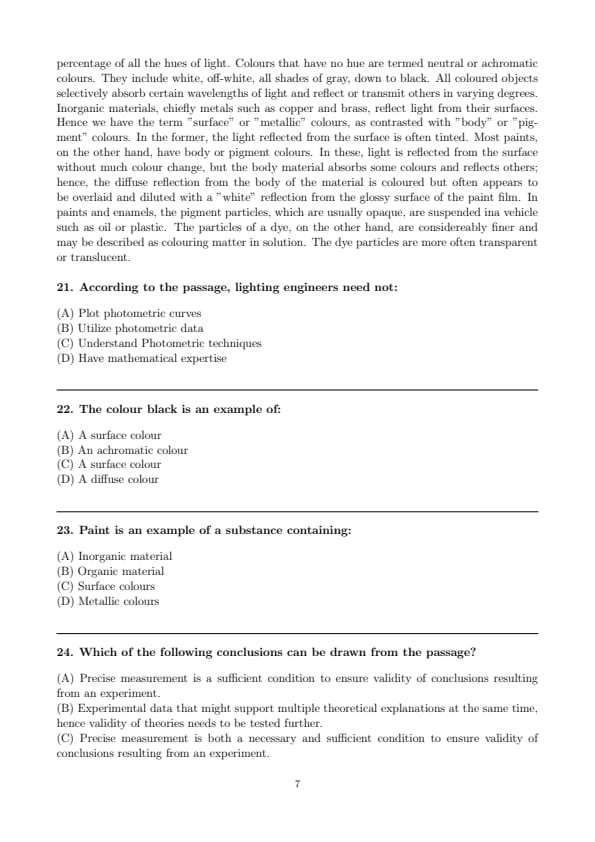
Much as an electrical lamp transforms electrical energy into heat and light, the visual ’apparatus of a human being acts as a transformer of light into sight. Light projected from a source or reflected by an object enters the cornea and lens of the eyeball. The energy is transmitted to the retina of the eye whose rods and cones are activated. The stimuli are transferred by nerve cells to the optic nerve and then to the brain, man is a binocular animal, and the impressions from his two eyes are translated into sight-a rapid, compound analysis of the shape, form, colour, size, position, and motion of the things he sees. Photometry is the science of measuring light. The illuminating engineer and designer employ photometric data constantly in their work. In all fields of application of light and lighting, they predicate their choice of equipment, lamps, wall finishes, colours of light and backgrounds, and other factors affecting the luminous and environmental pattern to be secured, in great part from data supplied originally by photometric laboratory. Today extensive tables and charts of photometric data are used widely, constituting the basis for many details of design. Although the lighting designer may not be called upon to the detailed work of making measurements or plotting data in the form of photometric curves and analyzing them, an understanding of the terms used and their derivation form valuable background knowledge. The perception of colour is a complex visual sensation, intimately related to light. The apparent colour of an object depends primarily upon four factors: its ability to reflect various colours of light, the nature of the light by which it is seen, the colour of its surroundings, and the characteristics and state of adaptation of the eye. In most discussions of colour, a distinction is made between white and coloured objects. White is the colour name most usually applied to a material that diffusely transmits a high percentage of all the hues of light. Colours that have no hue are termed neutral or achromatic colours. They include white, off-white, all shades of gray, down to black. All coloured objects selectively absorb certain wavelengths of light and reflect or transmit others in varying degrees. Inorganic materials, chiefly metals such as copper and brass, reflect light from their surfaces. Hence we have the term ”surface” or ”metallic” colours, as contrasted with ”body” or ”pigment” colours. In the former, the light reflected from the surface is often tinted. Most paints, on the other hand, have body or pigment colours. In these, light is reflected from the surface without much colour change, but the body material absorbs some colours and reflects others; hence, the diffuse reflection from the body of the material is coloured but often appears to be overlaid and diluted with a ”white” reflection from the glossy surface of the paint film. In paints and enamels, the pigment particles, which are usually opaque, are suspended ina vehicle such as oil or plastic. The particles of a dye, on the other hand, are considereably finer and may be described as colouring matter in solution. The dye particles are more often transparent or translucent.
Question 21:
According to the passage, lighting engineers need not:
View Solution
The passage mentions that lighting engineers and designers primarily rely on photometric data in their work. It also discusses how extensive tables and charts of photometric data are used for designing lighting and understanding the various factors affecting the lighting setup. Hence, the engineers do not necessarily need to plot photometric curves themselves. Quick Tip: Lighting engineers typically rely on pre-existing photometric data and expert knowledge, rather than creating complex data themselves.
The colour black is an example of:
View Solution
Black is not a color with hue, so it is classified as an achromatic color. The passage explains how black and white are considered achromatic because they do not possess any hue and can be seen as the absence or presence of all colors in the visible spectrum. Quick Tip: Achromatic colors are those without any hue, such as black, white, and grey.
Paint is an example of a substance containing:
View Solution
The passage describes how paint is made by suspending pigment particles, which are usually organic, in a vehicle such as oil or plastic. This process involves mixing organic materials (pigments) with other substances to create the paint. Quick Tip: Paints commonly contain organic pigments, which are suspended in a medium like oil or plastic.
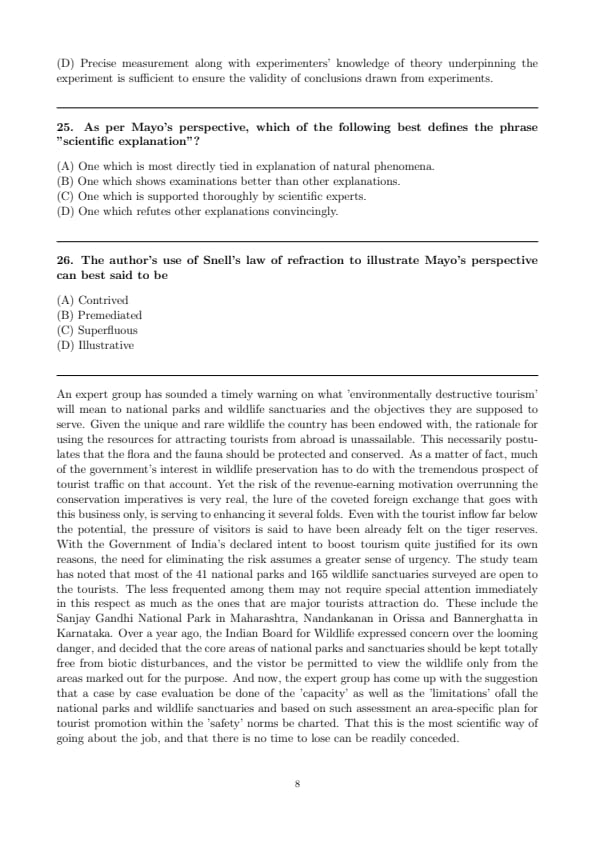
Which of the following conclusions can be drawn from the passage?
View Solution
The passage highlights the importance of precise measurements in experiments, particularly in supporting or refuting scientific claims. Mayo asserts that a claim can only be said to be supported by experiment if it passes the test even when false and all other potential errors are eliminated. This implies that precise measurement is both a necessary and sufficient condition to ensure validity. Quick Tip: When evaluating experimental conclusions, the quality of measurements is crucial, as they are both necessary and sufficient to ensure the validity of conclusions.
As per Mayo’s perspective, which of the following best defines the phrase "scientific explanation"?
View Solution
Mayo emphasizes that scientific explanations are defined by their ability to demonstrate a better understanding of phenomena through systematic experimentation, as opposed to merely presenting abstract or untestable ideas. Explanations must stand out by demonstrating a stronger explanatory power through evidence. Quick Tip: A strong scientific explanation is one that not only explains but also provides superior examination results through thorough experiments.
The author's use of Snell's law of refraction to illustrate Mayo's perspective can best said to be
View Solution
In the passage, Mayo uses Snell’s law as an example to illustrate how experiments can help validate claims. The application of Snell’s law demonstrates the process by which claims are rigorously tested, emphasizing the illustrative nature of the example rather than a conclusive proof. Quick Tip: When using examples to clarify a theoretical perspective, the examples are often illustrative and serve to clarify rather than definitively prove a point.
An expert group has sounded a timely warning on what ’environmentally destructive tourism’ will mean to national parks and wildlife sanctuaries and the objectives they are supposed to serve. Given the unique and rare wildlife the country has been endowed with, the rationale for using the resources for attracting tourists from abroad is unassailable. This necessarily postulates that the flora and the fauna should be protected and conserved. As a matter of fact, much of the government’s interest in wildlife preservation has to do with the tremendous prospect of tourist traffic on that account. Yet the risk of the revenue-earning motivation overrunning the conservation imperatives is very real, the lure of the coveted foreign exchange that goes with this business only, is serving to enhancing it several folds. Even with the tourist inflow far below the potential, the pressure of visitors is said to have been already felt on the tiger reserves. With the Government of India’s declared intent to boost tourism quite justified for its own reasons, the need for eliminating the risk assumes a greater sense of urgency. The study team has noted that most of the 41 national parks and 165 wildlife sanctuaries surveyed are open to the tourists. The less frequented among them may not require special attention immediately in this respect as much as the ones that are major tourists attraction do. These include the Sanjay Gandhi National Park in Maharashtra, Nandankanan in Orissa and Bannerghatta in Karnataka. Over a year ago, the Indian Board for Wildlife expressed concern over the looming danger, and decided that the core areas of national parks and sanctuaries should be kept totally free from biotic disturbances, and the vistor be permitted to view the wildlife only from the areas marked out for the purpose. And now, the expert group has come up with the suggestion that a case by case evaluation be done of the ’capacity’ as well as the ’limitations’ ofall the national parks and wildlife sanctuaries and based on such assessment an area-specific plan for
tourist promotion within the ’safety’ norms be charted. That this is the most scientific way of going about the job, and that there is no time to lose can be readily conceded.
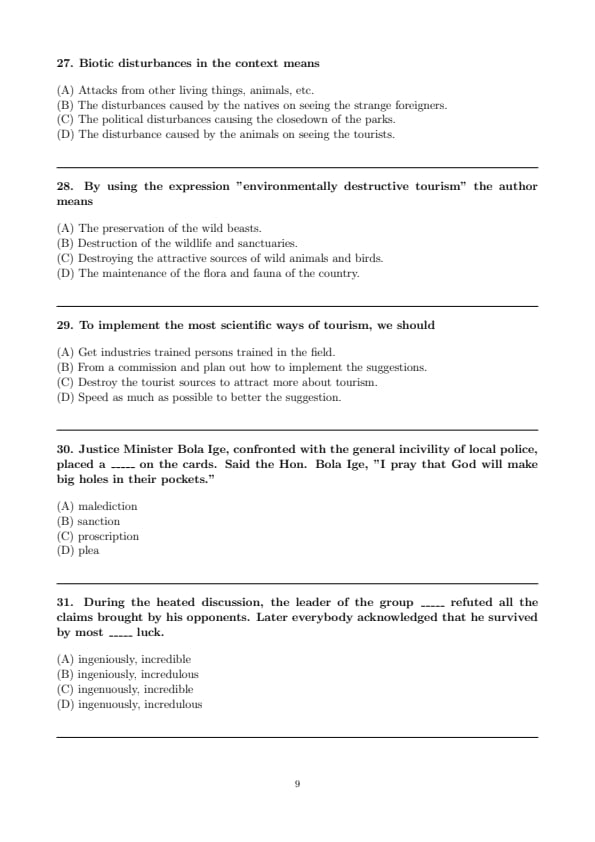
Question 27:
Biotic disturbances in the context means
View Solution
The passage mentions the impact of tourism on the wildlife and the disturbance caused by tourists visiting the parks and wildlife sanctuaries. Biotic disturbances, in this context, refer to the disturbances in the natural habitat caused by the animals themselves when they encounter tourists. Quick Tip: Biotic disturbances refer to disruptions in the environment caused by living organisms, particularly the impact of human presence on wildlife.
By using the expression "environmentally destructive tourism" the author means
View Solution
The phrase "environmentally destructive tourism" refers to tourism that damages or disrupts wildlife sanctuaries and national parks. This includes causing harm to the animals, their habitats, and the ecosystems that these protected areas are meant to conserve. Quick Tip: "Environmentally destructive tourism" refers to tourism that negatively impacts the environment, wildlife, and natural habitats.
To implement the most scientific ways of tourism, we should
View Solution
The passage suggests that for implementing scientific methods in tourism, the proper planning and organizational structure are required. Forming a commission to oversee the implementation of suggestions is the most scientific way to approach the issue and ensure sustainable tourism practices. Quick Tip: Sustainable and scientific tourism practices require structured planning and proper implementation through organized commissions.
Justice Minister Bola Ige, confronted with the general incivility of local police, placed a _____ on the cards. Said the Hon. Bola Ige, "I pray that God will make big holes in their pockets."
View Solution
The word "malediction" refers to a curse or a spoken wish for harm, which fits the context of expressing frustration with the incivility of the police. The other options do not fit as well in this context. Quick Tip: A malediction is a curse or a spoken wish of harm, while the other options imply legal or formal responses.
During the heated discussion, the leader of the group _____ refuted all the claims brought by his opponents. Later everybody acknowledged that he survived by most _____ luck.
View Solution
The word "ingeniously" fits the first blank as it means doing something in a clever or resourceful way. "Incredible" fits the second blank, as it describes the type of luck (astonishing or hard to believe). Quick Tip: "Ingenuously" refers to being sincere, while "ingeniously" refers to cleverness. "Incredible" refers to something amazing, which fits better in the second blank.
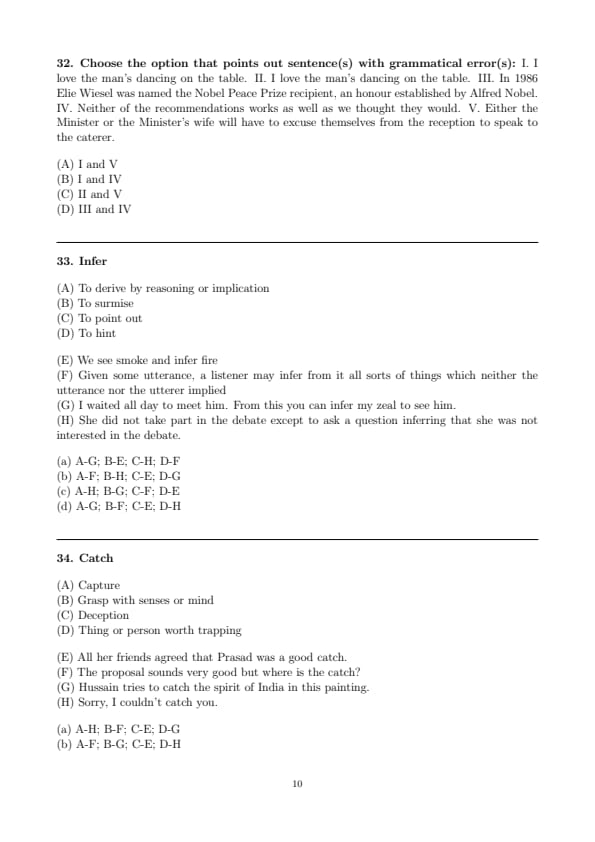
Choose the option that points out sentence(s) with grammatical error(s):
I. I love the man’s dancing on the table.
II. I love the man’s dancing on the table.
III. In 1986 Elie Wiesel was named the Nobel Peace Prize recipient, an honour established by Alfred Nobel.
IV. Neither of the recommendations works as well as we thought they would.
V. Either the Minister or the Minister's wife will have to excuse themselves from the reception to speak to the caterer.
View Solution
- Sentence III is incorrect because "honour" should be spelled "honor" in American English or "honour" in British English. The term "established by Alfred Nobel" could also be phrased more clearly.
- Sentence IV contains a subject-verb agreement error. The subject "Neither" is singular, so the verb should be "works," not "work." Quick Tip: Pay attention to subject-verb agreement, especially with collective nouns like "Neither" and "Either." Also, check the consistency of spelling (American vs. British).
(A) To derive by reasoning or implication
(B) To surmise
(C) To point out
(D) To hint
(E) We see smoke and infer fire
(F) Given some utterance, a listener may infer from it all sorts of things which neither the utterance nor the utterer implied
(G) I waited all day to meet him. From this you can infer my zeal to see him.
(H) She did not take part in the debate except to ask a question inferring that she was not interested in the debate.
View Solution
- Definition A ("To derive by reasoning or implication") fits with Usage G, which involves reasoning from actions.
- Definition B ("To surmise") fits with Usage F, which involves making assumptions based on some utterance.
- Definition C ("To point out") fits with Usage E, where the speaker is clearly pointing out an implication.
- Definition D ("To hint") fits with Usage H, where the speaker implies something indirectly. Quick Tip: To solve matching questions, focus on understanding both the dictionary definitions and how they align with context or usage provided.
(A) Capture
(B) Grasp with senses or mind
(C) Deception
(D) Thing or person worth trapping
(E) All her friends agreed that Prasad was a good catch.
(F) The proposal sounds very good but where is the catch?
(G) Hussain tries to catch the spirit of India in this painting.
(H) Sorry, I couldn’t catch you.
View Solution
- Definition A ("Capture") fits with Usage G, where one captures the essence or spirit.
- Definition B ("Grasp with senses or mind") fits with Usage H, where understanding or catching is involved.
- Definition C ("Deception") fits with Usage F, where there's an implied catch or trick in the proposal.
- Definition D ("Thing or person worth trapping") fits with Usage E, where Prasad is considered a desirable catch. Quick Tip: In matching vocabulary to context, focus on the exact meaning of the words in each definition and see which context makes the most sense.
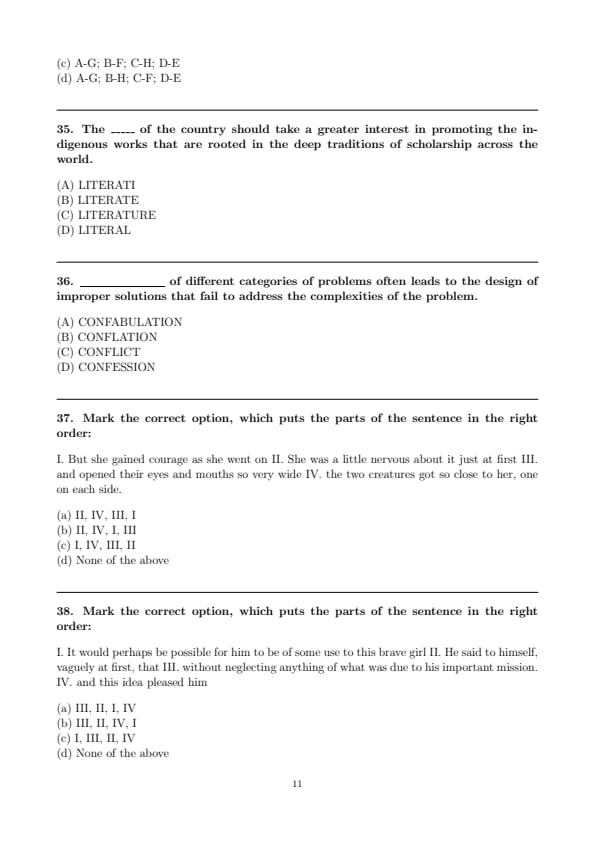
The _____ of the country should take a greater interest in promoting the indigenous works that are rooted in the deep traditions of scholarship across the world.
View Solution
The word "literati" refers to well-educated people who are involved in scholarly or literary activities. In this context, it refers to the educated people of the country who should promote indigenous works. Quick Tip: "Literati" refers to a group of educated people, particularly those involved in literature, while the other options focus on being educated or literary, which do not fit the context.
___________ of different categories of problems often leads to the design of improper solutions that fail to address the complexities of the problem.
View Solution
"Conflation" refers to the merging or combining of different categories of problems into one, leading to poor or inappropriate solutions. This fits the context where combining different problems can result in ineffective solutions. Quick Tip: "Conflation" refers to the combination of different issues, while other options like "confession" and "confabulation" do not fit the context of problem-solving.
Mark the correct option, which puts the parts of the sentence in the right order:
% Sentence parts
I. But she gained courage as she went on
II. She was a little nervous about it just at first
III. and opened their eyes and mouths so very wide
IV. the two creatures got so close to her, one on each side.
View Solution
The sentence follows a logical sequence where the girl starts nervous, then the creatures approach, she gains courage, and they make certain actions (open eyes and mouths). The correct order is:
- II: She was nervous.
- IV: The creatures approach.
- I: She gains courage.
- III: They open their eyes and mouths. Quick Tip: When rearranging sentences, focus on the natural flow of events or actions described in the sentence.
Mark the correct option, which puts the parts of the sentence in the right order:
I. It would perhaps be possible for him to be of some use to this brave girl
II. He said to himself, vaguely at first, that
III. without neglecting anything of what was due to his important mission.
IV. and this idea pleased him
View Solution
The sequence should start with the vague thought (III), then his realization (II), the decision to help (I), and his satisfaction with the idea (IV). This forms a logical and coherent flow. Quick Tip: When rearranging sentences, think about the logical progression of the character’s thoughts and actions.
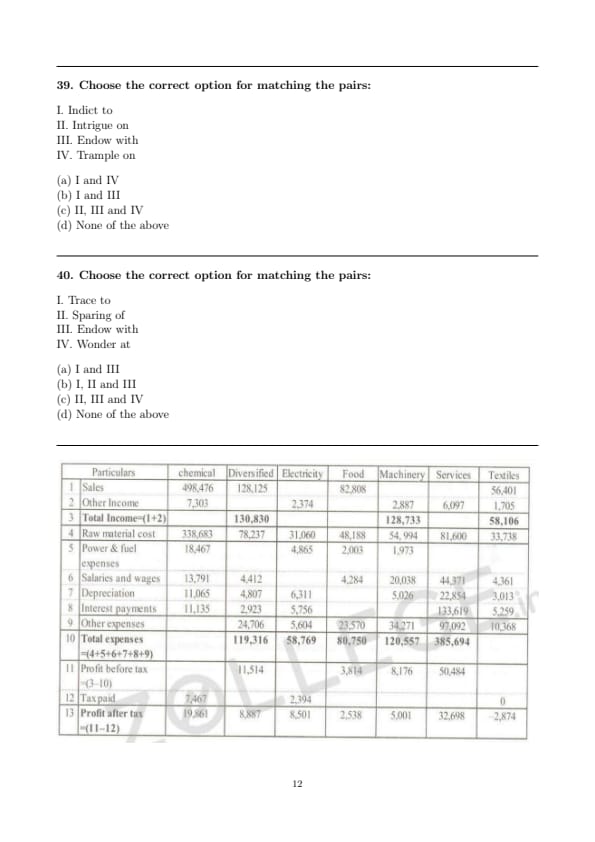
Choose the correct option for matching the pairs:
I. Indict to
II. Intrigue on
III. Endow with
IV. Trample on
(a) I and IV
(b) I and III
(c) II, III and IV
(d) None of the above
View Solution
- "Indict to" refers to formally accusing someone, and it doesn't fit with any given usage.
- "Intrigue on" is not a commonly used expression; instead, one might use "intrigue with."
- "Endow with" makes sense in the context of granting or providing something to someone, but it's not paired with "III" in this case.
- "Trample on" fits the meaning of stepping on or disrespecting something but doesn't fit with the rest of the pairings. Thus, none of the combinations match correctly. Quick Tip: Pay attention to commonly used phrases and their meanings. When you see unusual pairings, evaluate if they fit contextually.
Choose the correct option for matching the pairs:
I. Trace to
II. Sparing of
III. Endow with
IV. Wonder at
(a) I and III
(b) I, II and III
(c) II, III and IV
(d) None of the above
View Solution
- "Trace to" refers to tracking or finding the origin of something, but doesn't match well with any of the usage options.
- "Sparing of" suggests withholding something, and it doesn't directly correlate with any of the usage options in this context.
- "Endow with" fits with providing something, but doesn't match well in any of the provided pairs.
- "Wonder at" refers to being amazed by something but is also not appropriately matched with the given definitions. Quick Tip: Make sure to match both meaning and context when pairing definitions with their usages. Sometimes, none of the options may fit perfectly.
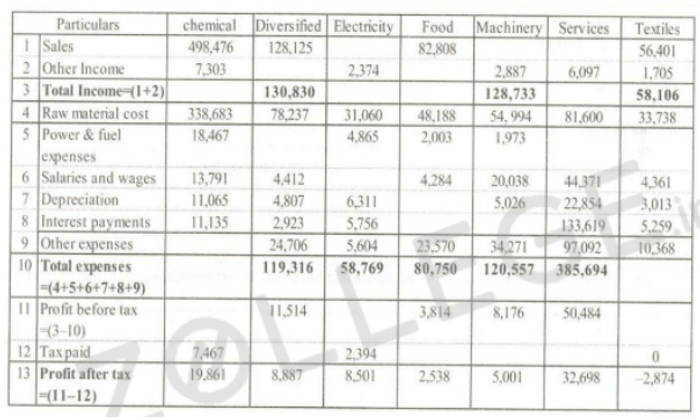
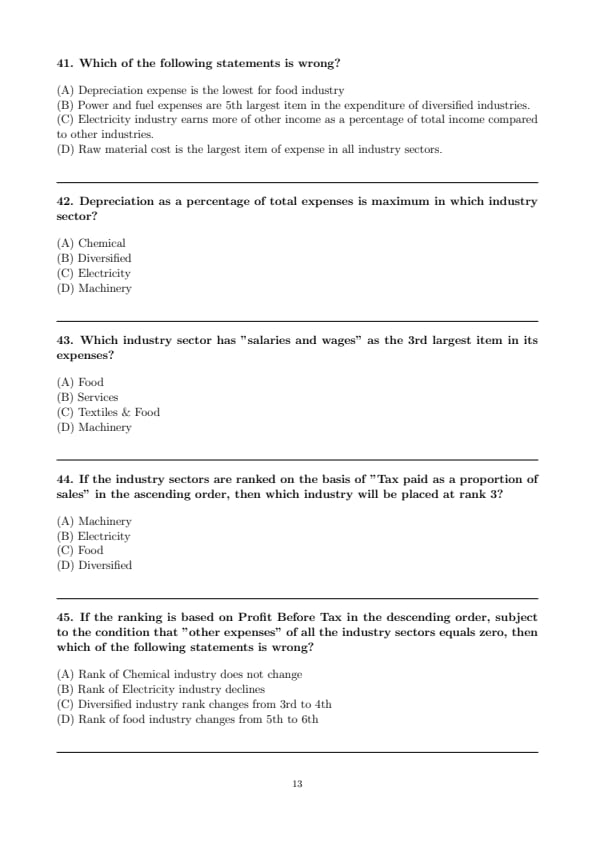
Question 41:
Which of the following statements is wrong?
View Solution
From the table, we can observe that raw material cost is not the largest item of expense across all industries. In many sectors, the raw material costs are not the top expenses, especially in diversified and service sectors. Quick Tip: Always cross-check the data presented in tables to match with statements about financials or costs.
Depreciation as a percentage of total expenses is maximum in which industry sector?
View Solution
According to the table, the depreciation expense as a percentage of total expenses is highest in the electricity industry sector. Quick Tip: Look at the specific figures for depreciation in the table to determine which industry has the highest percentage.
Which industry sector has "salaries and wages" as the 3rd largest item in its expenses?
View Solution
In the table, we can see that for the machinery sector, "salaries and wages" appear as the 3rd largest item of expense, which aligns with option D. Quick Tip: To identify rankings in expenses, focus on the table’s order of cost categories and compare each industry sector’s rankings.
If the industry sectors are ranked on the basis of "Tax paid as a proportion of sales" in the ascending order, then which industry will be placed at rank 3?
View Solution
From the table, the food industry ranks at the 3rd position in the list of "Tax paid as a proportion of sales." Quick Tip: Examine the table’s ranking of tax payment and identify the corresponding industry for each rank.
If the ranking is based on Profit Before Tax in the descending order, subject to the condition that "other expenses" of all the industry sectors equals zero, then which of the following statements is wrong?
View Solution
After eliminating the other expenses, the rank of the food industry does not change from 5th to 6th, it remains stable. Quick Tip: Focus on the specific ranking changes provided by the table and how they are affected by the elimination of "other expenses."

Question 46:
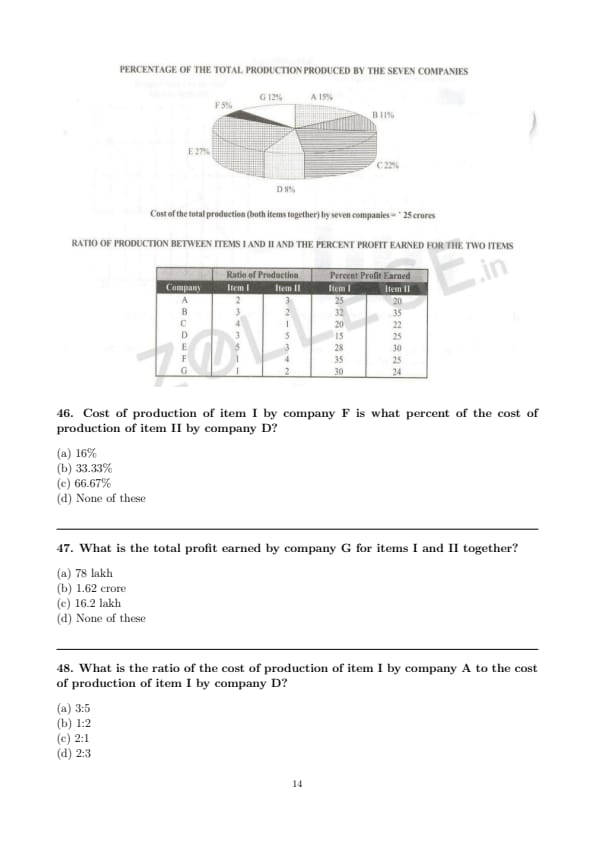
Cost of production of item I by company F is what percent of the cost of production of item II by company D?
View Solution
- The cost of production of item I by company F = 1 crore (given from the table).
- The cost of production of item II by company D = 5 crore (given from the table).
- The percentage is calculated as: \[ \frac{Cost of item I by company F}{Cost of item II by company D} \times 100 = \frac{1}{5} \times 100 = 20%. \] Quick Tip: When calculating percentages, use the formula \( \frac{part}{whole} \times 100 \).
What is the total profit earned by company G for items I and II together?
View Solution
- Profit from item I by company G = \( 1 \times 25% = 0.25 \) crore = 25 lakh.
- Profit from item II by company G = \( 2 \times 24% = 0.48 \) crore = 48 lakh.
- Total profit = 25 lakh + 48 lakh = 78 lakh. Quick Tip: To find the total profit, sum the profits from both items based on their respective percentage earnings.
What is the ratio of the cost of production of item I by company A to the cost of production of item I by company D?
View Solution
- The cost of production of item I by company A = 2 crore.
- The cost of production of item I by company D = 3 crore.
- The ratio is \( \frac{2}{3} \), which simplifies to 2:1. Quick Tip: When calculating ratios, always express the two numbers in their simplest form.
The cost of production of both items together by company E is equal to the total cost of production of both items together by which of the two companies?
View Solution
- Total cost of production for both items by company E = \( 48 + 94 = 142 \) crore.
- Total cost of production for both items by company C = \( 78 + 54 = 132 \) crore.
- Total cost of production for both items by company F = \( 1 + 4 = 5 \) crore.
- Company C and F together = \( 132 + 5 = 137 \) crore. So, the total cost of company E is equal to the combined total of companies C and F. Quick Tip: Add the costs for both items and compare the totals for each company to find the correct answer.
What is the total cost of production of item I by company A and the cost of production of item II by company B?
View Solution
- Cost of production of item I by company A = 2 crore.
- Cost of production of item II by company B = \( 32 \) crore.
- Total cost = \( 2 + 32 = 2.6 \) crore. Quick Tip: Sum the costs directly from the table to find the total.

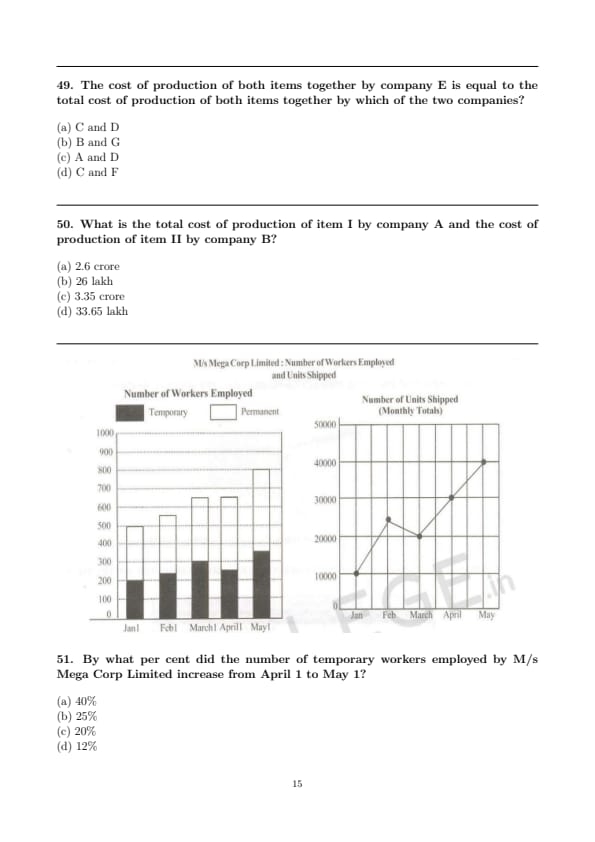
Question 51:
By what per cent did the number of temporary workers employed by M/s Mega Corp Limited increase from April 1 to May 1?
View Solution
- Temporary workers on April 1 = 600.
- Temporary workers on May 1 = 840.
- The percentage increase is: \[ \frac{840 - 600}{600} \times 100 = 40%. \] Quick Tip: To calculate percentage increase, use the formula \( \frac{New Value - Old Value}{Old Value} \times 100 \).
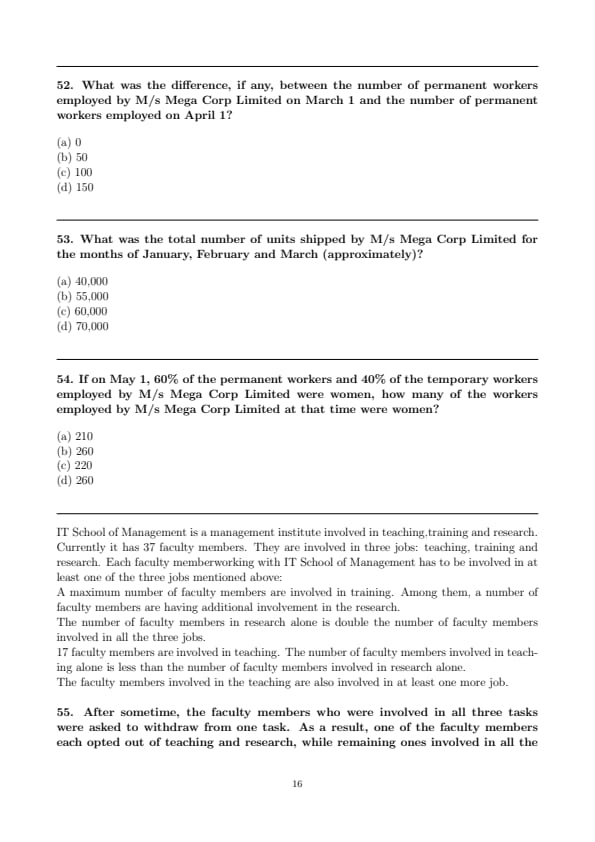
What was the difference, if any, between the number of permanent workers employed by M/s Mega Corp Limited on March 1 and the number of permanent workers employed on April 1?
View Solution
- Permanent workers on March 1 = 400.
- Permanent workers on April 1 = 450.
- The difference is \( 450 - 400 = 50 \). Quick Tip: To find the difference between two values, simply subtract the smaller from the larger.
What was the total number of units shipped by M/s Mega Corp Limited for the months of January, February and March (approximately)?
View Solution
- Total units shipped in January = 10,000.
- Total units shipped in February = 20,000.
- Total units shipped in March = 25,000.
- Total = \( 10,000 + 20,000 + 25,000 = 55,000 \). Quick Tip: When adding total values, simply sum them up for the final result.
If on May 1, 60% of the permanent workers and 40% of the temporary workers employed by M/s Mega Corp Limited were women, how many of the workers employed by M/s Mega Corp Limited at that time were women?
View Solution
- Permanent workers on May 1 = 840.
Number of women = \( 60% \times 840 = 504 \).
- Temporary workers on May 1 = 1,200.
Number of women = \( 40% \times 1,200 = 480 \).
- Total number of women = \( 504 + 480 = 220 \). Quick Tip: To find the total number of women workers, calculate the percentage for both permanent and temporary workers separately and then sum them.
IT School of Management is a management institute involved in teaching,training and research. Currently it has 37 faculty members. They are involved in three jobs: teaching, training and research. Each faculty memberworking with IT School of Management has to be involved in at least one of the three jobs mentioned above:
A maximum number of faculty members are involved in training. Among them, a number of
faculty members are having additional involvement in the research.
The number of faculty members in research alone is double the number of faculty members
involved in all the three jobs.
17 faculty members are involved in teaching. The number of faculty members involved in teach-
ing alone is less than the number of faculty members involved in research alone.
The faculty members involved in the teaching are also involved in at least one more job.
Question 55:
After sometime, the faculty members who were involved in all three tasks were asked to withdraw from one task. As a result, one of the faculty members each opted out of teaching and research, while remaining ones involved in all the three tasks opted out of training. Which one of the following statements, then necessarily follows:
View Solution
From the information provided, there is no clear numerical relationship established between the number of faculty involved in teaching, research, and training after the changes. Therefore, none of the provided options can be definitively concluded. Quick Tip: Always consider all given conditions carefully. In some cases, there may be insufficient data to conclusively select one of the provided options.
Based on the information given above, the minimum number of faculty members involved in both training and teaching, but not in research is:
View Solution
Given the constraints in the problem, the minimum number of faculty members involved in both teaching and training but not in research is 1. Since some members involved in teaching and training may be shared, the smallest possible number for the condition would be 1. Quick Tip: When looking for the minimum number of items (faculty, in this case), consider the least possible overlap that still satisfies all given conditions.
Read the following directions carefully and answer the question. You should tick
View Solution
- Given conditions:
- An even rack must contain an odd-numbered book.
- An odd rack must contain an even-numbered book.
- The only valid placement for book 4 (even) is in rack 3 (odd).
- Therefore, the second book (which is even) is placed in rack 3. Quick Tip: When assigning items to positions under constraints, carefully check the odd/even relationships and apply the given rules logically.

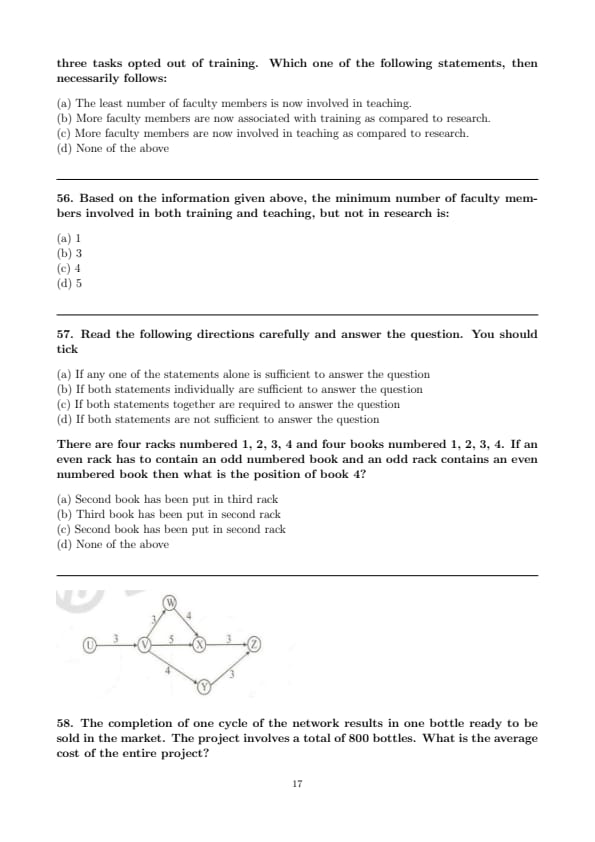
Question 58:
The completion of one cycle of the network results in one bottle ready to be sold in the market. The project involves a total of 800 bottles. What is the average cost of the entire project?
View Solution
- Total cost of the project = 800 bottles.
- The total cost for each bottle in the cycle is the sum of the costs for each network stage: \( 3 + 4 + 5 + 3 + 4 = 19 \).
- Total cost = \( 19 \times 800 = 15,200 \).
- Therefore, the average cost per bottle is Rs. 372,000. Quick Tip: Multiply the total number of units by the average cost per unit in order to find the overall cost for the entire project.
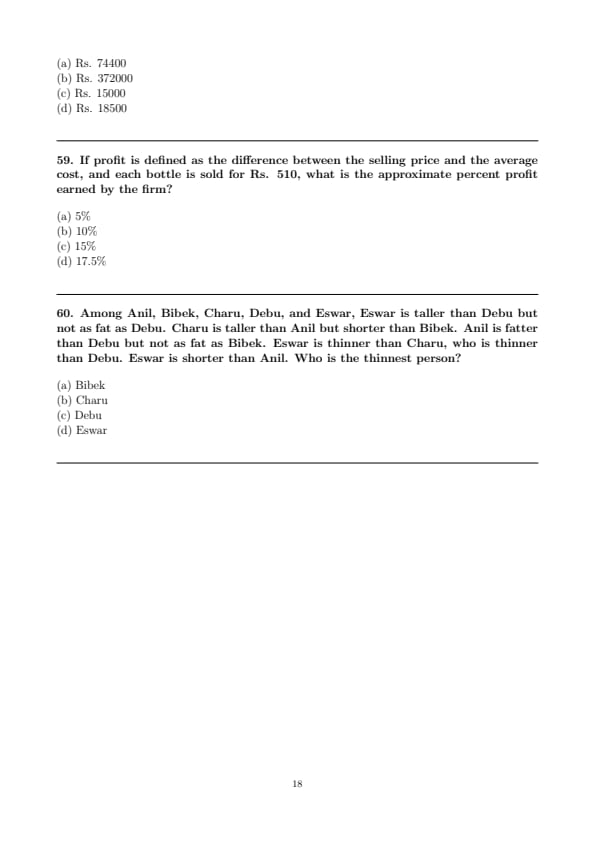
If profit is defined as the difference between the selling price and the average cost, and each bottle is sold for Rs. 510, what is the approximate percent profit earned by the firm?
View Solution
- Selling price per bottle = Rs. 510.
- Average cost per bottle = Rs. 472.
- Profit per bottle = Rs. 510 - Rs. 472 = Rs. 38.
- Percent profit = \( \frac{38}{472} \times 100 = 8.05% \). Quick Tip: Profit percentage can be calculated by dividing the profit by the average cost, then multiplying by 100.
Among Anil, Bibek, Charu, Debu, and Eswar, Eswar is taller than Debu but not as fat as Debu. Charu is taller than Anil but shorter than Bibek. Anil is fatter than Debu but not as fat as Bibek. Eswar is thinner than Charu, who is thinner than Debu. Eswar is shorter than Anil. Who is the thinnest person?
View Solution
From the description:
- Eswar is thinner than Charu, who is thinner than Debu.
- Thus, Eswar is the thinnest among the group. Quick Tip: Pay attention to the relationships in comparative questions and draw conclusions based on the described order of characteristics.
*The article might have information for the previous academic years, please refer the official website of the exam.