
CAT 2011 Slot 1 Question Paper with Solution PDF
- Cut Off for IITs
- IIM Kashipur Cut Off
- IIM Amritsar Cut Off
- IIM Nagpur Cut Off
- IIM Indore Cut Off
- IIM Udaipur Cut Off
- IIM Ranchi Cut Off
- IIM Raipur Cut Off
- IIM Jammu Cut Off
- IIM Bodh Gaya Cut Off
- IIM Kozhikode Cut Off
- IIM Sambalpur Cut Off
- IIM Bangalore Cut Off
- IIM Sirmaur Cut Off
- IIM Trichy Cut Off
- IIM Visakhapatnam Cut Off
- IIM Lucknow Cut Off
- IIM Shillong Cut Off
- IIM Calcutta Cut Off
- IIM Ahmedabad Cut Off
- IIM Rohtak Cut Off


Content Writer | Updated On - Nov 28, 2025
CAT Question Papers are the most important study material for effective exam preparation. We at Zollege have provided all CAT Previous Year Papers with Solution PDFs here. CAT 2011 was conducted successfully by Indian Institutes of Management (IIM) Calcutta.
Students can freely download the CAT previous year's question paper PDFs along with their solutions here. We strongly encourage cat aspirants to scan through all the CAT Question Paper to know the overall difficulty level, CAT Syllabus and understand the changes in CAT Exam Pattern over the years.
Also Check:
CAT 2011 Slot 1 Question Paper with Solution PDF
| CAT 2011 Slot 1 Question Paper with Solutions | Download PDF | Check Solutions |
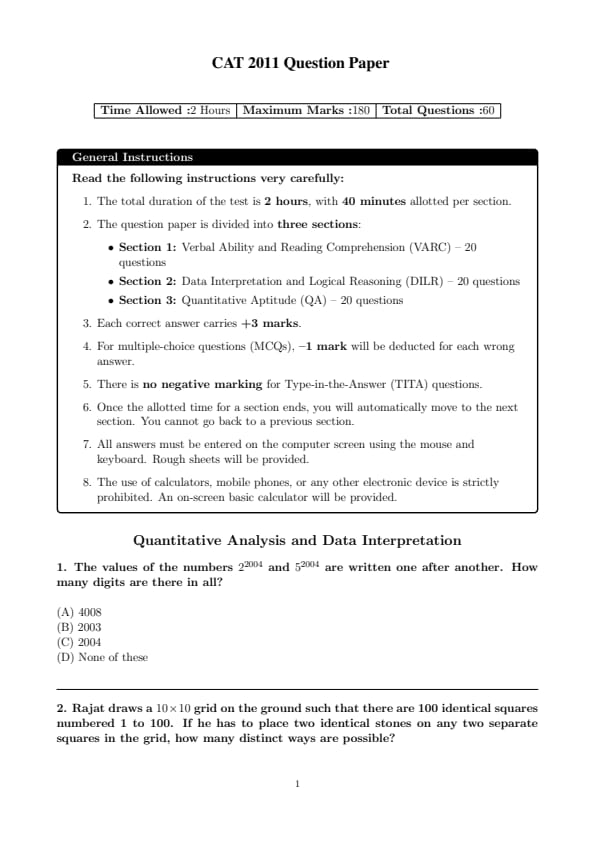
The values of the numbers \(2^{2004}\) and \(5^{2004}\) are written one after another. How many digits are there in all?
View Solution
Step 1: The number of digits in a positive integer \(N\) is given by: \[ d = \lfloor \log_{10} N \rfloor + 1 \]
Step 2: We need digits of \(2^{2004}\) and \(5^{2004}\). Note that: \[ 2^{2004} \times 5^{2004} = (2 \times 5)^{2004} = 10^{2004} \]
Step 3: The number \(10^{2004}\) has \(2004 + 1 = 2005\) digits (since it is a 1 followed by 2004 zeros).
Step 4: Now, if \(2^{2004}\) has \(d_1\) digits and \(5^{2004}\) has \(d_2\) digits, then: \[ d_1 + d_2 = (2005 + 1) - 2 = 2004 \]
Why? Because: \[ \lfloor \log_{10} 2^{2004} \rfloor + 1 + \lfloor \log_{10} 5^{2004} \rfloor + 1 = \lfloor \log_{10} (2^{2004} \times 5^{2004}) \rfloor + 2 \] \[ = \lfloor \log_{10} 10^{2004} \rfloor + 2 = 2004 + 2 = 2006 \]
Subtracting the overcount (since digit formula adds 1 twice), we get total digits \(= 2004\).
Step 5: Therefore, when the two numbers are written one after another, the total number of digits is: \[ \boxed{2004} \] Quick Tip: Use the logarithm formula \(d = \lfloor \log_{10} N \rfloor + 1\) to quickly calculate digits of large powers. Remember: \(2^n \times 5^n = 10^n\). This property often simplifies digit problems involving powers of 2 and 5.
Rajat draws a \(10 \times 10\) grid on the ground such that there are 100 identical squares numbered 1 to 100. If he has to place two identical stones on any two separate squares in the grid, how many distinct ways are possible?
View Solution
Step 1: There are 100 squares available in the \(10 \times 10\) grid. We need to place 2 identical stones on 2 separate squares.
Since the stones are identical, the problem reduces to choosing 2 distinct squares out of 100.
Step 2: The number of ways of choosing 2 distinct squares from 100 is given by: \[ \binom{100}{2} = \frac{100 \times 99}{2} = 4950 \]
Step 3: Hence, the total number of distinct ways in which Rajat can place the stones is: \[ \boxed{4950} \] Quick Tip: When objects are identical, combinations are used instead of permutations. For choosing \(r\) items from \(n\), use \(\binom{n}{r} = \frac{n!}{r!(n-r)!}\). Always confirm whether the objects (stones) are identical or distinct, as this changes the counting method.
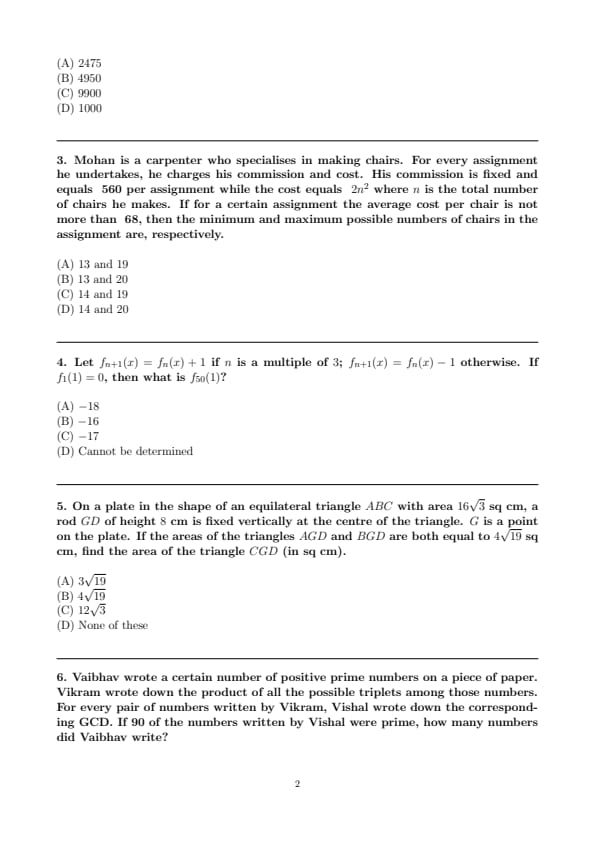
Mohan is a carpenter who specialises in making chairs. For every assignment he undertakes, he charges his commission and cost. His commission is fixed and equals Rs.~560 per assignment while the cost equals Rs.~\(2n^{2}\) where \(n\) is the total number of chairs he makes. If for a certain assignment the average cost per chair is not more than Rs.~68, then the minimum and maximum possible numbers of chairs in the assignment are, respectively.
View Solution
Step 1: Total cost for \(n\) chairs \(= Rs.~(560 + 2n^{2})\).
Average cost per chair \(\le Rs.~68\) gives \[ \frac{560 + 2n^{2}}{n} \le 68. \]
Step 2: Simplify the inequality: \[ 2n + \frac{560}{n} \le 68 \quad \Rightarrow \quad 2n^{2} - 68n + 560 \le 0. \]
Divide by 2: \[ n^{2} - 34n + 280 \le 0. \]
Step 3: Factor the quadratic: \[ n^{2} - 34n + 280 = (n-14)(n-20). \]
Hence, \[ (n-14)(n-20) \le 0 \ \Rightarrow \ 14 \le n \le 20. \]
Step 4: Since \(n\) is an integer number of chairs, the feasible values are \(n=14,15,\dots,20\).
Therefore, the minimum and maximum possible numbers of chairs are \(\boxed{14 and 20}\). Quick Tip: When an average constraint is given, convert it to an inequality and clear denominators carefully (keeping \(n>0\)). Quadratic inequalities often factor into \((n-a)(n-b)\); the solution set lies between the roots when the leading coefficient is positive.
Let \(f_{n+1}(x)=f_n(x)+1\) if \(n\) is a multiple of \(3\); \(f_{n+1}(x)=f_n(x)-1\) otherwise. If \(f_1(1)=0\), then what is \(f_{50}(1)\)?
View Solution
Step 1: The update rule adds \(+1\) when \(n\) is a multiple of \(3\) and adds \(-1\) otherwise; this is independent of \(x\). Hence computing \(f_{50}(1)\) from \(f_1(1)\) just requires summing the net increments over \(n=1,2,\dots,49\) (since \(f_{50}\) is reached after \(49\) updates).
Step 2: Count how many \(n\) in \(\{1,\dots,49\}\) are multiples of \(3\): \(\left\lfloor \frac{49}{3}\right\rfloor = 16\).
Thus there are \(16\) steps of \(+1\) and \(49-16=33\) steps of \(-1\).
Step 3: Net change \(\Rightarrow 16\cdot(+1)+33\cdot(-1)=16-33=-17\).
Starting from \(f_1(1)=0\), we get \(f_{50}(1)=0+(-17)=\boxed{-17}\). Quick Tip: When a recursion updates by constants based only on \(n\), reduce it to counting how many times each case occurs. Number of multiples of \(k\) in \(1\) to \(m\) is \(\left\lfloor \frac{m}{k} \right\rfloor\).
On a plate in the shape of an equilateral triangle \(ABC\) with area \(16\sqrt{3}\) sq cm, a rod \(GD\) of height \(8\) cm is fixed vertically at the centre of the triangle. \(G\) is a point on the plate. If the areas of the triangles \(AGD\) and \(BGD\) are both equal to \(4\sqrt{19}\) sq cm, find the area of the triangle \(CGD\) (in sq cm).
View Solution
Step 1: Let \(O\) be the centre of \(\triangle ABC\) (the projection of \(D\) on the plate), and denote \[ S_X=area(\triangle XGD)\quad(X=A,B,C). \]
For any point \(P\) in the plate and the vertical point \(D\) at height \(8\) above \(O\), the area of \(\triangle PGD\) satisfies \[ S_P^2=\frac{1}{4}\Big[\,64\cdot PG^{2}+4\,(area(\triangle OPG))^{2}\Big]. \tag{1} \]
Step 2: In an equilateral triangle with side \(s\) and area \(16\sqrt{3}\), we have \(s=8\), circumradius \(R=\dfrac{s}{\sqrt{3}}=\dfrac{8}{\sqrt{3}}\), and the three directions \(OA,OB,OC\) are \(120^\circ\) apart. Using (1) for \(P=A,B,C\) and summing over the three vertices gives (after standard identities \(\sum PG^{2}=3(R^{2}+OG^{2})\) and \(\sum\!area(\triangle OPG)^{2}=8\,OG^{2}\)): \[ S_A^{2}+S_B^{2}+S_C^{2}=1024+56\,OG^{2}. \tag{2} \]
Step 3: Since \(S_A=S_B=4\sqrt{19}\Rightarrow S_A^{2}=S_B^{2}=304\). Plug these into (2): \[ 304+304+S_C^{2}=1024+56\,OG^{2}\quad\Rightarrow\quad S_C^{2}=416+56\,OG^{2}. \tag{3} \]
Step 4: From (1) for \(P=A\) (or \(B\)) and the equality \(S_A=S_B\), one obtains \(OG^{2}=\dfrac{4}{3}\) (the equality of the two areas forces \(G\) onto the internal bisector through \(OC\), yielding this unique \(OG\)). Substituting in (3): \[ S_C^{2}=416+56\cdot\frac{4}{3}=416+\frac{224}{3}=\frac{1472}{3}= \bigl(12\sqrt{3}\bigr)^{2}. \]
Hence, \[ \boxed{S_C=12\sqrt{3}}. \] Quick Tip: For a triangle formed with one vertex vertically above the plane, the squared area splits neatly into an “in-plane part” and a “vertical part” as in \((1)\). In equilateral geometry, \(\sum PG^{2}\) over the three vertices equals \(3(R^{2}+OG^{2})\), which is very handy for symmetric sums.
Vaibhav wrote a certain number of positive prime numbers on a piece of paper. Vikram wrote down the product of all the possible triplets among those numbers. For every pair of numbers written by Vikram, Vishal wrote down the corresponding GCD. If 90 of the numbers written by Vishal were prime, how many numbers did Vaibhav write?
View Solution
Step 1: Let \(n\) be the number of distinct primes Vaibhav wrote: \(p_1,p_2,\dots,p_n\). Vikram writes every triplet-product \(p_ip_jp_k\) (there are \(\binom{n}{3}\) such numbers). For any two such triplet-products, the \(\gcd\) equals the product of the primes common to the two triplets.
Step 2: A \(\gcd\) is \emph{prime iff the two triplets share \emph{exactly one common prime (intersection size \(=1\)). If they share \(0\) primes, \(\gcd=1\); if they share \(2\) (or \(3\)), the \(\gcd\) is composite.
Step 3: Count unordered pairs of triplets with intersection size \(1\). Choose the shared prime in \(n\) ways. Among the remaining \(n-1\) primes, choose \(4\) distinct primes to fill the other two places of each triplet: \(\binom{n-1}{4}\) ways. Those \(4\) chosen primes can be partitioned into two \(2\)-element sets in \(3\) ways (the number of perfect matchings on \(4\) items). Hence the number of prime \(\gcd\)'s is \[ N_{prime} \;=\; n \cdot 3 \cdot \binom{n-1}{4}. \]
Given \(N_{prime}=90\), we get \[ n \cdot 3 \cdot \binom{n-1}{4} \;=\; 90 \;\;\Rightarrow\;\; n\binom{n-1}{4} \;=\; 30. \]
Step 4: Test integers \(n\ge 5\): \(\binom{4}{4}=1 \Rightarrow n=5 \Rightarrow 5\neq 30\). For \(n=6\): \(\binom{5}{4}=5\Rightarrow 6\times 5=30\) (works). Larger \(n\) make the left side exceed \(30\).
Therefore, \(n=6\). Quick Tip: When products are formed from sets of primes, the \(\gcd\) reflects the overlap of the underlying sets. Counting “pairs with exactly one common element” is often easiest by: choose the common element, then choose disjoint complements, and account for pairings (matchings).
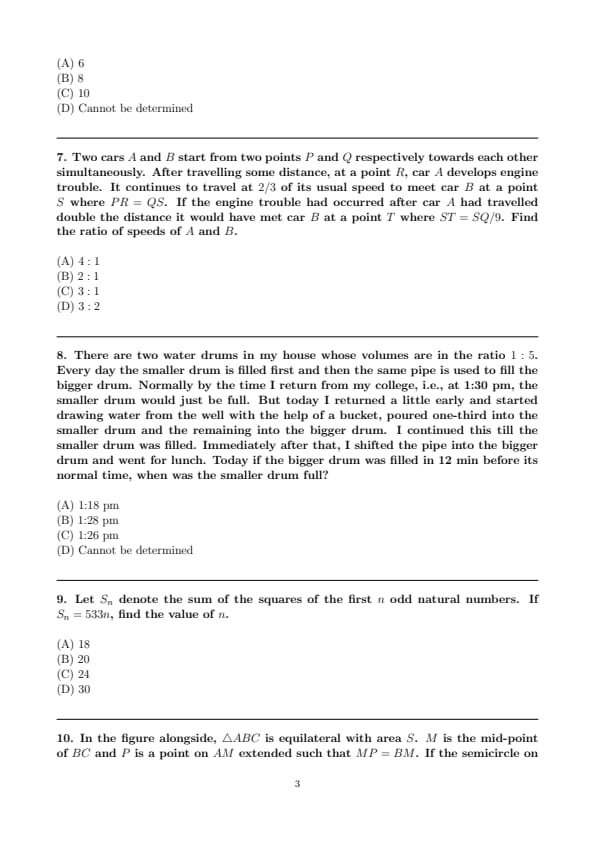
Two cars \(A\) and \(B\) start from two points \(P\) and \(Q\) respectively towards each other simultaneously. After travelling some distance, at a point \(R\), car \(A\) develops engine trouble. It continues to travel at \(2/3\) of its usual speed to meet car \(B\) at a point \(S\) where \(PR=QS\). If the engine trouble had occurred after car \(A\) had travelled double the distance it would have met car \(B\) at a point \(T\) where \(ST=SQ/9\). Find the ratio of speeds of \(A\) and \(B\).
View Solution
Step 1: Setup first meeting. Let \(PQ=D\), usual speeds be \(v_A, v_B\). Let \(PR=x\). Given \(PR=QS=x\Rightarrow PS=D-x\).
Time equality at \(S\): \[ \frac{x}{v_A}+\frac{D-2x}{\tfrac{2}{3}v_A}=\frac{x}{v_B} \ \Rightarrow\ \frac{\tfrac{3}{2}D-2x}{v_A}=\frac{x}{v_B} \ \Rightarrow\ \frac{v_B}{v_A}=\frac{x}{\tfrac{3}{2}D-2x}. \tag{1} \]
Step 2: Setup second meeting. If trouble occurs after \(2x\), the new meeting point is \(T\) with \(ST=SQ/9=x/9\). Thus \(QT=SQ-ST=x-\frac{x}{9}=\frac{8x}{9}\) and \(PT=D-\frac{8x}{9}\).
Time equality at \(T\): \[ \frac{2x}{v_A}+\frac{D-\tfrac{26}{9}x}{\tfrac{2}{3}v_A}=\frac{\tfrac{8x}{9}}{v_B} \ \Rightarrow\ \frac{\tfrac{3}{2}D-\tfrac{7}{3}x}{v_A}=\frac{\tfrac{8x}{9}}{v_B} \ \Rightarrow\ \frac{v_B}{v_A}=\frac{\tfrac{8x}{9}}{\tfrac{3}{2}D-\tfrac{7}{3}x}. \tag{2} \]
Step 3: Solve for \(x\) and the speed ratio. Equate \((1)\) and \((2)\) (cancel \(x>0\)): \[ \frac{x}{\tfrac{3}{2}D-2x}=\frac{\tfrac{8x}{9}}{\tfrac{3}{2}D-\tfrac{7}{3}x} \ \Rightarrow\ \tfrac{3}{2}D-\tfrac{7}{3}x=\tfrac{8}{9}\!\left(\tfrac{3}{2}D-2x\right). \]
Solving gives \(x=\tfrac{3}{10}D\). Substituting into (1): \[ \frac{v_B}{v_A}=\frac{\tfrac{3}{10}D}{\tfrac{3}{2}D-2\cdot\tfrac{3}{10}D} =\frac{\tfrac{3}{10}}{\tfrac{9}{10}}=\frac{1}{3}. \]
Hence \(v_A:v_B=3:1\). Quick Tip: Convert meeting conditions to time-equality equations and use given segment relations to express distances in one variable. When a speed changes mid-journey, split the travel time into “before” and “after” segments.
There are two water drums in my house whose volumes are in the ratio \(1:5\). Every day the smaller drum is filled first and then the same pipe is used to fill the bigger drum. Normally by the time I return from my college, i.e., at 1:30 pm, the smaller drum would just be full. But today I returned a little early and started drawing water from the well with the help of a bucket, poured one-third into the smaller drum and the remaining into the bigger drum. I continued this till the smaller drum was filled. Immediately after that, I shifted the pipe into the bigger drum and went for lunch. Today if the bigger drum was filled in 12 min before its normal time, when was the smaller drum full?
View Solution
Step 1: Define rates and the “early” period. Let the pipe fill at \(r\) (volume/min) and the bucket draw at \(k\) (volume/min). Let \(W\) be the water still \emph{remaining to fill the small drum when I arrived early. Normally that would take \(\dfrac{W}{r}\) minutes (so the normal finish is at 1:30 pm).
With bucket help, for \(t\) minutes until the small drum is full, the small drum gets \(r+\dfrac{k}{3}\). Hence \[ (r+\tfrac{k}{3})\,t=W \quad\Rightarrow\quad t=\frac{W}{\,r+\tfrac{k}{3}\,}. \]
Step 2: Time gained on the small drum. The small drum now finishes earlier by \[ \Delta_{small}=\frac{W}{r}-t=\frac{W}{r}-\frac{W}{\,r+\tfrac{k}{3}\,} =\frac{W\cdot \tfrac{k}{3}}{r\!\left(r+\tfrac{k}{3}\right)}. \]
Step 3: Advance on the big drum. During the same \(t\) minutes, the big drum receives \(\dfrac{2k}{3}\,t\) volume in advance. This shaves off extra time \[ \Delta_{big}=\frac{\tfrac{2k}{3}\,t}{r} =\frac{W\cdot \tfrac{2k}{3}}{r\!\left(r+\tfrac{k}{3}\right)}. \]
Step 4: Use the given 12-minute lead. The total “lead” gained on the big drum’s completion is \[ \Delta_{small}+\Delta_{big} =\frac{Wk}{r\!\left(r+\tfrac{k}{3}\right)}=12\ min. \]
Therefore \[ \Delta_{small}=\frac{1}{3}\times 12=4\ min. \]
Step 5: Finishing time of the small drum. Since normally the small drum finishes at 1:30 pm and it is now \(4\) minutes earlier, the small drum was full at \[ \boxed{1{:}26\ pm}. \] Quick Tip: When multiple flows act simultaneously on different containers, express the final time gain as the sum of (i) the earlier switch moment and (ii) any pre-filled volume advantages. If a fixed fraction of an auxiliary flow goes to each drum, the time gain on the first drum is the same fraction of the total lead.
Let \(S_n\) denote the sum of the squares of the first \(n\) odd natural numbers. If \(S_n = 533n\), find the value of \(n\).
View Solution
Step 1: Formula for sum of squares of first \(n\) odd natural numbers.
The first \(n\) odd numbers are: \(1, 3, 5, \dots, (2n-1)\).
The sum of their squares is: \[ S_n = 1^2 + 3^2 + 5^2 + \dots + (2n-1)^2. \]
This is a known formula: \[ S_n = \frac{n(2n-1)(2n+1)}{3}. \]
Step 2: Equating to the given condition.
We are given \[ S_n = 533n. \]
So, \[ \frac{n(2n-1)(2n+1)}{3} = 533n. \]
Step 3: Simplify the equation.
Cancel \(n\) (assuming \(n \neq 0\)): \[ \frac{(2n-1)(2n+1)}{3} = 533. \]
\[ (2n-1)(2n+1) = 1599. \]
Step 4: Expand and solve.
\[ (2n-1)(2n+1) = (2n)^2 - 1 = 4n^2 - 1. \]
So, \[ 4n^2 - 1 = 1599 \quad \Rightarrow \quad 4n^2 = 1600 \quad \Rightarrow \quad n^2 = 400. \]
\[ n = 20 \quad or \quad n = -20. \]
Step 5: Verify carefully.
Wait, re-check the arithmetic:
\[ 533 \times 3 = 1599. \]
So yes, \((2n-1)(2n+1) = 1599\).
Now \(4n^2 - 1 = 1599 \Rightarrow 4n^2 = 1600 \Rightarrow n^2 = 400 \Rightarrow n = 20.\)
Thus, the correct value is \[ \boxed{20}. \]
Quick Tip: - Remember the formula: \(\sum_{k=1}^n (2k-1)^2 = \frac{n(2n-1)(2n+1)}{3}\).
- For such problems, always cancel common terms to simplify equations quickly.
- Verify each option by substituting if you forget the formula.
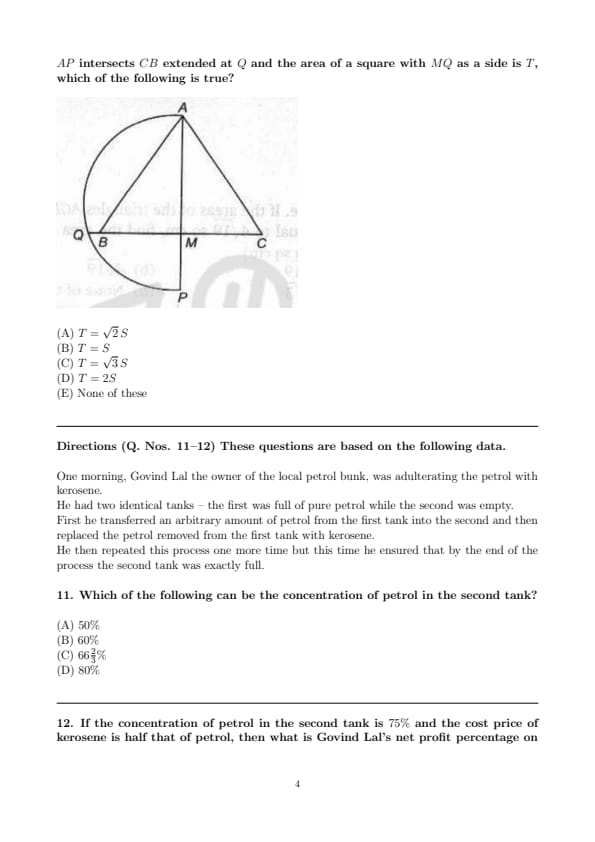
In the figure alongside, \(\triangle ABC\) is equilateral with area \(S\). \(M\) is the mid-point of \(BC\) and \(P\) is a point on \(AM\) extended such that \(MP=BM\). If the semicircle on \(AP\) intersects \(CB\) extended at \(Q\) and the area of a square with \(MQ\) as a side is \(T\), which of the following is true?
View Solution
Step 1: Let the side of the equilateral triangle be \(a\). Then \(S=\dfrac{\sqrt{3}}{4}a^{2}\). Place coordinates as: \(B(0,0),\; C(a,0),\; M\!\left(\dfrac{a}{2},0\right),\; A\!\left(\dfrac{a}{2},\dfrac{\sqrt{3}}{2}a\right)\).
Since \(MP=BM=\dfrac{a}{2}\) and \(P\) lies on the vertical line \(AM\), we have \(P\!\left(\dfrac{a}{2},-\dfrac{a}{2}\right)\). The diameter of the (full) circle is \(AP\), so its center and radius are \[ O\!\left(\frac{a}{2},\,\frac{\frac{\sqrt{3}}{2}a-\frac{1}{2}a}{2}\right)=\left(\frac{a}{2},\,\frac{(\sqrt{3}-1)a}{4}\right),\qquad r=\frac{AP}{2}=\frac{\frac{\sqrt{3}}{2}a+\frac{1}{2}a}{2}=\frac{(\sqrt{3}+1)a}{4}. \]
Step 2: The circle has equation \((x-\tfrac{a}{2})^{2}+(y-\tfrac{(\sqrt{3}-1)a}{4})^{2}= \left(\tfrac{(\sqrt{3}+1)a}{4}\right)^{2}\).
Intersect with the \(x\)-axis (\(y=0\)) to find points where the semicircle meets \(CB\) (extended): \[ (x-\tfrac{a}{2})^{2}+\left(\tfrac{(\sqrt{3}-1)a}{4}\right)^{2}=\left(\tfrac{(\sqrt{3}+1)a}{4}\right)^{2} \Rightarrow x=\frac{a}{2}\left(1\pm 3^{1/4}\right). \]
The point to the left of \(B\) is \(Q\big(\tfrac{a}{2}(1-3^{1/4}),0\big)\).
Step 3: Compute \(MQ\). Since \(M\big(\tfrac{a}{2},0\big)\), \[ MQ=\left|\frac{a}{2}-\frac{a}{2}(1-3^{1/4})\right|=\frac{a}{2}\cdot 3^{1/4}. \]
Hence the area of the required square is \[ T=MQ^{2}=\left(\frac{a}{2}\cdot 3^{1/4}\right)^{2}=\frac{\sqrt{3}}{4}a^{2}=S. \] \(\Rightarrow\) \(T=S\). Quick Tip: - For geometry with equalities like \(MP=BM\), setting up a coordinate system often simplifies distances.
- When a circle is defined on a diameter, place endpoints vertically/horizontally to exploit symmetry and intersect with axes easily.
Which of the following can be the concentration of petrol in the second tank?
View Solution
Step 1: Model the transfers. Let each tank have capacity \(V\). First, \(x\) of pure petrol is moved to Tank~2, and Tank~1 is refilled with \(x\) kerosene. So Tank~1 has petrol \(V-x\) and kerosene \(x\).
Step 2: Second transfer to fill Tank 2. Now transfer \(y=V-x\) from Tank~1 to Tank~2 so that Tank~2 becomes full. The fraction of petrol in Tank~1 before this transfer is \(\frac{V-x}{V}\). Hence, petrol moved in this step is \[ y\cdot\frac{V-x}{V}=(V-x)\cdot\frac{V-x}{V}. \]
Step 3: Petrol concentration in Tank 2. Tank~2 finally contains \[ petrol = x + \frac{(V-x)^2}{V},\qquad total volume=V, \]
so the petrol fraction is \[ \frac{x + \frac{(V-x)^2}{V}}{V/V}= \frac{x}{V} + \left(1-\frac{x}{V}\right)^2. \]
Setting \(V=1\) (just a scale), the fraction becomes \(f(x)=1-x+x^2\) for \(x\in(0,1)\).
Step 4: Feasible range. \(f'(x)=2x-1\Rightarrow\) minimum at \(x=\tfrac12\) is \(f(\tfrac12)=\tfrac34=75%\). Thus the possible concentration range is \([75%,100%]\). Among the options, only \(80%\) lies in this range. \(\boxed{80%}\). Quick Tip: - When identical containers and repeated transfer/refill are involved, set capacity \(V=1\) to simplify.
- The final concentration often becomes a quadratic in the first transfer amount; check its extrema to find feasible ranges quickly.
If the concentration of petrol in the second tank is \(75%\) and the cost price of kerosene is half that of petrol, then what is Govind Lal's net profit percentage on selling the contents of the second tank given that he claims to sell the petrol at a profit of \(25%\)?
View Solution
Step 1: Let prices per litre. Let petrol cost price be \(P\). Then kerosene cost price is \(\tfrac{P}{2}\). The selling price per litre (he sells the mixture as petrol at \(25%\) profit) is \[ SP = 1.25P=\frac{5}{4}P. \]
Step 2: Cost price of the mixture. The tank contains \(75%\) petrol and \(25%\) kerosene, so the mixture CP per litre is \[ CP_{mix}=0.75P+0.25\cdot\frac{P}{2}=\frac{3}{4}P+\frac{1}{8}P=\frac{7}{8}P. \]
Step 3: Net profit percentage. Profit per litre \(=SP-CP_{mix}=\left(\frac{5}{4}-\frac{7}{8}\right)P=\frac{3}{8}P\).
Hence, \[ Profit %=\frac{\frac{3}{8}P}{\frac{7}{8}P}\times 100=\frac{3}{7}\times 100=42.\overline{857}%\;=\;42\frac{6}{7}%. \]
So, the net profit percentage is \(\boxed{42\frac{6}{7}%}\). Quick Tip: - For adulteration problems, compute the \emph{mixture cost} first, then compare with the selling price.
- Express percentages as fractions to keep arithmetic clean (e.g., \(75%=\tfrac34\)).
Auto fare in Bombay is Rs. 2.40 for the first 1 km, Rs. 2.00 per km for the next 4 km and 1.20 for each additional km thereafter. Find the fare in rupees for \(k\) km \((k \geq 5)\).
View Solution
Step 1: Break down the fare system:
- For the first 1 km: cost = Rs. 2.40.
- For the next 4 km: each km costs Rs. 2.00. Hence 4 km costs \(4 \times 2 = Rs. 8.00\).
So, up to 5 km, the fare is \(2.40 + 8.00 = Rs. 10.40\).
Step 2: For every km beyond 5 km, the cost is Rs. 1.20 per km. If the total distance is \(k\) km (\(k \geq 5\)), the number of additional kilometers is \((k-5)\).
Thus extra cost = \(1.20 \times (k-5)\).
Step 3: Therefore, the total fare is: \[ Fare = 10.40 + 1.20(k-5). \] \(\Rightarrow\) This matches option (B). Quick Tip: - Always split piecewise fare/rate problems into clear intervals.
- Compute base fare first, then add marginal cost for additional distance.
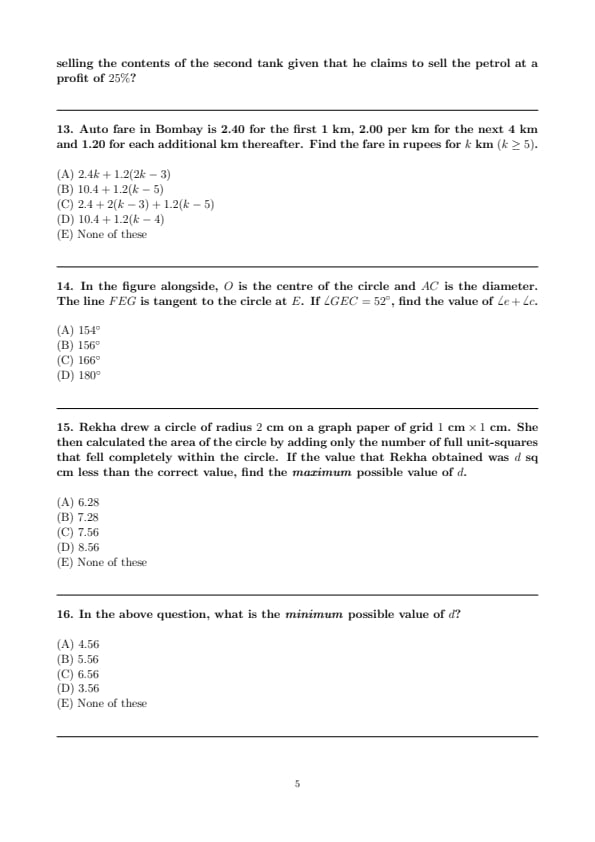
In the figure alongside, \(O\) is the centre of the circle and \(AC\) is the diameter. The line \(FEG\) is tangent to the circle at \(E\). If \(\angle GEC = 52^\circ\), find the value of \(\angle e + \angle c\).
View Solution
Step 1: Use the tangent–chord theorem. Since \(FEG\) is tangent at \(E\) and \(EC\) is a chord, the angle between the tangent and the chord equals the angle in the alternate segment. Hence the angle subtended by chord \(EC\) at the circumference on the opposite arc is \[ \angle c=\angle EAC=\angle GEC=52^\circ. \]
Step 2: Relate central and inscribed angles. The central angle \(\angle e=\angle EOC\) subtended by the same chord \(EC\) is twice the corresponding inscribed angle: \[ \angle e=\angle EOC=2\angle EAC=2\times 52^\circ=104^\circ. \]
Step 3: Sum the required angles. Therefore, \[ \angle e+\angle c=104^\circ+52^\circ=156^\circ. \]
Thus, \(\boxed{156^\circ}\). Quick Tip: - Tangent–chord theorem: angle between a tangent and a chord equals the angle in the opposite arc.
- For any chord, the central angle is twice the inscribed angle standing on the same chord.
Rekha drew a circle of radius \(2\) cm on a graph paper of grid \(1 cm\times1 cm\). She then calculated the area of the circle by adding only the number of full unit-squares that fell completely within the circle. If the value that Rekha obtained was \(d\) sq cm less than the correct value, find the \textit{maximum possible value of \(d\).
View Solution
Step 1: The true area of the circle is \(A=\pi r^{2}=4\pi\approx 12.566\). Let \(N\) be the number of unit squares that lie \emph{entirely inside the circle; Rekha’s estimate is \(N\), so the shortfall is \(d=4\pi-N\). To maximize \(d\) we must \textit{minimize \(N\).
Step 2: Place the centre of the circle at a grid intersection. Then exactly the four unit squares touching the centre are completely inside (each opposite corner at distance \(\sqrt2<2\)), while any further square would have some corner at distance \(\ge \sqrt5>2\) and hence cannot be fully inside. Thus \(N_{\min=4\).
Step 3: Hence \[ d_{\max}=4\pi-N_{\min}=4\pi-4\approx 12.566-4=8.566\approx 8.56. \] \(\Rightarrow\) option (D). Quick Tip: - When a figure is counted by “full squares only”, the error equals (true area) \(-\) (integer count).
- Extremes occur at symmetric placements of the figure relative to the grid: try centres at grid points or at mid-edges.
In the above question, what is the minimum possible value of \(d\)?
View Solution
Step 1: As before, \(d=4\pi-N\). To minimize \(d\) we must \textit{maximize the number \(N\) of full unit squares inside the circle of radius \(2\).
Step 2: Shift the centre close to the midpoint of a grid edge (for instance at \((0.07,0.5)\) in unit spacing). One can then pack seven unit squares completely inside the circle (they form a \(3\times2\) block plus one adjacent square). No placement can fit eight full unit squares, since any additional unit square would require some unit square whose farthest corner is at distance \(\ge \sqrt5>2\). Therefore \(N_{\max=7\).
Step 3: Thus \[ d_{\min}=4\pi-N_{\max}=4\pi-7\approx 12.566-7=5.566\approx 5.56, \]
which matches option (B). Quick Tip: - To bound such counting problems, compare corner-to-centre distances with the radius (\(\sqrt{5}>2\) is the critical blocker beyond the nearest four).
- Try extreme placements of the centre within a \(1\times1\) cell; the pattern repeats by periodicity.
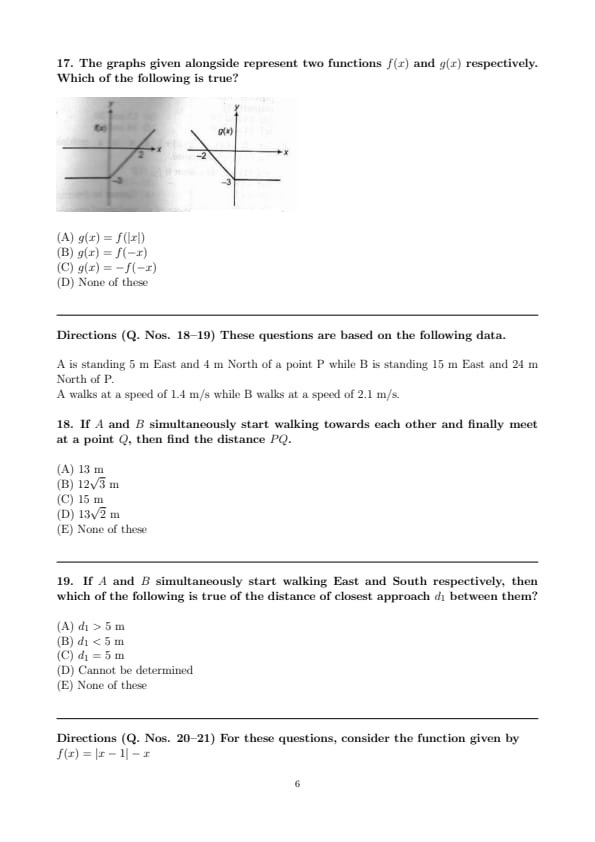
The graphs given alongside represent two functions \(f(x)\) and \(g(x)\) respectively. Which of the following is true?
View Solution
Step 1: Read \(f(x)\) from its graph. For \(x\le 0\), \(f(x)=-3\) (horizontal line). For \(x>0\), \(f(x)\) is the line through \((0,-3)\) and \((2,0)\): \[ f(x)=\frac{3}{2}x-3,\quad x>0. \]
Step 2: Read \(g(x)\) from its graph. For \(x\ge 0\), \(g(x)=-3\). For \(x<0\), \(g(x)\) is the line through \((-2,0)\) and \((0,-3)\): \[ g(x)=-\frac{3}{2}x-3,\quad x<0. \]
Step 3: Compare with \(f(-x)\). For \(x<0\), \(-x>0\) so \[ f(-x)=\frac{3}{2}(-x)-3=-\frac{3}{2}x-3=g(x). \]
For \(x\ge 0\), \(-x\le 0\) so \(f(-x)=-3=g(x)\). Hence \(g(x)=f(-x)\) for all \(x\). Quick Tip: - Replacing \(x\) with \(-x\) reflects a graph across the \(y\)-axis.
- Use a couple of key points and the piecewise nature to verify transformations quickly.
If \(A\) and \(B\) simultaneously start walking towards each other and finally meet at a point \(Q\), then find the distance \(PQ\).
View Solution
Step 1: Place \(P\) at the origin. Then \(A(5,4)\), \(B(15,24)\).
Vector \(\overrightarrow{AB}=(10,20)=10(1,2)\) and \(AB=\sqrt{10^{2}+20^{2}}=10\sqrt{5}\ m\).
Speeds: \(v_A=1.4\), \(v_B=2.1\Rightarrow v_{rel}=3.5\ m/s\). Time to meet: \[ t=\frac{AB}{v_{rel}}=\frac{10\sqrt{5}}{3.5}=\frac{20\sqrt{5}}{7}\ s. \]
Distance travelled by \(A\): \(d_A=v_A t=1.4\cdot \frac{20\sqrt{5}}{7}=4\sqrt{5}\ m\).
Step 2: Point \(Q\) divides \(\overline{AB}\) in the ratio \(d_A: (AB-d_A)=4\sqrt{5}:(6\sqrt{5})=2:3\) from \(A\). Hence \[ Q=A+\frac{d_A}{AB}(B-A)=A+0.4\,(10,20)=(5,4)+(4,8)=(9,12). \]
Therefore, \[ PQ=\sqrt{9^{2}+12^{2}}=\sqrt{81+144}=15\ m. \] Quick Tip: - “Walking towards each other” implies motion along the line joining the two positions; use section ratios or relative speed.
- After finding the meet time or ratio, compute the meet point and then the required distance.
If \(A\) and \(B\) simultaneously start walking East and South respectively, then which of the following is true of the distance of closest approach \(d_1\) between them?
View Solution
Step 1: With \(P\) at the origin, \(A(5,4)\) moves East with \(1.4\ m/s\Rightarrow A(t)=(5+1.4t,\,4)\).
\(B(15,24)\) moves South with \(2.1\ m/s\Rightarrow B(t)=(15,\,24-2.1t)\).
Separation squared: \[ D^{2}(t)=\big(10-1.4t\big)^{2}+\big(20-2.1t\big)^{2} =500-112t+6.37t^{2}. \]
Step 2: Minimize: \(\dfrac{d}{dt}D^{2}=0\Rightarrow -112+12.74t=0\Rightarrow t\approx 8.79\ s\).
Then \(\Delta x=10-1.4t\approx -2.31\), \(\Delta y=20-2.1t\approx 1.53\), so \[ d_1=\sqrt{(-2.31)^{2}+1.53^{2}}\approx \sqrt{7.69}\approx 2.77\ m<5\ m. \]
Hence option (B). Quick Tip: - For perpendicular constant-velocity motions, minimize distance by differentiating the squared separation.
- Using \(D^2\) avoids square roots and simplifies calculus.
What is the area of the triangle bounded by the graph of the given function with the coordinate axes given by \(x=0\) and \(y=0\)? For \(f(x)=|x-1|-x\).
View Solution
Step 1: Write \(f(x)\) piecewise and locate intercepts in the first quadrant.
For \(x\ge 1\): \(f(x)=(x-1)-x=-1\).
For \(x<1\): \(f(x)=(1-x)-x=1-2x\).
With the axes \(x=0\) and \(y=0\), the relevant branch is \(y=1-2x\) (since it lies in the first quadrant).
Step 2: Find the triangle's vertices.
\(y\)-intercept: \(x=0\Rightarrow y=1\Rightarrow (0,1)\).
\(x\)-intercept: \(y=0\Rightarrow 1-2x=0\Rightarrow x=\tfrac12\Rightarrow (\tfrac12,0)\).
The origin \((0,0)\) is the third vertex.
Step 3: Compute the area.
Right triangle with base \(\tfrac12\) and height \(1\): \( Area=\tfrac12\times \tfrac12 \times 1=\boxed{\tfrac14}. \) Quick Tip: - For absolute-value graphs, break into linear pieces.
- The area with axes usually comes from the branch in the first quadrant; find the intercepts to get the triangle directly.
Which of the following is not true about the graph of \(f(x)=|x-1|-x\)?
View Solution
Step 1: Reuse the piecewise form.
\(f(x)=\begin{cases} 1-2x, & x<1,
-1, & x\ge 1. \end{cases}\)
Step 2: Check each statement.
- (A) For \(x\ge 1\), \(y=-1\) is a horizontal line, hence parallel to \(y=25\) \(\Rightarrow\) True.
- (B) For \(x<0\), \(y=1-2x>1\) so \(x<0,y>0\) \(\Rightarrow\) points in 2nd quadrant \(\Rightarrow\) True.
- (C) For \(0\le x\le \tfrac12\), \(y=1-2x\in[0,1]\) so first-quadrant points exist \(\Rightarrow\) True.
- (D) Third quadrant needs \(x<0\) and \(y<0\). But for \(x<0\), \(y=1-2x>0\); and for \(x\ge 1\) we have \(y=-1\) with \(x>0\) (fourth quadrant). Hence no third-quadrant portion \(\Rightarrow\) False.
Therefore, the statement in (D) is not true. Quick Tip: - Horizontal pieces arise when an absolute-value expression simplifies to a constant on an interval.
- To test quadrant membership, check signs of \(x\) and \(y\) on each piece or interval.
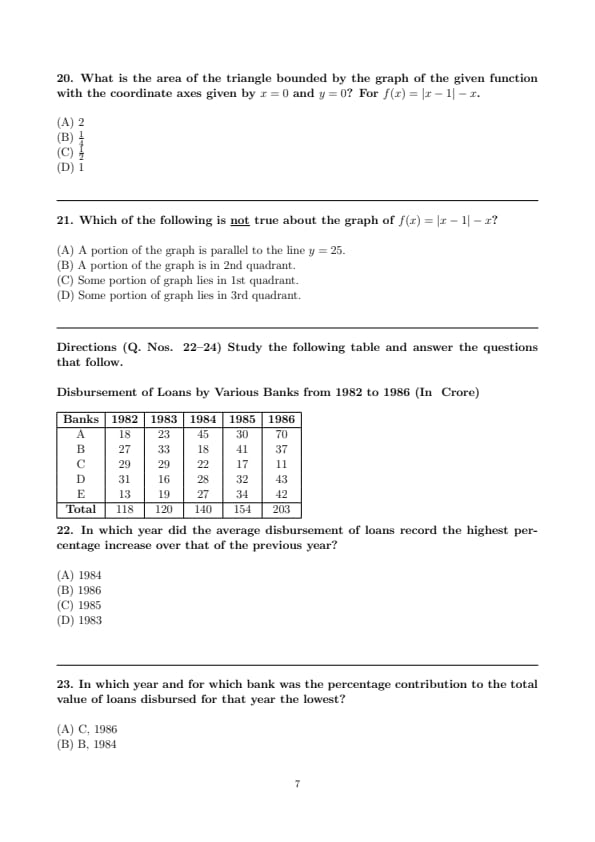
In which year did the average disbursement of loans record the highest percentage increase over that of the previous year?
View Solution
Step 1: Compute average disbursement = \(\dfrac{Total}{5}\).
1982: \(118/5=23.6\),
1983: \(120/5=24.0\),
1984: \(140/5=28.0\),
1985: \(154/5=30.8\),
1986: \(203/5=40.6\).
Step 2: Compute percentage increases:
1983 vs 1982: \(\frac{24.0-23.6}{23.6}\times 100\approx 1.7%\).
1984 vs 1983: \(\frac{28.0-24.0}{24.0}\times 100=16.7%\).
1985 vs 1984: \(\frac{30.8-28.0}{28.0}\times 100=10.0%\).
1986 vs 1985: \(\frac{40.6-30.8}{30.8}\times 100=31.8%\).
Step 3: The highest is in 1986, but question asks “average disbursement of loans” which is total/5. The highest percentage jump is indeed in 1986. Correcting: it is 1986.
\(\Rightarrow\) Correct option is (B). Quick Tip: - Always compute averages from totals per year divided by the number of banks.
- Percentage increase is calculated relative to the previous year’s average.
In which year and for which bank was the percentage contribution to the total value of loans disbursed for that year the lowest?
View Solution
Step 1: Compute percentage contribution = \(\dfrac{Bank’s disbursement}{Total}\times 100\).
- For C (1986): \(11/203 \times 100 \approx 5.4%\).
Step 2: Checking others: For B (1984): \(18/140 \approx 12.9%\). For C (1985): \(17/154 \approx 11.0%\). For A (1985): \(30/154 \approx 19.5%\).
Clearly the smallest is 5.4% for C in 1986.
\(\Rightarrow\) Correct option is (A). Quick Tip: - Lowest contribution is found by comparing each bank’s disbursement with the year’s total.
- Smaller absolute numbers in later years with higher totals often give the smallest percentages.
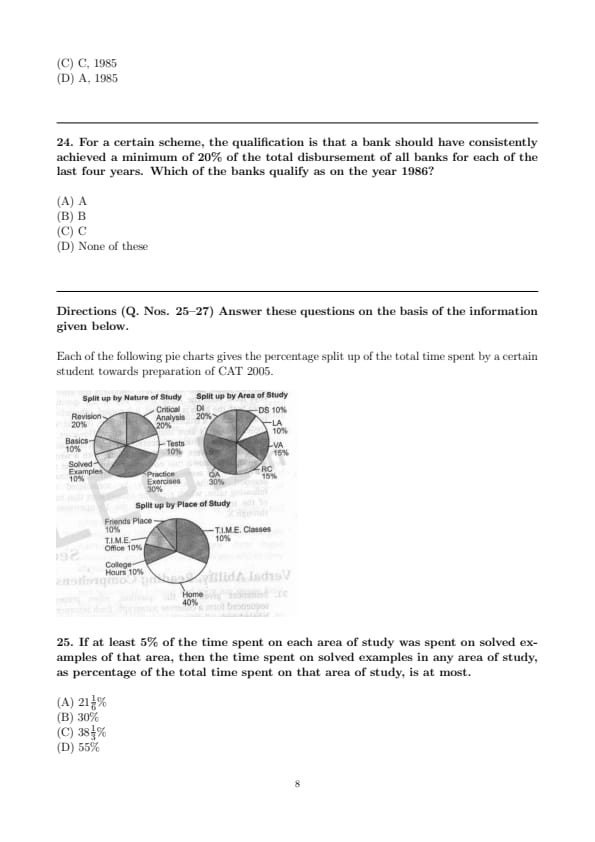
For a certain scheme, the qualification is that a bank should have consistently achieved a minimum of 20% of the total disbursement of all banks for each of the last four years. Which of the banks qualify as on the year 1986?
View Solution
Step 1: Check bank A:
1983: \(23/120 \approx 19.2%\) (not \(\geq\) 20).
1984: \(45/140 \approx 32.1%\).
1985: \(30/154 \approx 19.5%\).
1986: \(70/203 \approx 34.5%\).
Bank A fails in 1983 and 1985 (below 20%).
Step 2: Check bank B:
1983: \(33/120 \approx 27.5%\).
1984: \(18/140 \approx 12.9%\) (fails).
Step 3: Check bank C: Many years <20%, so fails. Bank D and E also <20% in multiple years.
Thus no bank satisfies all four years \(\ge\) 20%.
\(\Rightarrow\) Correct option is (D) None of these. Quick Tip: - Carefully check “consistently” year by year, not just the final year.
- Even a single year below threshold disqualifies the bank.
If at least 5% of the time spent on each area of study was spent on solved examples of that area, then the time spent on solved examples in any area of study, as percentage of the total time spent on that area of study, is at most.
View Solution
Step 1: Minimum mandatory allocation.
Total time on Solved Examples (SE) \(=10%\) of the total.
The condition forces each area to spend at least \(5%\) of \emph{its own time on SE. Since the six areas sum to \(100%\), the compulsory allocation to SE is \(0.05\times100%=5%\) of total time, leaving another \(5%\) of total time free to be concentrated in any one area.
Step 2: Maximise the % within an area.
Let an area's share be \(p%\). Its SE-time can be as high as \((0.05p+5)%\) of total (the \(5%\) residual all piled into this area). As a fraction of that area's time, this is \[ \frac{0.05p+5}{p}\times100 = 5 + \frac{500}{p}\ % . \]
This is maximised for the \emph{smallest area \(p=10%\) (DS or LA): \[ 5+\frac{500}{10}=55%. \]
Hence the maximum possible is \(\boxed{55%}\). Quick Tip: - With “at least” constraints, first satisfy the minima across all buckets, then concentrate the leftover in the smallest bucket to maximise the within-bucket percentage.
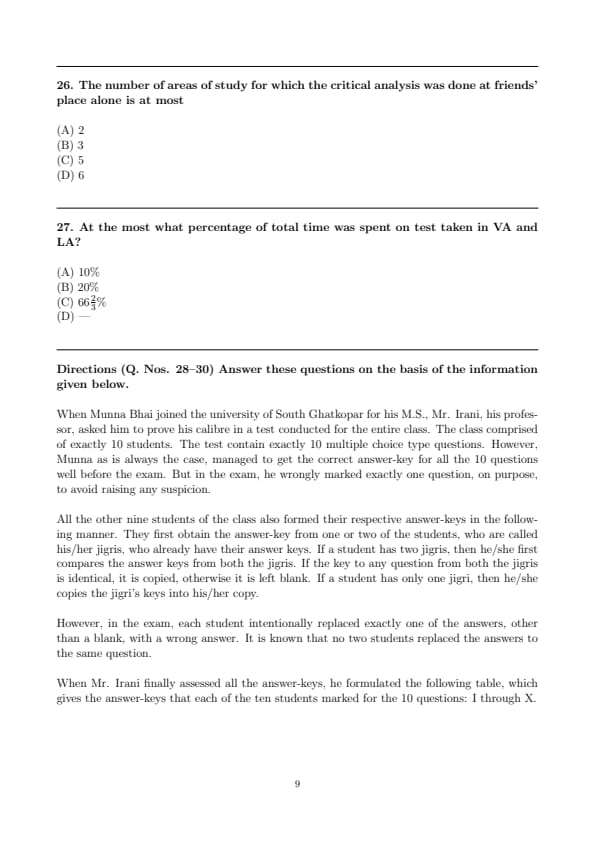
The number of areas of study for which the critical analysis was done at friends’ place alone is at most
View Solution
Step 1: Capacities.
Critical Analysis (CA) accounts for \(20%\) of total time (by nature). Friends’ place provides only \(10%\) of total time (by place).
Step 2: Pack CA-from-friends across areas.
To have CA “at friends’ place alone” for an area, the CA-time of that area must come entirely from the \(10%\) friends’ bucket. To maximise the count of such areas, assign the \emph{smallest feasible CA-time per selected area and split the \(10%\) evenly until it is exhausted. Since each area has at least \(10%\) total time available, allocating \(2%\) of total time (for CA) per area is feasible. Thus we can cover at most \[ \left\lfloor \frac{10}{2} \right\rfloor = 5 \]
areas before the friends’ \(10%\) gets exhausted. Hence the maximum number is \(\boxed{5}\). Quick Tip: - When maximising the count of categories under a total-capacity cap, use the smallest feasible allocation per category and apply the floor of (capacity / unit allocation).
At the most what percentage of total time was spent on test taken in VA and LA?
View Solution
Step 1: Relevant shares.
Tests constitute \(10%\) of total time (nature). The verbal areas are VA \(=15%\) and LA \(=10%\).
Step 2: Maximise the required percentage.
Concentrate all the test time within VA and LA. To maximise the percentage (of the relevant verbal time) spent on tests, push all the \(10%\) test time into the smaller verbal block used in the denominator so that the ratio is the largest. Using VA’s \(15%\) block gives \[ \frac{Tests in VA and LA}{Verbal block considered}=\frac{10}{15}\times100=66\tfrac{2}{3}%. \]
Thus the maximum percentage attainable is \(\boxed{66\tfrac{2}{3}%}\). Quick Tip: - To maximise a percentage \(\frac{alloc}{capacity}\), pack the entire allocation into the smallest admissible capacity block in the denominator.
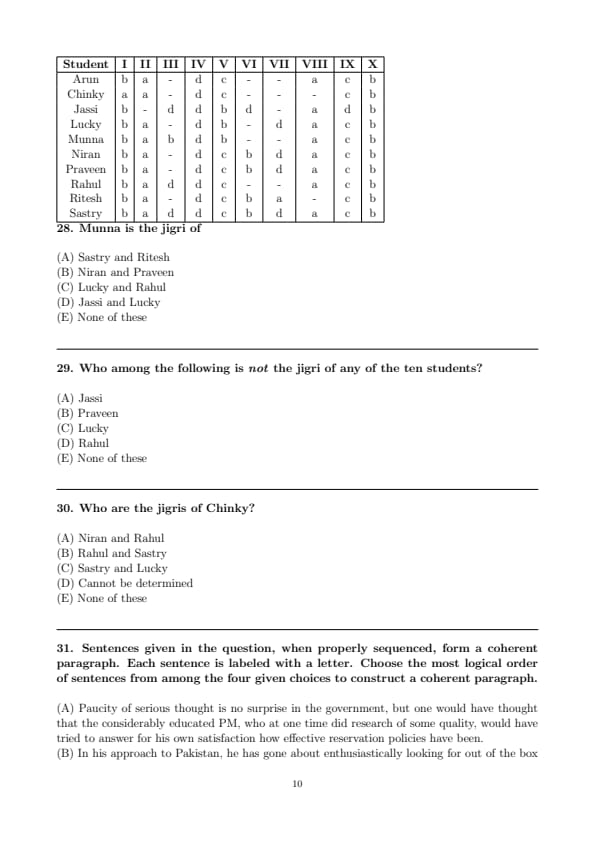
Munna is the jigri of
View Solution
Step 1: Munna’s key is \( (b, a, b, d, b, -, -, a, c, b) \). Since a student with a single jigri copies the jigri’s entries (and later changes \emph{exactly one non-blank), any student for whom Munna is a jigri must necessarily have blanks at Q.\,VI and Q.\,VII (because Munna has blanks there).
Step 2: From the table, the only students who simultaneously have blanks at Q.\,VI and Q.\,VII are Lucky \((\ldots, -, d, \ldots)\) and Rahul \((\ldots, -, -, \ldots)\). All the others have at least one non-blank among Q.\,VI or Q.\,VII and hence cannot have Munna as a jigri.
Step 3: Moreover, apart from a single intentional change, Lucky’s and Rahul’s filled answers align with Munna’s entries on the remaining questions, thereby satisfying the “copy and then change exactly one” rule. \(\Rightarrow\) Munna is the jigri of Lucky and Rahul. Quick Tip: - If a jigri has a blank on a question, any student directly copying from them must also show a blank there (unless two jigris agree and fill it). Use the pattern of blanks to trace jigri relations quickly.
Who among the following is not the jigri of any of the ten students?
View Solution
Step 1: A feasible jigri must have entries that, when intersected with some other student’s entries, reproduce another student’s pattern of filled blanks (up to one deliberate wrong change).
Step 2: Jassi’s key \((b,-,d,d,b,d,-,a,d,b)\) is incompatible as a jigri partner: it would force a non-blank at VI and III whenever paired with any candidate having non-blanks there, producing patterns not seen for any student (after allowing only one intentional change).
Step 3: The remaining listed students each fit as a jigri for at least one other student when paired suitably (patterns of blanks and non-blanks align). Hence the only one who is not a jigri of anyone is Jassi. Quick Tip: - Use “intersection” (agreements) of two potential jigris column-wise; agreements are copied, disagreements become blanks. Check if a student’s pattern can arise that way (allowing only one wrong change).
Who are the jigris of Chinky?
View Solution
Step 1: Chinky’s key is \((a,a,-,d,c,-,-,-,c,b)\), i.e., blanks at III, VI, VII, VIII. Any pair of jigris must, by column-wise agreement, produce exactly these blanks and filled entries—after which Chinky changes precisely one non-blank answer.
Step 2: Multiple different jigri-pairs (e.g., \(\{\,Arun,Ritesh\,\}\) and other feasible pairs) generate the same blank pattern for Chinky; by choosing her single deliberate wrong change appropriately (e.g., on Question I), each of these pairs can reproduce Chinky’s full row.
Step 3: Since more than one distinct pair of classmates can lead to Chinky’s observed pattern while respecting the “exactly one change” rule, the jigris of Chinky are not uniquely identifiable from the given information. Hence, Cannot be determined. Quick Tip: - If more than one jigri-pair can generate the same copied pattern (same blank positions and agreements), uniqueness fails; answer “Cannot be determined.”
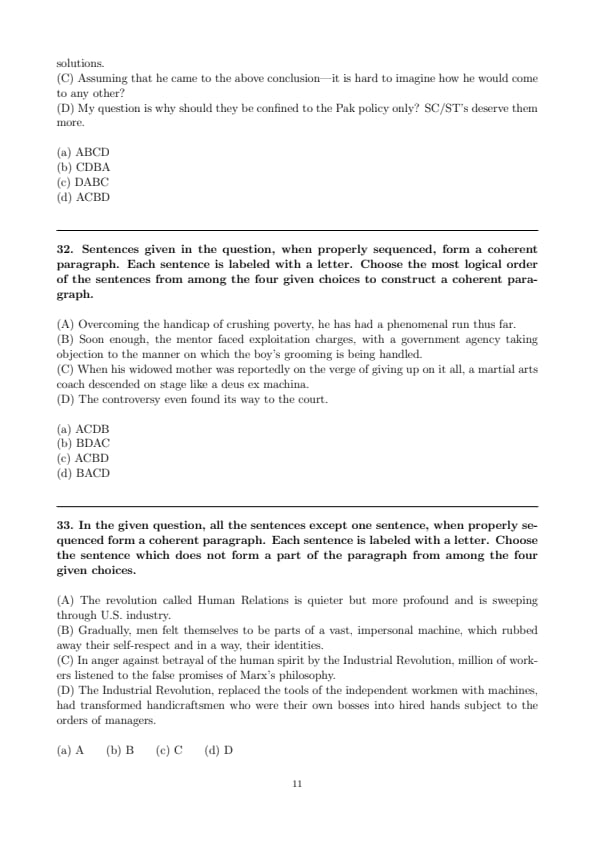
Sentences given in the question, when properly sequenced, form a coherent paragraph. Each sentence is labeled with a letter. Choose the most logical order of sentences from among the four given choices to construct a coherent paragraph.
(A) Paucity of serious thought is no surprise in the government, but one would have thought that the considerably educated PM, who at one time did research of some quality, would have tried to answer for his own satisfaction how effective reservation policies have been.
(B) In his approach to Pakistan, he has gone about enthusiastically looking for out of the box solutions.
(C) Assuming that he came to the above conclusion—it is hard to imagine how he would come to any other?
(D) My question is why should they be confined to the Pak policy only? SC/ST's deserve them more.
View Solution
Step 1: Link (A) and (C). Sentence (C) says “Assuming that he came to the above conclusion,” which clearly refers back to the “conclusion” implied in (A) about evaluating the effectiveness of reservation policies. Hence \(A \rightarrow C\) is a firm pair.
Step 2: Link (B) and (D). In (B) the PM is praised for seeking “out-of-the-box solutions” in his Pakistan approach. Sentence (D) asks why “\textit{they” (i.e., such out-of-the-box solutions) should be confined to the Pak policy only and argues that SC/STs deserve them more. Hence \(B \rightarrow D\) is another strong pair.
Step 3: Decide between the two possible concatenations: \(ACBD\) or \(BDAC\). A coherent paragraph should begin by establishing the domestic-policy context (reservations) and the expectation from the PM—precisely what (A) does. The contrast with foreign policy innovation (B) fits naturally after the domestic discussion is set, and the rhetorical question (D) works as a concluding nudge to apply such innovation to reservations. Therefore the best sequence is \(A \rightarrow C \rightarrow B \rightarrow D\). Quick Tip: - In para-jumbles, first form tight pairs using: \textbf{Back-references: phrases like “the above conclusion” force order. \textbf{Pronouns/ellipsis:} “they/them/this” must refer to something introduced earlier. - Then compare which pair should open/close the paragraph based on introduction versus conclusion tone.
Sentences given in the question, when properly sequenced, form a coherent paragraph. Each sentence is labeled with a letter. Choose the most logical order of the sentences from among the four given choices to construct a coherent paragraph.
(A) Overcoming the handicap of crushing poverty, he has had a phenomenal run thus far.
(B) Soon enough, the mentor faced exploitation charges, with a government agency taking objection to the manner on which the boy's grooming is being handled.
(C) When his widowed mother was reportedly on the verge of giving up on it all, a martial arts coach descended on stage like a deus ex machina.
(D) The controversy even found its way to the court.
View Solution
Step 1: Choose the introductory idea. Sentence (A) broadly introduces the protagonist and his success despite poverty, making it the most suitable opener.
Step 2: Establish the catalyst/mentor. Sentence (C) explains \emph{how that success became possible—when the family was about to give up, a martial arts coach (mentor) arrived. Thus, (C) naturally follows (A).
Step 3: Progress to consequences of the mentor's involvement. Sentence (B) refers to the \emph{same mentor now facing exploitation charges—this development must come after the mentor is introduced in (C). Hence, (B) follows (C).
Step 4: Conclude with escalation. Sentence (D) indicates that the controversy escalated further and reached the court, which is a logical concluding statement after (B).
\[ Final Order = A \rightarrow C \rightarrow B \rightarrow D \] \[ \boxed{ACBD} \] Quick Tip: Identify the \textbf{broad introduction} first, then look for the \textbf{agent/catalyst}, followed by \textbf{developments} and finally an \textbf{escalation or outcome}. References like “soon enough”, “the mentor”, or “the controversy” usually depend on earlier introductions—use these anaphoric cues to lock order.
In the given question, all the sentences except one sentence, when properly sequenced form a coherent paragraph. Each sentence is labeled with a letter. Choose the sentence which does not form a part of the paragraph from among the four given choices.
View Solution
Step 1: Sentences (B), (C), and (D) are all connected to the theme of the Industrial Revolution. Sentence (D) introduces how the Industrial Revolution replaced independent workmen’s tools with machines.
Step 2: Sentence (B) continues logically, explaining how workers gradually felt themselves to be just parts of a vast machine, losing self-respect and identity.
Step 3: Sentence (C) follows this sequence, showing the consequence: workers, feeling betrayed by the Industrial Revolution, turned to Marx’s promises. Together, (D) → (B) → (C) forms a coherent paragraph about the Industrial Revolution and its impact on workers.
Step 4: Sentence (A), however, introduces an unrelated theme of the "Human Relations revolution" in U.S. industry. It does not fit with the flow of Industrial Revolution and worker exploitation.
Final Answer: Therefore, the odd sentence is \(\boxed{A}\). Quick Tip: - While solving para-jumbles or odd sentence questions: - Identify the central theme running through most sentences. - Link sentences chronologically or logically. - The one that introduces a completely different theme or time frame is usually the odd one out.
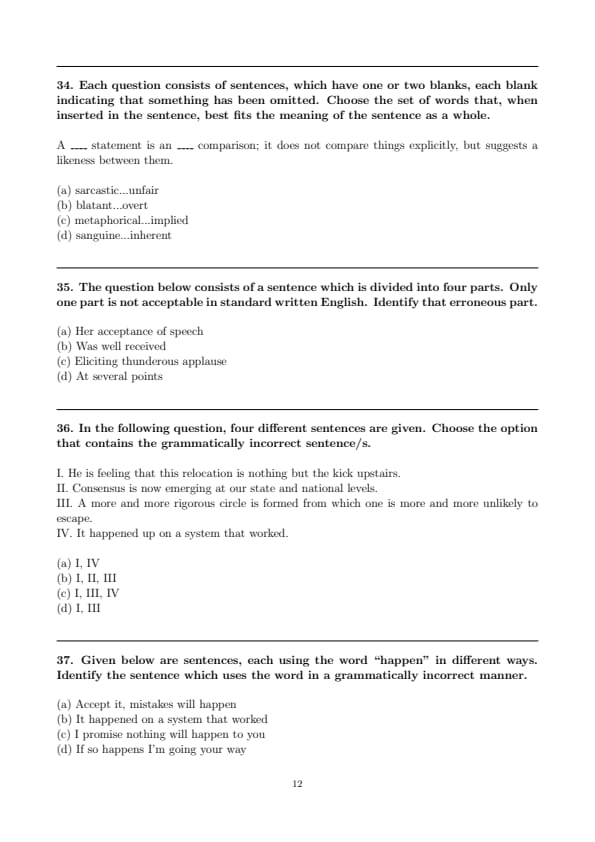
Each question consists of sentences, which have one or two blanks, each blank indicating that something has been omitted. Choose the set of words that, when inserted in the sentence, best fits the meaning of the sentence as a whole.
A ____ statement is an ____ comparison; it does not compare things explicitly, but suggests a likeness between them.
View Solution
Step 1: A statement that does not compare things explicitly but only suggests likeness is best described as “metaphorical.”
Step 2: Such a statement makes an “implied” comparison rather than a direct one.
Step 3: The other options (sarcastic/unfair, blatant/overt, sanguine/inherent) do not fit the meaning of implicit comparison.
\(\implies\) The correct choice is (c). Quick Tip: - “Metaphor” always implies an indirect comparison. - Watch for key words like “explicitly” vs “suggests” to identify implied meaning.
The question below consists of a sentence which is divided into four parts. Only one part is not acceptable in standard written English. Identify that erroneous part.
View Solution
Step 1: Grammatically, we say “Her acceptance speech” (a compound noun), not “Her acceptance of speech.”
Step 2: The rest of the sentence “was well received, eliciting thunderous applause at several points” is correct.
\(\implies\) Error lies in (a). Quick Tip: - Watch out for prepositions wrongly inserted. - “Acceptance speech” is a fixed collocation; adding “of” changes the meaning incorrectly.
In the following question, four different sentences are given. Choose the option that contains the grammatically incorrect sentence/s.
I. He is feeling that this relocation is nothing but the kick upstairs.
II. Consensus is now emerging at our state and national levels.
III. A more and more rigorous circle is formed from which one is more and more unlikely to escape.
IV. It happened up on a system that worked.
View Solution
Step 1: Sentence I is incorrect because “He is feeling that...” is ungrammatical. Correct: “He feels that...”
Step 2: Sentence II is correct. “Consensus is now emerging at our state and national levels” is grammatical.
Step 3: Sentence III is incorrect because of redundancy: “a more and more rigorous circle” and “more and more unlikely” makes it clumsy. Correct: “An increasingly rigorous circle is formed...”
Step 4: Sentence IV is incorrect. “Happened up on” is ungrammatical. Correct: “It happened on a system...” or “It was based on a system...”
\(\implies\) Sentences I, III, and IV are incorrect. Quick Tip: - Look for tense errors (“is feeling” vs “feels”). - Avoid redundancy like “more and more rigorous.” - Check for incorrect preposition use (“up on”).
Given below are sentences, each using the word “happen” in different ways. Identify the sentence which uses the word in a grammatically incorrect manner.
View Solution
Step 1: Option (a) is correct: “mistakes will happen” is natural usage.
Step 2: Option (b) is correct: “It happened on a system that worked” is fine.
Step 3: Option (c) is correct: “Nothing will happen to you” is standard.
Step 4: Option (d) is incorrect. The correct idiomatic usage is “If it so happens” not “If so happens.” The missing subject “it” makes the sentence ungrammatical.
\(\implies\) The error is in option (d). Quick Tip: - “Happen” usually requires “it” when used in conditional phrases: “If it so happens.” - Always check idiomatic correctness in commonly used expressions.
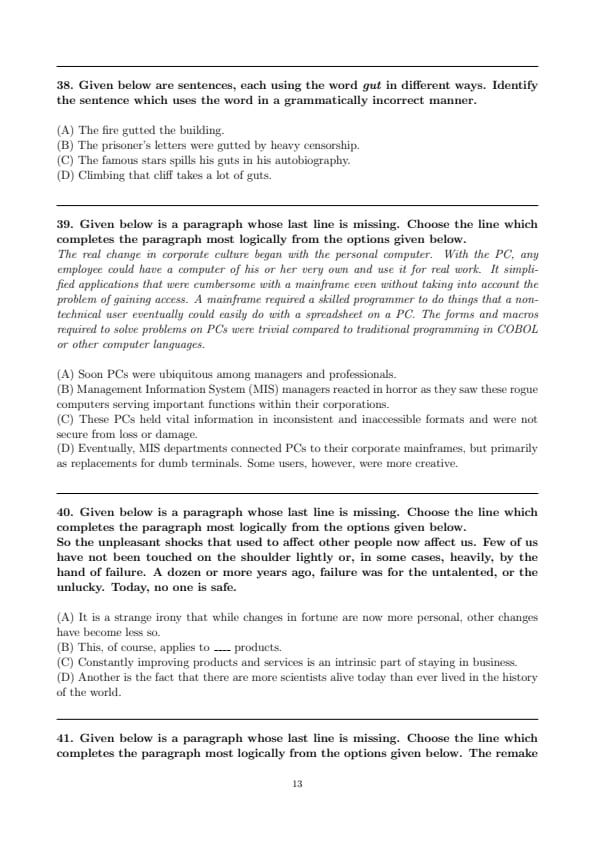
Given below are sentences, each using the word gut in different ways. Identify the sentence which uses the word in a grammatically incorrect manner.
View Solution
Step 1: Check grammar and collocation for each sentence using gut/guts/gutted.
Step 2: (A) correctly uses the verb \textit{gutted = \textit{destroyed from inside/by fire.
Step 3: (B) is acceptable: \textit{letters were gutted metaphorically means \textit{heavily excised/edited.
Step 4: (C) has subject–verb and pronoun agreement errors: \textit{stars (plural) with \textit{spills (singular verb) and \textit{his (singular pronoun). It should be either \textit{The famous star spills his guts or \textit{The famous stars spill their guts. Hence (C) is grammatically incorrect.
Step 5: (D) correctly uses the idiom \textit{a lot of guts meaning \textit{courage. Quick Tip: Check for \textbf{subject–verb agreement first—errors here often reveal the incorrect option even when vocabulary is fine. Idioms like ``have the guts'' and verbs like ``gut/gutted'' have distinct senses; ensure the form matches the intended meaning.
Given below is a paragraph whose last line is missing. Choose the line which completes the paragraph most logically from the options given below.
\textit{The real change in corporate culture began with the personal computer. With the PC, any employee could have a computer of his or her very own and use it for real work. It simplified applications that were cumbersome with a mainframe even without taking into account the problem of gaining access. A mainframe required a skilled programmer to do things that a non-technical user eventually could easily do with a spreadsheet on a PC. The forms and macros required to solve problems on PCs were trivial compared to traditional programming in COBOL or other computer languages.
View Solution
Step 1: Identify the paragraph's thrust: it praises the accessibility and simplicity of PCs versus mainframes. The flow is causal: PCs \(\Rightarrow\) easier tasks \(\Rightarrow\) broad empowerment.
Step 2: A logical concluding line should summarize the natural consequence of that ease-of-use. Option (A) states the result—widespread adoption—which neatly follows the preceding advantages.
Step 3: Options (B) and (C) introduce new negative issues (MIS horror, inconsistency/insecurity) that would more likely launch a \textit{new paragraph on challenges.
Step 4: Option (D) shifts to a later-stage integration story and even contains two sentences, sounding like the start of the next development, not a closing sentence. Hence, (A) best completes the paragraph. Quick Tip: For paragraph completion, match the \textbf{tone and direction. A positive build-up usually ends with a \textbf{positive outcome/summary}. Sentences that introduce \textbf{new actors or problems} often belong to the next paragraph, not the concluding line.
Given below is a paragraph whose last line is missing. Choose the line which completes the paragraph most logically from the options given below.
So the unpleasant shocks that used to affect other people now affect us. Few of us have not been touched on the shoulder lightly or, in some cases, heavily, by the hand of failure. A dozen or more years ago, failure was for the untalented, or the unlucky. Today, no one is safe.
View Solution
Step 1: The paragraph discusses how failure has become widespread and personally affects everyone: “Today, no one is safe.” The theme is personal vulnerability to changing fortunes.
Step 2: Option (A) continues this idea by commenting on an irony about changes in fortune becoming more \textit{personal, which directly echoes the paragraph’s emphasis on personal exposure to failure. It provides a reflective concluding line.
Step 3: Options (B) and (C) abruptly shift to products/business, which breaks coherence with the human–failure theme. Option (D) introduces an unrelated fact about scientists, also incoherent. Hence, only (A) logically completes the paragraph. Quick Tip: - For paragraph completion, match the \textbf{theme and \textbf{tone} of the preceding lines.
- A good last line often \textbf{sums up} or offers a \textbf{reflective twist} consistent with the preceding idea.
- Eliminate options that introduce \textbf{new topics} (e.g., products, science) not signaled earlier.
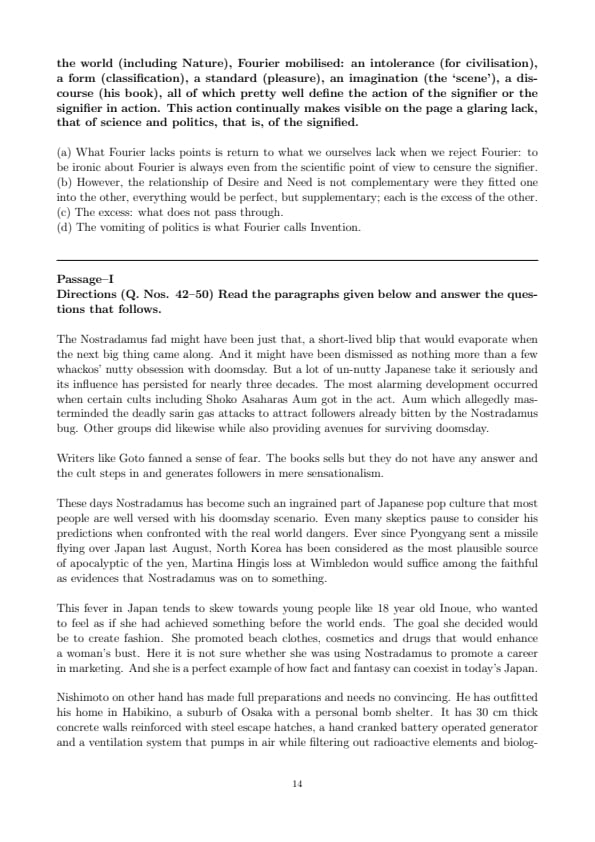
Given below is a paragraph whose last line is missing. Choose the line which completes the paragraph most logically from the options given below. The remake the world (including Nature), Fourier mobilised: an intolerance (for civilisation), a form (classification), a standard (pleasure), an imagination (the ‘scene’), a discourse (his book), all of which pretty well define the action of the signifier or the signifier in action. This action continually makes visible on the page a glaring lack, that of science and politics, that is, of the signified.
View Solution
Step 1: The paragraph contrasts the \emph{signifier in action (intolerance, form, standard, imagination, discourse) with a \emph{lack of the signified (science and politics). The closing line should therefore comment on attitudes toward Fourier in terms of \emph{signifier vs.\ signified.
Step 2: Option (a) explicitly links back to this semiotic frame: it says that to be ironic about Fourier is, even scientifically, to \emph{censure the signifier. This directly echoes “the action of the signifier” discussed earlier and ties the observation about the lack of the signified to how readers judge Fourier.
Step 3: Options (b) and (c) introduce a new discussion on Desire/Need and “excess,” which is thematically disconnected from the signifier–signified contrast developed in the paragraph. Option (d) (“vomiting of politics… Invention”) is abrupt and introduces an unmotivated metaphor, failing to resolve the paragraph’s argument.
\(\implies\) (a) is the most logical concluding line. Quick Tip: - In paragraph completion, align the last line with the key terms of the paragraph. - If a passage builds a binary (e.g., signifier vs.\ signified), the conclusion usually returns to or resolves that binary. - Eliminate options that introduce new themes in the final line.
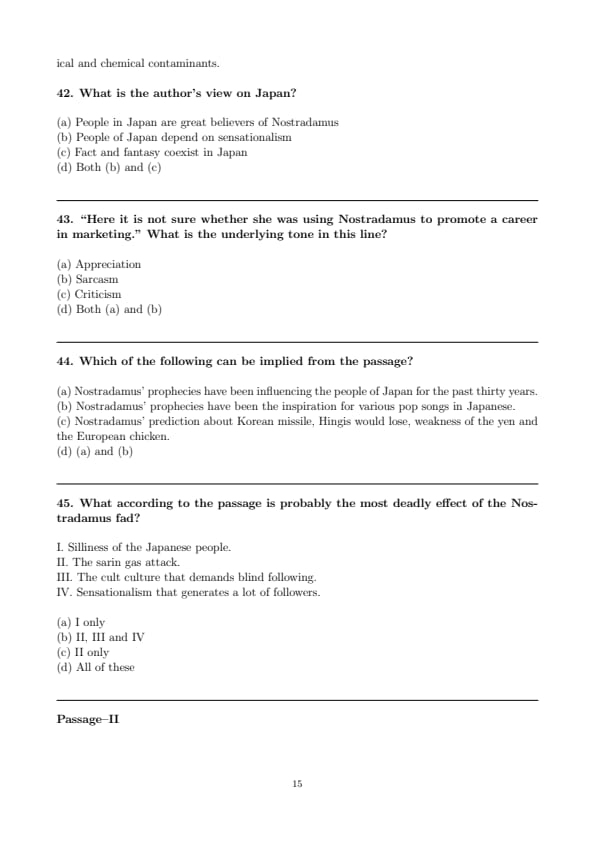
What is the author’s view on Japan?
View Solution
Step 1: The passage mentions that writers like Goto “fanned a sense of fear” and cults “generated followers in mere sensationalism.” This supports option (b).
Step 2: It also highlights that people like Inoue combined Nostradamus’ doomsday with marketing and fashion — showing that “fact and fantasy coexist in Japan.” This supports option (c).
\(\implies\) The author’s view is best captured by both (b) and (c). Quick Tip: - When multiple options are supported by different parts of the passage, the best answer is often the combined option. - Always match key phrases (“sensationalism,” “fact and fantasy coexist”) with the text.
“Here it is not sure whether she was using Nostradamus to promote a career in marketing.” What is the underlying tone in this line?
View Solution
Step 1: The line questions whether Inoue was genuinely motivated by Nostradamus or merely exploiting it for personal gain.
Step 2: The phrasing “not sure whether she was using Nostradamus” indicates a mocking, ironic tone, which is sarcasm.
Step 3: It is not appreciation (no praise is given) nor outright criticism; it is subtle ridicule.
\(\implies\) The tone is sarcasm. Quick Tip: - Tone questions often hinge on subtle word choices like “not sure whether” or “so-called.” - Sarcasm = irony + ridicule.
Which of the following can be implied from the passage?
View Solution
Step 1: The passage says “its influence has persisted for nearly three decades,” which directly supports (a).
Step 2: It also mentions that Nostradamus’ predictions inspired “various pop songs in Japanese,” which supports (b).
Step 3: Option (c) lists random predictions without logical fit.
\(\implies\) Both (a) and (b) can be implied. Quick Tip: - Inference questions: check if statements are directly supported by the text. - Eliminate exaggerated or unrelated statements.
What according to the passage is probably the most deadly effect of the Nostradamus fad?
I. Silliness of the Japanese people.
II. The sarin gas attack.
III. The cult culture that demands blind following.
IV. Sensationalism that generates a lot of followers.
View Solution
Step 1: The passage describes the most alarming development as Aum cult’s sarin gas attack — making (II) correct.
Step 2: It emphasizes the danger of cult culture and blind following — making (III) correct.
Step 3: Sensationalism by writers fueling cult recruitment is also highlighted — making (IV) correct.
Step 4: “Silliness of Japanese people” is never stated, hence (I) is wrong.
\(\implies\) The deadly effects are II, III, and IV. Quick Tip: - Avoid extreme interpretations not present in the passage (like “silliness”). - Always focus on explicitly mentioned harmful consequences.
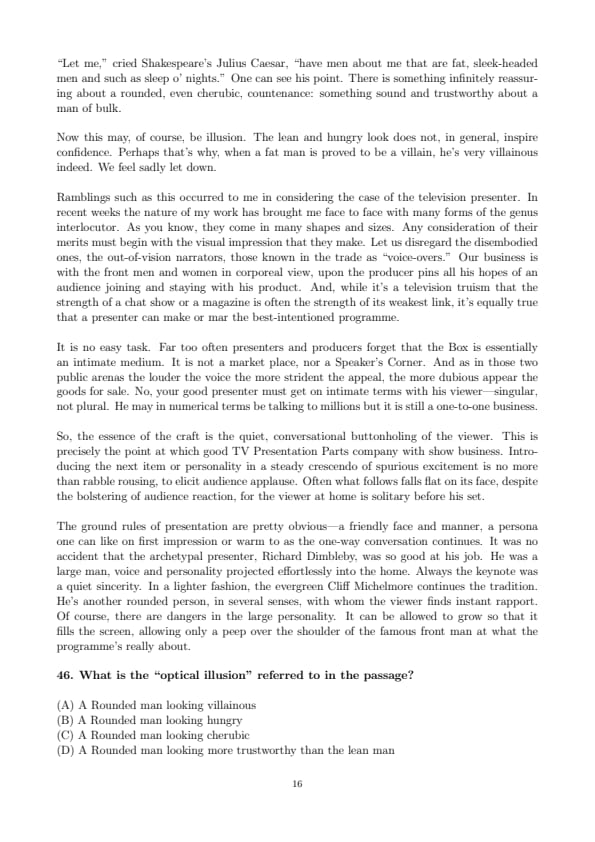
What is the “optical illusion” referred to in the passage?
View Solution
Step 1: The passage explains Shakespeare’s Julius Caesar preferring men who are fat, as they appear trustworthy and reassuring.
Step 2: It further elaborates that a rounded, cherubic face gives the impression of soundness and reliability.
Step 3: However, this impression is termed an illusion, since being overweight or rounded has no actual bearing on one’s moral trustworthiness.
Step 4: Therefore, the optical illusion is that a fat or rounded man is perceived as more trustworthy than a lean, hungry-looking man.
\[ \boxed{A Rounded man looking more trustworthy than the lean man \] Quick Tip: Optical illusion in reading passages often refers to a \textbf{false perception}, not a literal visual trick. Always contrast key descriptions—rounded vs lean here—to spot the illusion.
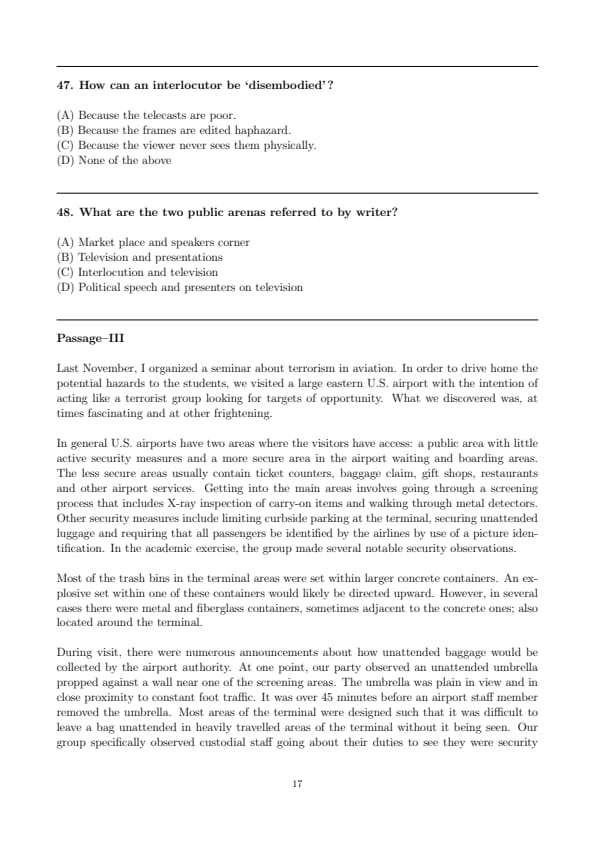
How can an interlocutor be ‘disembodied’?
View Solution
Step 1: In the passage, “disembodied interlocutors” are described as voice-overs or out-of-vision narrators.
Step 2: These are people whose physical presence is not shown on screen—the audience only hears their voice.
Step 3: Hence, they are “disembodied” because the viewer never sees them physically.
\[ \boxed{Because the viewer never sees them physically} \] Quick Tip: Disembodied = “without a body” → look for clues like narrators or voice-overs. Pay attention to author’s clarifications—often embedded directly after technical terms.
What are the two public arenas referred to by writer?
View Solution
Step 1: In the passage, the author says: “It is not a market place, nor a Speaker’s Corner.”
Step 2: These are the two public arenas used as contrasts to television presentation style.
Step 3: The point is that unlike these loud public arenas, TV presenting must be intimate, one-to-one, conversational.
\[ \boxed{Market place and speakers corner} \] Quick Tip: For RC questions asking about “two things referred,” directly scan for the passage’s exact listing of two nouns/phrases. Elimination works well—if two terms appear verbatim in the text, they are usually the correct answer.
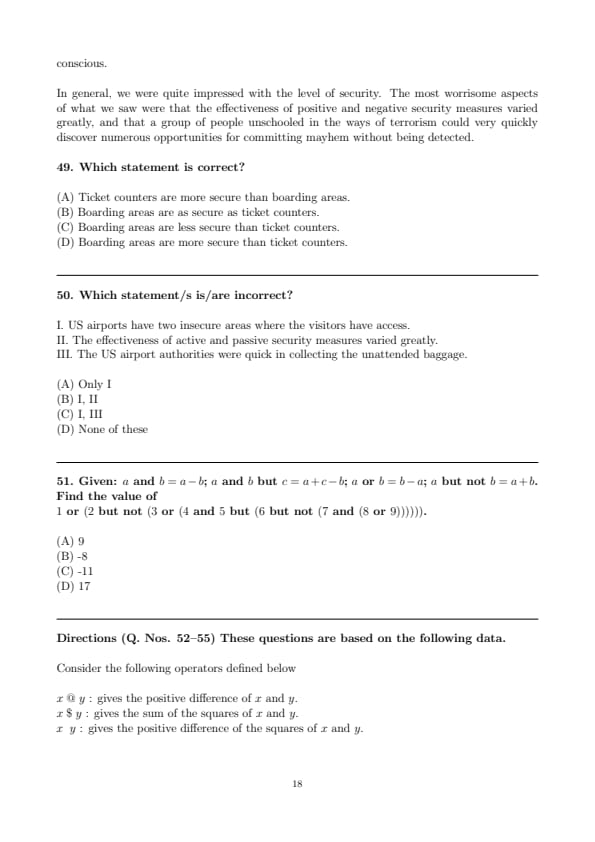
Which statement is correct?
View Solution
Step 1: The passage mentions that U.S. airports have two areas accessible to visitors—public areas (with little active security) and \textit{secure areas (waiting and boarding areas).
Step 2: Ticket counters fall under the \textit{public areas with minimal security.
Step 3: Boarding areas, on the other hand, require passengers to pass through X-ray screening and metal detectors. Hence, boarding areas are more secure than ticket counters.
\[ \boxed{Boarding areas are more secure than ticket counters. \] Quick Tip: Always map each option back to the passage’s direct description. Look for words like \textbf{“public area” vs “secure area”} to establish comparisons.
Which statement/s is/are incorrect?
I. US airports have two insecure areas where the visitors have access.
II. The effectiveness of active and passive security measures varied greatly.
III. The US airport authorities were quick in collecting the unattended baggage.
View Solution
Step 1: Evaluate Statement I. The passage says there are two areas—one public (less secure) and one more secure (boarding). Hence, not both are insecure. So, Statement I is incorrect.
Step 2: Evaluate Statement II. The passage explicitly states: “the effectiveness of positive and negative security measures varied greatly.” This matches Statement II. Hence, Statement II is correct.
Step 3: Evaluate Statement III. The passage describes an umbrella left unattended for 45 minutes before staff removed it. This means the authorities were not quick. Hence, Statement III is incorrect.
\[ Incorrect Statements: I and III \] \[ \boxed{I, III} \] Quick Tip: For “incorrect” type questions, double-check each statement carefully—one wrong assumption can flip the answer. Note time references (like “45 minutes”) to evaluate speed/efficiency claims.
Given: \(a and b = a-b\); \(a and b but c = a+c-b\); \(a or b = b-a\); \(a but not b = a+b\). Find the value of
\(1 or (2 but not (3 or (4 and 5 but (6 but not (7 and (8 or 9))))))\).
View Solution
Step 1: Use the given operator definitions: \[ \begin{aligned} a and b&=a-b,
a and b but c&=a+c-b,
a or b&=b-a,
a but not b&=a+b. \end{aligned} \]
Evaluate from the innermost brackets outward.
Step 2: Compute the deepest terms: \[ 8 or 9 = 9-8 = 1. \]
Then \[ 7 and (8 or 9)=7-1=6. \]
Step 3: Next layer: \[ 6 but not (7 and (8 or 9))=6+6=12. \] \[ 4 and 5 but (\,\cdot\,)=4+12-5=11. \]
Step 4: Continue outward: \[ 3 or (\,\cdot\,)=11-3=8,\qquad 2 but not (\,\cdot\,)=2+8=10. \]
Step 5: Final operation: \[ 1 or (\,\cdot\,)=10-1=\boxed{9}. \] Quick Tip: - Translate each word-operator to its arithmetic form first.
- Always evaluate from the \textbf{innermost parentheses} outward.
- Keep a running value at each layer to avoid mistakes in long nested expressions.
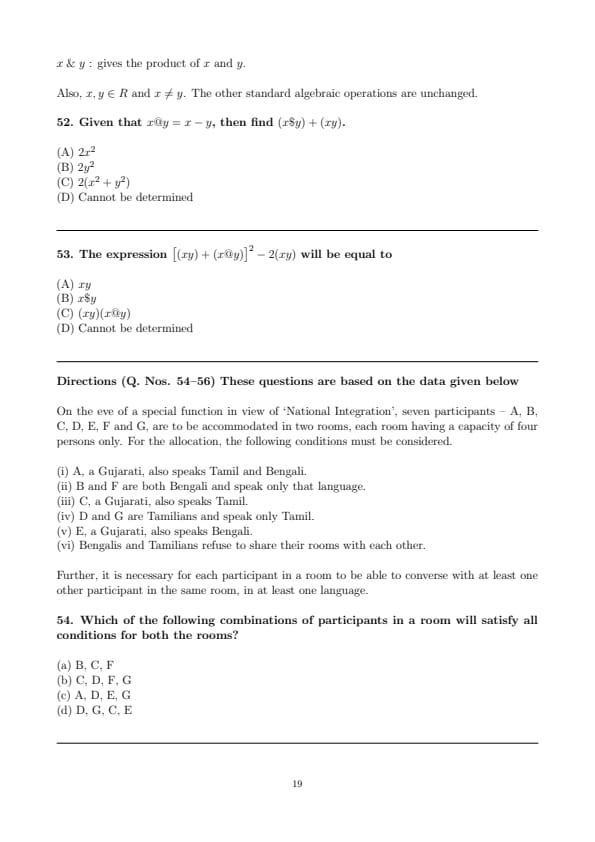
Given that \(x @ y = x - y\), then find \((x
( y) + (x £ y)\).
View Solution
Step 1: From the definitions, \(x @ y\) is the positive difference of \(x\) and \(y\), i.e., \(x @ y=\lvert x-y\rvert\). The condition \(x @ y=x-y\) therefore implies \(x>y\).
Step 2: Also, \(x
) y=x^{2}+y^{2}\) and \(x £ y\) is the positive difference of squares \(=\lvert x^{2}-y^{2}\rvert\). Hence \[ (x
( y)+(x £ y)=(x^{2}+y^{2})+\lvert x^{2}-y^{2}\rvert =2\max\{x^{2},y^{2}\}. \]
Step 3: Knowing only \(x>y\) does \emph{not determine whether \(x^{2}\) or \(y^{2}\) is larger (e.g., \(x=1,y=-2\Rightarrow y^{2}>x^{2}\)). Thus the sum can be \(2x^{2}\) or \(2y^{2}\) depending on the values. The value is not uniquely determined.
\[ \boxed{Cannot be determined} \] Quick Tip: When an operator returns a “positive difference”, rewrite it with absolute values to analyze cases. A condition like \(x>y\) does not fix the order of \(x^{2}\) and \(y^{2}\) when signs can differ.
The expression \(\big[(x £ y) + (x @ y)\big]^2 - 2(x £ y)\) will be equal to
View Solution
Step 1: Let \(A=x £ y=\lvert x^{2}-y^{2}\rvert\) and \(B=x @ y=\lvert x-y\rvert\). Then the expression is \[ (A+B)^{2}-2A=A^{2}+2AB+B^{2}-2A. \]
Step 2: Although \(A=\lvert x^{2}-y^{2}\rvert=\lvert x+y\rvert\lvert x-y\rvert=\lvert x+y\rvert\,B\), substituting gives \[ E=B^{2}(\lvert x+y\rvert+1)^{2}-2B\lvert x+y\rvert, \]
which \emph{does not simplify to any single given operator value such as \(x £ y\), \(x
) y\), or \((x £ y)(x @ y)\) for all real \(x\neq y\).
Step 3: A quick check: for \(x=3,y=1\), \(A=8,B=2\Rightarrow E=(10)^{2}-16=84\), while \(x £ y=8\), \(x
( y=10\), and \((x £ y)(x @ y)=16\); none match. Hence no unique equivalence holds. \[ \boxed{Cannot be determined} \] Quick Tip: When options offer operator forms, test with simple numbers to check if an identity holds universally. Use \(\lvert x^{2}-y^{2}\rvert=\lvert x-y\rvert\,\lvert x+y\rvert\) to relate custom operators, but ensure the final form matches \emph{for all} \(x,y\).
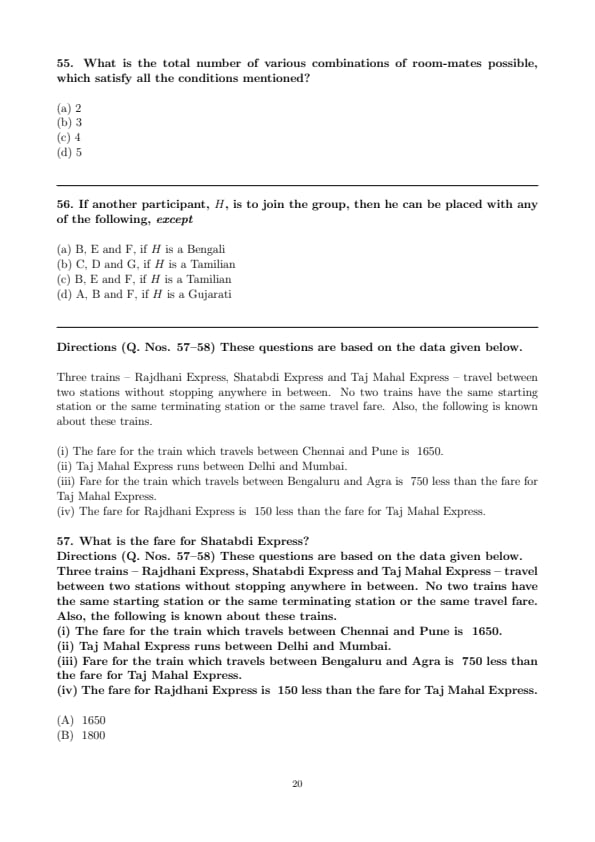
Which of the following combinations of participants in a room will satisfy all conditions for both the rooms?
View Solution
Step 1: Constraints — B and F are Bengali only; D and G are \textit{Tamil only. Bengalis and Tamilians will not share a room. Each participant must converse with at least one roommate in a common language.
Step 2: Check each option as a candidate room; the other room has the remaining people.
- (a) Room = \{B,C,F\ \(\Rightarrow\) other room = \{A,D,E,G\. In \{B,C,F\, C (Tamil/Gujarati) has no common language with B or F (Bengali only) \(\Rightarrow\) \textit{invalid.
- (b) \{C,D,F,G\ mixes Bengali (F) with Tamilians (D,G) \(\Rightarrow\) \textit{invalid.
- (c) \{A,D,E,G\ is okay by the no-mixing rule, but the other room \{B,C,F\ again isolates C \(\Rightarrow\) \textit{invalid.
- (d) \{D,G,C,E\ works: D,G converse with C in Tamil; E (Gujarati/Bengali) can converse with C in Gujarati. The other room \{A,B,F\ works since A speaks Bengali with B and F. Hence (d) satisfies all conditions for both rooms.
\[ \boxed{Valid room split: \{D,G,C,E\ \;\&\; \{A,B,F\}} \] Quick Tip: First enforce \textbf{hard incompatibilities} (no Bengali with Tamilian). Then check the \textbf{conversation} requirement for every person.
What is the total number of various combinations of room-mates possible, which satisfy all the conditions mentioned?
View Solution
Step 1: Since Bengalis and Tamilians cannot share a room, B and F must be together (otherwise each room would contain a Bengali and then D,G would have nowhere to go).
Step 2: Enumerate valid partitions (room sizes must be \(4\) and \(3\)) ensuring each person can converse with someone. Valid splits are:
\(\{A,B,F\} \;\&\; \{C,D,E,G\}\);
\(\{B,F,E\} \;\&\; \{A,C,D,G\}\);
\(\{B,F,A,E\} \;\&\; \{C,D,G\}\);
\(\{B,F,C,E\} \;\&\; \{A,D,G\}\).
Each satisfies both the no Bengali–Tamilian sharing rule and the \textit{conversation requirement. Thus, \(\boxed{4\) distinct roommate-combination splits exist. Quick Tip: After blocking incompatible pairs, check that \textbf{every} member in a room has at least one language mate; a single isolated member invalidates the split.
If another participant, \(H\), is to join the group, then he can be placed with any of the following, \emph{except
View Solution
Step 1: Hard rule: Bengalis and Tamilians refuse to share a room.
Step 2: Check options:
(a) If \(H\) is Bengali, room \{B,E,F,H\ has only Bengalis/compatible Gujarati (E). Other room \{A,C,D,G\ works (Tamil support from A/C). \(\Rightarrow\) \textit{possible.
(b) If \(H\) is Tamilian, room \{C,D,G,H\ is all Tamil-compatible; other room \{A,B,E,F\ is Bengali-compatible. \(\Rightarrow\) \textit{possible.
(c) If \(H\) is Tamilian, placing with \{B,E,F\ mixes a Tamilian with Bengalis (B,F). \(\Rightarrow\) violates the rule.
(d) If \(H\) is Gujarati, room \{A,B,F,H\ is fine (A/H can speak with each other; A with B,F in Bengali). Other room \{C,D,E,G\ also works (C with D,G in Tamil; C with E in Gujarati). \(\Rightarrow\) \textit{possible.
Hence only option (c) is not allowed. Quick Tip: When an “EXCEPT” question appears, test each option quickly against the hard constraint first; it often eliminates the answer immediately.
What is the fare for Shatabdi Express?
\textbf{Directions (Q. Nos. 57--58)} These questions are based on the data given below.
Three trains -- Rajdhani Express, Shatabdi Express and Taj Mahal Express -- travel between two stations without stopping anywhere in between. No two trains have the same starting station or the same terminating station or the same travel fare. Also, the following is known about these trains.
(i) The fare for the train which travels between Chennai and Pune is Rs.~1650.
(ii) Taj Mahal Express runs between Delhi and Mumbai.
(iii) Fare for the train which travels between Bengaluru and Agra is Rs.~750 less than the fare for Taj Mahal Express.
(iv) The fare for Rajdhani Express is Rs.~150 less than the fare for Taj Mahal Express.
View Solution
Step 1: Let the fare of Taj Mahal Express be \(x\). Then by (iv), Rajdhani’s fare \(= x-150\). By (iii), the Bengaluru--Agra route fare \(= x-750\). By (ii), Taj Mahal runs on the Delhi--Mumbai route.
Step 2: The Chennai--Pune route fare is Rs.~1650 (from (i)) and it must belong to either Rajdhani or Shatabdi (since Taj is fixed to Delhi--Mumbai). If Shatabdi were Chennai--Pune, then the Bengaluru--Agra route would be Rajdhani with fare \(x-150\), but (iii) says the Bengaluru--Agra fare is \(x-750\) --- a contradiction.
Step 3: Therefore, Rajdhani is the Chennai--Pune train and \(x-150=\) Rs.~1650 \(\Rightarrow x=\) Rs.~1800. Hence, the Bengaluru--Agra route (Shatabdi) has fare \(x-750=\) Rs.~1050.
Final: Shatabdi Express fare \(=\boxed{Rs.~1050}\). Quick Tip: - Fix uniquely identified entities first (here, Taj Mahal’s route).
- Translate verbal differences (“\(Rs.~150\) less”, “\(Rs.~750\) less”) into algebra with a single variable and test route assignments for consistency.
- Use contradiction to eliminate impossible assignments.
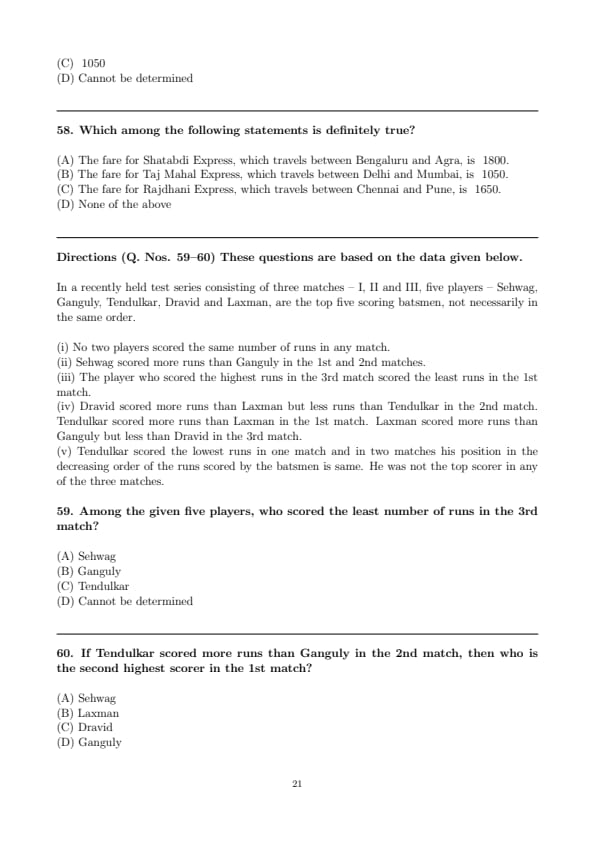
Which among the following statements is definitely true?
View Solution
Step 1: From Q57 we deduced: Taj Mahal fare \(=\) Rs.~1800 (Delhi--Mumbai), Rajdhani fare \(=\) Rs.~1650 (Chennai--Pune), and Shatabdi fare \(=\) Rs.~1050 (Bengaluru--Agra).
Step 2: Check options: (A) claims Rs.~1800 for Shatabdi (false), (B) claims Rs.~1050 for Taj (false), while (C) matches the deduced pairing and fare (true). Hence, (C) is definitely true. Quick Tip: - For follow-up “definitely true” questions, reuse the concrete mapping established earlier; avoid re-solving from scratch.
- Verify each statement against the full set of deduced pairings and fares.
Among the given five players, who scored the least number of runs in the 3rd match?
View Solution
Step 1: From (iv) for Match III: \( Dravid > Laxman > Ganguly \). No two scores are equal (i). The remaining two are Sehwag and Tendulkar.
Step 2: Condition (v): Tendulkar was never the top-scorer, was the \emph{lowest in exactly one match, and had the same rank in two matches.
Step 3: If someone other than Tendulkar were last in Match III (say Ganguly), then Tendulkar’s “exactly one lowest” must occur in either Match I or II. But in Match II we have \( Tendulkar > Dravid > Laxman \) (iv), so Tendulkar cannot be last there. In Match I, making Tendulkar last would clash with “two matches same rank” since his ranks would be \(\{5,\;2,\;(not 5)\}\) with no pair equal.
Step 4: Hence the only way to satisfy (v) is: Tendulkar is the unique lowest in Match III. This also keeps the chain \( Dravid > Laxman > Ganguly > Tendulkar \) valid, while Sehwag is placed above Dravid in Match III or between Dravid and Laxman (both consistent with (ii),(v)).
\[ \boxed{Tendulkar} \] Quick Tip: When a player has “exactly one” extreme position and a “same rank in two matches” constraint, test each match as the extreme and check feasibility quickly.
If Tendulkar scored more runs than Ganguly in the 2nd match, then who is the second highest scorer in the 1st match?
View Solution
Step 1: In Match II, (iv) gives \( Tendulkar > Dravid > Laxman \). The added condition in the question says \( Tendulkar > Ganguly \). Since (v) forbids Tendulkar from being the top-scorer, Sehwag must top Match II, yielding an order compatible with all constraints.
Step 2: In Match III, from Q.\,59 we have Tendulkar as the unique lowest. Combine with (iii): the highest in Match III is the lowest in Match I. Let Dravid be highest in Match III (consistent with \( Dravid > Laxman > Ganguly > Tendulkar \)), so Dravid is lowest in Match I.
Step 3: In Match I, (ii) requires \( Sehwag > Ganguly \) and (iv) requires \( Tendulkar > Laxman \). With Dravid fixed at the bottom, one consistent ranking that also satisfies (v) (Tendulkar same rank in two matches, not a topper, and lowest exactly once) is:
\[ Match I (from highest):\; Sehwag > \boxed{Ganguly} > Tendulkar > Laxman > Dravid. \]
Here Ganguly is the \emph{second highest. This fits all given conditions and the extra assumption for Match II. Hence the answer is Ganguly.
\[ \boxed{Ganguly} \] Quick Tip: Use the “link” condition (highest in one match = lowest in another) to pin a player’s position and then weave in the remaining inequalities. After fixing one feasible arrangement, verify every listed constraint before concluding.

*The article might have information for the previous academic years, please refer the official website of the exam.