
CAT 2018 VARC Slot 2 Question Paper with Solution PDF
- Cut Off for IITs
- IIM Kashipur Cut Off
- IIM Amritsar Cut Off
- IIM Nagpur Cut Off
- IIM Indore Cut Off
- IIM Udaipur Cut Off
- IIM Ranchi Cut Off
- IIM Raipur Cut Off
- IIM Jammu Cut Off
- IIM Bodh Gaya Cut Off
- IIM Kozhikode Cut Off
- IIM Sambalpur Cut Off
- IIM Bangalore Cut Off
- IIM Sirmaur Cut Off
- IIM Trichy Cut Off
- IIM Visakhapatnam Cut Off
- IIM Lucknow Cut Off
- IIM Shillong Cut Off
- IIM Calcutta Cut Off
- IIM Ahmedabad Cut Off
- IIM Rohtak Cut Off


Content Writer | Updated On - Nov 28, 2025
CAT Question Papers are the most important study material for effective exam preparation. We at Zollege have provided all CAT Previous Year Papers with Solution PDFs here. CAT 2013 VARC was conducted successfully by Indian Institutes of Management (IIM).
Students can freely download the CAT previous year's question paper PDFs along with their solutions here. We strongly encourage cat aspirants to scan through all the CAT Question Paper to know the overall difficulty level, CAT Syllabus and understand the changes in CAT Exam Pattern over the years.
Also Check:
CAT 2013 VARC Slot 2 Question Paper with Solution PDF
| CAT 2013 VARC Slot 2 with Answer Key | Download PDF | Check Solutions |

Question 1:
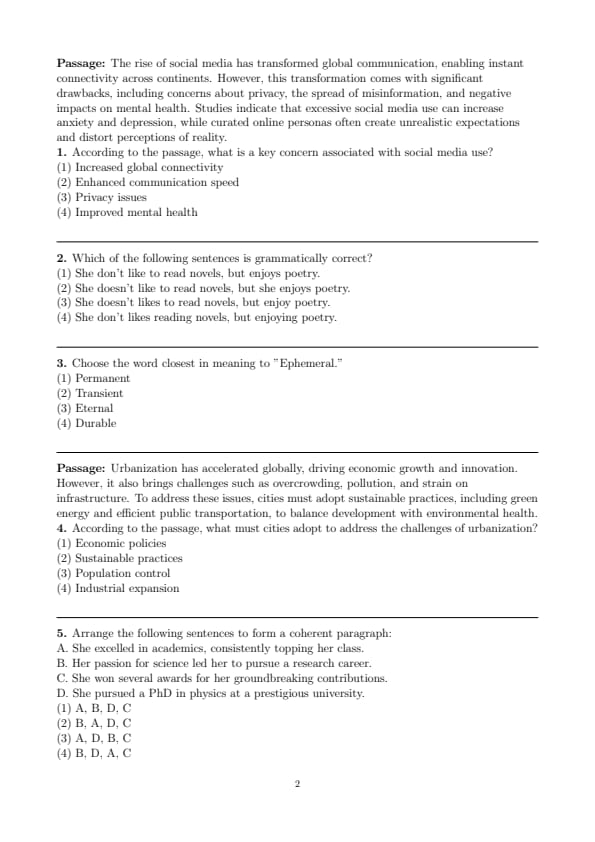
According to the passage, what is a key concern associated with social media use?
View Solution
The passage highlights both the positive and negative impacts of social media. While it acknowledges benefits such as instant connectivity and faster communication, it focuses more on the concerns—particularly privacy issues, spread of misinformation, and mental health problems. Among the given options, the only concern explicitly mentioned is privacy issues. Options (1) and (2) are advantages, not concerns, while option (4) contradicts the passage since social media is linked to negative mental health effects. Hence, the correct answer is (3) Privacy issues. Quick Tip: In CAT Reading Comprehension, always distinguish between positive aspects and negative concerns highlighted in the passage. Eliminate options that state benefits when the question asks about drawbacks.
Which of the following sentences is grammatically correct?
View Solution
To solve sentence correction questions in CAT, we must check subject-verb agreement, verb forms, and parallel structure.
- Option (1): “She don’t like” is incorrect, because the subject She (third-person singular) requires “doesn’t” instead of “don’t.”
- Option (2): Correct. “She doesn’t like” is the right form. The second clause “she enjoys poetry” maintains subject-verb agreement.
- Option (3): Incorrect. “She doesn’t likes” is grammatically wrong, as “doesn’t” must be followed by the base form of the verb → “like,” not “likes.”
- Option (4): Incorrect. It contains two errors: “She don’t likes” is wrong for the same reason as above, and “but enjoying poetry” is not parallel with the first clause.
Thus, the only grammatically correct option is (2). Quick Tip: In CAT sentence correction, watch out for auxiliary verbs (does/doesn’t) and ensure that the main verb is in its base form after them. Also, ensure parallelism between clauses.
Choose the word closest in meaning to "Ephemeral."
View Solution
The word Ephemeral comes from the Greek epi (upon) + hemera (day), meaning lasting for a very short time.
- Option (1): Permanent means lasting forever or for a long duration — opposite in meaning.
- Option (2): Transient means temporary, short-lived, or lasting only a brief period — this is the closest synonym.
- Option (3): Eternal means without beginning or end, everlasting — opposite in sense.
- Option (4): Durable means strong and long-lasting — again, opposite in meaning.
Hence, the correct synonym of Ephemeral is Transient. Quick Tip: In CAT vocabulary-based questions, focus on root words and etymology. Words like ephemeral, transient, fleeting, momentary often appear together — learning them as a cluster helps in faster recall.
According to the passage, what must cities adopt to address the challenges of urbanization?
View Solution
The passage first highlights the benefits of urbanization (economic growth and innovation) and then lists challenges (overcrowding, pollution, infrastructure strain). To counter these issues, it clearly states that cities must adopt sustainable practices such as green energy and efficient public transportation.
- Option (1): Economic policies are important but not mentioned as the solution here.
- Option (2): Sustainable practices — explicitly mentioned as the solution — is correct.
- Option (3): Population control is not discussed in the passage.
- Option (4): Industrial expansion would worsen the challenges instead of solving them.
Thus, the correct answer is (2) Sustainable practices. Quick Tip: In CAT RC, always look for directly stated solutions or recommendations in the passage. Avoid overthinking or bringing in outside knowledge. Stick to what the passage explicitly mentions.
Arrange the following sentences to form a coherent paragraph:
A. She excelled in academics, consistently topping her class.
B. Her passion for science led her to pursue a research career.
C. She won several awards for her groundbreaking contributions.
D. She pursued a PhD in physics at a prestigious university.
To solve Para Jumbles, identify the logical flow of ideas: - Sentence A introduces the subject’s strong academic foundation. - Sentence B follows naturally, linking her academic excellence to her passion for science. - Sentence D logically comes next, showing how this passion translated into pursuing a PhD in physics. - Sentence C concludes the paragraph, presenting the outcome of her journey: awards for groundbreaking contributions. Thus, the coherent order is A → B → D → C.
View Solution
N/A Quick Tip: In CAT Para Jumbles, look for: 1. Opening sentence (broad background or introduction). 2. Cause-effect links (e.g., passion → career). 3. Chronological order (education → research → recognition). This ensures a smooth logical flow.
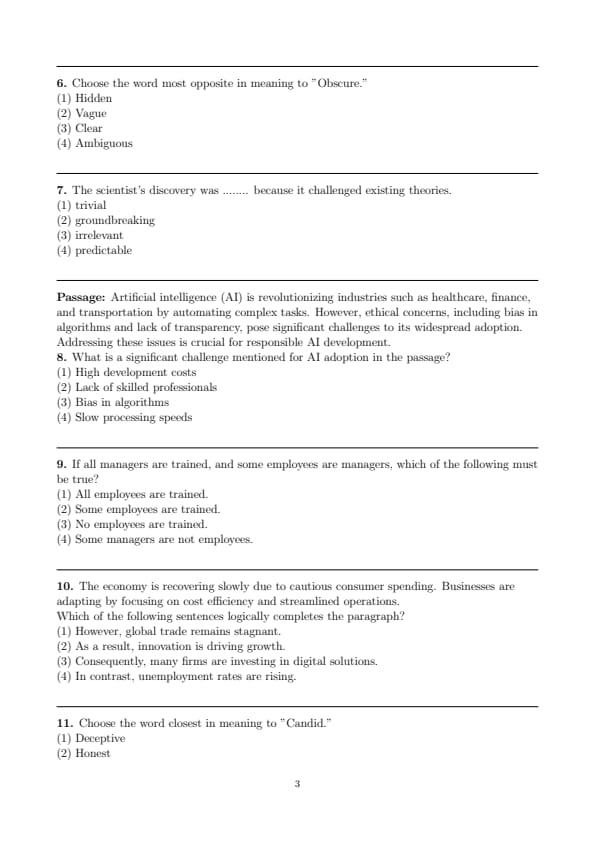
Choose the word most opposite in meaning to "Obscure."
View Solution
The word Obscure means unclear, hidden, or not easily understood.
- Option (1): Hidden is a synonym of Obscure, not an antonym.
- Option (2): Vague also means unclear, making it another synonym.
- Option (3): Clear is the exact opposite of Obscure — something easily seen or understood.
- Option (4): Ambiguous means open to multiple interpretations, which is again closer in meaning to Obscure.
Therefore, the most suitable antonym is Clear. Quick Tip: For CAT vocabulary antonyms, eliminate synonyms first. The option that conveys the direct opposite meaning is usually the correct answer.
The scientist’s discovery was ........ because it challenged existing theories.
View Solution
The key clue in the sentence is “because it challenged existing theories.”
- Option (1): Trivial means unimportant — this contradicts the context.
- Option (2): Groundbreaking means revolutionary, innovative, or introducing new ideas — fits perfectly with challenging existing theories.
- Option (3): Irrelevant means not connected, which doesn’t logically fit.
- Option (4): Predictable suggests something expected, which contradicts the element of challenge to theories.
Thus, the best word to complete the sentence is groundbreaking. Quick Tip: In CAT Sentence Completion, always look for context clues. Words like “challenged,” “contradicted,” or “supported” signal whether the blank should be positive, negative, or neutral.
What is a significant challenge mentioned for AI adoption in the passage?
View Solution
% Solution
Solution:
The passage highlights two main challenges to AI adoption: bias in algorithms and lack of transparency. These are ethical concerns that hinder responsible implementation of AI.
- Option (1): High development costs are not mentioned.
- Option (2): Lack of skilled professionals is a real-world concern but not discussed in this passage.
- Option (3): Bias in algorithms is explicitly mentioned as an ethical challenge — correct.
- Option (4): Slow processing speeds are not mentioned and, in fact, AI is known for fast computation.
Therefore, the correct answer is (3) Bias in algorithms. Quick Tip: In CAT RC, focus on keywords directly stated in the passage. If the passage mentions “ethical concerns” or “bias,” prefer those options over general assumptions.
If all managers are trained, and some employees are managers, which of the following must be true?
View Solution
- Statement given: All managers are trained.
- Also given: Some employees are managers.
From this, at least those employees who are managers must be trained (since all managers are trained).
- Option (1): All employees are trained — cannot be concluded, as the statement doesn’t apply to all employees.
- Option (2): Some employees are trained — this must be true, since the employees who are managers are trained.
- Option (3): No employees are trained — directly contradicted by the logic above.
- Option (4): Some managers are not employees — not supported; we only know some employees are managers, but nothing about managers outside employees.
Thus, the valid conclusion is (2) Some employees are trained. Quick Tip: In CAT critical reasoning, always separate what must be true from what may be true. Stick strictly to the given premises and avoid assumptions outside the statements.
The economy is recovering slowly due to cautious consumer spending. Businesses are adapting by focusing on cost efficiency and streamlined operations.
Which of the following sentences logically completes the paragraph?
View Solution
The paragraph describes:
1. Slow recovery of the economy due to cautious consumer spending.
2. Adaptation by businesses through cost efficiency and streamlined operations.
The logical next step should highlight a business response consistent with efficiency and adaptation.
- Option (1): Talks about global trade stagnation — unrelated to the focus on businesses’ adaptation.
- Option (2): Mentions innovation driving growth — too broad and vague, not directly linked to cost efficiency.
- Option (3): Investing in digital solutions — this directly aligns with efficiency and streamlining operations, making it the most logical continuation.
- Option (4): Unemployment rates rising — introduces a contrasting idea unrelated to business strategies.
Thus, the best completion is (3) Consequently, many firms are investing in digital solutions.
Quick Tip: In CAT Para Completion, ensure the added sentence provides a logical continuation of the given flow. Look for consistency in theme and tone rather than jumping to unrelated points.
Choose the word closest in meaning to "Candid."
View Solution
- Step 1: Define "Candid." "Candid" means truthful, straightforward, or frank, often used to describe open and honest communication without pretense.
- Step 2: Identify the synonym. A synonym for candid should convey truthfulness or openness.
- Step 3: Evaluate the options.
- Option (1): "Deceptive" means misleading or dishonest, the opposite of candid, so it is incorrect.
- Option (2): "Honest" means truthful and sincere, closely matching candid’s meaning, making it a strong candidate.
- Option (3): "Reserved" implies restraint or holding back, contrary to candid’s openness, so it is incorrect.
- Option (4): "Cautious" suggests carefulness or wariness, which does not align with candid’s straightforwardness, making it incorrect.
- Step 4: Eliminate opposites. Deceptive is a clear antonym, while Reserved and Cautious imply restraint rather than openness, leaving Honest as the best match.
- Step 5: Confirm with context. In a sentence like "She gave a candid opinion," substituting "honest" as "She gave an honest opinion" maintains the meaning, confirming the synonymy. For example, both "candid feedback" and "honest feedback" imply truthful communication.
- Step 6: Final conclusion. Option (2) Honest is the correct answer, as it is the closest synonym to "Candid."
Quick Tip: For synonym questions, test the word in a sentence context to ensure it can be used interchangeably with the given word, and eliminate opposites or unrelated terms.
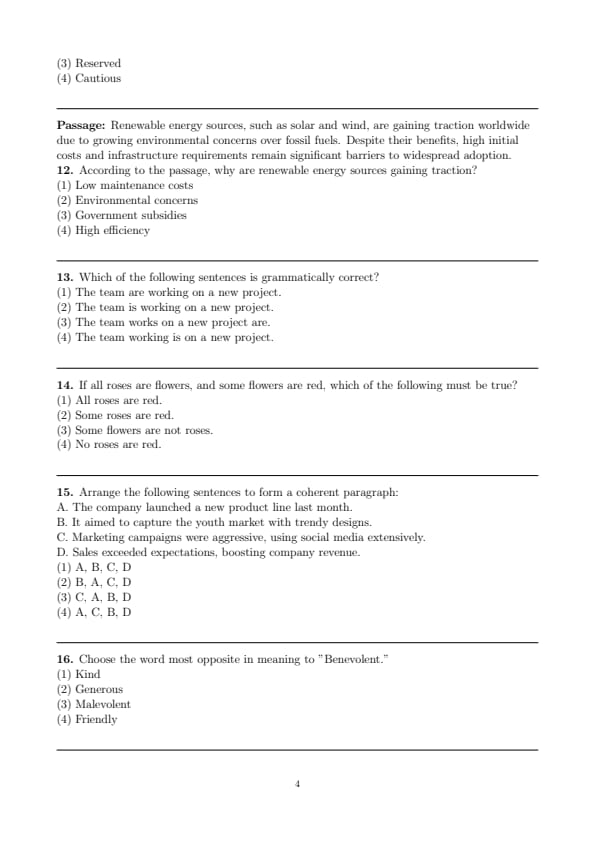
According to the passage, why are renewable energy sources gaining traction?
View Solution
- Step 1: Understand the question. The question asks for the reason renewable energy sources are gaining traction, requiring a specific cause stated in the passage.
- Step 2: Locate relevant information. The passage states, "Renewable energy sources, such as solar and wind, are gaining traction worldwide due to growing environmental concerns over fossil fuels." This directly identifies "environmental concerns" as the reason.
- Step 3: Evaluate the options.
- Option (1): "Low maintenance costs" is not mentioned; the passage discusses high initial costs, so this is incorrect.
- Option (2): "Environmental concerns" directly matches the passage’s explicit reason, making it the correct choice.
- Option (3): "Government subsidies" is not referenced in the passage, so it is irrelevant.
- Option (4): "High efficiency" is not mentioned as a reason for gaining traction, so it is incorrect.
- Step 4: Verify specificity. The phrase "due to growing environmental concerns" in the passage aligns precisely with option (2), leaving no ambiguity.
- Step 5: Cross-check for alternatives. The passage does not suggest other reasons like subsidies or efficiency, confirming that environmental concerns is the only correct answer.
- Step 6: Final conclusion. Option (2) Environmental concerns is the correct answer, as it directly reflects the passage’s stated reason for renewable energy’s traction.
Quick Tip: For reading comprehension questions about causes, find the exact phrase or synonym in the passage that explains the reason, and avoid assuming unstated factors.
Which of the following sentences is grammatically correct?
View Solution
- Step 1: Identify grammatical requirements. The sentence requires correct subject-verb agreement, appropriate verb tense, and logical structure. The subject "The team" is a singular collective noun, treated as singular unless referring to individual members.
- Step 2: Analyze each option for errors.
- Option (1): "The team are working on a new project." Uses "are," which is incorrect for the singular collective noun "team"; it should be "is." This makes option (1) incorrect.
- Option (2): "The team is working on a new project." Uses "is," correct for the singular "team," and "working" indicates present continuous tense, suitable for an ongoing action. The structure is clear and correct.
- Option (3): "The team works on a new project are." Contains two verbs ("works" and "are") without proper conjunction or structure, making it grammatically incorrect.
- Option (4): "The team working is on a new project." Uses "working" as a gerund and misplaces it, resulting in an awkward and incorrect sentence structure.
- Step 3: Confirm verb tense and structure. Option (2) uses the present continuous tense ("is working"), appropriate for an ongoing project, and follows a clear subject-verb-object structure: "The team" (subject), "is working" (verb), "on a new project" (object).
- Step 4: Verify correctness. Option (2) adheres to subject-verb agreement for a singular collective noun and maintains proper sentence structure.
- Step 5: Final conclusion. Option (2) The team is working on a new project is the only grammatically correct sentence.
Quick Tip: In sentence correction, treat collective nouns like "team" as singular unless the context emphasizes individual members. Check verb tense and sentence structure for clarity and correctness.
If all roses are flowers, and some flowers are red, which of the following must be true?
View Solution
- Step 1: Break down the premises. The question provides two premises:
- Premise 1: All roses are flowers (roses are a subset of the broader category of flowers).
- Premise 2: Some flowers are red (at least one flower is red).
- Step 2: Analyze logical implications. Since roses are a subset of flowers, the category of flowers is broader, implying there are flowers that are not roses (e.g., tulips, lilies). The fact that some flowers are red does not necessarily involve roses, but it reinforces the broader category of flowers.
- Step 3: Evaluate the options.
- Option (1): "All roses are red" is not guaranteed, as the red flowers may not include roses; the premises do not specify roses’ color.
- Option (2): "Some roses are red" is possible but not certain, as the red flowers could be other types of flowers.
- Option (3): "Some flowers are not roses" must be true, as the flower category includes roses and other types, ensuring non-rose flowers exist.
- Option (4): "No roses are red" is not guaranteed, as some roses could be red, contradicting the option.
- Step 4: Confirm with a Venn diagram. Imagine flowers as a large circle with roses as a smaller circle inside it. The larger circle includes other flowers, confirming that some flowers are not roses.
- Step 5: Verify necessity. Option (3) is the only statement that must be true, as the broader flower category necessarily includes non-rose flowers.
- Step 6: Final conclusion. Option (3) Some flowers are not roses is the correct answer, as it logically follows from the premises.
Quick Tip: In critical reasoning questions, focus on what must be true based on the premises, using subset-superset relationships or Venn diagrams to deduce logical conclusions. Avoid options that are only possible.
Arrange the following sentences to form a coherent paragraph:
A. The company launched a new product line last month.
B. It aimed to capture the youth market with trendy designs.
C. Marketing campaigns were aggressive, using social media extensively.
D. Sales exceeded expectations, boosting company revenue.
View Solution
- Step 1: Identify the paragraph’s structure. A coherent paragraph should introduce the main event, provide details about its purpose and execution, and conclude with its outcome, following a logical or chronological flow.
- Step 2: Analyze the role of each sentence.
- Sentence A: Introduces the product launch, serving as the starting point of the narrative.
- Sentence B: Explains the target market (youth) and design focus, providing the purpose of the launch.
- Sentence C: Describes the marketing strategy, detailing how the launch was promoted.
- Sentence D: States the result (sales success), serving as the conclusion.
- Step 3: Determine a logical sequence. The logical flow is: launch the product (A), state the target and purpose (B), describe marketing efforts (C), and conclude with sales results (D). This suggests the sequence A, B, C, D.
- Step 4: Test option (1) A, B, C, D. The sequence is: product launch (A) → targeting youth market (B) → aggressive marketing (C) → sales success (D). This forms a chronological and coherent narrative.
- Step 5: Evaluate other options.
- Option (2) B, A, C, D: Starting with the target market (B) before the launch (A) is illogical, as the launch sets the context.
- Option (3) C, A, B, D: Starting with marketing (C) before the launch (A) disrupts chronological order.
- Option (4) A, C, B, D: Placing marketing (C) before the target market (B) is less coherent, as the purpose (targeting youth) should precede the strategy.
- Step 6: Final conclusion. Option (1) A, B, C, D provides the most logical and coherent paragraph, reflecting a clear progression from launch to outcome.
Quick Tip: In para jumbles, start with an introductory action or event, follow with details about purpose or strategies, and end with outcomes to ensure a logical and chronological flow.
Choose the word most opposite in meaning to "Benevolent."
View Solution
- Step 1: Define "Benevolent." "Benevolent" means kind, generous, or well-meaning, often used to describe altruistic or charitable actions or intentions.
- Step 2: Identify the opposite. The opposite of benevolent would be harmful, unkind, or malicious in intent or action.
- Step 3: Evaluate the options.
- Option (1): "Kind" is a synonym of benevolent, as it implies similar positive intentions, so it is incorrect.
- Option (2): "Generous" is another synonym, closely related to benevolent’s sense of giving, so it is incorrect.
- Option (3): "Malevolent" means harmful, evil, or malicious, directly opposite to benevolent’s kind nature, making it a strong candidate.
- Option (4): "Friendly" implies warmth and kindness, similar to benevolent, so it is incorrect.
- Step 4: Eliminate synonyms. Options (1), (2), and (4) are synonyms or closely related to benevolent, as they all suggest positive or kind traits. Option (3) Malevolent stands out as the opposite.
- Step 5: Confirm with context. In a sentence like "A benevolent leader helped the community," replacing with "A malevolent leader harmed the community" creates a direct contrast, confirming the antonym relationship.
- Step 6: Final conclusion. Option (3) Malevolent is the correct answer, as it is the most opposite in meaning to "Benevolent."
Quick Tip: For antonym questions, eliminate synonyms or related words first, then confirm the opposite by testing it in a contrasting sentence context to ensure a direct opposition.
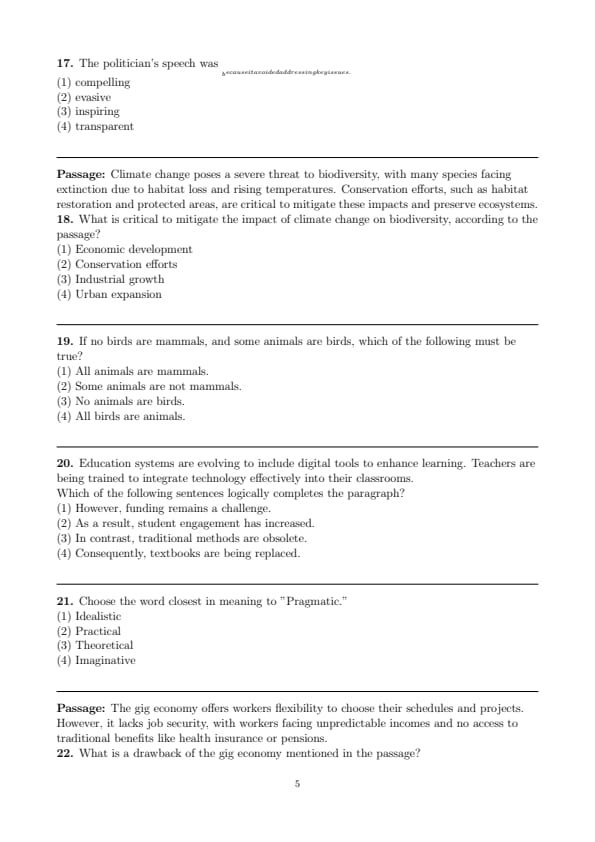
The politician’s speech was ______ because it avoided addressing key issues.
View Solution
- Step 1: Analyze the sentence context. The phrase "avoided addressing key issues" suggests the speech was deliberately vague or dodged important topics, implying a negative trait. The blank requires a word that reflects this avoidance.
- Step 2: Evaluate the options.
- Option (1): "compelling" means persuasive or engaging, which implies addressing issues effectively, contradicting the context, so it is incorrect.
- Option (2): "evasive" means deliberately avoiding or vague, perfectly fitting the context of avoiding key issues, making it a strong candidate.
- Option (3): "inspiring" implies motivating or uplifting, which does not align with avoidance, so it is incorrect.
- Option (4): "transparent" means open and clear, the opposite of avoiding issues, so it is incorrect.
- Step 3: Test the fit. Substituting "evasive" into the sentence: "The politician’s speech was evasive because it avoided addressing key issues" is logical and consistent with the context.
- Step 4: Eliminate alternatives. Compelling and inspiring suggest positive engagement, while transparent implies openness, all of which contradict the avoidance described. Only evasive aligns with the context.
- Step 5: Confirm with context. In political contexts, an evasive speech is one that sidesteps critical issues, matching the sentence’s implication.
- Step 6: Final conclusion. Option (2) evasive is the correct answer, as it best captures the context of avoiding key issues.
Quick Tip: In sentence completion questions, choose a word that matches the sentence’s tone (positive or negative) and logical implication, ensuring it aligns with the context provided.
What is critical to mitigate the impact of climate change on biodiversity, according to the passage?
View Solution
- Step 1: Understand the question. The question asks for what is critical to mitigate climate change’s impact on biodiversity, requiring a specific solution explicitly stated in the passage.
- Step 2: Locate relevant information. The passage states, "Conservation efforts, such as habitat restoration and protected areas, are critical to mitigate these impacts and preserve ecosystems." This directly identifies "conservation efforts" as the solution.
- Step 3: Evaluate the options.
- Option (1): "Economic development" is not mentioned in the passage as a solution to biodiversity loss, so it is incorrect.
- Option (2): "Conservation efforts" directly matches the passage’s wording, supported by examples like habitat restoration, making it the correct choice.
- Option (3): "Industrial growth" is not referenced and could exacerbate biodiversity loss, so it is incorrect.
- Option (4): "Urban expansion" is not mentioned and is likely harmful to biodiversity, making it incorrect.
- Step 4: Verify specificity. The passage explicitly uses "conservation efforts" with examples, ensuring option (2) is a precise match. No other solutions are mentioned.
- Step 5: Cross-check for alternatives. The passage does not suggest economic development, industrial growth, or urban expansion as solutions, confirming that conservation efforts is the only correct answer.
- Step 6: Final conclusion. Option (2) Conservation efforts is the correct answer, as it directly reflects the passage’s stated solution to mitigate biodiversity loss.
Quick Tip: For reading comprehension questions seeking solutions, look for explicit mentions or examples in the passage, and eliminate options that introduce unrelated or contradictory ideas.
If no birds are mammals, and some animals are birds, which of the following must be true?
View Solution
- Step 1: Break down the premises. The question provides two premises:
- Premise 1: No birds are mammals (birds and mammals are disjoint sets, with no overlap).
- Premise 2: Some animals are birds (at least one animal is a bird).
- Step 2: Analyze logical implications. Since some animals are birds, and no birds are mammals, those animals that are birds cannot be mammals. This implies that there are animals (the birds) that are not mammals.
- Step 3: Evaluate the options.
- Option (1): "All animals are mammals" is incorrect, as the bird-animals are not mammals, contradicting the premise.
- Option (2): "Some animals are not mammals" is true, as the animals that are birds (from premise 2) are not mammals (from premise 1), making it a strong candidate.
- Option (3): "No animals are birds" directly contradicts the second premise, so it is incorrect.
- Option (4): "All birds are animals" is possible but not necessarily true, as the premises do not confirm that all birds are animals, only that some animals are birds.
- Step 4: Confirm with a Venn diagram. Imagine animals as a large circle, with birds as a smaller circle inside it (from premise 2). Birds are outside the mammals circle (from premise 1), confirming that some animals (birds) are not mammals.
- Step 5: Verify necessity. Option (2) is the only statement that must be true, as the existence of birds as animals ensures non-mammal animals.
- Step 6: Final conclusion. Option (2) Some animals are not mammals is the correct answer, as it logically follows from the premises.
Quick Tip: In critical reasoning questions, use logical deductions or Venn diagrams to identify what must be true. Avoid options that are only possible or contradict the premises.
Education systems are evolving to include digital tools to enhance learning. Teachers are being trained to integrate technology effectively into their classrooms.
Which of the following sentences logically completes the paragraph?
View Solution
- Step 1: Analyze the paragraph’s theme. The paragraph describes the positive evolution of education systems through the adoption of digital tools and teacher training to integrate technology, suggesting improved learning outcomes.
- Step 2: Identify the logical continuation. The completion should reflect a positive result of incorporating digital tools and training, ideally using a connector like "as a result" to indicate an outcome.
- Step 3: Evaluate the options.
- Option (1): "However, funding remains a challenge" introduces a negative contrast, shifting focus to a problem not mentioned in the paragraph, making it incoherent.
- Option (2): "As a result, student engagement has increased" aligns with the positive impact of digital tools and training, as technology typically enhances engagement, making it a strong candidate.
- Option (3): "In contrast, traditional methods are obsolete" introduces a negative contrast and a new idea (obsolescence) not supported by the paragraph, so it is incorrect.
- Option (4): "Consequently, textbooks are being replaced" is specific but not directly supported, as the paragraph focuses on digital tools and training, not textbook replacement.
- Step 4: Test option (2). Adding "As a result, student engagement has increased" logically follows, as digital tools and effective teacher integration are known to boost student interest and participation.
- Step 5: Confirm coherence. Option (2) maintains the paragraph’s positive tone and focus on educational improvement, unlike options (1) and (3), which shift focus, or option (4), which is too specific.
- Step 6: Final conclusion. Option (2) As a result, student engagement has increased is the correct answer, as it provides a coherent and logical completion.
Quick Tip: For para completion questions, choose a sentence that reflects the paragraph’s tone and theme, using logical connectors to show cause-effect relationships.
Choose the word closest in meaning to "Pragmatic."
View Solution
- Step 1: Define "Pragmatic." "Pragmatic" means dealing with things realistically and practically, focusing on practical solutions rather than ideals or theories, often in problem-solving contexts.
- Step 2: Identify the synonym. A synonym for pragmatic should convey a focus on practicality or realistic approaches.
- Step 3: Evaluate the options.
- Option (1): "Idealistic" means pursuing ideals, often unrealistically, which is opposite to pragmatic’s practical focus, so it is incorrect.
- Option (2): "Practical" means focused on realistic and effective solutions, closely matching pragmatic’s meaning, making it a strong candidate.
- Option (3): "Theoretical" implies abstract or speculative thinking, contrary to pragmatic’s practicality, so it is incorrect.
- Option (4): "Imaginative" suggests creativity or inventiveness, which does not align with pragmatic’s focus on realism, so it is incorrect.
- Step 4: Eliminate opposites. Idealistic and Theoretical are antonyms or unrelated to pragmatic, as they focus on ideals or abstraction. Imaginative is also unrelated, leaving Practical as the best match.
- Step 5: Confirm with context. In a sentence like "A pragmatic approach solved the issue," substituting "practical" as "A practical approach solved the issue" maintains the meaning, confirming the synonymy.
- Step 6: Final conclusion. Option (2) Practical is the correct answer, as it is the closest synonym to "Pragmatic."
Quick Tip: For synonym questions, test the word in a practical sentence context to confirm it can be used interchangeably with the given word, and eliminate opposites or unrelated terms.
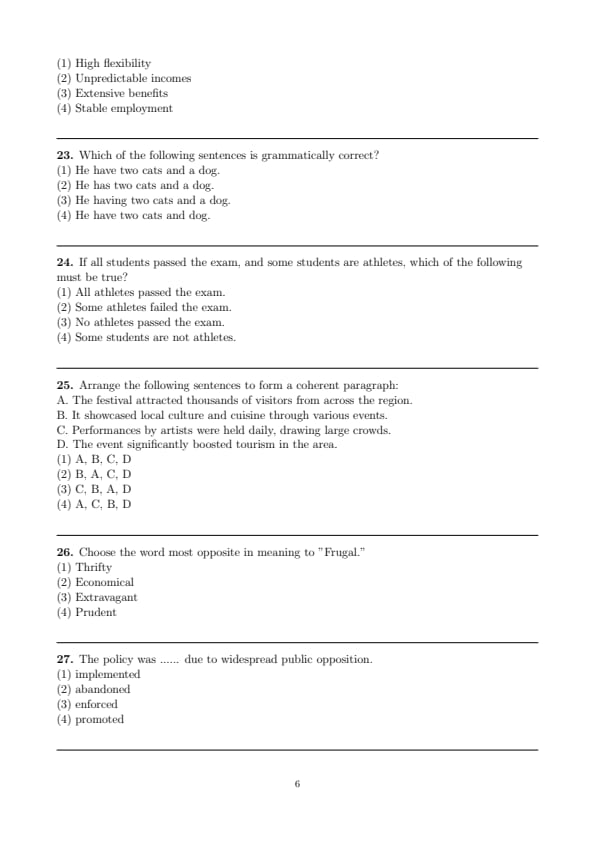
What is a drawback of the gig economy mentioned in the passage?
View Solution
- Step 1: Understand the question. The question asks for a drawback of the gig economy, requiring a negative aspect explicitly mentioned in the passage.
- Step 2: Locate relevant information. The passage states, "However, it lacks job security, with workers facing unpredictable incomes and no access to traditional benefits like health insurance or pensions." This identifies unpredictable incomes and lack of benefits as drawbacks.
- Step 3: Evaluate the options.
- Option (1): "High flexibility" is presented as a benefit of the gig economy, not a drawback, so it is incorrect.
- Option (2): "Unpredictable incomes" directly matches the passage’s wording, making it a strong candidate.
- Option (3): "Extensive benefits" contradicts the passage, which states there are no traditional benefits, so it is incorrect.
- Option (4): "Stable employment" contradicts the passage’s mention of lacking job security, so it is incorrect.
- Step 4: Verify specificity. The passage explicitly lists "unpredictable incomes" as a drawback, making option (2) a precise match. Lack of benefits is another drawback but is not an option.
- Step 5: Cross-check for alternatives. The passage does not present flexibility or stable employment as drawbacks, and extensive benefits is contradictory, confirming option (2) as the only correct choice.
- Step 6: Final conclusion. Option (2) Unpredictable incomes is the correct answer, as it directly reflects a drawback stated in the passage.
Quick Tip: For reading comprehension questions about drawbacks, focus on negative aspects explicitly stated in the passage, and eliminate options that describe benefits or contradict the text.
Which of the following sentences is grammatically correct?
View Solution
- Step 1: Identify grammatical requirements. The sentence requires correct subject-verb agreement, proper use of articles, and consistent structure. The subject "He" is third-person singular, and the verb should be in the present tense for a general statement.
- Step 2: Analyze each option for errors.
- Option (1): "He have two cats and a dog." Uses "have," which is incorrect for third-person singular; it should be "has." This makes option (1) incorrect.
- Option (2): "He has two cats and a dog." Uses "has," correct for third-person singular, and includes the article "a" before "dog," following standard grammar rules. This appears correct.
- Option (3): "He having two cats and a dog." Uses "having," a gerund form, which is incorrect as the main verb; a proper verb form like "has" is needed.
- Option (4): "He have two cats and dog." Uses incorrect "have" for "he" and omits the article "a" before "dog," violating article usage rules.
- Step 3: Confirm structure. Option (2) follows a clear subject-verb-object structure: "He" (subject), "has" (verb), "two cats and a dog" (objects), with proper articles ("a" before "dog").
- Step 4: Verify correctness. Option (2) adheres to subject-verb agreement, uses the correct present tense verb, and includes necessary articles, making it grammatically sound.
- Step 5: Final conclusion. Option (2) He has two cats and a dog is the only grammatically correct sentence.
Quick Tip: In sentence correction questions, check for subject-verb agreement and proper article usage (e.g., "a" before singular countable nouns). Ensure the verb tense aligns with the sentence’s context.
If all students passed the exam, and some students are athletes, which of the following must be true?
View Solution
- Step 1: Break down the premises. The question provides two premises:
- Premise 1: All students passed the exam (every student passed).
- Premise 2: Some students are athletes (at least one student is an athlete).
- Step 2: Analyze logical implications. Since some students are athletes, and all students passed the exam, the athletes who are students must also have passed the exam. If all athletes in the context are students, they all passed.
- Step 3: Evaluate the options.
- Option (1): "All athletes passed the exam" is true, as the athletes who are students (from premise 2) must have passed (from premise 1), assuming all relevant athletes are students.
- Option (2): "Some athletes failed the exam" contradicts premise 1, as all students (including athlete-students) passed.
- Option (3): "No athletes passed the exam" also contradicts premise 1, as athlete-students passed.
- Option (4): "Some students are not athletes" is possible but not necessarily true, as the premises do not confirm non-athlete students.
- Step 4: Confirm with a Venn diagram. Imagine students as a circle where all passed the exam, with athletes as a smaller circle inside (some students are athletes). All within the student circle passed, including athletes.
- Step 5: Address assumptions. The question implies athletes are within the student group, as no non-student athletes are mentioned. Thus, all relevant athletes passed.
- Step 6: Final conclusion. Option (1) All athletes passed the exam is the correct answer, as it logically follows from the premises.
Quick Tip: In critical reasoning questions, ensure the conclusion is necessitated by the premises, not just possible. Use subset relationships to deduce what must be true.
Arrange the following sentences to form a coherent paragraph:
A. The festival attracted thousands of visitors from across the region.
B. It showcased local culture and cuisine through various events.
C. Performances by artists were held daily, drawing large crowds.
D. The event significantly boosted tourism in the area.
View Solution
- Step 1: Identify the paragraph’s structure. A coherent paragraph should introduce the main event, provide details about its components, and conclude with its impact, following a logical or chronological flow.
- Step 2: Analyze the role of each sentence.
- Sentence A: Introduces the festival and its scale (thousands of visitors), serving as the starting point.
- Sentence B: Details what the festival showcased (culture and cuisine), providing context for its appeal.
- Sentence C: Describes specific activities (daily performances), adding detail to the events.
- Sentence D: States the outcome (boosted tourism), serving as the conclusion.
- Step 3: Determine a logical sequence. The logical flow is: introduce the festival (A), describe what it showcased (B), detail specific activities (C), and conclude with the impact (D). This suggests the sequence A, B, C, D.
- Step 4: Test option (1) A, B, C, D. The sequence is: festival attracted visitors (A) → showcased culture and cuisine (B) → daily performances (C) → boosted tourism (D). This forms a coherent narrative from introduction to outcome.
- Step 5: Evaluate other options.
- Option (2) B, A, C, D: Starting with showcasing (B) before introducing the festival (A) is illogical, as the festival’s context should come first.
- Option (3) C, A, B, D: Starting with performances (C) before the festival’s introduction (A) disrupts chronological flow.
- Option (4) A, C, B, D: Placing performances (C) before showcasing culture and cuisine (B) is less coherent, as the general appeal should precede specific activities.
- Step 6: Final conclusion. Option (1) A, B, C, D provides the most logical and coherent paragraph, reflecting a clear progression from event to impact.
Quick Tip: In para jumbles, start with a broad introductory sentence, add details about components or activities, and end with a concluding impact for a smooth narrative flow.
Choose the word most opposite in meaning to "Frugal."
View Solution
- Step 1: Define "Frugal." "Frugal" means economical, sparing, or avoiding waste, often describing careful or restrained spending habits.
- Step 2: Identify the opposite. The opposite of frugal would be wasteful, lavish, or excessive in spending or resource use.
- Step 3: Evaluate the options.
- Option (1): "Thrifty" means economical or careful with money, a synonym of frugal, so it is incorrect.
- Option (2): "Economical" also means careful with resources, another synonym of frugal, so it is incorrect.
- Option (3): "Extravagant" means lavish, wasteful, or excessive, directly opposite to frugal’s carefulness, making it a strong candidate.
- Option (4): "Prudent" implies carefulness or wisdom in resource use, similar to frugal, so it is incorrect.
- Step 4: Eliminate synonyms. Options (1), (2), and (4) are synonyms or closely related to frugal, as they all suggest careful resource use. Option (3) Extravagant stands out as the opposite.
- Step 5: Confirm with context. In a sentence like "Her frugal lifestyle saved money," replacing with "Her extravagant lifestyle wasted money" creates a direct contrast, confirming the antonym relationship.
- Step 6: Final conclusion. Option (3) Extravagant is the correct answer, as it is the most opposite in meaning to "Frugal."
Quick Tip: For antonym questions, eliminate synonyms or related words first, then confirm the opposite by testing it in a contrasting sentence context to ensure a direct opposition.
The policy was ...... due to widespread public opposition.
View Solution
- Step 1: Analyze the sentence context. The phrase "due to widespread public opposition" suggests the policy faced significant resistance, implying it was not continued or was discontinued. The blank requires a word reflecting this negative outcome.
- Step 2: Evaluate the options.
- Option (1): "implemented" means put into action, which contradicts the idea of opposition preventing action, so it is incorrect.
- Option (2): "abandoned" means discontinued or given up, fitting the context of public opposition leading to the policy’s cancellation, making it a strong candidate.
- Option (3): "enforced" implies forced implementation, unlikely in the face of widespread opposition, so it is incorrect.
- Option (4): "promoted" suggests active support or advocacy, contrary to opposition, so it is incorrect.
- Step 3: Test the fit. Substituting "abandoned" into the sentence: "The policy was abandoned due to widespread public opposition" is logical and consistent with the context.
- Step 4: Eliminate alternatives. Implemented, enforced, and promoted all suggest continuation or support of the policy, which contradicts the opposition described. Only abandoned aligns with discontinuation.
- Step 5: Confirm with context. In real-world scenarios, policies facing strong public opposition are often abandoned, as opposition typically leads to cancellation.
- Step 6: Final conclusion. Option (2) abandoned is the correct answer, as it best captures the context of discontinuing the policy due to opposition.
Quick Tip: In sentence completion questions, choose a word that logically aligns with the cause or outcome implied by the sentence’s context, ensuring it matches the tone and implication.
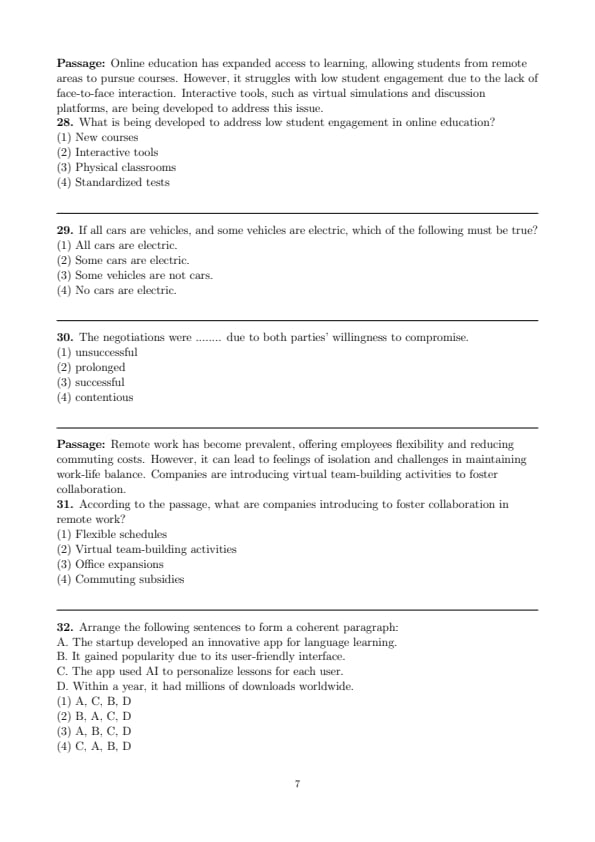
What is being developed to address low student engagement in online education?
View Solution
- Step 1: Understand the question. The question asks for what is being developed to address low student engagement in online education, requiring a specific solution from the passage.
- Step 2: Locate relevant information. The passage states, "Interactive tools, such as virtual simulations and discussion platforms, are being developed to address this issue." This directly identifies "interactive tools" as the solution.
- Step 3: Evaluate the options.
- Option (1): "New courses" is not mentioned as a solution to engagement issues, so it is incorrect.
- Option (2): "Interactive tools" directly matches the passage’s wording, supported by examples like virtual simulations, making it the correct choice.
- Option (3): "Physical classrooms" contradicts the online education context, so it is incorrect.
- Option (4): "Standardized tests" is not referenced and is irrelevant to engagement, so it is incorrect.
- Step 4: Verify specificity. The passage explicitly uses "interactive tools" with examples, ensuring option (2) is a precise match. No other solutions are mentioned.
- Step 5: Cross-check for alternatives. The passage does not suggest courses, classrooms, or tests as solutions, confirming that interactive tools is the only correct answer.
- Step 6: Final conclusion. Option (2) Interactive tools is the correct answer, as it directly reflects the passage’s stated solution to low student engagement.
Quick Tip: For reading comprehension questions about solutions, match the answer to the passage’s explicit mention or examples, and eliminate options that introduce unrelated or contradictory ideas.
If all cars are vehicles, and some vehicles are electric, which of the following must be true?
View Solution
- Step 1: Break down the premises. The question provides two premises:
- All cars are vehicles (cars are a subset of the broader vehicle category).
- Some vehicles are electric (at least one vehicle is electric).
- Step 2: Analyze logical implications. Since cars are a subset of vehicles, the vehicle category is broader, implying there are vehicles that are not cars (e.g., trucks, buses). The fact that some vehicles are electric does not necessarily involve cars.
- Step 3: Evaluate the options.
- Option (1): "All cars are electric" is not guaranteed, as the electric vehicles may not include cars.
- Option (2): "Some cars are electric" is possible but not certain, as the electric vehicles could be other types.
- Option (3): "Some vehicles are not cars" must be true, as the vehicle category includes non-car vehicles.
- Option (4): "No cars are electric" is not guaranteed, as some cars could be electric.
- Step 4: Confirm with a Venn diagram. Vehicles are a large circle, with cars as a smaller circle inside. The larger circle includes other vehicles, confirming some vehicles are not cars.
- Step 5: Verify necessity. Option (3) is the only statement that must be true, as the broader vehicle category ensures non-car vehicles exist.
- Step 6: Final conclusion. Option (3) Some vehicles are not cars is the correct answer, as it logically follows from the premises.
Quick Tip: In critical reasoning questions, focus on what must be true based on the premises. Use subset-superset relationships or Venn diagrams to deduce logical conclusions.
The negotiations were ........ due to both parties’ willingness to compromise.
View Solution
- Step 1: Analyze the sentence context. The phrase "due to both parties’ willingness to compromise" suggests a positive outcome, as compromise typically leads to agreement or success in negotiations. The blank requires a word reflecting this positive result.
- Step 2: Evaluate the options.
- Option (1): "unsuccessful" contradicts the positive implication of compromise, so it is incorrect.
- Option (2): "prolonged" suggests extended duration, which is not implied by compromise, so it is incorrect.
- Option (3): "successful" aligns with the positive outcome of compromise, making it a strong candidate.
- Option (4): "contentious" implies conflict, which contradicts the cooperative nature of compromise, so it is incorrect.
- Step 3: Test the fit. Substituting "successful" into the sentence: "The negotiations were successful due to both parties’ willingness to compromise" is logical and consistent.
- Step 4: Eliminate alternatives. Unsuccessful and contentious suggest negative outcomes, while prolonged is neutral and unrelated to compromise’s effect. Only successful fits the context.
- Step 5: Confirm with context. Compromise in negotiations typically leads to successful agreements, supporting option (3).
- Step 6: Final conclusion. Option (3) successful is the correct answer, as it best captures the positive outcome of compromise.
Quick Tip: In sentence completion questions, choose a word that aligns with the sentence’s tone and logical outcome, ensuring it matches the context provided by the clause.
According to the passage, what are companies introducing to foster collaboration in remote work?
View Solution
- Step 1: Understand the question. The question asks for what companies are introducing to foster collaboration in remote work, requiring a specific solution from the passage.
- Step 2: Locate relevant information. The passage states, "Companies are introducing virtual team-building activities to foster collaboration." This directly identifies "virtual team-building activities" as the solution.
- Step 3: Evaluate the options.
- Option (1): "Flexible schedules" is mentioned as a benefit of remote work, not a solution for collaboration, so it is incorrect.
- Option (2): "Virtual team-building activities" matches the passage’s wording, making it the correct choice.
- Option (3): "Office expansions" contradicts the remote work context, so it is incorrect.
- Option (4): "Commuting subsidies" is irrelevant, as the passage mentions reduced commuting costs, not subsidies.
- Step 4: Verify specificity. The passage explicitly uses "virtual team-building activities" to address collaboration, ensuring option (2) is a precise match.
- Step 5: Cross-check for alternatives. The passage does not suggest schedules, expansions, or subsidies as solutions, confirming option (2) as the only correct choice.
- Step 6: Final conclusion. Option (2) Virtual team-building activities is the correct answer, as it directly reflects the passage’s stated solution.
Quick Tip: For reading comprehension questions about solutions, match the answer to the passage’s explicit mention or examples, and eliminate options that are unrelated or contradictory.
Arrange the following sentences to form a coherent paragraph:
A. The startup developed an innovative app for language learning.
B. It gained popularity due to its user-friendly interface.
C. The app used AI to personalize lessons for each user.
D. Within a year, it had millions of downloads worldwide.
View Solution
- Step 1: Identify the paragraph’s structure. A coherent paragraph should introduce the main subject, provide details about its features or actions, explain its appeal, and conclude with its impact.
- Step 2: Analyze the role of each sentence.
- Sentence A: Introduces the startup’s app, serving as the starting point.
- Sentence C: Describes the app’s AI feature, providing a key detail about its functionality.
- Sentence B: Explains why it gained popularity (user-friendly interface), addressing its appeal.
- Sentence D: States the outcome (millions of downloads), serving as the conclusion.
- Step 3: Determine a logical sequence. The logical flow is: introduce the app (A), detail its AI feature (C), explain its popularity (B), and conclude with its success (D). This suggests the sequence A, C, B, D.
- Step 4: Test option (1) A, C, B, D. The sequence is: app developed (A) → AI personalization (C) → gained popularity (B) → millions of downloads (D). This forms a coherent narrative.
- Step 5: Evaluate other options.
- Option (2) B, A, C, D: Starting with popularity (B) before introducing the app (A) is illogical.
- Option (3) A, B, C, D: Placing popularity (B) before the AI feature (C) is less coherent, as the feature contributes to popularity.
- Option (4) C, A, B, D: Starting with the AI feature (C) before the app’s introduction (A) lacks context.
- Step 6: Final conclusion. Option (1) A, C, B, D provides the most logical and coherent paragraph, reflecting a clear progression from development to success.
Quick Tip: In para jumbles, start with the introduction of the main subject, add specific details, explain outcomes like popularity, and conclude with impact for a logical flow.
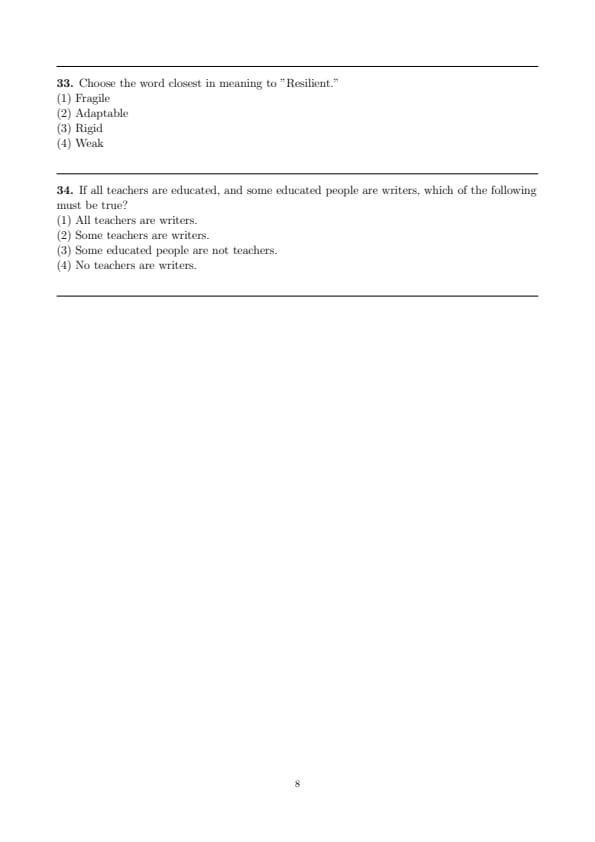
Choose the word closest in meaning to "Resilient."
View Solution
- Step 1: Define "Resilient." "Resilient" means able to recover quickly from difficulties or adapt to challenges, often describing strength or flexibility in adverse conditions.
- Step 2: Identify the synonym. A synonym for resilient should convey adaptability, strength, or recovery.
- Step 3: Evaluate the options.
- Option (1): "Fragile" means easily broken or weak, opposite to resilient, so it is incorrect.
- Option (2): "Adaptable" means able to adjust to new conditions, closely aligning with resilient’s ability to adapt and recover, making it a strong candidate.
- Option (3): "Rigid" implies inflexibility, contrary to resilient’s adaptability, so it is incorrect.
- Option (4): "Weak" suggests vulnerability, opposite to resilient’s strength, so it is incorrect.
- Step 4: Eliminate opposites. Fragile, Rigid, and Weak are antonyms or unrelated to resilient, as they imply weakness or inflexibility. Adaptable matches the adaptive aspect.
- Step 5: Confirm with context. In a sentence like "The resilient economy recovered quickly," substituting "adaptable" as "The adaptable economy recovered quickly" maintains a similar sense of flexibility.
- Step 6: Final conclusion. Option (2) Adaptable is the correct answer, as it is the closest synonym to "Resilient."
Quick Tip: For synonym questions, choose a word that reflects the core quality (e.g., adaptability for resilience) and test it in a sentence to confirm interchangeability.
If all teachers are educated, and some educated people are writers, which of the following must be true?
View Solution
- Step 1: Break down the premises. The question provides two premises:
- Premise 1: All teachers are educated (teachers are a subset of educated people).
- Premise 2: Some educated people are writers (at least one educated person is a writer).
- Step 2: Analyze logical implications. Since teachers are a subset of educated people, the educated category is broader, implying there are educated people who are not teachers (e.g., doctors, writers). The fact that some educated people are writers does not necessarily involve teachers.
- Step 3: Evaluate the options.
- Option (1): "All teachers are writers" is not guaranteed, as the writers may not include teachers.
- Option (2): "Some teachers are writers" is possible but not certain, as the educated writers could be non-teachers.
- Option (3): "Some educated people are not teachers" must be true, as the broader educated category includes non-teachers.
- Option (4): "No teachers are writers" is not guaranteed, as some teachers could be writers.
- Step 4: Confirm with a Venn diagram. Educated people are a large circle, with teachers as a smaller circle inside. The larger circle includes other educated individuals, confirming some are not teachers.
- Step 5: Verify necessity. Option (3) is the only statement that must be true, as the broader educated category ensures non-teacher educated people exist.
- Step 6: Final conclusion. Option (3) Some educated people are not teachers is the correct answer, as it logically follows from the premises.
Quick Tip: In critical reasoning questions, use subset-superset relationships or Venn diagrams to identify what must be true, avoiding options that are only possible.
*The article might have information for the previous academic years, please refer the official website of the exam.