
CAT 2014 VARC Slot 1 question Paper with Solution PDF
- Cut Off for IITs
- IIM Kashipur Cut Off
- IIM Amritsar Cut Off
- IIM Nagpur Cut Off
- IIM Indore Cut Off
- IIM Udaipur Cut Off
- IIM Ranchi Cut Off
- IIM Raipur Cut Off
- IIM Jammu Cut Off
- IIM Bodh Gaya Cut Off
- IIM Kozhikode Cut Off
- IIM Sambalpur Cut Off
- IIM Bangalore Cut Off
- IIM Sirmaur Cut Off
- IIM Trichy Cut Off
- IIM Visakhapatnam Cut Off
- IIM Lucknow Cut Off
- IIM Shillong Cut Off
- IIM Calcutta Cut Off
- IIM Ahmedabad Cut Off
- IIM Rohtak Cut Off


Content Writer | Updated On - Nov 28, 2025
CAT Question Papers are the most important study material for effective exam preparation. We at Zollege have provided all CAT Previous Year Papers with Solution PDFs here. CAT 2014 VARC was conducted successfully by Indian Institutes of Management (IIM).
Students can freely download the CAT previous year's question paper PDFs along with their solutions here. We strongly encourage cat aspirants to scan through all the CAT Question Paper to know the overall difficulty level, CAT Syllabus and understand the changes in CAT Exam Pattern over the years.
Also Check:
CAT 2014 VARC Slot 1 Question Paper with Solution PDF
| CAT 2014 VARC Slot 1 with Answer Key | Download PDF | Check Solutions |
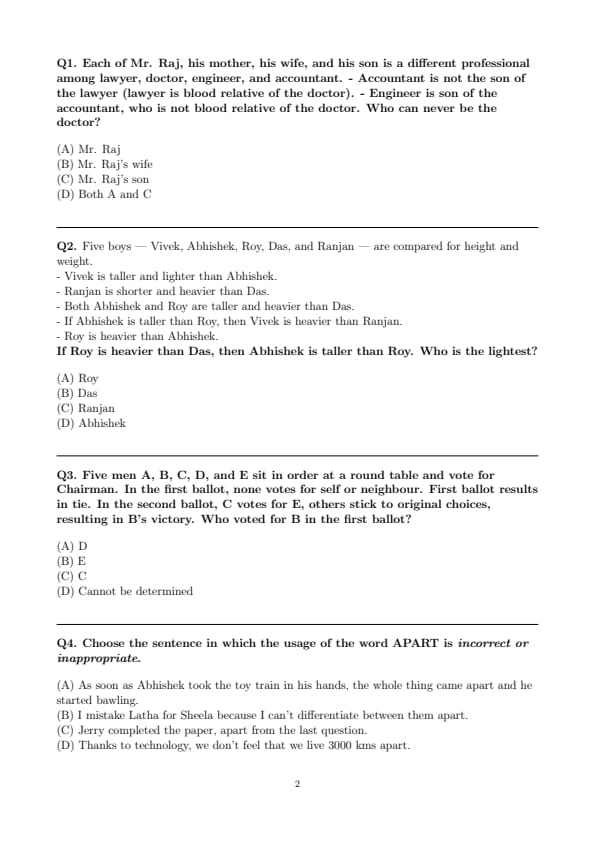
Each of Mr. Raj, his mother, his wife, and his son is a different professional among lawyer, doctor, engineer, and accountant.
- Accountant is not the son of the lawyer (lawyer is blood relative of the doctor).
- Engineer is son of the accountant, who is not blood relative of the doctor.
Who can \textbf{never} be the doctor?
View Solution
Step 1: Identify key relationships
- Lawyer is blood relative of doctor.
- Accountant is not a blood relative of doctor.
- Engineer is son of accountant.
Step 2: Deduce constraints
- Engineer being son of accountant implies accountant is a parent.
- Accountant is not blood relative of doctor \(\implies\) doctor cannot be accountant’s child or spouse.
- Lawyer is blood relative of doctor \(\implies\) doctor must be in lawyer’s family (parent, child, or sibling).
Step 3: Determine who cannot be doctor
- Mr. Raj: If he is doctor, then lawyer must be his blood relative. But accountant is parent of engineer and not related to doctor, leading to contradiction. Hence Mr. Raj cannot be doctor.
- Mr. Raj's son: Engineer is son of accountant, so Mr. Raj's son is the engineer or another child? Either way, being son of accountant, he cannot be doctor (accountant not blood relative of doctor).
Step 4: Conclusion
Thus, Mr. Raj and his son can never be doctor. Quick Tip: Use family and professional relationships step by step, marking blood relations and parent-child links, to eliminate impossible options.
Five boys — Vivek, Abhishek, Roy, Das, and Ranjan — are compared for height and weight.
- Vivek is taller and lighter than Abhishek.
- Ranjan is shorter and heavier than Das.
- Both Abhishek and Roy are taller and heavier than Das.
- If Abhishek is taller than Roy, then Vivek is heavier than Ranjan.
- Roy is heavier than Abhishek.
If Roy is heavier than Das, then Abhishek is taller than Roy. Who is the lightest?
View Solution
Step 1: List given conditions
1. Vivek \(>\) taller but lighter than Abhishek.
2. Ranjan \(<\) shorter but heavier than Das.
3. Abhishek and Roy \(>\) taller and heavier than Das.
4. Abhishek \(>\) taller than Roy \(\implies\) Vivek \(>\) heavier than Ranjan.
5. Roy \(>\) heavier than Abhishek.
6. Roy \(>\) heavier than Das \(\implies\) Abhishek \(>\) taller than Roy.
Step 2: Determine relative heights and weights
- From condition 1: Vivek lighter than Abhishek.
- From condition 2: Ranjan heavier than Das.
- From condition 3: Abhishek and Roy taller and heavier than Das.
- From condition 5 and 6: Roy heavier than Abhishek and Das.
Step 3: Identify lightest
- Vivek lighter than Abhishek.
- Das lighter than Ranjan, Abhishek, Roy, Vivek (since Vivek is lighter than Abhishek but heavier than Das?).
- Comparing all: Das is the lightest among the five. Quick Tip: Use a height-weight matrix to track relative comparisons; focus on transitive relations to determine extremes like lightest or tallest.
Five men A, B, C, D, and E sit in order at a round table and vote for Chairman. In the first ballot, none votes for self or neighbour. First ballot results in tie. In the second ballot, C votes for E, others stick to original choices, resulting in B’s victory. Who voted for B in the first ballot?
View Solution
Step 1: Understand restrictions
- No one votes for self or neighbour in first ballot.
- Seating is circular: A-B-C-D-E-A.
Step 2: Deduce possibilities
- Neighbours of C: B and D. C cannot vote for B or D, so C votes for either A or E.
- First ballot tie implies that each candidate received one vote.
Step 3: Second ballot change
- Only C changes vote to E, resulting in B’s victory.
- This implies in first ballot, C must have voted for B, so that when C switched to E, B gained one more vote and won.
Step 4: Conclusion
- Hence, C voted for B in the first ballot. Quick Tip: For circular seating logic puzzles, map neighbours and systematically track vote changes to deduce individual choices.
Choose the sentence in which the usage of the word \textbf{APART} is \emph{incorrect or inappropriate}.
View Solution
Step 1: Understand the meaning of "apart"
- "Apart" generally means separated by distance or excepting something (as in "apart from").
Step 2: Analyze each sentence
- (A) "came apart" – correct usage; means broke into pieces.
- (B) "differentiate between them apart" – incorrect; "apart" is unnecessary and grammatically wrong here. Correct form: "I can't differentiate between them."
- (C) "apart from the last question" – correct; means "except".
- (D) "live 3000 kms apart" – correct; refers to physical distance.
Step 3: Conclusion
- Sentence (B) misuses "apart", so it is the incorrect option. Quick Tip: Remember: "Apart" is used to indicate separation (physical or conceptual) or exception. Avoid using it redundantly after verbs like "differentiate."
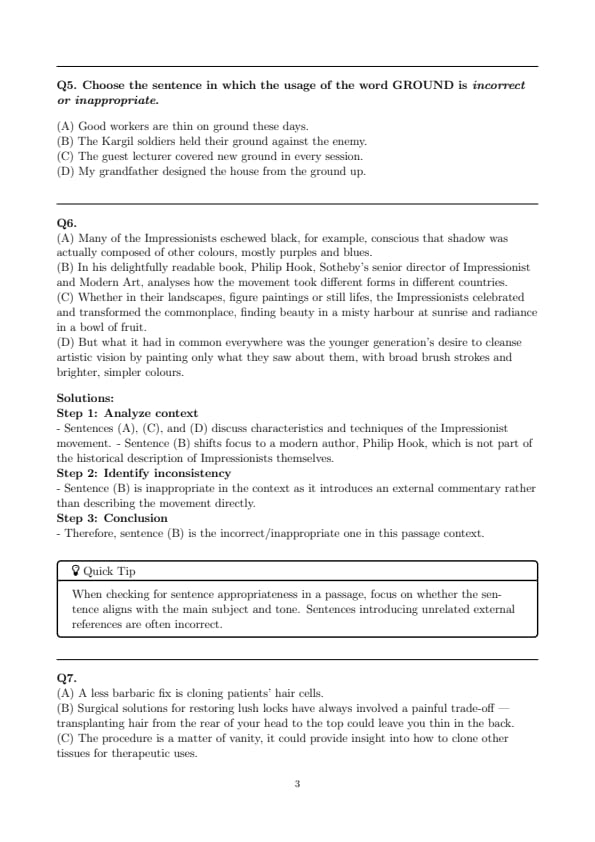
Choose the sentence in which the usage of the word \textbf{GROUND} is \emph{incorrect or inappropriate}.
View Solution
Step 1: Understand the idiomatic usage of "ground"
- "Ground" can mean basis, area, or metaphorical space depending on the idiom.
Step 2: Analyze each sentence
- (A) "thin on ground" – incorrect; the correct idiom is "thin on the ground."
- (B) "held their ground" – correct; means to defend position.
- (C) "covered new ground" – correct; means to explore new ideas.
- (D) "from the ground up" – correct; means from the very beginning.
Step 3: Conclusion
- Sentence (A) misuses "ground," missing the article "the," making it the incorrect option. Quick Tip: Many idiomatic expressions with "ground" require precise wording. Common ones: "thin on the ground," "hold one's ground," "cover new ground," "from the ground up."
(A) Many of the Impressionists eschewed black, for example, conscious that shadow was actually composed of other colours, mostly purples and blues.
(B) In his delightfully readable book, Philip Hook, Sotheby’s senior director of Impressionist and Modern Art, analyses how the movement took different forms in different countries.
(C) Whether in their landscapes, figure paintings or still lifes, the Impressionists celebrated and transformed the commonplace, finding beauty in a misty harbour at sunrise and radiance in a bowl of fruit.
(D) But what it had in common everywhere was the younger generation’s desire to cleanse artistic vision by painting only what they saw about them, with broad brush strokes and brighter, simpler colours.
View Solution
Step 1: Analyze context
- Sentences (A), (C), and (D) discuss characteristics and techniques of the Impressionist movement.
- Sentence (B) shifts focus to a modern author, Philip Hook, which is not part of the historical description of Impressionists themselves.
Step 2: Identify inconsistency
- Sentence (B) is inappropriate in the context as it introduces an external commentary rather than describing the movement directly.
Step 3: Conclusion
- Therefore, sentence (B) is the incorrect/inappropriate one in this passage context. Quick Tip: When checking for sentence appropriateness in a passage, focus on whether the sentence aligns with the main subject and tone. Sentences introducing unrelated external references are often incorrect.
(A) A less barbaric fix is cloning patients’ hair cells.
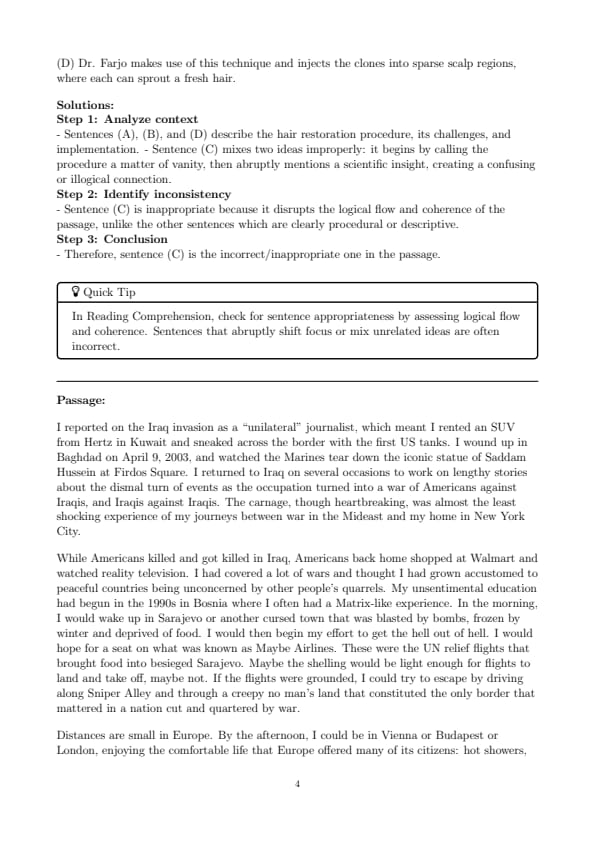
(B) Surgical Solution for restoring lush locks have always involved a painful trade-off — transplanting hair from the rear of your head to the top could leave you thin in the back.
(C) The procedure is a matter of vanity, it could provide insight into how to clone other tissues for therapeutic uses.
(D) Dr. Farjo makes use of this technique and injects the clones into sparse scalp regions, where each can sprout a fresh hair.
View Solution
Step 1: Analyze context
- Sentences (A), (B), and (D) describe the hair restoration procedure, its challenges, and implementation.
- Sentence (C) mixes two ideas improperly: it begins by calling the procedure a matter of vanity, then abruptly mentions a scientific insight, creating a confusing or illogical connection.
Step 2: Identify inconsistency
- Sentence (C) is inappropriate because it disrupts the logical flow and coherence of the passage, unlike the other sentences which are clearly procedural or descriptive.
Step 3: Conclusion
- Therefore, sentence (C) is the incorrect/inappropriate one in the passage. Quick Tip: In Reading Comprehension, check for sentence appropriateness by assessing logical flow and coherence. Sentences that abruptly shift focus or mix unrelated ideas are often incorrect.
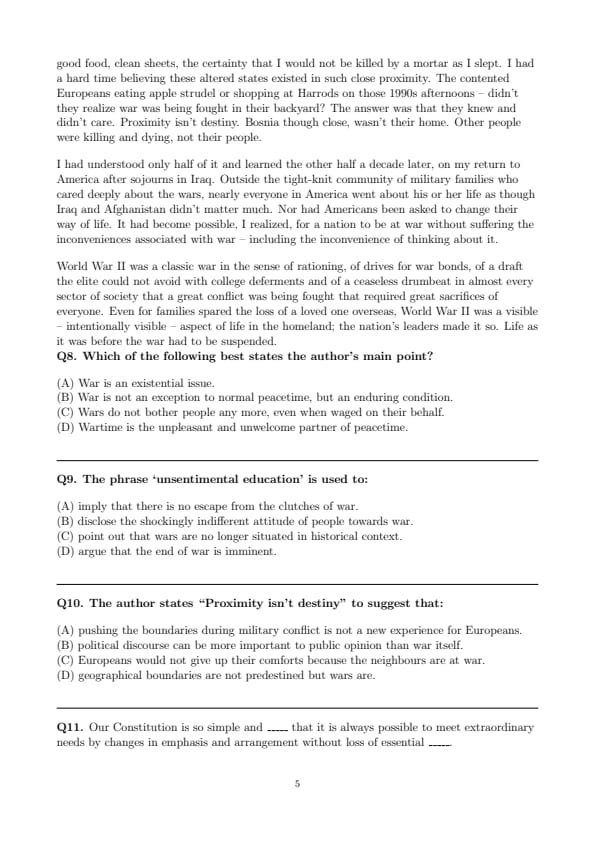
Which of the following best states the author’s main point?
View Solution
Step 1: Analyze the passage context
- The author discusses the paradoxical attitude of people towards war, noting that people increasingly accept or ignore wars, even when they are directly involved.
Step 2: Evaluate options
- (A) War as an existential issue: too general; not the focus.
- (B) War as an enduring condition: partially correct, but does not capture the behavioral aspect.
- (C) People are indifferent to wars waged on their behalf: directly captures the author’s main point.
- (D) Wartime is unpleasant: descriptive but misses the main insight about human indifference.
Step 3: Conclusion
- Hence, (C) best summarizes the main point of the passage. Quick Tip: For main point questions, focus on the author’s central argument or observation rather than examples or supporting details.
The phrase \textbf{‘unsentimental education’} is used to:
View Solution
Step 1: Understand the phrase
- ‘Unsentimental education’ refers to a learning or realization that is free from emotional indulgence, focusing on cold, hard facts.
Step 2: Contextual meaning
- In the passage, the phrase highlights that people have become indifferent or emotionally detached about war; they accept its realities without sentiment.
Step 3: Evaluate options
- (A) Incorrect: does not emphasize detachment.
- (B) Correct: accurately conveys the idea of indifferent attitude.
- (C) Incorrect: historical context is not the focus.
- (D) Incorrect: phrase does not suggest the end of war.
Step 4: Conclusion
- Therefore, (B) is the correct interpretation. Quick Tip: For phrase-in-context questions, always relate the phrase to the passage’s central theme rather than its literal dictionary meaning.
The author states \textbf{“Proximity isn’t destiny”} to suggest that:
View Solution
Step 1: Understand the phrase
- “Proximity isn’t destiny” implies that physical closeness to a situation does not necessarily dictate one’s experiences or reactions.
Step 2: Contextual meaning
- The passage explains that even though Europeans were geographically close to wars, their daily life, comforts, and perceptions were not drastically altered.
Step 3: Evaluate options
- (A) Incorrect: focuses on historical experience, not the intended meaning.
- (B) Incorrect: not the primary point conveyed by the phrase.
- (C) Correct: directly reflects that proximity to conflict did not force Europeans to change their lifestyle.
- (D) Incorrect: misinterprets the metaphor as literal geographical determinism.
Step 4: Conclusion
- Therefore, option (C) correctly captures the author’s intended meaning. Quick Tip: For idiomatic phrases in RC passages, connect the figurative meaning to the context rather than literal interpretation.
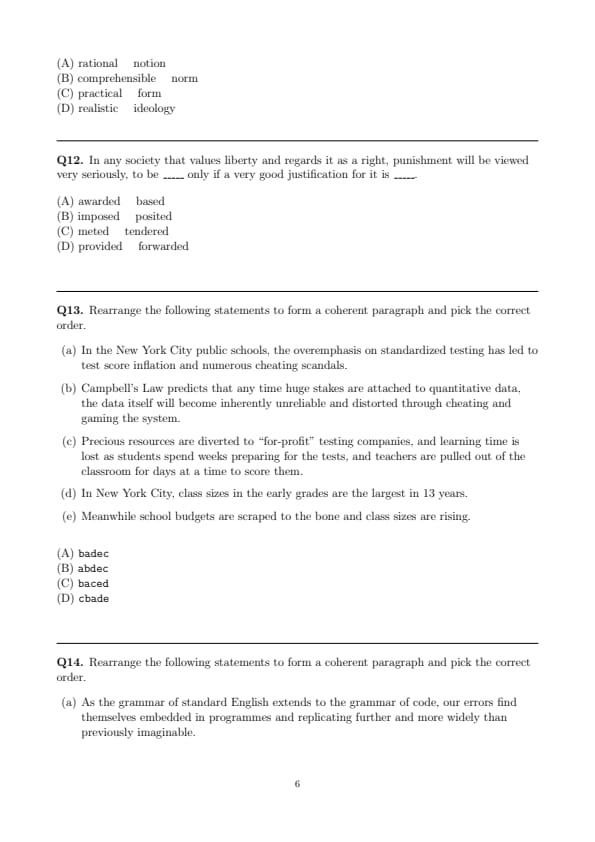
Our Constitution is so simple and _____ that it is always possible to meet extraordinary needs by changes in emphasis and arrangement without loss of essential _____.
View Solution
Step 1: Analyze sentence structure
- The sentence emphasizes flexibility in the Constitution — “changes in emphasis and arrangement without loss of essential ___”.
- The first blank describes the nature of the Constitution.
Step 2: Evaluate options for first blank
- (A) rational – logical, but doesn’t convey adaptability.
- (B) comprehensible – readable, but doesn’t imply functional practicality.
- (C) practical – implies workable and adaptable, fits context.
- (D) realistic – close, but less precise than “practical” in this constitutional context.
Step 3: Evaluate options for second blank
- (A) notion – too vague.
- (B) norm – general rule, not ideal.
- (C) form – the essential structure remains intact, aligns with the idea of arrangement and emphasis.
- (D) ideology – implies ideology, which is not being emphasized.
Step 4: Conclusion
- The best pair that fits both blanks is practical and form. Quick Tip: Look for contextual clues like “changes in emphasis and arrangement” to decide which word best conveys adaptability and structural integrity.
In any society that values liberty and regards it as a right, punishment will be viewed very seriously, to be _____ only if a very good justification for it is _____.
View Solution
Step 1: First blank analysis
The context is punishment — the correct collocation is “meted out” (meaning given or inflicted).
- “Awarded” is inappropriate for punishment,
- “Imposed” could work but is weaker than the precise legal term “meted”,
- “Provided” is entirely incorrect for punishment.
Step 2: Second blank analysis
A justification can be “tendered” (formally offered or presented), which fits the formal tone of the sentence.
- “Based” doesn’t fit grammatically,
- “Posited” means assumed or put forward, but less formal/legal in tone,
- “Forwarded” is about sending something physically, not a formal presentation.
Step 3: Final check
“Meted ... tendered” conveys the sense of punishment being given only when a valid justification is formally presented.
\[ \boxed{Meted \ \ \ Tendered} \] Quick Tip: For formal contexts like law or governance, prefer precise collocations such as “meted out” or “tendered” that are standard in legal language.
Rearrange the following statements to form a coherent paragraph and pick the correct order.
[(a)] In the New York City public schools, the overemphasis on standardized testing has led to test score inflation and numerous cheating scandals.
[(b)] Campbell’s Law predicts that any time huge stakes are attached to quantitative data, the data itself will become inherently unreliable and distorted through cheating and gaming the system.
[(c)] Precious resources are diverted to “for-profit” testing companies, and learning time is lost as students spend weeks preparing for the tests, and teachers are pulled out of the classroom for days at a time to score them.
[(d)] In New York City, class sizes in the early grades are the largest in 13 years.
[(e)] Meanwhile school budgets are scraped to the bone and class sizes are rising.
View Solution
Step 1: Identify the theme
The paragraph is about the negative consequences of over-reliance on standardized testing in public schools, especially NYC.
Step 2: Identify the logical starting point
(b) introduces Campbell’s Law, which is a general principle — best used as an opener.
Step 3: Follow with specific application
(a) applies that law to NYC schools.
(c) elaborates on the negative impact of testing logistics.
(e) continues the consequences, linking to budget cuts.
(d) gives a final data point: rising class sizes.
Final order: b \(\rightarrow\) a \(\rightarrow\) c \(\rightarrow\) e \(\rightarrow\) d
\[ \boxed{baced} \] Quick Tip: Start with general theory if present, then proceed to examples, consequences, and conclusions. Look for cause-effect flow.
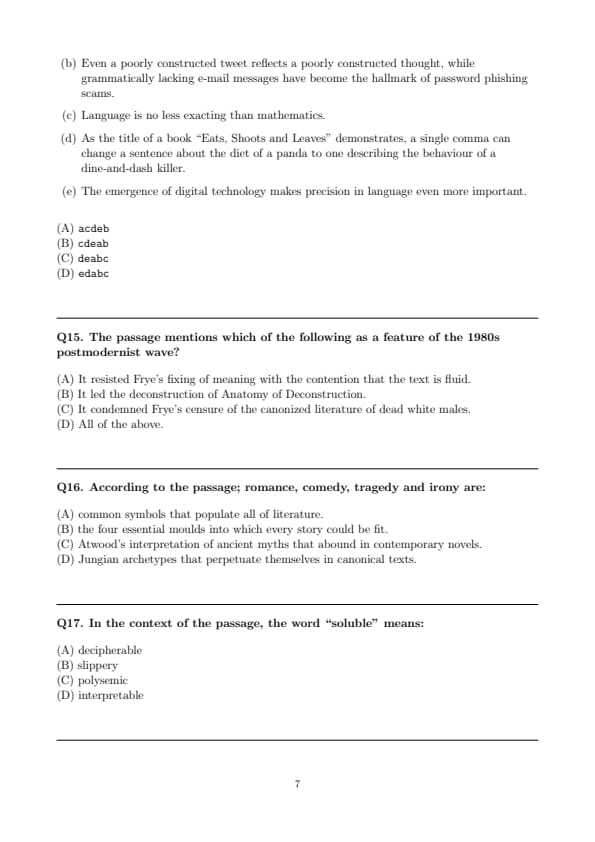
Rearrange the following statements to form a coherent paragraph and pick the correct order.
[(a)] As the grammar of standard English extends to the grammar of code, our errors find themselves embedded in programmes and replicating further and more widely than previously imaginable.
[(b)] Even a poorly constructed tweet reflects a poorly constructed thought, while grammatically lacking e-mail messages have become the hallmark of password phishing scams.
[(c)] Language is no less exacting than mathematics.
[(d)] As the title of a book “Eats, Shoots and Leaves” demonstrates, a single comma can change a sentence about the diet of a panda to one describing the behaviour of a dine-and-dash killer.
[(e)] The emergence of digital technology makes precision in language even more important.
View Solution
Step 1: Logical opener
(a) introduces the main theme: the connection between language errors and digital replication — a strong conceptual start.
Step 2: Build sequence
(c) gives a general assertion: language is rigorous — supports the idea in (a).
(d) gives a humorous example of grammar's precision.
(e) concludes the theme, stressing digital impact.
(b) gives a real-world example of bad grammar in tech leading to phishing.
Final order: a \(\rightarrow\) c \(\rightarrow\) d \(\rightarrow\) e \(\rightarrow\) b
\[ \boxed{acdeb} \] Quick Tip: Place abstract ideas or metaphors early. Follow with examples or analogies. Let the paragraph build toward modern relevance.
The passage mentions which of the following as a feature of the 1980s postmodernist wave?
View Solution
Step 1: Identifying the features
The passage describes the 1980s postmodernist wave as:
- resisting fixed meaning (fluid text),
- leading deconstructionist approaches,
- condemning exclusionary literary canon practices.
Step 2: Matching options
(A), (B), and (C) are all mentioned in the passage as characteristics of this wave.
\[ \boxed{D} \] Quick Tip: When multiple listed points in a passage match the options, check if “All of the above” is justified before selecting it.
According to the passage; romance, comedy, tragedy and irony are:
View Solution
Step 1: Referencing the passage
The passage explicitly states that these four literary modes are categories into which all stories can be classified — aligning with Frye’s structural criticism.
Step 2: Eliminating wrong choices
(A) refers to “symbols”, not modes.
(C) is unrelated — Atwood is not linked to defining these four modes.
(D) refers to Jungian archetypes, which is separate from Frye’s framework.
\[ \boxed{B} \] Quick Tip: When a passage defines specific categories, use the exact definition from the text instead of inferring broader symbolic meanings.
In the context of the passage, the word “soluble” means:
View Solution
Step 1: Context clue from passage
In the passage, “soluble” is used metaphorically to describe text meaning as dissolvable into multiple interpretations — a postmodernist idea.
Step 2: Matching the meaning
“Polysemic” means having multiple meanings, which fits the idea that a text’s meaning is not fixed but can dissolve into many readings.
Step 3: Eliminating wrong choices
(A) and (D) mean understandable but do not capture multiplicity.
(B) “slippery” is figurative but imprecise.
\[ \boxed{C} \] Quick Tip: In RC vocabulary questions, match the word to the conceptual framework of the passage rather than relying on its most common dictionary meaning.
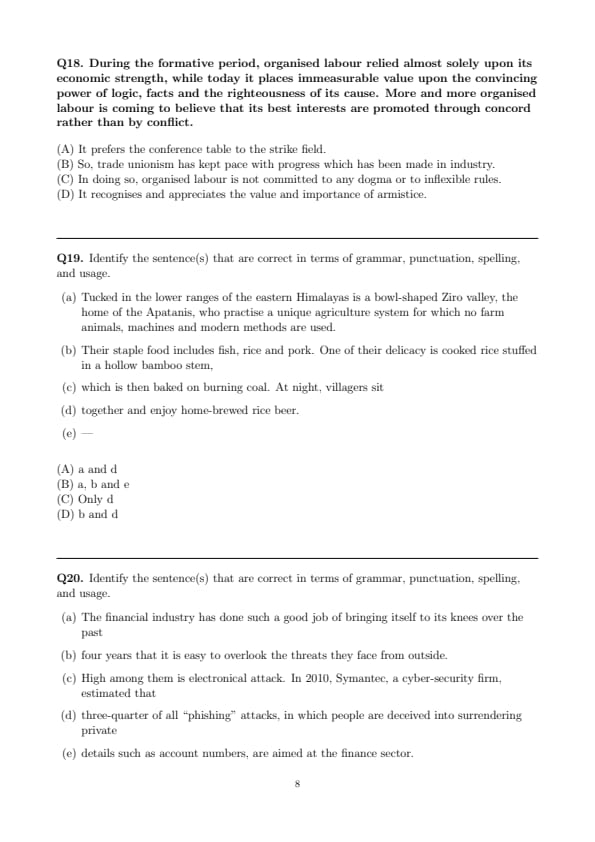
During the formative period, organised labour relied almost solely upon its economic strength, while today it places immeasurable value upon the convincing power of logic, facts and the righteousness of its cause. More and more organised labour is coming to believe that its best interests are promoted through concord rather than by conflict.
View Solution
Step 1: Understanding the paragraph flow
The paragraph describes a shift from economic power and confrontation toward logic, facts, and concord as the main tools of organised labour.
Step 2: Identifying the suitable closing sentence
The best concluding line should directly summarise the shift from conflict to peaceful negotiation. Option (A) does this perfectly: “It prefers the conference table to the strike field” neatly encapsulates the idea of preferring dialogue over confrontation.
Step 3: Eliminating wrong choices
(B) talks about trade unionism keeping pace with industry — a new idea, not a conclusion to this thought.
(C) mentions dogma and inflexible rules — tangential, not the main contrast.
(D) uses “armistice” — more military-oriented than the labour negotiation context.
\[ \boxed{A} \] Quick Tip: In paragraph completion, the correct last sentence will reinforce the main idea without introducing new unrelated themes.
Identify the sentence(s) that are correct in terms of grammar, punctuation, spelling, and usage.
[(a)] Tucked in the lower ranges of the eastern Himalayas is a bowl-shaped Ziro valley, the home of the Apatanis, who practise a unique agriculture system for which no farm animals, machines and modern methods are used.
[(b)] Their staple food includes fish, rice and pork. One of their delicacy is cooked rice stuffed in a hollow bamboo stem,
[(c)] which is then baked on burning coal. At night, villagers sit
[(d)] together and enjoy home-brewed rice beer.
[(e)] ---
View Solution
Step 1: Checking each sentence
(a) Grammatically correct, proper punctuation, and clear meaning.
(b) Incorrect — “One of their delicacy” should be “One of their delicacies”.
(c) Grammatically fine as a fragment but is dependent on (b); since (b) is incorrect, this sequence fails.
(d) Correct grammar, punctuation, and usage.
Step 2: Conclusion
Only (a) and (d) are fully correct independently.
\[ \boxed{A} \] Quick Tip: When checking grammar correctness, watch for number agreement (“delicacy” vs “delicacies”) and sentence completeness.
Identify the sentence(s) that are correct in terms of grammar, punctuation, spelling, and usage.
[(a)] The financial industry has done such a good job of bringing itself to its knees over the past
[(b)] four years that it is easy to overlook the threats they face from outside.
[(c)] High among them is electronical attack. In 2010, Symantec, a cyber-security firm, estimated that
[(d)] three-quarter of all “phishing” attacks, in which people are deceived into surrendering private
[(e)] details such as account numbers, are aimed at the finance sector.
View Solution
Step 1: Checking each sentence
(a) Grammatically fine except “bringing itself to its knees” is idiomatic but the clause is incomplete without continuation — not independently complete.
(b) Correct as a continuation but given separately, it is incomplete without (a).
(c) Incorrect — “electronical attack” should be “electronic attack”.
(d) Correct — “three-quarter” is correct in singular form before “of all … attacks” and punctuation is fine.
(e) Correct — continues logically from (d) and is grammatically fine.
Step 2: Conclusion
Only (d) and (e) are correct and complete as per grammar and usage.
\[ \boxed{C} \] Quick Tip: When identifying correct sentences, ensure each is both grammatically correct and independent in structure, unless explicitly forming a multi-part sentence.
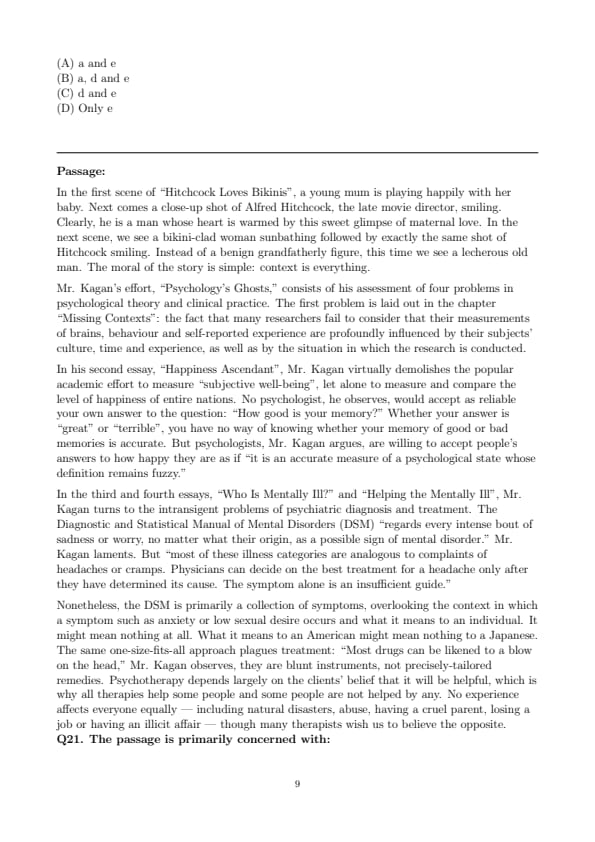
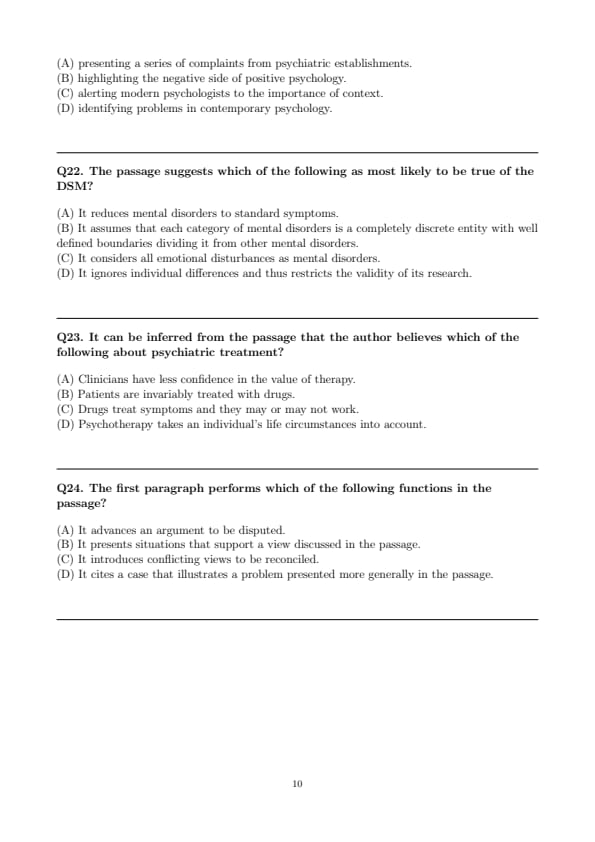
The passage is primarily concerned with:
View Solution
The passage, based on Mr. Kagan’s essays, critiques various aspects of current psychology — from measurement issues to psychiatric diagnosis and treatment. It identifies problems such as overreliance on subjective measures, ignoring context, and the limitations of the DSM. Therefore, the most accurate answer is (D).
\[ \boxed{D} \] Quick Tip: Look for the overarching theme in multiple paragraphs — here, it’s pointing out flaws and limitations in psychology rather than focusing on a single subtopic.
The passage suggests which of the following as most likely to be true of the DSM?
View Solution
The DSM is criticized for being primarily a collection of symptoms, where diagnosis is based on symptom lists rather than underlying causes or individual contexts. This matches option (A) exactly.
\[ \boxed{A} \] Quick Tip: Focus on direct criticisms from the passage — the DSM's symptom-based approach is explicitly highlighted.
It can be inferred from the passage that the author believes which of the following about psychiatric treatment?
View Solution
The passage notes that most drugs can be likened to a blow on the head — they are blunt instruments, not precisely tailored remedies, and may or may not help. This directly supports option (C).
\[ \boxed{C} \] Quick Tip: In inference questions, link the answer to specific descriptive analogies or evaluations used by the author.
The first paragraph performs which of the following functions in the passage?
View Solution
The Hitchcock scene is used as an example to illustrate the importance of context — the broader problem addressed in the passage. This makes it a specific illustrative case for the general critique to follow.
\[ \boxed{D} \] Quick Tip: Look for how the opening sets the tone — here, it’s an analogy that mirrors the main argument about context in psychology.
*The article might have information for the previous academic years, please refer the official website of the exam.