
CAT 2014 VARC Slot 2 Question Paper with Solution PDF
- Cut Off for IITs
- IIM Kashipur Cut Off
- IIM Amritsar Cut Off
- IIM Nagpur Cut Off
- IIM Indore Cut Off
- IIM Udaipur Cut Off
- IIM Ranchi Cut Off
- IIM Raipur Cut Off
- IIM Jammu Cut Off
- IIM Bodh Gaya Cut Off
- IIM Kozhikode Cut Off
- IIM Sambalpur Cut Off
- IIM Bangalore Cut Off
- IIM Sirmaur Cut Off
- IIM Trichy Cut Off
- IIM Visakhapatnam Cut Off
- IIM Lucknow Cut Off
- IIM Shillong Cut Off
- IIM Calcutta Cut Off
- IIM Ahmedabad Cut Off
- IIM Rohtak Cut Off


Content Writer | Updated On - Nov 28, 2025
CAT Question Papers are the most important study material for effective exam preparation. We at Zollege have provided all CAT Previous Year Papers with Solution PDFs here. CAT 2014 VARC was conducted successfully by Indian Institutes of Management (IIM).
Students can freely download the CAT previous year's question paper PDFs along with their solutions here. We strongly encourage cat aspirants to scan through all the CAT Question Paper to know the overall difficulty level, CAT Syllabus and understand the changes in CAT Exam Pattern over the years.
Also Check:
CAT 2014 VARC Slot 2 Question Paper with Solution PDF
| CAT 2014 VARC Slot 2 with Answer Key | Download PDF | Check Solutions |
Question 1:
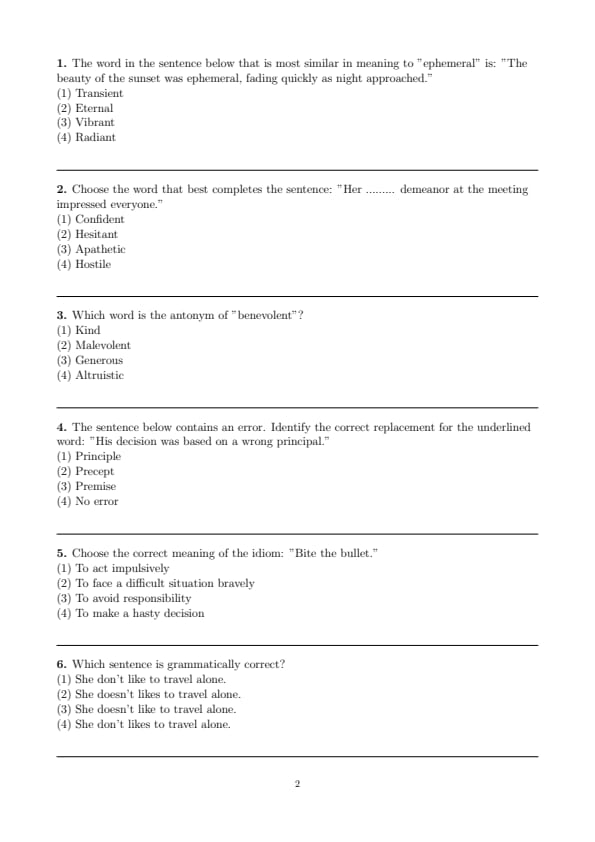
The word in the sentence below that is most similar in meaning to "ephemeral" is:
"The beauty of the sunset was ephemeral, fading quickly as night approached."
View Solution
Step 1: Understand the meaning of 'ephemeral'
The word "ephemeral" means something that lasts for a very short time or is temporary.
Step 2: Compare options
- Transient: Temporary, short-lived
- Eternal: Lasting forever
- Vibrant: Full of energy or color
- Radiant: Shining or glowing brightly
Step 3: Choose the correct synonym
"Transient" matches the meaning of "ephemeral" as both indicate short duration. Quick Tip: For vocabulary questions, focus on the context of the sentence to determine the precise meaning of the word.
Choose the word that best completes the sentence:
"Her ......... demeanor at the meeting impressed everyone."
View Solution
Step 1: Understand the context
The sentence mentions that her demeanor "impressed everyone," indicating a positive, strong, and admirable quality.
Step 2: Analyze options
- Confident: Self-assured and poised; would impress others
- Hesitant: Unsure or indecisive; unlikely to impress
- Apathetic: Showing no interest or emotion; negative
- Hostile: Aggressive or unfriendly; negative
Step 3: Select the best word
"Confident" aligns perfectly with the context of impressing everyone at the meeting. Quick Tip: Focus on the effect or reaction described in the sentence. Words conveying positive traits usually fit when the sentence mentions admiration or impression.
Which word is the antonym of "benevolent"?
View Solution
Step 1: Understand the meaning of "benevolent"
"Benevolent" means kind, charitable, or showing goodwill.
Step 2: Analyze options
- Kind: Similar in meaning to benevolent
- Malevolent: Having or showing a desire to harm others
- Generous: Similar in meaning to benevolent
- Altruistic: Similar in meaning to benevolent
Step 3: Select the antonym
"Malevolent" directly opposes "benevolent," making it the correct antonym. Quick Tip: For antonym questions, always first identify the core meaning of the word and then select the option that conveys the opposite sentiment.
The sentence below contains an error. Identify the correct replacement for the underlined word:
"His decision was based on a wrong principal."
View Solution
Step 1: Identify the incorrect word
The sentence uses "principal" which refers to a person (e.g., head of a school). Here, the intended meaning is a fundamental truth or rule.
Step 2: Determine the correct word
- Principle: A fundamental truth, law, or belief
- Precept: A rule or instruction, similar but less commonly used in this context
- Premise: A statement or proposition used in reasoning
- No error:, there is an error in the word choice
Step 3: Replace correctly
The correct word is "principle," making the sentence: "His decision was based on a wrong principle." Quick Tip: Remember: "principal" often refers to a person or sum of money, while "principle" refers to a rule, law, or fundamental truth.
Choose the correct meaning of the idiom: "Bite the bullet."
View Solution
Step 1: Understand the idiom
"Bite the bullet" is an idiom that means to endure a painful or otherwise unpleasant situation that is unavoidable.
Step 2: Analyze options
- To act impulsively (does not match the idiom)
- To face a difficult situation bravely (correct meaning)
- To avoid responsibility (opposite meaning)
- To make a hasty decision (not related)
Step 3: Conclusion
The idiom "Bite the bullet" means to face a difficult or painful situation with courage. Quick Tip: Many idioms are metaphorical; "bite the bullet" historically referred to soldiers biting a bullet during surgery to endure pain, hence the meaning of facing difficulty bravely.
Which sentence is grammatically correct?
View Solution
Step 1: Subject-Verb Agreement
The subject "She" is third person singular, so the auxiliary verb should be "does".
Step 2: Correct Verb Form
After "does", the main verb should be in base form (like "like"), not "likes".
Step 3: Analyze options
- She don’t like ("don’t" is incorrect with third person singular)
- She doesn’t likes (main verb should be base form "like")
- She doesn’t like (correct subject-verb agreement and base form)
- She don’t likes (both auxiliary and main verb incorrect)
Step 4: Conclusion
The grammatically correct sentence is: "She doesn’t like to travel alone." Quick Tip: With third-person singular subjects (he, she, it), always use "does" + base verb in negative sentences. Example: "He doesn’t go", "She doesn’t play".
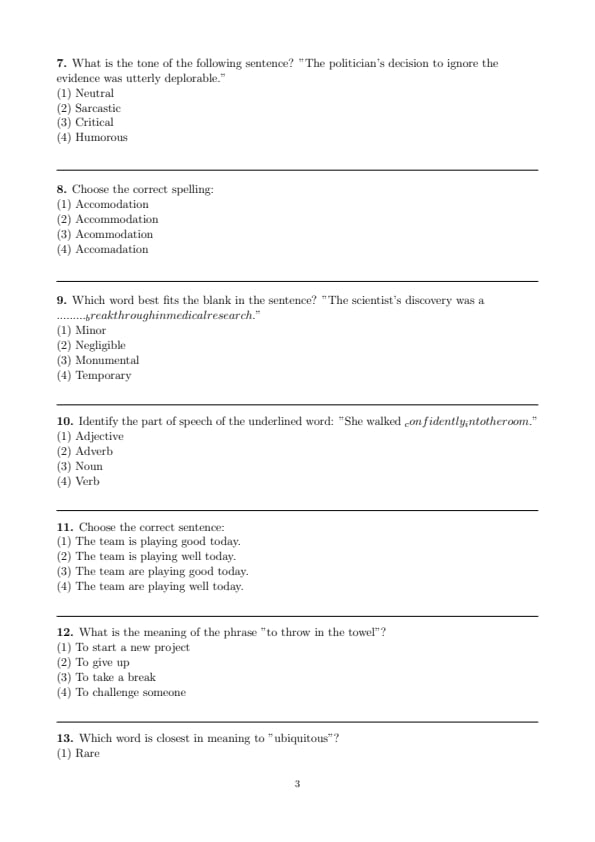
What is the tone of the following sentence?
"The politician’s decision to ignore the evidence was utterly deplorable."
View Solution
Step 1: Understand the meaning of key words
The word "deplorable" indicates strong disapproval or condemnation.
Step 2: Identify tone
The sentence expresses judgment and disapproval about the politician’s decision. This is characteristic of a critical tone.
Step 3: Eliminate other options
- Neutral : The sentence clearly expresses strong opinion.
- Sarcastic : There is no mockery or irony.
- Humorous : The sentence is serious, not funny.
- Critical ✅: Accurately reflects disapproval.
Step 4: Conclusion
The tone of the sentence is critical. Quick Tip: Words like "deplorable", "unacceptable", "blatant" often signal a critical or disapproving tone in comprehension passages.
Choose the correct spelling:
View Solution
Step 1: Recognize common spelling patterns
The word "Accommodation" has a double 'c' and double 'm'.
Step 2: Eliminate incorrect options
- (1) Accomodation : Only one 'm', incorrect.
- (3) Acommodation : Only one 'c', incorrect.
- (4) Accomadation : 'a' instead of 'o', incorrect.
- (2) Accommodation : Correct spelling with double 'c' and double 'm'.
Step 3: Conclusion
The correct spelling is "Accommodation". Quick Tip: Remember: "Accommodation" has double 'c' and double 'm'. Mnemonics like “two cots and two mattresses” can help recall the correct spelling.
Which word best fits the blank in the sentence?
"The scientist’s discovery was a ........._ breakthrough in medical research."
View Solution
- Step 1: Context: A breakthrough in medical research is likely significant.
- Step 2: Evaluate: (1) Minor (small), (2) Negligible (insignificant), (3) Monumental (major), (4) Temporary (short-lived).
- Step 3: Monumental fits a significant discovery.
- Step 4: Eliminate options that suggest insignificance or temporariness.
- Step 5: Option (3) is correct.
Quick Tip: Choose words that match the context and intensity of the sentence’s meaning.
Identify the part of speech of the underlined word:
"She walked _confidently_ into the room."
View Solution
- Step 1: "Confidently" describes how she walked, modifying the verb.
- Step 2: Evaluate: (1) Adjective (modifies noun), (2) Adverb (modifies verb), (3) Noun (person/place/thing), (4) Verb (action).
- Step 3: Adverb fits as it describes the action "walked."
- Step 4: Confirm: "Confidently" ends in "-ly," typical for adverbs.
- Step 5: Option (2) is correct.
Quick Tip: Identify part of speech by analyzing what the word modifies in the sentence.
Choose the correct sentence:
View Solution
- Step 1: "Team" is singular, so use "is."
- Step 2: "Well" (adverb) modifies "playing"; "good" (adjective) is incorrect.
- Step 3: Evaluate: (1) Wrong adverb, (2) Correct, (3) Wrong verb and adverb, (4) Wrong verb.
- Step 4: Confirm: "Is playing well" is grammatically correct.
- Step 5: Option (2) is correct.
Quick Tip: Use "well" to modify verbs and ensure subject-verb agreement for collective nouns.
What is the meaning of the phrase "to throw in the towel"?
View Solution
- Step 1: The phrase "throw in the towel" means to surrender or quit.
- Step 2: Evaluate: (1) Incorrect (opposite), (2) Correct, (3) Incorrect (implies pause), (4) Incorrect (implies confrontation).
- Step 3: Confirm: Originates from boxing, where throwing a towel signals defeat.
- Step 4: Eliminate options not related to giving up.
- Step 5: Option (2) is correct.
Quick Tip: Learn common idioms and their origins to understand their meanings.
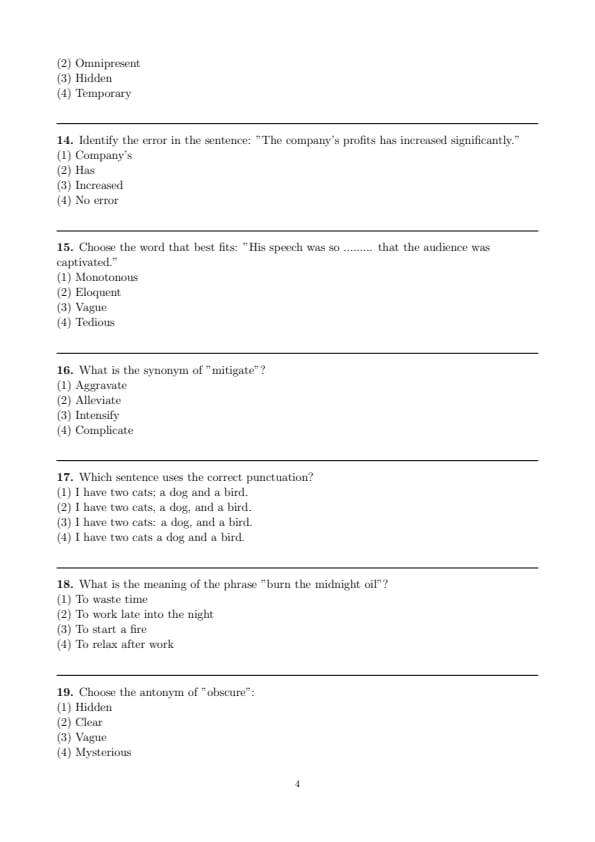
Which word is closest in meaning to "ubiquitous"?
View Solution
- Step 1: "Ubiquitous" means present everywhere.
- Step 2: Evaluate: (1) Rare (opposite), (2) Omnipresent (everywhere), (3) Hidden (opposite), (4) Temporary (unrelated).
- Step 3: Omnipresent is synonymous with ubiquitous.
- Step 4: Eliminate options that don’t mean "everywhere."
- Step 5: Option (2) is correct.
Quick Tip: For synonyms, choose words with the closest meaning in all contexts.
Identify the error in the sentence:
"The company’s profits has increased significantly."
View Solution
- Step 1: "Company" is singular, so the verb should be "have" for plural or "has" corrected to "have" in context.
- Step 2: Evaluate: (1) Correct possessive, (2) "Has" should be "have" (typo in question), (3) Correct verb, (4) Incorrect as error exists.
- Step 3: Correct sentence: "The company’s profits have increased."
- Step 4: Confirm: Subject-verb agreement error in "has."
- Step 5: Option (2) is correct.
Quick Tip: Check subject-verb agreement, especially with collective nouns like "company."
Choose the word that best fits:
"His speech was so ......... that the audience was captivated."
View Solution
- Step 1: "Captivated" suggests a positive, engaging quality.
- Step 2: Evaluate: (1) Monotonous (boring), (2) Eloquent (articulate, captivating), (3) Vague (unclear), (4) Tedious (dull).
- Step 3: Eloquent fits a captivating speech.
- Step 4: Eliminate negative or neutral options.
- Step 5: Option (2) is correct.
Quick Tip: Match the adjective to the emotional impact described in the sentence.
What is the synonym of "mitigate"?
View Solution
- Step 1: "Mitigate" means to reduce or lessen.
- Step 2: Evaluate: (1) Aggravate (worsen), (2) Alleviate (reduce), (3) Intensify (increase), (4) Complicate (make complex).
- Step 3: Alleviate is synonymous with mitigate.
- Step 4: Eliminate options that mean the opposite or unrelated.
- Step 5: Option (2) is correct.
Quick Tip: For synonyms, ensure the word matches the exact meaning, not just a related concept.
Which sentence uses the correct punctuation?
View Solution
- Step 1: A list requires commas, with "and" before the last item.
- Step 2: Evaluate: (1) Incorrect semicolon, (2) Correct commas and "and," (3) Incorrect colon, (4) Missing commas.
- Step 3: Confirm: Standard list punctuation uses commas and "and."
- Step 4: Option (2) is correct.
Quick Tip: Use commas to separate items in a list and "and" before the final item.
What is the meaning of the phrase "burn the midnight oil"?
View Solution
- Step 1: The phrase means working hard late at night.
- Step 2: Evaluate: (1) Incorrect (opposite), (2) Correct, (3) Literal and incorrect, (4) Incorrect (opposite).
- Step 3: Confirm: Refers to working by lamplight historically.
- Step 4: Eliminate unrelated meanings.
- Step 5: Option (2) is correct.
Quick Tip: Interpret idioms by considering their historical or contextual origins.
Choose the antonym of "obscure":
View Solution
- Step 1: "Obscure" means unclear or hidden.
- Step 2: Antonym: (1) Hidden (synonym), (2) Clear (opposite), (3) Vague (synonym), (4) Mysterious (synonym).
- Step 3: Clear is the opposite of obscure.
- Step 4: Eliminate synonyms of obscure.
- Step 5: Option (2) is correct.
Quick Tip: For antonyms, select the word that directly opposes the given word’s meaning.
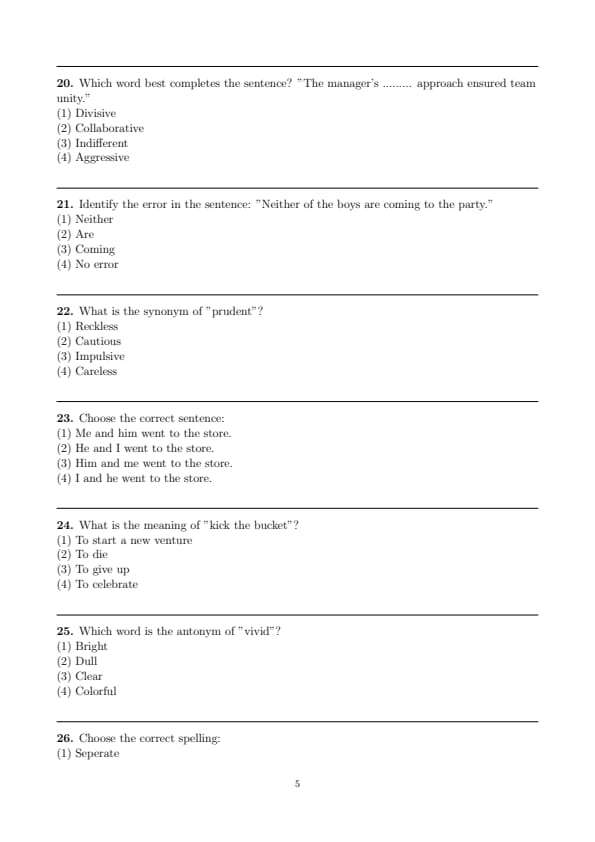
Which word best completes the sentence?
"The manager’s ......... approach ensured team unity."
View Solution
- Step 1: "Team unity" suggests a positive, cooperative approach.
- Step 2: Evaluate: (1) Divisive (causes conflict), (2) Collaborative (promotes unity), (3) Indifferent (neutral), (4) Aggressive (hostile).
- Step 3: Collaborative fits best for unity.
- Step 4: Eliminate options that don’t promote unity.
- Step 5: Option (2) is correct.
Quick Tip: Choose words that align with the outcome described in the sentence.
Identify the error in the sentence:
"Neither of the boys are coming to the party."
View Solution
- Step 1: "Neither" takes a singular verb ("is").
- Step 2: Evaluate: (1) Correct usage, (2) "Are" should be "is," (3) Correct verb, (4) Incorrect as error exists.
- Step 3: Correct sentence: "Neither of the boys is coming."
- Step 4: Confirm: Singular verb required for "neither."
- Step 5: Option (2) is correct.
Quick Tip: Use singular verbs with "neither" or "either" in subject-verb agreement.
What is the synonym of "prudent"?
View Solution
- Step 1: "Prudent" means careful or wise.
- Step 2: Evaluate: (1) Reckless (opposite), (2) Cautious (synonym), (3) Impulsive (opposite), (4) Careless (opposite).
- Step 3: Cautious matches prudent’s meaning.
- Step 4: Eliminate opposites.
- Step 5: Option (2) is correct.
Quick Tip: For synonyms, ensure the word conveys the same sense in similar contexts.
Choose the correct sentence:
View Solution
- Step 1: Subject pronouns: Use "he" and "I" for subjects.
- Step 2: Evaluate: (1) Incorrect pronouns, (2) Correct, (3) Incorrect pronouns, (4) Correct but less conventional order.
- Step 3: "He and I" is standard for subjects.
- Step 4: Confirm: Test by removing "he": "I went" is correct.
- Step 5: Option (2) is correct.
Quick Tip: Use subject pronouns (he, I) for the subject of a sentence.
What is the meaning of "kick the bucket"?
View Solution
- Step 1: The idiom means to pass away.
- Step 2: Evaluate: (1) Incorrect, (2) Correct, (3) Incorrect (similar to "throw in the towel"), (4) Incorrect.
- Step 3: Confirm: Common euphemism for death.
- Step 4: Eliminate unrelated meanings.
- Step 5: Option (2) is correct.
Quick Tip: Memorize idioms and their specific meanings to avoid confusion with similar phrases.
Which word is the antonym of "vivid"?
View Solution
- Step 1: "Vivid" means bright or clear.
- Step 2: Antonym: (1) Bright (synonym), (2) Dull (opposite), (3) Clear (synonym), (4) Colorful (synonym).
- Step 3: Dull is the opposite of vivid.
- Step 4: Eliminate synonyms.
- Step 5: Option (2) is correct.
Quick Tip: Identify antonyms by considering the opposite quality or intensity of the word.
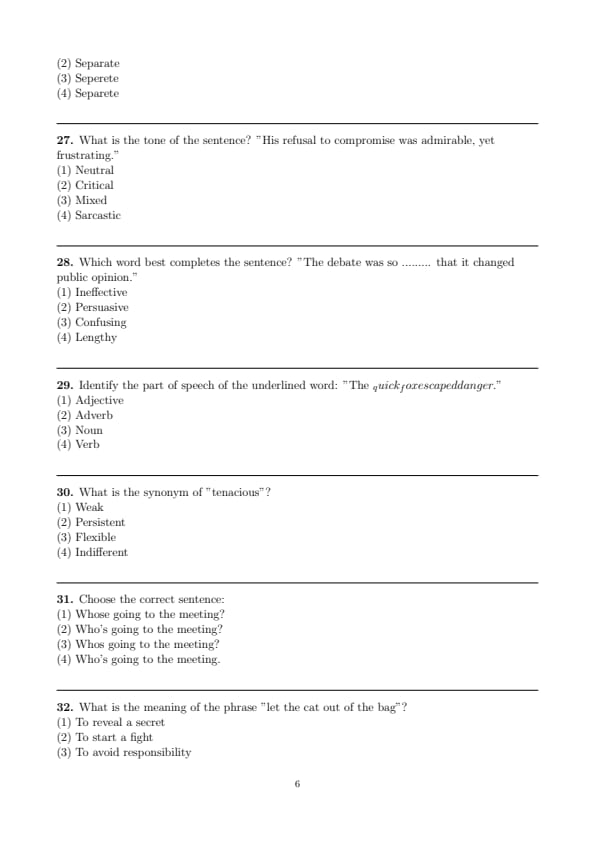
Choose the correct spelling:
View Solution
- Step 1: Standard spelling is "separate" with "a" in the middle.
- Step 2: Evaluate: (1) Incorrect "e," (2) Correct, (3) Incorrect vowels, (4) Incorrect vowels.
- Step 3: Confirm: "Separate" is correct.
- Step 4: Eliminate incorrect spellings.
- Step 5: Option (2) is correct.
Quick Tip: Recall common spelling patterns for frequently misspelled words.
What is the tone of the sentence?
"His refusal to compromise was admirable, yet frustrating."
View Solution
- Step 1: "Admirable" is positive; "frustrating" is negative.
- Step 2: Evaluate: (1) Neutral (no emotion), (2) Critical (only negative), (3) Mixed (positive and negative), (4) Sarcastic (no mockery).
- Step 3: Mixed tone reflects both admiration and frustration.
- Step 4: Confirm: Sentence balances two emotions.
- Step 5: Option (3) is correct.
Quick Tip: Identify mixed tones by noting contrasting emotional words in the sentence.
Which word best completes the sentence?
"The debate was so ......... that it changed public opinion."
View Solution
- Step 1: "Changed public opinion" suggests a strong, effective debate.
- Step 2: Evaluate: (1) Ineffective (opposite), (2) Persuasive (effective), (3) Confusing (negative), (4) Lengthy (unrelated).
- Step 3: Persuasive fits the context of influence.
- Step 4: Eliminate options that don’t imply influence.
- Step 5: Option (2) is correct.
Quick Tip: Choose words that align with the sentence’s described outcome or impact.
Identify the part of speech of the underlined word:
"The _quick_ fox escaped danger."
View Solution
- Step 1: "Quick" describes the noun "fox."
- Step 2: Evaluate: (1) Adjective (modifies noun), (2) Adverb (modifies verb), (3) Noun (thing), (4) Verb (action).
- Step 3: Adjective fits as it describes "fox."
- Step 4: Confirm: "Quick" modifies a noun, not a verb.
- Step 5: Option (1) is correct.
Quick Tip: Determine part of speech by identifying what the word describes or modifies.
What is the synonym of "tenacious"?
View Solution
- Step 1: "Tenacious" means holding firm or persistent.
- Step 2: Evaluate: (1) Weak (opposite), (2) Persistent (synonym), (3) Flexible (unrelated), (4) Indifferent (unrelated).
- Step 3: Persistent matches tenacious.
- Step 4: Eliminate unrelated or opposite terms.
- Step 5: Option (2) is correct.
Quick Tip: For synonyms, choose words that share the same core meaning in context.
Choose the correct sentence:
View Solution
- Step 1: "Who’s" is the contraction of "who is"; "whose" is possessive.
- Step 2: Question requires a question mark.
- Step 3: Evaluate: (1) Wrong contraction, (2) Correct, (3) No apostrophe, (4) Missing question mark.
- Step 4: Confirm: "Who’s" and question mark are correct.
- Step 5: Option (2) is correct.
Quick Tip: Distinguish between "who’s" (who is) and "whose" (possessive) in questions.
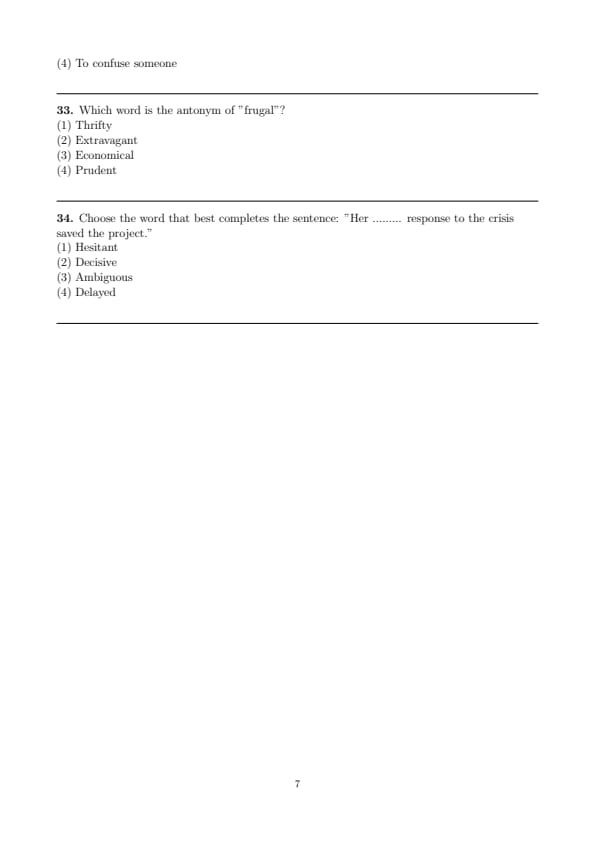
What is the meaning of the phrase "let the cat out of the bag"?
View Solution
- Step 1: The phrase means to disclose something hidden.
- Step 2: Evaluate: (1) Correct, (2) Incorrect, (3) Incorrect, (4) Incorrect.
- Step 3: Confirm: Common idiom for revealing secrets.
- Step 4: Eliminate unrelated meanings.
- Step 5: Option (1) is correct.
Quick Tip: Understand idioms by focusing on their figurative, not literal, meanings.
Which word is the antonym of "frugal"?
View Solution
- Step 1: "Frugal" means economical or sparing.
- Step 2: Antonym: (1) Thrifty (synonym), (2) Extravagant (opposite), (3) Economical (synonym), (4) Prudent (similar).
- Step 3: Extravagant means wasteful, opposite of frugal.
- Step 4: Eliminate synonyms.
- Step 5: Option (2) is correct.
Quick Tip: For antonyms, focus on words that directly oppose the given word’s meaning.
Choose the word that best completes the sentence:
"Her ......... response to the crisis saved the project."
View Solution
- Step 1: "Saved the project" suggests a positive, effective action.
- Step 2: Evaluate: (1) Hesitant (uncertain), (2) Decisive (clear, effective), (3) Ambiguous (unclear), (4) Delayed (late).
- Step 3: Decisive fits a crisis-saving response.
- Step 4: Eliminate options that don’t imply success.
- Step 5: Option (2) is correct.
Quick Tip: Select words that match the sentence’s outcome and context.
*The article might have information for the previous academic years, please refer the official website of the exam.