
CAT 2015 VARC Slot 1 Question Paper with Solution PDF
- Cut Off for IITs
- IIM Kashipur Cut Off
- IIM Amritsar Cut Off
- IIM Nagpur Cut Off
- IIM Indore Cut Off
- IIM Udaipur Cut Off
- IIM Ranchi Cut Off
- IIM Raipur Cut Off
- IIM Jammu Cut Off
- IIM Bodh Gaya Cut Off
- IIM Kozhikode Cut Off
- IIM Sambalpur Cut Off
- IIM Bangalore Cut Off
- IIM Sirmaur Cut Off
- IIM Trichy Cut Off
- IIM Visakhapatnam Cut Off
- IIM Lucknow Cut Off
- IIM Shillong Cut Off
- IIM Calcutta Cut Off
- IIM Ahmedabad Cut Off
- IIM Rohtak Cut Off


Content Writer | Updated On - Nov 28, 2025
CAT Question Papers are the most important study material for effective exam preparation. We at Zollege have provided all CAT Previous Year Papers with Solution PDFs here. CAT 2015 VARC was conducted successfully by Indian Institutes of Management (IIM).
Students can freely download the CAT previous year's question paper PDFs along with their solutions here. We strongly encourage cat aspirants to scan through all the CAT Question Paper to know the overall difficulty level, CAT Syllabus and understand the changes in CAT Exam Pattern over the years.
Also Check:
CAT 2015 VARC Slot 1 Question Paper with Solution PDF
| CAT 2015 VARC with Answer Key | Download PDF | Check Solutions |

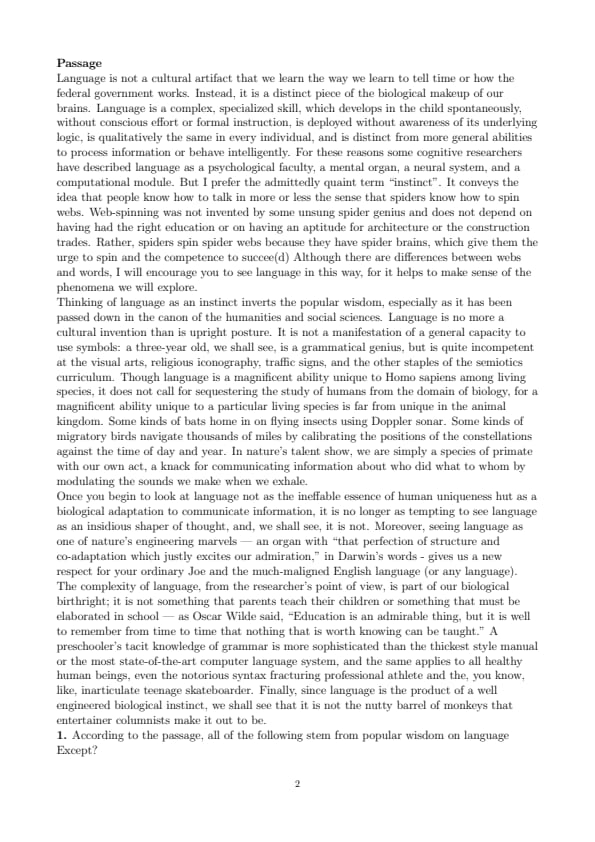
Question 1:
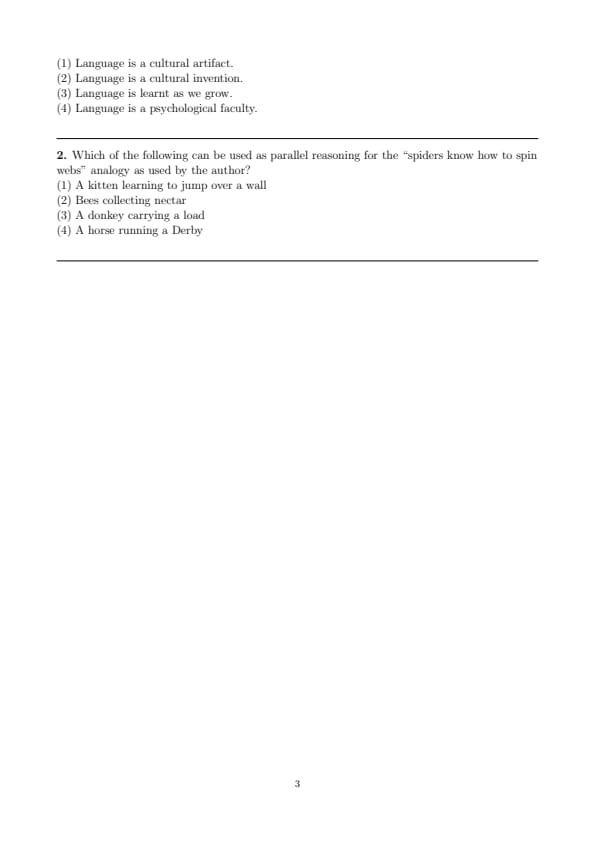
According to the passage, all of the following stem from popular wisdom on language Except?
View Solution
The author contrasts the popular wisdom with the scientific view of language.
- Popular wisdom suggests that language is a cultural artifact, a cultural invention, or something learnt as we grow.
- The author refutes this, arguing instead that language is an instinct, a biological adaptation, and sometimes described as a psychological faculty or mental organ.
Thus, "Language is a psychological faculty" does not stem from popular wisdom but from the scientific/cognitive perspective. Quick Tip: In Reading Comprehension, carefully separate the author’s view from the opposing/popular views mentioned. Look for words like "in contrast," "but," or "instead" to identify shifts in argument.
Which of the following can be used as parallel reasoning for the “spiders know how to spin webs” analogy as used by the author?
View Solution
The analogy “spiders know how to spin webs” highlights an **innate, instinctive ability** rather than a learned skill. Spiders are not taught to weave webs; it is an inborn behavior.
- (1) A kitten learning to jump over a wall → This involves **learning**, not instinct.
- (2) Bees collecting nectar → This is an **instinctive and natural ability**, just like spiders spinning webs.
- (3) A donkey carrying a load → This is not instinctive; it happens when humans train or force it.
- (4) A horse running a Derby → While running is natural, a Derby involves **training and competition**, not instinct.
Hence, the best parallel reasoning is **Bees collecting nectar**. Quick Tip: When solving **analogy-based reasoning questions**, identify whether the action is **innate (instinctive)** or **acquired (learned)**, and choose the option that matches the same category.
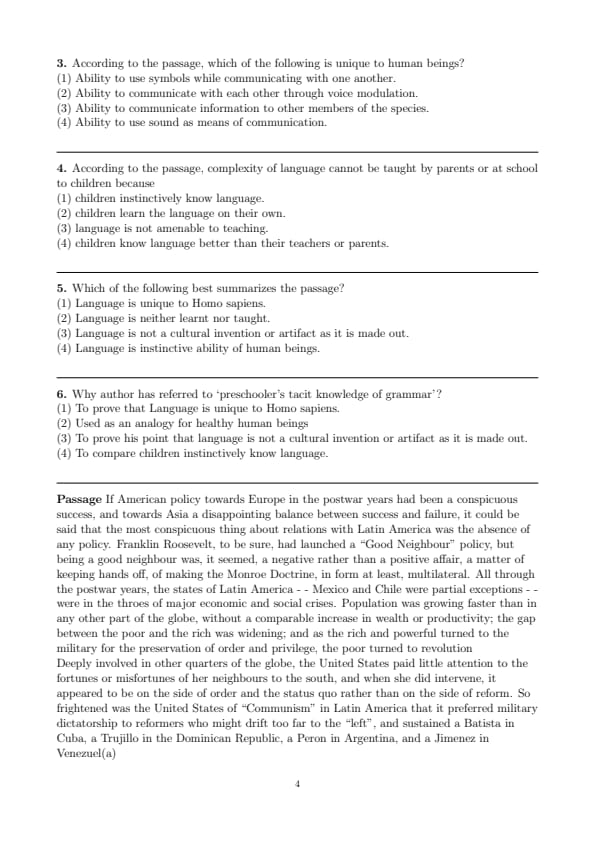
According to the passage, which of the following is unique to human beings?
View Solution
The passage highlights that many species, such as bees and birds, communicate effectively with one another. However, the **distinct feature of humans** lies in their ability to convey **nuances and complex meanings through voice modulation**. While other species also use sound and symbols to some extent, this particular capacity for **modulated vocal communication**—enabling abstract, layered, and diverse expression—is unique to humans. Quick Tip: In CAT RC questions, carefully look for keywords like *unique*, *only*, or *distinctive*—these help identify what sets humans apart from other species in such analogy-based questions.
According to the passage, complexity of language cannot be taught by parents or at school to children because
View Solution
The passage highlights that while communication skills can be nurtured, the deeper complexity of language is an innate human capacity. This suggests that children are born with an instinctive understanding of language structures, which cannot simply be imparted by parents or teachers. Hence, option (1) is correct. Quick Tip: For Reading Comprehension, focus on the underlying idea the author emphasizes rather than surface-level statements. This helps in eliminating close distractors.
Which of the following best summarizes the passage?
View Solution
The passage highlights that language is not a cultural artifact or invention, nor is it something that can be fully taught or learned like other skills. Instead, it emphasizes that the complexity of language is already innate in humans—children instinctively acquire it without formal teaching. Therefore, the best summary captures this instinctive and inherent nature of language in human beings. Option (4) clearly expresses this core idea, while the other options represent partial or narrower aspects of the passage.
Quick Tip: When asked for the “best summary,” focus on the central theme of the passage rather than specific supporting details. Eliminate options that are too narrow or only partially reflect the main idea.
Why author has referred to ‘preschooler’s tacit knowledge of grammar’?
View Solution
The passage highlights that language is not a cultural artifact or invention, nor is it something that can be fully taught or learned like other skills. Instead, it emphasizes that the complexity of language is already innate in humans—children instinctively acquire it without formal teaching. Therefore, the best summary captures this instinctive and inherent nature of language in human beings. Option (4) clearly expresses this core idea, while the other options represent partial or narrower aspects of the passage.
Quick Tip: When asked for the “best summary,” focus on the central theme of the passage rather than specific supporting details. Eliminate options that are too narrow or only partially reflect the main idea.
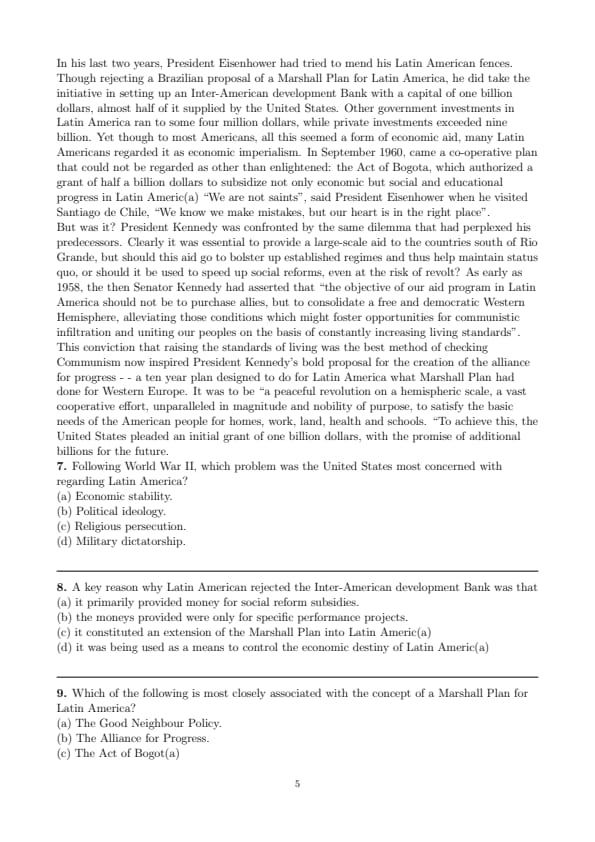
Following World War II, which problem was the United States most concerned with regarding Latin America?
View Solution
The passage states that the United States, in its dealings with Latin America, was "so frightened of Communism" that it preferred to support military dictators rather than allow reformers who might move towards the left. This clearly shows that the primary concern of the U.S. was not economic or religious issues, but political ideology — specifically the fear of communist influence in Latin America. Thus, Option (b) Political ideology is correct. Options (a) and (d) were present in the context but were secondary to the main concern, while (c) is not mentioned at all.
Quick Tip: In RC passages, look for repeated emphasis. Here, "Communism" and "fear of left-leaning reformers" were stressed multiple times, indicating the U.S. focus was on political ideology.
A key reason why Latin American rejected the Inter-American development Bank was that
View Solution
The passage highlights Latin America’s skepticism toward external financial institutions like the Inter-American Development Bank. While such banks provided financial aid, the concern was not the type of projects or subsidies, but the larger issue of external control. Latin American countries perceived these initiatives as mechanisms through which the U.S. and other powers could influence and dominate their economic policies and development trajectory. Hence, the rejection was rooted in the fear of losing autonomy over their own economic destiny. Quick Tip: In Reading Comprehension, always identify the underlying theme or concern. If multiple options seem plausible, choose the one that addresses the broader issue rather than the narrower detail.
Which of the following is most closely associated with the concept of a Marshall Plan for Latin America?
View Solution
- Step 1: The passage states that Kennedy’s “Alliance for Progress” was designed to do for Latin America what the Marshall Plan had done for Europe.
- Step 2: This makes it a direct comparison — the plan’s magnitude, funding, and goals were all modeled similarly.
- Step 3: The Good Neighbour Policy was about keeping hands off, not ai(d) The Act of Bogota was a grant, not a full plan. The Monroe Doctrine was about military and territorial policy.
- Step 4: Therefore, only (b) directly aligns with the Marshall Plan analogy.
Quick Tip: Watch for direct parallels stated in the passage like “designed to do for Latin America what Marshall Plan had done for Europe.”
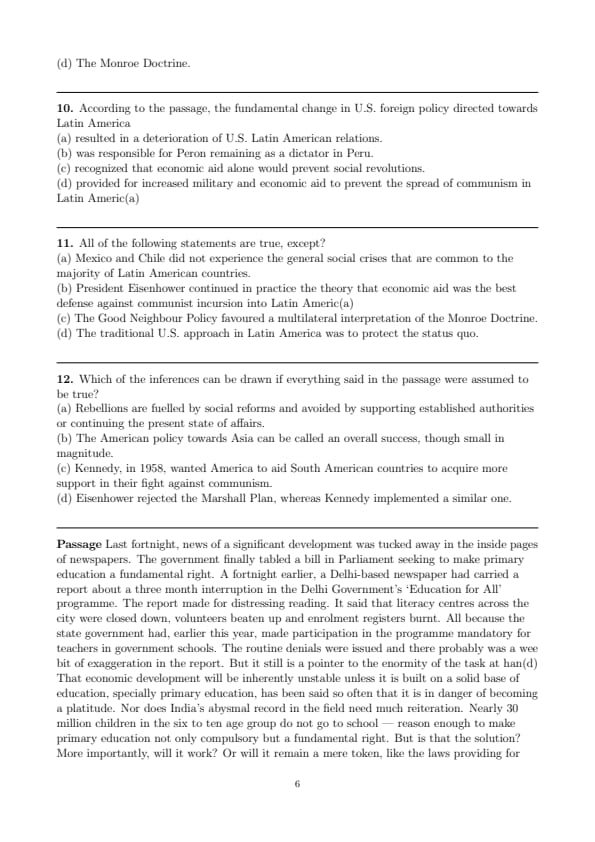
According to the passage, the fundamental change in U.S. foreign policy directed towards Latin America
View Solution
- Step 1: The passage discusses how the U.S. often supported military dictators to avoid communist threats.
- Step 2: Even aid packages (like Eisenhower’s and Kennedy’s) were partly driven by a desire to prevent “leftward drift” in politics.
- Step 3: Kennedy’s Alliance for Progress was a major economic move, but also ideologically motivated to contain communism.
- Step 4: Hence, option (d) reflects the combined use of military and economic tools to maintain U.S. interests in the region.
Quick Tip: Foreign aid is often political — always ask what the aid is trying to prevent or promote.
All of the following statements are true, except?
View Solution
- Step 1: The passage notes that Eisenhower rejected Brazil’s proposal of a Marshall Plan and only later initiated limited aid efforts.
- Step 2: Though he set up an Inter-American bank, the aid wasn’t presented as an organized anti-communist doctrine.
- Step 3: Unlike Kennedy’s bold ideological aid proposal, Eisenhower’s actions lacked conviction and scale.
- Step 4: Thus, while other statements are supported by the passage, (b) exaggerates Eisenhower’s alignment with anti-communist aid policy.
Quick Tip: “Except” questions require validating all options — isolate the one not fully supported by the passage.
Which of the inferences can be drawn if everything said in the passage were assumed to be true?
View Solution
- Step 1: The passage clearly states Eisenhower rejected a Marshall Plan for Latin America proposed by Brazil.
- Step 2: It also states that Kennedy proposed the “Alliance for Progress,” which was “designed to do for Latin America what Marshall Plan had done for Europe.”
- Step 3: This makes (d) a correct inference based on fact.
- Step 4: Option (a) misrepresents the logic — rebellions were caused by neglect, not reform.
- Step 5: Option (b) is incorrect — the passage calls Asia a “disappointing balance.”
- Step 6: Option (c) distorts Kennedy’s 1958 stance — he emphasized improving living standards, not gaining support in war.
Quick Tip: When asked to infer, connect cause-effect facts directly stated in the passage — avoid speculation.
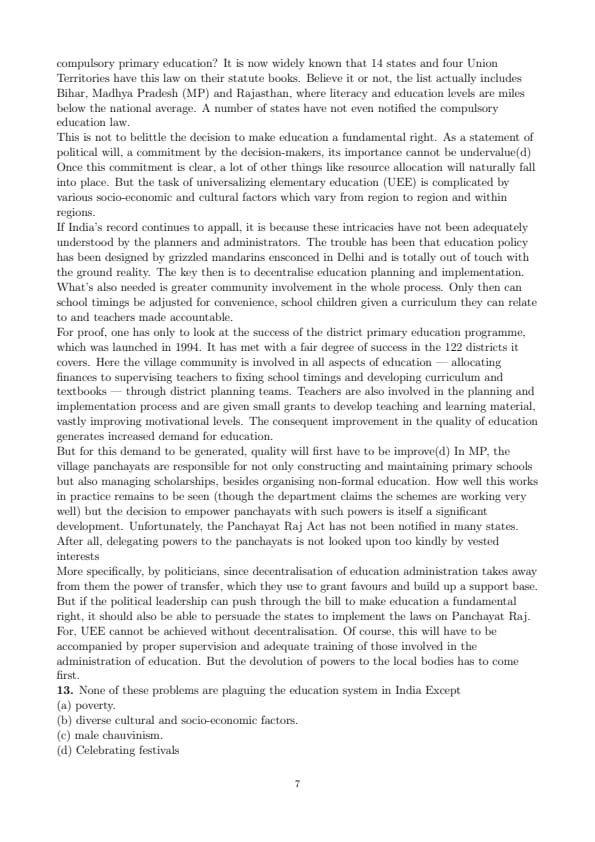
None of these problems are plaguing the education system in India Except
View Solution
- Step 1: The question uses “Except,” meaning we are looking for the option that is actually mentioned as a problem in the passage.
- Step 2: The passage clearly highlights that the task of universalising education is complicated by “various socio-economic and cultural factors.”
- Step 3: Poverty and male chauvinism are not directly blamed in this passage. “Celebrating festivals” is not mentioned at all.
- Step 4: Therefore, the only issue explicitly noted is option (b).
Quick Tip: “Except” questions require careful reading to find the one valid statement among false ones.
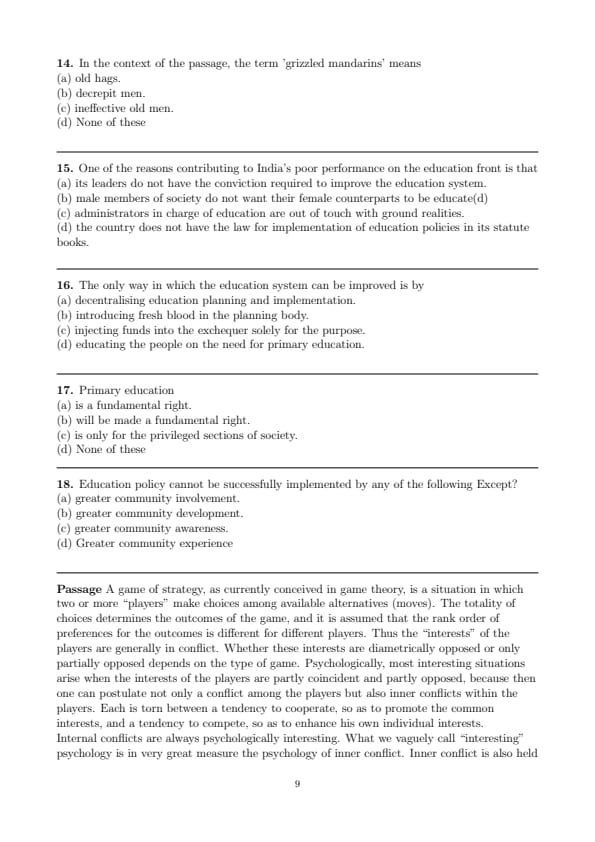
In the context of the passage, the term 'grizzled mandarins' means
View Solution
- Step 1: The term "grizzled mandarins" refers to aged bureaucrats in Delhi designing education policies.
- Step 2: The tone of the passage implies criticism — these men are out of touch and ineffective in practice.
- Step 3: Option (c) captures both the age and ineffectiveness implied by the term.
- Step 4: Options (a) and (b) are either gendered or vague and do not match the specific criticism.
Quick Tip: Context clues in a passage help decode figurative language — read the sentence carefully.
One of the reasons contributing to India's poor performance on the education front is that
View Solution
- Step 1: The passage directly criticizes “grizzled mandarins ensconced in Delhi” who design policies without understanding the ground situation.
- Step 2: This disconnection between policy makers and practical conditions is highlighted as a major issue.
- Step 3: The other options are either not mentioned or inaccurate — especially (a), which is contradicted by the mention of political will.
- Step 4: Therefore, (c) accurately reflects a key reason stated in the passage.
Quick Tip: Eliminate options not supported in the passage. Match keywords like “out of touch” or “mandarins” with answer choices.
The only way in which the education system can be improved is by
View Solution
- Step 1: A key theme in the passage is decentralisation — it’s presented as the “key” to solving education problems.
- Step 2: The success of the District Primary Education Programme (DPEP) and Panchayat-led planning in MP further proves this.
- Step 3: None of the other options are presented as viable or primary Solution in the passage.
- Step 4: Therefore, (a) is the correct answer.
Quick Tip: Focus on the main argument of the passage when answering “only way” or “best method” questions.
Primary education
View Solution
- Step 1: The passage opens with the news that the government “finally tabled a bill” to make primary education a fundamental right.
- Step 2: That means the law is not yet in effect but is in the process of being passe(d)
- Step 3: So, (a) is premature and (c) is unrelated to the context.
- Step 4: Therefore, (b) accurately captures the current status.
Quick Tip: “Will be made” means legislation has been introduced but not yet enacted — verify timing with phrases like “tabled a bill.”
Education policy cannot be successfully implemented by any of the following Except?
View Solution
- Step 1: This is an “Except” question, so we’re looking for the one option that IS actually effective.
- Step 2: The passage gives strong support to the idea that community involvement helped the success of DPEP.
- Step 3: The other options — development, awareness, and experience — are not directly cited as contributing to implementation.
- Step 4: Hence, option (a) is the only one that does help, making it the correct answer for an “Except” question.
Quick Tip: When “Except” appears, verify which option is positively supported in the text while others are not.
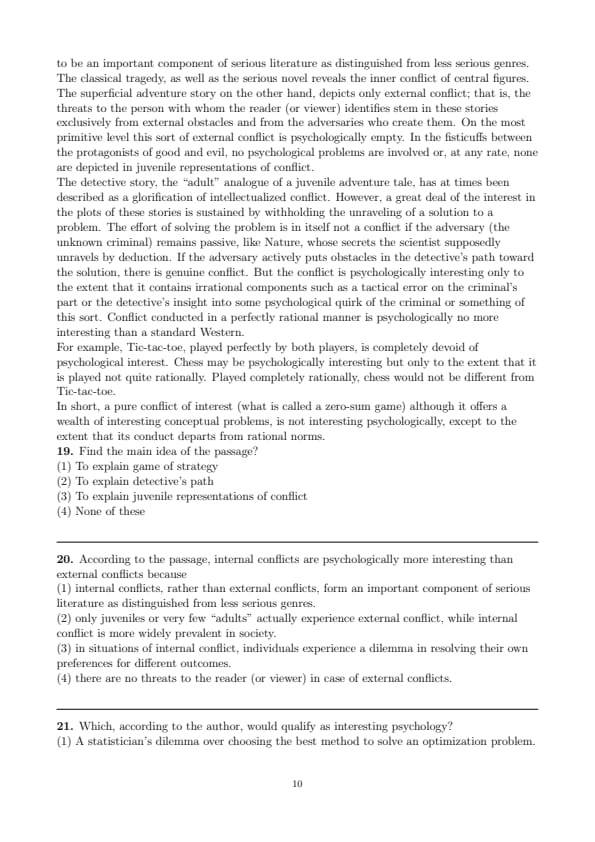
Find the main idea of the passage?
View Solution
- Step 1: The passage opens with the definition of a “game of strategy” in game theory.
- Step 2: It then elaborates on how internal conflicts (within players) and external conflicts (between players) shape the psychological interest in such games.
- Step 3: While detective stories and chess are used as examples, the main thread throughout the passage is explaining how strategy, conflict of interest, and psychological elements relate in game theory.
- Step 4: Hence, the best summary or main idea is option (1).
Quick Tip: The main idea usually aligns with the topic discussed throughout the entire passage, not just in parts.
According to the passage, internal conflicts are psychologically more interesting than external conflicts because
View Solution
- Step 1: The passage states that internal conflict involves players being “torn between” cooperation and competition.
- Step 2: This indicates a dilemma between different motives — enhancing one’s own outcome vs. promoting mutual benefit.
- Step 3: Option (3) directly addresses this psychological tension.
- Step 4: Options (1) and (2) are indirectly related, but less precise. Option (4) is irrelevant to the nature of psychological interest.
Quick Tip: Look for reasoning behind concepts — psychological interest often arises from inner tension or contradiction.
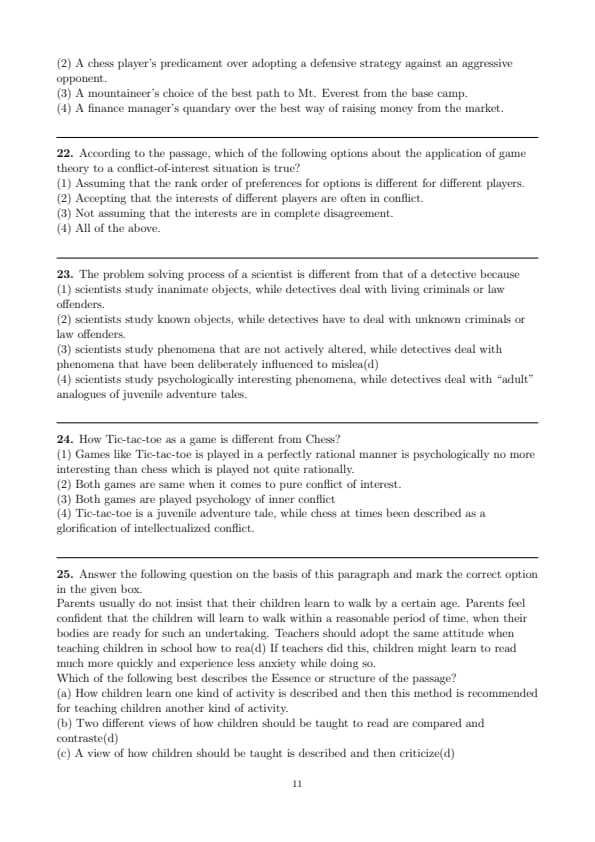
Which, according to the author, would qualify as interesting psychology?
View Solution
- Step 1: The passage says that games like chess are interesting “only to the extent that it is played not quite rationally,” implying inner strategic conflict.
- Step 2: A chess player facing an aggressive opponent must balance defense vs counter-attack — a situation involving internal strategy-based conflict.
- Step 3: Other scenarios involve optimization or logistics, not inner psychological dilemmas.
- Step 4: Thus, (2) best reflects a psychologically interesting conflict.
Quick Tip: Psychologically interesting situations often include strategic doubt, emotional tension, or internal conflict.
According to the passage, which of the following options about the application of game theory to a conflict-of-interest situation is true?
View Solution
- Step 1: The first paragraph explicitly states that the rank order of preferences varies among players — confirming (1).
- Step 2: It also says that the interests are generally in conflict — confirming (2).
- Step 3: It further mentions that these interests are not necessarily diametrically opposed — confirming (3).
- Step 4: Therefore, all statements are true, making (4) the correct answer.
Quick Tip: Combine statements logically — if each one is supported by the passage, “All of the above” is likely correct.
The problem solving process of a scientist is different from that of a detective because
View Solution
- Step 1: The passage compares a scientist solving nature’s puzzles (which are passive) with a detective solving crimes where criminals actively mislea(d)
- Step 2: This distinction is about the presence or absence of active interference in the problem space.
- Step 3: Option (3) precisely captures that contrast.
- Step 4: Other options are inaccurate or oversimplifie(d) Option (4), for example, misrepresents the point about psychological interest.
Quick Tip: Look for phrases like “passive like Nature” vs “active adversary” — these contrasts clarify reasoning questions.
How Tic-tac-toe as a game is different from Chess?
View Solution
- Step 1: The passage explains that Tic-tac-toe, when played rationally, lacks psychological interest.
- Step 2: Chess, though strategic, is only psychologically interesting when not played in a fully rational way.
- Step 3: This comparison between the two games is explicitly mentioned to illustrate rational vs irrational engagement.
- Step 4: Therefore, option (1) is the most accurate and directly supported by the passage.
Quick Tip: Focus on how rationality impacts psychological engagement in games, as emphasized in the passage.
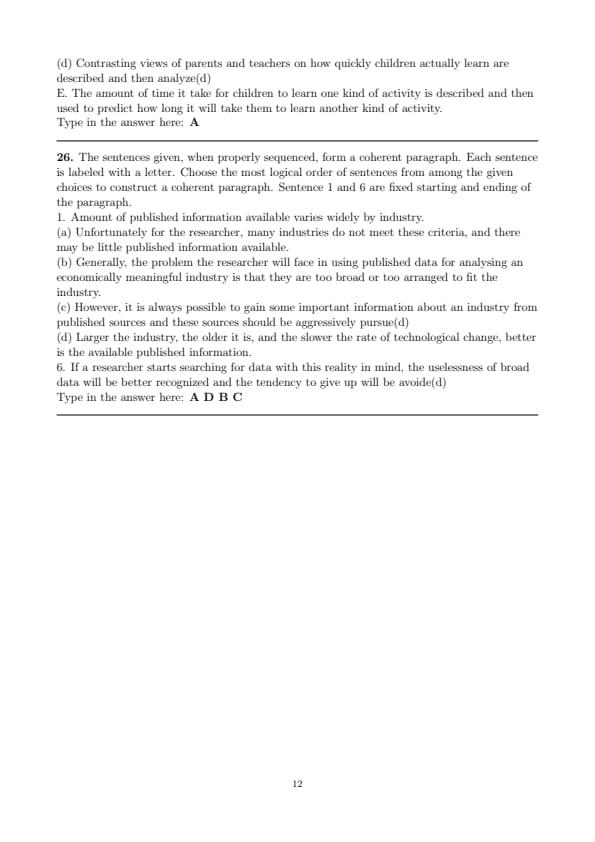
Answer the following question on the basis of this paragraph and mark the correct option in the given box.
Parents usually do not insist that their children learn to walk by a certain age. Parents feel confident that the children will learn to walk within a reasonable period of time, when their bodies are ready for such an undertaking. Teachers should adopt the same attitude when teaching children in school how to rea(d) If teachers did this, children might learn to read much more quickly and experience less anxiety while doing so.
Which of the following best describes the Essence or structure of the passage?
(a) How children learn one kind of activity is described and then this method is recommended for
teaching children another kind of activity.
(b) Two different views of how children should be taught to read are compared and contraste(d)
(c) A view of how children should be taught is described and then criticize(d)
(d) Contrasting views of parents and teachers on how quickly children actually learn are described
and then analyze(d)
E. The amount of time it take for children to learn one kind of activity is described and then used to predict how long it will take them to learn another kind of activity.
Type in the answer here: A
View Solution
- The passage begins by describing how parents trust the natural pace of their children's development when it comes to walking.
- It then draws a parallel to how reading should be taught in schools — with the same patience and lack of pressure.
- This is not a comparison of two opposing views or a critique.
- It uses one example (learning to walk) to recommend a teaching strategy for another skill (learning to read).
- Therefore, the structure is: describe one learning process and recommend it for another — matching option (a)
Quick Tip: Focus on how rationality impacts psychological engagement in games, as emphasized in the passage.
The sentences given, when properly sequenced, form a coherent paragraph. Each sentence is labeled with a letter. Choose the most logical order of sentences from among the given choices to construct a coherent paragraph. Sentence 1 and 6 are fixed starting and ending of the paragraph.
1. Amount of published information available varies widely by industry.
(a) Unfortunately for the researcher, many industries do not meet these criteria, and there may be little published information available.
(b) Generally, the problem the researcher will face in using published data for analysing an economically meaningful industry is that they are too broad or too arranged to fit the industry.
(c) However, it is always possible to gain some important information about an industry from published sources and these sources should be aggressively pursue(d)
(d) Larger the industry, the older it is, and the slower the rate of technological change, better is the available published information.
6. If a researcher starts searching for data with this reality in mind, the uselessness of broad data will be better recognized and the tendency to give up will be avoide(d)
Type in the answer here: A D B C
View Solution
- Sentence A introduces the key limitation: many industries don’t fit the ideal for data richness.
- Sentence D elaborates on the condition under which good data is available.
- Sentence B discusses the actual practical problem in using existing dat(a)
- Sentence C concludes on a slightly optimistic note: even imperfect data sources should be pursue(d)
- This logical sequence (A D B C) fits perfectly between Sentence 1 and 6.
Quick Tip: Focus on how rationality impacts psychological engagement in games, as emphasized in the passage.
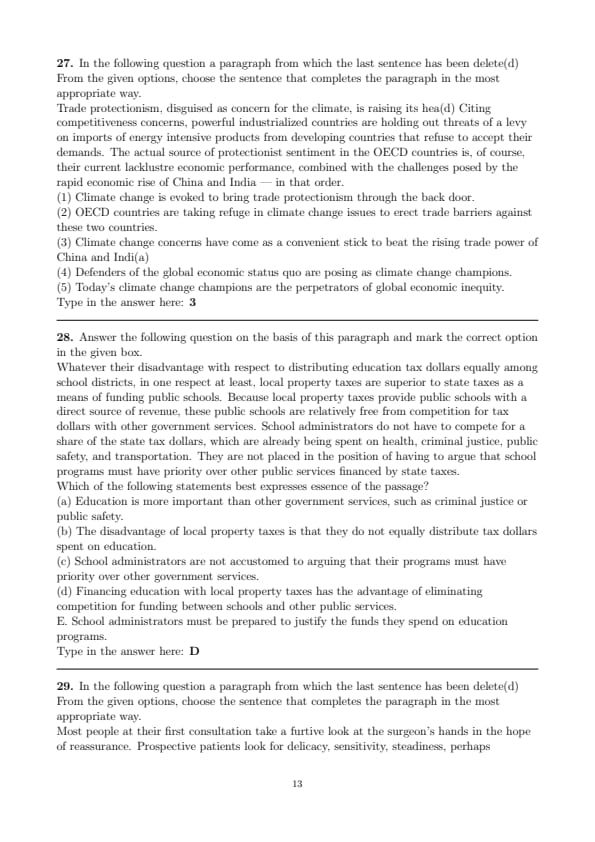
In the following question a paragraph from which the last sentence has been delete(d) From the given options, choose the sentence that completes the paragraph in the most appropriate way.
Trade protectionism, disguised as concern for the climate, is raising its hea(d) Citing competitiveness concerns, powerful industrialized countries are holding out threats of a levy on imports of energy intensive products from developing countries that refuse to accept their demands. The actual source of protectionist sentiment in the OECD countries is, of course, their current lacklustre economic performance, combined with the challenges posed by the rapid economic rise of China and India — in that order.
(1) Climate change is evoked to bring trade protectionism through the back door.
(2) OECD countries are taking refuge in climate change issues to erect trade barriers against these
two countries.
(3) Climate change concerns have come as a convenient stick to beat the rising trade power of China
and Indi(a)
(4) Defenders of the global economic status quo are posing as climate change champions.
(5) Today’s climate change champions are the perpetrators of global economic inequity.
Type in the answer here: 3
View Solution
- The paragraph discusses how climate change is being used as a false excuse for protectionism.
- It concludes that the real issue is the economic threat posed by China and Indi(a)
- Option 3 clearly captures the idea: climate concerns are being misused to limit trade with rising economies.
- It maintains tone, logic, and continues the argument effectively.
Quick Tip: Focus on how rationality impacts psychological engagement in games, as emphasized in the passage.
Answer the following question on the basis of this paragraph and mark the correct option in the given box.
Whatever their disadvantage with respect to distributing education tax dollars equally among school districts, in one respect at least, local property taxes are superior to state taxes as a means of funding public schools. Because local property taxes provide public schools with a direct source of revenue, these public schools are relatively free from competition for tax dollars with other government services. School administrators do not have to compete for a share of the state tax dollars, which are already being spent on health, criminal justice, public safety, and transportation. They are not placed in the position of having to argue that school programs must have priority over other public services financed by state taxes.
Which of the following statements best expresses essence of the passage?
(a) Education is more important than other government services, such as criminal justice or public
safety.
(b) The disadvantage of local property taxes is that they do not equally distribute tax dollars spent on education.
(c) School administrators are not accustomed to arguing that their programs must have priority over
other government services.
(d) Financing education with local property taxes has the advantage of eliminating competition for
funding between schools and other public services.
E. School administrators must be prepared to justify the funds they spend on education programs.
Type in the answer here: D
View Solution
- The paragraph highlights the key benefit of using local property taxes: schools get a dedicated source of revenue.
- This protects schools from having to compete with other public sectors for limited state funds.
- Option D captures this exact idea: that local funding eliminates competition between education and other public services.
Quick Tip: Focus on how rationality impacts psychological engagement in games, as emphasized in the passage.
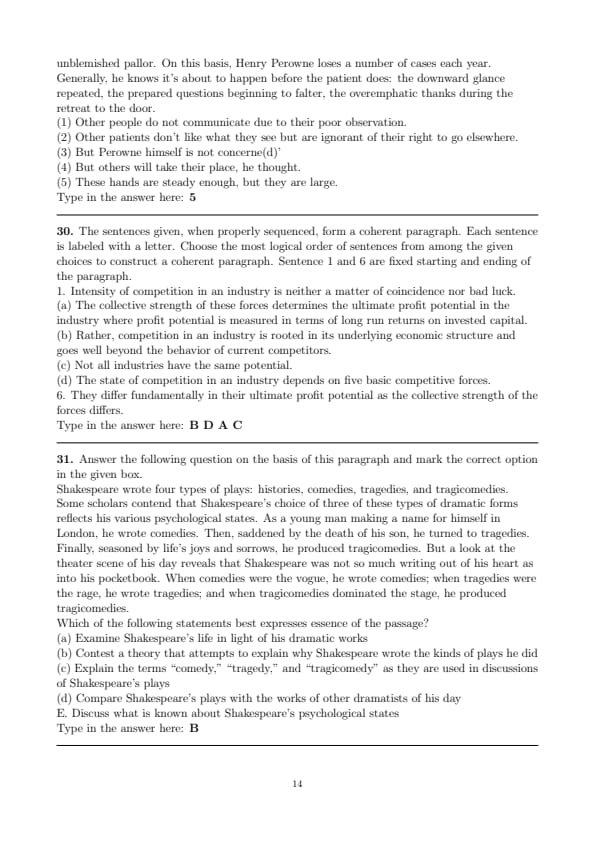
In the following question a paragraph from which the last sentence has been delete(d) From the given options, choose the sentence that completes the paragraph in the most appropriate way.
Most people at their first consultation take a furtive look at the surgeon’s hands in the hope of reassurance. Prospective patients look for delicacy, sensitivity, steadiness, perhaps unblemished pallor. On this basis, Henry Perowne loses a number of cases each year. Generally, he knows it’s about to happen before the patient does: the downward glance repeated, the prepared questions beginning to falter, the overemphatic thanks during the retreat to the door.
(1) Other people do not communicate due to their poor observation.
(2) Other patients don’t like what they see but are ignorant of their right to go elsewhere.
(3) But Perowne himself is not concerne(d)’
(4) But others will take their place, he thought.
(5) These hands are steady enough, but they are large.
Type in the answer here: 5
View Solution
- The entire paragraph is focused on patients judging the surgeon by the appearance of his hands.
- The natural conclusion would explain what they are seeing that disappoints them.
- Option 5 completes the thought: the hands are steady (reassuring), but large (possibly intimidating).
- This justifies the reactions and fits the tone and narrative perfectly.
Quick Tip: Focus on how rationality impacts psychological engagement in games, as emphasized in the passage.
The sentences given, when properly sequenced, form a coherent paragraph. Each sentence is labeled with a letter. Choose the most logical order of sentences from among the given choices to construct a coherent paragraph. Sentence 1 and 6 are fixed starting and ending of the paragraph.
1. Intensity of competition in an industry is neither a matter of coincidence nor bad luck.
(a) The collective strength of these forces determines the ultimate profit potential in the industry where profit potential is measured in terms of long run returns on invested capital.
(b) Rather, competition in an industry is rooted in its underlying economic structure and goes well beyond the behavior of current competitors.
(c) Not all industries have the same potential.
(d) The state of competition in an industry depends on five basic competitive forces.
6. They differ fundamentally in their ultimate profit potential as the collective strength of the forces differs.
Type in the answer here: B D A C
View Solution
- Sentence B refutes the idea of coincidence by stating that competition is due to economic structure.
- Sentence D introduces the five competitive forces that form this structure.
- Sentence A explains how these forces affect profitability.
- Sentence C sums up that not all industries benefit equally, which ties into the final sentence.
- Therefore, B-D-A-C is the most coherent sequence.
Quick Tip: Focus on how rationality impacts psychological engagement in games, as emphasized in the passage.
Answer the following question on the basis of this paragraph and mark the correct option in the given box.
Shakespeare wrote four types of plays: histories, comedies, tragedies, and tragicomedies. Some scholars contend that Shakespeare’s choice of three of these types of dramatic forms reflects his various psychological states. As a young man making a name for himself in London, he wrote comedies. Then, saddened by the death of his son, he turned to tragedies. Finally, seasoned by life’s joys and sorrows, he produced tragicomedies. But a look at the theater scene of his day reveals that Shakespeare was not so much writing out of his heart as into his pocketbook. When comedies were the vogue, he wrote comedies; when tragedies were the rage, he wrote tragedies; and when tragicomedies dominated the stage, he produced tragicomedies.
Which of the following statements best expresses essence of the passage?
(a) Examine Shakespeare’s life in light of his dramatic works
(b) Contest a theory that attempts to explain why Shakespeare wrote the kinds of plays he did
(c) Explain the terms “comedy,” “tragedy,” and “tragicomedy” as they are used in discussions of
Shakespeare’s plays
(d) Compare Shakespeare’s plays with the works of other dramatists of his day
E. Discuss what is known about Shakespeare’s psychological states
Type in the answer here: B
View Solution
- Step 1: The paragraph presents two contrasting explanations for Shakespeare’s body of work: personal emotion vs market trends.
- Step 2: The first half supports the psychological theory — Shakespeare wrote based on life phases.
- Step 3: The second half disputes this and says he followed popular stage trends for financial reasons.
- Step 4: Therefore, the paragraph aims to contest a psychological theory about Shakespeare's plays.
Quick Tip: Look for contrast words like “but” — they often signal the author’s actual position when evaluating competing theories.
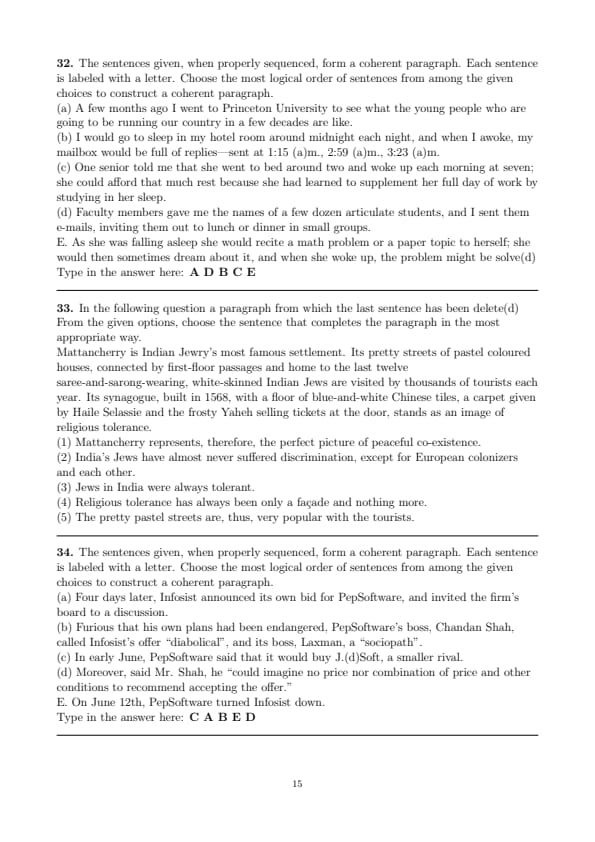
The sentences given, when properly sequenced, form a coherent paragraph. Each sentence is labeled with a letter. Choose the most logical order of sentences from among the given choices to construct a coherent paragraph.
(a) A few months ago I went to Princeton University to see what the young people who are going to be running our country in a few decades are like.
(b) I would go to sleep in my hotel room around midnight each night, and when I awoke, my mailbox would be full of replies—sent at 1:15 (a)m., 2:59 (a)m., 3:23 (a)m.
(c) One senior told me that she went to bed around two and woke up each morning at seven; she could afford that much rest because she had learned to supplement her full day of work by studying in her sleep.
(d) Faculty members gave me the names of a few dozen articulate students, and I sent them e-mails, inviting them out to lunch or dinner in small groups.
E. As she was falling asleep she would recite a math problem or a paper topic to herself; she would then sometimes dream about it, and when she woke up, the problem might be solve(d)
Type in the answer here: A D B C E
View Solution
- Step 1: A sets the scene — a visit to Princeton to observe future leaders.
- Step 2: D follows — the narrator contacts articulate students.
- Step 3: B shows the unusual late-night email replies, highlighting student routines.
- Step 4: C introduces a specific student’s routine.
- Step 5: E elaborates on that student’s “study while sleeping” technique.
- Conclusion: A D B C E forms a coherent narrative flow from general to specifi(c)
Quick Tip: Always identify opening context first — look for sentence(s) that introduce who, where, or why.
In the following question a paragraph from which the last sentence has been delete(d) From the given options, choose the sentence that completes the paragraph in the most appropriate way.
Mattancherry is Indian Jewry’s most famous settlement. Its pretty streets of pastel coloured houses, connected by first-floor passages and home to the last twelve saree-and-sarong-wearing, white-skinned Indian Jews are visited by thousands of tourists each year. Its synagogue, built in 1568, with a floor of blue-and-white Chinese tiles, a carpet given by Haile Selassie and the frosty Yaheh selling tickets at the door, stands as an image of religious tolerance.
(1) Mattancherry represents, therefore, the perfect picture of peaceful co-existence.
(2) India’s Jews have almost never suffered discrimination, except for European colonizers and each
other.
(3) Jews in India were always tolerant.
(4) Religious tolerance has always been only a façade and nothing more.
(5) The pretty pastel streets are, thus, very popular with the tourists.
Type in the answer here: 1
View Solution
- Step 1: The paragraph focuses on cultural beauty and the peaceful coexistence in Mattancherry.
- Step 2: The mention of tourists and iconic artifacts builds an image of harmony and historical richness.
- Step 3: The final sentence should capture this theme — Option 1 does this by summarizing it as a “perfect picture of peaceful co-existence.”
- Step 4: Other options distract or shift the focus from the paragraph’s consistent tone and ide(a)
Quick Tip: The final sentence of a descriptive paragraph often echoes or reinforces the dominant theme or moo(d)
The sentences given, when properly sequenced, form a coherent paragraph. Each sentence is labeled with a letter. Choose the most logical order of sentences from among the given choices to construct a coherent paragraph.
(a) Four days later, Infosist announced its own bid for PepSoftware, and invited the firm’s board to a discussion.
(b) Furious that his own plans had been endangered, PepSoftware’s boss, Chandan Shah, called Infosist’s offer “diabolical”, and its boss, Laxman, a “sociopath”.
(c) In early June, PepSoftware said that it would buy J.(d)Soft, a smaller rival.
(d) Moreover, said Mr. Shah, he “could imagine no price nor combination of price and other conditions to recommend accepting the offer.”
E. On June 12th, PepSoftware turned Infosist down.
Type in the answer here: C A B E D
View Solution
- Step 1: C initiates the timeline — PepSoftware wants to buy J.(d)Soft.
- Step 2: A follows — Infosist counters by bidding for PepSoftware.
- Step 3: B shows Chandan Shah’s emotional response to Infosist’s interference.
- Step 4: E states the formal rejection of Infosist’s offer.
- Step 5: D adds a strong quote justifying PepSoftware's refusal.
- Conclusion: The sequence C A B E D maintains chronological flow and builds from corporate action to emotional and strategic fallout.
Quick Tip: Follow chronological clues like dates and reactions to arrange business/economic event narratives.

*The article might have information for the previous academic years, please refer the official website of the exam.