
CAT 2015 VARC Slot 2 Question Paper with Solution PDF
- Cut Off for IITs
- IIM Kashipur Cut Off
- IIM Amritsar Cut Off
- IIM Nagpur Cut Off
- IIM Indore Cut Off
- IIM Udaipur Cut Off
- IIM Ranchi Cut Off
- IIM Raipur Cut Off
- IIM Jammu Cut Off
- IIM Bodh Gaya Cut Off
- IIM Kozhikode Cut Off
- IIM Sambalpur Cut Off
- IIM Bangalore Cut Off
- IIM Sirmaur Cut Off
- IIM Trichy Cut Off
- IIM Visakhapatnam Cut Off
- IIM Lucknow Cut Off
- IIM Shillong Cut Off
- IIM Calcutta Cut Off
- IIM Ahmedabad Cut Off
- IIM Rohtak Cut Off


Content Writer | Updated On - Nov 28, 2025
CAT Question Papers are the most important study material for effective exam preparation. We at Zollege have provided all CAT Previous Year Papers with Solution PDFs here. CAT 2015 VARC was conducted successfully by Indian Institutes of Management (IIM).
Students can freely download the CAT previous year's question paper PDFs along with their solutions here. We strongly encourage cat aspirants to scan through all the CAT Question Paper to know the overall difficulty level, CAT Syllabus and understand the changes in CAT Exam Pattern over the years.
Also Check:
CAT 2015 VARC Slot 2 Question Paper with Solution PDF
| CAT 2015 VARC with Answer Key | Download PDF | Check Solutions |

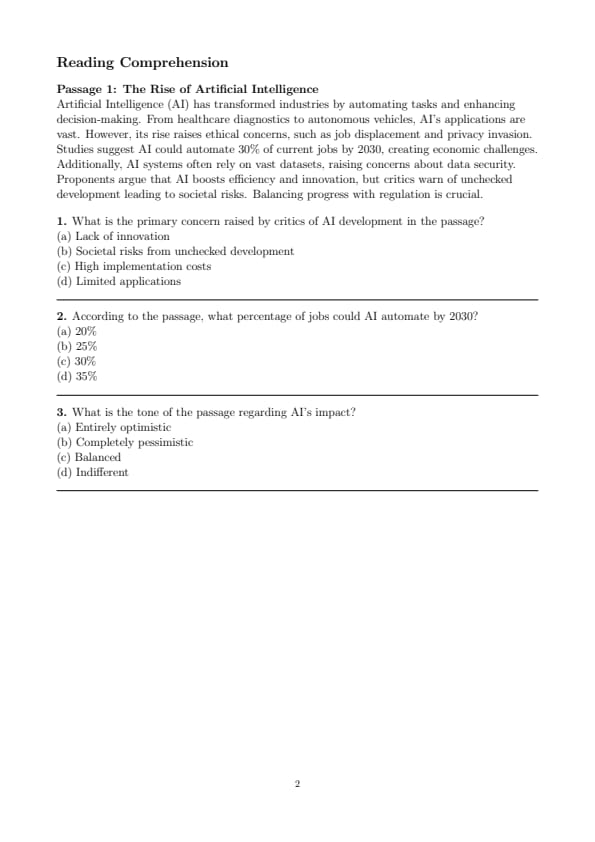
Question 1:
What is the primary concern raised by critics of AI development in the passage?
View Solution
The passage highlights both the opportunities and the challenges of AI. While proponents emphasize efficiency and innovation, critics express worries about the consequences of AI growing without proper regulation. Specifically, it mentions that “critics warn of unchecked development leading to societal risks.” This directly points to option (B) as the correct answer. Options (A), (C), and (D) are not supported by the passage. Quick Tip: In Reading Comprehension questions, focus on the contrast words like “however,” “but,” or “critics warn” — these often signal the main concern or counter-argument in the passage.
According to the passage, what percentage of jobs could AI automate by 2030?
View Solution
The passage clearly states: “Studies suggest AI could automate 30% of current jobs by 2030.” This is a factual detail-based question. Hence, the correct option is (C) 30%. Options (A), (B), and (D) are not mentioned in the passage and are incorrect. Quick Tip: For fact-based Reading Comprehension questions, directly locate and extract the numerical or keyword data from the passage. Avoid overthinking — these are memory-based checks.
What is the tone of the passage regarding AI’s impact?
View Solution
The passage discusses both positive and negative aspects of AI. On one hand, it highlights benefits such as efficiency, innovation, and vast applications. On the other hand, it raises concerns like job displacement, privacy invasion, and societal risks. Since it presents both sides and stresses the need to balance progress with regulation, the tone is clearly \emph{balanced. Therefore, option (C) is correct. Quick Tip: For tone questions, look for whether the author is one-sided or presents multiple perspectives. If both positives and negatives are highlighted, the tone is usually “balanced” or “neutral.”
What does the passage suggest is crucial for AI’s development?
View Solution
Towards the end of the passage, it is clearly stated: “Balancing progress with regulation is crucial.” This indicates that while AI growth is important, it must be accompanied by appropriate rules and oversight to avoid societal risks. Options (A), (C), and (D) are either partial or incorrect, as the passage does not suggest them as the key requirement. Hence, option (B) is correct. Quick Tip: In RC questions asking “what is crucial/important/essential,” directly check the concluding lines of the passage — authors often summarize their main stance there.
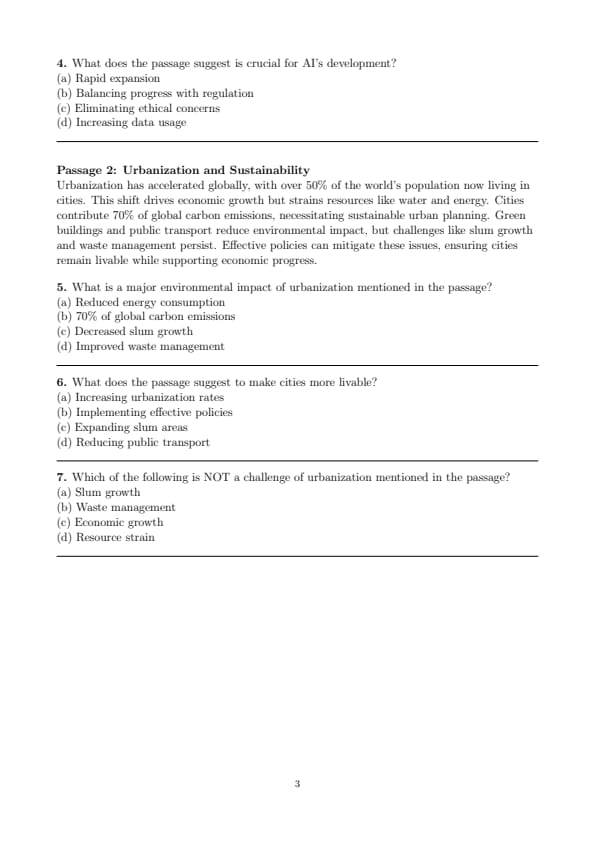
What is a major environmental impact of urbanization mentioned in the passage?
View Solution
The passage clearly states that “Cities contribute 70% of global carbon emissions.” This is mentioned as a key environmental consequence of rapid urbanization. Options (A), (C), and (D) are either the opposite of what the passage highlights or not directly mentioned as impacts. Thus, the correct answer is option (B). Quick Tip: For fact-based RC questions, pay attention to statistics and percentages in the passage — these are often tested directly in the exam.
What does the passage suggest to make cities more livable?
View Solution
The passage concludes by stating: “Effective policies can mitigate these issues, ensuring cities remain livable while supporting economic progress.” This shows that policy implementation is the key recommendation.
- Option (A) is incorrect because urbanization itself is causing strain on resources.
- Option (B) is correct as directly stated in the passage.
- Option (C) is incorrect since slum growth is highlighted as a challenge, not a solution.
- Option (D) is incorrect because reducing public transport would worsen sustainability issues; the passage promotes public transport.
Thus, option (B) is the right answer. Quick Tip: In RC questions about “solutions,” check the last 2–3 lines of the passage — authors usually end with recommendations or policy directions.
Which of the following is NOT a challenge of urbanization mentioned in the passage?
View Solution
The passage lists several challenges linked to urbanization: slum growth, waste management, and strain on resources like water and energy. However, it also mentions that urbanization drives economic growth — but this is presented as a positive outcome, not a challenge.
- Option (A): Slum growth → explicitly mentioned as a challenge.
- Option (B): Waste management → clearly listed as a challenge.
- Option (C): Economic growth → highlighted as a benefit, not a problem.
- Option (D): Resource strain → discussed as a major challenge.
Hence, the correct answer is option (C). Quick Tip: For “NOT mentioned” or “EXCEPT” type RC questions, carefully separate positives (benefits) from negatives (challenges) and confirm directly from the passage.
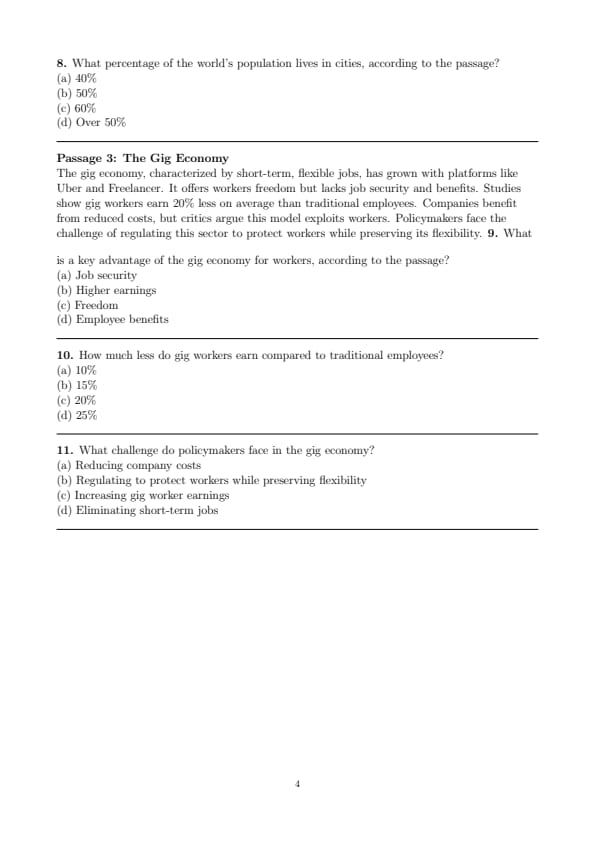
What percentage of the world’s population lives in cities, according to the passage?
View Solution
The passage begins with the statement: “Urbanization has accelerated globally, with over 50% of the world’s population now living in cities.” This makes it clear that the correct answer is option (D).
- Option (A) 40% → Not mentioned.
- Option (B) 50% → Incorrect, as the passage says “over 50%,” not exactly 50.
- Option (C) 60% → Not stated in the passage.
- Option (D) Over 50% → Matches the passage exactly.
Thus, the correct answer is (D). Quick Tip: For number or percentage-based RC questions, be careful with words like “over,” “nearly,” or “about.” These qualifiers often make one option correct over another.
What is a key advantage of the gig economy for workers, according to the passage?
View Solution
The passage states that the gig economy “offers workers freedom but lacks job security and benefits.” This means the primary advantage for workers is the flexibility and independence that comes with gig work.
- Option (A) Job security → Incorrect; the passage highlights lack of job security.
- Option (B) Higher earnings → Incorrect; it says gig workers earn 20% less.
- Option (C) Freedom → Correct, directly stated in the passage.
- Option (D) Employee benefits → Incorrect; the passage mentions absence of benefits.
Hence, option (C) is the right answer.
Quick Tip: When answering RC questions on advantages/disadvantages, look for contrasting words like “offers,” “but lacks,” or “however” — they clearly separate pros from cons.
How much less do gig workers earn compared to traditional employees?
View Solution
The passage explicitly mentions: “Studies show gig workers earn 20% less on average than traditional employees.” This makes option (C) the direct and correct choice.
- Option (A) 10% → Incorrect, not supported by the passage.
- Option (B) 15% → Incorrect, not mentioned.
- Option (C) 20% → Correct, exactly stated in the passage.
- Option (D) 25% → Incorrect, not mentioned.
Thus, the correct answer is option (C). Quick Tip: For percentage or data-based RC questions, locate the exact figure in the passage — these questions are usually direct and fact-based.
What challenge do policymakers face in the gig economy?
View Solution
The passage clearly states: “Policymakers face the challenge of regulating this sector to protect workers while preserving its flexibility.”
- Option (A): Reducing company costs → Incorrect; companies already benefit from reduced costs.
- Option (B): Regulating to protect workers while preserving flexibility → Correct, directly mentioned in the passage.
- Option (C): Increasing gig worker earnings → Not stated as policymakers’ role.
- Option (D): Eliminating short-term jobs → Incorrect, as the passage discusses regulation, not elimination.
Thus, the correct answer is option (B).
Quick Tip: For RC “challenge” questions, focus on lines with words like “problem,” “difficulty,” or “face the challenge.” These usually contain the exact answer.
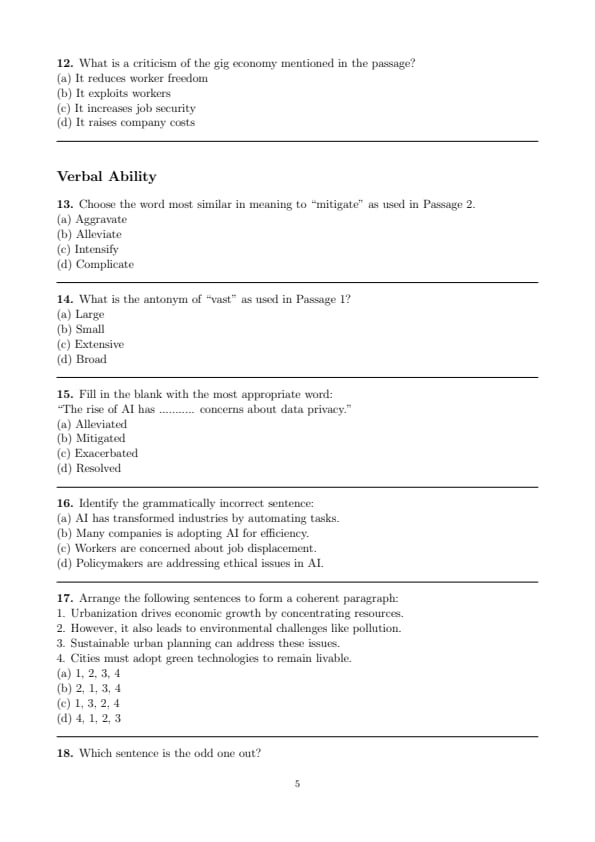
What is a criticism of the gig economy mentioned in the passage?
View Solution
The passage highlights that one major criticism of the gig economy is that it exploits workers. While companies benefit from reduced costs and flexibility, workers often face issues such as lack of benefits, job insecurity, and unfair treatment. Options (a), (c), and (d) do not match the criticism discussed in the passage.
Quick Tip: In reading comprehension, focus on \textbf{negative keywords} like "criticism," "concern," or "problem" to identify the right answer.
Choose the word most similar in meaning to “mitigate” as used in Passage 2.
View Solution
The word “mitigate” means to make something less severe, harmful, or painful. Among the given options:
- (a) “Aggravate” means to make worse, which is the opposite.
- (c) “Intensify” means to increase severity, also opposite in meaning.
- (d) “Complicate” means to make more difficult, which does not fit.
- (b) “Alleviate” means to reduce severity or ease, which is closest in meaning to “mitigate.”
Hence, the correct answer is **(b) Alleviate**.
Quick Tip: In synonym questions, eliminate options that have the opposite meaning first. This narrows down the choices quickly and helps focus on the most context-appropriate word.
What is the antonym of “vast” as used in Passage 1?
View Solution
The word “vast” means very large or extensive in size, amount, or degree. Its opposite (antonym) would be something that indicates the opposite sense, i.e., limited in size or tiny. Among the given options, “Small” directly conveys the opposite meaning of “vast.” The other words — “Large,” “Extensive,” and “Broad” — are actually synonyms or related in meaning to “vast.” Quick Tip: When solving antonym questions, first confirm the exact contextual meaning of the word in the passage. Then eliminate words with similar meanings to the original term, leaving the most appropriate opposite.
Fill in the blank with the most appropriate word:
“The rise of AI has ........... concerns about data privacy.”
View Solution
The sentence refers to the "rise of AI" and its impact on concerns about data privacy. The word needed should reflect an \emph{increase in worries rather than a decrease.
- (a) Alleviated means to lessen or reduce the severity, which is opposite in meaning.
- (b) Mitigated also means to make less severe, which does not fit the context.
- (c) Exacerbated means to make a problem or situation worse, which matches the context because AI has increased privacy concerns.
- (d) Resolved means to settle or find a solution, which again does not fit.
Hence, the most appropriate word is **Exacerbated**. Quick Tip: In fill-in-the-blank questions, always look for contextual clues. Words like “concerns” or “issues” often signal whether the missing word should show an increase or decrease in intensity.
Identify the grammatically incorrect sentence:
View Solution
- Option (a): Grammatically correct — "AI has transformed industries" is correct usage.
- Option (b): Incorrect — The subject "companies" is plural, so the correct verb form should be **"are adopting"** instead of **"is adopting"**.
- Option (c): Grammatically correct — "Workers are concerned" matches the plural subject with the correct verb form.
- Option (d): Grammatically correct — "Policymakers are addressing" is correct subject-verb agreement.
Hence, the grammatically incorrect sentence is **(b)**. Quick Tip: Always check **subject-verb agreement**: singular subjects take singular verbs, and plural subjects take plural verbs. Words ending in "s" are often plural (e.g., companies → are).
Arrange the following sentences to form a coherent paragraph:
1. Urbanization drives economic growth by concentrating resources.
2. However, it also leads to environmental challenges like pollution.
3. Sustainable urban planning can address these issues.
4. Cities must adopt green technologies to remain livable.
View Solution
The logical flow begins with sentence (1), which introduces urbanization as a driver of economic growth. Sentence (2) follows naturally, presenting the downside of urbanization, i.e., environmental challenges. Sentence (3) provides a solution through sustainable urban planning, and sentence (4) concludes with a specific recommendation for green technologies. Hence, the correct sequence is 1, 2, 3, 4. Quick Tip: In para jumbles, always look for the opening sentence that introduces the topic, then identify contrasting or supporting ideas, and finally spot the concluding recommendation or solution.
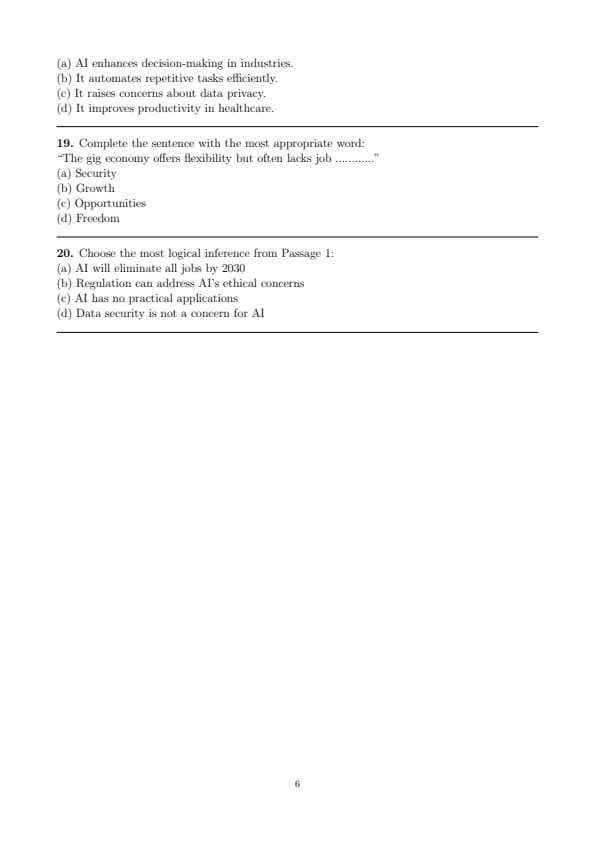
Which sentence is the odd one out?
View Solution
Sentences (a), (b), and (d) highlight the positive applications and benefits of Artificial Intelligence (AI), such as decision-making, task automation, and productivity in healthcare.
Sentence (c), however, introduces a concern or drawback — data privacy issues. This does not align with the positive framing of the other sentences, making it the odd one out. Quick Tip: When solving odd one out questions, check whether most sentences share a common tone, theme, or direction (positive/negative, cause/effect, advantage/disadvantage). The sentence that breaks this consistency is usually the odd one out.
Complete the sentence with the most appropriate word:
“The gig economy offers flexibility but often lacks job ............”
View Solution
The gig economy is characterized by short-term, contract-based, or freelance work. While it offers flexibility and independence, one major drawback is the lack of stable employment benefits such as pensions, insurance, and guaranteed salaries. Therefore, the sentence completion requires the word “Security,” as gig workers often lack long-term job security. Quick Tip: In CAT sentence completion questions, always look for contrast words like “but,” “although,” or “however.” They signal that the second part of the sentence will highlight a limitation or drawback of the first part.
Choose the most logical inference from Passage 1:
View Solution
The passage emphasizes both the benefits of AI and the ethical challenges it poses, particularly around issues like data privacy and fairness. Among the given options, the most logical inference is that **regulation can address AI’s ethical concerns**, as it directly connects with the idea of managing risks while still allowing AI’s positive contributions to continue.
- Option (a) is an exaggeration not supported by the passage.
- Option (c) contradicts the evidence of AI’s practical applications in industries.
- Option (d) is factually incorrect because data security is mentioned as a key concern.
Thus, option (b) is the correct inference. Quick Tip: In CAT inference questions, eliminate extreme or absolute statements first. Look for moderate, balanced conclusions that logically follow from the passage.
*The article might have information for the previous academic years, please refer the official website of the exam.