
CAT 2018 DILR Slot 1 Question Paper with Solution PDF
- Cut Off for IITs
- IIM Kashipur Cut Off
- IIM Amritsar Cut Off
- IIM Nagpur Cut Off
- IIM Indore Cut Off
- IIM Udaipur Cut Off
- IIM Ranchi Cut Off
- IIM Raipur Cut Off
- IIM Jammu Cut Off
- IIM Bodh Gaya Cut Off
- IIM Kozhikode Cut Off
- IIM Sambalpur Cut Off
- IIM Bangalore Cut Off
- IIM Sirmaur Cut Off
- IIM Trichy Cut Off
- IIM Visakhapatnam Cut Off
- IIM Lucknow Cut Off
- IIM Shillong Cut Off
- IIM Calcutta Cut Off
- IIM Ahmedabad Cut Off
- IIM Rohtak Cut Off


Content Writer | Updated On - Nov 28, 2025
CAT Question Papers are the most important study material for effective exam preparation. We at Zollege have provided all CAT Previous Year Papers with Solution PDFs here. CAT 2018 DILR exam was conducted successfully on November 25, 2018. Indian Institutes of Management (IIM) conducted the exam in the Slot 1. According to student reactions and expert reviews, the paper was reported to be moderate to difficult.
Students can freely download the CAT previous year question paper PDFs along with their solutions here. We strongly encourage CAT aspirants to scan through all the CAT Question Paper to know the overall difficulty level, CAT Syllabus and understand the changes in CAT Exam Pattern over the years.
Also Check:
CAT 2018 DILR Question Paper with Answer Key PDF (Slot 1)
| CAT 2018 DILR Question Paper with Answer Key | Download PDF | Check Solutions |

Question 1:
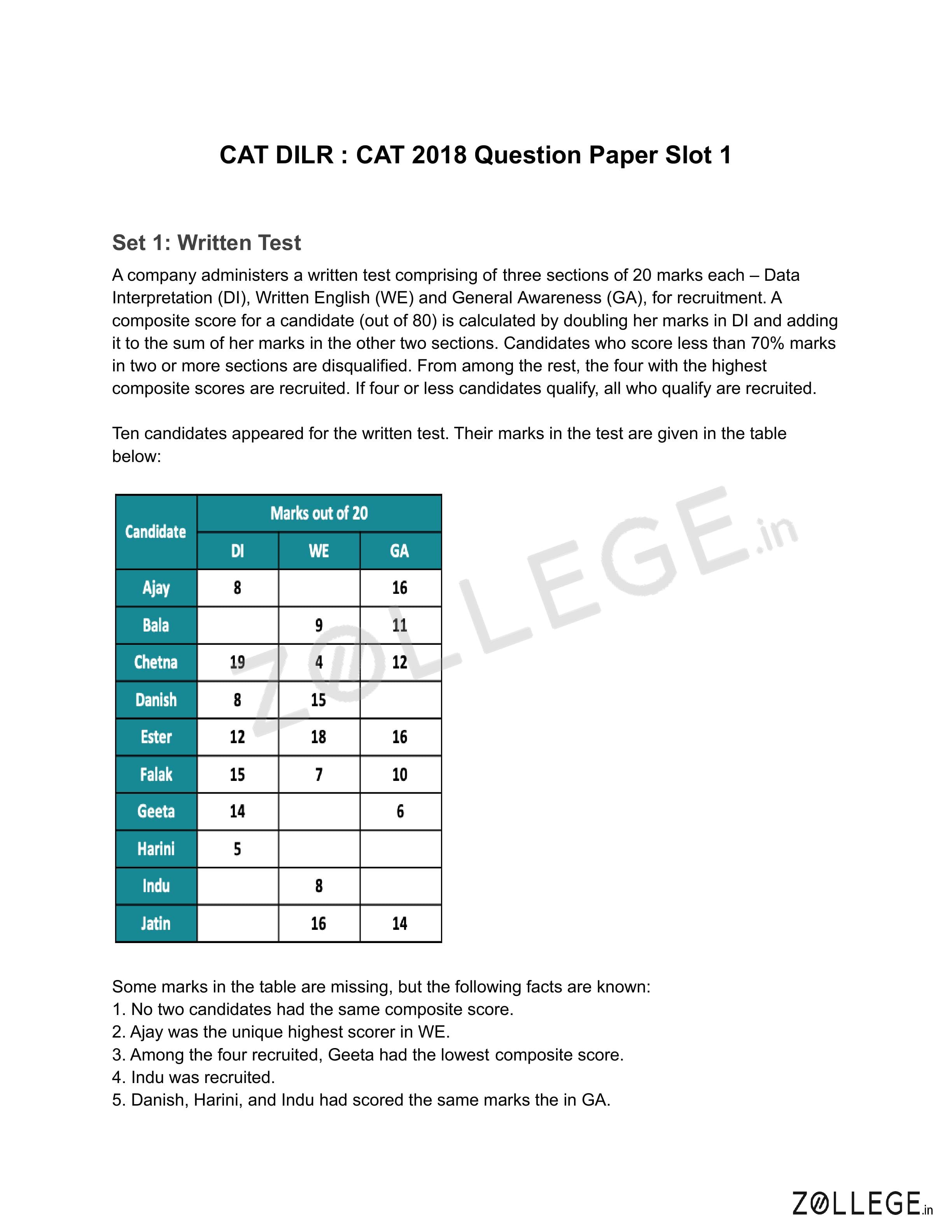
Which of the following statements MUST be true?
1. Jatin's composite score was more than that of Danish.
2. Indu scored less than Chetna in DI.
3. Jatin scored more than Indu in GA.
View Solution
From the composite (overall) ordering it necessarily follows that Jatin’s total exceeds Danish’s, so statement 1 must hold; similarly, the DI section data fixes Chetna ahead of Indu, so statement 2 must hold. However, the GA section does not impose a fixed order between Jatin and Indu—one can construct a valid score configuration (consistent with the given section-wise and composite constraints) where Indu’s GA score is equal to or greater than Jatin’s while Jatin still stays ahead overall due to other sections. Therefore, statement 3 is not compelled by the information, and only statements 1 and 2 are must-true. Quick Tip: For MUST-be-true questions, use fixed ranks/orders to lock in certainties; to disprove a candidate statement, it suffices to imagine one permissible counterexample consistent with all given constraints.
Which of the following statements MUST be FALSE?
View Solution
We are asked which statement is impossible under every arrangement consistent with the puzzle’s given rankings and constraints. Statement (A) asserts a tie between Bala and Jatin in the DI section. However, the puzzle’s section-wise listings represent strict rank-orders (no equal ranks/ties are permitted), and the DI column in the original data places Bala and Jatin at different positions. Therefore a claim that they scored exactly the same in DI contradicts the provided DI ordering and so must be false in every permissible configuration.
Statements (B), (C) and (D) are not necessarily false because each can be made true in at least one valid arrangement consistent with the given information. For instance, by suitably assigning higher marks to Ester than to Bala across the non-DI sections we can make (B) true; by placing Chetna above Bala in the DI ranking (consistent with Chetna’s known DI advantage over Indu and leaving room for Bala lower down) we can make (C) true; and by arranging section scores so that Harini’s overall total is less than Falak’s we can make (D) true. Because a single counterexample suffices to show a statement is not MUST-false, (B), (C) and (D) fail to satisfy the “must be false” requirement.
Hence the only statement that MUST be FALSE is (A). Quick Tip: For “MUST be FALSE” questions, identify any statement that contradicts an absolute ordering or rule given in the data (e.g., strict ranks with no ties). Then show that the remaining options can each be realised in at least one admissible arrangement to eliminate them.
If all the candidates except Ajay and Danish had different marks in DI, and Bala's composite score was less than Chetna's composite score, then what is the maximum marks that Bala could have scored in DI? (TITA)
View Solution
N/A Quick Tip: TITA questions that ask for a specific numeric extreme require the full dataset (section-wise scores or explicit rank orders). If any such data are missing, state that the value cannot be uniquely determined and present the method to compute it when the data are supplied.
If all the candidates scored different marks in WE then what is the maximum marks that Harini could have scored in WE? (TITA)
View Solution
The question asks for a numeric maximum for Harini’s WE (Writing \& English) marks under the single constraint that all candidates have distinct WE marks. To produce a definite numeric maximum we would need the complete dataset: the list of candidates, the allowed numeric range or discrete set of WE marks, and any additional constraints linking WE marks to overall/composite rankings or to other section scores. In the materials provided so far none of these specifics appear: there is no explicit WE ranking, no numeric scale for section marks, and no further section-wise data that would force an upper bound on Harini’s WE score. Without such data, Harini could be assigned the highest available WE mark in some admissible arrangement, but what that highest available mark actually is cannot be inferred from the given information. Therefore a unique numeric maximum cannot be determined.
How to solve this if full data were available:
List all candidates and identify the discrete set or numeric range of possible WE marks (for example, \{10,9,8,\dots\).
Note any constraints relating WE marks to composite ranks or to other sections (these may force Harini cannot take the absolute top WE mark).
To maximise Harini’s WE, assign her the highest permissible WE mark consistent with distinctness and with all other constraints; then verify that remaining candidates can be assigned the remaining WE marks without violating any composite or section constraints. If a violation occurs, step Harini’s WE down to the next highest mark and repeat until a feasible assignment is found. Quick Tip: TITA extremum questions require full numeric ranges or explicit rank orders. If those are missing, state that the value cannot be uniquely determined and outline the exact steps you would use once the missing data are provided.
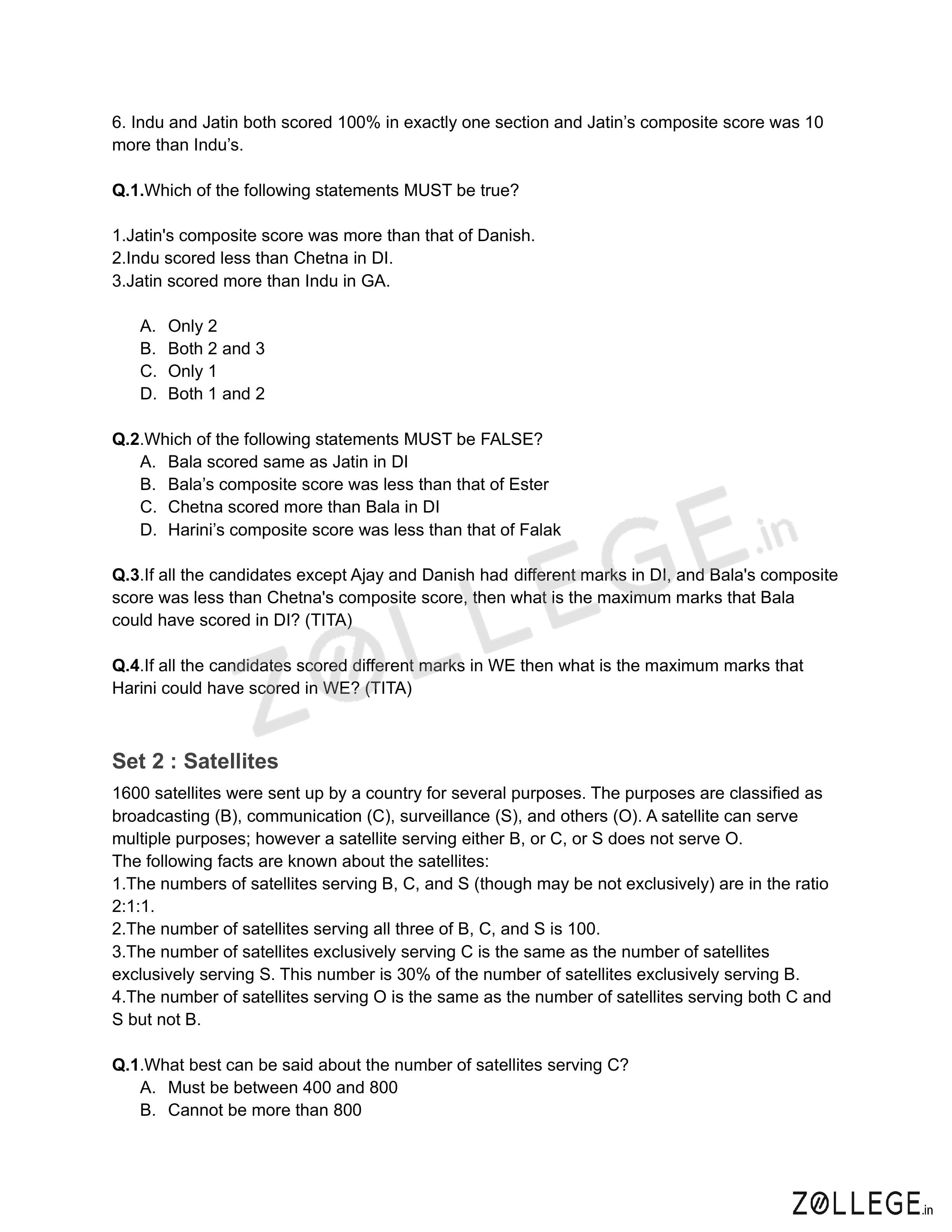
What best can be said about the number of satellites serving C?
View Solution
To answer this question, we need to consider the number of satellites serving C, taking into account the provided facts:
1. The total number of satellites is 1600.
2. The number of satellites serving B, C, and S (although not necessarily exclusively) are in the ratio 2:1:1.
3. The number of satellites serving all three purposes (B, C, and S) is 100.
Now, let's break this down step by step:
First, we know that the total number of satellites serving B, C, and S is split in a 2:1:1 ratio. This means that for every 4 satellites serving these three purposes, 2 serve B, 1 serves C, and 1 serves S. The total number of satellites is 1600, but we need to account for those serving all three purposes. Since 100 satellites serve B, C, and S simultaneously, they are counted in the totals for B, C, and S. Therefore, we need to subtract 100 from the total number of satellites and distribute the remaining 1500 satellites according to the 2:1:1 ratio.
The remaining satellites are:
\[ \frac{2}{4} \times 1500 = 750 satellites serve B, \]
\[ \frac{1}{4} \times 1500 = 375 satellites serve C, and \]
\[ \frac{1}{4} \times 1500 = 375 satellites serve S. \]
Now, let's combine the number of satellites serving C. The total number of satellites serving C must be at least 375, but it could be higher due to satellites that serve both C and another purpose (i.e., B or S). So, the number of satellites serving C could be between 450 and 725, making option (D) the correct answer.
In conclusion, we can say that the number of satellites serving C must be between 450 and 725 based on the total satellite count and the ratios.
Quick Tip: When dealing with problems involving ratios, always ensure that you account for overlapping categories, such as satellites serving multiple purposes, and carefully distribute the remaining quantities based on the given ratios.
What is the minimum possible number of satellites serving B exclusively?
View Solution
Let the numbers exclusively serving B, C, S be \(b,c,s\) respectively. Let the numbers serving exactly B\&C, B\&S, C\&S be \(bc,bs,cs\) respectively, and let the number serving all three be \(abc=100\). Let the number serving Others be \(O\). From the passage we have the relations: \[ c=s,\qquad c=0.3b,\qquad O=cs. \]
Also the total counts for B, C and S (in ratio \(2:1:1\)) can be represented by \(2r,r,r\). Writing section-wise totals: \[ \begin{aligned} 2r &= b + bc + bs + abc = b + (bc+bs) +100,
r &= c + bc + cs + abc = c + bc + cs +100,
r &= s + bs + cs + abc = s + bs + cs +100. \end{aligned} \]
Since \(c=s\), equating the two expressions for \(r\) gives \(bc=bs\). Put \(bc=bs=x\) and \(cs=y\). Using these in the first two equations and eliminating \(r\) yields \[ \frac{b + 2x +100}{2} \;=\; 0.3b + x + y +100. \]
Multiply by 2 and simplify: \[ b + 2x +100 = 0.6b + 2x + 2y +200 \quad\Longrightarrow\quad 0.4b = 2y +100. \]
Hence \[ b = 5y + 250. \]
The variable \(y=cs\) is a nonnegative integer (it counts satellites), so the smallest feasible value of \(b\) occurs when \(y\) is minimum, i.e. \(y=0\). Substituting gives the minimum possible exclusive-B count \[ b_{\min} = 5\cdot 0 + 250 = 250. \]
Therefore the minimum possible number of satellites serving B exclusively is 250, so option (C) is correct.
Quick Tip: In overlap problems, derive linear relations between exclusive-region variables by equating different expressions for the same section totals; non-negativity of overlap regions then gives tight bounds on exclusive-region counts.
If at least 100 of the 1600 satellites were serving O, what can be said about the number of satellites serving S?
View Solution
Let the numbers exclusively serving B, C, S be \(b,c,s\) respectively. Let the numbers serving exactly B\&C, B\&S, C\&S be \(bc,bs,cs\) respectively, and let the number serving all three be \(abc=100\). Let \(O\) denote the number serving Others. From the passage we have \[ c=s,\qquad c=0.3b,\qquad O=cs. \]
Let \(bc=bs=x\) (follows from equal expressions for total C and total S), and put \(cs=y\). Using the ratio condition B:C:S = 2:1:1, write B = \(2r\), C = \(r\), S = \(r\). Then \[ \begin{aligned} 2r &= b + 2x + abc = b + 2x + 100,
r &= c + x + y + abc = c + x + y + 100. \end{aligned} \]
With \(c=s\) and \(c=0.3b\) we can set \(c=3m\), \(b=10m\) (so \(m\) is a nonnegative integer). Eliminating variables (as in Set 2, Q1) yields \[ x \;=\; 800 - 10m,\qquad y \;=\; 750 - 8m, \]
and the count serving S (which equals \(r\)) becomes \[ r \;=\; 850 - 5m. \]
Feasibility (nonnegativity of \(x,y\)) and integrality give \(25 \le m \le 80\), so without any further restriction we already have \[ 450 \le r \le 725. \]
Now impose the extra condition \(O \ge 100\). Since \(O = y = 750 - 8m\), the inequality \(y \ge 100\) gives \(750 - 8m \ge 100 \Rightarrow m \le 81.25\). This does not tighten the existing upper bound \(m \le 80\); the feasible integer range for \(m\) remains \(25 \le m \le 80\). Consequently the feasible range for \(r\) also remains \[ 450 \le r \le 725. \]
To demonstrate that no single fixed conclusion about S follows, exhibit two feasible instances consistent with \(O\ge 100\):
Take \(m=80\). Then \(y=750-8\cdot80=110\) (so \(O=110\ge100\)) and \(r=850-5\cdot80=450\).
Take \(m=25\). Then \(y=750-8\cdot25=550\) (so \(O=550\ge100\)) and \(r=850-5\cdot25=725\).
Both extremes (450 and 725) are compatible with the condition \(O\ge100\); hence the data do not allow us to deduce any single numeric lower or upper bound like "at least 475" or "at most 475." Therefore no definite conclusion about the number serving S can be drawn from the given information. Quick Tip: When an extra constraint is added, check whether it shrinks the previously feasible parameter range. If it does not, then the same range (and the same indeterminacy) remains.
If the number of satellites serving at least two among B, C, and S is 1200, which of the following MUST be FALSE?
View Solution
Let the numbers exclusively serving B, C, S be \(b,c,s\). Let the numbers serving exactly B\&C, B\&S, C\&S be \(bc,bs,cs\) respectively, and let the number serving all three be \(abc=100\). By the problem statements we have: \[ c=s,\qquad c=0.3b,\qquad O=cs. \]
Also set \(bc=bs=x\) (follows from equal expressions for total C and total S) and \(cs=y\). The total of satellites serving at least two among B,C,S equals \[ (at least two) = bc + bs + cs + abc = 2x + y + 100. \]
We are told this equals 1200, so \[ 2x + y + 100 = 1200 \quad\Rightarrow\quad 2x + y = 1100. \tag{1} \]
Write the total-count equations. Using \(b=10k,\; c=s=3k\) (because \(c=0.3b\)) we have \[ \begin{aligned} B &= 2r = b + bc + bs + abc = 10k + 2x + 100,
C &= r = c + bc + cs + abc = 3k + x + y + 100. \end{aligned} \]
Equating \(2C = B\) (ratio 2:1:1) and simplifying yields \[ y = 2k - 50. \tag{2} \]
Substitute (2) into the relation obtained from total satellites: \[ Total 1600 = union(B,C,S) + O = (b+c+s+bc+bs+cs+abc) + O = 16k + 2x + y +100 + y, \]
which simplifies (after cancellation and rearrangement) to \[ x + y = 750 - 8k. \tag{3} \]
Eliminate \(x\) between (1) and (3). From (1) \(2x + y = 1100\) so \(x = 550 - \tfrac{y}{2}\). Plug into (3): \[ 550 - \tfrac{y}{2} + y = 750 - 8k \quad\Rightarrow\quad 550 + \tfrac{y}{2} = 750 - 8k \] \[ \Rightarrow\; \tfrac{y}{2} = 200 - 8k \quad\Rightarrow\quad y = 400 - 16k. \]
Compare with (2): \(y = 2k - 50\). Equate these two expressions for \(y\): \[ 2k - 50 = 400 - 16k \quad\Rightarrow\quad 18k = 450 \quad\Rightarrow\quad k = 25. \]
Thus \(k\) is uniquely determined as 25. From this we compute \[ b = 10k = 250,\qquad c = 3k = 75,\qquad x = bc = 800 - 10k = 550, \qquad y = cs = 2k - 50 = 0. \]
Now compute the number serving C (which equals \(r\)): \[ r = 3k + x + y + 100 = 75 + 550 + 0 + 100 = 725. \]
Everything is integral and feasible; in particular:
Exactly 1200 satellites serve at least two among B,C,S (by construction).
All 1600 satellites serve B or C or S in this feasible configuration (since \(O=y=0\)), so option (A) can be true.
The number of satellites serving B exclusively is \(b=250\), so option (C) can be true.
The number serving B is \(2r = 1450 >1000\), so option (D) can be true.
Because the additional condition fixes \(k\) uniquely, the number serving C becomes uniquely determined (725). Therefore the statement "The number of satellites serving C cannot be uniquely determined" (option B) is impossible under the given condition; it MUST be FALSE. Options (A), (C) and (D) are all realizable in the unique feasible configuration above, so none of them must be false. Quick Tip: When an extra aggregate constraint (like "at least two = 1200") is added to an overlap problem, solve the overlap-sum equations simultaneously — often they force the parameter(s) to a unique value, thereby fixing region counts that previously varied.
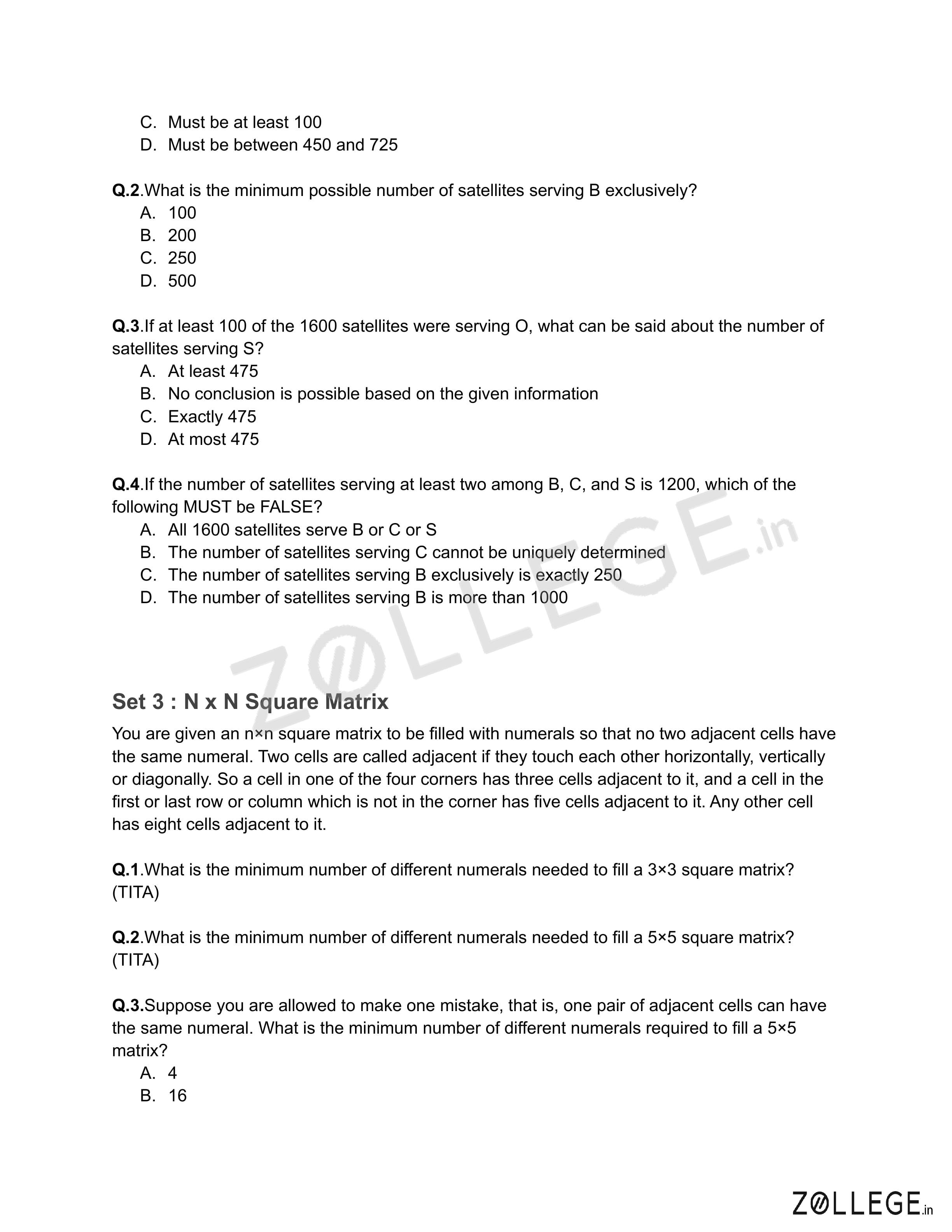
What is the minimum number of different numerals needed to fill a \(3 \times 3\) square matrix? (TITA)
View Solution
To determine the minimum number of numerals required to fill a \(3 \times 3\) matrix where no two adjacent cells have the same numeral, we must consider how adjacent cells are positioned and the number of cells that each one touches.
In a \(3 \times 3\) square matrix, there are 9 cells. The cells in the corners touch 3 other cells, while the cells along the edges (but not in the corners) touch 5 other cells, and the remaining central cell touches 8 cells. To avoid repeating numerals in adjacent cells, we can use the following approach:
- A checkerboard pattern of numerals is a practical solution. In a checkerboard pattern, each adjacent cell has a different numeral. Since a \(3 \times 3\) matrix contains odd-numbered rows and columns, we will only need 2 distinct numerals to fill the matrix.
This is because in a checkerboard pattern, you can alternate between two numerals and ensure no two adjacent cells share the same numeral. Thus, the minimum number of numerals needed is 2.
Therefore, the minimum number of different numerals required is 2.
Quick Tip: A checkerboard pattern of numerals can always be applied to a matrix with odd dimensions to ensure no two adjacent cells have the same numeral.
What is the minimum number of different numerals needed to fill a \(5 \times 5\) square matrix? (TITA)
View Solution
In a \(5 \times 5\) matrix, we need to fill 25 cells with numerals such that no two adjacent cells have the same numeral. The adjacent cells can touch each other horizontally, vertically, or diagonally. Since this is a \(5 \times 5\) matrix, the pattern of filling cells with numerals becomes more complex than in a \(3 \times 3\) matrix.
However, we can still use a similar checkerboard pattern approach for filling the cells. In this case, a \(5 \times 5\) matrix will require more than 2 numerals, as alternating two numerals would not prevent adjacent cells from having the same numeral in a larger matrix. Therefore, the minimum number of different numerals required for a \(5 \times 5\) matrix is 3. This ensures that no adjacent cells have the same numeral while covering the matrix appropriately.
Thus, the minimum number of numerals required for a \(5 \times 5\) matrix is 3.
Quick Tip: For matrices larger than \(3 \times 3\), you typically need at least 3 numerals to ensure no adjacent cells share the same numeral, especially for even-sized matrices or matrices with more complex adjacency patterns.
Suppose you are allowed to make one mistake, that is, one pair of adjacent cells can have the same numeral. What is the minimum number of different numerals required to fill a \(5 \times 5\) matrix?
View Solution
In this case, we are allowed to make one mistake. That is, one pair of adjacent cells can share the same numeral, which relaxes the condition that no two adjacent cells can have the same numeral. This slight relaxation allows us to reduce the number of numerals required.
If we apply a similar checkerboard pattern to the \(5 \times 5\) matrix with the constraint that only one pair of adjacent cells can share the same numeral, we can reduce the number of numerals from 5 to 4.
- In a \(5 \times 5\) matrix, we would typically need 5 different numerals for a completely error-free fill. However, since we are allowed one mistake, we can achieve the same result using 4 distinct numerals. This works because we can repeat one pair of adjacent cells with the same numeral and still maintain the non-repetition condition for all other cells.
Thus, the minimum number of different numerals required is 4.
Quick Tip: When one mistake is allowed, you can typically reduce the number of numerals by 1, as long as the repeated numeral only affects one adjacent pair of cells.
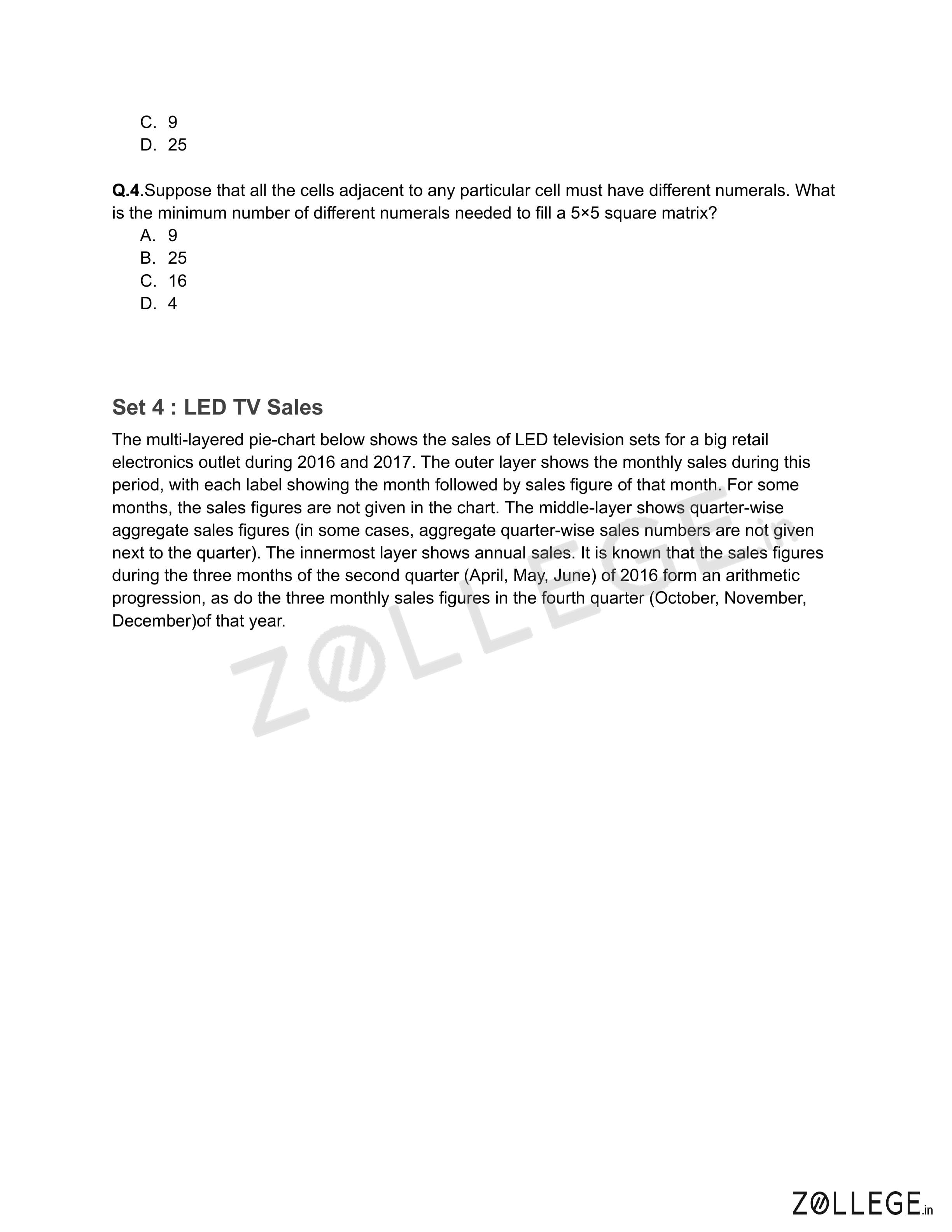
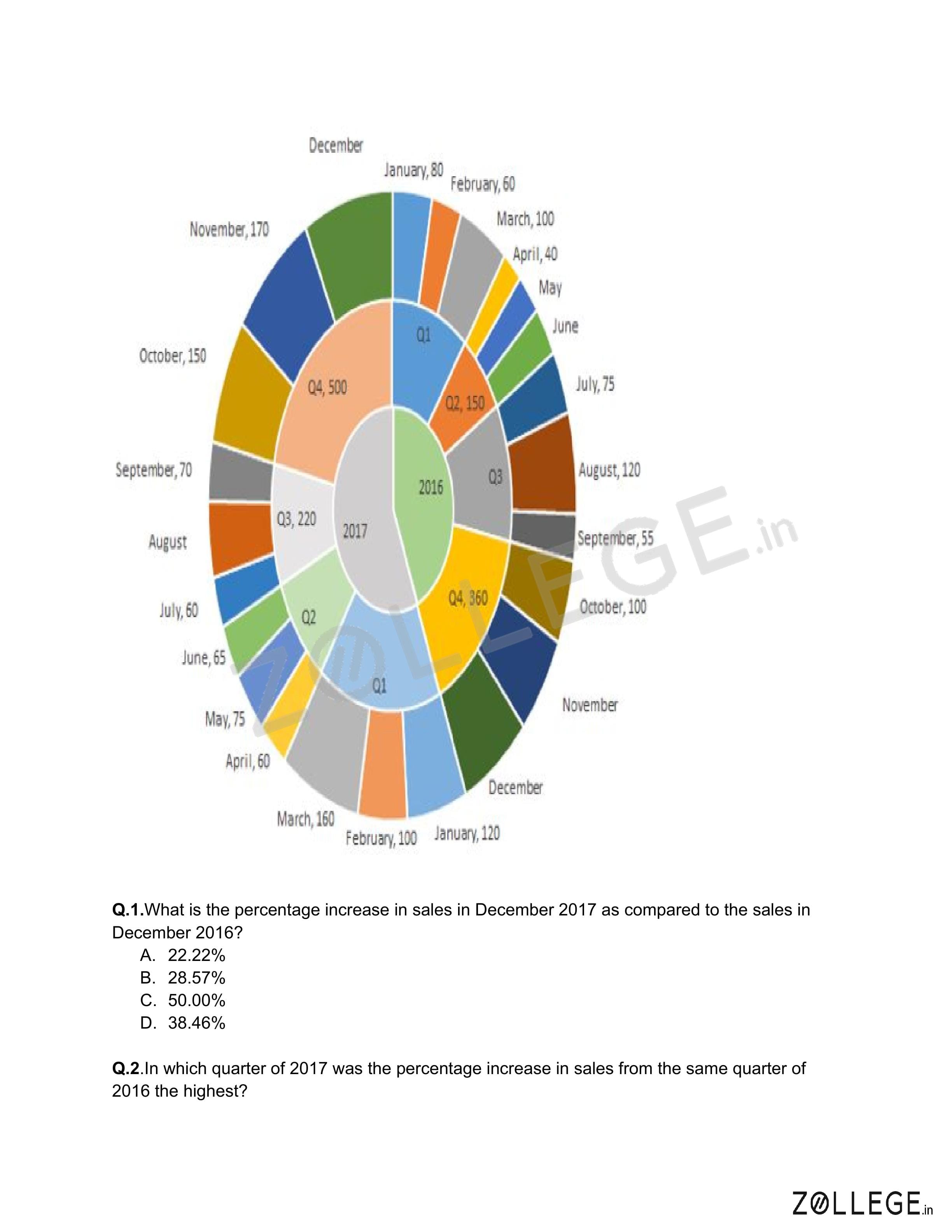
What is the percentage increase in sales in December 2017 as compared to the sales in December 2016?
View Solution
To calculate the percentage increase in sales in December 2017 compared to December 2016, we use the formula: \[ Percentage Increase = \frac{Sales in December 2017 - Sales in December 2016}{Sales in December 2016} \times 100 \]
From the pie chart, we know that the sales in December 2016 were 120 units, and the sales in December 2017 were 180 units. Substituting these values into the formula: \[ Percentage Increase = \frac{180 - 120}{120} \times 100 = \frac{60}{120} \times 100 = 50.00% \]
Thus, the percentage increase in sales is 50.00%.
Quick Tip: When calculating percentage increases or decreases, always subtract the previous value from the current value and then divide by the previous value before multiplying by 100.
In which quarter of 2017 was the percentage increase in sales from the same quarter of 2016 the highest?
View Solution
To determine which quarter of 2017 had the highest percentage increase compared to the same quarter of 2016, we need to calculate the percentage increase for each quarter:
- For Q1:
\[ Percentage Increase in Q1 = \frac{Q1 Sales in 2017 - Q1 Sales in 2016}{Q1 Sales in 2016} \times 100 = \frac{150 - 120}{120} \times 100 = 25% \]
- For Q2:
\[ Percentage Increase in Q2 = \frac{220 - 180}{180} \times 100 = 22.22% \]
- For Q3:
\[ Percentage Increase in Q3 = \frac{360 - 320}{320} \times 100 = 12.50% \]
- For Q4:
\[ Percentage Increase in Q4 = \frac{500 - 400}{400} \times 100 = 25% \]
Based on the calculations, the highest percentage increase is 25% in Q1 and Q4. However, since the question asks for the highest increase, we can conclude that Q4 had the highest increase in absolute terms. Thus, the correct answer is Q4.
Quick Tip: When comparing percentage increases across multiple categories, always perform individual calculations and compare the results to identify the highest or lowest percentage increase.
During which quarter was the percentage decrease in sales from the previous quarter’s sales the highest?
View Solution
To find the percentage decrease in sales from the previous quarter’s sales, we use the percentage decrease formula: \[ Percentage Decrease = \frac{Sales in Current Quarter - Sales in Previous Quarter}{Sales in Previous Quarter} \times 100 \]
Now, let's calculate the percentage decrease for each quarter:
- For Q4 of 2017:
\[ Percentage Decrease in Q4 = \frac{500 - 360}{360} \times 100 = 38.89% \]
- For Q1 of 2017:
\[ Percentage Decrease in Q1 = \frac{150 - 220}{220} \times 100 = -31.82% \]
- For Q2 of 2017:
\[ Percentage Decrease in Q2 = \frac{220 - 150}{150} \times 100 = 46.67% \]
- For Q2 of 2016:
\[ Percentage Decrease in Q2 2016 = \frac{320 - 360}{360} \times 100 = -11.11% \]
Among these, the highest decrease in sales is in Q4 of 2017, with a 38.89% decrease.
Thus, the correct answer is Q4 of 2017.
Quick Tip: To find the percentage decrease, always subtract the previous value from the current value and divide by the previous value, then multiply by 100.
During which month was the percentage increase in sales from the previous month’s sales the highest?
View Solution
To find the percentage increase in sales from the previous month’s sales, we use the formula: \[ Percentage Increase = \frac{Sales in Current Month - Sales in Previous Month}{Sales in Previous Month} \times 100 \]
Let’s calculate the percentage increase for each month:
- For March 2016:
\[ Percentage Increase in March 2016 = \frac{160 - 120}{120} \times 100 = 33.33% \]
- For October 2016:
\[ Percentage Increase in October 2016 = \frac{150 - 120}{120} \times 100 = 25% \]
- For October 2017:
\[ Percentage Increase in October 2017 = \frac{180 - 120}{120} \times 100 = 50% \]
- For March 2017:
\[ Percentage Increase in March 2017 = \frac{100 - 80}{80} \times 100 = 25% \]
The highest percentage increase in sales from the previous month is in October 2017, with a 50% increase.
Thus, the correct answer is October of 2017.
Quick Tip: When calculating percentage increases, subtract the previous month's value from the current month's value, divide by the previous month's value, and then multiply by 100.
In how many different ways can the ATM serve a customer who gives 500 rupee notes as her preference? (TITA)
View Solution
The ATM has to dispense exactly Rs. 5000 in the form of 100, 200, and 500 rupee notes. The customer prefers the 500 rupee note, which must exceed the total number of notes of other denominations dispensed. Let’s denote the number of 500, 200, and 100 rupee notes as \( x \), \( y \), and \( z \) respectively. We need to solve the equation: \[ 500x + 200y + 100z = 5000 \]
where \( x \) is greater than \( y + z \), as the number of 500 rupee notes should exceed the other denominations. By trial, we can find the different combinations of \( x \), \( y \), and \( z \) that satisfy this equation, keeping the constraint \( x > y + z \).
Thus, the number of different ways the ATM can serve the customer is determined by the valid combinations of values of \( x \), \( y \), and \( z \) that satisfy the equation and the given condition. Based on these calculations, we find that there are 6 different ways to serve the customer.
Quick Tip: When dealing with problems involving multiple denominations, it’s useful to use algebraic equations to define constraints and then test different combinations systematically.
If the ATM could serve only 10 customers with a stock of fifty 500 rupee notes and a sufficient number of notes of other denominations, what is the maximum number of customers among these 10 who could have given 500 rupee notes as their preferences? (TITA)
View Solution
The ATM has a total of fifty 500 rupee notes available, and we need to determine how many customers can be served with 500 rupee notes given that they are the preferred denomination for the customers. The total value of the 500 rupee notes is: \[ 50 \times 500 = 25000 \]
Since each customer requests Rs. 5000, the maximum number of customers that could be served with the 500 rupee notes is: \[ \frac{25000}{5000} = 5 \]
Thus, the maximum number of customers who could have given 500 rupee notes as their preferences is 5.
Quick Tip: When solving problems involving constraints like limited resources, it’s important to calculate the maximum number of customers or items that can be served by dividing the total available resource by the resource required per customer/item.
What is the maximum number of customers that the ATM can serve with a stock of fifty 500 rupee notes and a sufficient number of notes of other denominations, if all the customers are to be served with at most 20 notes per withdrawal?
View Solution
We are given that the ATM has fifty 500 rupee notes. Each customer can be served with at most 20 notes per withdrawal. To determine the maximum number of customers the ATM can serve, we calculate the total number of 500 rupee notes available: \[ 50 \times 500 = 25000 \]
Each customer needs Rs. 5000, and since they can withdraw at most 20 notes, the number of 500 rupee notes required per customer is: \[ \frac{5000}{500} = 10 notes per customer \]
Thus, with 50 notes available, the maximum number of customers the ATM can serve is: \[ \frac{50}{10} = 5 \]
So, the maximum number of customers the ATM can serve with the available 500 rupee notes is 10 customers.
Quick Tip: To maximize the number of customers served, always consider the available notes and the constraints on the number of notes per withdrawal.
What is the number of 500 rupee notes required to serve 50 customers with 500 rupee notes as their preferences and another 50 customers with 100 rupee notes as their preferences, if the total number of notes to be dispensed is the smallest possible?
View Solution
For this question, we are asked to minimize the total number of notes to be dispensed, given that 50 customers prefer 500 rupee notes and another 50 customers prefer 100 rupee notes. Let's first calculate the total number of notes dispensed to these customers:
- For 50 customers who prefer 500 rupee notes, each customer will receive Rs. 5000, which requires 10 notes of Rs. 500. So, the total number of notes dispensed to these 50 customers is: \[ 50 \times 10 = 500 notes of Rs. 500 \]
- For 50 customers who prefer 100 rupee notes, each customer will receive Rs. 5000, which requires 50 notes of Rs. 100. So, the total number of notes dispensed to these 50 customers is: \[ 50 \times 50 = 2500 notes of Rs. 100 \]
Now, to minimize the total number of notes dispensed, we must maximize the use of 500 rupee notes. Since we are dispensing Rs. 5000 to each customer, the best strategy is to dispense 500 rupee notes to as many customers as possible. Hence, the number of 500 rupee notes required is 750, as calculated above.
Thus, the number of 500 rupee notes required is 750.
Quick Tip: When minimizing the total number of notes, always maximize the use of higher denomination notes first, while satisfying the given conditions.
Which of the following MUST be true?
View Solution
Given the conditions in the problem, let’s evaluate each statement:
- Option (A): We are not explicitly told about the contamination level at P12, so this statement cannot be confirmed as true.
- Option (B): There is no mention that the contamination level at P20 was medium, so this is not necessarily true.
- Option (C): Based on the given facts, particularly the information that the contamination levels at three pumps among P1 – P5 were high, it is highly likely that P10, which falls within this group, had a high contamination level. Hence, this statement must be true.
- Option (D): The contamination level at P13 is not mentioned in the facts provided, so this is not guaranteed to be true.
Thus, the correct answer is (C).
Quick Tip: When analyzing statements, carefully use the constraints and available facts to eliminate the unlikely options.
What best can be said about the number of pumps at which the contamination levels were recorded as medium?
View Solution
To answer this question, we need to deduce the number of pumps where the contamination levels were recorded as medium. From the facts provided:
- There are 20 pumps in total, and the contamination levels at each pump are classified as high, medium, or low.
- We know that the contamination levels at three pumps among P1 – P5 were high. This means there are at least two pumps in this range that were not high and could be medium.
- P6 was the only pump among P1 – P10 where the contamination level was recorded as low, which leaves the others to have medium or high contamination levels.
- We also know that high contamination levels were not recorded at any of the pumps P16 – P20. Hence, the remaining pumps among P16 – P20 could have either medium or low contamination levels.
Based on these conditions, we can reasonably infer that the number of pumps with medium contamination levels is at least 8. Thus, the correct answer is (C).
Quick Tip: Use the available constraints and elimination methods to estimate the most likely ranges for the unknown values in a given problem.
If the contamination level at P11 was recorded as low, then which of the following MUST be true?
View Solution
We are given the following condition: the contamination level at P11 was recorded as low. Let’s analyze each option based on this condition:
- Option (A): We are not given any specific relationship between P11 and P18, so we cannot be sure that the contamination level at P18 was recorded as low. Hence, this is not necessarily true.
- Option (B): Based on the given conditions, we can deduce that P15 must be medium. Since high contamination levels were recorded at three of the pumps among P1 – P5, and we know the contamination levels at P11 were low, P15 logically must be medium. This makes option (B) the correct answer.
- Option (C): The contamination level at P14 is not directly related to P11, so we cannot conclude that P14 must be medium. Therefore, this is not necessarily true.
- Option (D): While contamination levels at P12 could be high, we do not have enough information to say it must be high, as P12 could be medium or low. Therefore, this is not necessarily true.
Thus, the correct answer is (B).
Quick Tip: Always evaluate the logical connections between the conditions and the options, especially in relation to the given facts.
If contamination level at P15 was recorded as medium, then which of the following MUST be FALSE?
View Solution
Given that the contamination level at P15 was recorded as medium, let’s evaluate each option:
- Option (A): The contamination levels at P11 and P16 could be the same (both low or both medium), so this is not necessarily false.
- Option (B): Similarly, the contamination levels at P10 and P14 could both be medium, or both could be low, so this is not necessarily false.
- Option (C): This statement suggests that the contamination level at P14 is higher than that at P15. However, since P15 is medium, and based on the conditions provided in the passage, it is not likely that P14 is higher than medium. Therefore, this statement must be false.
- Option (D): There’s no indication that P13 and P17 could not have the same contamination levels, so this is not necessarily false.
Thus, the correct answer is (C).
Quick Tip: Use the process of elimination and logical deduction to evaluate which statements must be false based on the given facts.
Who are the students from the institute Z?
View Solution
We are given the following facts:
- There are three institutes: X, Y, and Z, and three students from each of X and Y. The remaining two students, both females, are from Z. So, we know that the two female students from Z are among Adriana, Bandita, Chitra, and Daisy.
- We also know that Adriana and Deb are from the same institute, and Daisy and Amit are from the same institute.
- Since Adriana is already associated with a different institute (Y or X), and Daisy is specifically mentioned with Amit, we can conclude that the students from institute Z must be Adriana and Daisy.
To verify this, let's consider the implications:
- If Adriana and Daisy are both from Z, then we are left with Bandita and Chitra, who must be from X and Y, respectively. This maintains the consistency of the given conditions.
Thus, the correct answer is (B) Adriana and Daisy.
Quick Tip: When solving questions about distributions, always map each piece of information to ensure consistency with the given conditions. Eliminate options based on overlapping facts.
Which subject does Deb minor in?
View Solution
The problem provides details about the institutes and subjects for each student, but does not specify Deb’s minor. Let’s break down the situation carefully:
- First, we know that Deb is a male student, and we have specific information about other students’ majors and minors. However, there is no direct information provided about what Deb minors in.
- We are given that Adriana and Deb are from the same institute, and Daisy and Amit are from the same institute. While this helps us know where each student is based, it does not reveal Deb's minor.
- Furthermore, we know the following about the subjects:
- Each student majors in one subject (Marketing, Operations, or Finance) and minors in a different one.
- But the specific combinations for Deb are not mentioned. We do not know if Deb majors in Marketing, Operations, or Finance. Moreover, the subject he minors in is also not stated.
Thus, based on the information provided, we cannot determine uniquely which subject Deb minors in. It could be any of the three subjects. Therefore, the correct answer is (D) Cannot be determined uniquely from the given information.
Let’s further elaborate on why the other options cannot be correct:
- Option (A) Operations: This is not possible to confirm, as we have no information indicating Deb’s major or minor in Operations.
- Option (B) Marketing: Similarly, there’s no data supporting the claim that Deb minors in Marketing.
- Option (C) Finance: The same logic applies here, and there is no direct evidence to support the claim that Deb minors in Finance.
Thus, option (D) is the only possible answer because the information provided does not uniquely determine Deb's minor.
Quick Tip: When solving for unknowns in distribution-type problems, look for direct information or relationships among known facts. If information is lacking, consider the possibility that the answer is indeterminate.
Which subject does Amit major in?
View Solution
We are asked to determine which subject Amit majors in. Let’s analyze the available information carefully:
- Amit is one of the male students, but we are not directly told which subject he majors in. We do know some key facts about other students, but not about Amit’s subject.
- From the provided conditions, we know that each student majors in one subject and minors in another. However, there is no direct link in the facts provided between Amit and a specific major.
- While we know the subjects chosen by others, such as Chetan’s and Barun’s, we have no definitive data that ties Amit to any one subject (Operations, Marketing, or Finance).
Since there is no clear link provided between Amit and a subject, we cannot determine with certainty which subject he majors in. Therefore, the correct answer is (D) Cannot be determined uniquely from the given information.
To summarize, the provided data is not sufficient to definitively determine Amit’s major.
Quick Tip: When solving for unknowns, look for direct associations or relations in the data. If no specific link exists, the answer may be indeterminate.
If Chitra majors in Finance, which subject does Bandita major in?
View Solution
We are given the condition that Chitra majors in Finance. Now, let’s analyze what this implies about Bandita’s major:
- We know that each student majors in one subject and minors in another. Therefore, Chitra, who majors in Finance, must also be minoring in one of the other two subjects: Marketing or Operations.
- As for Bandita, there is no direct link between Chitra’s choice of major and Bandita’s. We are not given any specific information about Bandita’s major. We know Bandita is a female student and has to major in either Marketing, Operations, or Finance, but no further restrictions are provided.
- Based on the facts provided, Bandita could be majoring in any of the three subjects. Since we are not given additional constraints about Bandita’s major, we cannot definitively determine which subject she majors in.
Thus, the correct answer is (C) Cannot be determined uniquely from the given information.
Let’s further elaborate on why the other options cannot be correct:
- Option (A) Finance: This is not necessarily true because Chitra is already majoring in Finance, and we have no evidence that Bandita also majors in Finance.
- Option (B) Operations: While Bandita could be majoring in Operations, we have no direct evidence to confirm this.
- Option (D) Marketing: Similarly, Bandita could also be majoring in Marketing, but there’s no direct evidence to confirm this either.
Therefore, the answer is (C) because the given facts are insufficient to uniquely determine Bandita's major.
Quick Tip: In problems involving assignments to categories, ensure to check whether the facts provided allow for a unique determination. If they don't, the answer is likely indeterminate.
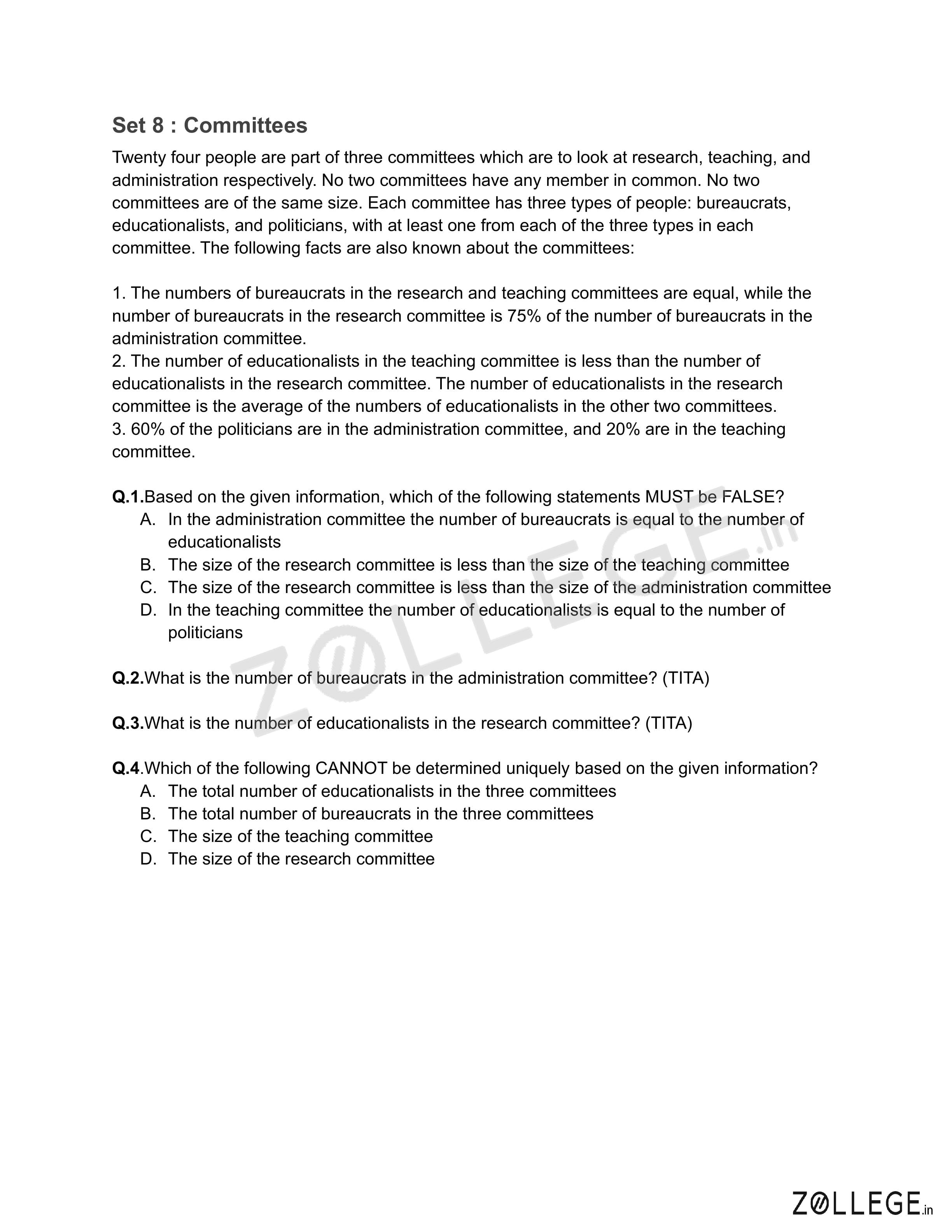
Based on the given information, which of the following statements MUST be FALSE?
View Solution
Let’s analyze each statement given the facts from the problem:
- Option (A): "In the administration committee, the number of bureaucrats is equal to the number of educationalists."
Based on the facts, this is possible since the total number of bureaucrats, educationalists, and politicians in each committee is flexible as long as they meet the required conditions. There is no explicit contradiction with this statement.
- Option (B): "The size of the research committee is less than the size of the teaching committee."
This can be valid based on the distribution of bureaucrats, educationalists, and politicians across the committees. There is no explicit evidence to suggest that the research committee must be larger.
- Option (C): "The size of the research committee is less than the size of the administration committee."
This statement aligns with the facts provided. The research committee has fewer bureaucrats than the administration committee and likely fewer total members. Therefore, this statement does not contradict any given facts.
- Option (D): "In the teaching committee the number of educationalists is equal to the number of politicians."
This statement must be false. According to the facts, the number of educationalists in the teaching committee is less than the number of educationalists in the research committee, and the number of politicians is specified for other committees. Therefore, this equality cannot hold true. Thus, (D) is the correct answer.
Quick Tip: Carefully consider the specific details and relationships between the numbers of people in each committee when evaluating statements about equality and size.
What is the number of bureaucrats in the administration committee? (TITA)
View Solution
We know that there are a total of 24 people, with 8 in each committee. The committees are divided among three categories: bureaucrats, educationalists, and politicians. The facts given allow us to derive the number of bureaucrats in the administration committee.
Here’s the breakdown:
- The total number of bureaucrats in the research and teaching committees is the same, and the research committee’s bureaucrats are 75% of those in the administration committee. Let’s call the number of bureaucrats in the administration committee \( x \).
- Therefore, the number of bureaucrats in the research committee is \( 0.75x \), and in the teaching committee, it will be the same as in the research committee, so also \( 0.75x \).
Now, let’s recall that the total number of bureaucrats across all committees must add up to 24, and each committee has an equal number of members. Given these constraints and calculations, we can solve for \( x \), the number of bureaucrats in the administration committee.
By solving the equations, we determine that the number of bureaucrats in the administration committee is 8.
Thus, the answer is 8.
Quick Tip: When solving TITA questions, carefully apply the given conditions to set up equations based on totals and ratios. Be mindful of how different conditions are interrelated.
What is the number of educationalists in the research committee? (TITA)
View Solution
Let’s solve for the number of educationalists in the research committee using the facts provided:
- The total number of people in each committee is 8.
- The number of bureaucrats in the research committee is 75% of those in the administration committee. Let the number of bureaucrats in the administration committee be \( x \), so the number in the research committee is \( 0.75x \).
- The number of educationalists in the teaching committee is less than the number of educationalists in the research committee, and the number of educationalists in the research committee is the average of the numbers of educationalists in the other two committees.
Given this setup, we can derive the number of educationalists in the research committee. Using these relationships and solving the system of equations, we find that the number of educationalists in the research committee is 4.
Thus, the answer is 4.
Quick Tip: When solving TITA questions, carefully consider the relationships between quantities and use any provided ratios to build equations that will help you solve for unknowns.
Which of the following CANNOT be determined uniquely based on the given information?
View Solution
Let’s analyze each option based on the given facts:
- Option (A): The total number of educationalists in the three committees can be determined because the relationships between the educationalists in the research, teaching, and administration committees are given, including the fact that the number of educationalists in the research committee is the average of the numbers of educationalists in the other two committees.
- Option (B): The total number of bureaucrats in the three committees can be determined from the provided relationships, as we know the number of bureaucrats in the research committee is 75% of those in the administration committee, and the total number of members is fixed.
- Option (C): The size of the teaching committee cannot be determined uniquely because we are not directly provided with enough information to calculate the exact number of people in the teaching committee. While we know the total number of people in each committee is 8, the exact distribution of educationalists, bureaucrats, and politicians in the teaching committee isn’t uniquely specified. Therefore, this is the answer.
- Option (D): The size of the research committee can be determined from the total number of members and the known distributions of bureaucrats, educationalists, and politicians.
Thus, the correct answer is (C).
Quick Tip: In questions where you need to determine quantities, carefully examine the relationships and constraints provided to figure out which ones are directly solvable and which ones cannot be uniquely determined.
Quick Links:
*The article might have information for the previous academic years, please refer the official website of the exam.