
CAT 2018 VARC Slot 2 Question Paper with Solution PDF
- Cut Off for IITs
- IIM Kashipur Cut Off
- IIM Amritsar Cut Off
- IIM Nagpur Cut Off
- IIM Indore Cut Off
- IIM Udaipur Cut Off
- IIM Ranchi Cut Off
- IIM Raipur Cut Off
- IIM Jammu Cut Off
- IIM Bodh Gaya Cut Off
- IIM Kozhikode Cut Off
- IIM Sambalpur Cut Off
- IIM Bangalore Cut Off
- IIM Sirmaur Cut Off
- IIM Trichy Cut Off
- IIM Visakhapatnam Cut Off
- IIM Lucknow Cut Off
- IIM Shillong Cut Off
- IIM Calcutta Cut Off
- IIM Ahmedabad Cut Off
- IIM Rohtak Cut Off


Content Writer | Updated On - Nov 28, 2025
CAT Question Papers are the most important study material for effective exam preparation. We at Zollege have provided all CAT Previous Year Papers with Solution PDFs here. CAT 2018 VARC exam was conducted successfully on November 25, 2018. Indian Institutes of Management (IIM) conducted the exam in the Slot 1. According to student reactions and expert reviews, the paper was reported to be moderate to difficult.
Students can freely download the CAT previous year question paper PDFs along with their solutions here. We strongly encourage CAT aspirants to scan through all the CAT Question Paper to know the overall difficulty level, CAT Syllabus and understand the changes in CAT Exam Pattern over the years.
Also Check:
CAT 2018 VARC Question Paper with Answer Key PDF (Slot 1)
| CAT 2018 VARC Question Paper with Answer Key | Download PDF | Check Solutions |

Question 1:
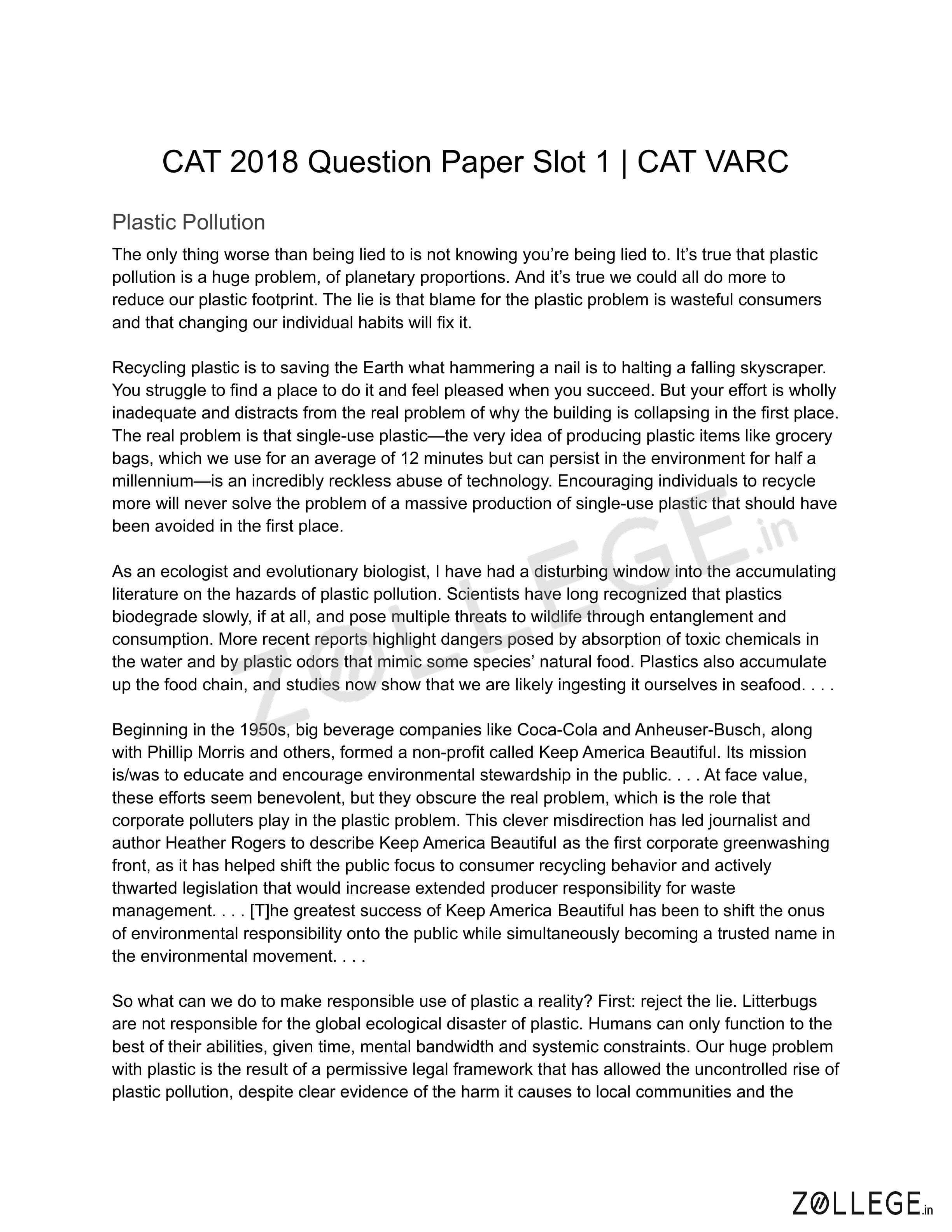
Plastic Pollution
The only thing worse than being lied to is not knowing you’re being lied to. It’s true that
plastic pollution is a huge problem, of planetary proportions. And it’s true we could all do
more to reduce our plastic footprint. The lie is that blame for the plastic problem is wasteful
consumers and that changing our individual habits will fix it.
Read More
Recycling plastic is to saving the Earth what hammering a nail is to halting a falling skyscraper.You struggle to find a place to do it and feel pleased when you succeed. But your effort is wholly
inadequate and distracts from the real problem of why the building is collapsing in the first
place. The real problem is that single-use plastic—the very idea of producing plastic items like
grocery bags, which we use for an average of 12 minutes but can persist in the environment
for half a millennium—is an incredibly reckless abuse of technology. Encouraging individuals
to recycle more will never solve the problem of a massive production of single-use plastic that
should have been avoided in the first place.
As an ecologist and evolutionary biologist, I have had a disturbing window into the accumulat-
ing literature on the hazards of plastic pollution. Scientists have long recognized that plastics
biodegrade slowly, if at all, and pose multiple threats to wildlife through entanglement and
consumption. More recent reports highlight dangers posed by absorption of toxic chemicals in
the water and by plastic odors that mimic some species’ natural food. Plastics also accumulate
up the food chain, and studies now show that we are likely ingesting it ourselves in seafood. .
. .
Beginning in the 1950s, big beverage companies like Coca-Cola and Anheuser-Busch, along
with Phillip Morris and others, formed a non-profit called Keep America Beautiful. Its mission
is/was to educate and encourage environmental stewardship in the public. . . . At face value,
these efforts seem benevolent, but they obscure the real problem, which is the role that corpo-
rate polluters play in the plastic problem. This clever misdirection has led journalist and author
Heather Rogers to describe Keep America Beautiful as the first corporate greenwashing front,
as it has helped shift the public focus to consumer recycling behavior and actively thwarted
legislation that would increase extended producer responsibility for waste management. . . .
[T]he greatest success of Keep America Beautiful has been to shift the onus of environmental
responsibility onto the public while simultaneously becoming a trusted name in the environ-
mental movement. . . .
So what can we do to make resolve use of plastic a reality? First: reject the lie. Litterbugs
are not responsible for the global ecological disaster of plastic. Humans can only function to
the best of their abilities, given time, mental bandwidth and systemic constraints. Our huge
problem demands the establishment of a permissive legal framework that has solved the causes
of plastic pollution, despite clear evidence of the harm it causes to local communities and the
world’s oceans. Recycling is also too hard in most parts of the U.S. and lacks the proper in-
centives to make it work well.
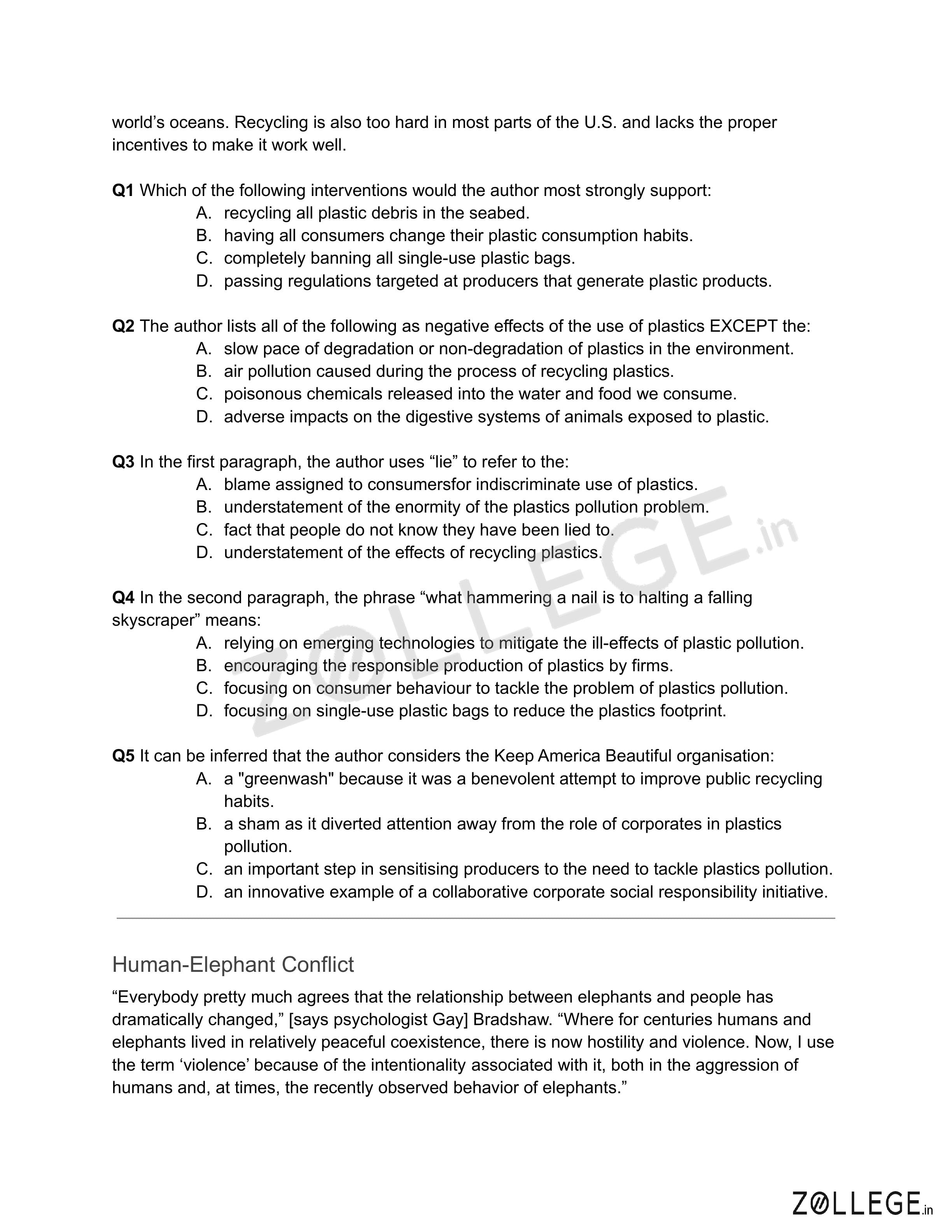
Which of the following interventions would the author most strongly support?
View Solution
The author emphasizes that the root cause of plastic pollution lies in the systemic overproduction of single-use plastics and the corporate strategies that shift responsibility onto consumers. He explicitly rejects the idea that individual behavior change or recycling efforts alone can solve the crisis, calling them distractions from the real issue. Instead, he stresses the need for a “permissive legal framework” and criticizes how corporations have “thwarted legislation” aimed at increasing extended producer responsibility. Hence, the author would most strongly support regulations on producers, as this addresses the problem at its source. Options (A) and (B) fail because they represent downstream or consumer-centered solutions, which the author considers inadequate. Option (C), while partially aligned with his criticism of single-use plastics, is too narrow, as his stance is for broader systemic reforms rather than isolated bans. Therefore, option (D) is the best supported by the passage. Quick Tip: Always distinguish between symptom-focused measures (like cleanup or recycling) and root-cause solutions (like producer responsibility and systemic reform) when answering inference questions in RC passages.
The author lists all of the following as negative effects of the use of plastics EXCEPT the:
View Solution
The passage mentions several harmful effects of plastics. First, it states that plastics degrade very slowly, if at all, and remain in the environment for centuries, which matches option (A). Second, it highlights that plastics absorb toxic chemicals from water and that these toxins make their way into the food chain, which supports option (C). Third, it describes how plastics threaten wildlife through entanglement and ingestion, leading to adverse effects on animals' digestive systems, which supports option (D). However, the passage does not mention air pollution caused by recycling plastics. Therefore, option (B) is the correct answer, as it is not discussed in the text. Quick Tip: In EXCEPT questions, carefully identify what is explicitly mentioned in the passage. Eliminate the options supported by the text and choose the one that is not referred to.
In the first paragraph, the author uses "lie" to refer to the:
View Solution
In the very first paragraph, the author acknowledges two truths: that plastic pollution is a major global problem, and that individuals could indeed do more to reduce their plastic footprint. However, the author then highlights the "lie"—the belief that consumers are mainly responsible for the plastic problem and that changing individual habits will be sufficient to solve it. This indicates that the falsehood lies not in the severity of the issue (which is fully acknowledged), nor in the ineffectiveness of recycling (though later criticized), but in wrongly shifting responsibility from producers and corporations to consumers. Thus, option (A) correctly captures the meaning of the "lie." Option (B) is incorrect because the author does not claim the problem is understated; rather, its scale is acknowledged. Option (C) misinterprets the statement—the issue is not ignorance about being lied to, but the specific false narrative. Option (D) is also incorrect because while recycling is deemed insufficient, it is not described as the "lie." Therefore, the right answer is (A).
Quick Tip: When interpreting metaphors like "lie" in RC passages, always connect them to the broader argument. Focus on what the author is challenging rather than taking the word literally.
In the second paragraph, the phrase "what hammering a nail is to halting a falling skyscraper" means:
View Solution
In the second paragraph, the author compares recycling efforts to hammering a nail in an attempt to stop a skyscraper from collapsing. This metaphor illustrates how small and ineffective consumer actions like recycling are when compared to the enormous scale of the plastic pollution problem. The author emphasizes that such efforts make individuals feel satisfied, but they do not address the root cause, which is the large-scale production of single-use plastics. Option (C) directly captures this idea: focusing on consumer behaviour, such as recycling or minor habit changes, is inadequate to solve the crisis. Option (A) is irrelevant, as the author does not discuss technological solutions here. Option (B) is the systemic solution the author actually supports, but it is not what the metaphor explains. Option (D) is too narrow, as the metaphor addresses the broader issue of consumer-focused approaches, not just single-use bags. Thus, the correct answer is (C). Quick Tip: When you see analogies or metaphors in RC passages, ask: what is being compared, and what does it reveal about the author’s stance? Usually, the weaker element highlights inadequacy, and the stronger element highlights the scale of the problem.
It can be inferred that the author considers the Keep America Beautiful organisation:
View Solution
The passage describes Keep America Beautiful as the "first corporate greenwashing front," highlighting how it successfully shifted responsibility for plastic pollution onto consumers while obscuring the culpability of corporations. Although the organisation promoted environmental stewardship on the surface, the author argues that its real agenda was to prevent legislation that would increase corporate accountability, particularly through extended producer responsibility. This shows that the group’s success lay in misdirection—portraying consumers as the problem and positioning itself as a trusted environmental body while protecting corporate interests. Option (B) captures this criticism perfectly. Option (A) is incorrect because while the organisation was labelled a "greenwash," the reason is not that it benevolently improved recycling habits but that it deliberately misled. Option (C) is wrong because there is no indication that producers were sensitised; rather, they were shielded. Option (D) is also inaccurate as the author clearly views it as manipulative, not innovative. Therefore, option (B) is the correct inference.
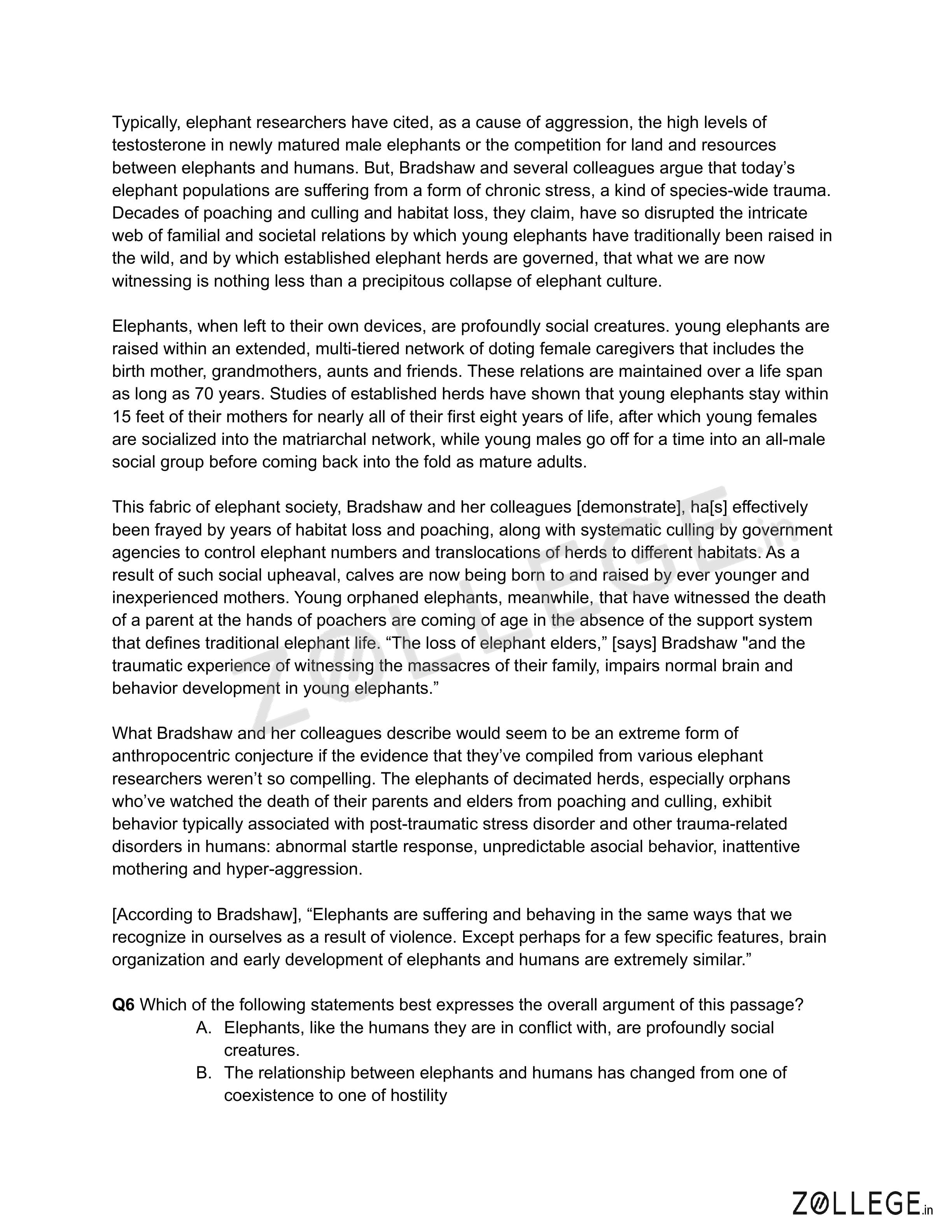
Human-Elephant Conflict
”Everybody pretty much agrees that the relationship between elephants and people has dramat-
ically changed,” [says psychologist Gay] Bradshaw. ”Where for centuries humans and elephants
lived in relatively peaceful coexistence, there is now hostility and violence. Now, I use the term
’violence’ because of the intentionality associated with it, both in the aggression of humans
and, at times, the recently observed behavior of elephants.”
Read More
Typically, elephant researchers have cited, as a cause of aggression, the high levels of testos-terone in newly matured male elephants or the competition for land and resources between
elephants and humans. But, Bradshaw and several colleagues argue that today’s elephant pop-
ulations are suffering from a form of chronic stress, a kind of species-wide trauma. Decades
of poaching and culling and habitat loss, they claim, have so disrupted the intricate web of
familial and societal relations by which young elephants have traditionally been raised in the
wild, and by which established elephant herds are governed, that what we are now witnessing
is nothing less than a precipitous collapse of elephant culture.
Elephants, when left to their own devices, are profoundly social creatures. young elephants are
raised within an extended, multi-tiered network of doting female caregivers that includes the
birth mother, grandmothers, aunts and friends. These relations are maintained over a life span
as long as 70 years. Studies of established herds have shown that young elephants stay within
15 feet of their mothers for nearly all of their first eight years of life, after which young females
are socialized into the matriarchal network, while young males go off for a time into an all-male
social group before coming back into the fold as mature adults.
This fabric of elephant society, Bradshaw and her colleagues [demonstrate], ha[s] effectively
been frayed by years of habitat loss and poaching, along with systematic culling by government
agencies to control elephant numbers and translocations of herds to different habitats. As a
result of such social upheaval, calves are now being born to and raised by ever younger and
inexperienced mothers. Young orphaned elephants, meanwhile, that have witnessed the death
of a parent at the hands of poachers are coming of age in the absence of the support system
that defines traditional elephant life. ”The loss of elephant elders,” [says] Bradshaw ”and the
traumatic experience of witnessing the massacres of their family, impairs normal brain and
behavior development in young elephants.”
What Bradshaw and her colleagues describe would seem to be an extreme form of anthropocen-
tric conjecture if the evidence that they’ve compiled from various elephant researchers weren’t
so compelling. The elephants of decimated herds, especially orphans who’ve watched the death
of their parents and elders from poaching and culling, exhibit behavior typically associated
with post-traumatic stress disorder and other trauma-related disorders in humans: abnormal
startle response, unpredictable asocial behavior, inattentive mothering and hyper-aggression.
[According to Bradshaw], ”Elephants are suffering and behaving in the same ways that we
recognize in ourselves as a result of violence. Except perhaps for a few specific features, brain
organization and early development of elephants and humans are extremely similar.”
Which of the following statements best expresses the overall argument of this passage?
% Correct Answer \textbf{Correct Answer:} (B) The relationship between elephants and humans has changed from one of coexistence to one of hostility.
View Solution
The passage opens by noting that the long-standing coexistence between elephants and humans has given way to hostility and violence. The rest of the passage explains the reasons for this shift, including poaching, culling, habitat loss, and the resulting collapse of elephant social structures. While the discussion of trauma, social organisation, and similarities to humans (options A, C, and D) provides supporting evidence, these are not the main argument but rather details used to illustrate the underlying change in human-elephant relations. The central thrust is that human actions have fundamentally altered this relationship, leading to aggression and conflict. Therefore, option (B) captures the overall argument most accurately. Option (A) is only a description of elephant sociality. Option (C) highlights an important point about trauma but narrows the scope to behaviour rather than the overarching human-elephant relationship. Option (D) is a fact mentioned at the end but not the central message. Thus, (B) is correct. Quick Tip: When asked about the “overall argument,” distinguish between supporting details and the central claim. Supporting evidence may be striking, but the right answer will summarize the full passage’s main point.
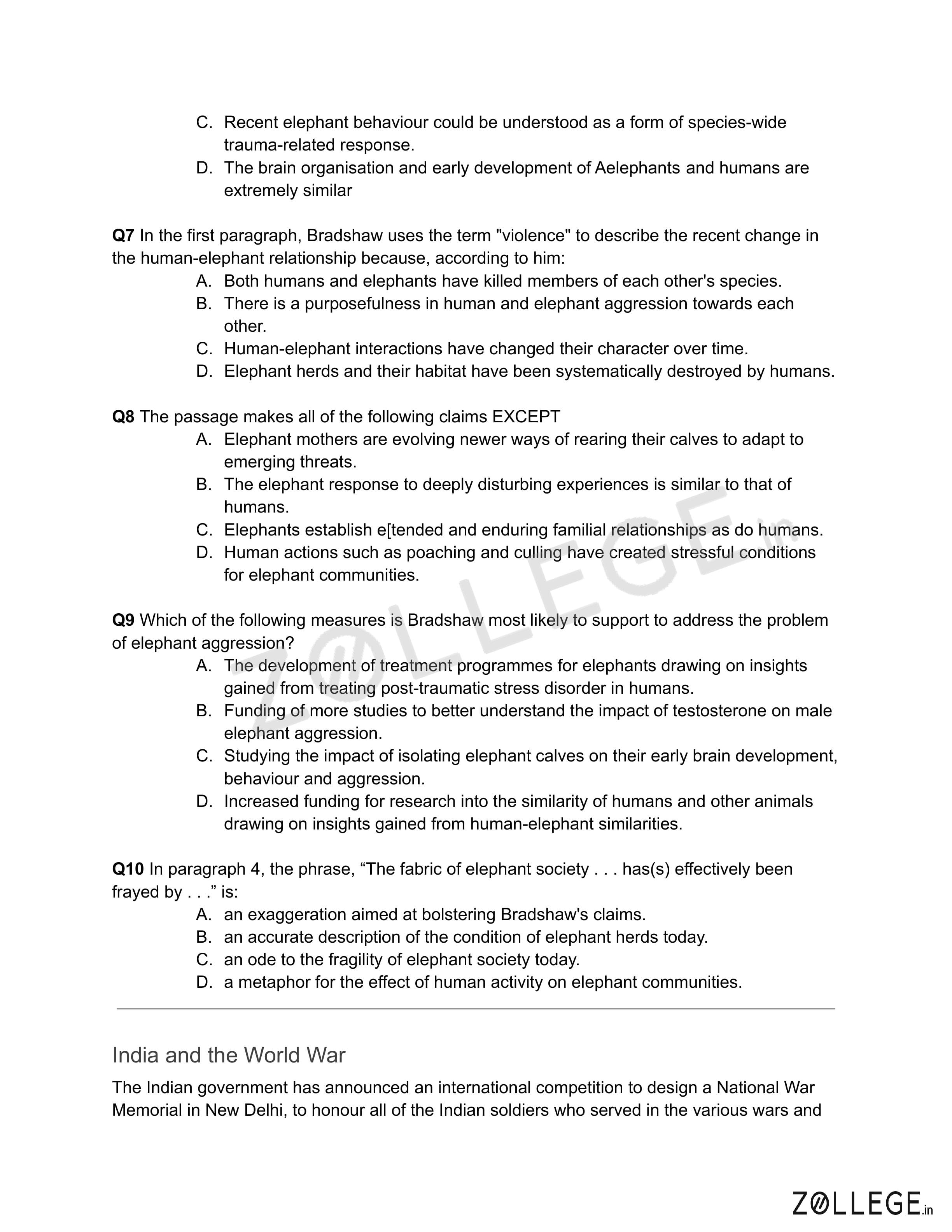
In the first paragraph, Bradshaw uses the term "violence" to describe the recent change in the human-elephant relationship because, according to him:
View Solution
In the opening paragraph, Bradshaw observes that for centuries humans and elephants coexisted relatively peacefully, but now this relationship has turned hostile. He uses the term "violence" because of the intentionality behind the aggression shown by both humans and elephants in their interactions. While option (B) highlights intentionality, it misses the broader point that the change is in the very nature and character of the relationship—from coexistence to hostility. Option (A) is too narrow since Bradshaw is not simply referring to killings but to a larger transformation in behaviour. Option (D) refers to destruction of habitat, which is a cause of stress and trauma but not the reason why he specifically uses the term "violence." Hence, option (C) best captures Bradshaw’s reasoning, as it reflects the shift in the fundamental nature of interactions over time. Quick Tip: When interpreting why a specific term is used in RC, focus on the context in which it is introduced. The correct option will capture the broader transformation or meaning, not just a single detail.
The passage makes all of the following claims EXCEPT
View Solution
The question asks us to identify the option that is NOT claimed in the passage. This is a classic CAT “EXCEPT” question, where three statements are directly supported by the passage, and one is not.
- Option (B): The passage explicitly states that elephants display emotional responses, trauma, and stress patterns similar to humans. Hence, this claim is made.
- Option (C): The passage mentions that elephants form lasting social bonds, extended family networks, and care for each other like humans do. Therefore, this is clearly stated.
- Option (D): The passage directly links human activities such as poaching and culling to severe stress in elephant communities. This claim is explicitly made.
- Option (A): Nowhere in the passage is there any mention of elephant mothers *evolving newer methods of rearing calves*. The passage speaks about trauma, stress, and social bonds, but not about evolutionary changes in maternal behavior. Hence, this is the claim NOT made in the passage.
Therefore, the correct answer is (A).
Quick Tip: In CAT “EXCEPT” questions, eliminate the options directly mentioned in the passage first. The one option that cannot be traced back to the text is the correct answer. Always double-check for extreme or added words like "evolving" or "newer ways," which may not be present in the passage.
Which of the following measures is Bradshaw most likely to support to address the problem of elephant aggression?
View Solution
The passage highlights Bradshaw’s view that elephant aggression arises from trauma caused by human actions (such as culling, poaching, and habitat destruction). She draws parallels between the psychological trauma experienced by elephants and post-traumatic stress disorder (PTSD) in humans. Hence, the most logical solution she would support is to develop treatment programmes for elephants based on insights from treating PTSD in humans.
Option (B) is incorrect as the focus is not on hormonal imbalance (testosterone) but on psychological trauma.
Option (C) is incorrect since Bradshaw is not advocating for new studies on calves, but treatment for traumatized elephants.
Option (D) is incorrect as while similarities between humans and elephants are acknowledged, Bradshaw’s emphasis is on therapeutic measures, not just more research.
Thus, option (A) aligns directly with her perspective.
Quick Tip: In CAT Reading Comprehension, always link the author’s main argument or solution in the passage to the most relevant option—avoid choosing answers that just suggest more research unless the passage emphasizes it.
In paragraph 4, the phrase, “The fabric of elephant society . . . has(s) effectively been frayed by . . .” is:
View Solution
The phrase "The fabric of elephant society has effectively been frayed" refers to the disruption of the natural order within elephant communities due to human actions such as poaching, culling, and habitat loss. This is a metaphor, suggesting that the social structure and stability of elephant societies have been torn apart due to human interference. This metaphor highlights the fragile nature of elephant societies, which once functioned harmoniously but are now under stress due to human actions. Option (D) best captures this idea.
- Option (A) is incorrect because while the phrase is impactful, it is not an exaggeration; it accurately describes the impact of human actions on elephant societies.
- Option (B) might be partially true, but the phrase does not provide a direct description of current elephant herds in general; instead, it metaphorically addresses the effects of human disruption.
- Option (C) is a tempting option, but the phrase uses a metaphor to indicate a breakdown in elephant society, rather than offering an artistic or poetic expression of fragility.
Quick Tip: Metaphors often use vivid language to describe a situation in more symbolic terms. Here, the "fraying fabric" symbolizes the breakdown of social structures in elephants due to human activities.
India and the World War
The Indian government has announced an international competition to design a National War
Memorial in New Delhi, to honour all of the Indian soldiers who served in the various wars and
counter-insurgency campaigns from 1947 onwards. The terms of the competition also speci-
fied that the new structure would be built adjacent to the India Gate – a memorial to the
Indian soldiers who died in the First World War. Between the old imperialist memorial and
the proposed nationalist one, India’s contribution to the Second World War is airbrushed out
of existence.
Read More
The Indian government’s conception of the war memorial was not merely absentminded. Rather,it accurately reflected the fact that both academic history and popular memory have yet to come
to terms with India’s Second World War, which continues to be seen as little more than mood
music in the drama of India’s advance towards independence and partition in 1947. Further,
the political trajectory of the postwar subcontinent has militated against popular remembrance
of the war. With partition and the onset of the India-Pakistan rivalry, both of the new nations
needed fresh stories for self-legitimisation rather than focusing on shared wartime experiences.
However, the Second World War played a crucial role in both the independence and partition
of India. The Indian army recruited, trained and deployed some 2.5 million men, almost 90,000
of which were killed and many more injured. Even at the time, it was recognised as the largest
volunteer force in the war.
India’s material and financial contribution to the war was equally significant. India emerged as
a major military-industrial and logistical base for Allied operations in south-east Asia and the
Middle East. This led the United States to take considerable interest in the country’s future,
and ensured that this was no longer the preserve of the British government. Other wartime
developments pointed in the direction of India’s independence. In a stunning reversal of its
long-standing financial relationship with Britain, India finished the war as one of the largest
creditors to the imperial power.
Such extraordinary mobilization for war was achieved at great human cost, with the Bengal
famine the most extreme manifestation of widespread wartime deprivation. The costs on In-
dia’s home front must be counted in millions of lives.
Indians signed up to serve on the war and home fronts for a variety of reasons. Many were
convinced that their contribution would open the doors to India’s freedom. The political and
social churn triggered by the war was evident in the massive waves of popular protest and
unrest that washed over rural and urban India in the aftermath of the conflict. This turmoil
was crucial in persuading the Attlee government to rid itself of the incubus of ruling India.
Seventy years on, it is time that India engaged with the complex legacies of the Second World
War. Bringing the war into the ambit of the new national memorial would be a fitting – if not
overdue – recognition that this was India’s War
In the first paragraph, the author laments the fact that
View Solution
The first paragraph of the passage highlights a central issue: the lack of recognition of India's contribution to the Second World War. The author laments that while a new war memorial is being constructed, it does not acknowledge the significant role Indian soldiers played in the war. The new memorial will honor the soldiers who died in the First World War but fails to recognize the Indian soldiers who served in the Second World War, which is central to the author’s frustration. Thus, the correct answer is (B).
- Option (A), though the location of the new memorial is noted, does not align with the author’s main complaint. The concern is not about the memorial's proximity to the India Gate, but about its focus on the First World War while overlooking the Second.
- Option (C) refers to concerns about the funds spent on constructing another war memorial, but the author's primary frustration stems from the lack of recognition for the soldiers of the Second World War, not merely the expenditure of resources.
- Option (D), while India did lose thousands of lives during the Second World War, this is a tragic fact but does not reflect the central lament in the first paragraph. The passage stresses the omission of India’s involvement in the Second World War, not the loss of life itself.
Quick Tip: Pay close attention to the core argument of each paragraph. The first paragraph primarily focuses on the absence of recognition for Indian soldiers who fought in the Second World War, which is central to the author’s lament.
The author lists all of the following as outcomes of the Second World War EXCEPT:
View Solution
The passage highlights the various outcomes and consequences of India's involvement in the Second World War. It mentions several significant points, including the recognition of India’s strategic importance by the US, the devastating famine in Bengal, and the direct link between India’s contribution in the war and the eventual independence and partition of India. However, the passage does not mention the large financial debt India owed to Britain after the war, making Option (D) the correct answer.
- Option (A) is true, as the passage notes that the United States recognized India’s importance in terms of its strategic location and role in the war, which increased their interest in India’s future.
- Option (B) refers to the Bengal famine, which was a direct consequence of the war and the immense deprivation caused by wartime policies. The passage makes it clear that the costs on India’s home front, especially in terms of famine, were devastating.
- Option (C) is also correct, as the passage specifically discusses how the Second World War played a significant role in India’s independence and the subsequent partition into two countries, marking a pivotal moment in Indian history.
Quick Tip: Look for the details mentioned explicitly in the passage. Focus on what is discussed regarding India’s contributions, the war’s impact, and how these shaped India’s future, while eliminating options that are not referenced.
The phrase “mood music” is used in the second paragraph to indicate that the Second World War is viewed as:
View Solution
The term "mood music" in this context refers to how the Second World War is often treated in Indian historical memory. The phrase implies that the war is not given due importance on its own, but instead is seen as a backdrop or setting for the more prominent events that followed, such as the independence and partition of India. The author suggests that the war is often overlooked or overshadowed by the national struggle for independence. Hence, Option (B) is the most fitting choice.
- Option (A) is incorrect because while the India-Pakistan rivalry is a significant consequence of partition, it does not directly relate to how the war is framed as "mood music." The war's connection to partition is more complex and involves both historical and political contexts.
- Option (C) misinterprets the phrase as indicating the war as part of a narrative about colonial rule's ill-effects. The passage suggests that while colonial rule had negative effects, the war is seen as more peripheral to these discussions.
- Option (D) could be argued as a secondary aspect of the war, but it is not the central theme in the passage. The focus is on the war being less recognized and treated more as a background to other developments like independence.
Quick Tip: Look for how phrases like “mood music” reflect a secondary role in the passage. Here, the war is not the primary focus but rather a background element to larger political changes like independence and partition.
The author suggests that a major reason why India has not so far acknowledged its role in the Second World War is that:
View Solution
In the passage, the author highlights that the memory of the Second World War in India is overshadowed by the drive for independence and the post-colonial identity that India sought to build after the war. The author suggests that one of the primary reasons for the lack of recognition of India’s contribution to the war is that the focus has been on distancing the country from its colonial past and emphasizing an independent national identity. This is best reflected in Option (B).
- Option (A) is incorrect because, while the war was costly, the focus on forgetting the toll does not directly explain why India has not acknowledged its role. The political need for independence and rejecting colonial ties is a stronger motivator.
- Option (C) is partially true, but the emphasis in the passage is more on the nationalist focus post-independence, rather than India’s role being overshadowed by a global perspective on the Allied efforts. The role India played is significant but politically minimized.
- Option (D) may be a part of the broader conversation, but the partition is not the sole reason for the lack of recognition. The author primarily points to India’s desire to solidify a non-colonial, independent identity.
Quick Tip: When interpreting why something is overlooked, focus on the political and identity-related motivations. In this case, India's post-independence focus on non-colonial identity led to the neglect of the war’s significance.
The author claims that omitting mention of Indians who served in the Second World War from the new National War Memorial is:
View Solution
The author suggests that the omission of Indian soldiers from the new National War Memorial is an oversight that could be rectified by constructing a separate memorial specifically dedicated to India’s contribution in the Second World War. This is evident in the passage, where the author calls for the inclusion of India’s role in the new memorial or the creation of a new one to rectify this historical oversight. Option (D) directly reflects this suggestion.
- Option (A) could be true in some sense, but it does not reflect the author's primary argument about rectifying the issue through a separate memorial. The focus is more on the lack of recognition, not on the misplaced priorities.
- Option (B) is not the correct interpretation, as the passage discusses the lack of recognition rather than reflecting the popular and academic view, which often minimizes India’s role.
- Option (C) is incorrect because the author does not suggest that the India Gate memorial is the appropriate place for such recognition. The proposal is for a separate memorial.
Quick Tip: Pay attention to how the author proposes to address the issue raised in the question. In this case, the solution offered is the creation of a separate memorial, not the inclusion of names in the existing one.
Question 16:
Economy and Happiness
Economists have spent most of the 20th century ignoring psychology, positive or otherwise. But
today there is a great deal of emphasis on how happiness can shape global economies, or - on a
smaller scale - successful business practice. This is driven, in part, by a trend in ”measuring”
positive emotions, mostly so they can be optimized. Neuroscientists, for example, claim to
be able to locate specific emotions, such as happiness or disappointment, in particular areas of
the brain. Wearable technologies, such as Spire, offer data-driven advice on how to reduce stress.
We are no longer just dealing with ”happiness” in a philosophical or romantic sense - it has
become something that can be monitored and measured, including by our behavior, use of
social media and bodily indicators such as pulse rate and facial expressions. There is nothing
automatically sinister about this trend. But it is disquieting that the businesses and experts
driving the quantification of happiness claim to have our best interests at heart, often concealing
their own agendas in the process. In the workplace, happy workers are viewed as a ”win-win.”
Work becomes more pleasant, and employees, more productive. But this is now being pursued
through the use of performance-evaluating wearable technology, such as Humanyze or Virgin
Pulse, both of which monitor physical signs of stress and activity toward the goal of increasing
productivity.
Read More
Cities such as Dubai, which has pledged to become the ”happiest city in the world,” dream upever-more elaborate and intrusive ways of collecting data on well-being - to the point where
there is now talk of using CCTV cameras to monitor facial expressions in public spaces. New
ways of detecting emotions are hitting the market all the time: One company, Beyond Verbal,
aims to calculate moods conveyed in a phone conversation, potentially without the knowledge
of at least one of the participants. And Facebook [has] demonstrated that it could influence
our emotions through tweaking our news feeds - opening the door to ever-more targeted ma-
nipulation in advertising and influence.
As the science grows more sophisticated and technologies become more intimate with our
thoughts and bodies, a clear trend is emerging. Where happiness indicators were once used
as a basis to reform society, challenging the obsession with money that G.D.P. measurement
entrenches, they are increasingly used as a basis to transform or discipline individuals.
Happiness becomes a personal project, that each of us must now work on, like going to the
gym. Since the 1970s, depression has come to be viewed as a cognitive or neurological defect
in the individual, and never a consequence of circumstances. All of this simply escalates the
sense of responsibility each of us feels for our own feelings, and with it, the sense of failure
when things go badly. A society that deliberately removed certain sources of misery, such as
precarious and exploitative employment, may well be a happier one. But we won’t get there
by making this single, often fleeting emotion, the over-arching goal.
According to the author, wearable technologies and social media are contributing most to:
View Solution
The author points out how happiness is no longer just a philosophical concept or a mere emotional state but is now perceived as something individuals need to work on and "manage." The rise of wearable technologies and the increased use of social media have amplified this view by allowing individuals to track and optimize their happiness, turning it into a personal project much like working out at the gym. The correct answer, therefore, is (A).
- Option (B) is incorrect because the author does not state that depression is a thing of the past. In fact, the passage suggests that depression is still viewed as a personal failing but has become more of an individual concern, not a thing of the past.
- Option (C) is not entirely accurate. While the passage mentions how happiness is increasingly treated as a responsibility, it doesn’t emphasize disciplining individuals. Rather, it focuses on the idea that happiness is being optimized and managed with the help of new technologies.
- Option (D) partially relates to the content but is not the central focus. While wearable devices do make people aware of stress, this is only one element of the broader conversation about how happiness is treated as a personal project to be optimized.
Quick Tip: Focus on the way the author describes happiness as a "personal project." This is the crux of how modern technologies and social media influence our perception of happiness.
The author’s view would be undermined by which of the following research findings?
View Solution
The author emphasizes how the collection of emotional and well-being data through wearable technologies and social media has become a dominant trend. This growing trend suggests that people are more in control of monitoring their happiness and well-being. If research were to indicate that stakeholders are moving away from collecting such data, it would directly contradict the author’s argument. Option (B) would undermine the author’s claim because it suggests a shift away from this trend, which is central to the passage.
- Option (A) is supportive of the author’s argument. The author discusses how wearable technology is increasingly adopted to measure emotions, which aligns with the statement in Option (A).
- Option (C) is related to the broader theme of tracking well-being. The proliferation of gyms that collect data on customer well-being supports the author's idea of using technology to manage happiness and health.
- Option (D) also supports the author’s viewpoint, as individuals worldwide using technologies to monitor and increase their well-being shows the increasing integration of technology in our emotional lives, in line with the author’s argument.
Quick Tip: When assessing options, pay attention to shifts in trends. A finding that goes against the emerging trend of data collection on well-being would directly undermine the author's argument.
According to the author, Dubai:
View Solution
The author specifically mentions that Dubai has pledged to become the "happiest city in the world," which involves implementing increasingly sophisticated and sometimes intrusive technologies to monitor and influence the well-being of its residents. This is the central theme of Option (A). Dubai’s ambition is to collect data on happiness and well-being to improve its citizens' lives and establish itself as the happiest city.
- Option (B) is incorrect because although Facebook’s role in influencing emotions is discussed, the passage does not claim that Dubai collaborates with Facebook specifically for this purpose. The focus is on Dubai’s own initiatives.
- Option (C) is partially correct in that Dubai uses sophisticated technologies to monitor well-being, but the author focuses more on Dubai's ambition to become the happiest city, rather than the specifics of technology development.
- Option (D) is not discussed in the passage. While the focus is on data collection for happiness and well-being, there is no mention of Dubai incentivizing companies for worker welfare.
Quick Tip: Look for specific references to cities, goals, and technological initiatives in the passage. Dubai’s focus is on collecting data to improve happiness, which directly correlates with its ambition to become the "happiest city."
In the author's opinion, the shift in thinking in the 1970s:
View Solution
The author points out that the shift in thinking in the 1970s, where depression was increasingly viewed as a personal responsibility rather than a result of external circumstances, introduced greater stress into people’s lives. This shift held individuals accountable for their emotional state, putting more pressure on them to manage their own happiness, hence leading to more stress. Therefore, Option (B) is correct.
- Option (A) is incorrect because while the 1970s shift is noted, the author does not view it as a "welcome change." Rather, the passage critiques the shift for placing undue responsibility on individuals.
- Option (C) is incorrect because the author does not state that the 1970s shift "put people in touch with their own feelings," but rather emphasizes the stress caused by personal responsibility for happiness.
- Option (D) is a separate issue. The author does mention neuroscience’s role, but it’s not linked directly to the 1970s shift. The focus is more on the individual responsibility aspect.
Quick Tip: Look for key words like “responsibility” and “stress” in the passage. The author emphasizes how the shift in the 1970s introduced personal accountability for happiness, leading to more pressure on individuals.
From the passage we can infer that the author would like economists to:
View Solution
The author discusses the increasing role of neuroscience and psychology in shaping economics, particularly how emotional states are quantified and factored into business and economic models. The author seems to suggest that economists should work closely with neuroscientists to better understand human behavior and its impact on economics. This aligns with Option (D).
- Option (A) is incorrect because while the author advocates for incorporating psychological findings, the passage does not emphasize a cautious approach but rather a more active collaboration with other fields, particularly neuroscience.
- Option (B) is not the central idea of the passage. The author discusses emotional measurement, but it is framed more as an individual project (personal responsibility) than as a correlation with economic indicators.
- Option (C) is unrelated to the author’s primary focus, which is on understanding and utilizing psychology and neuroscience to shape economics. The passage does not suggest measuring social media effectiveness as a priority for economists.
Quick Tip: Focus on how the author frames the relationship between economics and other fields. The collaboration with neuroscientists, not just incorporating psychology, is highlighted as crucial to understanding human behavior in economics.
Acquired Characteristics
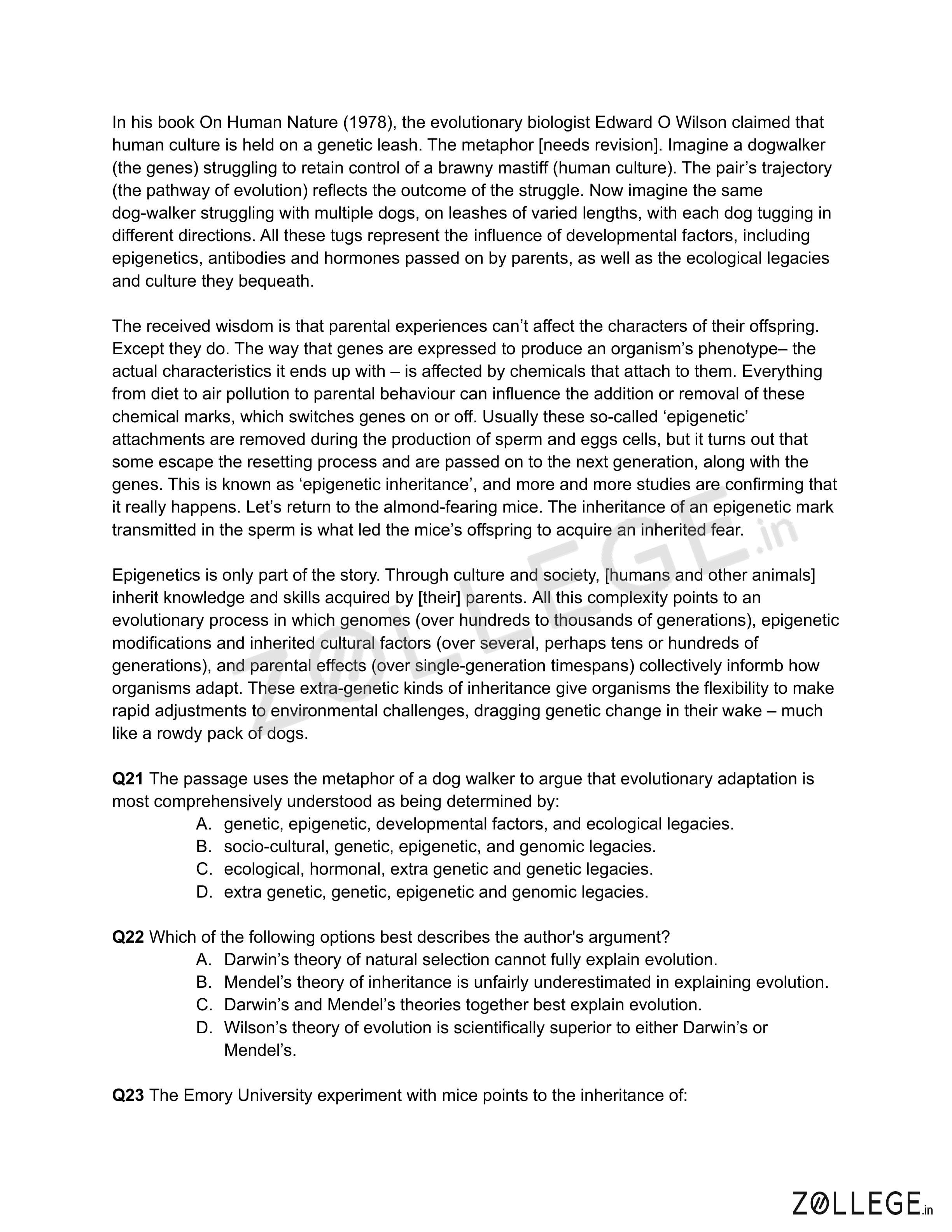
When researchers at Emory University in Atlanta trained mice to fear the smell of almonds (by
pairing it with electric shocks), they found, to their consternation, that both the children and
grandchildren of these mice were spontaneously afraid of the same smell. That is not supposed
to happen. Generations of schoolchildren have been taught that the inheritance of acquired
characteristics is impossible. A mouse should not be born with something its parents have
learned during their lifetimes, any more than a mouse that loses its tail in an accident should
give birth to tailless mice.
Read More
Modern evolutionary biology dates back to a synthesis that emerged around the 1940s–60s,which married Charles Darwin’s mechanism of natural selection with Gregor Mendel’s discov-
eries of how genes are inherited. The traditional, and still dominant, view is that adaptations
– from the human brain to the peacock’s tail – are fully and satisfactorily explained by natu-
ral selection (and subsequent inheritance). Yet [new evidence] from genomics, epigenetics and
developmental biology [indicates] that evolution is more complex than we once assumed.
In his book On Human Nature (1978), the evolutionary biologist Edward O. Wilson claimed
that human culture is held on a genetic leash. The metaphor [needs revision]. Imagine a
dogwalker (the genes) struggling to retain control of a brawny mastiff (human culture). The
pair’s trajectory (the pathway of evolution) reflects the outcome of the struggle. Now imagine
the same dog-walker struggling with multiple dogs, on leashes of varied lengths, with each dog
tugging in different directions. All these tugs represent the influence of developmental factors,
including epigenetics, antibodies and hormones passed on by parents, as well as the ecological
legacies and culture they bequeath.
The received wisdom is that parental experiences can’t affect the characters of their offspring.
Except they do. The way that genes are expressed to produce an organism’s phenotype—the
actual characteristics it ends up with—is affected by chemicals that attach to them. Every-
thing from diet to air pollution to parental behavior can influence the addition or removal
of these chemical marks, which switches genes on or off. Usually these so-called ‘epigenetic’
attachments are removed during the production of sperm and eggs cells, but it turns out that
some escape the resetting process and are passed on to the next generation, along with the
genes. This is known as ‘epigenetic inheritance’, and more and more studies are confirming
that it really happens. Let’s return to the almond-fearing mice. The inheritance of an epige-
netic mark transmitted in the sperm is what led the mice’s offspring to acquire an inherited fear.
Epigenetics is only part of the story. Through culture and society, [humans and other ani-
mals] inherit knowledge and skills acquired by [their] parents. All this complexity points to
an evolutionary process in which genomes (over hundreds to thousands of generations), epi-
genetic modifications and inherited cultural factors (over several, perhaps tens or hundreds of
generations), and parental effects (over single-generation timespans) collectively inform how or-
ganisms adapt. These extra-genetic kinds of inheritance give organisms the flexibility to make
rapid adjustments to environmental challenges, dragging genetic change in their wake – much
like a rowdy pack of dogs.
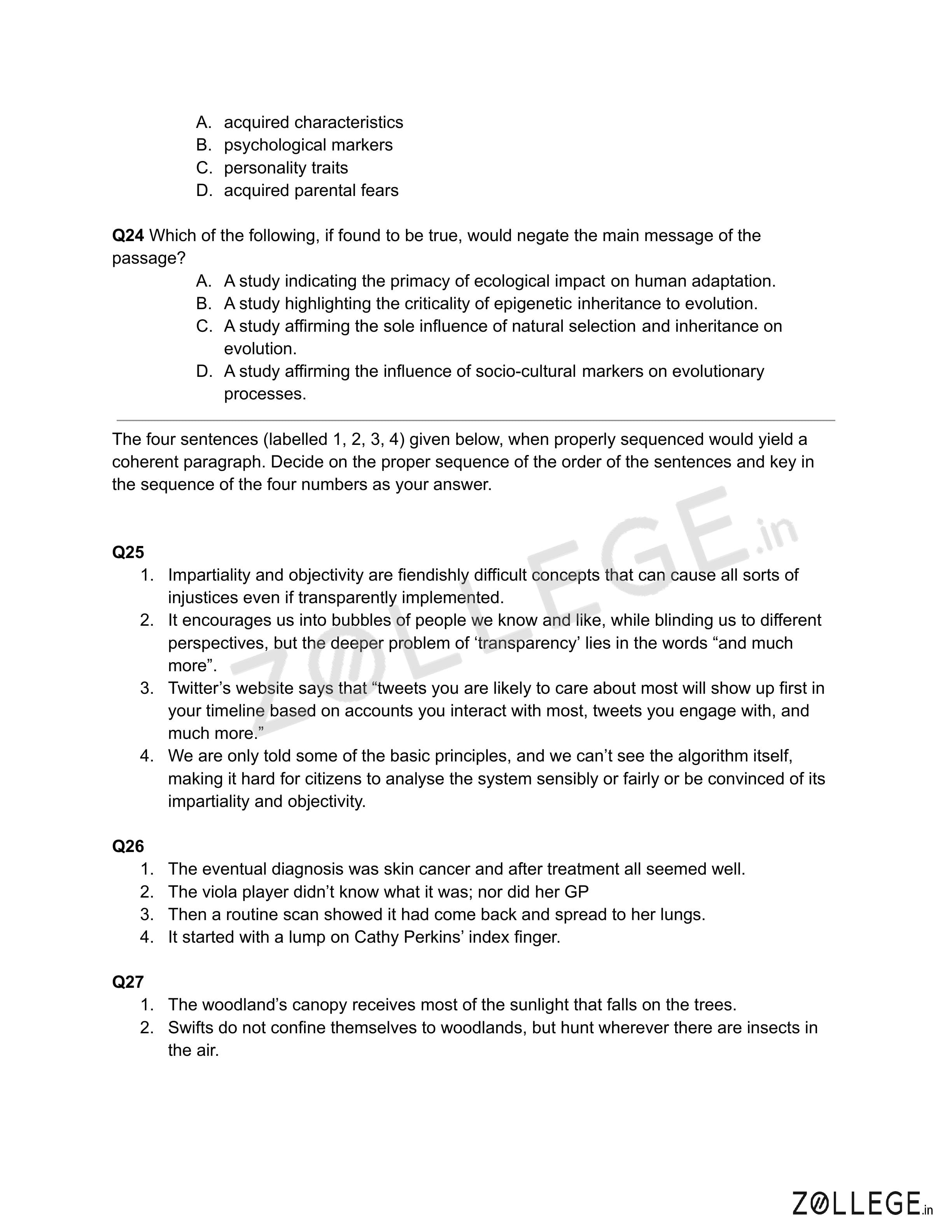
The passage uses the metaphor of a dog walker to argue that evolutionary adaptation is most comprehensively understood as being determined by:
View Solution
In the passage, the metaphor of the dog walker represents the various forces tugging at evolutionary adaptation, which are described as genetic, epigenetic, developmental, and ecological. These forces are reflected in the author’s metaphor, where each "tug" represents a different influence on evolution. Option (D) correctly captures this comprehensive view of evolutionary forces, combining genetic, epigenetic, and genomic influences, as well as other legacies outside the direct genetic scope (extra-genetic). This idea is expanded by the metaphor of the dog walker struggling with multiple forces pulling in different directions.
- Option (A) is not entirely correct because while it mentions genetic and epigenetic factors, it overlooks the full range of legacies (e.g., extra-genetic) mentioned in the passage.
- Option (B) is close, but it introduces socio-cultural legacies, which are not directly discussed in the passage. The author emphasizes a combination of genetic and epigenetic influences along with the extra-genetic factors.
- Option (C) is partially correct but misses the critical combination of all the legacies that affect evolutionary adaptation as outlined in the passage.
Quick Tip: Pay attention to how the metaphor of the dog walker emphasizes a variety of forces at play in evolutionary adaptation. The correct answer should reflect the full range of these factors, including genetic, epigenetic, and extra-genetic legacies.
Which of the following options best describes the author's argument?
View Solution
The author discusses the synthesis of Darwin’s theory of natural selection with Mendel’s discoveries on inheritance. The passage emphasizes that both of these theories together provide a comprehensive explanation of evolution. The combination of Darwin’s mechanism of natural selection and Mendel’s principles of inheritance allows for a fuller understanding of how evolution occurs. Therefore, Option (C) is the most accurate representation of the author’s argument.
- Option (A) is incorrect because while the author acknowledges the complexity of evolution, the passage does not argue that Darwin’s theory cannot explain evolution; rather, it suggests that Darwin’s and Mendel’s theories complement each other.
- Option (B) is inaccurate because the author does not claim that Mendel’s theory is unfairly underestimated; instead, the passage discusses how both theories need to be integrated to fully understand evolution.
- Option (D) is not supported by the passage, which does not suggest that Wilson’s theory of evolution is superior. The focus is on how Darwin’s and Mendel’s theories combine to explain evolutionary processes.
Quick Tip: Look for how the passage discusses the relationship between different scientific theories. The author emphasizes the importance of integrating Darwin’s and Mendel’s theories rather than favoring one over the other.
The Emory University experiment with mice points to the inheritance of:
View Solution
The Emory University experiment discussed in the passage found that mice, when trained to fear the smell of almonds, passed this fear on to their offspring, even though the offspring had not been directly exposed to the almonds or the shocks. This suggests that the offspring inherited not physical traits but rather "acquired parental fears" — specifically, the emotional response to a particular stimulus that their parents had developed. This finding supports the concept of epigenetic inheritance, where environmental factors experienced by parents can influence their offspring’s traits. Therefore, the correct answer is Option (D).
- Option (A) is incorrect because the passage critiques the notion that characteristics acquired during a lifetime cannot be passed down, but the study does not show the inheritance of physical characteristics. It focuses on an emotional or fear response.
- Option (B) is too general as "psychological markers" could refer to a wide range of inherited traits, but the experiment specifically addresses the inheritance of a fear, not a broad psychological marker.
- Option (C) is incorrect as the experiment does not explore personality traits, but rather a specific acquired fear, which is much more narrowly defined.
Quick Tip: Look for specifics about what is being inherited in the study. In this case, it’s not physical traits or general psychological markers, but the emotional responses (fears) that are passed on.
Which of the following, if found to be true, would negate the main message of the passage?
View Solution
The passage argues that evolutionary biology is more complex than previously understood, particularly due to the influence of epigenetics, where characteristics acquired during a parent’s life can be passed to offspring. This introduces a dimension of inheritance beyond traditional genetic inheritance. A study that reaffirms only the role of natural selection and genetic inheritance (as in Option (C)) would directly contradict the idea that acquired traits (such as learned fears) can be inherited through epigenetic mechanisms. Therefore, Option (C) would negate the main message of the passage.
- Option (A) does not directly counter the passage’s message because while ecological impact can influence evolutionary processes, it does not negate the role of epigenetics.
- Option (B) actually supports the passage’s argument, as the author emphasizes the role of epigenetic inheritance in evolutionary biology.
- Option (D) focuses on socio-cultural factors, which are part of the broader discussion on how traits are passed down, but it does not directly contradict the message about epigenetics and evolutionary processes.
Quick Tip: Look for the study that challenges the notion of epigenetic inheritance, which is central to the passage. A study supporting only natural selection would undermine the argument about the complexity of evolutionary mechanisms.
The four sentences (labelled 1, 2, 3, 4) given below, when properly sequenced, would yield a coherent paragraph. Decide on the proper sequence of the order of the sentences and key in the sequence of the four numbers as your answer.
% Sentence 1
(1) Impartiality and objectivity are fiendishly difficult concepts that can cause all sorts of injustices even if transparently implemented.
% Sentence 2
(2) It encourages us into bubbles of people we know and like, while blinding us to different perspectives, but the deeper problem of ‘transparency’ lies in the words “and much more”.
% Sentence 3
(3) Twitter’s website says that “tweets you are likely to care about most will show up first in your timeline based on accounts you interact with most, tweets you engage with, and much more.”
% Sentence 4
(4) We are only told some of the basic principles, and we can’t see the algorithm itself, making it hard for citizens to analyse the system sensibly or fairly or be convinced of its impartiality and objectivity.
View Solution
The correct order of the sentences is: 1 → 2 → 3 → 4. Let's break down the reasoning behind this sequence:
- Sentence (1) introduces the central concept of the paragraph: impartiality and objectivity. It states that these concepts are difficult to implement correctly and that their failure can lead to injustices. This is a general introduction to the problem of fairness and transparency, and it sets the stage for the rest of the discussion.
- Sentence (2) then expands on the challenge of impartiality and objectivity, particularly emphasizing how they are difficult to achieve because they are often undermined by biases, such as the "bubbles" that people find themselves in. These bubbles restrict exposure to differing perspectives, creating a skewed sense of reality. Additionally, the deeper issue of “transparency” is mentioned, with a particular focus on how the word “and much more” in the context of transparency adds another layer of complexity.
- Sentence (3) introduces a concrete example related to Twitter’s algorithm, which is directly connected to the concept of transparency discussed in Sentence (2). It shows how the algorithm works, prioritizing tweets from accounts that users interact with the most, which reinforces the idea that transparency is not as clear-cut as it may seem. The algorithm is only partially disclosed, contributing to the problems of fairness and objectivity raised earlier.
- Sentence (4) concludes the argument by explaining how the lack of full transparency—in this case, the inability to see the algorithm itself—makes it difficult for the public to evaluate whether the system is truly fair and objective. The conclusion stresses that while basic principles are shared, they are insufficient for true accountability.
Thus, the sequence flows logically from the introduction of the problem, to the explanation of biases and transparency issues, to the example of Twitter's algorithm, and finally to the conclusion about the difficulty of analyzing the system due to limited transparency.
Quick Tip: When sequencing sentences, start by introducing the main topic, build on it with details and examples, and conclude with a summary or implication of the issue.
The four sentences (labelled 1, 2, 3, 4) given below, when properly sequenced, would yield a coherent paragraph. Decide on the proper sequence of the order of the sentences and key in the sequence of the four numbers as your answer.
% Sentence 1
(1) The eventual diagnosis was skin cancer and after treatment all seemed well.
% Sentence 2
(2) The viola player didn’t know what it was; nor did her GP.
% Sentence 3
(3) Then a routine scan showed it had come back and spread to her lungs.
% Sentence 4
(4) It started with a lump on Cathy Perkins’ index finger.
View Solution
The correct sequence is: 4 → 2 → 3 → 1. Let's analyze this step by step:
- Sentence (4) introduces the initial symptom of the problem: a lump on Cathy Perkins' index finger. This is the first and crucial piece of information, as it sets the stage for the subsequent medical evaluation. The lump is the physical manifestation that prompts the concern.
- Sentence (2) follows with the confusion that arose from the initial symptoms. The viola player and her GP did not know what it was, which is a critical development in the case. The lack of immediate clarity from both the patient and the medical professional helps to build tension and suggests the complexity of the medical condition.
- Sentence (3) introduces the routine scan, a typical next step in medical diagnostics. The scan reveals that the cancer has spread to the lungs, which dramatically shifts the situation from a simple lump to a much more serious health crisis. This progression highlights the escalation of the condition from initial uncertainty to a life-threatening diagnosis.
- Sentence (1) concludes the sequence by providing the final diagnosis of skin cancer, confirming the severity of the situation. After treatment, it seems that everything was well, providing a sense of resolution and closure to the story. It is important to note that the sentence also reflects the final medical status after treatment, which brings a sense of relief.
By arranging the sentences in this order, we ensure that the story flows logically from the initial symptom to the final diagnosis and recovery. Each sentence provides a key step in the narrative, from discovery to diagnosis and, finally, treatment.
Quick Tip: When sequencing medical or narrative sentences, start with the initial symptom or event, move through confusion or diagnosis, describe the progression or complications, and conclude with the resolution or outcome.
The four sentences (labelled 1, 2, 3, 4) given below, when properly sequenced, would yield a coherent paragraph. Decide on the proper sequence of the order of the sentences and key in the sequence of the four numbers as your answer.
% Sentence 1
(1) The woodland’s canopy receives most of the sunlight that falls on the trees.
% Sentence 2
(2) Swifts do not confine themselves to woodlands, but hunt wherever there are insects in the air.
% Sentence 3
(3) With their streamlined bodies, swifts are agile flyers, ideally adapted to twisting and turning through the air as they chase flying insects – the creatures that form their staple diet.
% Sentence 4
(4) Hundreds of thousands of insects fly in the sunshine up above the canopy, some falling prey to swifts and swallows.
View Solution
The correct order of the sentences is: 1 → 4 → 3 → 2. Let's go through the reasoning step by step:
- Sentence (1) introduces the woodland canopy and the fact that it receives most of the sunlight. This sets the stage for the discussion of life within the woodland environment. It’s the first key point, establishing the setting.
- Sentence (4) follows logically because it explains what happens in the sunlight above the canopy. It introduces the insects flying in the sunlight, setting up the potential food source for predators like swifts. It creates a natural progression in the narrative, explaining how the insects are involved in the food chain.
- Sentence (3) connects directly to sentence (4) by describing the swifts, which feed on these insects. It provides a more detailed description of swifts' flight abilities, explaining how their streamlined bodies make them well-suited to catching flying insects. This explanation fits as the next logical step after introducing the insects in sentence (4).
- Sentence (2) concludes the paragraph by describing the behavior of the swifts, which do not limit themselves to woodland but hunt wherever there are insects in the air. This final sentence wraps up the general behavior of swifts, explaining their wider habitat beyond the woodland.
Thus, the sequence is: 1 → 4 → 3 → 2, which moves from the introduction of the woodland environment, to the presence of insects, to the swifts’ adaptations and their behavior.
Quick Tip: To sequence sentences logically, start by introducing the environment or setting, then describe the actions or behaviors of the subjects within that setting, and end by explaining their broader actions or relationships.
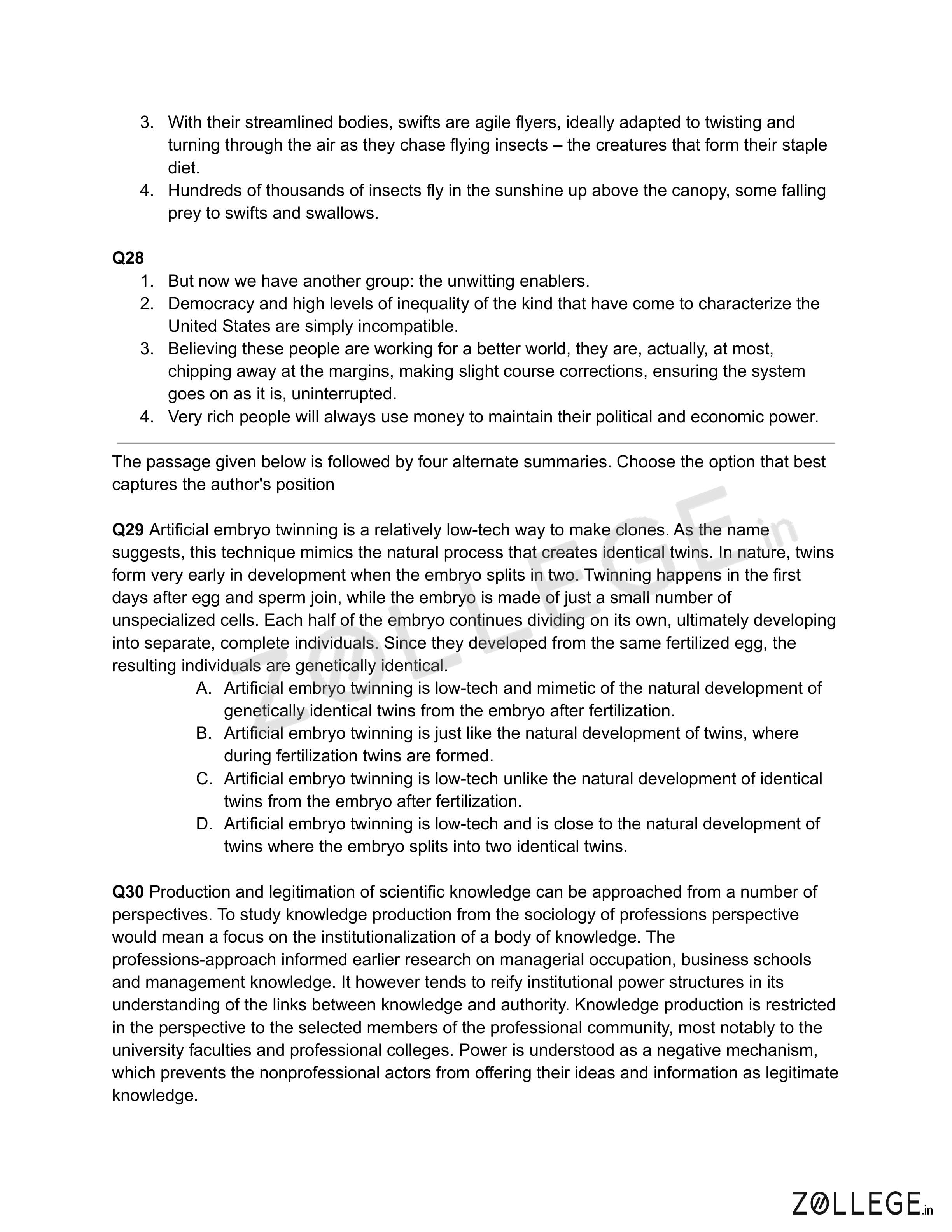
The four sentences (labelled 1, 2, 3, 4) given below, when properly sequenced, would yield a coherent paragraph. Decide on the proper sequence of the order of the sentences and key in the sequence of the four numbers as your answer.
% Sentence 1
(1) But now we have another group: the unwitting enablers.
% Sentence 2
(2) Democracy and high levels of inequality of the kind that have come to characterize the United States are simply incompatible.
% Sentence 3
(3) Believing these people are working for a better world, they are, actually, at most, chipping away at the margins, making slight course corrections, ensuring the system goes on as it is, uninterrupted.
% Sentence 4
(4) Very rich people will always use money to maintain their political and economic power.
View Solution
The correct sequence is: 2 → 4 → 3 → 1. Here’s the reasoning behind this order:
- Sentence (2) sets up the core issue by arguing that democracy and high inequality are fundamentally incompatible. This statement introduces the central problem and lays the foundation for the rest of the discussion.
- Sentence (4) expands on this by stating that the very rich use their wealth to maintain political and economic power. This sentence is a direct continuation of the argument in sentence (2), providing a specific example of the inequality issue. The rich control power, reinforcing the central idea that inequality undermines democracy.
- Sentence (3) then elaborates on the behavior of the unwitting enablers, explaining that these individuals believe they are working for a better world, but in reality, they are merely chipping away at the margins and upholding the status quo. This sentence introduces the unwitting enablers as people who, although well-meaning, inadvertently support the existing system.
- Sentence (1) concludes by introducing the unwitting enablers, which wraps up the idea that, despite their intentions, they are contributing to the persistence of the issues highlighted in the previous sentences. This sentence ties the idea of enablers to the broader societal problem.
Thus, the correct sequence is 2 → 4 → 3 → 1, starting with the incompatibility of democracy and inequality, followed by an explanation of the rich’s power, then detailing the enablers, and finally identifying this group of people.
Quick Tip: When sequencing sentences, start with the main problem or issue, provide specific examples, explain the underlying causes or behaviors, and conclude by identifying the people or groups involved.
Artificial embryo twinning is a relatively low-tech way to make clones. As the name suggests, this technique mimics the natural process that creates identical twins. In nature, twins form very early in development when the embryo splits in two. Twinning happens in the first days after egg and sperm join, while the embryo is made of just a small number of unspecialized cells. Each half of the embryo continues dividing on its own, ultimately developing into separate, complete individuals. Since they developed from the same fertilized egg, the resulting individuals are genetically identical.
View Solution
The passage discusses artificial embryo twinning and how it mimics the natural process of identical twins formation. Let's break down the options:
- Option (A) is correct because it emphasizes that artificial embryo twinning is both low-tech and mimics the natural process of developing genetically identical twins, as described in the passage. The key detail in the passage is that the technique mimics the natural process of twinning from the embryo.
- Option (B) is incorrect because it suggests that twins are formed during fertilization, which is not accurate. The passage specifies that twinning happens after fertilization, when the embryo splits in two.
- Option (C) is also incorrect because it states that artificial twinning is unlike the natural development, which contradicts the passage's claim that it mimics the natural process.
- Option (D) is not the best because although it mentions splitting into two identical twins, it misses the crucial idea that artificial embryo twinning mimics the natural process of developing identical twins, not just splitting the embryo.
Thus, the correct option is (A).
Quick Tip: Look for keywords in the passage such as "mimic" or "similar" when determining the correct summary of the author's position. The key idea here is that artificial embryo twinning mimics the natural process of forming identical twins.
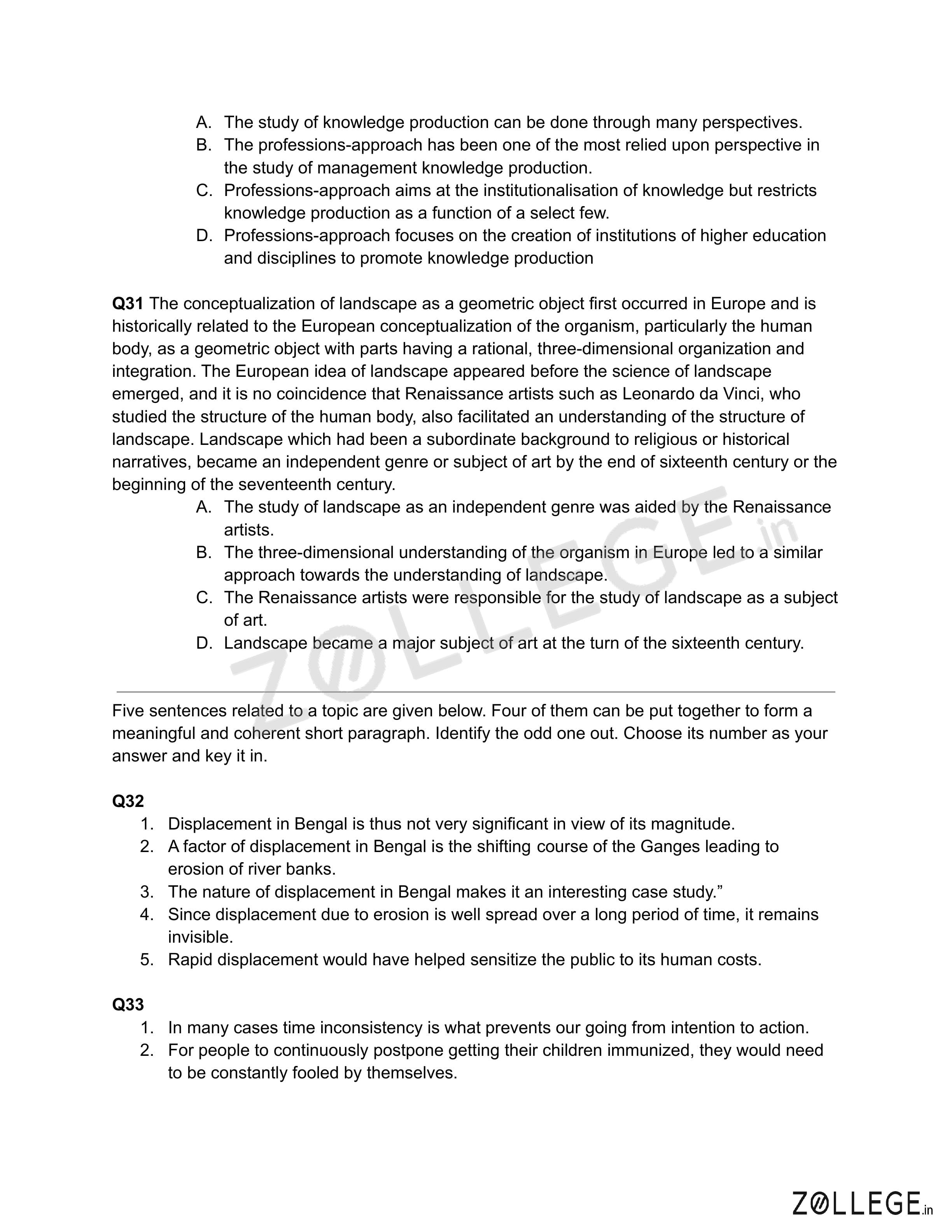
Production and legitimation of scientific knowledge can be approached from a number of perspectives. To study knowledge production from the sociology of professions perspective would mean a focus on the institutionalization of a body of knowledge. The professions-approach informed earlier research on managerial occupation, business schools and management knowledge. It however tends to reify institutional power structures in its understanding of the links between knowledge and authority. Knowledge production is restricted in the perspective to the selected members of the professional community, most notably to the university faculties and professional colleges. Power is understood as a negative mechanism, which prevents the nonprofessional actors from offering their ideas and information as legitimate knowledge.
View Solution
The passage discusses how knowledge production can be studied from the perspective of sociology, specifically the professions-approach. Let's break down the options:
- Option (A) is not fully accurate. While the passage mentions that knowledge production can be studied from multiple perspectives, it doesn't emphasize this as the key point. The passage is more focused on the professions-approach.
- Option (B) is partially correct but not fully comprehensive. It mentions the professions-approach as an important perspective, but it doesn’t capture the restriction aspect that the passage highlights.
- Option (C) is the correct summary. It accurately reflects the professions-approach which institutionalizes knowledge but limits access to that knowledge to a select few within the professional community, as explained in the passage.
- Option (D) is incorrect because the passage does not discuss the creation of institutions specifically or the promotion of knowledge production by disciplines. It focuses more on the restriction of knowledge production to professional groups.
Thus, the correct option is (C).
Quick Tip: When selecting the correct summary, look for the option that captures both the positive and restrictive aspects mentioned in the passage, rather than just focusing on one side of the argument.
The conceptualization of landscape as a geometric object first occurred in Europe and is historically related to the European conceptualization of the organism, particularly the human body, as a geometric object with parts having a rational, three-dimensional organization and integration. The European idea of landscape appeared before the science of landscape emerged, and it is no coincidence that Renaissance artists such as Leonardo da Vinci, who studied the structure of the human body, also facilitated an understanding of the structure of landscape. Landscape, which had been a subordinate background to religious or historical narratives, became an independent genre or subject of art by the end of the sixteenth century or the beginning of the seventeenth century.
View Solution
The passage explains the historical relationship between the understanding of the human body and the landscape, emphasizing how the three-dimensional approach to the human body helped facilitate a similar approach to landscape in European art. Let's break down the options:
- Option (A) refers to the role of Renaissance artists in helping the study of landscape as an independent genre, but the passage highlights that the understanding of the structure of the landscape came from the understanding of the human body, rather than solely from the artists themselves.
- Option (B) is correct as it accurately describes the connection between the three-dimensional understanding of the human body and how this understanding influenced the approach to landscape. The passage links the two concepts explicitly.
- Option (C) is partially correct but not the best answer. While Renaissance artists contributed to the study of landscape, the passage does not claim that they were entirely responsible for the subject of landscape art—it was more about how the understanding of the body helped in the understanding of landscape.
- Option (D) mentions that landscape became a major subject of art at the turn of the sixteenth century, but the passage points out that this shift occurred by the end of the sixteenth century or the beginning of the seventeenth century, not exactly at the turn. The other options provide more focused and accurate reflections of the author's position.
Thus, the correct option is (B).
Quick Tip: When identifying the correct summary, focus on the key relationships the author highlights. Here, the focus is on the connection between the three-dimensional understanding of the body and landscape rather than the role of artists alone.
Five sentences related to a topic are given below. Four of them can be put together to form a meaningful and coherent short paragraph. Identify the odd one out. Choose its number as your answer and key it in.
% Sentence 1
(1) Displacement in Bengal is thus not very significant in view of its magnitude.
% Sentence 2
(2) A factor of displacement in Bengal is the shifting course of the Ganges leading to erosion of river banks.
% Sentence 3
(3) The nature of displacement in Bengal makes it an interesting case study.
% Sentence 4
(4) Since displacement due to erosion is well spread over a long period of time, it remains invisible.
% Sentence 5
(5) Rapid displacement would have helped sensitize the public to its human costs.
View Solution
- Sentence (1) is the odd one out because it contradicts the overall tone and focus of the other sentences. The other sentences focus on the nature of displacement, how it occurs, and its impact, whereas sentence (1) dismisses its significance.
- Sentence (2) provides a cause for displacement in Bengal.
- Sentence (3) explains that displacement in Bengal is an interesting case study, adding context to the issue.
- Sentence (4) discusses the invisibility of displacement, caused by the slow erosion process.
- Sentence (5) highlights how rapid displacement would have sensitized the public to the issue.
Thus, Sentence (1) doesn't fit because it downplays the significance, whereas the others explain it in detail.
Quick Tip: When identifying the odd sentence, look for the one that contradicts or does not fit with the overall theme or logical flow of the paragraph.
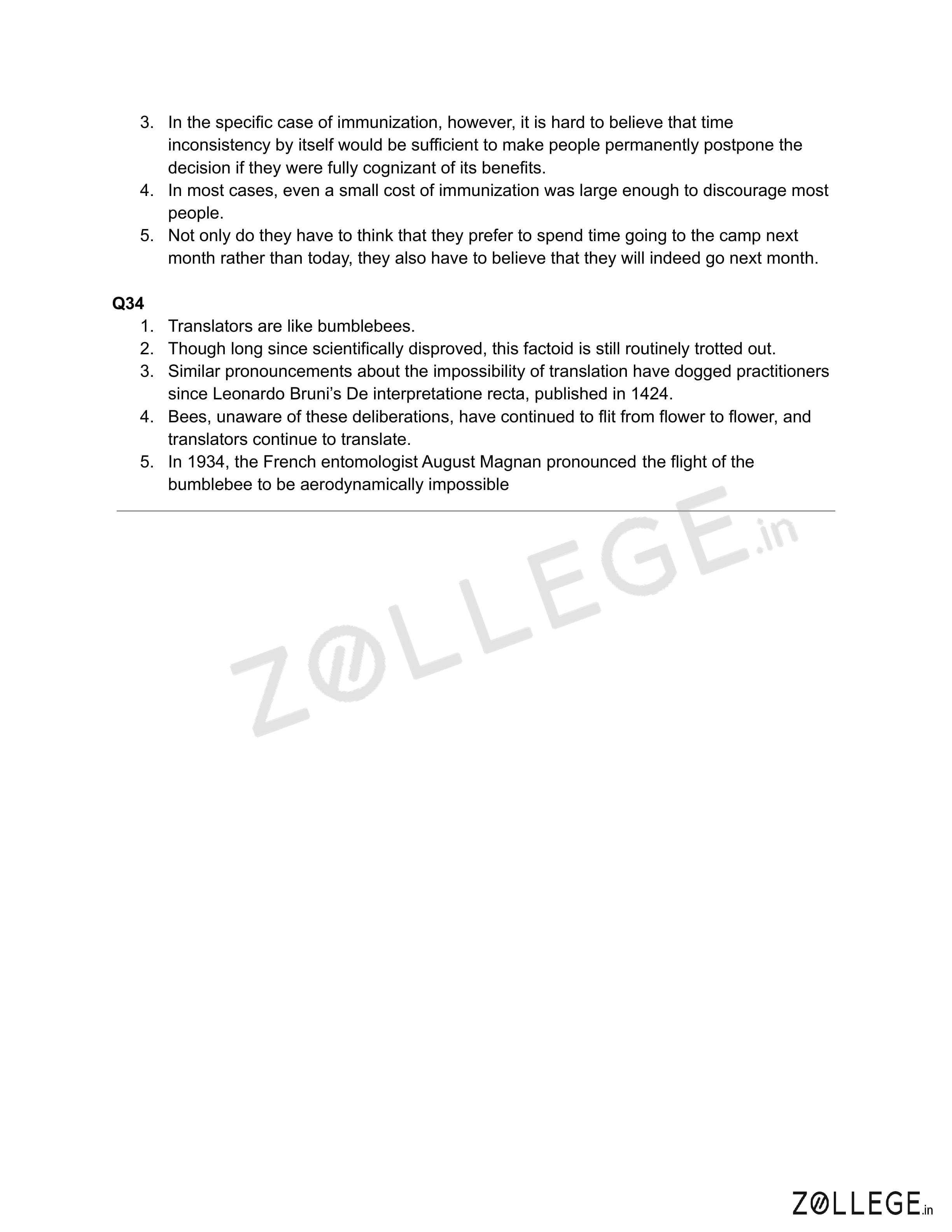
Five sentences related to a topic are given below. Four of them can be put together to form a meaningful and coherent short paragraph. Identify the odd one out. Choose its number as your answer and key it in.
% Sentence 1
(1) In many cases, time inconsistency is what prevents our going from intention to action.
% Sentence 2
(2) For people to continuously postpone getting their children immunized, they would need to be constantly fooled by themselves.
% Sentence 3
(3) In the specific case of immunization, however, it is hard to believe that time inconsistency by itself would be sufficient to make people permanently postpone the decision if they were fully cognizant of its benefits.
% Sentence 4
(4) In most cases, even a small cost of immunization was large enough to discourage most people.
% Sentence 5
(5) Not only do they have to think that they prefer to spend time going to the camp next month rather than today, they also have to believe that they will indeed go next month.
View Solution
- Sentence (4) is the odd one out because it introduces a different aspect (cost of immunization) that is not central to the idea of time inconsistency. The paragraph primarily discusses time inconsistency and how it affects decision-making.
- Sentence (1) introduces time inconsistency as the core problem.
- Sentence (2) suggests that self-deception is needed for delaying immunization, continuing the idea of time inconsistency.
- Sentence (3) refines the argument, saying that time inconsistency alone is not enough if the benefits are understood, shifting the discussion towards the awareness of benefits.
- Sentence (5) explains how people deceive themselves into thinking they will act later, continuing the theme of time inconsistency.
Thus, Sentence (4) doesn't fit because it discusses cost rather than time inconsistency.
Quick Tip: When identifying the odd sentence, look for one that introduces an unrelated concept or shifts the focus of the paragraph. In this case, time inconsistency is the main theme, and cost is a separate issue.
Five sentences related to a topic are given below. Four of them can be put together to form a meaningful and coherent short paragraph. Identify the odd one out. Choose its number as your answer and key it in.
% Sentence 1
(1) Translators are like bumblebees.
% Sentence 2
(2) Though long since scientifically disproved, this factoid is still routinely trotted out.
% Sentence 3
(3) Similar pronouncements about the impossibility of translation have dogged practitioners since Leonardo Bruni's De interpretatione recta, published in 1424.
% Sentence 4
(4) Bees, unaware of these deliberations, have continued to flit from flower to flower, and translators continue to translate.
% Sentence 5
(5) In 1934, the French entomologist August Magnan pronounced the flight of the bumblebee to be aerodynamically impossible.
View Solution
- Sentence (5) is the odd one out because it is primarily about a scientific fact regarding bumblebees, while the rest of the sentences focus on a metaphorical comparison between translators and bumblebees.
- Sentence (1) sets up the analogy of translators being like bumblebees.
- Sentence (2) introduces the myth or misconception about the impossibility of the bumblebee's flight, which parallels the misconception about translation.
- Sentence (3) connects the idea of impossibility in translation, referencing historical doubts about the practice.
- Sentence (4) concludes the metaphor by showing that despite the disbelief (in both translation and bumblebees), both continue to function as normal.
Thus, Sentence (5) is unrelated to the metaphor and stands out as factual rather than metaphorical.
Quick Tip: In identifying the odd sentence, look for the one that breaks the metaphorical or thematic flow of the paragraph. The odd one out often introduces a literal fact rather than a metaphor or analogy.
Quick Links:
*The article might have information for the previous academic years, please refer the official website of the exam.