
CAT 2018 VARC Slot 2 Question Paper with Solution PDF
- Cut Off for IITs
- IIM Kashipur Cut Off
- IIM Amritsar Cut Off
- IIM Nagpur Cut Off
- IIM Indore Cut Off
- IIM Udaipur Cut Off
- IIM Ranchi Cut Off
- IIM Raipur Cut Off
- IIM Jammu Cut Off
- IIM Bodh Gaya Cut Off
- IIM Kozhikode Cut Off
- IIM Sambalpur Cut Off
- IIM Bangalore Cut Off
- IIM Sirmaur Cut Off
- IIM Trichy Cut Off
- IIM Visakhapatnam Cut Off
- IIM Lucknow Cut Off
- IIM Shillong Cut Off
- IIM Calcutta Cut Off
- IIM Ahmedabad Cut Off
- IIM Rohtak Cut Off


Content Writer | Updated On - Nov 28, 2025
CAT Question Papers are the most important study material for effective exam preparation. We at Zollege have provided all CAT Previous Year Papers with Solution PDFs here. CAT 2018 VARC exam was conducted successfully on November 25, 2018. Indian Institutes of Management (IIM) conducted the exam in the Slot 2. According to student reactions and expert reviews, the paper was reported to be moderate to difficult.
Students can freely download the CAT previous year question paper PDFs along with their solutions here. We strongly encourage CAT aspirants to scan through all the CAT Question Paper to know the overall difficulty level, CAT Syllabus and understand the changes in CAT Exam Pattern over the years.
Also Check:
CAT 2018 VARC Question Paper with Answer Key PDF (Slot 2)
| CAT 2018 VARC Slot 2 Question Paper with Answer Key | Download PDF | Check Solutions |

Question 1:
Passage: E-Governance
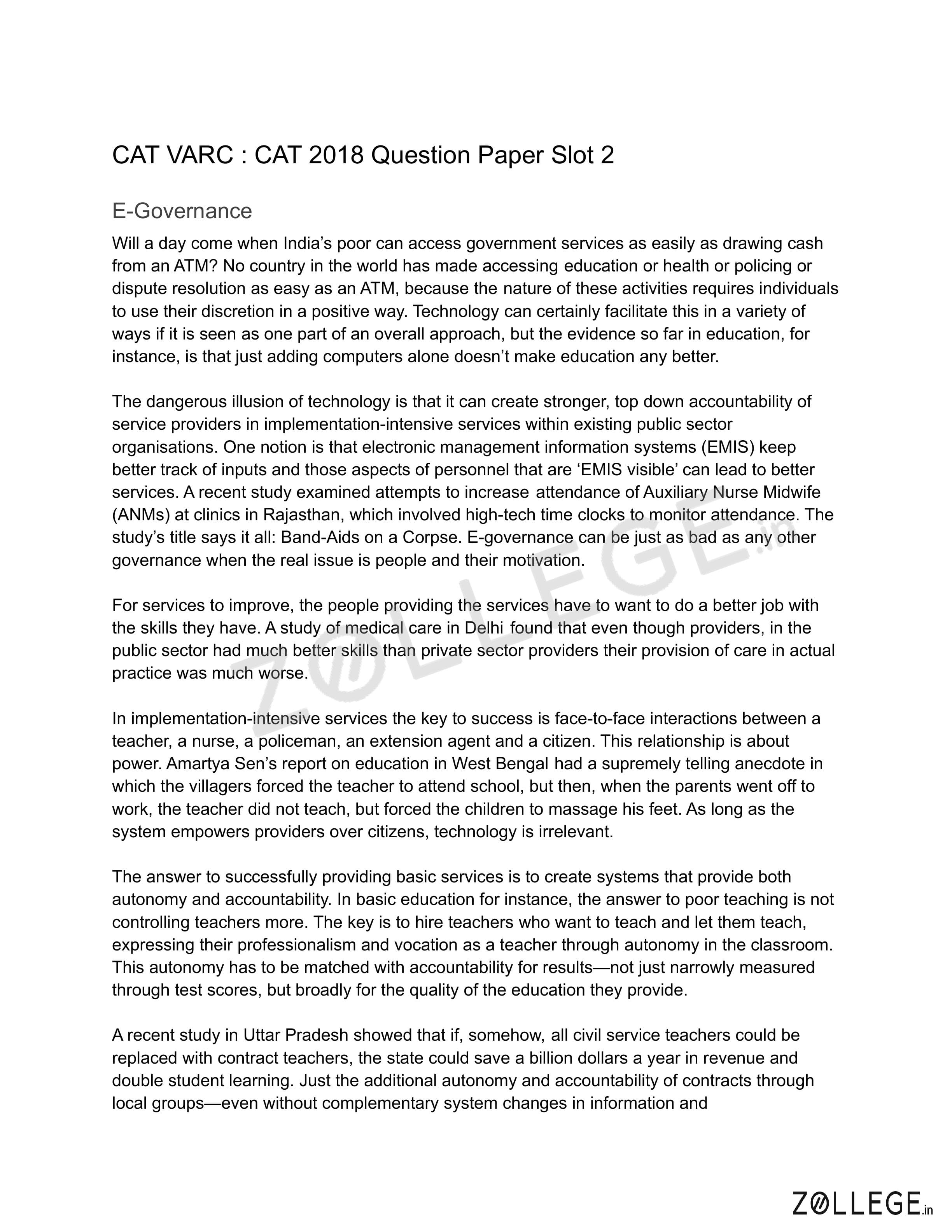
Will a day come when India’s poor can access government services as easily as drawing cash
from an ATM?
No country in the world has made accessing education or health or policing or dispute
resolution as easy as an ATM,because the nature of these activities requires individuals
to use their discretion in a positive way.
Read More
Technology can certainly facilitate this in a variety of ways if it is seen as one part of anoverall approach,
but the evidence so far in education, for instance, is that just adding computers alone doesn’t
make education any better.
The dangerous illusion of technology is that it can create stronger, top down accountability of
service providers
in implementation-intensive services within existing public sector organisations.
One notion is that electronic management information systems (EMIS) keep better track of
inputs and those aspects of personnel
that are ‘EMIS visible’ can lead to better services.
A recent study examined attempts to increase attendance of Auxiliary Nurse Midwife
(ANMs) at clinics in Rajasthan,
which involved high-tech time clocks to monitor attendance.
The study’s title says it all: Band-Aids on a Corpse.
E-governance can be just as bad as any other governance when the real issue is people and
their motivation.
For services to improve, the people providing the services have to want to do a better job with
the skills they have.
A study of medical care in Delhi found that even though providers in the public sector had
much better skills
than private sector providers, their provision of care in actual practice was much worse.
In implementation-intensive services the key to success is face-to-face interactions
between a teacher, a nurse, a policeman, an extension agent and a citizen.
This relationship is about power. Amartya Sen’s report on education in West Bengal had a
supremely telling anecdote
in which the villagers forced the teacher to attend school, but then, when the parents went off
to work,
the teacher did not teach, but forced the children to massage his feet.
As long as the system empowers providers over citizens, technology is irrelevant.
The answer to successfully providing basic services is to create systems
that provide both autonomy and accountability.
In basic education for instance, the answer to poor teaching is not controlling teachers more.
The key is to hire teachers who want to teach and let them teach, expressing their
professionalism and vocation
as a teacher through autonomy in the classroom.
This autonomy has to be matched with accountability for results—
not just narrowly measured through test scores,
but broadly for the quality of the education they provide.
A recent study in Uttar Pradesh showed that if, somehow, all civil service teachers could be
replaced with contract teachers,
the state could save a billion dollars a year in revenue and double student learning.
Just the additional autonomy and accountability of contracts through local groups—
even without complementary system changes in information and empowerment-led to that
much improvement. The first step to being part of the solution is to create performance
information accessible to those outside of the government.
In the context of the passage, we can infer that the title “Band Aids on a Corpse” (in paragraph 2) suggests that:
View Solution
The passage introduces the Rajasthan study immediately after discussing the limits of technology in fixing implementation-intensive services. The phrase "Band-Aids on a Corpse" is used as the study’s title and the author cites it to illustrate that installing high-tech time clocks (an electronic monitoring system) was merely a superficial fix that did not address the deeper human problems—motivation, accountability, and the larger organisational dysfunction. Thus the metaphor criticises a cosmetic technological intervention applied to a fundamentally broken system, which matches option (B). Option (A) is not supported: the passage does not claim the nurses lacked training, but rather that monitoring cannot substitute for motivation and proper incentives. Option (C) focuses on ill-equipped clinics, which is not the thrust of the metaphor; the emphasis is on misdirected technological fixes, not on equipment. Option (D) wrongly narrows the claim to funding and performance monitoring outcomes; the passage argues that technology can be irrelevant when underlying power relations an
d lack of provider accountability persist. Therefore (B) is the best choice. Quick Tip: When interpreting metaphors or titles like "Band Aids on a Corpse," look for symbolic meaning in the passage—usually indicating a shallow solution to a deep-rooted problem.
According to the author, service delivery in Indian education can be improved in all of the following ways EXCEPT through:
View Solution
The passage highlights that better service delivery in Indian education can be ensured by leveraging technology, encouraging the recruitment of motivated teachers, and providing access to transparent information regarding teaching quality. These approaches directly aim to strengthen accountability, effectiveness, and efficiency in the system. However, the author never advocates the elimination of government involvement. In fact, government intervention is considered necessary to regulate standards, ensure equity, and expand access. Hence, among the given options, the only one that is inconsistent with the author's argument is (D).
Quick Tip: In CAT Reading Comprehension (RC), “EXCEPT” questions require you to carefully eliminate all correct statements and pick the one that contradicts or is not mentioned in the passage. Always scan for tone and scope of the author’s argument.
Which of the following, IF TRUE, would undermine the passage’s main argument?
View Solution
The main argument of the passage is that **empowering service providers with autonomy** and **using technology in a balanced way** can improve performance and accountability in service delivery.
- Option (A): Talks about absolute surveillance, which only contrasts with "moderate surveillance" and doesn’t directly undermine the argument—it only suggests a different degree of monitoring.
- Option (C): Supports the argument by reinforcing that autonomy increases responsibility and productivity, so it cannot undermine.
- Option (D): Compares private and public sector skills, but the argument is not about inter-sector comparison, so it is irrelevant.
- Option (B): Directly undermines the argument because if empowerment actually leads to complacency and manipulated results, then the central claim (that empowerment improves performance) is contradicted.
Hence, **(B)** most strongly undermines the passage’s main argument. Quick Tip: When asked to identify what *undermines* an argument, focus on options that **directly contradict the core reasoning** of the passage. Supporting evidence or irrelevant comparisons cannot undermine.
The author questions the use of monitoring systems in services that involve face-to-face interaction between service providers and clients because such systems:
View Solution
The passage emphasizes that face-to-face service delivery depends heavily on the commitment and intrinsic motivation of the service provider. Monitoring systems, while effective in tracking quantitative metrics, cannot instill commitment or genuine concern for the client. Hence, such systems fail to improve the quality of services that fundamentally rely on the provider’s dedication. Options (B), (C), and (D) either bring in irrelevant distinctions (public vs. private, skills vs. motivation, or government control), none of which are the author’s central argument. Therefore, option (A) correctly captures the author’s reasoning.
Quick Tip: When analyzing RC questions, focus on the author’s central argument rather than secondary details. Always connect the answer to the *main idea* of the passage.
The main purpose of the passage is to:
View Solution
The passage emphasizes that certain services, particularly those requiring implementation at the ground level, often fail when overly controlled by the government. It highlights that efficiency improves when autonomy is provided to service providers, while simultaneously holding them accountable for outcomes. Thus, the author is not merely criticizing the government or proposing a specific solution, but is advocating for a balanced approach where independence and accountability go hand in hand. This directly aligns with option (B). Quick Tip: In RC questions on the "purpose of the passage," focus on the central theme rather than specific examples. Identify what the author is arguing for or advocating against.
Passage: White-lipped Grove Snails
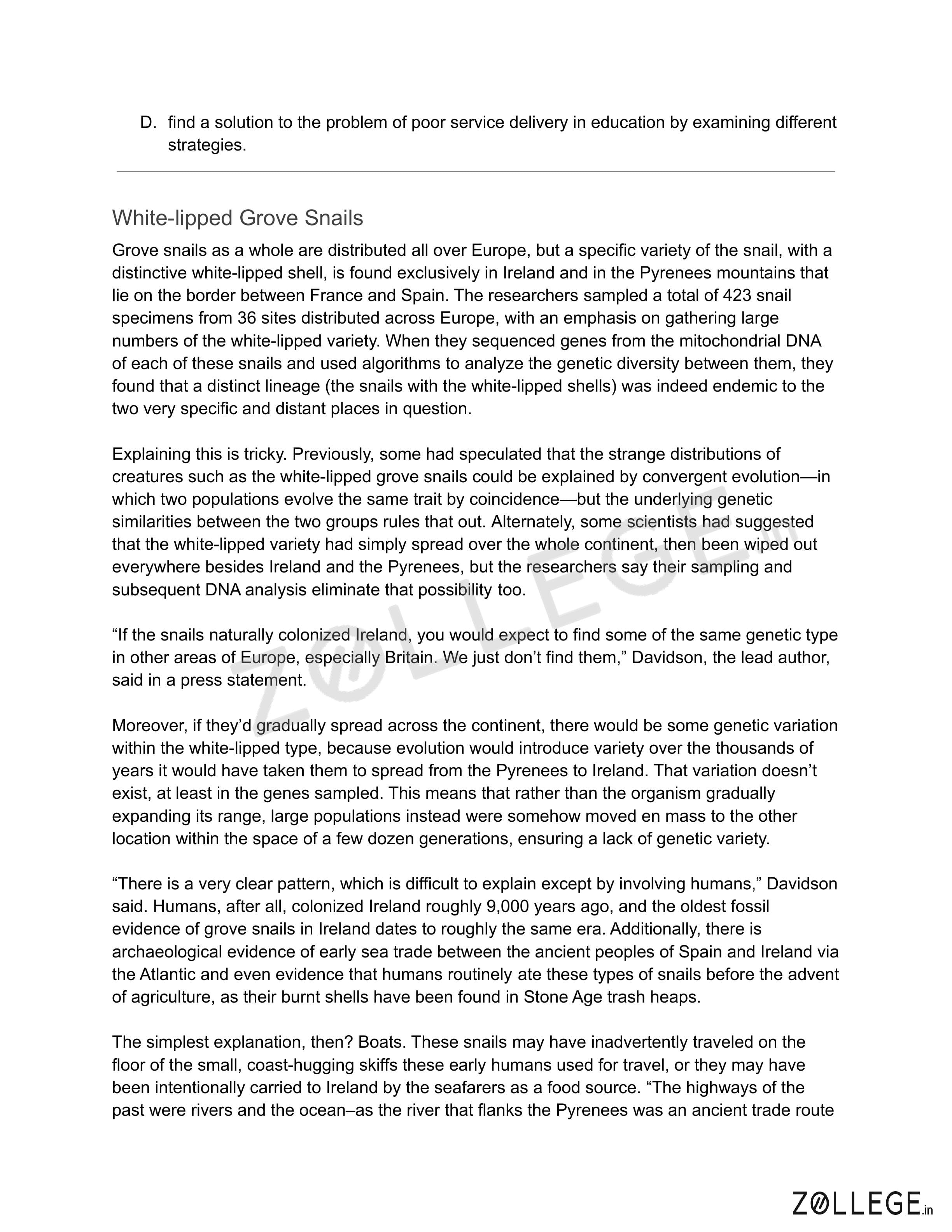
Grove snails as a whole are distributed all over Europe,
but a specific variety of the snail, with a distinctive white-lipped shell,
is found exclusively in Ireland and in the Pyrenees mountains that lie on the border between
France and Spain.
Read More
The researchers sampled a total of 423 snail specimens from 36 sites distributed across Europe,with an emphasis on gathering large numbers of the white-lipped variety.
When they sequenced genes from the mitochondrial DNA of each of these snails and used
algorithms
to analyze the genetic diversity between them, they found that a distinct lineage
(the snails with the white-lipped shells) was indeed endemic to the two very specific and
distant places in question.
Explaining this is tricky.
Previously, some had speculated that the strange distributions of creatures such as the
white-lipped grove snails
could be explained by convergent evolution—in which two populations evolve the same trait
by coincidence—
but the underlying genetic similarities between the two groups rules that out.
Alternately, some scientists had suggested that the white-lipped variety had simply spread
over the whole continent,
then been wiped out everywhere besides Ireland and the Pyrenees,
but the researchers say their sampling and subsequent DNA analysis eliminate that possibility
too.
“If the snails naturally colonized Ireland, you would expect to find some of the same genetic
type
in other areas of Europe, especially Britain. We just don’t find them,”
Davidson, the lead author, said in a press statement.
Moreover, if they’d gradually spread across the continent,
there would be some genetic variation within the white-lipped type,
because evolution would introduce variety over the thousands of years
it would have taken them to spread from the Pyrenees to Ireland.
That variation doesn’t exist, at least in the genes sampled.
This means that rather than the organism gradually expanding its range,
large populations instead were somehow moved en masse to the other location
within the space of a few dozen generations, ensuring a lack of genetic variety.
“There is a very clear pattern, which is difficult to explain except by involving humans,”
Davidson said.
Humans, after all, colonized Ireland roughly 9,000 years ago,
and the oldest fossil evidence of grove snails in Ireland dates to roughly the same era.
Additionally, there is archaeological evidence of early sea trade between the ancient peoples of
Spain and Ireland via the Atlantic
and even evidence that humans routinely ate these types of snails before the advent of
agriculture,
as their burnt shells have been found in Stone Age trash heaps.
The simplest explanation? Boats.
These snails may have inadvertently traveled on the floor of the small, coast-hugging skiffs
these early humans used for travel,
or they may have been intentionally carried to Ireland by the seafarers as a food source.
“The highways of the past were rivers and the ocean—as the river that flanks the Pyrenees
was an ancient trade route to the Atlantic, what we’re actually seeing might be the long
lasting legacy of snails that hitched a ride as humans travelled from the South of France to
Ireland 8,000 years ago,” Davidson said.”
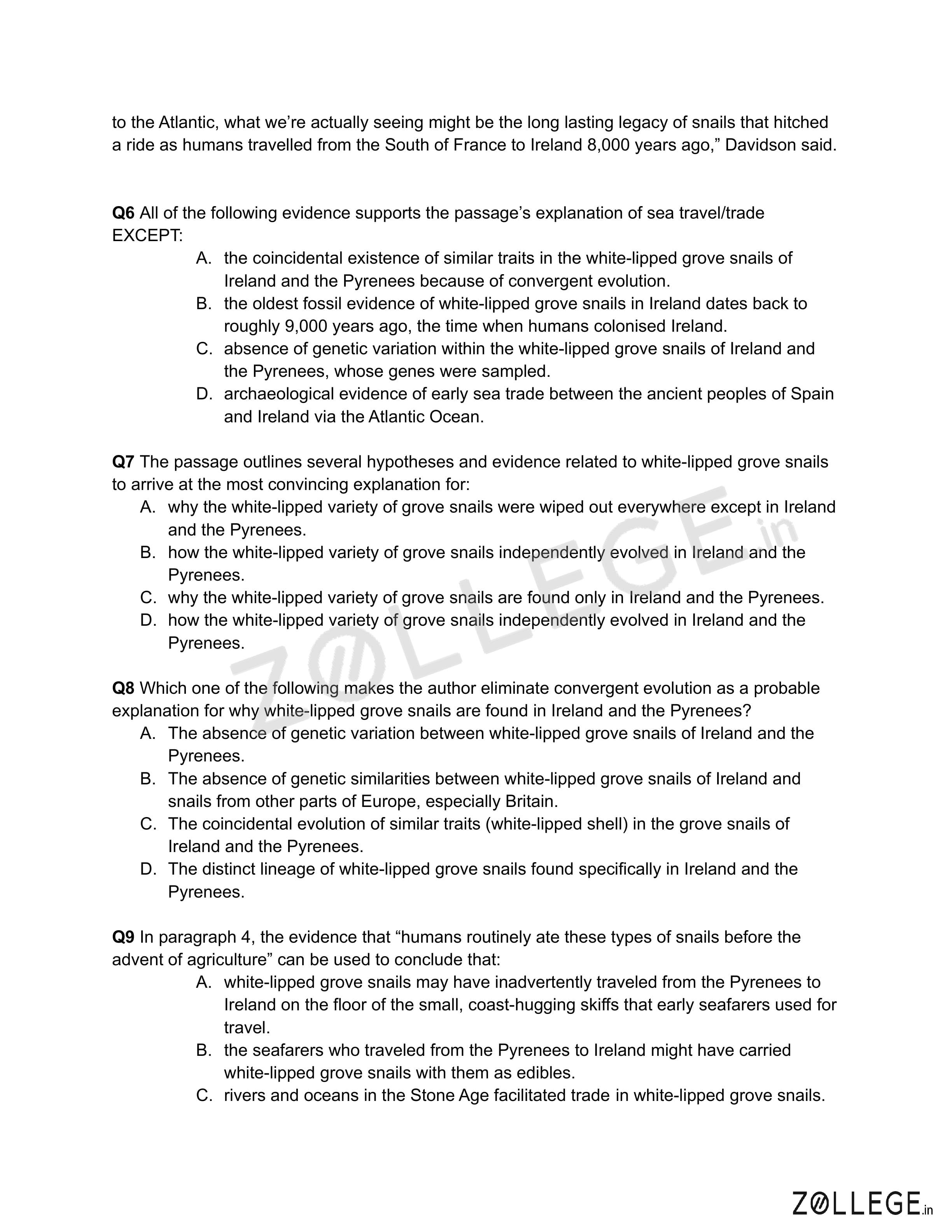
All of the following evidence supports the passage’s explanation of sea travel/trade EXCEPT:
View Solution
The passage explains the distribution of white-lipped grove snails in Ireland and the Pyrenees by suggesting sea travel or trade as the most plausible cause. Evidence in support includes fossil records from 9,000 years ago (B), the absence of genetic variation between the two populations (C), and archaeological evidence of sea trade (D). However, option (A), which attributes the similarity to convergent evolution, contradicts the explanation of sea travel/trade rather than supporting it. Hence, (A) is the correct answer.
Quick Tip: In EXCEPT questions, identify which options directly strengthen the author’s explanation and select the one that weakens or contradicts it.
The passage outlines several hypotheses and evidence related to white-lipped grove snails to arrive at the most convincing explanation for:
View Solution
The passage presents multiple hypotheses about the origin and distribution of the white-lipped grove snails. It considers possibilities such as extinction in other regions or independent evolution in Ireland and the Pyrenees. However, the passage emphasizes evidence that the variety is present exclusively in these two places, not because it evolved independently but due to specific historical and geographical factors. Thus, the passage's reasoning is directed toward explaining the restricted distribution — that is, why they are found only in Ireland and the Pyrenees — making option (C) the most accurate. \ Quick Tip: In RC questions, focus on what the passage is \textbf{explaining}, not just what it is describing. If the passage rules out multiple possibilities and settles on a reasoning, the correct answer usually reflects the central conclusion.
Which one of the following makes the author eliminate convergent evolution as a probable explanation for why white-lipped grove snails are found in Ireland and the Pyrenees?
View Solution
Convergent evolution implies that unrelated species independently evolve similar traits due to similar environmental pressures. However, in this case, the evidence shows that the white-lipped grove snails in Ireland and the Pyrenees belong to the same distinct lineage. This indicates a shared ancestry rather than independent evolution of the same trait. Hence, convergent evolution is ruled out, and option (D) is correct.
Quick Tip: In reading comprehension, eliminate answer choices that contradict the author's reasoning. Focus on evidence of "shared lineage" versus "independent evolution" to avoid confusion.
In paragraph 4, the evidence that “humans routinely ate these types of snails before the advent of agriculture” can be used to conclude that:
View Solution
The paragraph highlights that humans consumed these snails before agriculture began. This means that early seafarers who traveled from the Pyrenees to Ireland could have carried the snails as a part of their food supply. The fact that humans already ate these snails provides the most logical explanation for how the snails reached Ireland.
Option (A) is incorrect because it suggests accidental transport on boat floors, but the paragraph emphasizes human consumption, not accidental movement.
Option (C) is incorrect because there is no mention of trade in snails; the focus is on human dietary habits.
Option (D) is incorrect because while travel is possible, the evidence specifically connects to human consumption, not merely travel routes.
Therefore, option (B) best aligns with the evidence given in paragraph 4.
Quick Tip: In Reading Comprehension (RC) questions, focus on the specific evidence mentioned in the passage. If the passage gives a cause (e.g., humans ate snails), the correct inference will logically extend from that cause, not introduce unrelated possibilities like trade or accidental transport.
Passage: Meritocracy
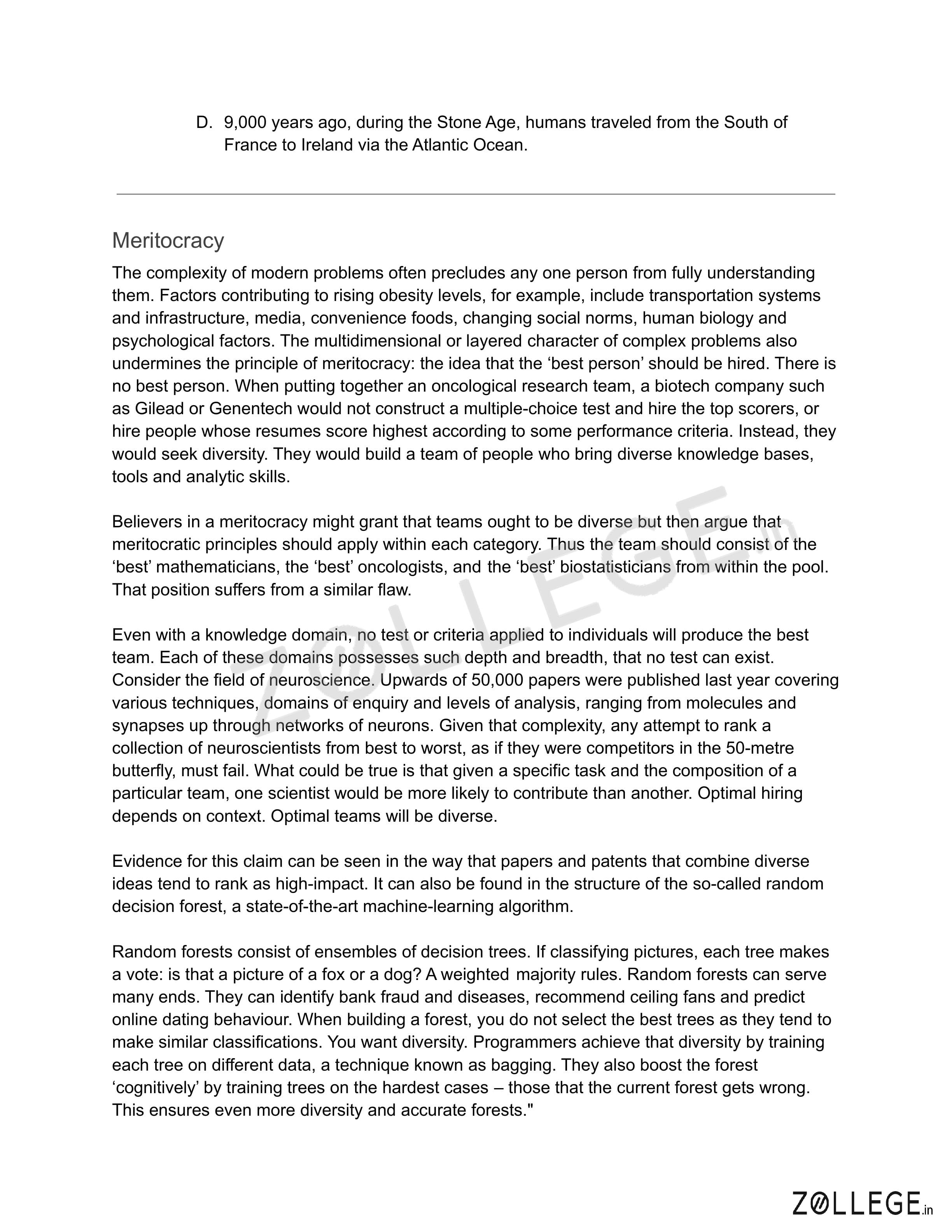
The complexity of modern problems often precludes any one person from fully understanding
them.Factors contributing to rising obesity levels, for example, include transportation systems and
infrastructure,media, convenience foods, changing social norms, human biology and psychological factors.
The multidimensional or layered character of complex problems also undermines the principle
of meritocracy:
Read More
the idea that the ‘best person’ should be hired. There is no best person.When putting together an oncological research team, a biotech company such as Gilead or
Genentech
would not construct a multiple-choice test and hire the top scorers, or hire people whose
resumes score highest
according to some performance criteria.
Instead, they would seek diversity. They would build a team of people who bring diverse
knowledge bases,
tools and analytic skills.
Believers in a meritocracy might grant that teams ought to be diverse
but then argue that meritocratic principles should apply within each category.
Thus the team should consist of the ‘best’ mathematicians, the ‘best’ oncologists,
and the ‘best’ biostatisticians from within the pool. That position suffers from a similar flaw.
Even with a knowledge domain, no test or criteria applied to individuals will produce the best
team.
Each of these domains possesses such depth and breadth, that no test can exist.
Consider the field of neuroscience.
Upwards of 50,000 papers were published last year covering various techniques, domains of
enquiry and levels of analysis,
ranging from molecules and synapses up through networks of neurons.
Given that complexity, any attempt to rank a collection of neuroscientists from best to worst,
as if they were competitors in the 50-metre butterfly, must fail.
What could be true is that given a specific task and the composition of a particular team,
one scientist would be more likely to contribute than another.
Optimal hiring depends on context. Optimal teams will be diverse.
Evidence for this claim can be seen in the way that papers and patents that combine diverse
ideas tend to rank as high-impact.
It can also be found in the structure of the so-called random decision forest,
a state-of-the-art machine-learning algorithm.
Random forests consist of ensembles of decision trees.
If classifying pictures, each tree makes a vote: is that a picture of a fox or a dog?
A weighted majority rules. Random forests can serve many ends.
They can identify bank fraud and diseases, recommend ceiling fans and predict online dating
behaviour.
When building a forest, you do not select the best trees as they tend to make similar
classifications.
You want diversity. Programmers achieve that diversity by training each tree on different
data,
a technique known as bagging.
They also boost the forest ‘cognitively’ by training trees on the hardest cases —
those that the current forest gets wrong.
This ensures even more diversity and accurate forests.
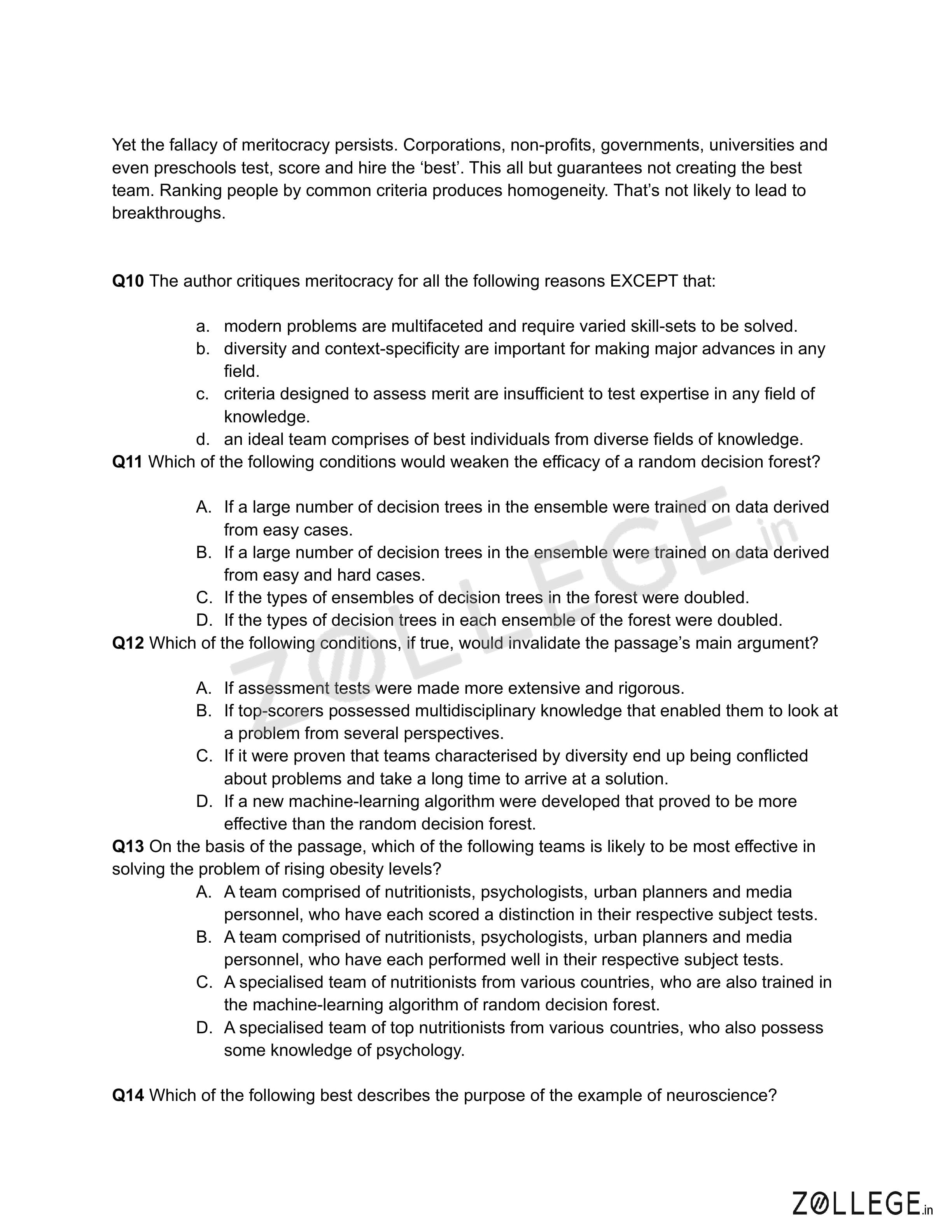
Yet the fallacy of meritocracy persists. Corporations, non-profits, governments, universities
and even preschools test, score and hire the ’best’. This all but guarantees not creating the
best team. Ranking people by common criteria produces homogeneity. That’s not likely to
lead to breakthroughs.
The author critiques meritocracy for all the following reasons EXCEPT that:
View Solution
The author rejects convergent evolution as an explanation because genetic studies reveal that the white-lipped grove snails in Ireland and the Pyrenees share a distinct lineage, meaning they are closely related despite being geographically separated. If convergent evolution were the reason, the similarity in appearance would be due to independent evolutionary paths rather than a shared ancestry. However, the presence of a distinct genetic lineage specific to these regions indicates that the populations are not products of coincidental adaptation but rather of common origin, which rules out convergent evolution.
Quick Tip: When answering questions on evolutionary explanations, remember that convergent evolution implies independent development of similar traits without shared ancestry. If genetic lineage proves common ancestry, convergent evolution can be eliminated.
Which of the following conditions would weaken the efficacy of a random decision forest?
View Solution
The passage describes how random forests work: they rely on ensembles of decision trees that are trained on diverse data.
One method used to enhance accuracy is to expose trees to the hardest cases—examples that other trees in the forest misclassified.
Option (A) – If trees are trained only on easy cases, they won’t learn how to handle complex or ambiguous inputs.
This leads to uniform and less accurate predictions, directly weakening the power of the ensemble.
Option (B) – This aligns with the passage. Including hard cases improves the forest by promoting diversity and accuracy.
Option (C) – Increasing the number of ensembles could increase computational load but not necessarily reduce accuracy.
Option (D) – Doubling the diversity among decision trees would likely improve the model, not weaken it.
Therefore, Option (A) would most clearly reduce the efficacy of the random forest by limiting learning to only simple scenarios.
Quick Tip: Random forests rely on variety and exposure to difficult data to become accurate. Training only on easy cases reduces their predictive strength.
Which of the following conditions, if true, would invalidate the passage’s main argument?
View Solution
The core argument of the passage is that diversity—not individual merit—is key to solving complex, modern problems.
The author repeatedly argues that diversity in knowledge bases, perspectives, and methods increases problem-solving capability.
Option (A) – Making tests more rigorous doesn’t address the main issue, which is that no test can capture the complexity of domains like neuroscience.
Even the most refined tests wouldn’t replace the value of diverse contributions.
Option (B) – If top-scorers had multidisciplinary knowledge, it might help,
but it still wouldn’t replicate the diversity of perspectives from multiple individuals with varied backgrounds.
This alone wouldn’t invalidate the overall argument.
Option (C) – This directly contradicts the main claim.
If diverse teams were proven to be inefficient or conflicted, then the justification for hiring based on diversity would weaken.
Thus, this condition would fundamentally challenge the passage’s core thesis.
Option (D) – The example of random forests is used as an analogy to support the argument,
but the argument doesn’t hinge on it. A better algorithm wouldn’t invalidate the value of diversity in teams.
Therefore, Option (C) is the correct answer.
Quick Tip: To invalidate an argument, the condition must directly contradict the main idea or assumption the argument depends on.
On the basis of the passage, which of the following teams is likely to be most effective in solving the problem of rising obesity levels?
View Solution
According to the passage, solving modern issues like obesity requires diverse expertise.
Obesity is described as a multidimensional problem that involves psychology, nutrition, media, transportation, and infrastructure.
Option (A) – While it includes a diverse team, the emphasis on scoring distinction goes against the author's stance.
The author criticizes meritocratic measures such as test performance as ineffective in forming great teams.
Option (B) – This is the best choice. It features a diverse team with relevant domain knowledge.
The mention that they performed well—not necessarily ranked the best—aligns with the author’s argument that context and diversity matter more than rank.
Option (C) – This team is too narrowly focused on nutrition and machine learning.
It lacks the multidimensional diversity needed for addressing obesity from multiple angles.
Option (D) – Similar to (C), this team is too narrowly focused on nutrition and lacks enough diversity in domain perspectives.
Hence, Option (B) is most in line with the passage’s view on solving complex, interdisciplinary issues like obesity.
Quick Tip: When the passage advocates diversity, choose the answer with varied expertise, not just high individual performance in a single field.
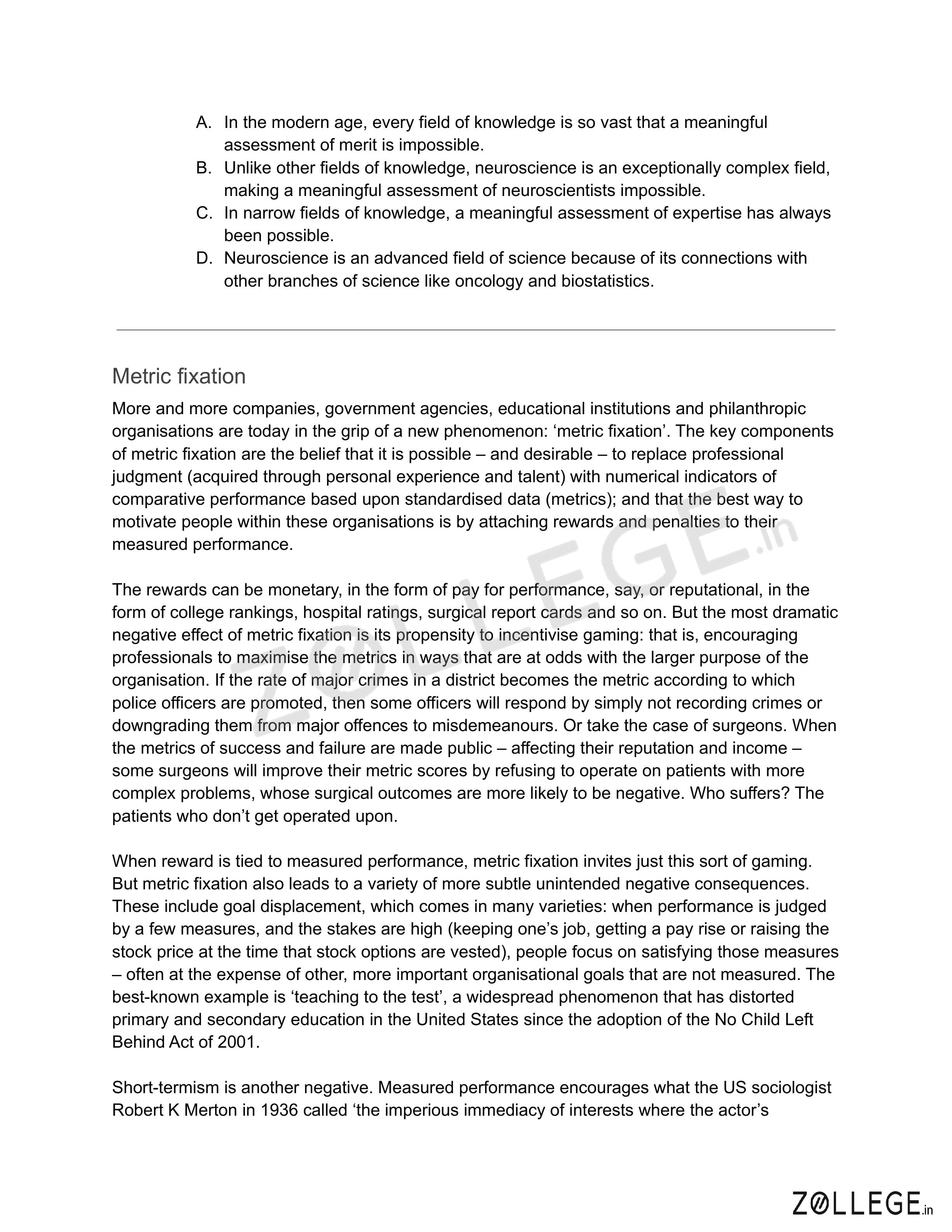
Which of the following best describes the purpose of the example of neuroscience?
View Solution
The example of neuroscience is used in the passage to illustrate the idea that within any complex field,
the sheer volume and diversity of research make it impossible to meaningfully rank individuals by merit.
The author states that over 50,000 neuroscience papers were published in a single year
covering diverse topics—from molecules and synapses to neural networks—making a single test or ranking method invalid.
The point is not that neuroscience is uniquely complex, but that it is representative of most modern domains
where depth and breadth prevent objective assessment of individual excellence.
Option (A) – This matches the author’s reasoning. The neuroscience example supports the broader claim
that assessment of merit is nearly impossible in modern, complex fields due to volume and variability.
Option (B) – This wrongly implies that neuroscience is an exception, whereas the author uses it as an example of a general trend.
Option (C) – The passage does not claim assessment is possible in narrow fields; it challenges the very idea of ranking individuals.
Option (D) – The point isn’t about neuroscience being advanced or multidisciplinary—it’s about its complexity making merit assessment difficult.
Therefore, Option (A) best explains why the author included the example of neuroscience.
Quick Tip: Look for the role the example plays in the argument—whether it's an illustration, exception, or evidence. Neuroscience is an illustration of a general point.
Passage: Metric Fixation
More and more companies, government agencies, educational institutions and philanthropic
organisations
are today in the grip of a new phenomenon: ‘metric fixation’.
The key components of metric fixation are the belief that it is possible – and desirable –
to replace professional judgment (acquired through personal experience and talent)
with numerical indicators of comparative performance based upon standardised data
(metrics);
Read More
and that the best way to motivate people within these organisations is by attaching rewardsand penalties
to their measured performance.
The rewards can be monetary, in the form of pay for performance, say,
or reputational, in the form of college rankings, hospital ratings, surgical report cards and so
on.
But the most dramatic negative effect of metric fixation is its propensity to incentivise
gaming:
that is, encouraging professionals to maximise the metrics in ways that are at odds with the
larger purpose of the organisation.
If the rate of major crimes in a district becomes the metric according to which police officers
are promoted,
then some officers will respond by simply not recording crimes or downgrading them from
major offences to misdemeanours.
Or take the case of surgeons.
When the metrics of success and failure are made public – affecting their reputation and
income –
some surgeons will improve their metric scores by refusing to operate on patients with more
complex problems,
whose surgical outcomes are more likely to be negative.
Who suffers? The patients who don’t get operated upon.
When reward is tied to measured performance, metric fixation invites just this sort of gaming.
But metric fixation also leads to a variety of more subtle unintended negative consequences.
These include goal displacement, which comes in many varieties:
when performance is judged by a few measures, and the stakes are high (keeping one’s job,
getting a pay rise or raising the stock price
at the time that stock options are vested), people focus on satisfying those measures –
often at the expense of other, more important organisational goals that are not measured.
The best-known example is ‘teaching to the test’, a widespread phenomenon
that has distorted primary and secondary education in the United States
since the adoption of the No Child Left Behind Act of 2001.
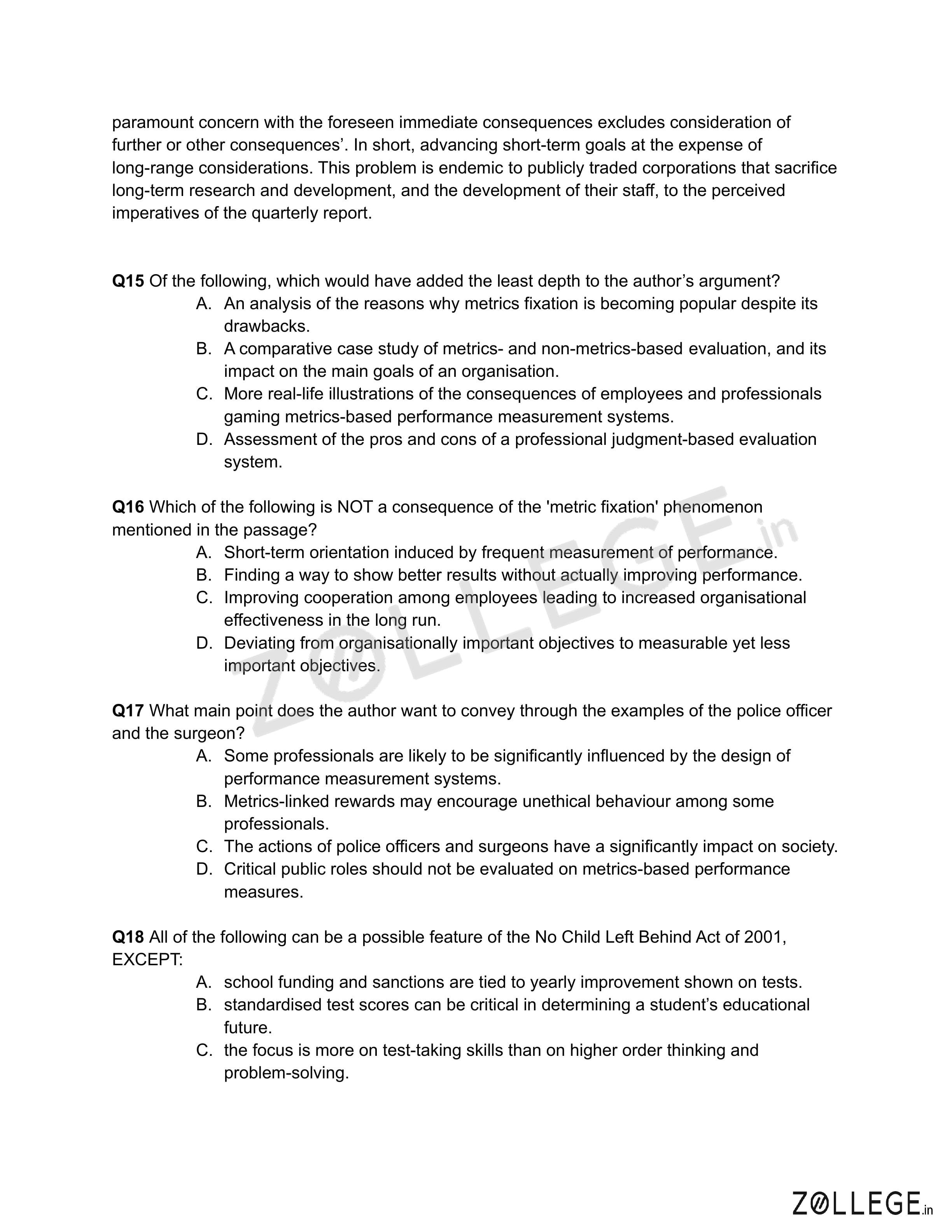
Short-termism is another negative.
Measured performance encourages what the US sociologist Robert K Merton in 1936 called
“the imperious immediacy of interests” where the actor’s paramount concern with the
foreseen immediate consequences excludes consideration of further or other consequences’. In
short, advancing short-term goals at the expense of long-range considerations. This problem
is endemic to publicly traded corporations that sacrifice long-term research and development,
and the development of their staff, to the perceived imperatives of the quarterly report.
Of the following, which would have added the least depth to the author’s argument?
View Solution
The author’s main argument criticizes metric fixation and highlights its unintended negative consequences,
such as incentivising gaming, distorting organisational goals, and promoting short-termism.
Option (A) – An analysis of the reasons for its popularity would enhance the discussion by providing context and rationale.
Option (B) – A case study comparing metric and non-metric systems would offer concrete evidence, which strengthens the argument.
Option (C) – More real-life examples would give further weight to the critique by showing actual harm caused.
Option (D) – Evaluating the pros and cons of professional judgment would shift focus to an alternative model,
but it doesn’t directly deepen the critique of metric fixation itself.
It would be a tangent rather than a deeper exploration of the existing argument.
Hence, Option (D) adds the least depth to the author’s primary line of reasoning.
Quick Tip: When asked about “least depth,” choose the option that goes off-topic or adds the least relevance to the author’s main concern.
Which of the following is NOT a consequence of the 'metric fixation' phenomenon mentioned in the passage?
View Solution
The passage outlines several problems caused by metric fixation:
gaming the system, goal displacement, short-termism, and neglecting broader organisational goals.
Option (A) – Short-term orientation is explicitly discussed as a negative consequence.
Option (B) – This is the essence of “gaming the metrics,” like surgeons avoiding high-risk patients.
Option (D) – Goal displacement is mentioned, where measurable goals replace more important, unmeasured ones.
Option (C) – This is not mentioned anywhere in the passage.
In fact, the passage highlights negative consequences, not improved cooperation or long-term organisational success.
Therefore, Option (C) is the correct answer as it is not a stated consequence.
Quick Tip: For “NOT” questions, verify each option directly against the passage content and eliminate clearly stated consequences.
What main point does the author want to convey through the examples of the police officer and the surgeon?
View Solution
The passage uses the examples of police officers and surgeons to demonstrate how tying rewards or reputation to metrics
can lead professionals to manipulate outcomes in unethical or harmful ways.
For example, police officers may downgrade major crimes to misdemeanours or avoid reporting them altogether
to improve performance statistics that influence promotions.
Similarly, surgeons may refuse to operate on complex patients to avoid bad outcomes that would negatively affect their ratings.
Option (A) – While technically true, this is too vague and broad. It doesn’t emphasize the moral consequences.
Option (B) – This is the best answer because it directly captures the author’s critique:
the link between metrics and rewards may drive unethical practices.
Option (C) – Although public roles do impact society, this is not the core message of these examples.
Option (D) – This is more of an opinion or policy proposal than a summary of the examples.
Thus, Option (B) accurately reflects the author's intended point.
Quick Tip: Focus on the ethical and behavioural consequences described in the passage when interpreting illustrative examples.
All of the following can be a possible feature of the No Child Left Behind Act of 2001, EXCEPT:
View Solution
The passage refers to the No Child Left Behind Act of 2001 in the context of how metric fixation
has distorted education through “teaching to the test.”
This suggests an emphasis on measurable, standardised performance rather than subjective evaluation.
Option (A) – True. It fits with the idea of using test improvement as a metric for school funding or sanctions.
Option (B) – Likely true. Standardised scores become significant in education under such policy frameworks.
Option (C) – Correct. The author mentions that test-focused systems can undermine broader educational goals,
like critical thinking.
Option (D) – This is the EXCEPT case. Subjective, teacher-based assessments are not part of metric fixation;
they are actually opposed to it. The author criticises reliance on rigid data and external metrics,
which exclude teacher discretion.
Hence, Option (D) does not align with the characteristics of the No Child Left Behind Act as portrayed.
Quick Tip: When asked for the “EXCEPT” option, identify the one choice that contradicts the main theme or mechanism described in the passage.
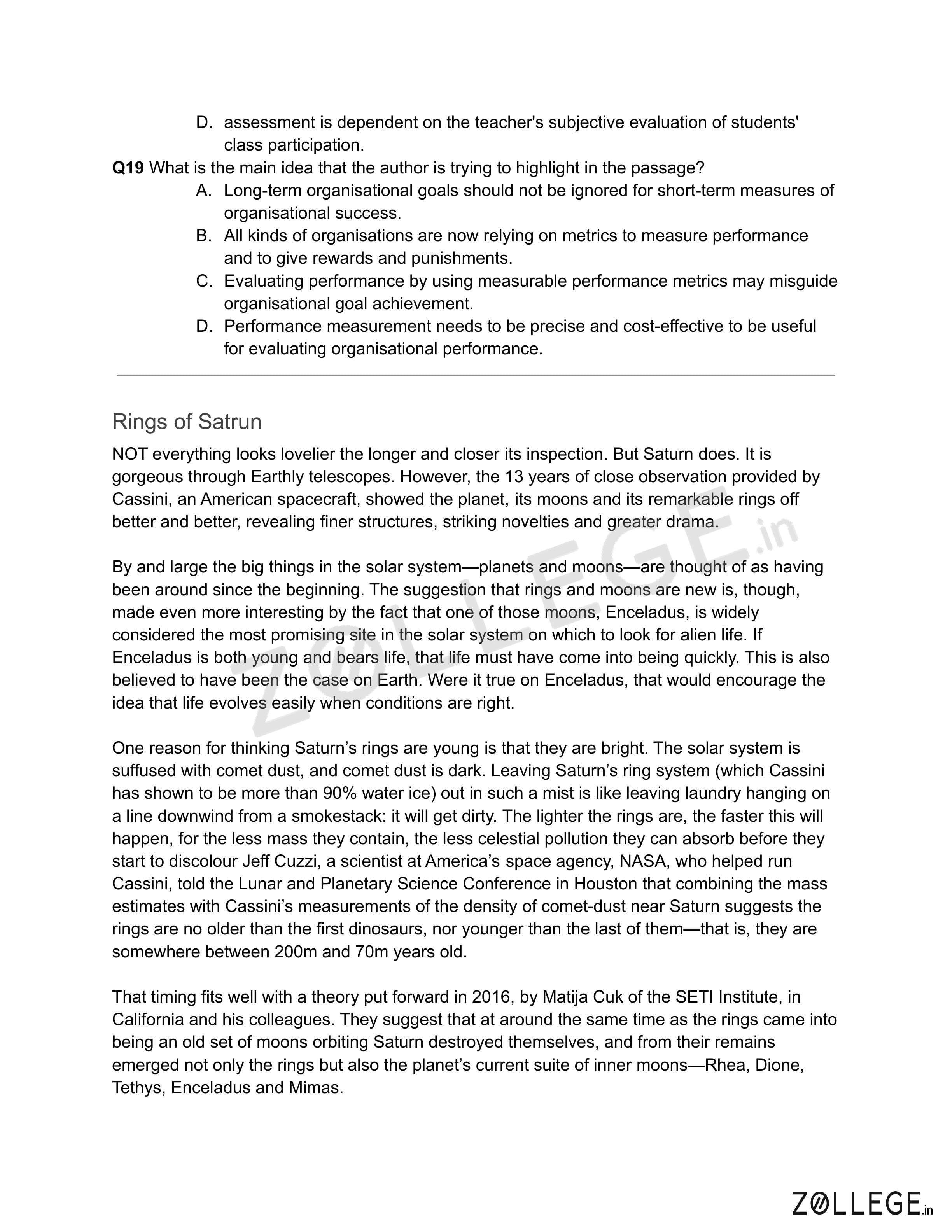
What is the main idea that the author is trying to highlight in the passage?
View Solution
The main argument of the passage is a critique of “metric fixation.”
The author highlights that the practice of tying rewards and punishments to performance metrics can backfire
by encouraging gaming, distorting priorities, and displacing more important but less measurable goals.
The entire passage explains how overemphasis on measurable data—such as test scores, crime stats, or surgical outcomes—
can misrepresent actual performance and steer organisations away from their real objectives.
Option (A) – This is mentioned, but it reflects only a secondary point about short-termism, not the core idea.
Option (B) – This is a statement of fact and context, not the main idea. It describes what is happening but not why it's problematic.
Option (C) – This best captures the author's purpose.
The focus is on how metric-based evaluation can mislead and hinder genuine organisational success.
Option (D) – This option focuses on accuracy and cost-efficiency, which are not concerns raised in the passage.
Thus, Option (C) is the most accurate expression of the main idea.
Quick Tip: When identifying the main idea, prioritize the author’s central argument or concern—especially the one supported by multiple examples.
Passage: Rings of Saturn
NOT everything looks lovelier the longer and closer its inspection. But Saturn does.
It is gorgeous through Earthly telescopes. However, the 13 years of close observation provided
by Cassini,an American spacecraft, showed the planet, its moons and its remarkable rings off better and
better,
Read More
revealing finer structures, striking novelties and greater drama.By and large the big things in the solar system—planets and moons—are thought of as
having been around since the beginning.
The suggestion that rings and moons are new is, though, made even more interesting by the
fact that one of those moons, Enceladus,
is widely considered the most promising site in the solar system on which to look for alien life.
If Enceladus is both young and bears life, that life must have come into being quickly.
This is also believed to have been the case on Earth.
Were it true on Enceladus, that would encourage the idea that life evolves easily when
conditions are right.
One reason for thinking Saturn’s rings are young is that they are bright.
The solar system is suffused with comet dust, and comet dust is dark.
Leaving Saturn’s ring system (which Cassini has shown to be more than 90% water ice) out in
such a mist
is like leaving laundry hanging on a line downwind from a smokestack: it will get dirty.
The lighter the rings are, the faster this will happen, for the less mass they contain,
the less celestial pollution they can absorb before they start to discolour.
Jeff Cuzzi, a scientist at America’s space agency, NASA, who helped run Cassini,
told the Lunar and Planetary Science Conference in Houston that combining the mass
estimates
with Cassini’s measurements of the density of comet-dust near Saturn suggests
the rings are no older than the first dinosaurs, nor younger than the last of them—
that is, they are somewhere between 200m and 70m years old.
That timing fits well with a theory put forward in 2016, by Matija Cuk of the SETI Institute,
in California and his colleagues.
They suggest that at around the same time as the rings came into being
an old set of moons orbiting Saturn destroyed themselves,
and from their remains emerged not only the rings but also the planet’s current suite of inner
moons—
Rhea, Dione, Tethys, Enceladus and Mimas.
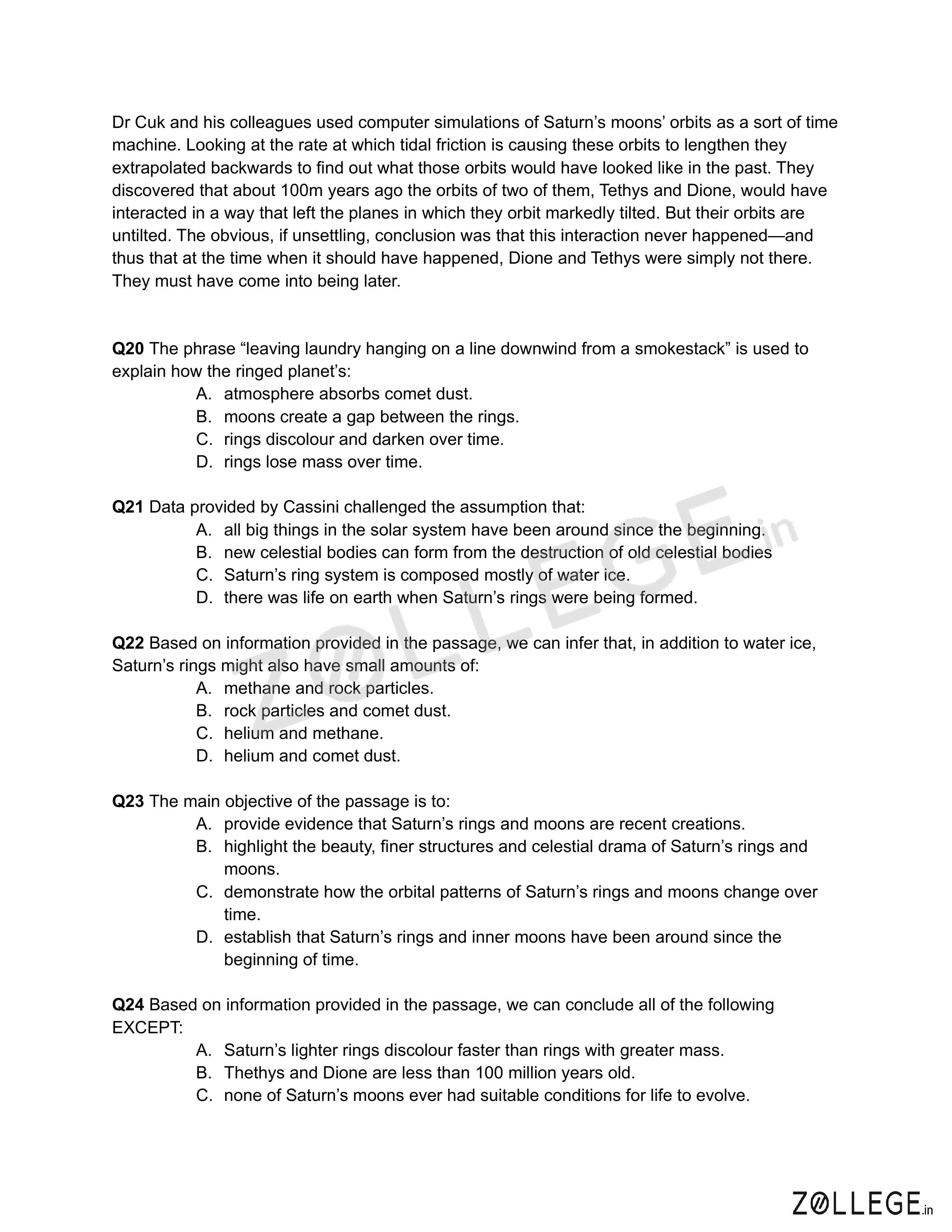
Dr Cuk and his colleagues used computer simulations of Saturn’s moons’ orbits as a sort of
time machine.
Looking at the rate at which tidal friction is causing these orbits to lengthen,
they extrapolated backwards to find out what those orbits would have looked like in the past.
They discovered that about 100m years ago the orbits of two of them, Tethys and Dione,
would have interacted in a way that left the planes in which they orbit markedly tilted.
But their orbits are untilted.
The obvious, if unsettling, conclusion was that this interaction never happened—
and thus that at the time when it should have happened, Dione and Tethys were simply not
there.
They must have come into being later.
The phrase “leaving laundry hanging on a line downwind from a smokestack” is used to explain how the ringed planet’s:
View Solution
The passage compares Saturn’s rings, made mostly of water ice, to clean laundry
and the solar system’s comet dust to pollution coming from a smokestack.
Just like laundry would become dirty if hung downwind from a smokestack, Saturn’s bright rings would darken
when exposed to the constant mist of dark comet dust in space.
This analogy is specifically used to explain how Saturn’s rings, if old, should appear darker than they are.
Since they are still bright, scientists infer that they must be relatively young.
Option (A) – Incorrect. The atmosphere of Saturn is not being discussed in this context.
Option (B) – Irrelevant. Moons creating gaps is not related to the “smokestack” analogy.
Option (C) – Correct. The analogy clearly illustrates how the rings would become discoloured over time.
Option (D) – Not the focus of the analogy. Mass loss is discussed elsewhere but not here.
Therefore, Option (C) is the best interpretation of the comparison.
Quick Tip: When interpreting a metaphor or analogy, identify the specific physical process being illustrated in context.
Data provided by Cassini challenged the assumption that:
View Solution
A central theme in the passage is that Cassini’s data suggests that Saturn’s rings and several of its moons are relatively young
— only 70 to 200 million years old — compared to the age of the solar system.
This contradicts the long-held assumption that planets, moons, and rings have been present since the formation of the solar system.
Option (A) – Correct. The discovery of young rings and moons directly challenges this assumption.
Option (B) – This is actually supported by the theory mentioned in the passage, not contradicted.
Option (C) – Cassini confirmed that Saturn’s rings are composed mostly of water ice; this is not challenged.
Option (D) – The passage mentions life on Earth as a comparison but doesn't challenge any assumption about it.
Hence, Option (A) best captures the assumption challenged by Cassini’s data.
Quick Tip: Focus on key scientific findings in the passage to determine what long-standing ideas they challenge or overturn.
Based on information provided in the passage, we can infer that, in addition to water ice, Saturn’s rings might also have small amounts of:
View Solution
The passage states that Saturn’s rings are made up of more than 90% water ice.
It also explains how comet dust in the solar system causes discoloration of the rings over time.
This implies that comet dust can accumulate in small amounts within the rings.
Additionally, since the rings are made up of debris from earlier moons (as inferred from the theory proposed by Matija Ćuk),
and moons are typically composed of rock and ice, it is reasonable to infer that rock particles are also present in the rings.
Option (A) – Methane is not mentioned in the passage as a component of the rings.
Option (B) – Correct. Both rock particles (from moon remnants) and comet dust are supported by the passage.
Option (C) and (D) – Helium is not referenced at all.
Thus, Option (B) is the best inference based on the passage.
Quick Tip: For inference questions, combine explicit statements with logical connections drawn from the text.
The main objective of the passage is to:
View Solution
The passage opens by discussing the findings of Cassini and quickly pivots to the surprising idea that Saturn’s rings and moons might be relatively young.
It presents multiple strands of evidence:
- The brightness of the rings (indicating low contamination from comet dust),
- Mass measurements suggesting a young age, and
- Orbital simulations of moons like Tethys and Dione supporting their recent emergence.
These details collectively argue against the earlier assumption that such planetary features are as old as the solar system.
Option (A) – Correct. This option captures the central thesis of the passage.
Option (B) – Though beauty is mentioned briefly, it is not the focus.
Option (C) – The passage mentions orbital patterns but uses them to support the age hypothesis, not as the main theme.
Option (D) – This is directly contradicted by the evidence presented.
Hence, the main objective is best captured by Option (A).
Quick Tip: To identify the main objective, look for the conclusion that all examples, data, and theories are collectively supporting.
Based on information provided in the passage, we can conclude all of the following EXCEPT:
View Solution
This is an EXCEPT question, so we are looking for the statement that is not supported by the passage.
Option (A) – This is supported. The passage explains that lighter rings, which have less mass, accumulate celestial “pollution”
(comet dust) more quickly, causing them to darken faster.
Option (B) – Supported. According to orbital simulations, Dione and Tethys must have come into being after the time
when they should have interacted, around 100 million years ago. Therefore, they are likely less than 100 million years old.
Option (C) – This is not supported and is in fact contradicted.
The passage clearly states that Enceladus, one of Saturn’s moons, is considered a promising candidate for harboring life
due to its geological activity and subsurface ocean. Thus, at least one of Saturn’s moons does have suitable conditions.
Option (D) – Supported. The passage presents a theory that Saturn’s current rings and inner moons were formed
from the remains of a previous generation of moons that were destroyed.
Therefore, Option (C) is the only statement that cannot be concluded from the passage.
Quick Tip: In EXCEPT questions, identify the one choice that clearly contradicts the information or inference from the passage.


Quick Links:
*The article might have information for the previous academic years, please refer the official website of the exam.