
CAT 2025 Slot 1 Question Paper DILR: Download Question Paper PDF with Answer Key and Solutions
- Cut Off for IITs
- IIM Kashipur Cut Off
- IIM Amritsar Cut Off
- IIM Nagpur Cut Off
- IIM Indore Cut Off
- IIM Udaipur Cut Off
- IIM Ranchi Cut Off
- IIM Raipur Cut Off
- IIM Jammu Cut Off
- IIM Bodh Gaya Cut Off
- IIM Kozhikode Cut Off
- IIM Sambalpur Cut Off
- IIM Bangalore Cut Off
- IIM Sirmaur Cut Off
- IIM Trichy Cut Off
- IIM Visakhapatnam Cut Off
- IIM Lucknow Cut Off
- IIM Shillong Cut Off
- IIM Calcutta Cut Off
- IIM Ahmedabad Cut Off
- IIM Rohtak Cut Off


Content Writer | Updated On - Jun 25, 2026
CAT 2025 Slot 1 Data Interpretation & Logical Reasoning (DILR) question paper with solutions is available here for free download. The section had 22 questions to be attempted in 40 minutes; download the PDF and check the detailed solution for every question below.
CAT 2025 Slot 1 DILR Question Paper with Solutions PDF
| CAT 2025 Slot 1 DILR Question Paper with Solutions PDF | Download PDF | Check Solutions |
|---|

Comprehension:
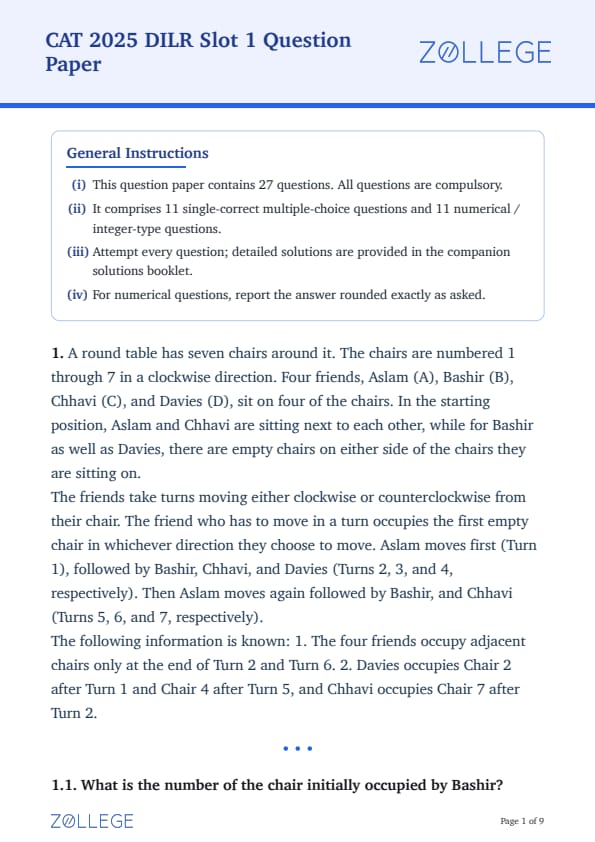
A round table has seven chairs around it. The chairs are numbered 1 through 7 in a clockwise direction. Four friends, Aslam (A), Bashir (B), Chhavi (C), and Davies (D), sit on four of the chairs. In the starting position, Aslam and Chhavi are sitting next to each other, while for Bashir as well as Davies, there are empty chairs on either side of the chairs they are sitting on.
The friends take turns moving either clockwise or counterclockwise from their chair. The friend who has to move in a turn occupies the first empty chair in whichever direction they choose to move. Aslam moves first (Turn 1), followed by Bashir, Chhavi, and Davies (Turns 2, 3, and 4, respectively). Then Aslam moves again followed by Bashir, and Chhavi (Turns 5, 6, and 7, respectively).
The following information is known:
1. The four friends occupy adjacent chairs only at the end of Turn 2 and Turn 6.
2. Davies occupies Chair 2 after Turn 1 and Chair 4 after Turn 5, and Chhavi occupies Chair 7 after Turn 2.
Question 1:
What is the number of the chair initially occupied by Bashir?
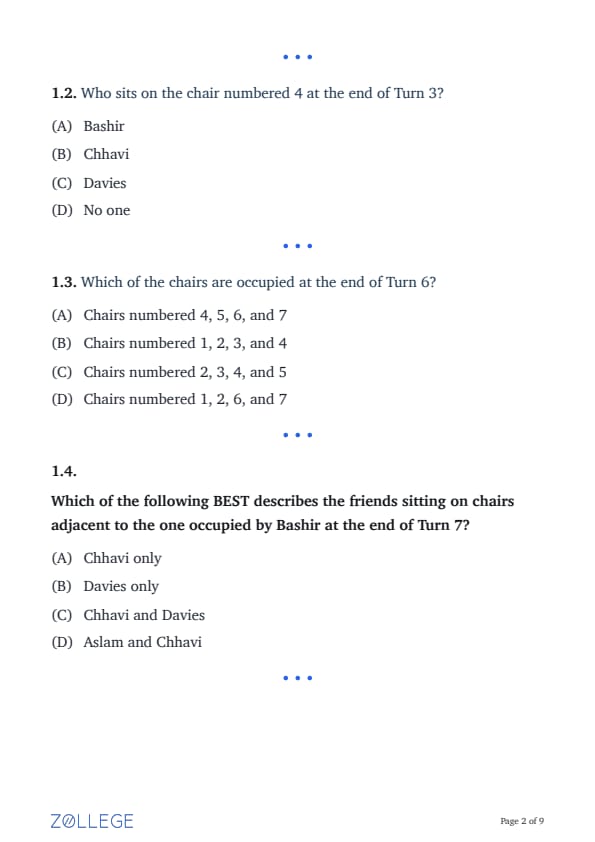
Who sits on the chair numbered 4 at the end of Turn 3?
Which of the chairs are occupied at the end of Turn 6?
Which of the following BEST describes the friends sitting on chairs adjacent to the one occupied by Bashir at the end of Turn 7?
Comprehension:
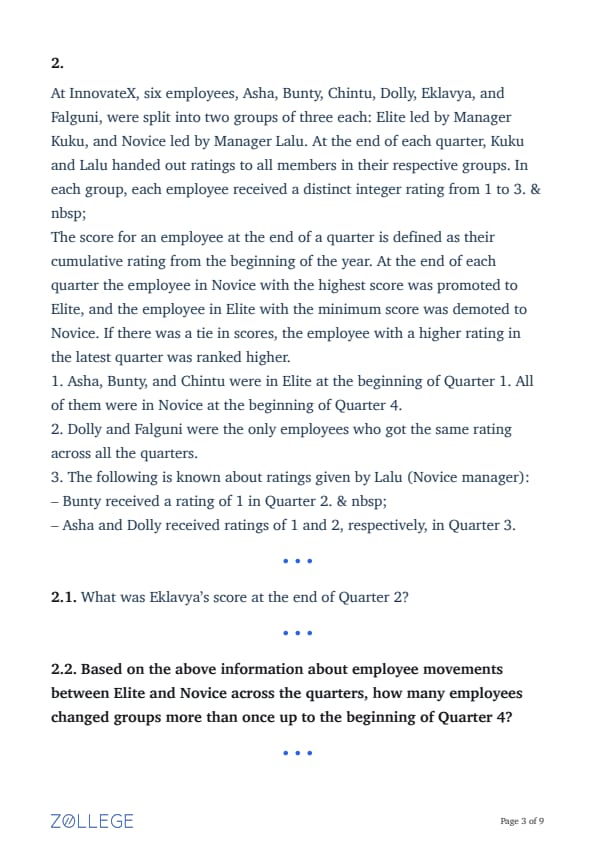
At InnovateX, six employees, Asha, Bunty, Chintu, Dolly, Eklavya, and Falguni, were split into two groups of three each: Elite led by Manager Kuku, and Novice led by Manager Lalu.
At the end of each quarter, Kuku and Lalu handed out ratings to all members in their respective groups. In each group, each employee received a distinct integer rating from 1 to 3.
The score for an employee at the end of a quarter is defined as their cumulative rating from the beginning of the year. At the end of each quarter the employee in Novice with the highest score was promoted to Elite, and the employee in Elite with the minimum score was demoted to Novice. If there was a tie in scores, the employee with a higher rating in the latest quarter was ranked higher.
[1.] Asha, Bunty, and Chintu were in Elite at the beginning of Quarter 1. All of them were in Novice at the beginning of Quarter 4.
[2.] Dolly and Falguni were the only employees who got the same rating across all the quarters.
[3.] The following is known about ratings given by Lalu (Novice manager):
Bunty received a rating of 1 in Quarter 2.
Asha and Dolly received ratings of 1 and 2, respectively, in Quarter 3.
Question 5:
What was Eklavya’s score at the end of Quarter 2?
Based on the above information about employee movements between Elite and Novice across the quarters, how many employees changed groups more than once up to the beginning of Quarter 4?
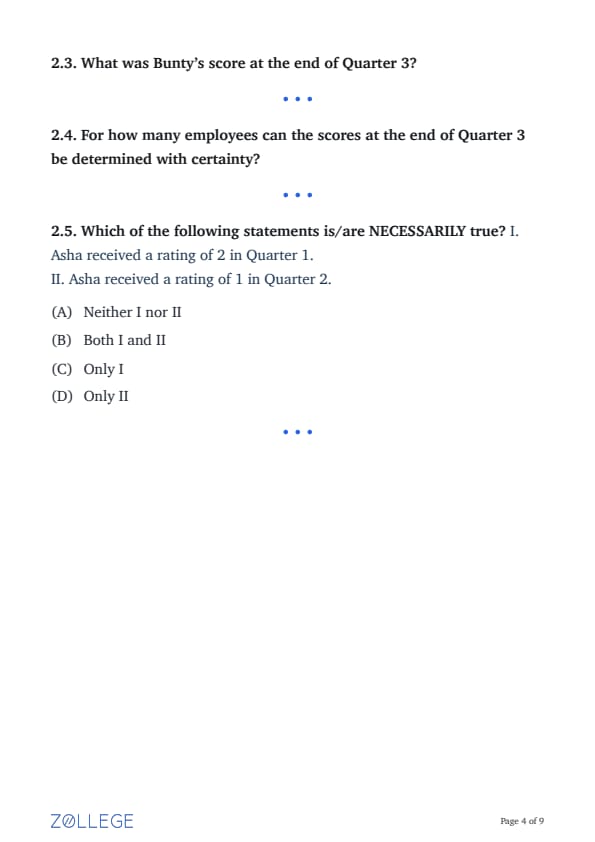
What was Bunty’s score at the end of Quarter 3?
For how many employees can the scores at the end of Quarter 3 be determined with certainty?
Which of the following statements is/are NECESSARILY true?
I. Asha received a rating of 2 in Quarter 1.
II. Asha received a rating of 1 in Quarter 2.
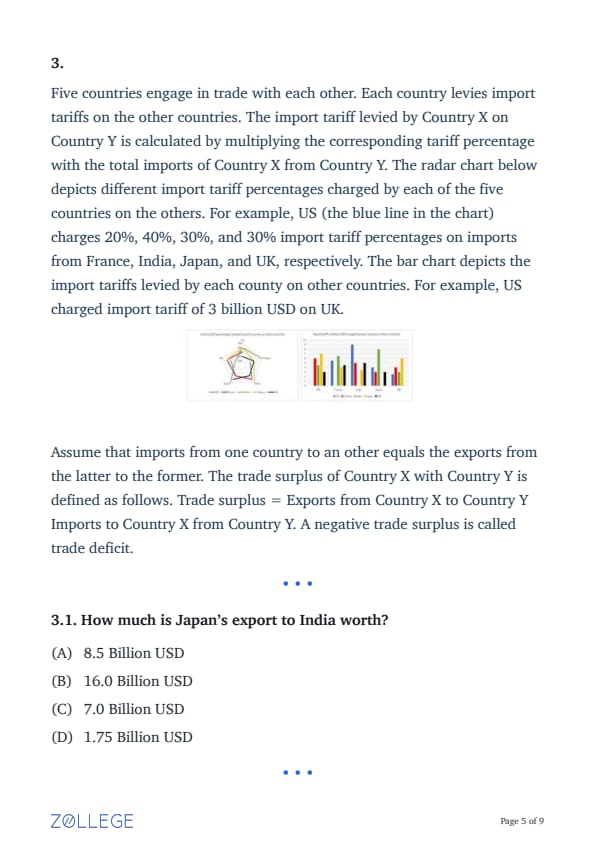
How much is Japan’s export to India worth?
Which among the following is the highest?
1. Exports by Japan to UK
2. Imports by US from France
3. Exports by France to Japan
4. Imports by France from India
What is the trade surplus/trade deficit of India with UK?
1. Surplus of 15.0 Billion USD
2. Deficit of 15.0 Billion USD
3. Surplus of 10.0 Billion USD
4. Deficit of 10.0 Billion USD
Among France and UK, who has/have trade surplus(es) with US?
1. Neither France nor UK
2. Both France and UK
3. Only UK
4 Only France
Comprehension:
A train travels from Station A to Station E, passing through stations B, C, and D, in that order. The train has a seating capacity of 200. A ticket may be booked from any station to any other station ahead on the route, but not to any earlier station.
A ticket from one station to another reserves one seat on every intermediate segment of the route. For example, a ticket from B to E reserves a seat in the intermediate segments B – C, C – D, and D – E.
The occupancy factor for a segment is the total number of seats reserved in the segment as a percentage of the seating capacity. The total number of seats reserved for any segment cannot exceed 200.
The following information is known.
1. Segment C – D had an occupancy factor of 95%. Only segment B – C had a higher occupancy factor.
2. Exactly 40 tickets were booked from B to C and 30 tickets were booked from B to E.
3. Among the seats reserved on segment D – E, exactly four-sevenths were from stations before C.
4. The number of tickets booked from A to C was equal to that booked from A to E, and it was higher than that from B to E.
5. No tickets were booked from A to B, from B to D and from D to E.
6. The number of tickets booked for any segment was a multiple of 10.
Question 14:
What was the occupancy factor for segment D–E?
1. 35%
2. 70%
3. 77%
4. 84%
How many tickets were booked from Station A to Station E?
How many tickets were booked from Station C?
What is the difference between the number of tickets booked to Station C and the number of tickets booked to Station D?
How many tickets were booked to travel in exactly one segment?
Comprehension:
Alia, Badal, Clive, Dilshan, and Ehsaan played a game in which each asks a unique question to all the others and they respond by tapping their feet, either once or twice or thrice. One tap means “Yes”, two taps mean “No”, and three taps mean “Maybe”.
A total of 40 taps were heard across the five questions. Each question received at least one “Yes”, one “No”, and one “Maybe.”
The following information is known.
1. Alia tapped a total of 6 times and received 9 taps to her question. She responded “Yes” to the questions asked by both Clive and Dilshan.
2. Dilshan and Ehsaan tapped a total of 11 and 9 times respectively. Dilshan responded “No” to Badal.
3. Badal, Dilshan, and Ehsaan received equal number of taps to their respective questions.
4. No one responded “Yes” more than twice.
5. No one’s answer to Alia’s question matched the answer that Alia gave to that person’s question. This was also true for Ehsaan.
6. Clive tapped more times in total than Badal.
Question 19:
How many taps did Clive receive for his question?
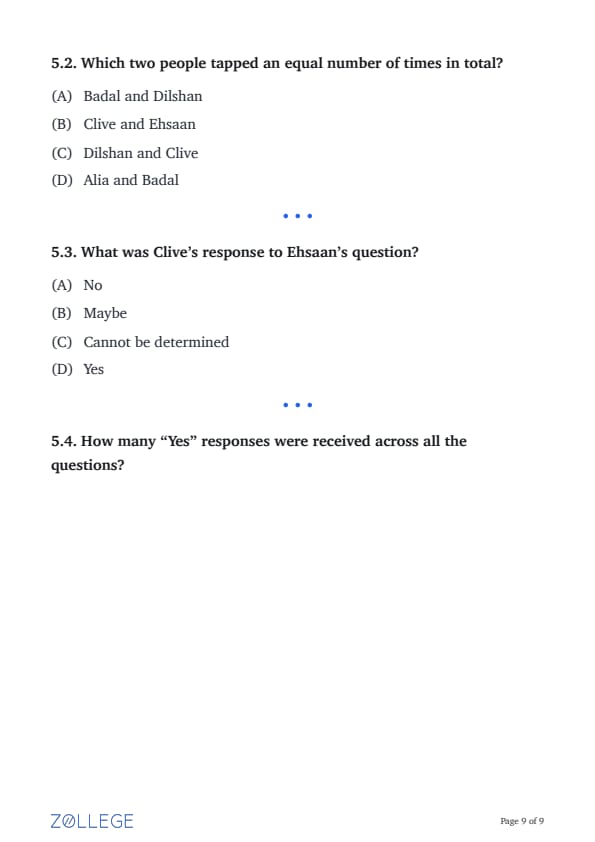
Which two people tapped an equal number of times in total?
What was Clive’s response to Ehsaan’s question?
How many “Yes” responses were received across all the questions?
CAT 2025 Difficulty Level Analysis
| Section | Number of Questions | Total Marks | Difficulty Level | Time Required (Avg.) | Strategy |
| Verbal Ability and Reading Comprehension (VARC) | 24 | 72 | Moderate | 60 mins | Focus on speed reading and eliminating incorrect options |
| Data Interpretation and Logical Reasoning (DILR) | 22 | 66 | High | 40-45 mins | Prioritize easier questions first; manage time carefully |
| Quantitative Ability (QA) | 22 | 66 | Moderate to High | 60 mins | Solve easy questions first; focus on accuracy |
| Overall | 68 | 204 | Moderate to High | 180 mins | Time management is key; balance speed and accuracy |
CAT 2025 Most Expected Questions
*The article might have information for the previous academic years, please refer the official website of the exam.