
CAT 2025 Slot 1 Question Paper VARC: Download Question Paper with Solution Pdf
- Cut Off for IITs
- IIM Kashipur Cut Off
- IIM Amritsar Cut Off
- IIM Nagpur Cut Off
- IIM Indore Cut Off
- IIM Udaipur Cut Off
- IIM Ranchi Cut Off
- IIM Raipur Cut Off
- IIM Jammu Cut Off
- IIM Bodh Gaya Cut Off
- IIM Kozhikode Cut Off
- IIM Sambalpur Cut Off
- IIM Bangalore Cut Off
- IIM Sirmaur Cut Off
- IIM Trichy Cut Off
- IIM Visakhapatnam Cut Off
- IIM Lucknow Cut Off
- IIM Shillong Cut Off
- IIM Calcutta Cut Off
- IIM Ahmedabad Cut Off
- IIM Rohtak Cut Off


Content Writer | Updated On - Jun 25, 2026
CAT 2025 Slot 1 Verbal Ability & Reading Comprehension (VARC) question paper with solutions is available here for free download. The section had 24 questions to be attempted in 40 minutes; download the PDF and check the detailed solution for every question below.
CAT 2025 Slot 1 VARC Question Paper with Solutions PDF
| CAT 2025 Slot 1 VARC Question Paper with Solutions PDF | Download PDF | Check Solutions |
|---|
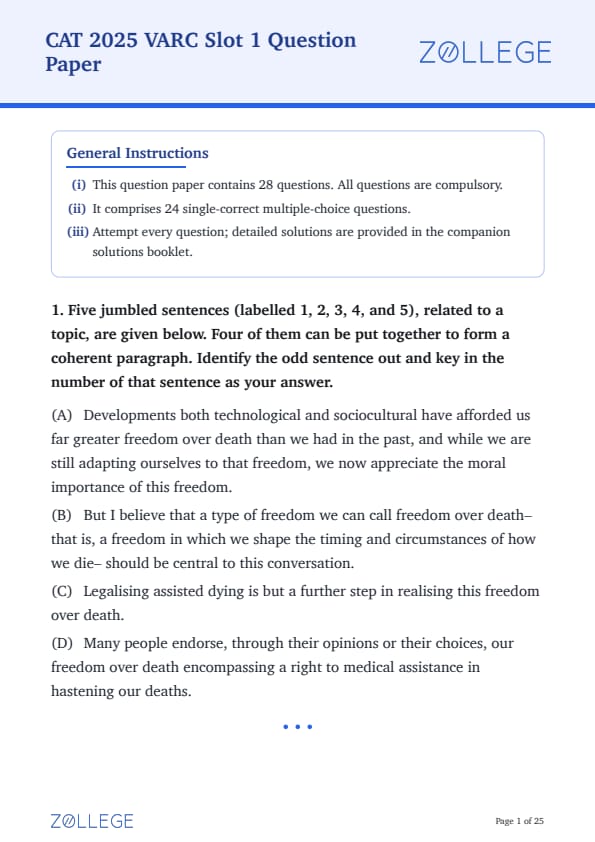

Five jumbled sentences (labelled 1, 2, 3, 4, and 5), related to a topic, are given below. Four of them can be put together to form a coherent paragraph. Identify the odd sentence out and key in the number of that sentence as your answer.
1. Developments both technological and sociocultural have afforded us far greater freedom over death than we had in the past, and while we are still adapting ourselves to that freedom, we now appreciate the moral importance of this freedom.
2. But I believe that a type of freedom we can call freedom over death - that is, a freedom in which we shape the timing and circumstances of how we die - should be central to this conversation.
3. Legalising assisted dying is but a further step in realising this freedom over death.
4. Many people endorse, through their opinions or their choices, our freedom over death encompassing a right to medical assistance in hastening our deaths.
5. Freedom is a notoriously complex and contested philosophical notion, and I won't pretend to settle any of the big controversies it raises.
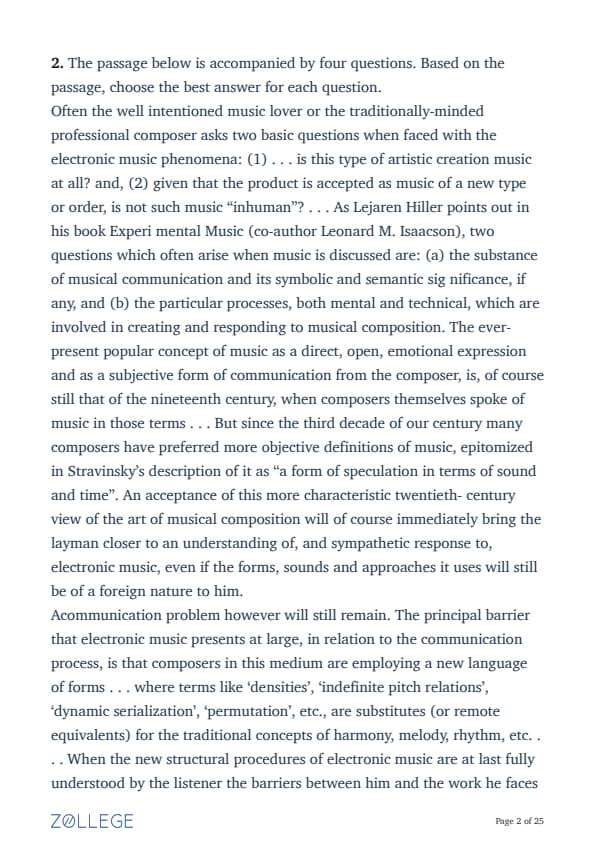
Comprehension: The passage below is accompanied by four questions. Based on the
passage, choose the best answer for each question.
Often the well intentioned music lover or the traditionally-minded professional composer asks two basic questions when faced with the electronic music phenomena: (1) . is this type of artistic creation music at all? and, (2) given that the product is accepted as music of a new type or order, is not such music “inhuman"? . As Lejaren Hiller points out in his book Experimental Music (co-author Leonard M. Isaacson), two questions which often arise when music is discussed are: (a) the substance of musical communication and its symbolic and semantic significance, if any, and (b) the particular processes, both mental and technical, which are involved in creating and responding to musical composition. The ever-present popular concept of music as a direct, open, emotional expression and as a subjective form of communication from the composer, is, of course still that of the nineteenth century, when composers themselves spoke of music in those terms But since the third decade of our century many composers have preferred more objective definitions of music, epitomized in Stravinsky's description of it as “a form of speculation in terms of sound and time”. An acceptance of this more characteristic twentieth- century view of the art of musical composition will of course immediately bring the layman closer to an understanding of, and sympathetic response to, electronic music, even if the forms, sounds and approaches it uses will still be of a foreign nature to him.
A communication problem however will still remain. The principal barrier that electronic music presents at large, in relation to the communication process, is that composers in this medium are employing a new language of forms... where terms like 'densities', 'indefinite pitch relations', 'dynamic serialization', ‘permutation', etc., are substitutes (or remote equivalents) for the traditional concepts of harmony, melody, rhythm, etc. ... When the new structural procedures of electronic music are at last fully understood by the listener the barriers between him and the work he faces will be removed.
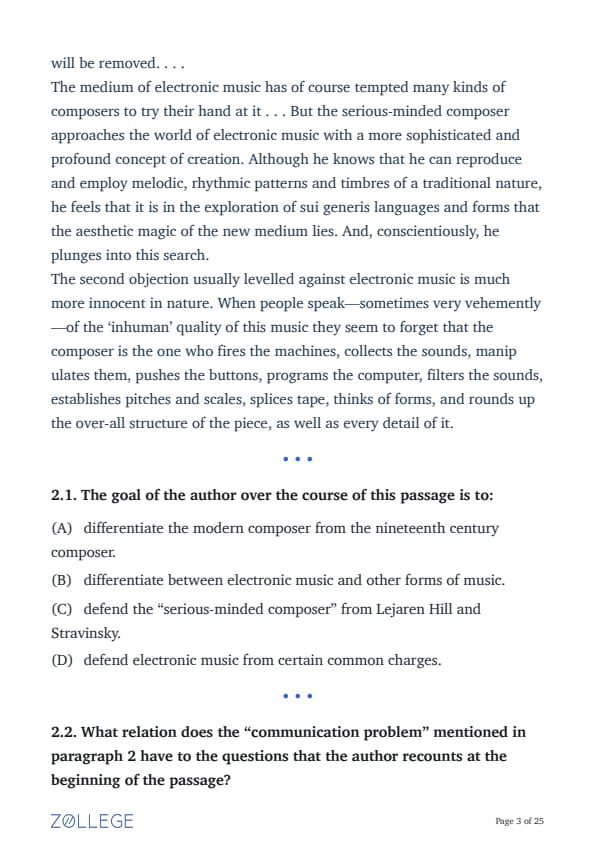
The medium of electronic music has of course tempted many kinds of composers to try their hand at it . But the serious-minded composer approaches the world of electronic music with a more sophisticated and profound concept of creation. Although he knows that he can reproduce and employ melodic, rhythmic patterns and timbres of a traditional nature, he feels that it is in the exploration of sui generis languages and forms that the aesthetic magic of the new medium lies. And, conscientiously, he plunges into this search.
The second objection usually levelled against electronic music is much more innocent in nature. When people speak—sometimes very vehemently—of the 'inhuman' quality of this music they seem to forget that the composer is the one who fires the machines, collects the sounds, manipulates them, pushes the buttons, programs the computer, filters the sounds, establishes pitches and scales, splices tape, thinks of forms, and rounds up the over-all structure of the piece, as well as every detail of it.
Question 2:
The goal of the author over the course of this passage is to:
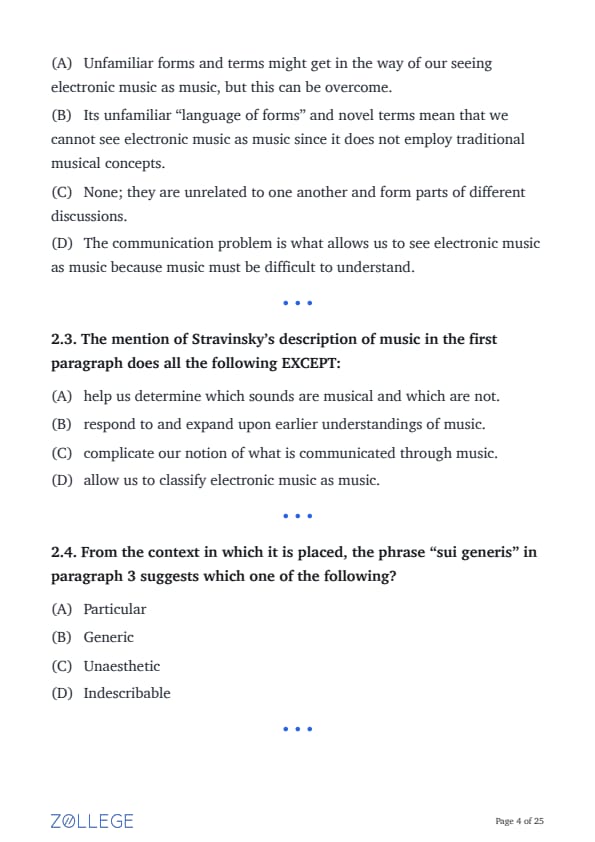
What relation does the “communication problem” mentioned in paragraph 2 have to the questions that the author recounts at the beginning of the passage?
The mention of Stravinsky's description of music in the first paragraph does all the following EXCEPT:
From the context in which it is placed, the phrase “sui generis" in paragraph 3 suggests which one of the following?
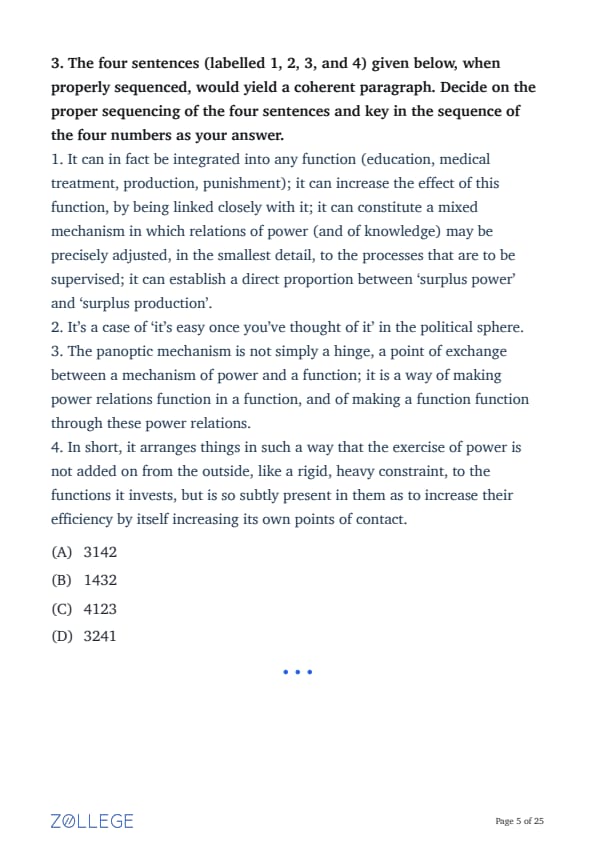
The four sentences (labelled 1, 2, 3, and 4) given below, when properly sequenced, would yield a coherent paragraph. Decide on the proper sequencing of the four sentences and key in the sequence of the four numbers as your answer.
1. It can in fact be integrated into any function (education, medical treatment, production, punishment); it can increase the effect of this function, by being linked closely with it; it can constitute a mixed mechanism in which relations of power (and of knowledge) may be precisely adjusted, in the smallest detail, to the processes that are to be supervised; it can establish a direct proportion between ‘surplus power' and 'surplus production'.
2. It's a case of 'it's easy once you've thought of it' in the political sphere.
3. The panoptic mechanism is not simply a hinge, a point of exchange between a mechanism of power and a function; it is a way of making power relations function in a function, and of making a function function through these power relations.
4. In short, it arranges things in such a way that the exercise of power is not added on from the outside, like a rigid, heavy constraint, to the functions it invests, but is so subtly present in them as to increase their efficiency by itself increasing its own points of contact.
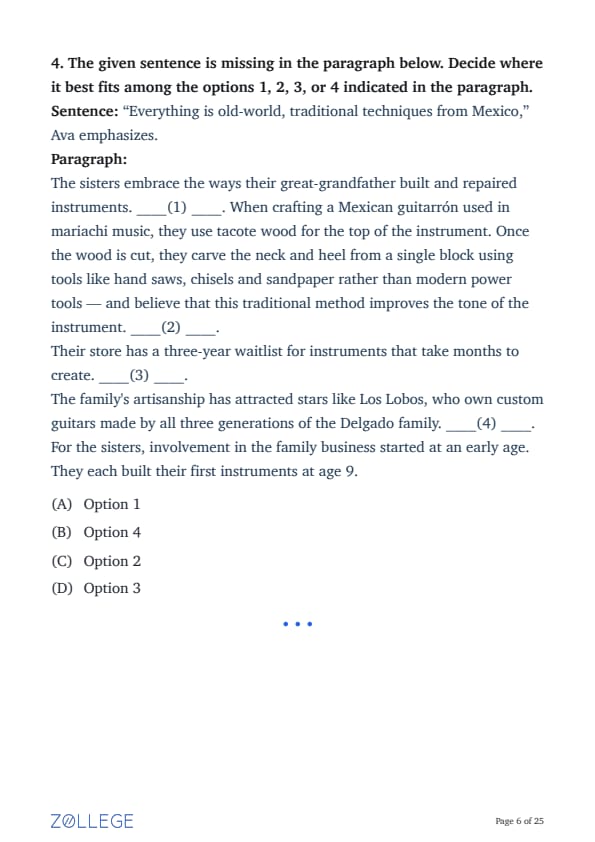
The given sentence is missing in the paragraph below. Decide where it best fits among the options 1, 2, 3, or 4 indicated in the paragraph.
Sentence: “Everything is old-world, traditional techniques from Mexico,” Ava emphasizes.
Paragraph: The sisters embrace the ways their great-grandfather built and repaired instruments. (1) When crafting a Mexican guitarrón used in mariachi music, they use tacote wood for the top of the instrument. Once the wood is cut, they carve the neck and heel from a single block using tools like hand saws, chisels and sandpaper rather than modern power tools — and believe that this traditional method improves the tone of the instrument. (2) Their store has a three-year waitlist for instruments that take months to create. (3) The family's artisanship has attracted stars like Los Lobos, who own custom guitars made by all three generations of the Delgado family. (4) For the sisters, involvement in the family business started at an early age. They each built their first instruments at age 9.
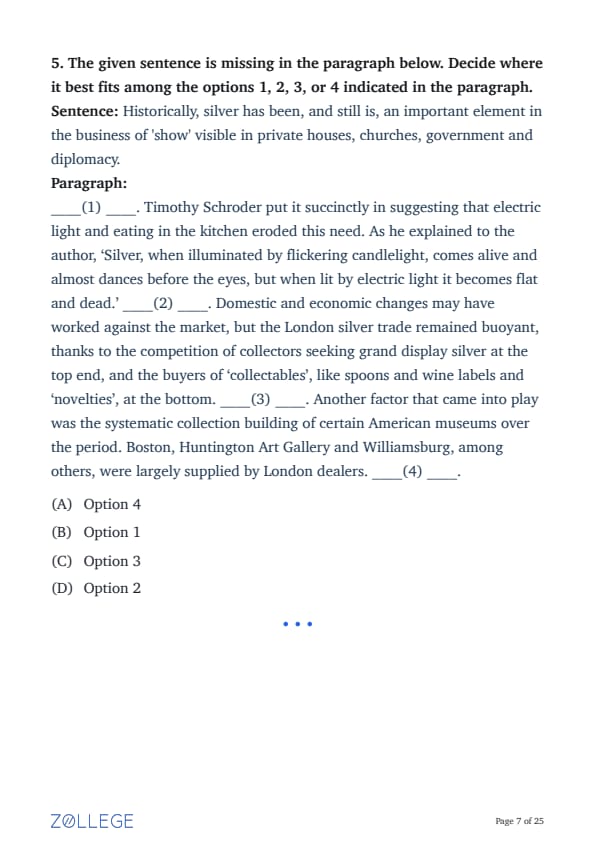
The given sentence is missing in the paragraph below. Decide where it best fits among the options 1, 2, 3, or 4 indicated in the paragraph.
Sentence: Historically, silver has been, and still is, an important element in the business of 'show' visible in private houses, churches, government and diplomacy.
Paragraph: (1) Timothy Schroder put it succinctly in suggesting that electric light and eating in the kitchen eroded this need. As he explained to the author, ‘Silver, when illuminated by flickering candlelight, comes alive and almost dances before the eyes, but when lit by electric light it becomes flat and dead.’ (2) Domestic and economic changes may have worked against the market, but the London silver trade remained buoyant, thanks to the competition of collectors seeking grand display silver at the top end, and the buyers of ‘collectables’, like spoons and wine labels and ‘novelties’, at the bottom. (3) Another factor that came into play was the systematic collection building of certain American museums over the period. Boston, Huntington Art Gallery and Williamsburg, among others, were largely supplied by London dealers. (4)
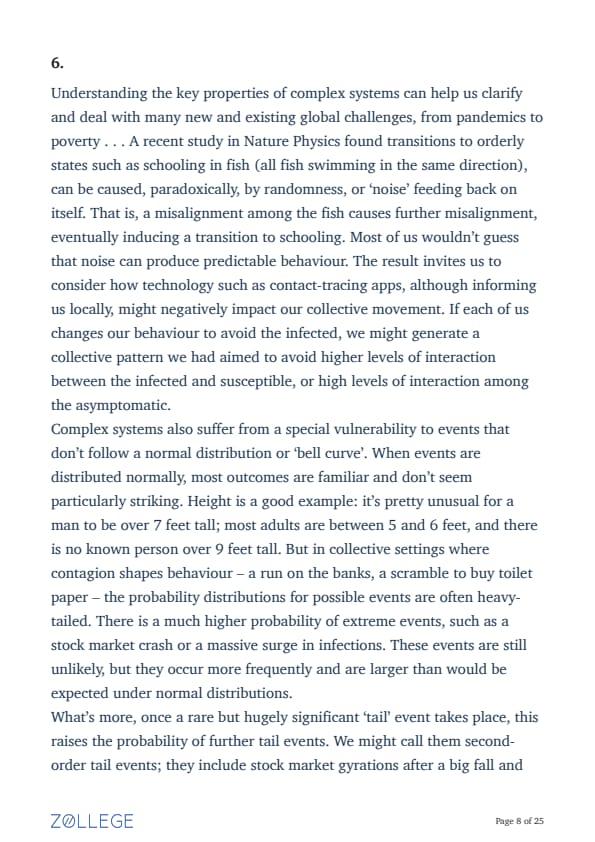
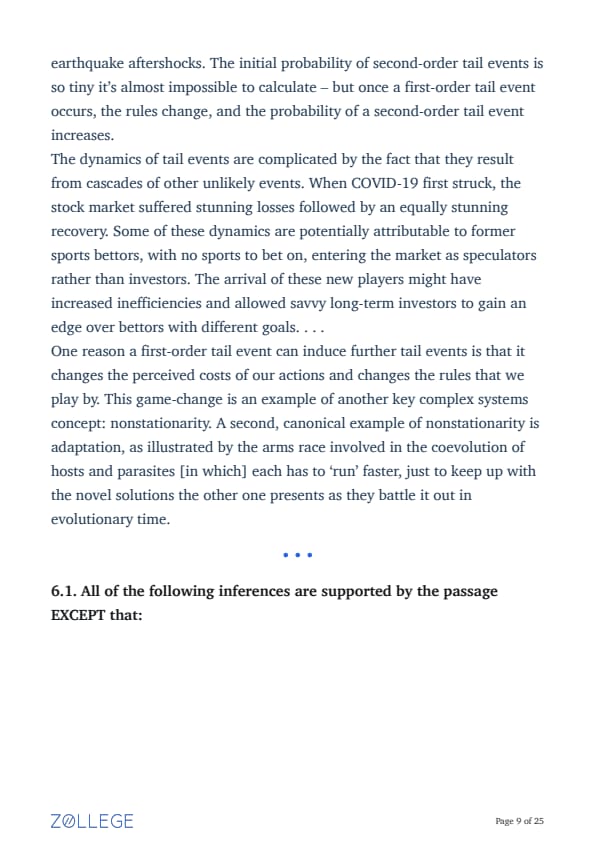
All of the following inferences are supported by the passage EXCEPT that:
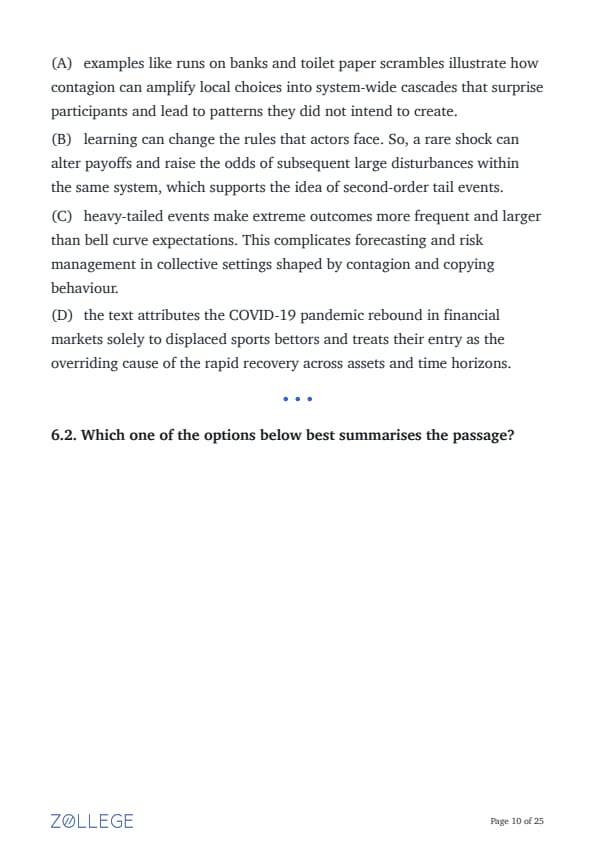
Which one of the options below best summarises the passage?
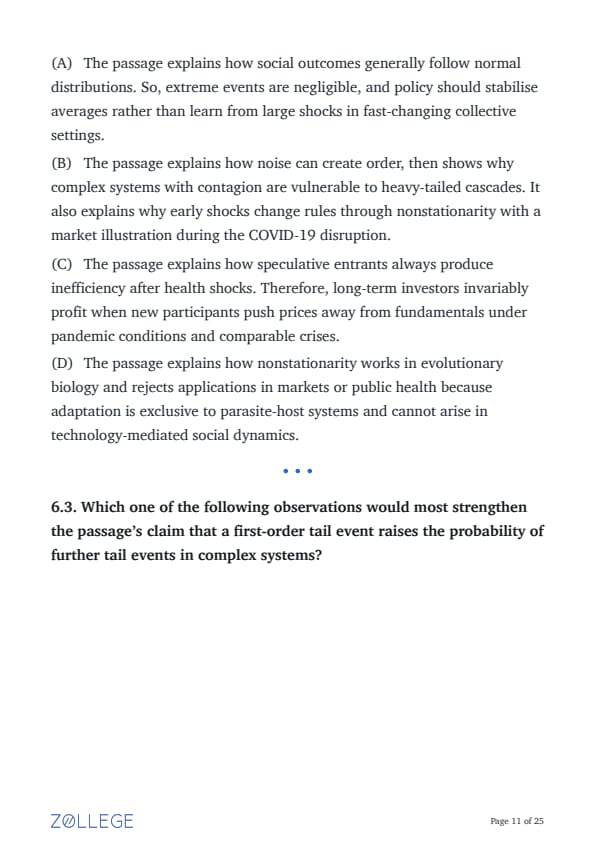
Which one of the following observations would most strengthen the passage's claim that a first-order tail event raises the probability of further tail events in complex systems?
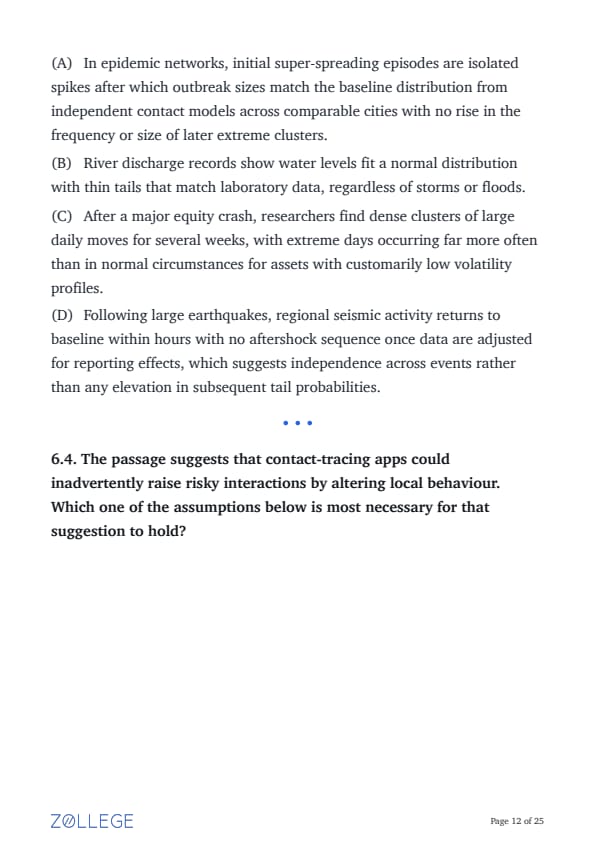
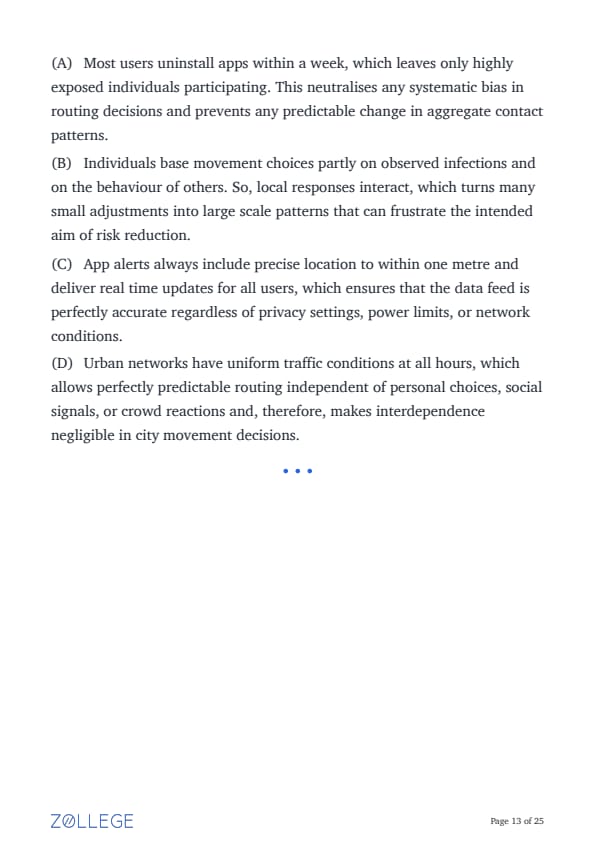
The passage suggests that contact-tracing apps could inadvertently raise risky interactions by altering local behaviour. Which one of the assumptions below is most necessary for that suggestion to hold?
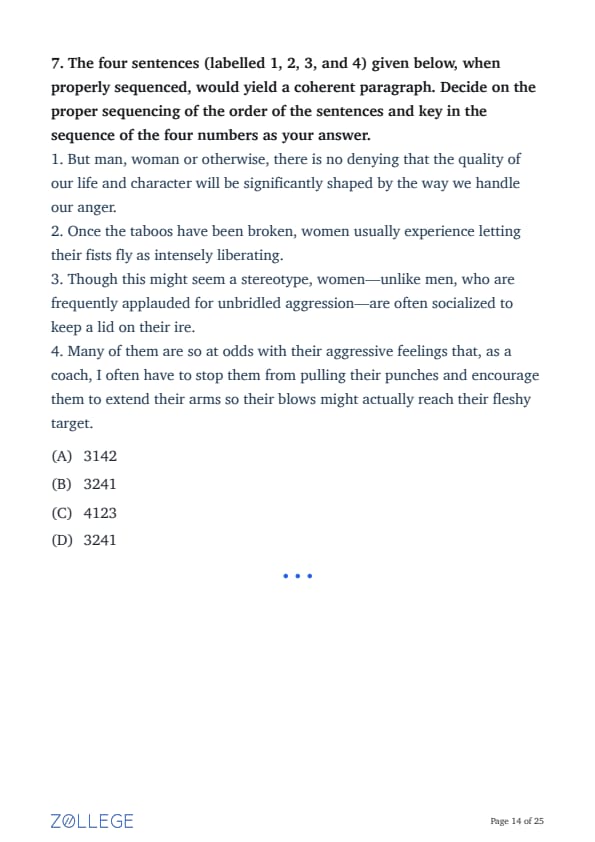
The four sentences (labelled 1, 2, 3, and 4) given below, when properly sequenced, would yield a coherent paragraph. Decide on the proper sequencing of the order of the sentences and key in the sequence of the four numbers as your answer.
1. But man, woman or otherwise, there is no denying that the quality of our life and character will be significantly shaped by the way we handle our anger.
2. Once the taboos have been broken, women usually experience letting their fists fly as intensely liberating.
3. Though this might seem a stereotype, women—unlike men, who are frequently applauded for unbridled aggression—are often socialized to keep a lid on their ire.
4. Many of them are so at odds with their aggressive feelings that, as a coach, I often have to stop them from pulling their punches and encourage them to extend their arms so their blows might actually reach their fleshy target.
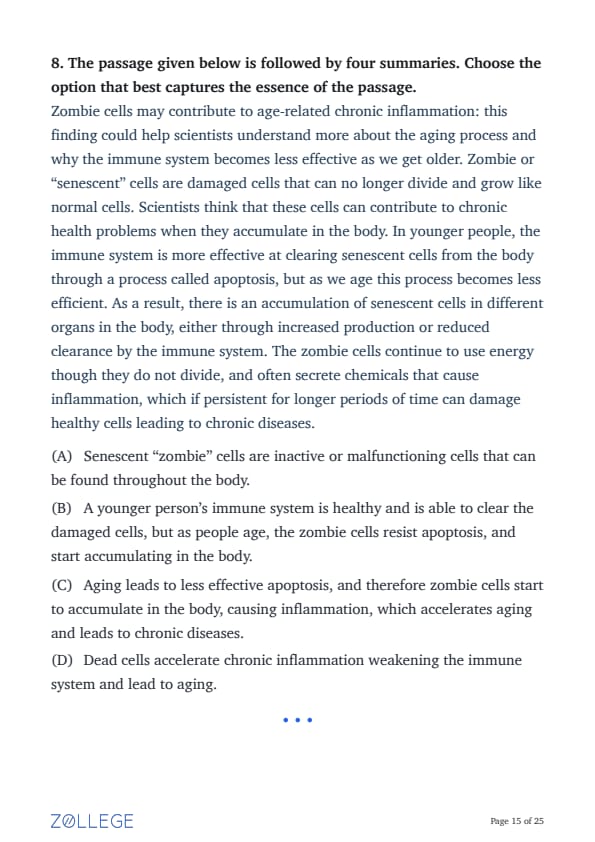
The passage given below is followed by four summaries. Choose the option that best captures the essence of the passage.
Zombie cells may contribute to age-related chronic inflammation: this finding could help scientists understand more about the aging process and why the immune system becomes less effective as we get older. Zombie or “senescent” cells are damaged cells that can no longer divide and grow like normal cells. Scientists think that these cells can contribute to chronic health problems when they accumulate in the body. In younger people, the immune system is more effective at clearing senescent cells from the body through a process called apoptosis, but as we age this process becomes less efficient. As a result, there is an accumulation of senescent cells in different organs in the body, either through increased production or reduced clearance by the immune system. The zombie cells continue to use energy though they do not divide, and often secrete chemicals that cause inflammation, which if persistent for longer periods of time can damage healthy cells leading to chronic diseases.
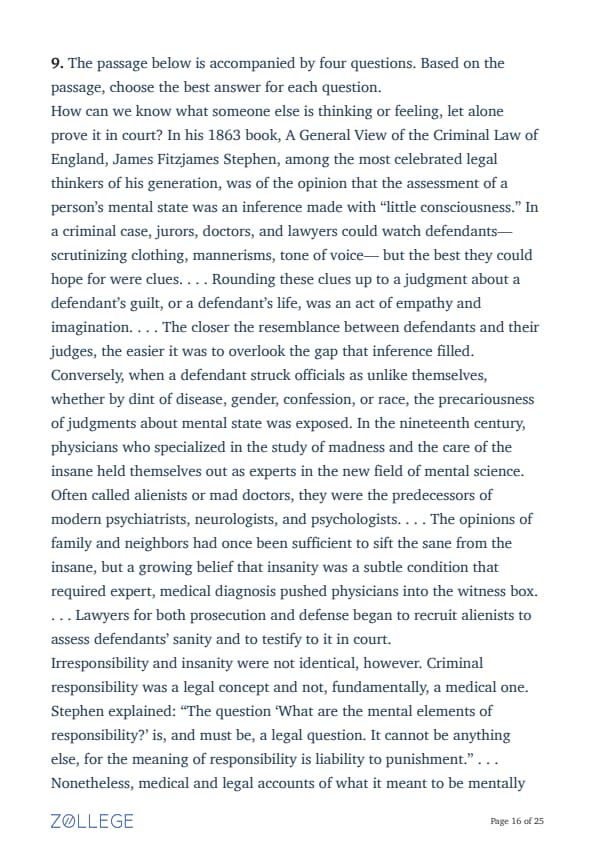
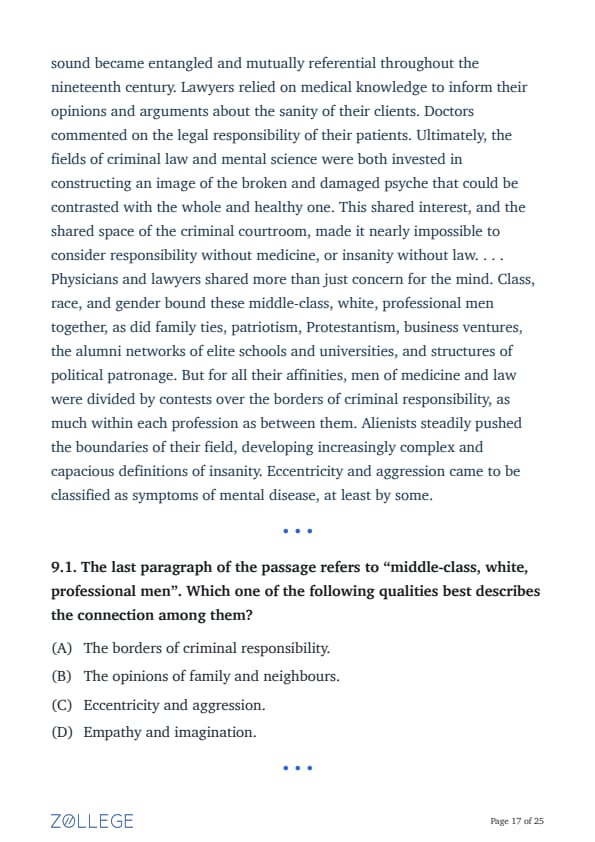
The last paragraph of the passage refers to “middle-class, white, professional men". Which one of the following qualities best describes the connection among them?
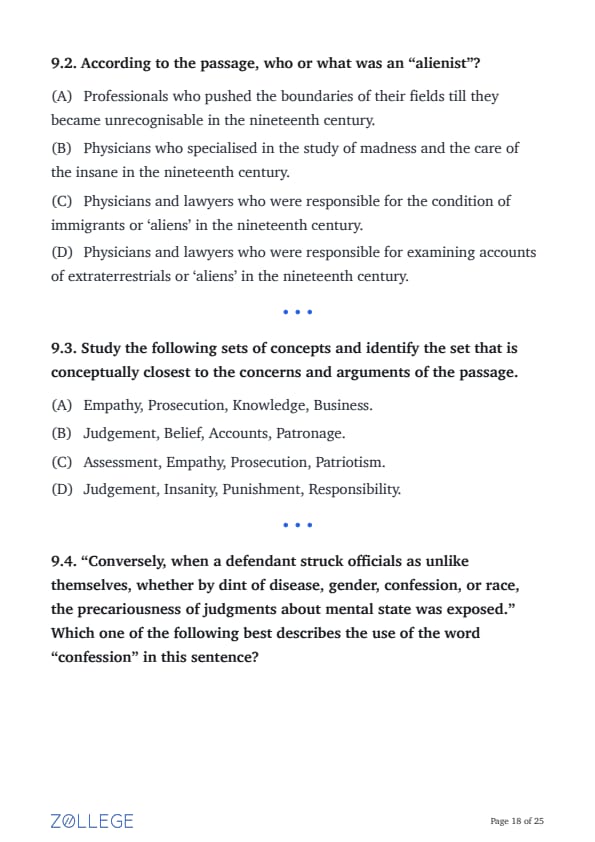
According to the passage, who or what was an "alienist"?
Study the following sets of concepts and identify the set that is conceptually closest to the concerns and arguments of the passage.
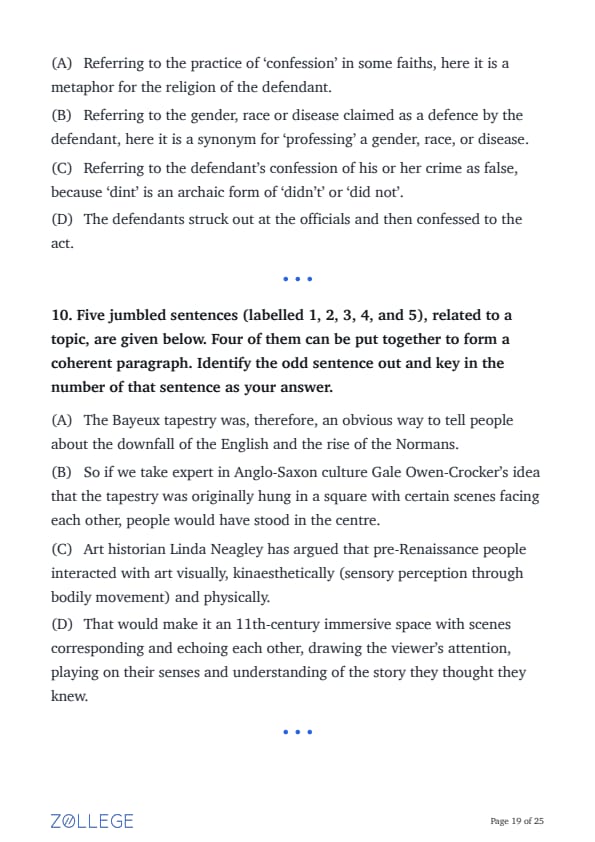
"Conversely, when a defendant struck officials as unlike themselves, whether by dint of disease, gender, confession, or race, the precariousness of judgments about mental state was exposed.” Which one of the following best describes the use of the word “confession" in this sentence?
Five jumbled sentences (labelled 1, 2, 3, 4, and 5), related to a topic, are given below. Four of them can be put together to form a coherent paragraph. Identify the odd sentence out and key in the number of that sentence as your answer.
1. The Bayeux tapestry was, therefore, an obvious way to tell people about the downfall of the English and the rise of the Normans.
2. So if we take expert in Anglo-Saxon culture Gale Owen-Crocker's idea that the tapestry was originally hung in a square with certain scenes facing each other, people would have stood in the centre.
3. Art historian Linda Neagley has argued that pre-Renaissance people interacted with art visually, kinaesthetically (sensory perception through bodily movement) and physically.
4. That would make it an 11th-century immersive space with scenes corresponding and echoing each other, drawing the viewer's attention, playing on their senses and understanding of the story they thought they knew.
5. The Bayeux tapestry would have been hung at eye level to enable this.
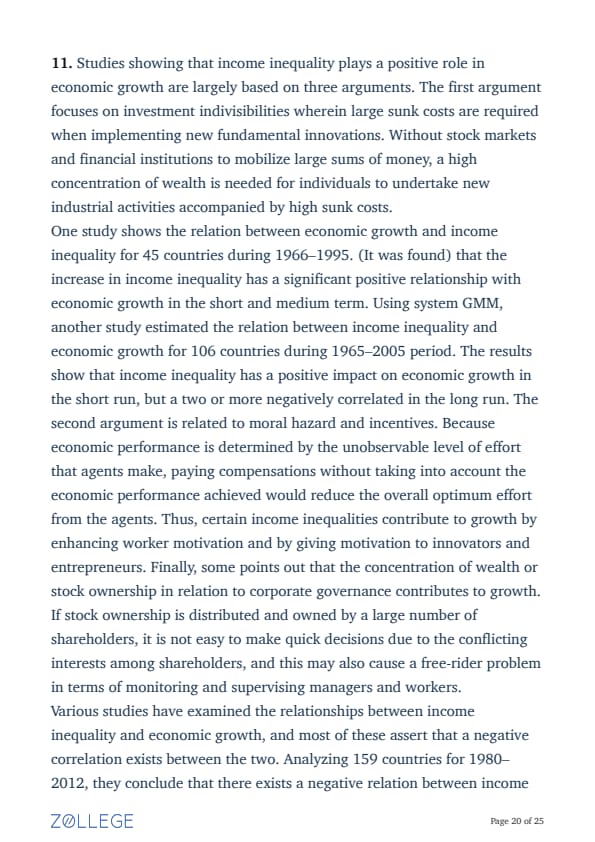
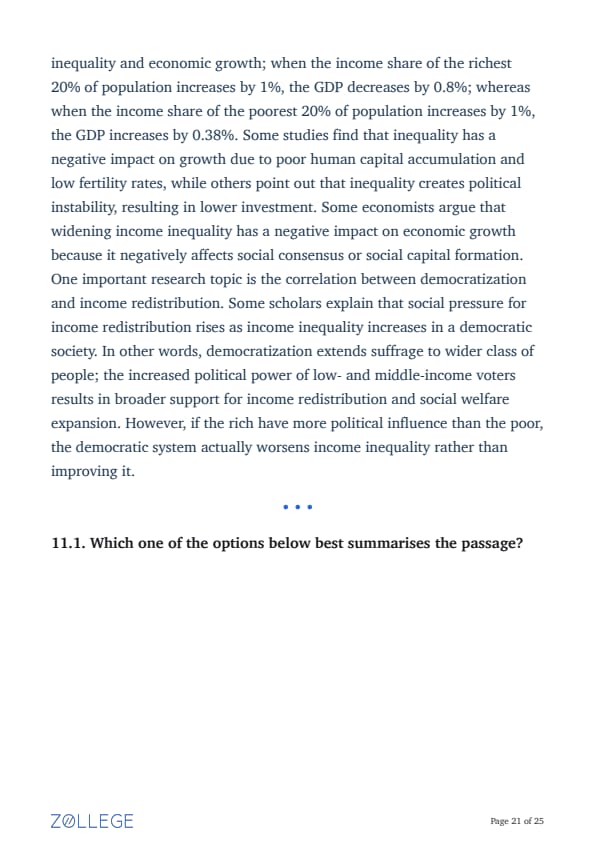
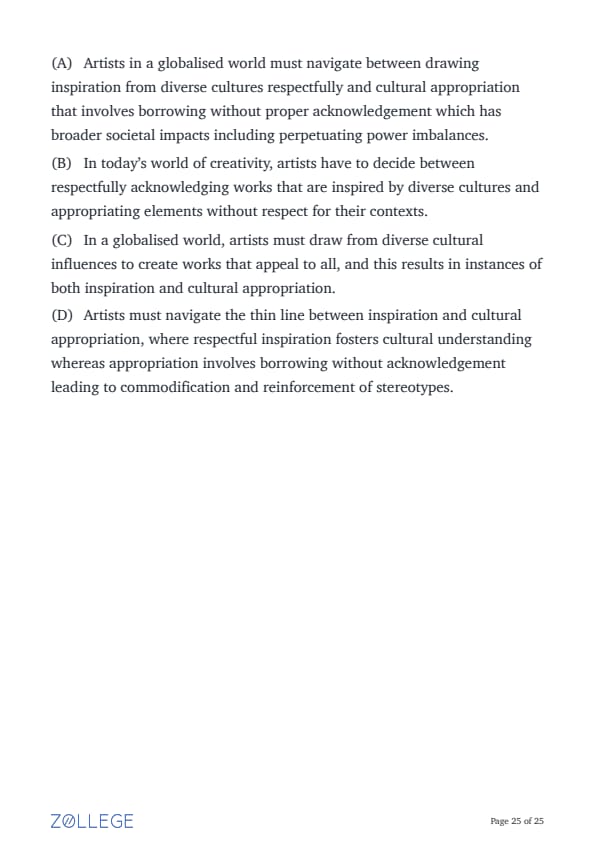
Which one of the options below best summarises the passage?
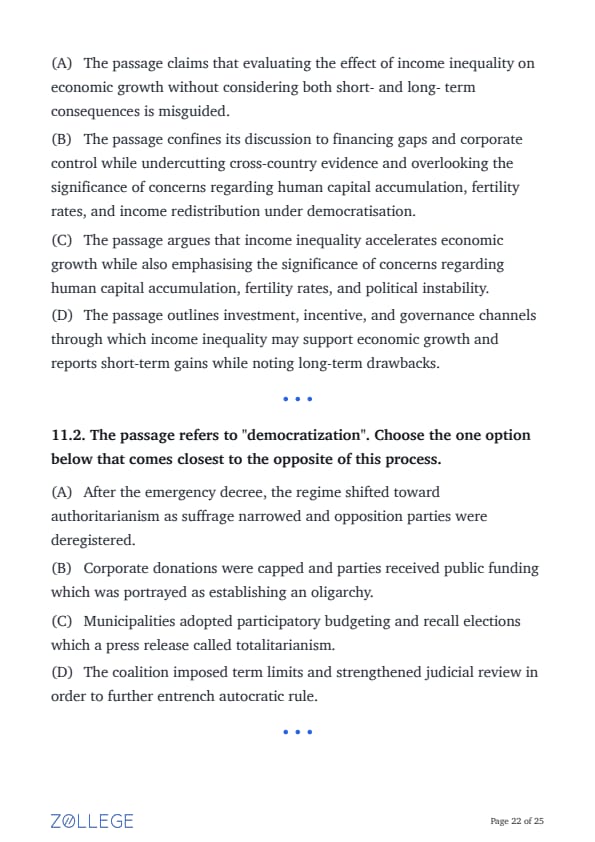
The passage refers to "democratization”. Choose the one option below that comes closest to the opposite of this process.
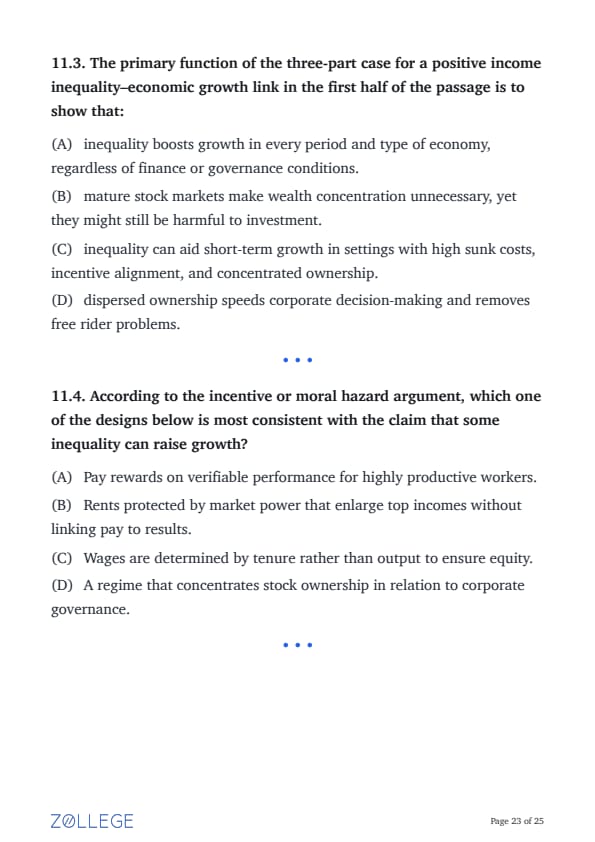
The primary function of the three-part case for a positive income inequality-economic growth link in the first half of the passage is to show that:
According to the incentive or moral hazard argument, which one of the designs below is most consistent with the claim that some inequality can raise growth?
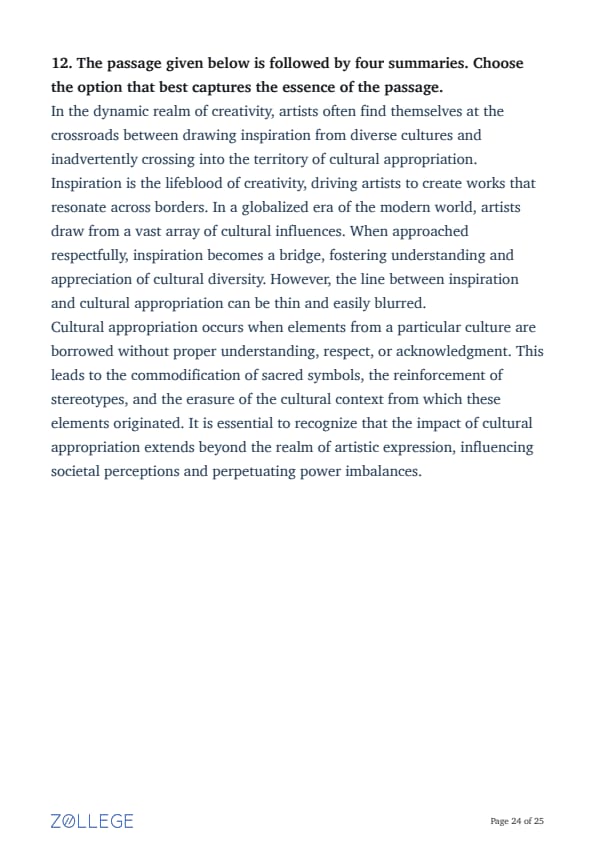
The passage given below is followed by four summaries. Choose the option that best captures the essence of the passage.
*The article might have information for the previous academic years, please refer the official website of the exam.