
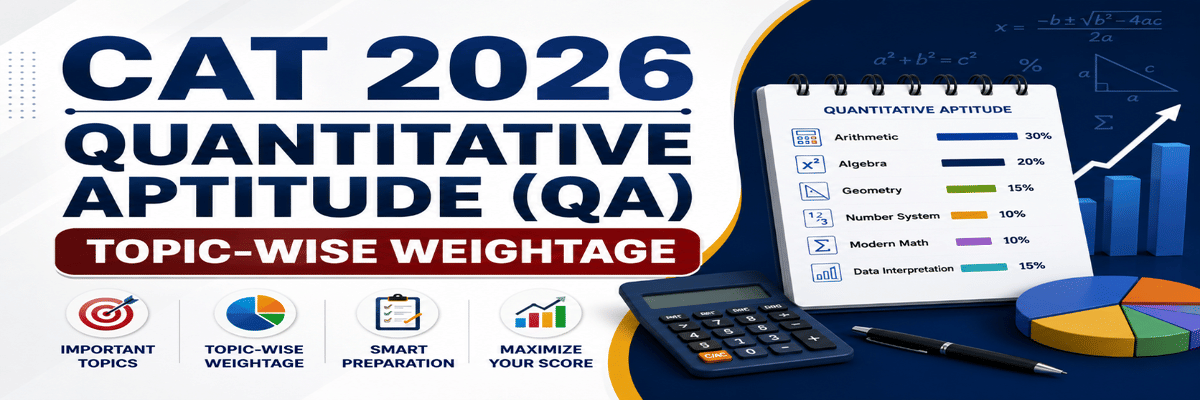
CAT 2026 Quantitative Aptitude (QA) Topic-wise Weightage
- Cut Off for IITs
- IIM Kashipur Cut Off
- IIM Amritsar Cut Off
- IIM Nagpur Cut Off
- IIM Indore Cut Off
- IIM Udaipur Cut Off
- IIM Ranchi Cut Off
- IIM Raipur Cut Off
- IIM Jammu Cut Off
- IIM Bodh Gaya Cut Off
- IIM Kozhikode Cut Off
- IIM Sambalpur Cut Off
- IIM Bangalore Cut Off
- IIM Sirmaur Cut Off
- IIM Trichy Cut Off
- IIM Visakhapatnam Cut Off
- IIM Lucknow Cut Off
- IIM Shillong Cut Off
- IIM Calcutta Cut Off
- IIM Ahmedabad Cut Off
- IIM Rohtak Cut Off


Content Curator | Updated On - Aug 4, 2026
CAT 2026 Quantitative Aptitude has a weightage of 66 marks. The section has a total of 22 questions, with 3 marks for each correct answer and -1 for each wrong MCQ.
- In CAT 2026 Quantitative Aptitude, arithmetic has about 36-45% weightage with 8-10 questions, including profit & loss, time work, ratio, and more.
- Algebra carries about 5-8 questions in CAT 2026 Quantitative Aptitude, with a weightage of up to 23%, covering equations, logarithms, and more.
- As per the trends in slots, the number of questions in CAT 2026 Quantitative Aptitude will be the same.
Related Article:
Key Summary
|
CAT 2026 Quantitative Aptitude Weightage- Overview
CAT topic-wise weightage is not released officially by IIM Indore. However, as per the previous years’ trends, topics like Arithmetic, Algebra, Geometry & Mensuration, Number System, and Modern Mathematics are asked frequently with high weightage. Arithmetic will have 8-10 questions followed by Algebra with 5-6 questions.
| Particular | Detail |
|---|---|
| Conducting Body | IIM Indore (expected) |
| Exam Date | November 29, 2026 (expected) |
| Official Syllabus | Not released by the IIMs |
| QA Questions | 22 |
| QA Marks | 66 |
| QA Duration | 40 minutes |
| Question Types | MCQ and TITA |
| Highest Weightage Topic | Arithmetic- 8 to 10 questions, followed by Algebra- 5 to 6 questions |
| Section Switching | Not allowed |
CAT 2026 Quantitative Aptitude-Marks Pattern
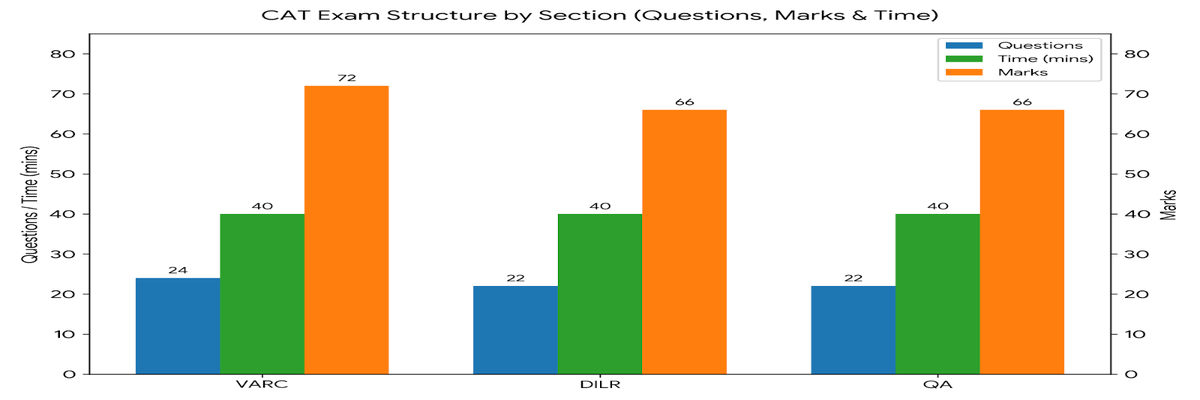
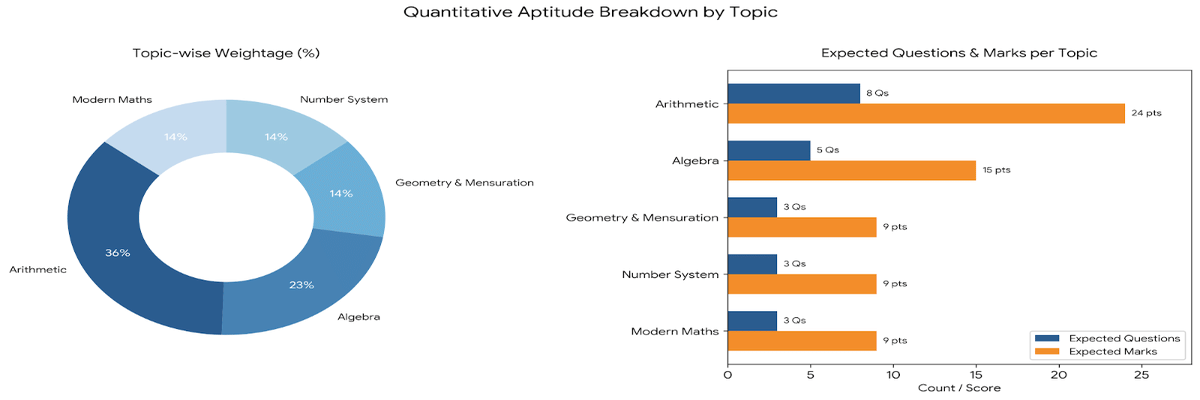
The weightage for CAT 2026 Quantitative Aptitude will be divided amongst 5 major topics with 22 questions and 66 marks in total within 40 minutes. Arithmetic will have 36% of weight, followed by algebra with 23%.
| Section | Questions | Marks | Time |
|---|---|---|---|
| Verbal Ability and Reading Comprehension (VARC) | 24 | 72 | 40 minutes |
| Data Interpretation and Logical Reasoning (DILR) | 22 | 66 | 40 minutes |
| Quantitative Aptitude (QA) | 22 | 66 | 40 minutes |
| Total | 68 | 204 | 120 minutes |
CAT 2026 Quantitative Aptitude-Topic Wise Distribution
Having a strong base in arithmetic and algebra will get you a 90+ percentile in CAT 2026 Quantitative Aptitude.
- In CAT 2026 Quantitative Aptitude, maximum weight is given to algebra and arithmetic, with a total of 12-13 questions together.
- Other topics like Geometry & Mensuration, Number System, and Modern Mathematics Will have 8-10 questions together.
| Topic | Expected Questions | Expected Marks | Weightage (%) |
|---|---|---|---|
| Arithmetic | 8 | 24 | 36% |
| Algebra | 5 | 15 | 23% |
| Geometry and Mensuration | 3 | 9 | 14% |
| Number System | 3 | 9 | 14% |
| Modern Maths | 3 | 9 | 14% |
| Total | 22 | 66 | 100% |
Source: YouTube
CAT 2026 Quantitative Aptitude- Arithmetic Weightage
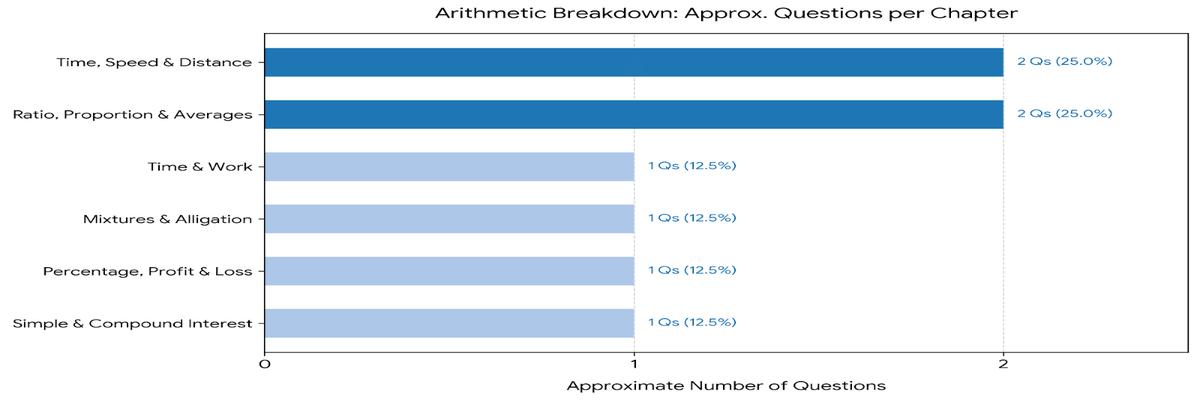
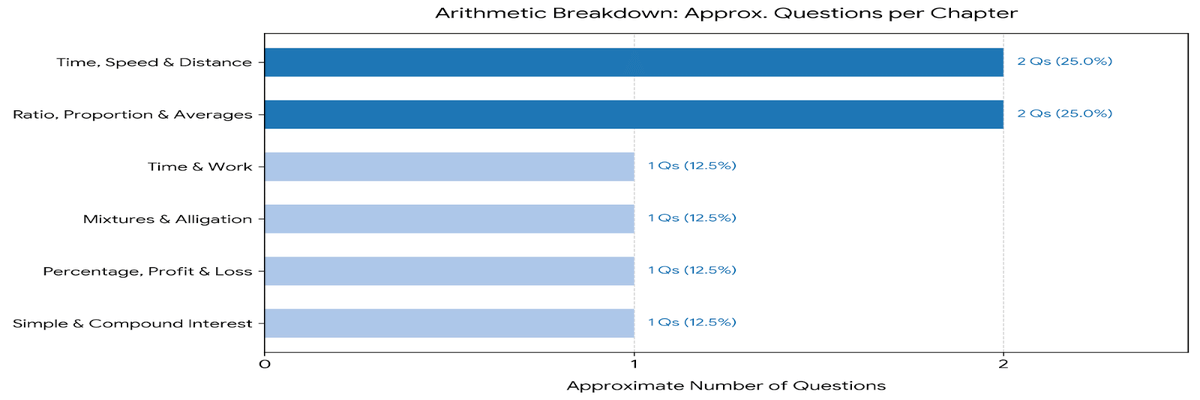
Chapters and topics asked in CAT Arithmetic are listed in the table below along with the topic-wise weightage.
| Chapters | What Gets Asked | Approx. Questions |
|---|---|---|
| Time, Speed and Distance | Trains, boats and streams, relative speed, races | 2 |
| Time and Work | Work rates, pipes and cisterns, efficiency | 1 |
| Ratio, Proportion and Averages | Ratio, averages, partnership | 2 |
| Mixtures and Alligation | 2-3mixtures, replacement | 1 |
| Percentage, Profit and Loss | Successive changes, discount, marked price | 1 |
| Simple and Compound Interest | Instalments, rate calculation, growth | 1 |
CAT 2026 Quantitative Aptitude- Algebra
Chapters and topics asked in CAT Algebra are listed in the table below along with the topic-wise weightage.
| Chapter | What Gets Asked | Approx. Questions |
|---|---|---|
| Linear Equations and Inequalities | Multi-variable equations, integers | 2 |
| Quadratic Equations | Roots, maxima and minima, sign | 1 |
| Logarithms and Exponents | Logs, base change, mixed inequalities | 1 |
| Functions and Modulus | Composite functions, graphs, absolute value | 1 |
CAT 2026 Quantitative Aptitude- Geometry and Mensuration
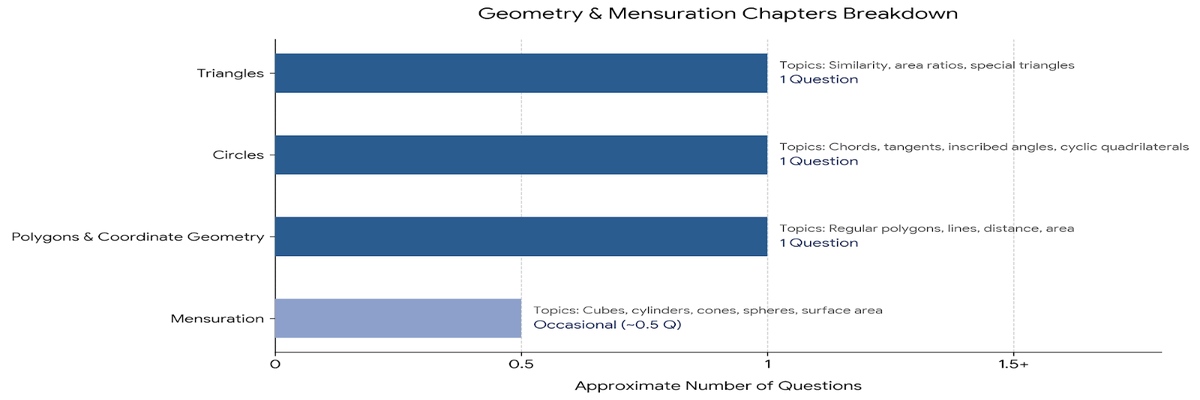
Chapters and topics asked in CAT Geometry and Mensuration are listed in the table below along with the topic-wise weightage.
| Chapter | What Gets Asked | Approx. Questions |
|---|---|---|
| Triangles | Similarity, area ratios, special triangles | 1 |
| Circles | Chords, tangents, inscribed angles, cyclic quadrilaterals | 1 |
| Polygons and Coordinate Geometry | Regular polygons, lines, distance, area | 1 |
| Mensuration | Cubes, cylinders, cones, spheres, surface area | 0-1 |
CAT 2026 Quantitative Aptitude- Number System
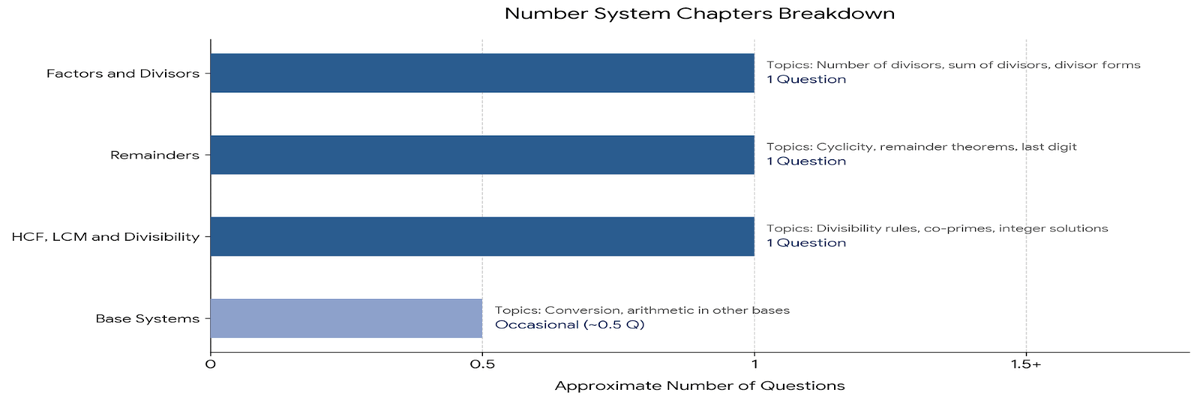
Chapters and topics asked in CAT Number System are listed in the table below along with the topic-wise weightage.
| Chapter | What Gets Asked | Approx. Questions |
|---|---|---|
| Factors and Divisors | Number of divisors, sum of divisors, divisor forms | 1 |
| Remainders | Cyclicity, remainder theorems, last digit | 1 |
| HCF, LCM and Divisibility | Divisibility rules, co-primes, integer solutions | 1 |
| Base Systems | Conversion, arithmetic in other bases | 0-1 |
CAT 2026 Quantitative Aptitude- Modern Mathematics
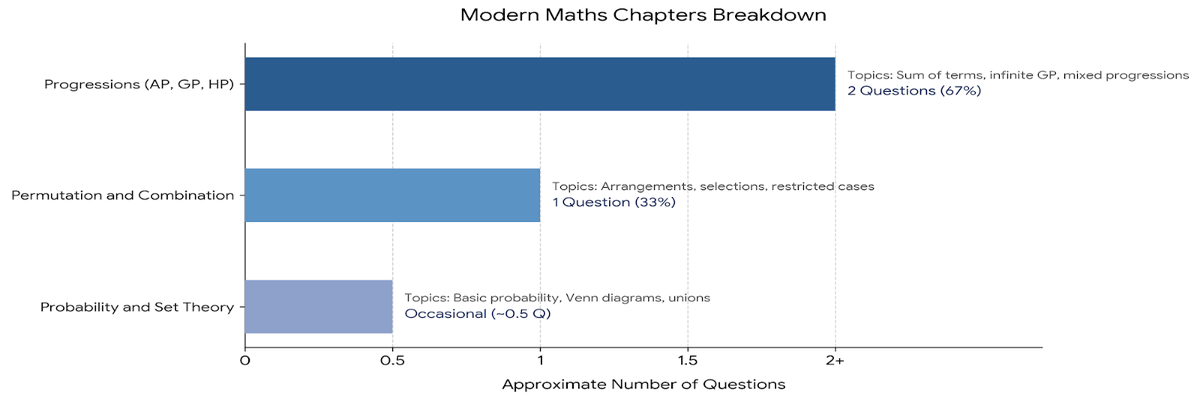
Chapters and topics asked in CAT Modern Mathematics are listed in the table below along with the topic-wise weightage.
| Chapter | Topic | Approx. Questions |
|---|---|---|
| Progressions (AP, GP, HP) | Sum of terms, infinite GP, mixed progressions | 2 |
| Permutation and Combination | Arrangements, selections, restricted cases | 1 |
| Probability and Set Theory | Basic probability, Venn diagrams, unions | 0-1 |
CAT 2026 Quantitative Aptitude FAQs
Ques. What is the maximum marks in CAT 2026 Quantitative Aptitude?
Ans. The maximum marks in CAT 2026 Quantitative Aptitude are 66, with 22 questions and 3 marks for all correct answers and -1 for wrong answers. The time is 40 minutes and is the last section, needing good focus and accuracy.
Ques. What is the maximum marks in CAT 2026?
Ans. The maximum marks in CAT 2026 are 204, with 68 questions and 3 marks for all correct answers and -1 for wrong answers. VARC has 72 marks, and DILR has 66 marks, with CAT 2026 Quantitative Aptitude also having 66 marks. You need to have a structured study plan to get good marks in all sections.
Ques. What are the most important chapters in CAT 2026 Quantitative Aptitude?
Ans. There are 5 important chapters in CAT 2026 Quantitative Aptitude. The highest is Arithmetic with 36% weight, followed by Algebra with 23% weight, Geometry & Mensuration, Modern Maths, and Number System having 14% weightage each. Only arithmetic and algebra will score 90+ if done with focus and accuracy.
*The article might have information for the previous academic years, please refer the official website of the exam.