
CAT 2026 DILR Topic-wise Weightage
- Cut Off for IITs
- IIM Kashipur Cut Off
- IIM Amritsar Cut Off
- IIM Nagpur Cut Off
- IIM Indore Cut Off
- IIM Udaipur Cut Off
- IIM Ranchi Cut Off
- IIM Raipur Cut Off
- IIM Jammu Cut Off
- IIM Bodh Gaya Cut Off
- IIM Kozhikode Cut Off
- IIM Sambalpur Cut Off
- IIM Bangalore Cut Off
- IIM Sirmaur Cut Off
- IIM Trichy Cut Off
- IIM Visakhapatnam Cut Off
- IIM Lucknow Cut Off
- IIM Shillong Cut Off
- IIM Calcutta Cut Off
- IIM Ahmedabad Cut Off
- IIM Rohtak Cut Off


Content Curator | Updated On - Aug 21, 2026
CAT 2026 DILR section comprises 2 sections, including DI with graphs & tables, and LR with arrangements and games.
- CAT 2026 topic-wise weightage for Hybrid Puzzle / Unstructured Sets is 20-25% and is quite unpredictable.
- Tables & Structured/Missing Graphs will have a 30% - 40% topic-wise weightage in DILR.
Related Articles:
Key Summary
|
CAT 2026 Exam Pattern: DILR Overall Weightage
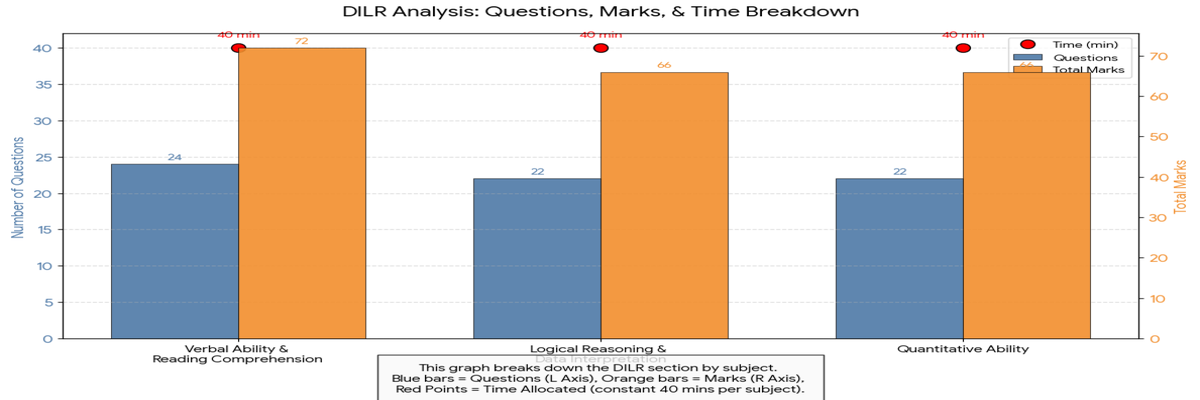
According to the CAT 2026 exam pattern, there will be a total of 22 questions asked in the DILR section. Total marks in the CAT DILR section are 66, with an allotted time duration of 40 minutes.
| Subjects | Questions | Total Marls | Time |
|---|---|---|---|
| Verbal Ability & Reading Comprehension | 24 | 72 | 40 min |
| Logical Reasoning & Data Interpretation | 22 | 66 | 40 min |
| Quantitative Ability | 22 | 66 | 40 min |
Source- YouTube
CAT 2026 DILR Syllabus
DILR focuses on different topics like Logical Reasoning (LR)- Advanced Scheduling, and Data Interpretation (DI) like Line & Bar Graphs.
| Logical Reasoning (LR) | Data Interpretation (DI) |
|---|---|
| Matrix & Linear Arrangements | Dense / Unstructured Tables |
| Games & Tournaments | Multi-variable Bar Graphs |
| Advanced Scheduling | Caselets & Missing Datasets |
| Networks & Routes | Combined & Mixed Visual Charts |
Source- YouTube
CAT 2026 DILR Topic-wise Weightage
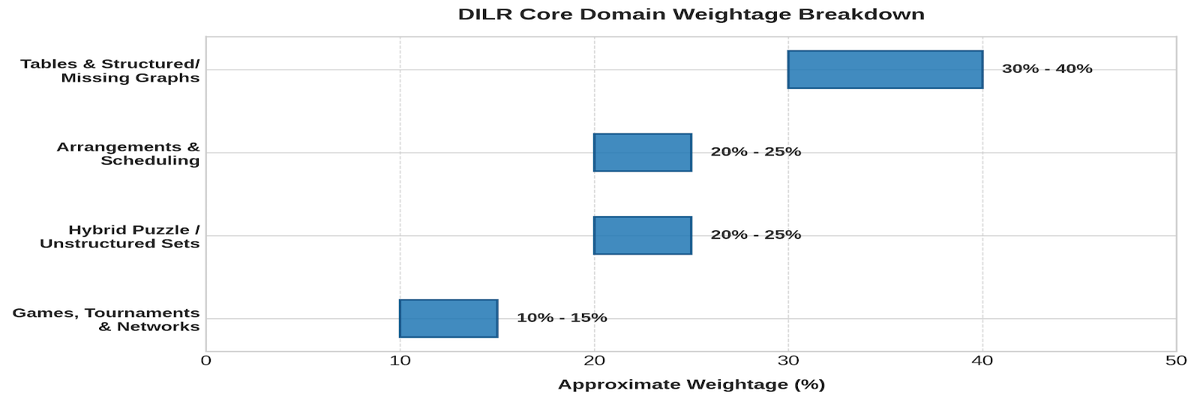
In CAT 2026 DILR, the topic-wise weightage is as follows-
- Tables are quite calculative and highly logical but carry a weightage of about 30-40%.
- Hybrid Puzzle/Unstructured Sets are unpredictable and will have a 20-25% weightage.
| DILR Core Domain | Approx. Weightage | Strategic Difficulty Level |
|---|---|---|
| Tables & Structured/Missing Graphs | 30% - 40% | Calculation-heavy, highly logical but standard to enter. |
| Arrangements & Scheduling | 20% - 25% | High entry potential; depends entirely on constraint grids. |
| Hybrid Puzzle / Unstructured Sets | 20% - 25% | Unpredictable difficulty; relies heavily on intuition. |
Source: YouTube
CAT 2026 DILR Strategy
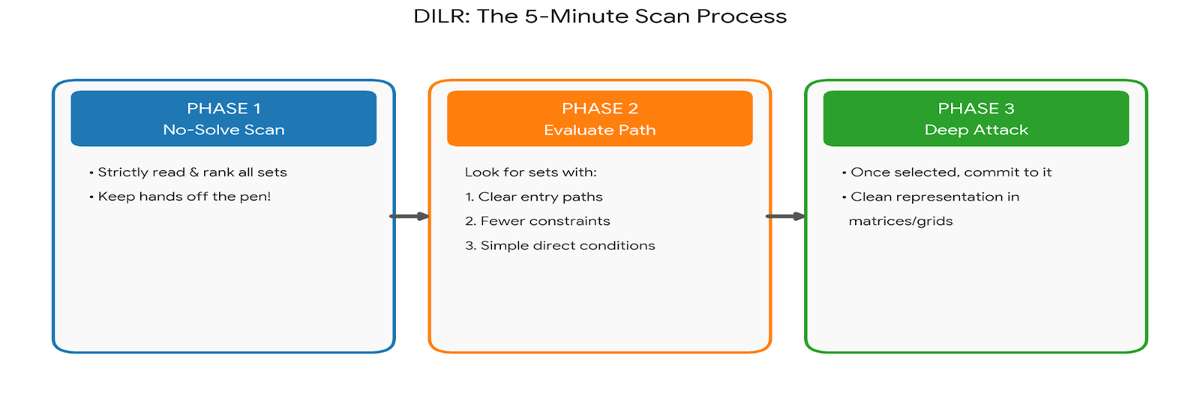
You will not be rewarded for solving all sections in the DILR; thus, make sure to select your sets wisely.
| Phase | Phase Name | Guidelines & Action |
|---|---|---|
| Phase 1 | No-Solve Scan | First, for 2–5 minutes, strictly read and rank all sets. |
| Phase 2 | Evaluate Path | Look for sets containing: 1) Clear entry paths, 2) Fewer constraints, 3) Simple direct conditions. |
| Phase 3 | Deep Attack | Once selected, commit to it. |
Source: YouTube
Mistakes to Avoid- CAT 2026 DILR Section
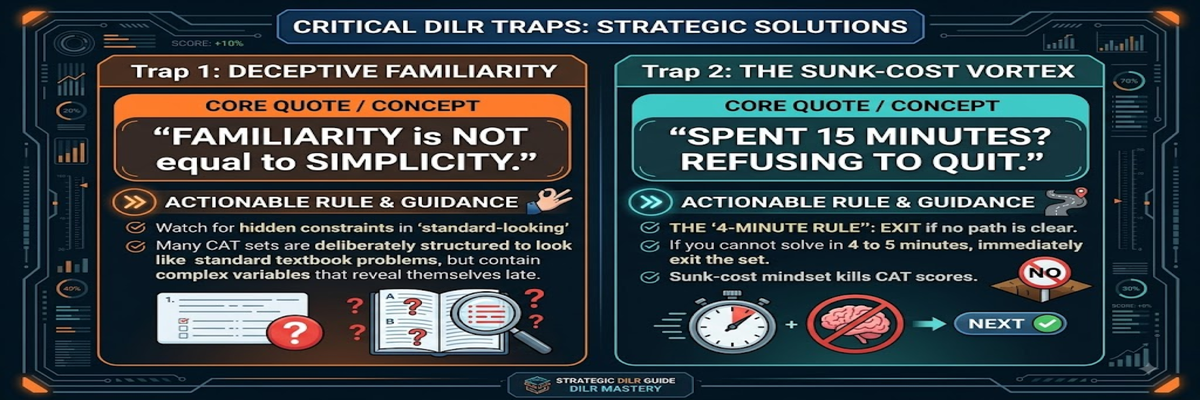
Many CAT 2026 problems are made in a way to look like a textbook problem but do have confusion and complex restrictions to be completed in a specified time.
| Trap | Core Quote / Concept | Actionable Rule & Guidance |
|---|---|---|
| Trap 1: Deceptive Familiarity | "Familiarity is NOT equal to simplicity." | Watch for hidden constraints in "standard-looking" sets. Many CAT sets are deliberately structured to look like standard textbook problems, but contain complex variables that reveal themselves late. |
| Trap 2: The Sunk-Cost Vortex | "Spent 15 minutes? Refusing to quit." | The "4-Minute Rule": Exit if no path is clear. If you cannot solve it in 4 to 5 minutes, immediately exit the set. Sunk-cost mindset kills CAT scores. |
Source: YouTube
CAT 2026 DILR Topic-wise Weightage FAQs
Ques. What are the high-weighting chapters in DILR?
Ans. Hybrid Puzzle / Unstructured Sets in CAT 2026 will have a good topic-wise weightage of 20-25% and is quite unpredictable. Tables & Structured/Missing Graphs will have 30% - 40% topic-wise weightage in DILR. Arrangements & Scheduling have 25% weight and can give easy marks if attempted with strategy.
Ques. How to attempt the CAT 2026 DILR high-weightage chapters?
Ans. Solving all the sets is not advised. But scan and then solve. First, for 2–5 minutes, strictly read and rank all sets. Choose which ones to attempt. Look for sets containing clear entry paths, fewer constraints, and simple, direct conditions. If a set takes more than 4-5 minutes to solve, do not go further. After selecting sets, commit to it.
*The article might have information for the previous academic years, please refer the official website of the exam.